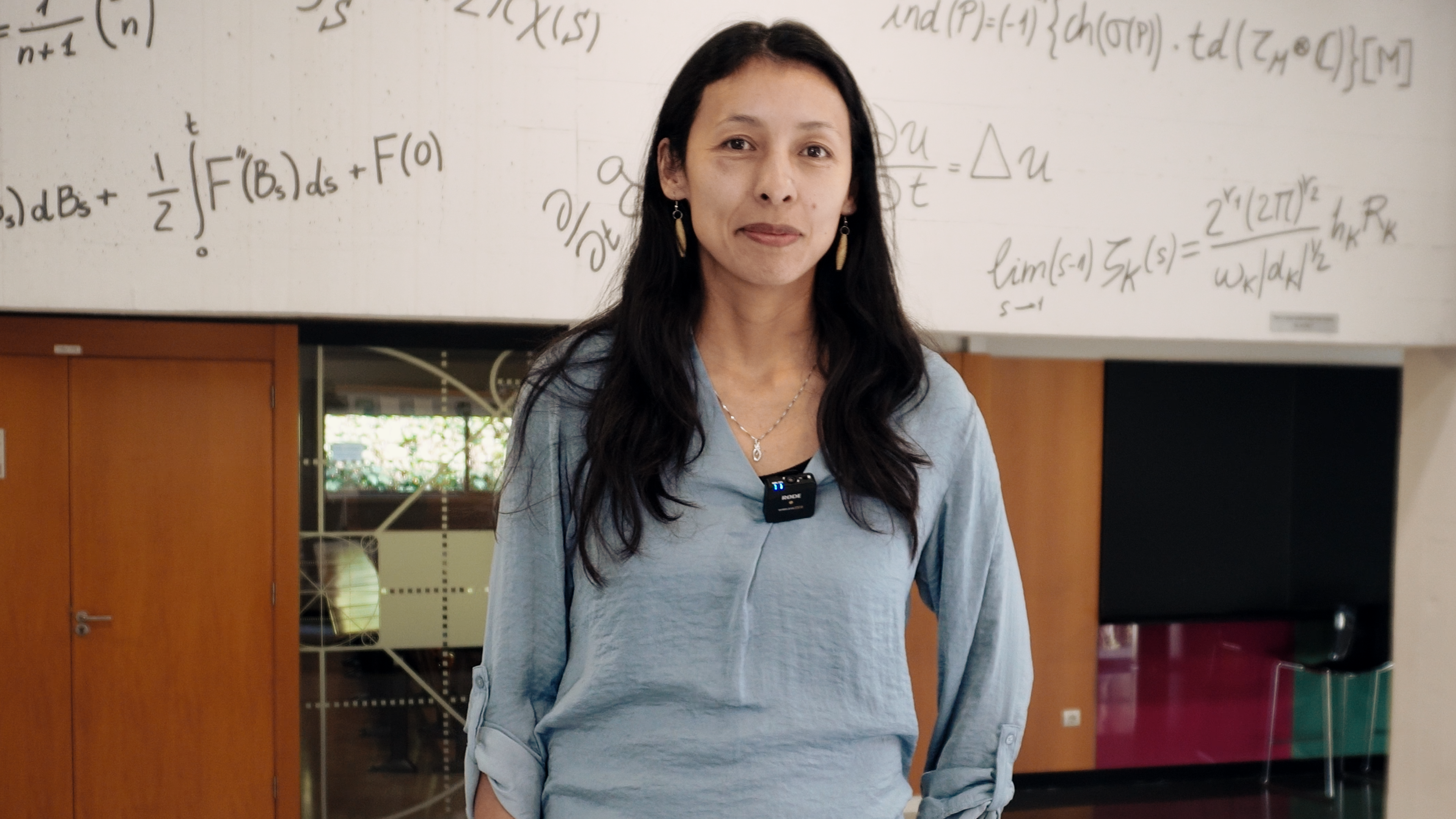
Carolina Benedetti, associate professor at the Universidad de los Andes in Bogotá, spent March at the CRM as a Lluís Santaló Fellow. A specialist in algebraic and geometric combinatorics, she is collaborating with Kolja Knauer (UB/CRM) on questions at the intersection of polytopes, permutations, and non-negativity.
Research runs on a resource that grant applications rarely mention. Funding can be estimated, and travel costs projected. Time is harder to account for: not calendar time, but the kind of accumulated, unhurried hours in which a mathematical conversation can go wrong, restart, and find its way somewhere neither person expected. A week at a conference, however stimulating, rarely produces that. You teach, you listen, you have lunch with people you have been meaning to contact for years, and the week ends before any of it has had time to settle.
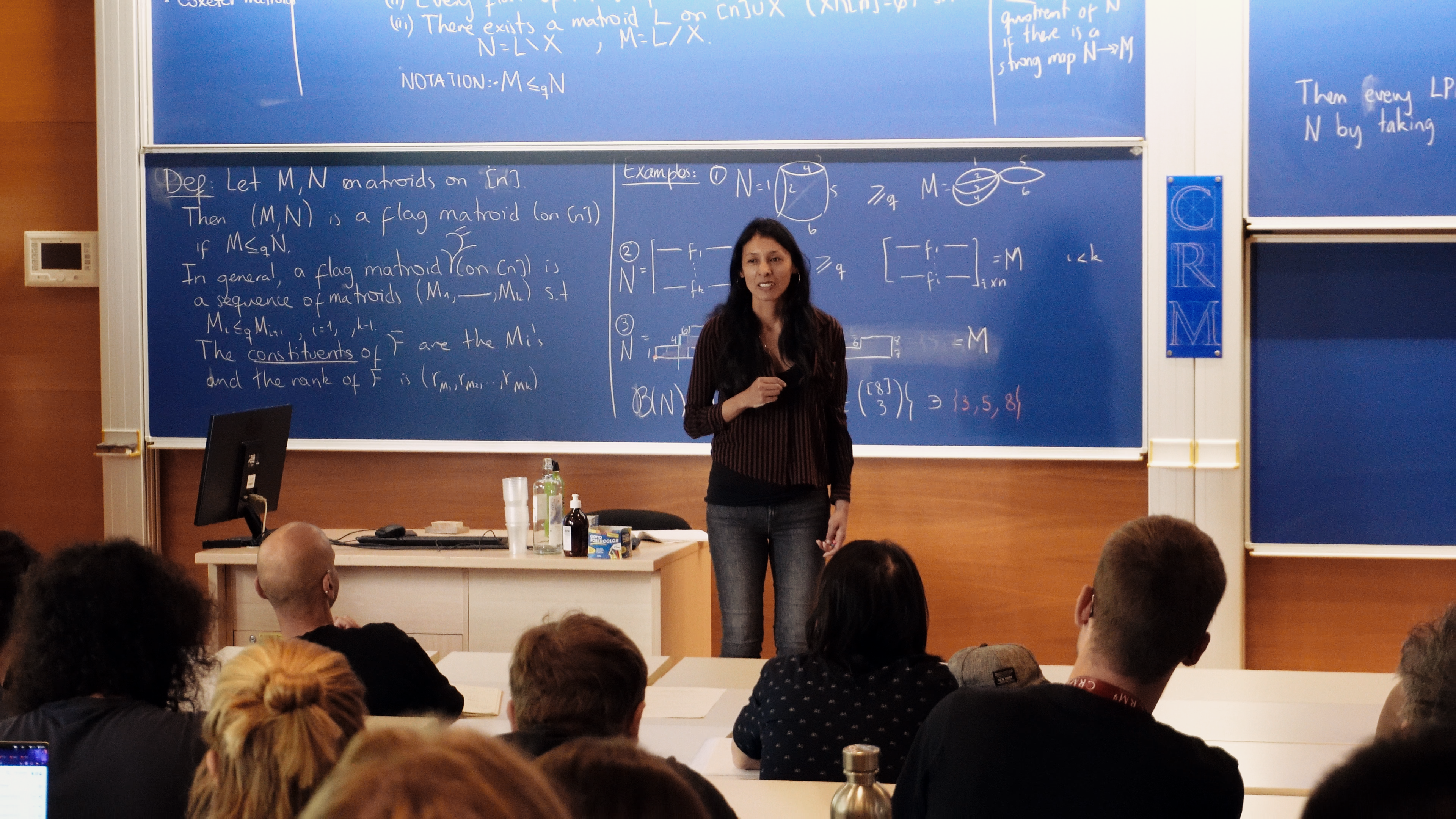
In October, Carolina Benedetti came to Barcelona exactly like that. She was one of two invited lecturers at the CRM’s Research School on Combinatorial Geometries and Geometric Combinatorics, a week-long intensive course that brought together more than fifty researchers from institutions across three continents. Each morning, she gave one of her five minicourse sessions. Each afternoon, she sat through the parallel course or worked with participants in the exercise sessions that filled most of the schedule. In the evenings, she went back to the hotel and prepared the next day’s class. “Teaching my class, attending the other talks, trying to digest a little of what was happening, going back to the hotel, preparing the next day’s class, and repeat,” she says. Ideas surfaced. Names got written down. There was no room to follow anything further.
What a research stay offers is something more basic: the chance to actually be somewhere with enough time to work. Ideas that appeared during a week of intensity can, weeks later, be picked up and examined properly. Collaborations that felt promising at a conference dinner can be tested against a real problem, in a shared room, over several mornings. “The difference is really enormous,” Benedetti says. She is back in Barcelona now, this time as a Lluís Santaló Fellow at the CRM, and things, she says, are materialising.
Discrete objects, multiple angles
Benedetti works at the intersection of algebraic and geometric combinatorics. The objects that interest her are discrete: finite sets with algebraic or geometric structure, rather than continuous curves or surfaces. Permutations (the different ways to arrange a set of elements) are a recurring protagonist. So are matroids, which are abstract structures that generalise the notion of independence in linear algebra, and positroids, a specific subfamily with particularly rich geometric properties that has drawn considerable attention in recent years for its connections to non-negativity in tropical geometry.
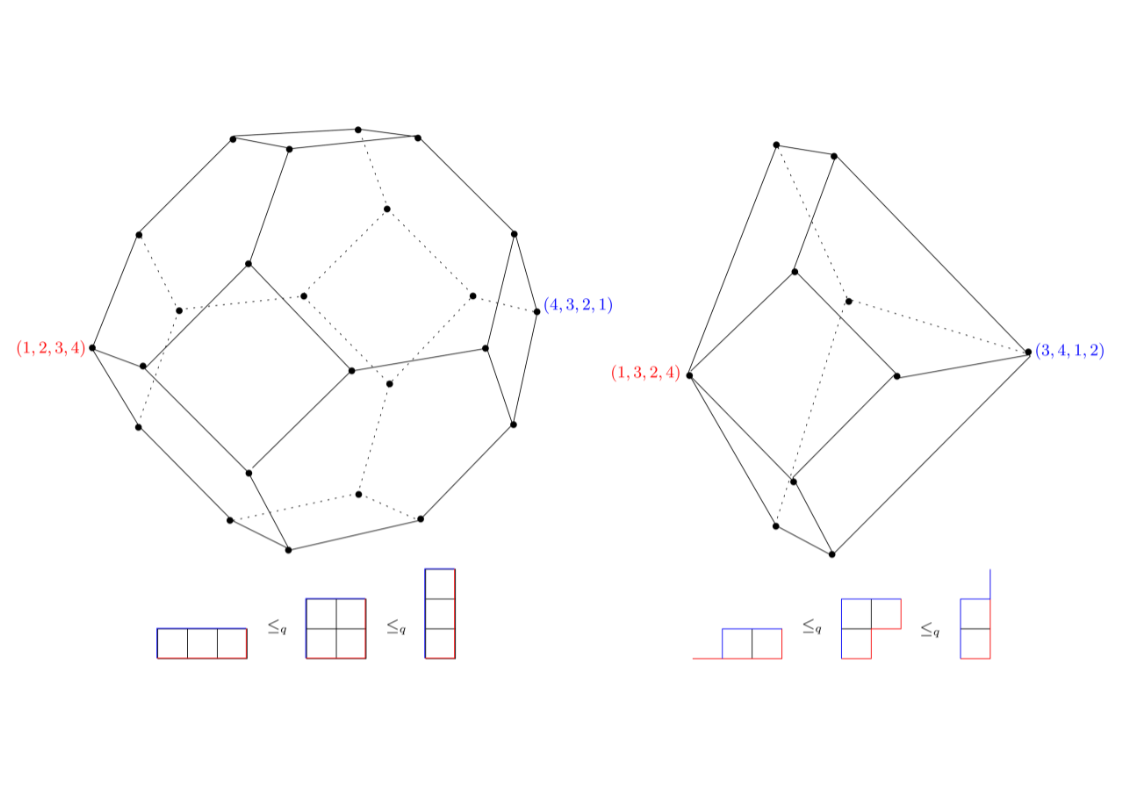
Two geometric realisations of permutation structure on four elements. Each vertex represents a permutation (labelled in red and blue), and edges connect permutations differing by a simple adjacent swap. The left figure shows the full permutohedron on 24 vertices, with dotted lines indicating an internal combinatorial decomposition. The right figure presents a constrained substructure, where only a subset of permutations is retained, yielding a reduced polytope. The diagrams below encode the associated partial order on combinatorial shapes (Young diagram–like objects), illustrating how these geometric configurations reflect an underlying order relation.
The reach of these objects is broader than it might look. In algebraic geometry, there is a classical problem of counting how many points lie at the intersection of certain spaces called Schubert varieties. The geometry involved is complicated and difficult to manipulate directly. What Benedetti’s work shows is that permutations and the operations between them can encode the answer. “With combinatorics you can respond to certain problems,” she explained at the 5 Talks in Combinatorics thematic day held at the Universitat de Barcelona on 18 March, “by forgetting that you are asking about the intersection of spaces, and simply focusing on how the underlying combinatorial objects reflect that intersection problem.” Her talk, on the combinatorics of products of quantum Schubert polynomials, drew on threads that go back to her doctoral work in Toronto and connect directly to what she is building now.
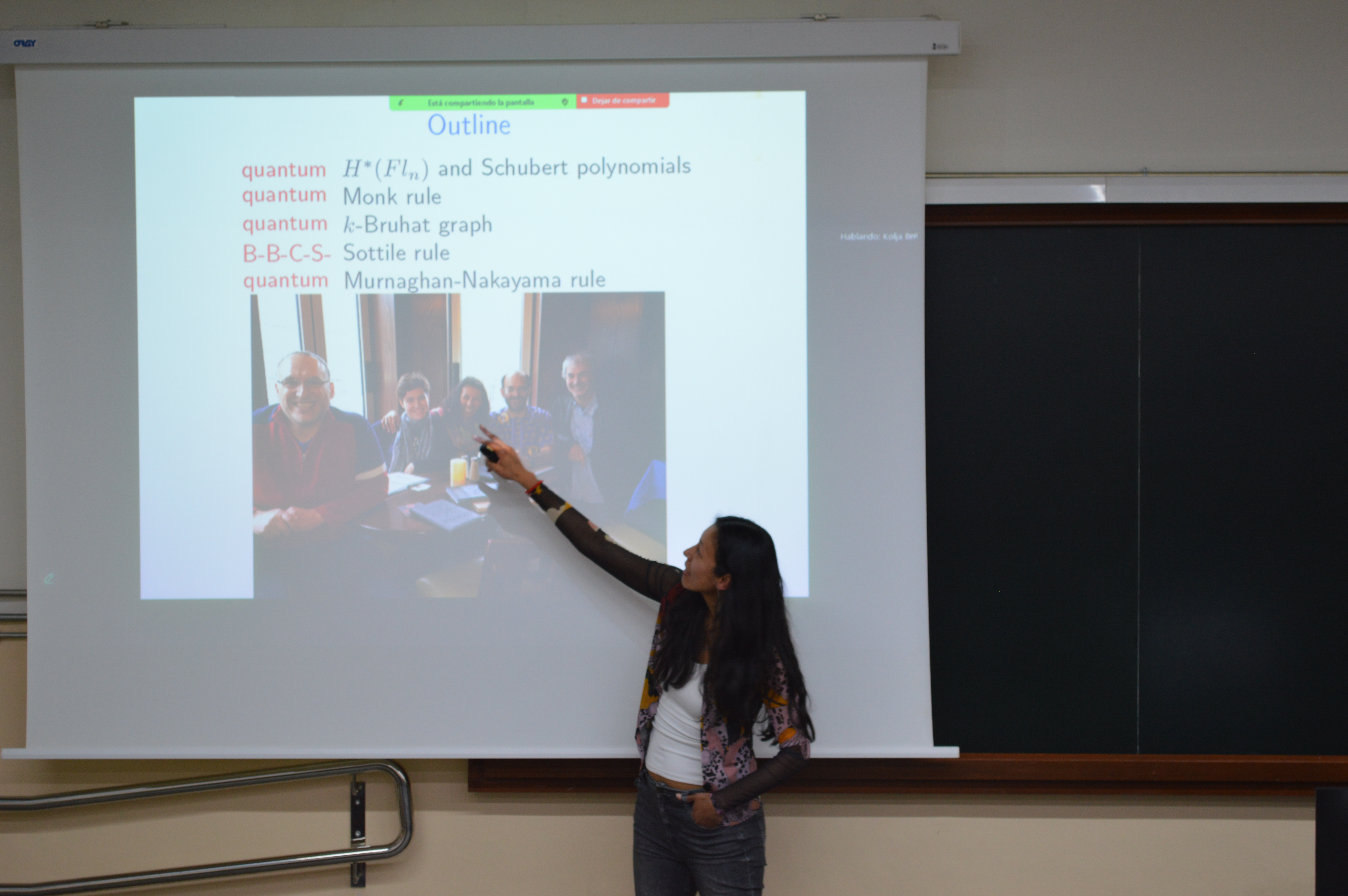
Her October minicourse at the CRM covered different territory: flags of matroids and positroids, and in particular what can be said about subdivisions of the flag polytope D_n into flags of lattice path matroids. The course introduced participants to positroids, flags of matroids, the corresponding polytopes, and the structural properties that make them interesting objects to subdivide. It ended with a set of open problems, some of them fresh from her current work. That, it turned out, was not just a rhetorical device. Several of the researchers who sat in that room in October are now working on those problems with her.
“It is not the same when you have the chance to collaborate in person, because that is where a little more of the magic actually happens.”
The current collaboration with Knauer, Deligeorgaki and Giardino grew directly from that week, though it has roots that go further back. Knauer and Benedetti first crossed paths during the pandemic, in Bogotá, in the kind of encounter that is almost impossible to engineer deliberately. He was visiting; she was there; they started talking about mathematics. What they found was that they were looking at some of the same objects from genuinely different angles. Benedetti’s approach is more combinatorial, focused on the discrete structures and their properties. Knauer’s tends toward the order-theoretic, more interested in the partially ordered sets that underlie those structures. “He has a different point of view on how I approach the discrete objects we have in common,” she says. “That was complementary.” A paper on lattice path matroids followed. Then further meetings. Then this month.
What the four of them are investigating now concerns polytopes whose vertices are permutations, objects that carry a double life: geometrically, they are polyhedra in high-dimensional space, and algebraically, they arise from vector spaces. The question pulling the group forward has to do with a notion of non-negativity in those spaces, and whether the structure of the underlying partially ordered sets can be used to understand it better than the polytopes alone allow. It is, by Benedetti’s own account, work that is still finding its shape. That is precisely what this kind of stay is for.
Mathematics is not done the same way everywhere
Benedetti did her PhD at York University in Toronto, held a postdoctoral position at Michigan State University, and has been back in Bogotá since 2023, teaching at Los Andes. Each move, she says, added something harder to name than technical breadth: a feel for which tools from which tradition fit which problem. Before Canada, she barely spoke English, a prerequisite for working internationally. Beyond language, each country had a different centre of gravity. In Canada, algebra dominated everything. “Algebra is like the queen there,” she says. The approach she encountered in Toronto bore little resemblance to what tends to go usually under the name of combinatorics, where counting and enumeration have traditionally been more central. Spain adds another angle again. One of the things a career built on moving between communities gives you, eventually, is the ability to recognise which version of a problem you are looking at.
Back in Colombia, Benedetti is one of the people behind two initiatives that have shaped how the country’s mathematical community sees itself. As founder of Círculos Matemáticos Colombia, she works to bring mathematical thinking to students and communities well outside the university circuit. And as a member of the Comunidad Colombiana de Combinatoria, a network whose growth owes a great deal to the mathematician Federico Ardila, she has been part of an effort to show that Colombian mathematicians can work at the highest level without leaving their culture at the door. “Mathematics is not done the same way everywhere,” Benedetti says, and that has something to do with idiosyncrasy, with music, with how people celebrate, with the particular texture of where you grew up.
The Lluís Santaló fellowship carries its own version of that logic. Santaló (born in Girona, 1911; died in Buenos Aires, 2001) was a Catalan mathematician who, like thousands of others, had to leave Spain when the Civil War ended and settle elsewhere. He chose Argentina, arriving in 1939, and spent the rest of his career there, first in Rosario, then in Buenos Aires, building what became one of the founding contributions to integral geometry and leaving a mark on an entire generation of Argentine mathematicians. He also cared, throughout his life, about mathematical education and about making mathematics visible beyond the university walls.
The CRM fellowship that bears his name was created specifically for researchers from Latin American institutions, to make collaboration between Latin America and Europe a little less costly than it would otherwise be. The distance is real, the expense is real, and the asymmetry of who gets to travel to whom is real. A programme that exists to push against that carries genuine weight. “To make something with lasting impact from an unfortunate situation,” Benedetti says of Santaló’s story. “That is an honour.”
She adds, without much elaboration, that there is now a new wave of mathematicians moving from the Americas towards Europe for reasons that are not entirely different from Santaló’s. The fellowship named after him has been running since 2011. It keeps finding new reasons to matter.
Watch the full interview with Carolina Benedetti Velásquez on the CRM YouTube channel.
___________________________________________________
The Lluís Santaló Visiting Fellowship call for 2027 stays is currently open. The application deadline is 30 April 2026. More information here.
Newsletter
Get the latest CRM news and activities delivered to your inbox
Subscribe now
Recent newsletters →
The CRM opens the academic year and unveils its Directors’ Gallery
A review of the year, the Communication Plan 2026–2030 and three research talks filled the morning of 19 October.The unveiling of the Directors’ Gallery.CRM CommPau VarelaCRMComm@crm.catGet the latest CRM news and activities in your inbox.Recent...
The CRM Mentoring Programme, as Told by One of Its Pairs
PhD student Joaquim Duran and mathematician Robert Cardona, one of the pairs in the CRM Mentoring ProgrammeJoaquim Duran (left) and Robert Cardona.CRM CommPau VarelaCRMComm@crm.catGet the latest CRM news and activities in your inbox.Recent...
When the reward comes within reach, the brain changes what it compares
As the tokens piled up, choices got faster and more accurate at the same time. The yardstick for judging each offer had moved.CRM CommPau VarelaCRMComm@crm.catGet the latest CRM news and activities in your inbox.Recent newsletters →Two subjects...

Almost every automaton can be reset with a short word
For a random automaton with n states, a word of about √n log n letters is almost always enough to reset it.CRM CommPau VarelaCRMComm@crm.catGet the latest CRM news and activities in your inbox.Recent newsletters →Picture a conveyor belt carrying...
Exposició ‘Les matemàtiques de Gaudí’
CRM quod erat demonstrandum | 48

ADA: Decoding Brain Signals Misaligned in Time
The study addresses a key limitation of current brain decoding techniques: the difficulty of interpreting internal mental processes whose temporal dynamics vary from trial to trial.Decoding what is happening in a person’s mind from their brain activity is one of the...
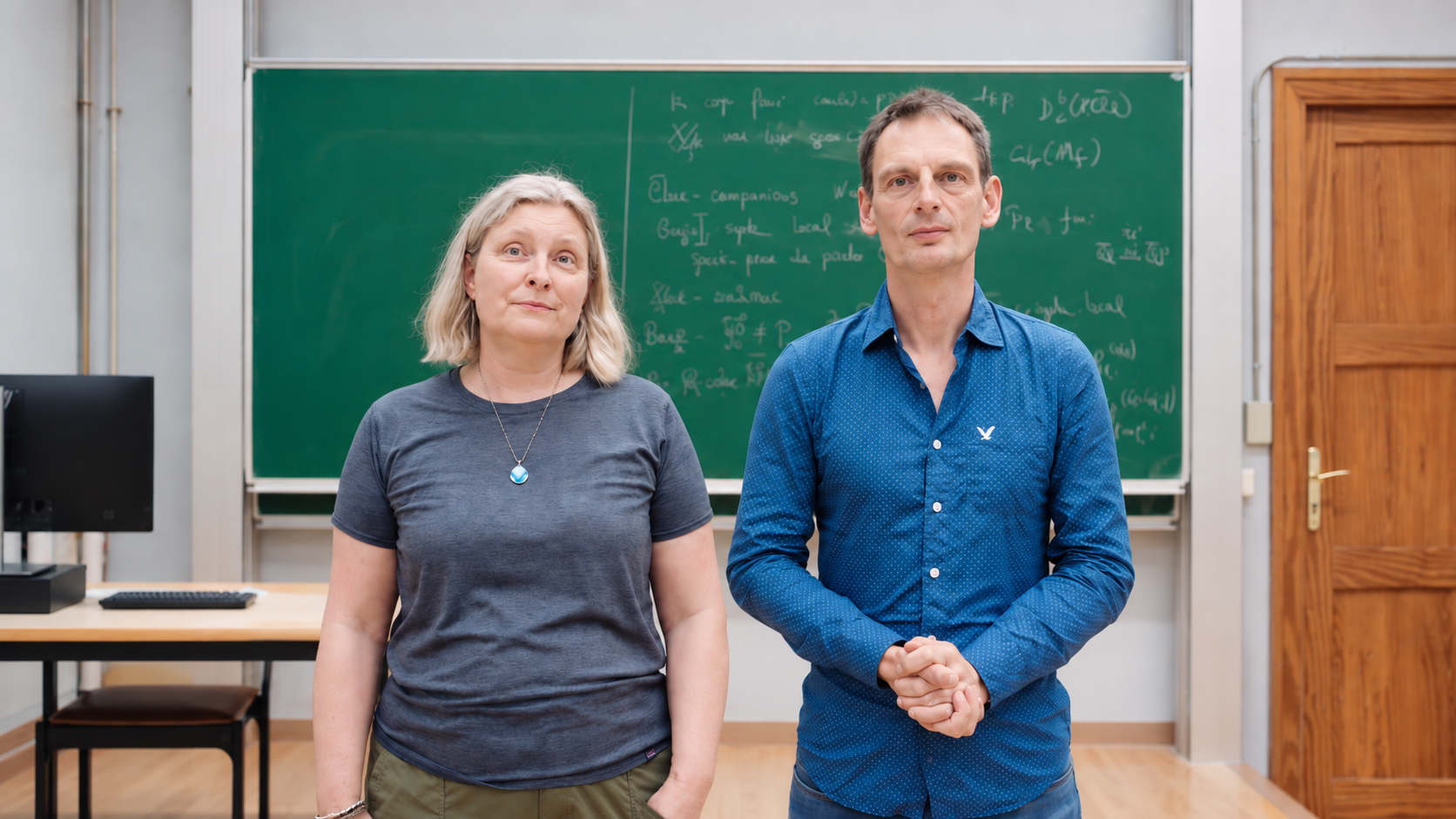
Rare curves, many points: Christophe Ritzenthaler and Rachel Pries on their research and the work around it
Christophe Ritzenthaler (Université de Rennes) and Rachel Pries (Colorado State University) both work on curves over finite fields: he hunts curves with as many points as possible, she hunts curves that almost never occur. In conversation with the CRM during their...
Call open for the 2027 Ferran Sunyer i Balaguer Prize
The Ferran Sunyer i Balaguer Foundation is accepting submissions for its 2027 prize, which awards 15,000 euros and publication in Birkhäuser's Progress in Mathematics series to an expository monograph on an active area of mathematical research. The deadline is 27...
Susanna Terracini delivers the CRM Colloquium 2026
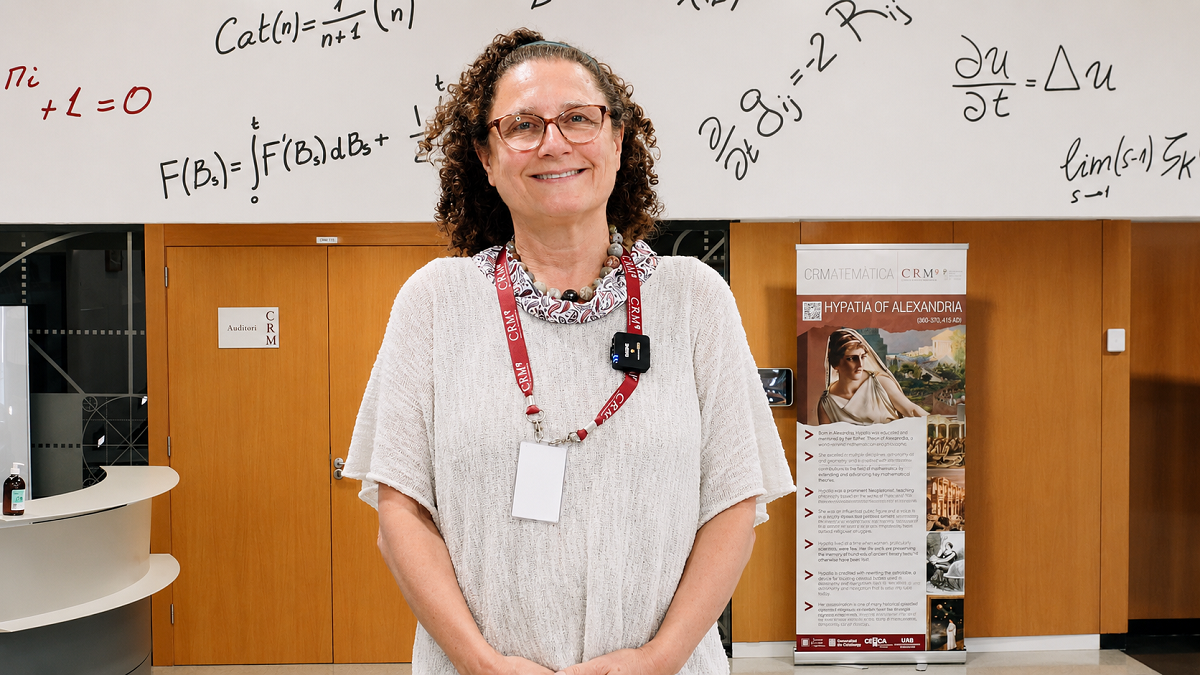
Susanna Terracini (Università di Torino) delivered the CRM Colloquium 2026 on 14 July, presenting a rigidity result for Kepler billiards obtained with Stefano Baranzini, Vivina Barutello and Irene De Blasi. She was at the centre as a member of the CRM Scientific...
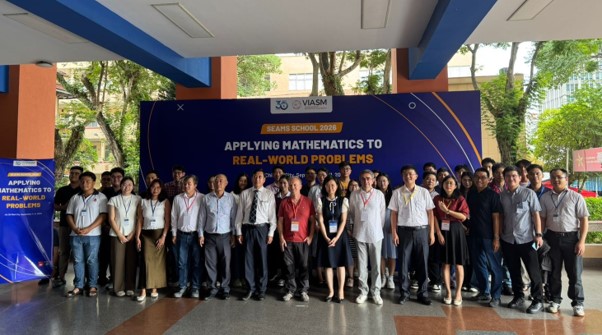
Ho Chi Minh City hosts the SEAMS School on applying mathematics to real-world problems
Students from across the region took courses and worked on group projects at a school co-organised by CRM researcher Tim Myers.CRM CommPau VarelaCRMComm@crm.catGet the latest CRM news and activities in your inbox.Recent newsletters →Between 4 and...

A single ball on a fixed table can compute: Eva Miranda and Isaac Ramos prove that two-dimensional billiards are Turing complete
Eva Miranda (UPC, CRM) and Isaac Ramos (ETH Zürich) show that a point particle bouncing inside a planar table with fixed walls can simulate a universal Turing machine, settling a question Cristopher Moore left open in 1990. The result grew out of a master’s project...
|
|
CRM CommPau Varela
|