
- The 4th BMS-BGSMath Junior Meeting, held from June 26-28, 2024, at the Zuse Institute Berlin, featured plenary talks, short presentations, and elevator talks, fostering dynamic exchanges between young researchers from the Berlin Mathematical School and CRM’s Barcelona Graduate School of Mathematics.
- CRM researchers, including Joaquim Duran, Tassio Naia, Frank Trujillo, and Pablo Nicolas, presented on diverse topics, emphasizing the importance of such meetings for professional growth, interdisciplinary communication, and building connections within and across research communities.
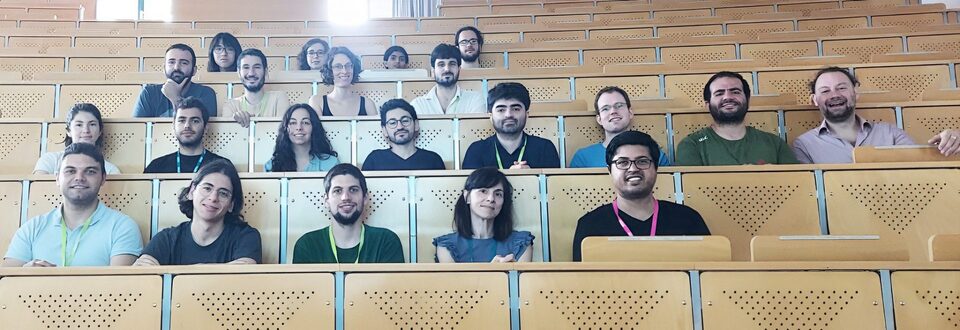
The 4th edition of the BMS-BGSMath Junior Meeting took place from June 26-28, 2024, at the Zuse Institute Berlin. This biennial event alternates between Barcelona and Berlin and provides a platform for building connections and fostering collaboration between young researchers from the Berlin Mathematical School (BMS) and the CRM (under its training unit the BGSMath).
The meeting featured plenary talks by four distinguished speakers: María Ángeles García Ferrero from the Instituto de Ciencias Matemáticas (ICMAT), Frank Trujillo from the Centre de Recerca Matemàtica (CRM), Thibaut Mazuir from Humboldt Universität zu Berlin, and Giulia Codenotti from the Freie Universität Berlin. Additionally, researchers from both institutions delivered shorter presentations, complemented by a session of elevator talks. These informal sessions allowed researchers to succinctly introduce their topics, fostering a dynamic and engaging exchange of ideas.
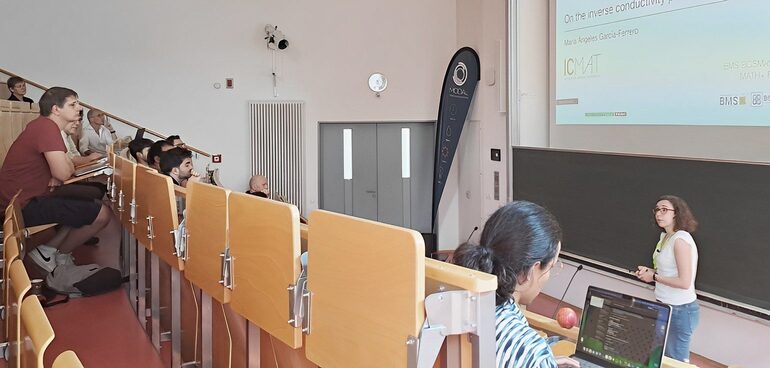
Joaquim Duran, a CRM PhD researcher, presented on the Spectral gap of generalized MIT bag models in relativistic quantum mechanics. He highlighted the new results obtained with his PhD advisor, Dr. Albert Mas Blesa. Joaquim described his experience at the meeting as highly enjoyable, emphasizing that it “provided a scenario to strengthen the Barcelona community of young researchers and to build links with the Berlin community, both in a professional and human way”.
Tassio Naia, a CRM postdoctoral researcher, discussed his work on “Separating systems and rainbow covers for graphs,” focusing on efficiently identifying faulty links within networks. He found the meeting “captivating and thought-provoking to me, mathematically and otherwise. Perhaps my main takeaway is a clearer vision of how much work it takes to communicate, even from across fields in the same science”. Tassio stressed that collaboration goes beyond writing articles together, addressing broader academic challenges and fostering scientific connections.
Frank Trujillo, a Marie Curie Fellow, chose to speak about KAM theory, a significant development in classical mechanics and dynamical systems. He believes that meetings like this are “very important as they give chances to young researchers to share their research interests and to get familiar with topics that are far from their research field”.
Pablo Nicolas, another CRM PhD researcher, presented recent results in Poisson geometry, focusing on fundamental techniques to engage a broad audience. He had a positive experience, interacting with researchers in related fields and networking with new colleagues. “I was lucky that many people from Berlin were working in topics closely related to my research, so I was able to follow the talks and interact with them,” Pablo noted. He highlighted the importance of such meetings for young researchers to meet people from diverse backgrounds and prepare for future conferences.
The BMS-BGSMath Junior Meeting continues to be a key event for fostering scientific exchange, strengthening research collaborations, and enhancing the multicultural experience for students and faculty from both institutions.
Subscribe for more CRM News
|
|
CRM CommPau Varela & Mariona Fucho
|

When the reward comes within reach, the brain changes what it compares
As the tokens piled up, choices got faster and more accurate at the same time. The yardstick for judging each offer had moved.CRM CommPau VarelaCRMComm@crm.catGet the latest CRM news and activities in your inbox.Recent newsletters →Two subjects...

Almost every automaton can be reset with a short word
Guillaume Chapuy (Université Paris Cité, CNRS) and Guillem Perarnau (UPC, CRM) have shown that a random finite automaton with n states can, with high probability, be reset by a word of length of order √n log n. The result, published in ACM Transactions on Algorithms, pins the exponent at 1/2, the lower end of a decade of numerical estimates, and addresses the random version of the synchronization problem behind a conjecture Ján Černý posed in 1964 and which still remains open.
Exposició ‘Les matemàtiques de Gaudí’
CRM quod erat demonstrandum | 48

ADA: Decoding Brain Signals Misaligned in Time
The study addresses a key limitation of current brain decoding techniques: the difficulty of interpreting internal mental processes whose temporal dynamics vary from trial to trial.Decoding what is happening in a person’s mind from their brain activity is one of the...
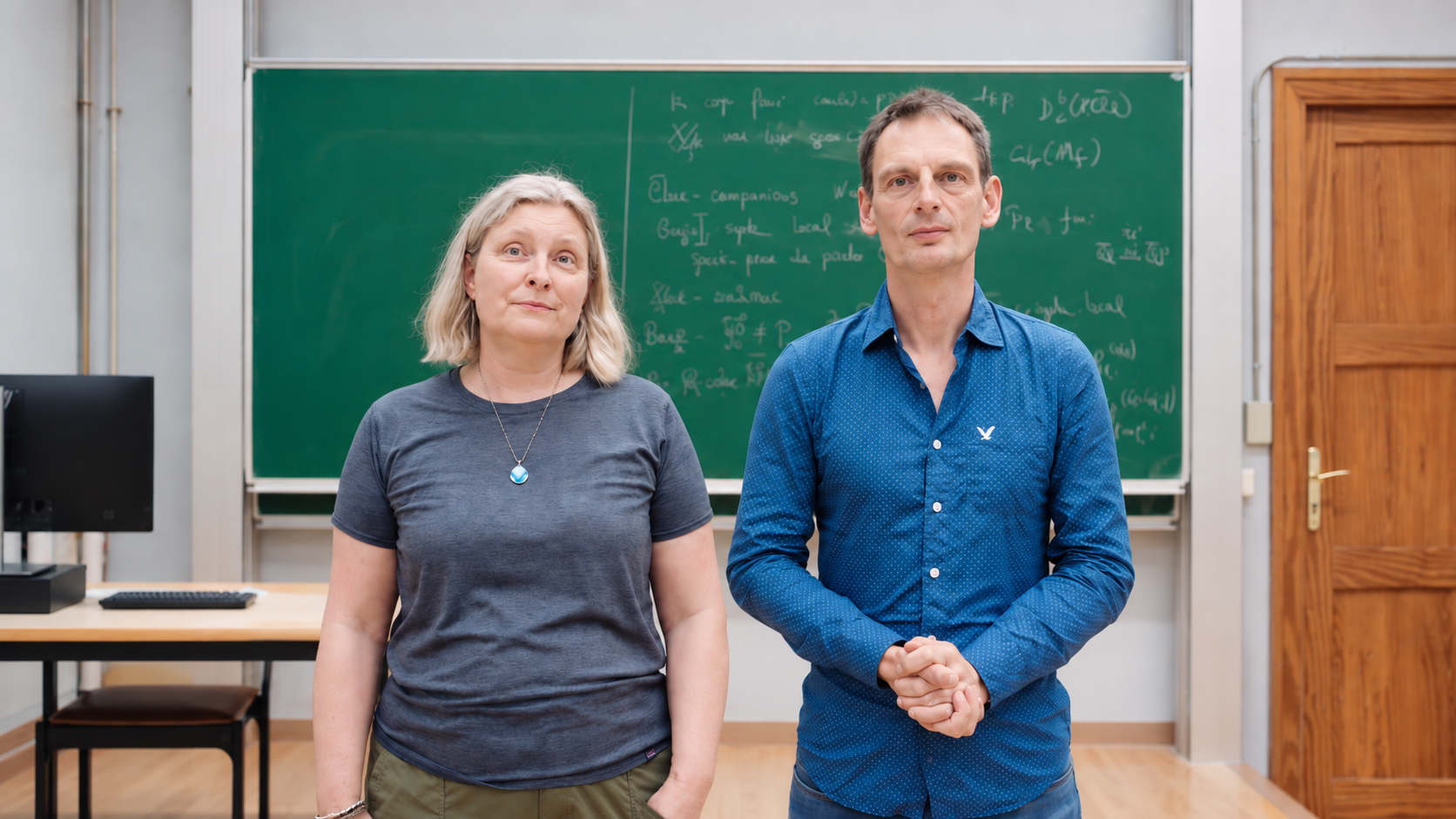
Rare curves, many points: Christophe Ritzenthaler and Rachel Pries on their research and the work around it
Christophe Ritzenthaler (Université de Rennes) and Rachel Pries (Colorado State University) both work on curves over finite fields: he hunts curves with as many points as possible, she hunts curves that almost never occur. In conversation with the CRM during their...

Call open for the 2027 Ferran Sunyer i Balaguer Prize
The Ferran Sunyer i Balaguer Foundation is accepting submissions for its 2027 prize, which awards 15,000 euros and publication in Birkhäuser's Progress in Mathematics series to an expository monograph on an active area of mathematical research. The deadline is 27...
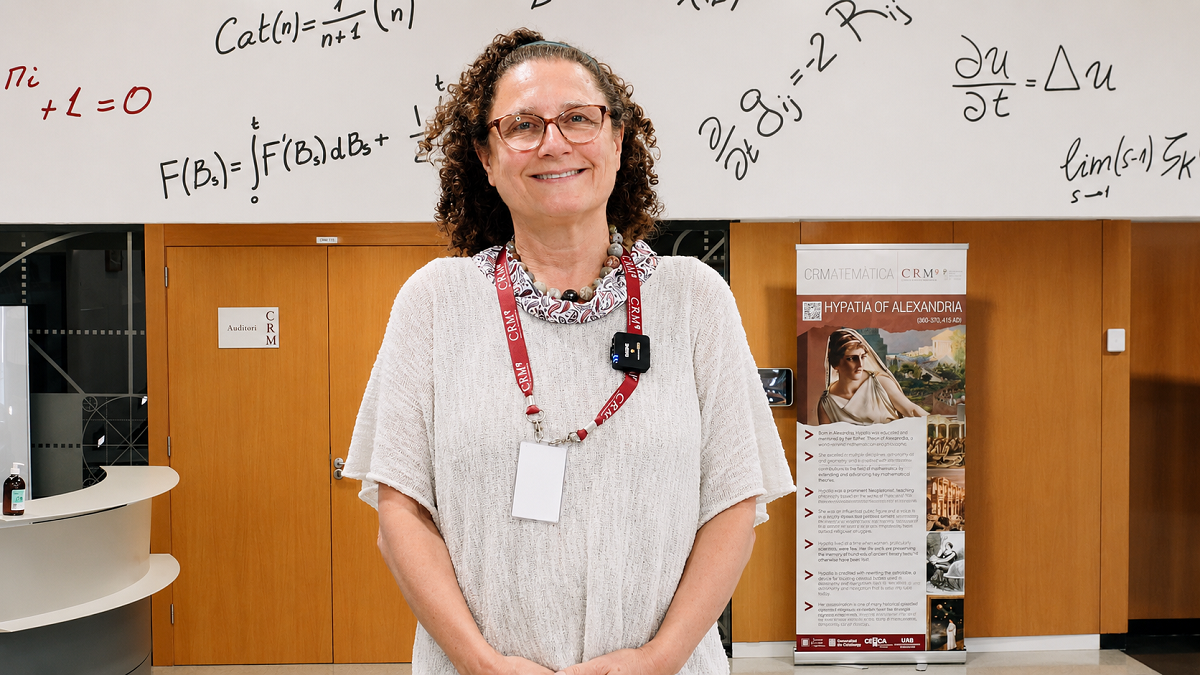
Susanna Terracini delivers the CRM Colloquium 2026
Susanna Terracini (Università di Torino) delivered the CRM Colloquium 2026 on 14 July, presenting a rigidity result for Kepler billiards obtained with Stefano Baranzini, Vivina Barutello and Irene De Blasi. She was at the centre as a member of the CRM Scientific...
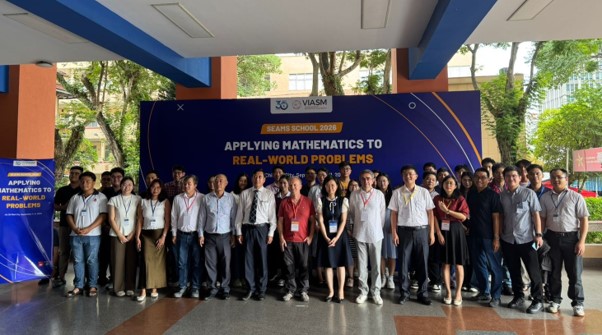
Ho Chi Minh City hosts the SEAMS School on applying mathematics to real-world problems
Students from across the region took courses and worked on group projects at a school co-organised by CRM researcher Tim Myers.CRM CommPau VarelaCRMComm@crm.catGet the latest CRM news and activities in your inbox.Recent newsletters →Between 4 and...

A single ball on a fixed table can compute: Eva Miranda and Isaac Ramos prove that two-dimensional billiards are Turing complete
Eva Miranda (UPC, CRM) and Isaac Ramos (ETH Zürich) show that a point particle bouncing inside a planar table with fixed walls can simulate a universal Turing machine, settling a question Cristopher Moore left open in 1990. The result grew out of a master’s project...
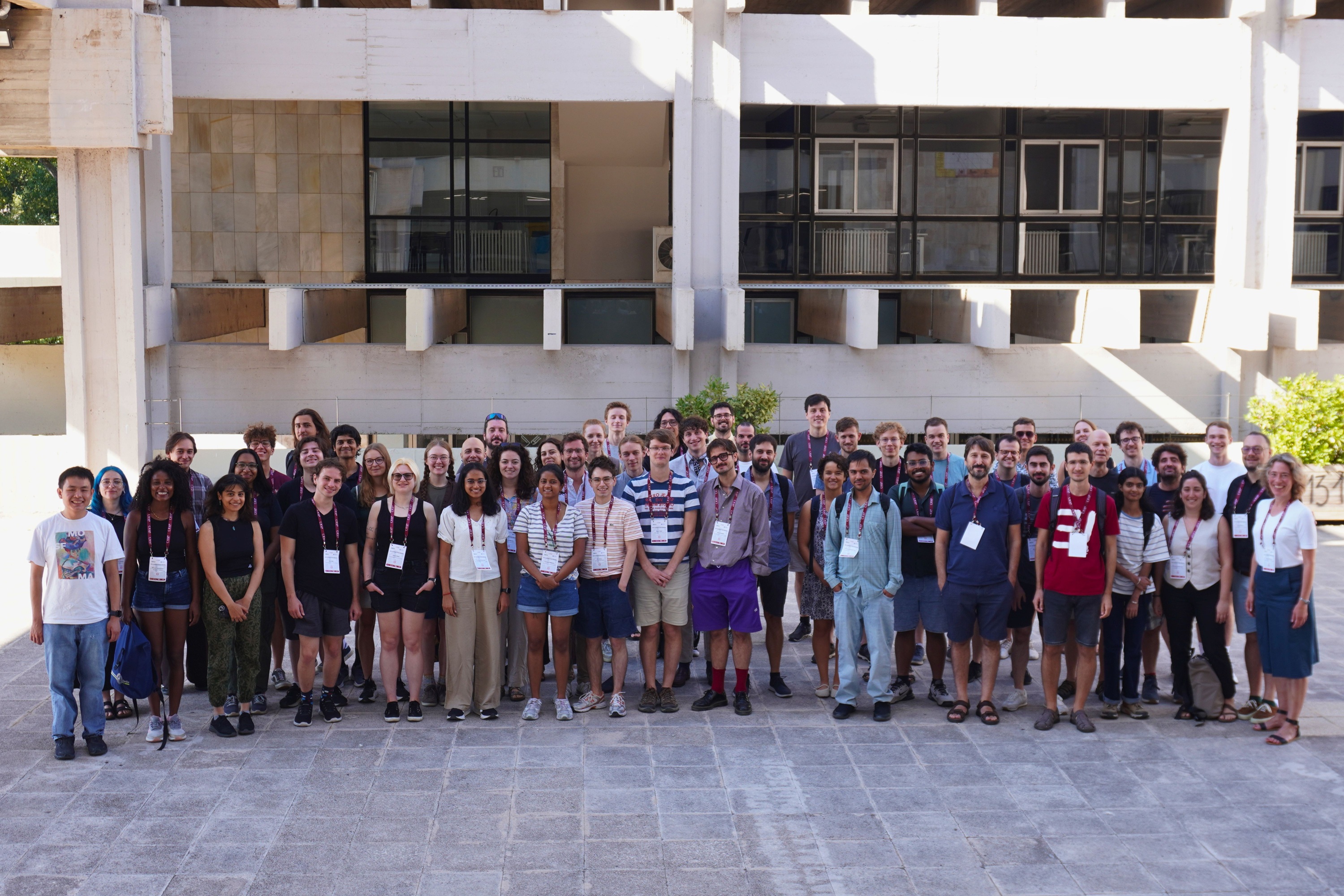
BMS-BGSMath Junior Meeting 2026: Barcelona and Berlin Strengthen Scientific Ties
From 2 to 4 September 2026, the Centre de Recerca Matemàtica (CRM) hosted the BMS-BGSMath Junior Meeting 2026, a three-day event jointly organised by the Berlin Mathematical School (BMS) and the Barcelona Graduate School of Mathematics (BGSMath), with the Centre de...
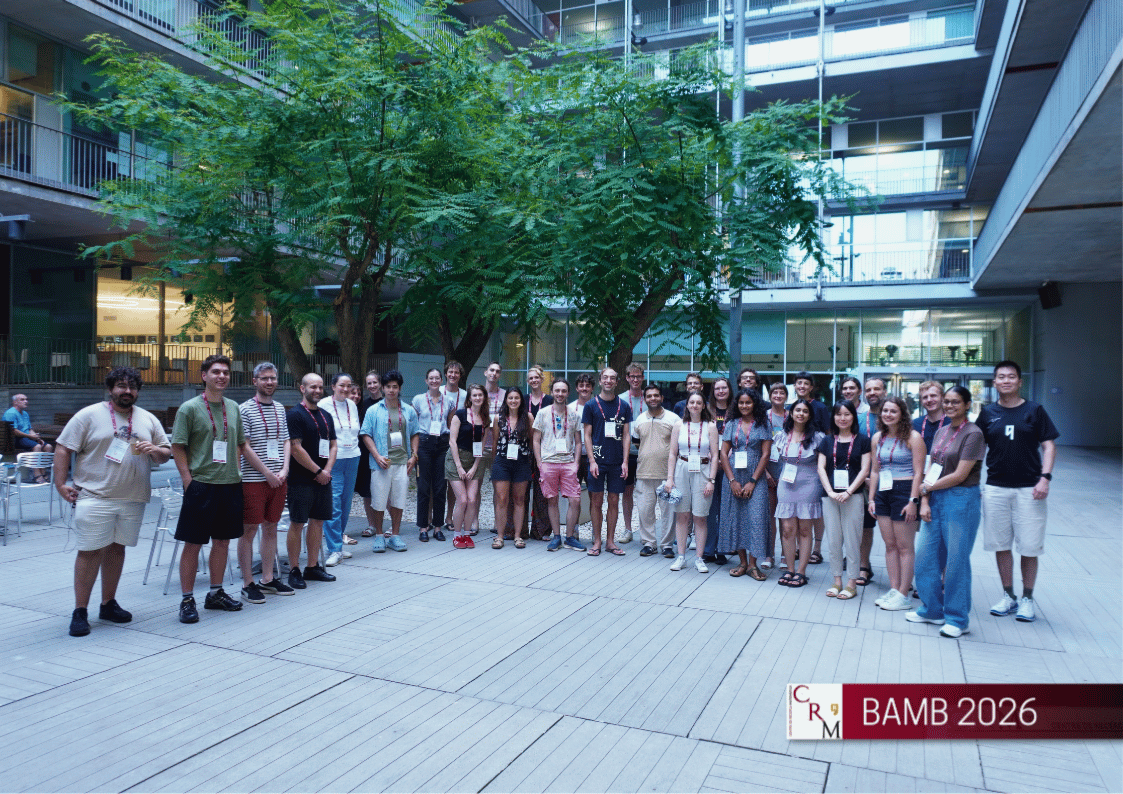
The CRM organises the 2026 Barcelona Summer School for Advanced Modeling of Behavior
The Centre de Recerca Matemàtica held the sixth edition of BAMB!, the Barcelona Summer School for Advanced Modeling of Behavior, from 12 to 23 July 2026 at the Parc de Recerca Biomèdica de Barcelona. Thirty early-career researchers from fourteen countries followed...