Supervised by Inmaculada Baldomá and Pau Martín, the thesis proves the existence of chaotic dynamics in a broad family of area-preserving maps and combines classical analysis with computer-assisted proof. The defence took place on 3 July 2026 at the FME (UPC).
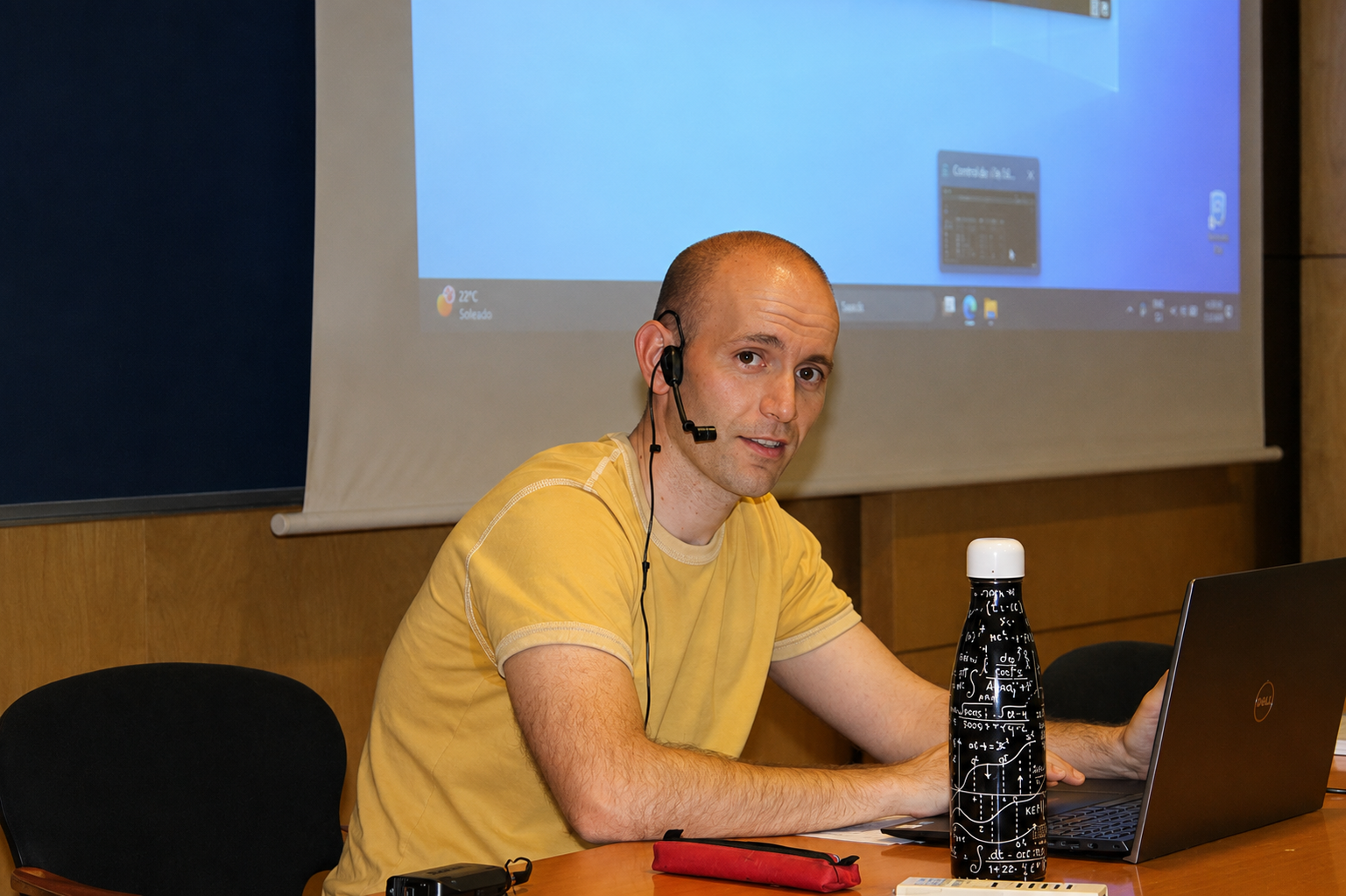
Dídac Gil Rams defended his doctoral thesis, Splitting of separatrices in generalized standard maps, on 3 July 2026 at the Facultat de Matemàtiques i Estadística of the Universitat Politècnica de Catalunya. The work was supervised by Inmaculada Baldomá and Pau Martín, both professors at the UPC and affiliated researchers at CRM, within the UPC doctoral programme in Applied Mathematics. Dídac carried out his doctoral research as a PhD student at the Centre de Recerca Matemàtica, within the Dynamical Systems group.
The starting point was a request rather than a topic. “When I finally decided to do a doctorate with my supervisors, I gave them a single requirement: I wanted to prove chaos,” Dídac explains. Baldomá and Martín proposed a family of dynamical systems that contained one member already known to be chaotic. Everything pointed to there being others.
Chaos has more than one accepted mathematical definition, and the one Dídac uses in a talk depends on the audience. In a strict sense he follows Devaney: a system is chaotic if it depends sensitively on initial conditions, is topologically transitive, and has dense periodic orbits of every period. Less formally, he describes it as “a certain level of unpredictability, the feeling that every kind of behaviour has room in it.”
Establishing that a given system meets the definition is a global problem, and the thesis takes the classical route through the Birkhoff-Smale homoclinic theorem: if a planar map has a hyperbolic fixed point whose stable and unstable invariant manifolds intersect transversally, the system is chaotic. “Summed up, my job is to see that two curves cross at an angle different from zero,” Dídac says.
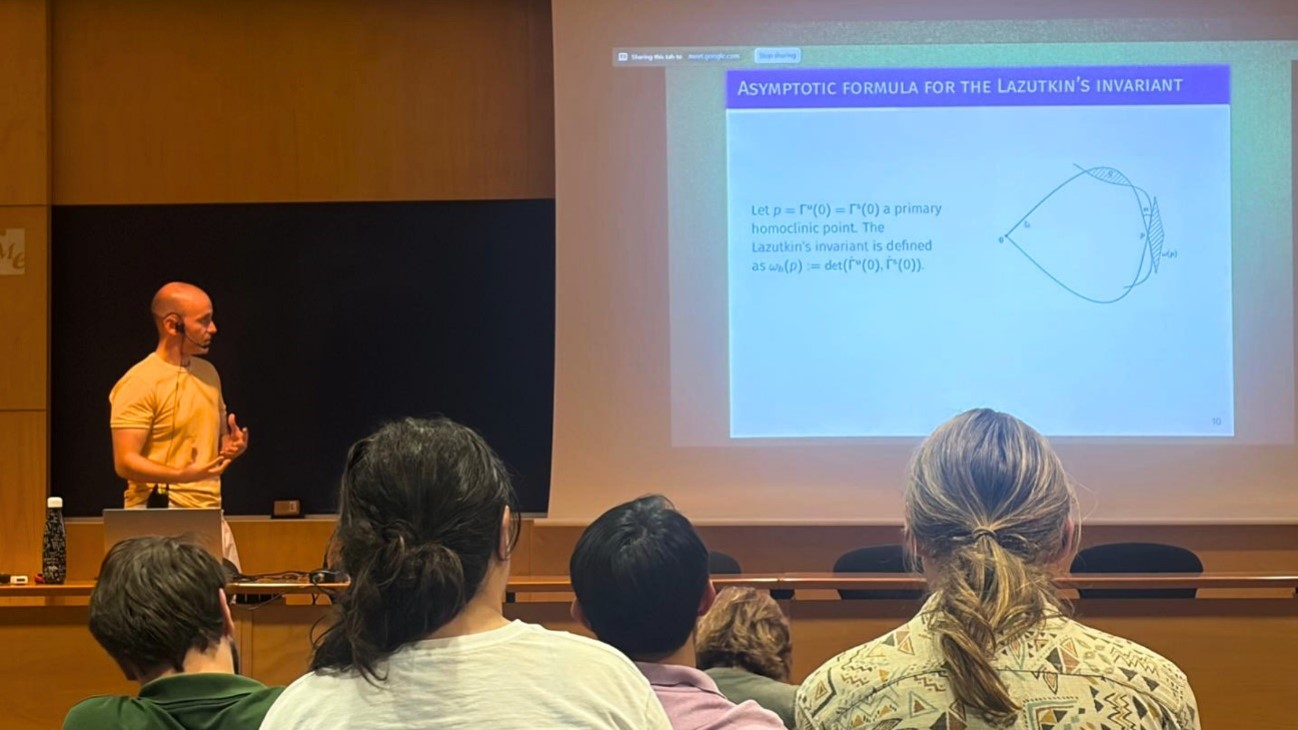
Dídac Gil Rams during his doctoral thesis defence at the FME (UPC), 3 July 2026.
The difficulty lies in the size of that angle. For the maps he studies it is exponentially small in the perturbation parameter, a beyond-all-orders phenomenon that classical Melnikov theory cannot capture. Measuring it requires complexifying time and working near the singularities of the unperturbed connection, in a region of the complex plane where the curves are no longer defined. “That smallness complicates the study quite a bit, to the point that in the middle of the calculations you can forget that all you want is to see how two curves cross.”
“Summed up, my job is to see that two curves cross at an angle different from zero.”
The family under study, the generalized standard maps, was introduced by Baldomá and Martín in 2012 and includes the Chirikov standard map, the Hénon map and the perturbed McMillan map. Dídac is clear about applications outside mathematics, describing his experience so far as “mathematics applied to mathematics, as one of my friends likes to put it.” The thesis does, however, close a gap of long standing within dynamical systems: the result it establishes for the Hénon map had been used for close to twenty years without a proof. “That makes us particularly happy, because in a way, we’re giving mathematical support to all those results.”
The leading term of the asymptotic formulas obtained in the first part of the thesis depends on a Stokes constant, an object that is generally out of analytical reach. The second part develops an algorithm to enclose these constants rigorously by computer-assisted proof, using the interval arithmetic tools of the CAPD library (Computer Assisted Proofs in Dynamics), developed in Kraków, where Dídac worked with his collaborator Maciej Capiński during the final two years of his doctorate. The method yields nonzero Stokes constants for polynomial cases up to degree 970 and for trigonometric polynomials of any degree (all of them under some extra conditions), the standard and Hénon maps among them, together with one example where the constant vanishes.
“What surprised me most was that in all the initial cases it was different from zero, meaning all those systems were chaotic,” he says. “Stokes constants are really unknown, and being able to say so many things about them after this study is pretty good.” The vanishing example opened a further line of work and became one of the conjectures of the thesis: that for sufficiently complex systems there exists a set of parameters of comparable complexity for which the constant is zero.
On the use of computers in proof, his position comes from having worked with the tools directly. Interval arithmetic performs calculations while accounting for the errors the machine introduces, so the result is delivered as an interval guaranteed to contain the true value. “Once you understand that, and once you trust the professors who programmed the library, you can be a hundred percent sure that the result you were after is contained in the interval you got. Where the pencil doesn’t reach, maybe the computer can give you that last push.“
The day-to-day of the thesis he describes as quiet and largely solitary, with colleagues as the social part of the day and supervision as a small fraction of the hours involved. He declines to identify a single moment of being stuck. “For me the whole process has been being stuck until you find the way out. One challenge after another. I think that’s my view of mathematics now.” The most recent instance came days before depositing the thesis, when they realised that a function had been stated to be real analytic without proof. Repairing it took a month of continuous work.
Dídac intends to continue in research and is honest about the conditions. He has two articles still to submit and others in preparation, and no publications yet. “This world, like any other, runs on CV and a lot of luck. For now, mine isn’t competitive when it comes to winning grants or postdoc positions.” A contact through a friend now working in Dalian has opened the possibility of a research stay there. Beyond that, he leaves it open. “The rest, the future will tell: whether I can keep doing research, or whether I’d better go back to the bakery with my parents.”
Asked what the doctorate gave him beyond the degree, he puts the title last. “Looking back, the title of doctor is the least important part of the whole process.” He points instead to the people he met, to the international congresses and courses, and to something nobody who knew him before the thesis had predicted: he speaks English now.
A recorded talk by Dídac on the subject of the thesis, given in March 2024, is available here.
Dídac has written about his research stay in Poland here.
Newsletter
Get the latest CRM news and activities delivered to your inbox
Subscribe now
Recent newsletters →
The CRM opens the academic year and unveils its Directors’ Gallery
A review of the year, the Communication Plan 2026–2030 and three research talks filled the morning of 19 October.The unveiling of the Directors’ Gallery.CRM CommPau VarelaCRMComm@crm.catGet the latest CRM news and activities in your inbox.Recent...
The CRM Mentoring Programme, as Told by One of Its Pairs
PhD student Joaquim Duran and mathematician Robert Cardona, one of the pairs in the CRM Mentoring ProgrammeJoaquim Duran (left) and Robert Cardona.CRM CommPau VarelaCRMComm@crm.catGet the latest CRM news and activities in your inbox.Recent...
When the reward comes within reach, the brain changes what it compares
As the tokens piled up, choices got faster and more accurate at the same time. The yardstick for judging each offer had moved.CRM CommPau VarelaCRMComm@crm.catGet the latest CRM news and activities in your inbox.Recent newsletters →Two subjects...

Almost every automaton can be reset with a short word
For a random automaton with n states, a word of about √n log n letters is almost always enough to reset it.CRM CommPau VarelaCRMComm@crm.catGet the latest CRM news and activities in your inbox.Recent newsletters →Picture a conveyor belt carrying...
Exposició ‘Les matemàtiques de Gaudí’
|
|
CRM CommPau Varela
|