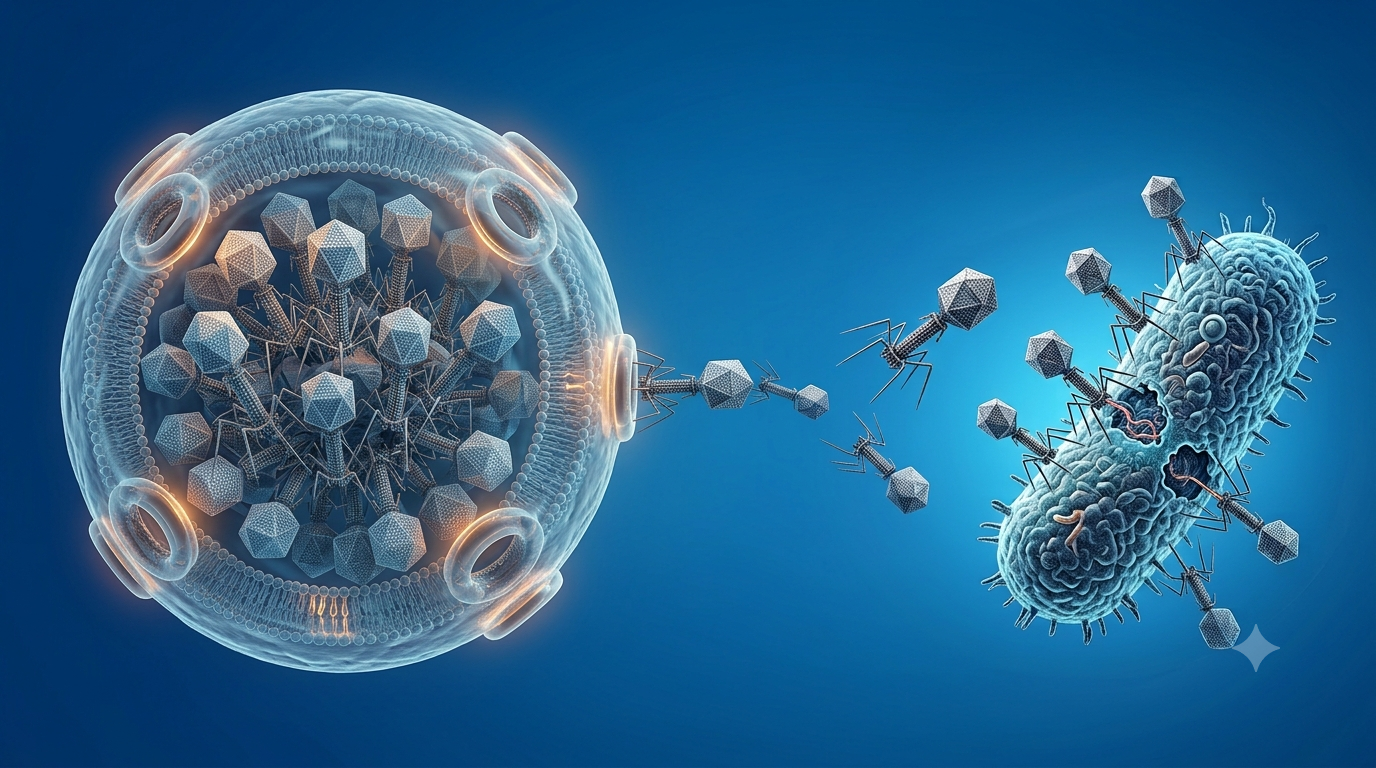
Bacteriophages — viruses capable of infecting and destroying bacteria — are considered one of the most promising alternatives to tackle the growing problem of antibiotic resistance. However, for these treatments to work, phages must overcome several obstacles before reaching their target. When administered orally, for example, they must pass through hostile environments such as the stomach, where some of them may degrade before reaching the site of infection.
In the article Dynamics of Encapsulated Bacteriophage in the Gastrointestinal Tract, Sílvia Cuadrado (Centre de Recerca Matemàtica and Universitat Autònoma de Barcelona), together with Carles Barril and Xavier Bardina (Universitat Autònoma de Barcelona), presents a mathematical model to study how bacteriophages behave when administered inside protective microcapsules. The goal is to better understand the advantages and limitations of this strategy and determine under which conditions encapsulation can contribute to improving treatment efficacy.
“This work emerged through our interaction with the UAB Department of Microbiology, particularly the group led by Prof. Montserrat Llagostera. They introduced us to bacteriophage therapy and, more specifically, to phage encapsulation.”
— Sílvia Cuadrado (Universitat Autònoma de Barcelona – Centre de Recerca Matemàtica)
The study provides a tool to analyze what happens to bacteriophages from the moment they are administered until they reach their destination, making it possible to explore different encapsulation and administration strategies without initially relying on complex experimental assays.
Bacteriophages: An Alternative to Antibiotics
Bacteriophages were discovered in the early twentieth century by Frederick Twort and Félix d’Herelle. These viruses infect bacteria by attaching to their surface, injecting their genetic material, and using the bacterial machinery to reproduce. In the case of lytic phages, this process ultimately destroys the bacterium and releases new viruses capable of infecting other bacterial cells.
Shortly after their discovery, bacteriophages began to be used to combat bacterial diseases. However, the success of antibiotics relegated this therapeutic strategy to the background for decades in much of the world, remaining in use mainly in parts of Eastern Europe and the former Soviet Union.
In recent years, the rise of antimicrobial resistance has renewed interest in phage therapy. These viruses possess a particularly attractive feature: they can recognize and attack specific bacteria, making them a promising alternative for treating certain bacterial infections.
Nevertheless, turning this potential into effective treatments is not straightforward. For bacteriophages to work, they must first survive the journey to the site of infection, a challenge that has motivated the development of new delivery and protection strategies.
The Challenge: Protecting Phages Without Preventing Them From Acting
Despite their therapeutic potential, bacteriophages face important obstacles before reaching their target. When administered orally to treat intestinal infections, they must first pass through the stomach, where the acidic environment can rapidly degrade them and reduce treatment efficacy.
To address this issue, several research groups have developed encapsulation systems based on protective microcapsules. These capsules help preserve phages during their passage through the digestive tract, increasing their chances of reaching the infection site intact.
“Our model describes the dynamics of encapsulated bacteriophages in the gastrointestinal tract and addresses the central question of the balance between protection and release of phages to maximise therapeutic effectiveness.”
— Sílvia Cuadrado (Universitat Autònoma de Barcelona – Centre de Recerca Matemàtica)
However, this solution introduces a new challenge. While bacteriophages remain inside the microcapsules, they cannot infect bacteria. At the same time, if administered at an early stage of infection, some phages may be eliminated by the immune system before they have a chance to replicate.
As a result, capsule design requires a delicate balance between protection and release. A highly permeable capsule releases phages quickly but offers little protection against the acidic environment of the stomach. Conversely, a highly protective capsule may delay their release too much, preventing them from acting when they reach their destination. Understanding and quantifying this trade-off is one of the main objectives of the work by Sílvia Cuadrado and her collaborators.
A Mathematical Model for Encapsulation
To study this problem, Sílvia Cuadrado and her colleagues developed a mathematical model —utilizing structured populations and differential equations— describing what happens to bacteriophages when they are administered inside protective microcapsules. The model incorporates three key components: bacteria, bacteriophages, and the microcapsules that transport them.
The proposed framework describes how phages are gradually released from the capsules, how they travel through the gastrointestinal tract, and how they subsequently interact with bacteria. It also allows researchers to analyze different biological scenarios and investigate how factors such as administration frequency, capsule properties, or phage release rates affect treatment efficacy.
One of the most significant contributions of the study is the explicit incorporation of encapsulation into a mathematical model of phage therapy, an aspect that, according to the authors, has been largely unexplored in the literature. The model also distinguishes between the actual dose of bacteriophages administered and the effective dose, that is, the amount of virus that ultimately becomes available to fight the infection.
The researchers investigated different scenarios using one- and two-compartment models. In the simplest case, where phages can act directly at the site of infection, encapsulation does not provide significant advantages, since part of the viral load is lost during the release process and the effective dose never exceeds the administered dose.
The situation changes, however, when bacteriophages must first pass through a hostile environment before reaching their target. To represent this scenario, the authors developed a two-compartment model that can be interpreted, for example, as the passage from the stomach to the intestine. Along this journey, phages may degrade, be lost, or remain encapsulated, and the model makes it possible to calculate how many ultimately arrive in conditions suitable for combating the infection.
The results show that, in this context, encapsulation can be beneficial because it protects phages during transit and allows a larger number of them to reach the infected area. In addition, the model makes it possible to study which administration frequencies are most suitable for maximizing treatment efficacy.
In this way, mathematics helps answer questions that are difficult to address experimentally: How many bacteriophages actually reach their destination? What characteristics should microcapsules have? How frequently should they be administered to achieve the best outcome?
A Tool for Designing Better Therapies
Rather than providing a specific clinical prescription, the model developed by Sílvia Cuadrado and her collaborators offers a tool to virtually explore different encapsulation and administration strategies before testing them in the laboratory. This approach makes it possible to evaluate when encapsulation is beneficial and which microcapsule characteristics maximize their protective effect without compromising bacteriophage release.
The results show that the effectiveness of these capsules depends both on their properties and on the biological context in which they are used. The model allows researchers to compare different designs and analyze how factors such as administration frequency or phage release rates may influence treatment efficacy.
“The analysis of these dynamics could potentially help biologists design more effective phage therapies. Our research aims to serve as a tool for therapy developers and to highlight the questions that could be addressed through mathematical modelling of phage-bacteria systems.”
— Sílvia Cuadrado (Universitat Autònoma de Barcelona – Centre de Recerca Matemàtica)
The authors highlight that this mathematical framework could help identify the most suitable strategies for different types of infection in the future. However, the model’s predictions will first need to be validated experimentally. To this end, they propose developing interconnected bioreactor systems capable of reproducing the different stages of the gastrointestinal tract and comparing theoretical predictions with real biological data.
Future research directions also include studying alternative mechanisms for bacteriophage release from microcapsules, incorporating stochastic effects that more realistically describe small virus populations, and extending the model to scenarios involving multiple biological compartments.
Ultimately, the study illustrates how mathematics can contribute to the design of new therapeutic strategies, helping answer a fundamental question in phage therapy: how can we ensure that these viruses survive the journey to an infection without preventing them from doing their job once they arrive?
Newsletter
Get the latest CRM news and activities delivered to your inbox
Subscribe now
Recent newsletters →

The CRM opens the academic year and unveils its Directors’ Gallery
A review of the year, the Communication Plan 2026–2030 and three research talks filled the morning of 19 October.The unveiling of the Directors’ Gallery.CRM CommPau VarelaCRMComm@crm.catGet the latest CRM news and activities in your inbox.Recent...

The CRM Mentoring Programme, as Told by One of Its Pairs
PhD student Joaquim Duran and mathematician Robert Cardona, one of the pairs in the CRM Mentoring ProgrammeJoaquim Duran (left) and Robert Cardona.CRM CommPau VarelaCRMComm@crm.catGet the latest CRM news and activities in your inbox.Recent...
When the reward comes within reach, the brain changes what it compares
As the tokens piled up, choices got faster and more accurate at the same time. The yardstick for judging each offer had moved.CRM CommPau VarelaCRMComm@crm.catGet the latest CRM news and activities in your inbox.Recent newsletters →Two subjects...

Almost every automaton can be reset with a short word
For a random automaton with n states, a word of about √n log n letters is almost always enough to reset it.CRM CommPau VarelaCRMComm@crm.catGet the latest CRM news and activities in your inbox.Recent newsletters →Picture a conveyor belt carrying...

Exposició ‘Les matemàtiques de Gaudí’
CRM quod erat demonstrandum | 48
|
|
CRM CommNatalia Vallina
|