Nine secondary school students from six countries spent eight days at the CRM in July, working through four minicourses on fluid dynamics, perturbation methods, iteration and chaos, and randomness from Markov chains to machine learning, plus a session on how mathematical models are transferred to industry and public institutions. The project formed part of the 10th edition of the Barcelona International Youth Science Challenge, organised by Fundació Catalunya La Pedrera, which brought more than 170 students to sixteen research centres, universities and hospitals across Catalonia.
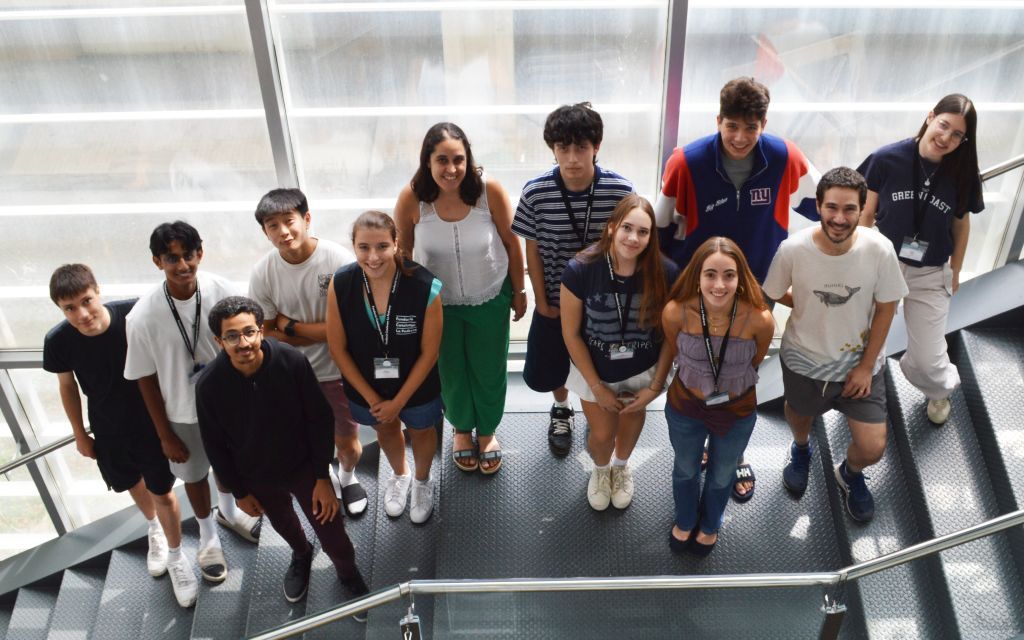
The Centre de Recerca Matemàtica (CRM) took part this July in the 10th edition of the Barcelona International Youth Science Challenge (BIYSC), a two-week research programme organised by Fundació Catalunya La Pedrera that brings secondary school students from around the world into research centres across Catalonia. More than 170 students aged 15 to 18 joined this year’s edition, working in small groups on projects proposed by sixteen participating institutions.
BIYSC, now in its tenth edition, runs every July. Participants apply from schools worldwide and spend the programme embedded in a host centre, developing a research project alongside working scientists and presenting their results at a closing ceremony. The host institutions span research centres, universities and hospitals across Catalonia: alongside the CRM, this year’s edition included the Institute for Research in Biomedicine (IRB Barcelona), the Institute of Chemical Research of Catalonia (ICIQ), the Institute of Neurosciences (INc-UAB), the Centre for Research in Agricultural Genomics (CRAG), Hospital Universitari de Bellvitge and the Department of Medicine and Life Sciences (UPF), among others. Projects covered leukaemia research, planarian stem cells, trauma neurobiology and tumourigenesis in the biosciences; cardiovascular and infectious diseases in medicine; astrophysics, cryptography and quantum physics; photochemistry and drug synthesis; nanosatellite design and acoustic engineering; and, in mathematics and computational sciences, supercomputing for the cities of the future alongside the CRM’s own project.
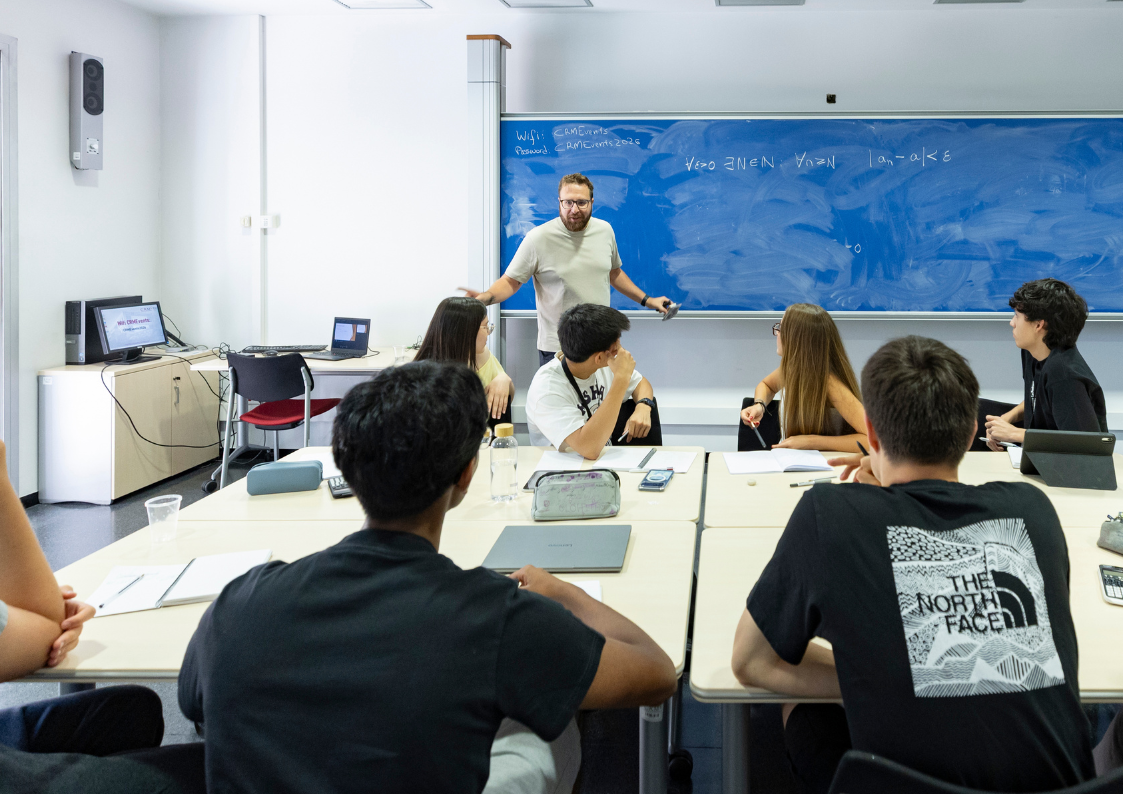
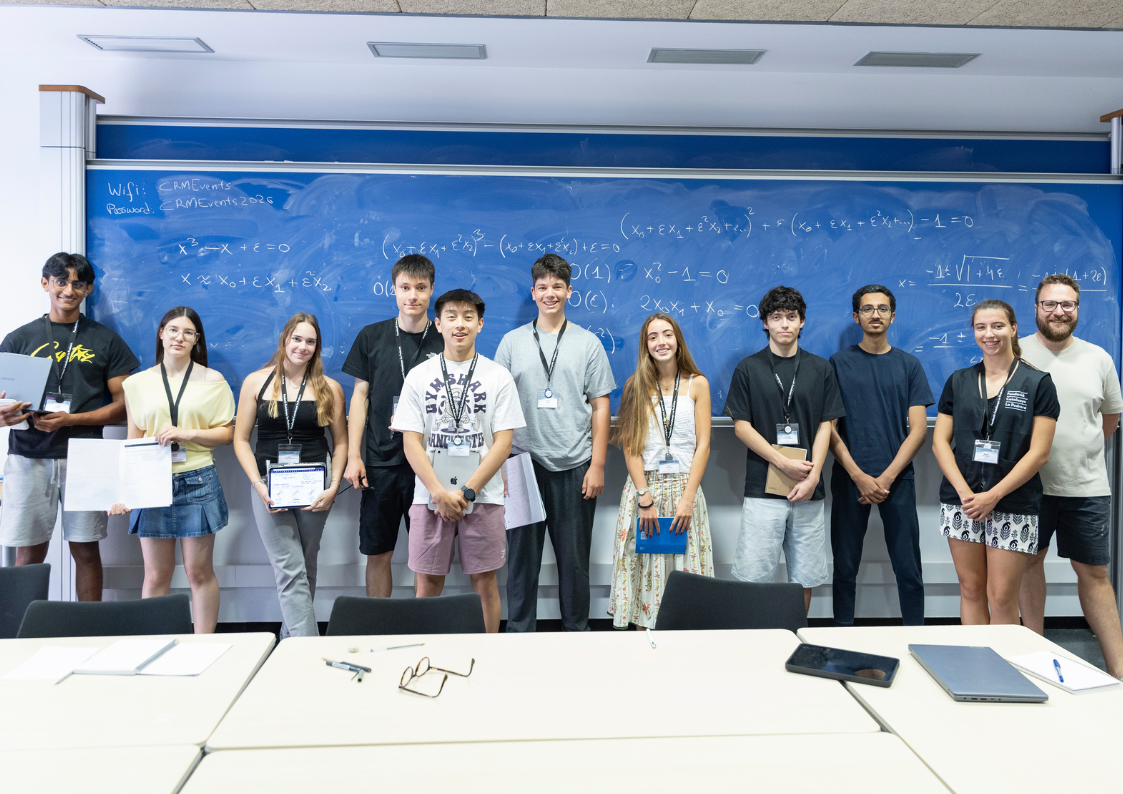
The CRM’s proposal, “Advanced Mathematics: from Fundamental Theory to its Real-World Impact”, ran from 8 to 16 July and received nine students from Chile, Russia, Saudi Arabia, Slovenia, Spain and the United Kingdom. The project was structured around four minicourses covering a deliberately wide span of mathematics, from foundational theory to methods used in current research.
Jezabel Curbelo (UPC, CRM) taught “Following Trajectories: The Mathematics Behind Motion and Patterns in Fluids”, which began with the equations that describe how fluids move: Euler’s formulation of 1757 for an inviscid fluid, the Navier–Stokes equations that Navier and Stokes derived from it by adding viscosity, and the Coriolis terms that enter once the fluid is sitting on a rotating planet. Whether Navier–Stokes can be solved at all remains one of the seven Millennium Prize problems. Since in practice the equations cannot be solved, the second half of the course was numerical. Students integrated particle trajectories with Euler’s method, approximated their length using the trapezoidal rule, and represented the result as a colour map over a grid of starting positions. The structures that surface in those maps, known as Lagrangian coherent structures, are what allow eddies and jets to be picked out of real ocean and atmospheric velocity data.
Marc Calvo (UPC, CRM) led “The Mathematics of ‘Almost'”, which took five sessions to get from a falling apple to a decelerating train. The first was a tour of where applied mathematics ends up: the Radon transform that lets a CT scanner assemble thousands of flat images into a body, Gaudí’s catenaries and ruled surfaces, the integer ratios Pythagoras found in consonant intervals and the Fourier series that accounts for timbre. The second built the derivative out of Newton’s apple, average speed narrowing towards instantaneous speed as the interval shrinks, and carried it through to differential equations, phase portraits, and the question of why an apple dropped from an aeroplane stops accelerating.
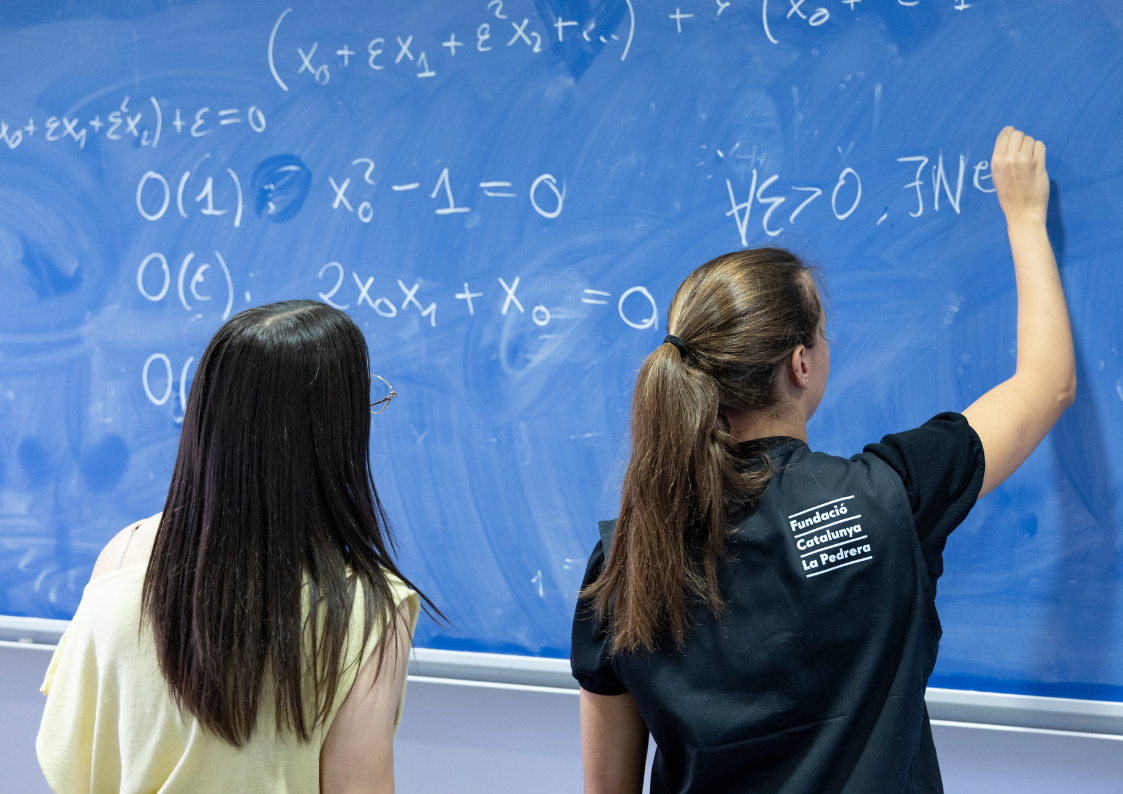
The two sessions that followed were the substance of the course. Almost nothing that describes the physical world can be solved exactly, so the working method is to solve a simpler version and then correct it: treat the third body in a three-body problem as a small pull on a solvable two-body one, treat a manufacturing flaw as a small deviation from a perfectly straight beam. None of that can begin until the problem has been nondimensionalised, since a quantity carrying units cannot be called small at all. Calvo’s example: 0.001 is small in kilometres and equal to one in millimetres. The course ended with a modelling exercise on a maglev train coming to a stop.
Kostiantyn Drach (UB, CRM) taught “When Time Ticks: Iteration, Chaos, and the Mandelbrot Set”, a course built on a single operation repeated without end: take a rule, apply it, apply it again. The opening examples were deliberately ordinary. Compound interest, mortgage repayments, Malthus’s 1798 population model, Fibonacci’s rabbits from the Liber Abaci of 1202, Newton’s method for finding roots of polynomials that cannot be solved by formula. The logistic map carried the rest of the course. Students located its fixed points, tested whether each one attracted or repelled nearby orbits, and computed the bifurcation diagram in which stable behaviour splits into cycles of period two, four, eight, and onwards into a region that no longer resolves into any cycle at all. Measuring the gaps between those splittings yields Feigenbaum’s constant, roughly 4.669, which comes out the same for entire families of otherwise unrelated maps; the result was observed numerically in the 1970s and only proved for real maps in 1999, and for complex ones in 2023. A change of coordinates turns the logistic family into z² + c, and letting both quantities be complex opens onto Julia sets and the Mandelbrot set, which the last session explored through zoom applets.
Tássio Naia (CRM) closed the set with “Learning from Chance: Markov Chains and Monte Carlo Methods”, four sessions that used the random walk as a thread through probability, simulation, machine learning and graph theory. The first built Markov chains out of state diagrams and transition matrices and asked what a system settles into over the long run, including the caveat that a chain can also get trapped or oscillate forever. The second treated repeated random trials as a measuring instrument, estimating π by counting how many darts thrown at a square land inside the circle drawn in it, and arriving at the error rule that makes each extra digit of accuracy a hundred times more expensive. The third moved to machine learning: features and labels, training and test data, overfitting, and what a model inherits from data that leaves people out. The last returned to graphs, where a walker visits each vertex in proportion to how many edges meet there, which is not far from the principle behind ranking pages on the web.
The programme also included a session by David Romero (CRM), of the centre’s Knowledge Transfer Unit, titled “Mathematics in Action: from Abstract Ideas to Practical Applications”, on how mathematical models developed at the CRM are applied in ongoing projects, from decision-making under risk in mountain environments to the modelling of heat transfer in urban infrastructure. Throughout the sessions, students worked hands-on in computational environments, building and testing the models themselves.
The edition opened on 7 July at the Auditori de La Pedrera and closed on 17 July at the Aula Magna of the Faculty of Law of the Universitat de Barcelona, where each group presented its work. The CRM students delivered their presentation to an auditorium of fellow participants, researchers and families, condensing eight days of mathematics into five minutes.
This was the CRM’s second participation in BIYSC, after a first project in 2024 taught by Antoni Guillamon, Carlos d’Andrea and Natalia Castellana. It is a way of opening mathematical research to secondary students at the point where many of them are deciding what to study. Applications for future editions are managed by Fundació Catalunya La Pedrera through the programme website, biysc.org.
The mathematics project’s turn begins at 1:35:00 in the recording of the closing ceremony.
Fundació Catalunya La Pedrera has also published a summary video of the edition.
Newsletter
Get the latest CRM news and activities delivered to your inbox
Subscribe now
Recent newsletters →
The CRM Mentoring Programme, as Told by One of Its Pairs
PhD student Joaquim Duran and mathematician Robert Cardona, one of the pairs in the CRM Mentoring ProgrammeJoaquim Duran (left) and Robert Cardona.CRM CommPau VarelaCRMComm@crm.catGet the latest CRM news and activities in your inbox.Recent...
When the reward comes within reach, the brain changes what it compares
As the tokens piled up, choices got faster and more accurate at the same time. The yardstick for judging each offer had moved.CRM CommPau VarelaCRMComm@crm.catGet the latest CRM news and activities in your inbox.Recent newsletters →Two subjects...

Almost every automaton can be reset with a short word
For a random automaton with n states, a word of about √n log n letters is almost always enough to reset it.CRM CommPau VarelaCRMComm@crm.catGet the latest CRM news and activities in your inbox.Recent newsletters →Picture a conveyor belt carrying...
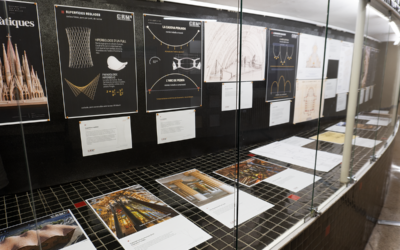
Exposició ‘Les matemàtiques de Gaudí’
CRM quod erat demonstrandum | 48
|
|
CRM CommPau Varela
|