
A study in PNAS by Pere Puig (UAB, CRM) and Joana Maria Pujadas-Mora (UOC, ICREA) reports what happens when the daily health records kept in Son Servera and Capdepera during the 1820 outbreak are analysed with a Bayesian epidemiological model: an unusually short infectious period and an estimated case-fatality ratio of 78%. The findings point away from the traditional rat-flea account and towards a much larger role for human-centred transmission.

A ship out of Tangier dropped anchor off Son Servera, on the east coast of Mallorca, in May 1820. Whatever was unloaded, and the documents of the period point to contraband, reached land in small rowing boats hauled onto the sand. People in Son Servera started dying a few weeks later, on an island that had not seen plague since 1652. In Son Servera’s collective memory, the epidemic begins with a shepherd boy who found a sailor’s coat, put it on and carried the infection home. The story has become part of the town’s account of the disaster; since 2008, a statue of the pastoret has stood in Plaça de Sant Joan as a memorial to the epidemic’s victims and survivors.
Historians have treated the episode, for the better part of two centuries, as a late instance of bubonic plague, the disease behind the Black Death, in which Yersinia pestis circulates in rat populations, travels in rat fleas and reaches humans through a bite. That form of plague typically produces painful swollen lymph nodes, the buboes from which it takes its name. Without treatment, WHO estimates that 30 to 60% of patients die.
None of that is what the doctors in Son Servera wrote down. They recorded fever and a profound weakness, and patients who were well in the morning and dead by nightfall. Buboes hardly figure. By 31 December 1820, the date on which the epidemic was declared over once the towns had been disinfected and the possessions of the dead burned, more than 2,400 people had died out of roughly 7,500 living in the affected area. Son Servera alone counted some 1,340 cases among about 1,684 inhabitants.
That mismatch between the expected disease and the recorded one is what Pere Puig, professor of statistics at the Universitat Autònoma de Barcelona (UAB) and researcher at the Centre de Recerca Matemàtica (CRM), and Joana Maria Pujadas-Mora, professor at the Universitat Oberta de Catalunya (UOC) and ICREA Acadèmia researcher, set out to test. Writing in Proceedings of the National Academy of Sciences, they treat the daily returns the towns were ordered to file as an epidemiological series and fit a Bayesian model to it, estimating three quantities: the basic reproduction number, the mean infectious period and the case-fatality ratio.
A daily record of the epidemic
What sets this outbreak apart from most epidemics of its era is the paperwork it generated. Every town inside the cordon had to send the Junta Superior de Sanidad (the island’s health board) a daily return listing new cases, deaths, patients convalescing and patients recovered, with men separated from women and adults from children. Before anyone touched a sheet it was doused in vinegar. The returns are held today in the Historical Archive of the Royal Academy of Medicine of the Balearic Islands, whose 1820 plague collection can now be consulted through the UIB-hosted historical archives catalogue, though the daily series had not previously been analysed in this way.
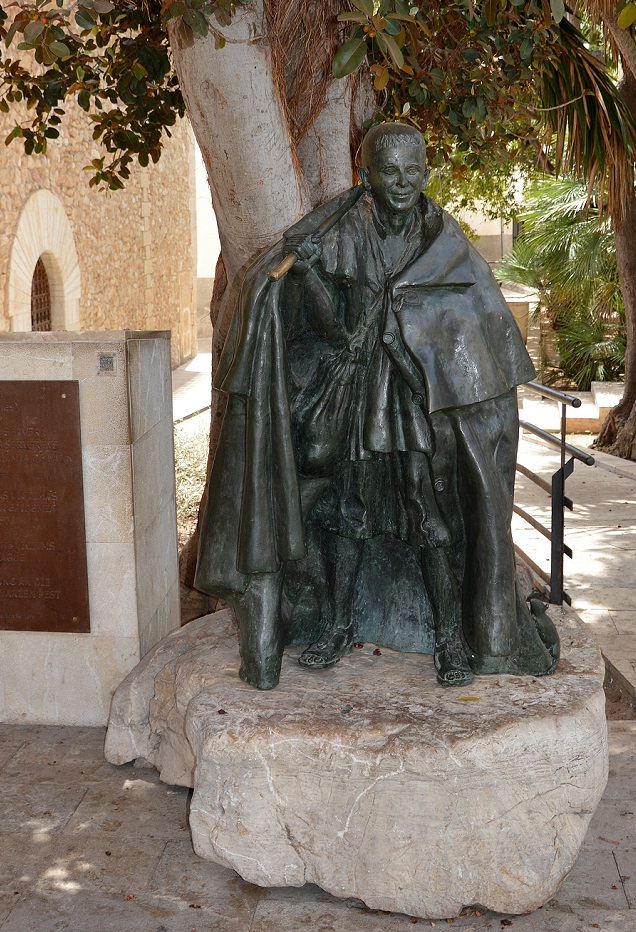
The Pastoret monument in Son Servera, commemorating the town’s 1820 plague and the shepherd-boy story associated with its arrival. Sculpture by Eduard Servera.
Those sheets are the raw material of the new study. Puig and Pujadas-Mora have asked what the shape of the daily curve reveals about the biology behind it, which is a problem of statistical inference before it is one of history.
R0 estimates how many people, on average, one infectious person would infect in a fully susceptible population; above 1, an outbreak can grow. The model also estimates the mean infectious period and the case-fatality ratio, and because the analysis is Bayesian, all three parameters are inferred probabilistically from the daily records, with uncertainty carried through the calculation.
Son Servera and Capdepera do not return the same estimates: in Son Servera,R0 works out at roughly 1.3, with a mean infectious period near 2.8 days. Capdepera gives an R0 close to 1.0 and an infectious period of about 2.0 days, which matches the far smaller outbreak recorded there: around 146 infections in a population of 1,179. Taken over the whole outbreak, the model gives an estimated overall case-fatality ratio of 78%.
What the estimates rule out
That combination, an infectious period of only two to three days and roughly four deaths for every five cases, is difficult to reconcile with a classic rat-flea-human bubonic outbreak. Untreated bubonic plague has a case-fatality ratio of roughly 30 to 60%, whereas pneumonic plague is almost invariably fatal without prompt treatment, and septicaemic plague can also be rapidly lethal. The authors argue that pneumonic and septicaemic forms probably accounted for a substantial share of the severe disease, and that once Y. pestis had entered the population it may have passed from person to person on their own fleas and lice and, in pneumonic cases, directly in respiratory droplets. The historical evidence argues strongly against a sustaining reservoir in Mallorcan rats. The returns hold one further pattern: mortality among children rose significantly during the outbreak, a shift in the age profile of death that the authors read as age-differentiated vulnerability.
The authors are open about a complication. The reports that omit buboes also omit the cough and bloody sputum characteristic of pneumonic plague, a gap that is partly historical: physicians in 1820 lacked the bacteriological framework that would allow Wu Lien-teh, during the Manchurian epidemic of 1910 and 1911, to establish pneumonic plague as the cause of a major outbreak and identify respiratory transmission. The diagnosis nonetheless rests on dynamics, since there is no clinical description that securely diagnoses pneumonic plague in Son Servera, and no microbiological evidence from individual victims could establish the clinical form or the route of transmission.
The records are least ambiguous about where the disease did not go. The epidemic eventually affected four municipalities in eastern Mallorca: Son Servera, Artà, Capdepera and Sant Llorenç. The new statistical analysis concentrates on Son Servera and Capdepera, where the surviving series allow the authors to reconstruct transmission dynamics. Once the authorities recognised they were dealing with contagion, sanitary cordons isolated the affected area and sharply restricted movement and trade: Son Servera, Artà and Capdepera were cordoned, with Manacor added later. Troops held the line, commerce and travel between towns ceased, and camps kept the sick apart from those who appeared healthy. Apart from one reported case in Manacor, sustained transmission did not establish itself elsewhere on the island.
The outbreak came near the end of the Second Plague Pandemic and bears on a long-running argument over whether rats and their fleas can explain the speed and pattern of historical plague in Europe. Mallorca offers an unusually well documented late case in which the rodent explanation fits poorly and restrictions on human movement appear to have worked. The broader methodological point is just as important: records created for administrative purposes in 1820 can, two centuries later, be turned into an epidemiological time series and used to test competing biological explanations.
Reference:
Puig, P., & Pujadas-Mora, J. M. (2026). The 1820 Mallorca plague was not a classic bubonic outbreak. Proceedings of the National Academy of Sciences, 123(34), e2536892123. https://doi.org/10.1073/pnas.2536892123
The research forms part of the project PID2021-128010OB-I00, Epidemias, estado y desigualdades socioeconómicas: predictibilidad y perdurabilidad, siglos XIX y XX (EPI-DESIGUAL), funded by the Spanish Ministry of Science, Innovation and Universities.
Newsletter
Get the latest CRM news and activities delivered to your inbox
Subscribe now
Recent newsletters →
When the reward comes within reach, the brain changes what it compares
As the tokens piled up, choices got faster and more accurate at the same time. The yardstick for judging each offer had moved.CRM CommPau VarelaCRMComm@crm.catGet the latest CRM news and activities in your inbox.Recent newsletters →Two subjects...

Almost every automaton can be reset with a short word
For a random automaton with n states, a word of about √n log n letters is almost always enough to reset it.CRM CommPau VarelaCRMComm@crm.catGet the latest CRM news and activities in your inbox.Recent newsletters →Picture a conveyor belt carrying...

Exposició ‘Les matemàtiques de Gaudí’

CRM quod erat demonstrandum | 48

ADA: Decoding Brain Signals Misaligned in Time
The study addresses a key limitation of current brain decoding techniques: the difficulty of interpreting internal mental processes whose temporal dynamics vary from trial to trial.Decoding what is happening in a person’s mind from their brain activity is one of the...
|
|
CRM CommPau Varela
|