
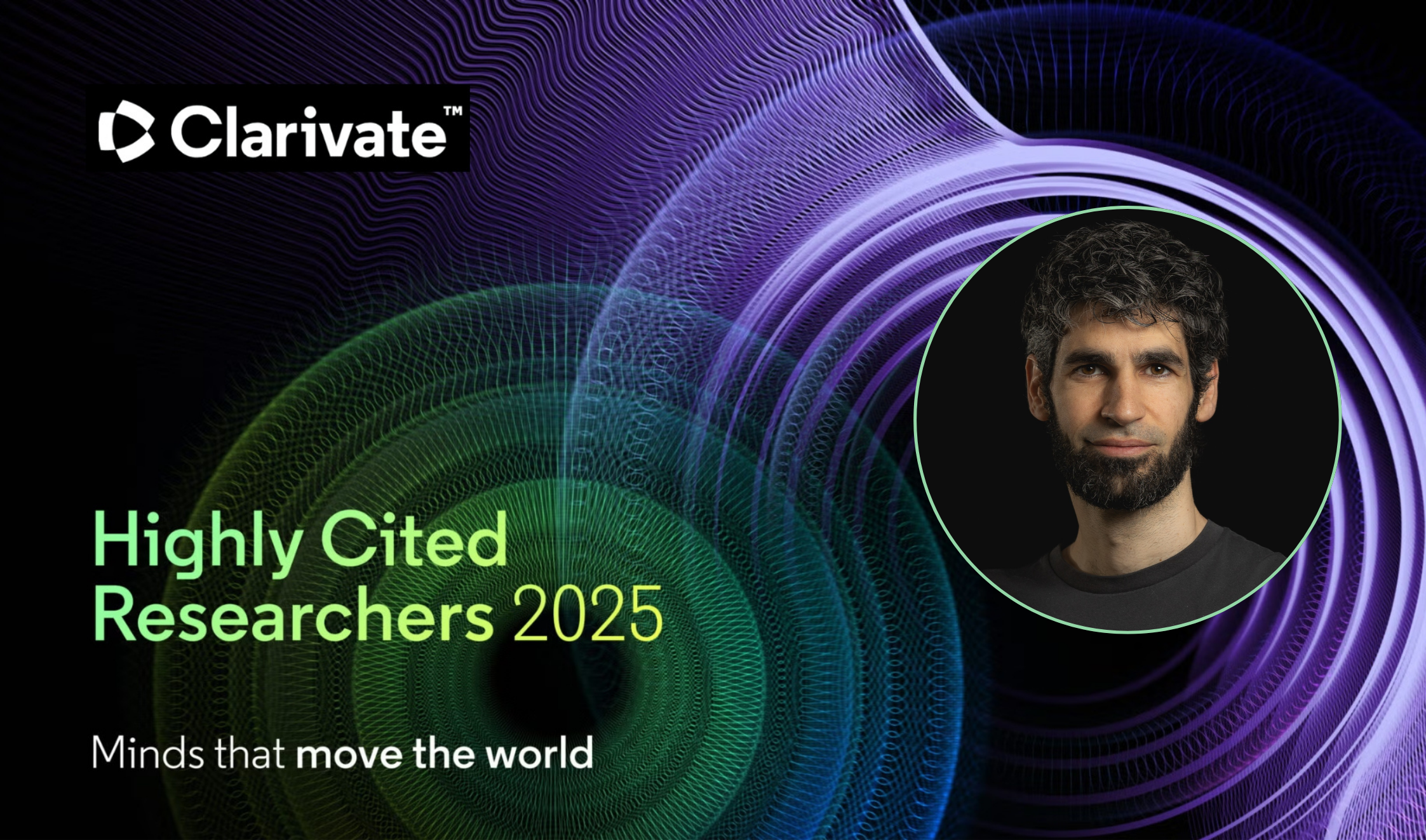
ICREA professor at the Universitat de Barcelona and CRM affiliated researcher Xavier Ros-Oton appears on Clarivate’s Highly Cited Researchers 2025 list, which this year reinstates the mathematics category after two years of exclusion.
Citations are a strange way to measure influence. They don’t count the theorems you prove, but the conversations you generate: who responds to your arguments, who extends your proofs, who finds in your results a starting point to explore territories you hadn’t envisioned. In this sense, Xavier Ros-Oton maintains many conversations at once. The Barcelona-born mathematician, an ICREA professor at the Universitat de Barcelona and an affiliated researcher at CRM, has been recognised as one of the 65 most influential mathematicians in the world, according to Clarivate’s Highly Cited Researchers 2025 list, published on November 12. The list identifies researchers whose articles rank in the top 1% most cited in their respective fields over the past eleven years. Among more than 6,800 researchers from all scientific and social disciplines, only 65 are mathematicians.
That mathematics returns to the Clarivate list this year is news in itself. The scientific intelligence company eliminated the category in 2023 after detecting anomalous patterns indicating that some researchers were “gaming” the system. For two years, mathematics disappeared from the list while Clarivate worked to develop more sophisticated filters. In 2025, the discipline has returned with reinforced integrity criteria. The company consulted with Domingo Docampo, a mathematician at the University of Vigo, who developed an independent algorithm to evaluate citation quality based on who cites and in what context. The 65 who now appear represent, according to Clarivate, greater diversity and include mathematicians and statisticians who have received significant recognition from their peers, many of whom have been awarded top-tier international prizes.
Conversations across disciplines
“For me, it’s a satisfaction to know that some of my articles, to which we’ve dedicated many hours of work with my collaborators, have an impact on the work of other researchers,” Ros-Oton explains. But what excites him most isn’t necessarily the volume of citations, but the type of conversations they generate. “I especially like it when ideas or results from my articles are used in very different areas, for example, in geometry or probability.”
“I especially like it when ideas or results from my articles are used in very different areas, for example in geometry or probability.”
A recent example: a result on minimal surfaces published in Quanta Magazine uses techniques developed by Ros-Oton in the context of free boundary problems. That a result on regularity in PDEs ends up helping understand singularities in geometry is exactly the type of influence that citations try to capture, but which is often difficult to quantify.
Ros-Oton is aware of the limitations of metrics. “Citations don’t reflect all the work behind them; they often don’t even reflect the quality of an article,” he notes. “The ones I consider my best articles aren’t necessarily the most cited, and the number of citations depends on many different factors.” Clarivate’s recognition, then, isn’t an assessment of which works are most important, but of which have generated the most dialogue.
Looking ahead
Beyond consolidating results on classical problems, Ros-Oton is already exploring new territories. “Recently, I started to work on the Boltzmann equation, which is fundamental in statistical mechanics, and there are many mathematical questions we still don’t know how to solve,” he explains. The Boltzmann equation describes how gases evolve at the molecular level, and despite its physical importance, many of its mathematical properties remain a mystery.
But there’s another direction Ros-Oton considers especially promising: the mathematical foundations of machine learning algorithms. “I think it’s a point where researchers from different areas could meet, and there are questions from theoretical computer science, probability, PDEs, analysis, and dynamical systems. In fact, CRM will host a workshop on this topic from January 7-9, organised by Ros-Oton together with Joan Bruna (NYU) and Domènec Ruiz-Balet (UB). “I would encourage all those potentially interested to participate,” he adds.
There are ways to influence that don’t appear in any database: conversations in conference hallways, questions you ask in a seminar that change the direction of a proof, the student you train who ends up opening a new line of research. But in a field as vast and globalised as mathematics, citations are a way to see who’s talking to whom, and what ideas are moving through the world.
That Xavier Ros-Oton ranks among the sixty-five most cited mathematicians on the planet tells you that the tools he has built and the results he has shaped are helping others push further.
|
|
CRM CommPau Varela
|

The CRM opens the academic year and unveils its Directors’ Gallery
A review of the year, the Communication Plan 2026–2030 and three research talks filled the morning of 19 October.The unveiling of the Directors’ Gallery.CRM CommPau VarelaCRMComm@crm.catGet the latest CRM news and activities in your inbox.Recent...
The CRM Mentoring Programme, as Told by One of Its Pairs
PhD student Joaquim Duran and mathematician Robert Cardona, one of the pairs in the CRM Mentoring ProgrammeJoaquim Duran (left) and Robert Cardona.CRM CommPau VarelaCRMComm@crm.catGet the latest CRM news and activities in your inbox.Recent...
When the reward comes within reach, the brain changes what it compares
As the tokens piled up, choices got faster and more accurate at the same time. The yardstick for judging each offer had moved.CRM CommPau VarelaCRMComm@crm.catGet the latest CRM news and activities in your inbox.Recent newsletters →Two subjects...

Almost every automaton can be reset with a short word
Guillaume Chapuy (Université Paris Cité, CNRS) and Guillem Perarnau (UPC, CRM) have shown that a random finite automaton with n states can, with high probability, be reset by a word of length of order √n log n. The result, published in ACM Transactions on Algorithms, pins the exponent at 1/2, the lower end of a decade of numerical estimates, and addresses the random version of the synchronization problem behind a conjecture Ján Černý posed in 1964 and which still remains open.
Exposició ‘Les matemàtiques de Gaudí’
CRM quod erat demonstrandum | 48

ADA: Decoding Brain Signals Misaligned in Time
The study addresses a key limitation of current brain decoding techniques: the difficulty of interpreting internal mental processes whose temporal dynamics vary from trial to trial.Decoding what is happening in a person’s mind from their brain activity is one of the...
Rare curves, many points: Christophe Ritzenthaler and Rachel Pries on their research and the work around it
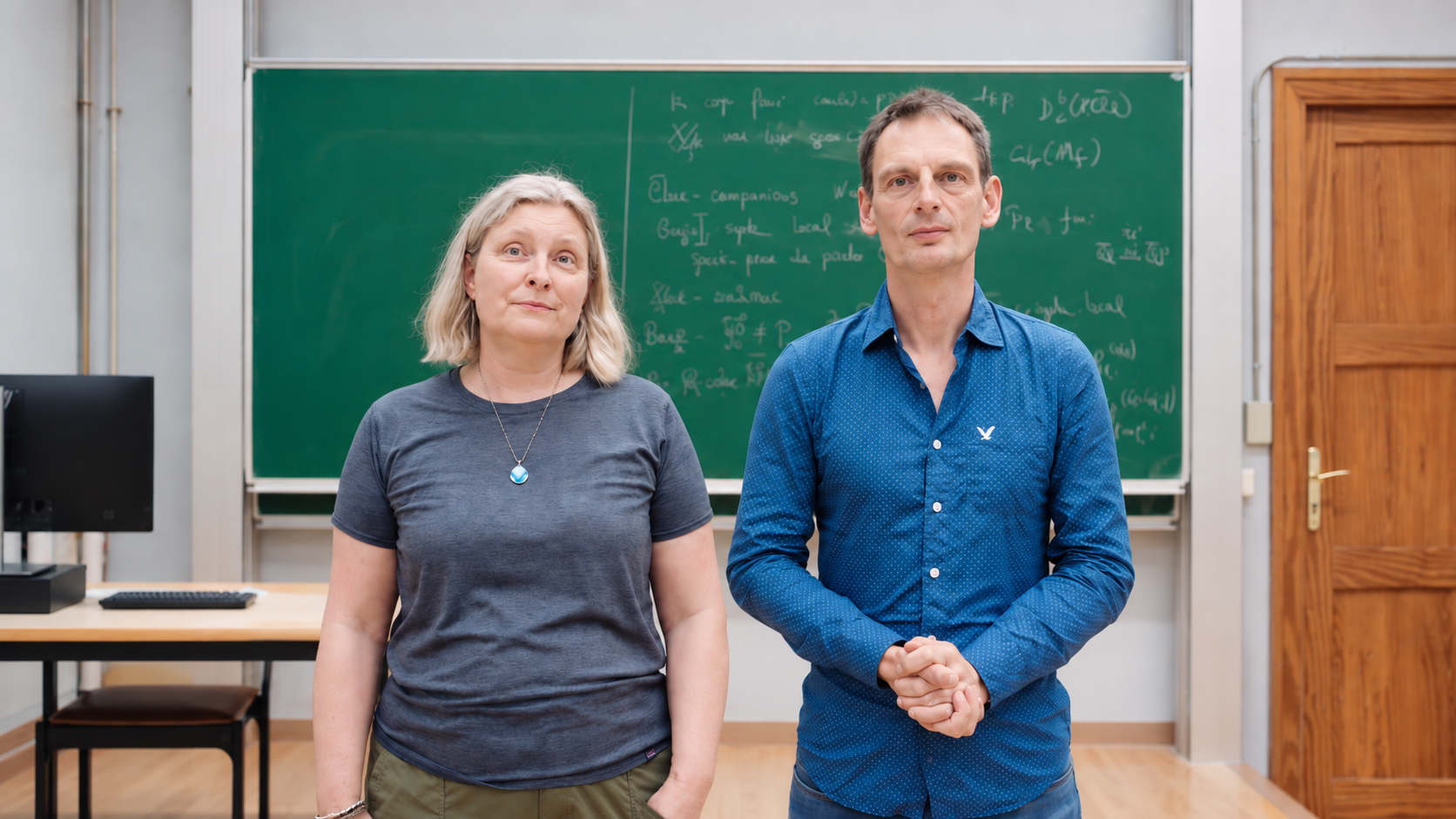
Christophe Ritzenthaler (Université de Rennes) and Rachel Pries (Colorado State University) both work on curves over finite fields: he hunts curves with as many points as possible, she hunts curves that almost never occur. In conversation with the CRM during their...
Call open for the 2027 Ferran Sunyer i Balaguer Prize
The Ferran Sunyer i Balaguer Foundation is accepting submissions for its 2027 prize, which awards 15,000 euros and publication in Birkhäuser's Progress in Mathematics series to an expository monograph on an active area of mathematical research. The deadline is 27...
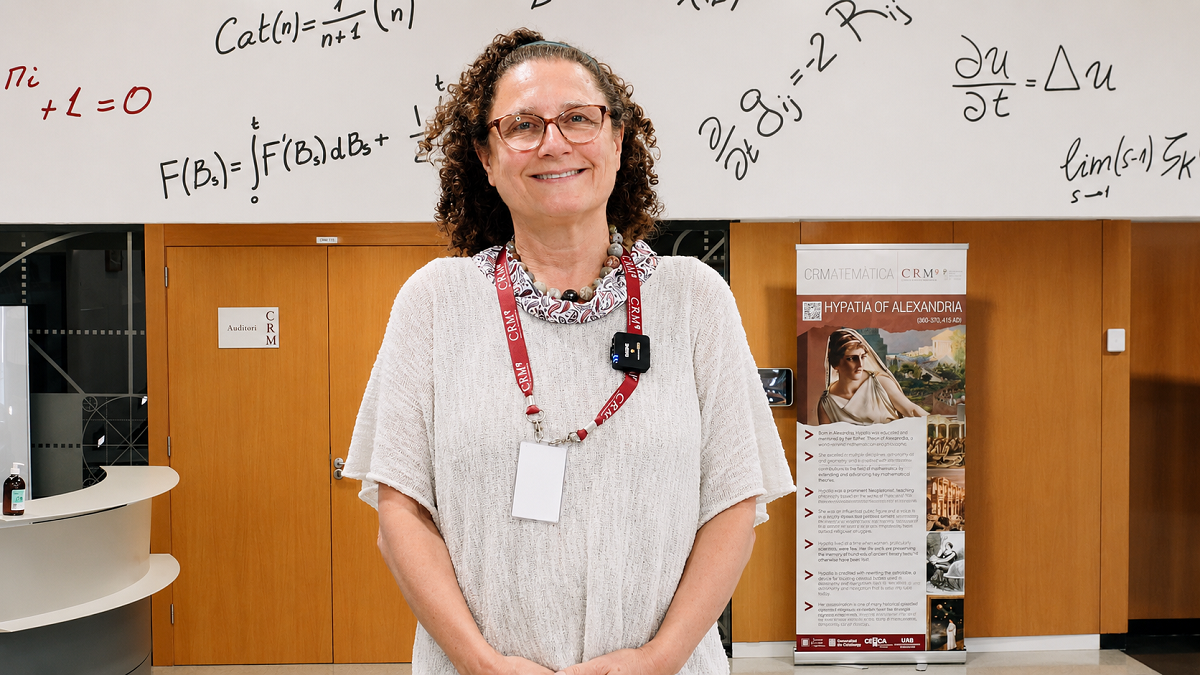
Susanna Terracini delivers the CRM Colloquium 2026
Susanna Terracini (Università di Torino) delivered the CRM Colloquium 2026 on 14 July, presenting a rigidity result for Kepler billiards obtained with Stefano Baranzini, Vivina Barutello and Irene De Blasi. She was at the centre as a member of the CRM Scientific...
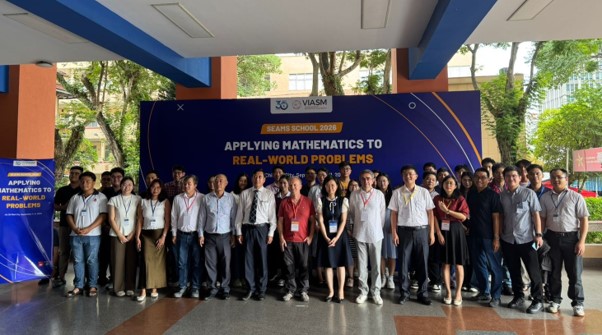
Ho Chi Minh City hosts the SEAMS School on applying mathematics to real-world problems
Students from across the region took courses and worked on group projects at a school co-organised by CRM researcher Tim Myers.CRM CommPau VarelaCRMComm@crm.catGet the latest CRM news and activities in your inbox.Recent newsletters →Between 4 and...

A single ball on a fixed table can compute: Eva Miranda and Isaac Ramos prove that two-dimensional billiards are Turing complete
Eva Miranda (UPC, CRM) and Isaac Ramos (ETH Zürich) show that a point particle bouncing inside a planar table with fixed walls can simulate a universal Turing machine, settling a question Cristopher Moore left open in 1990. The result grew out of a master’s project...