
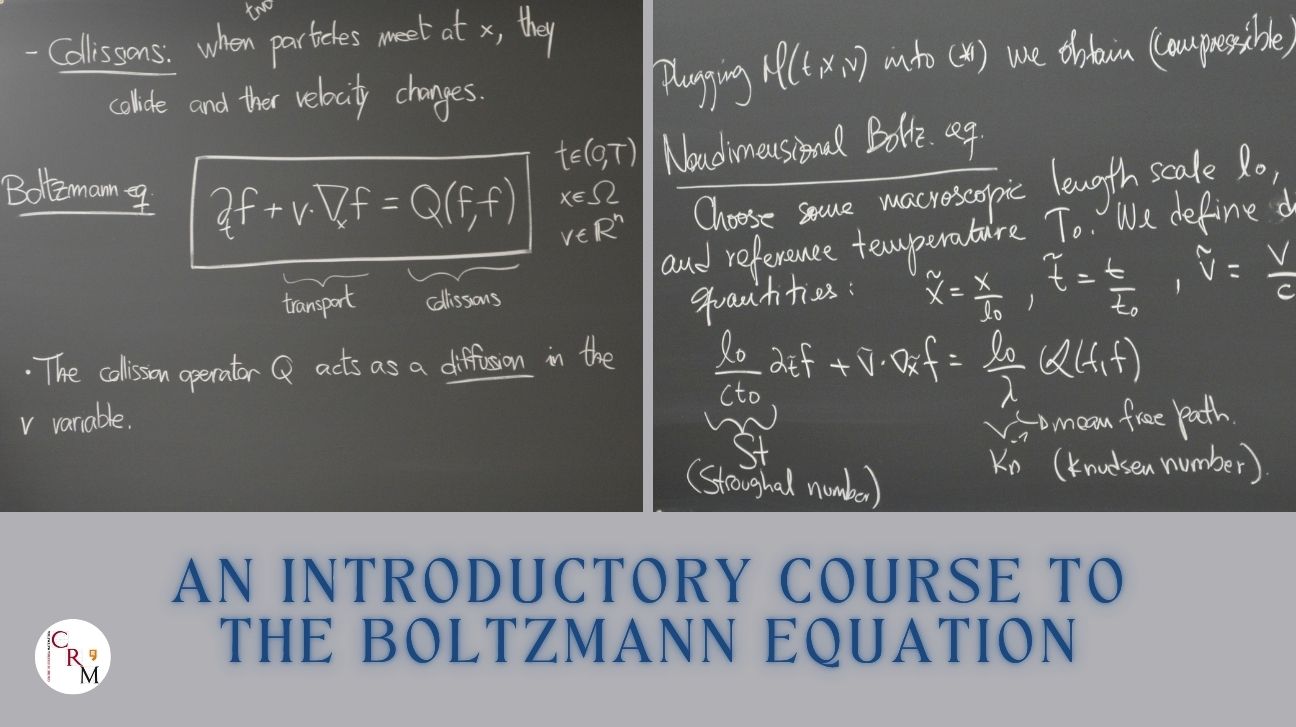
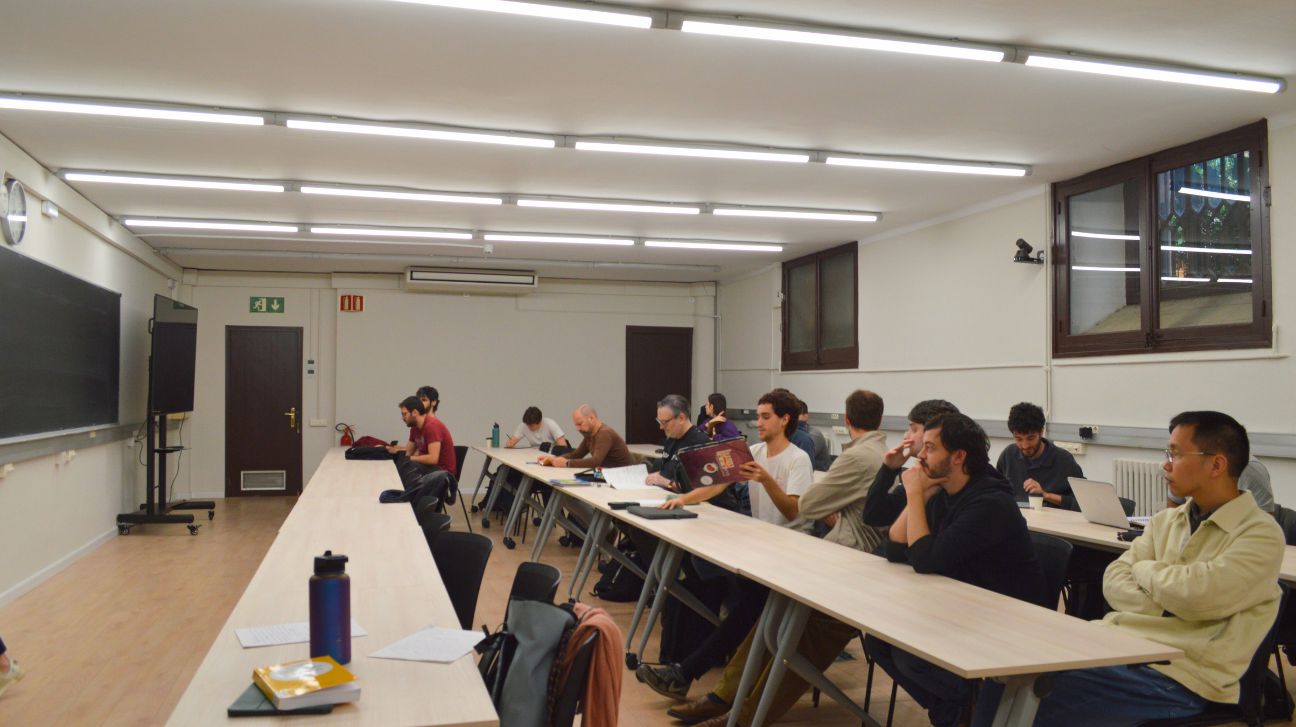
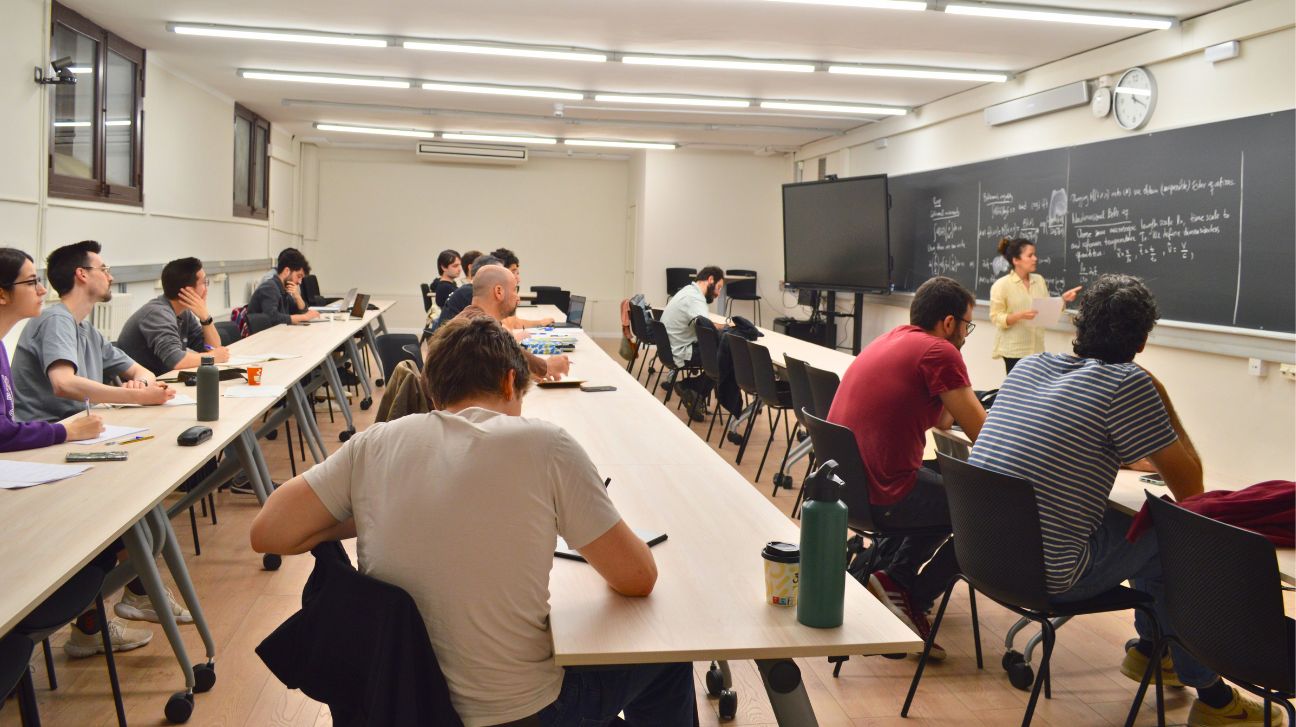
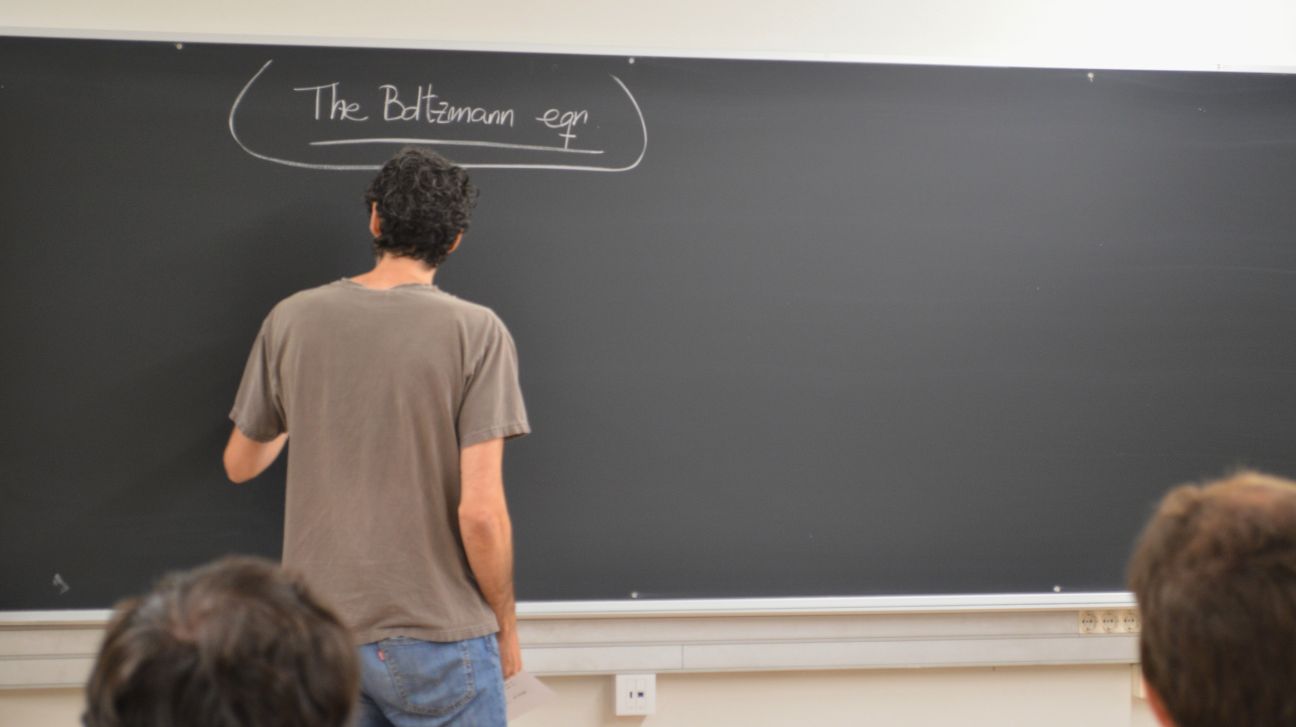
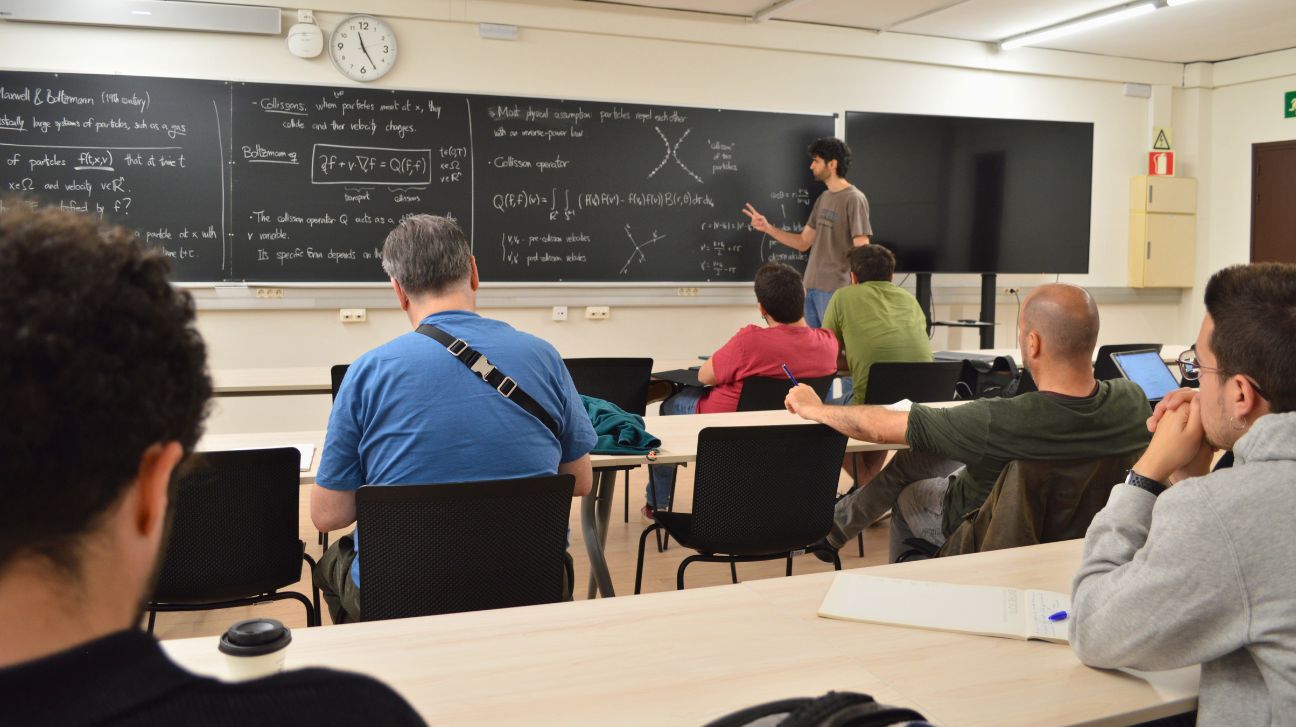
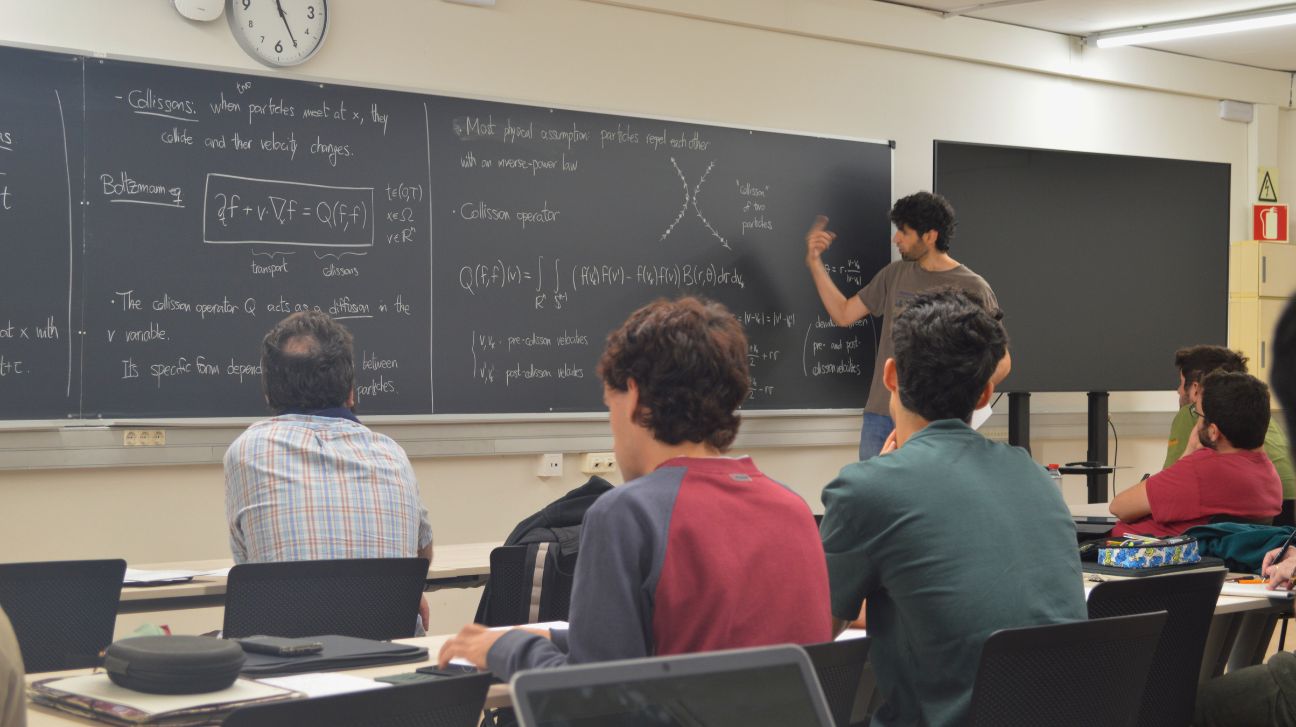
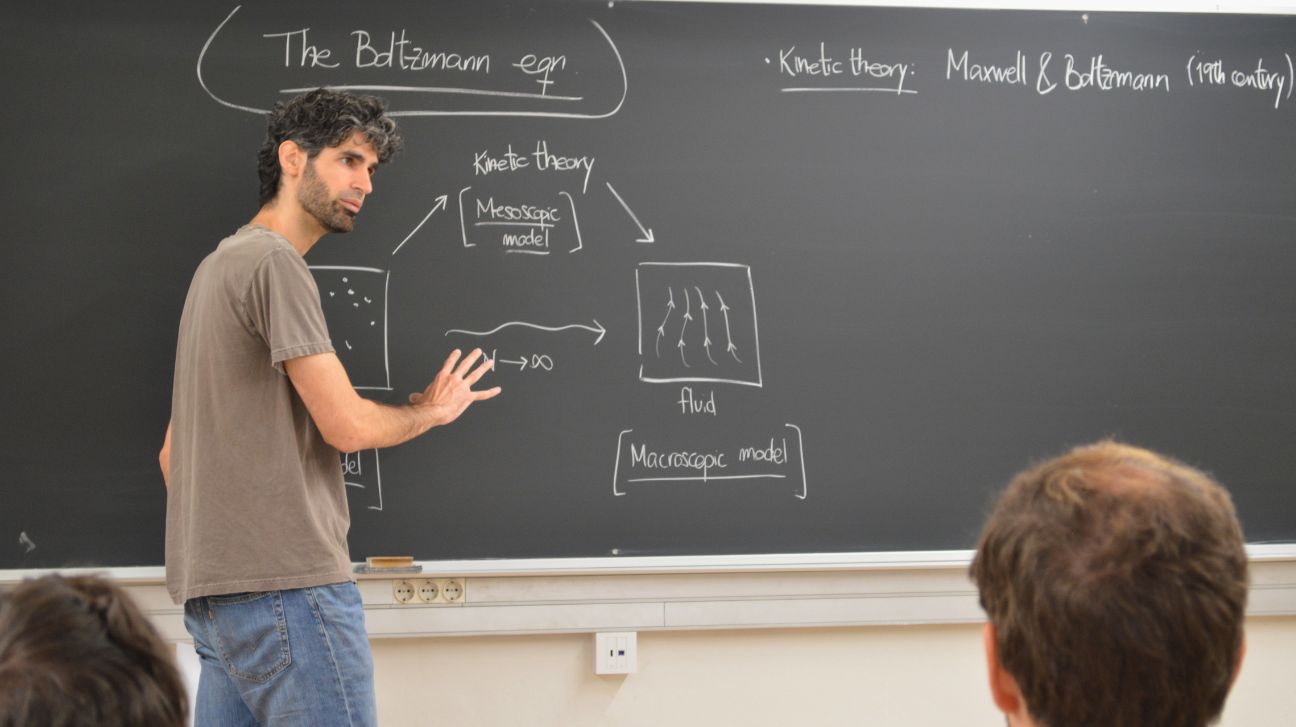
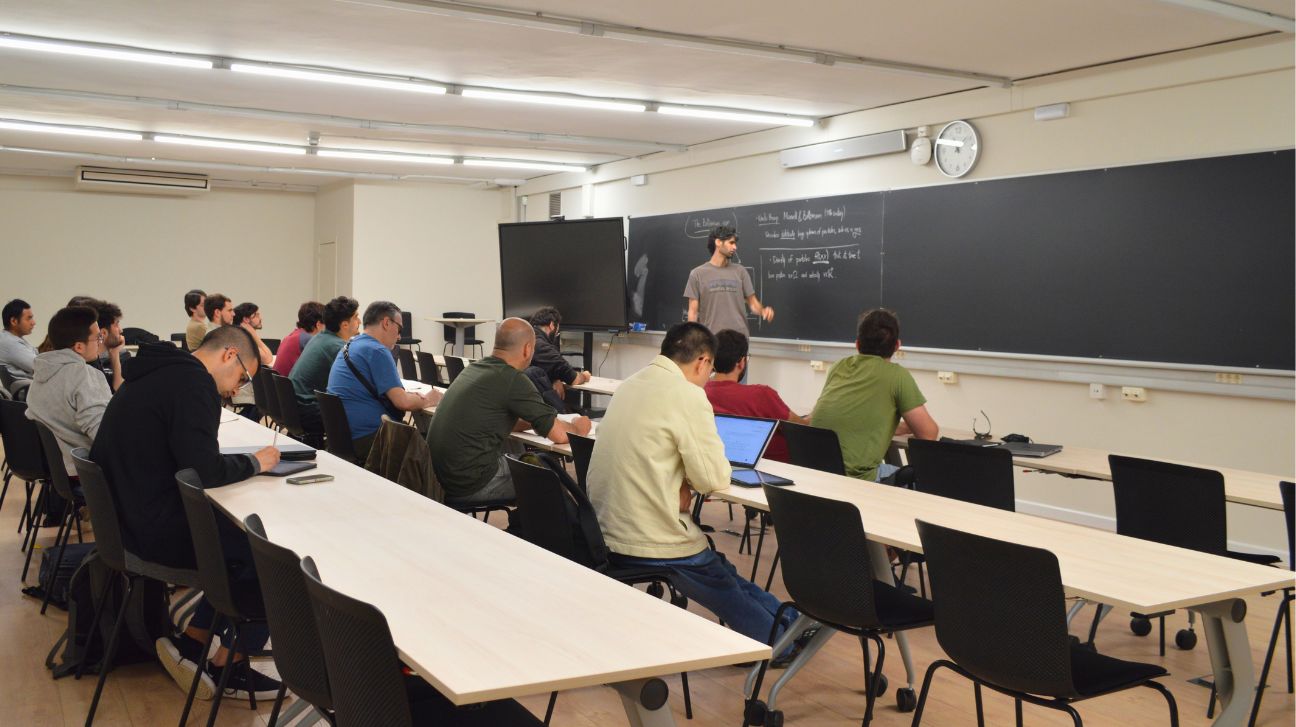
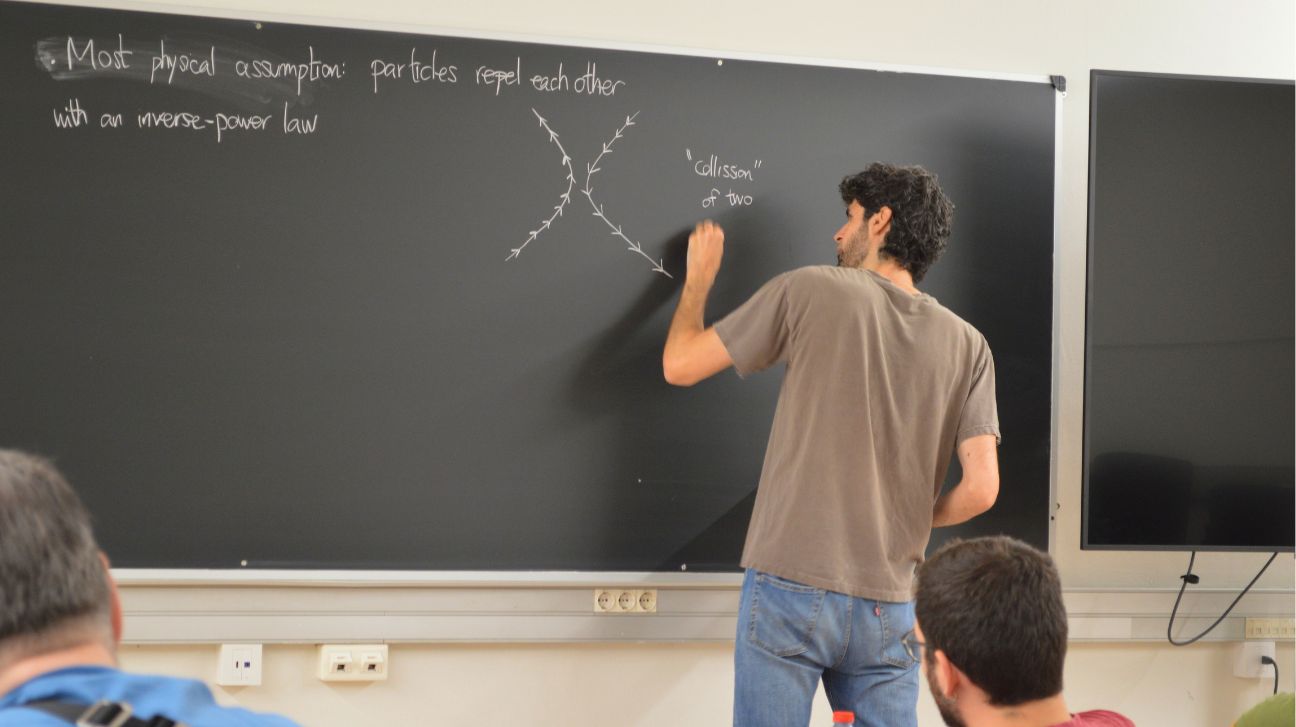
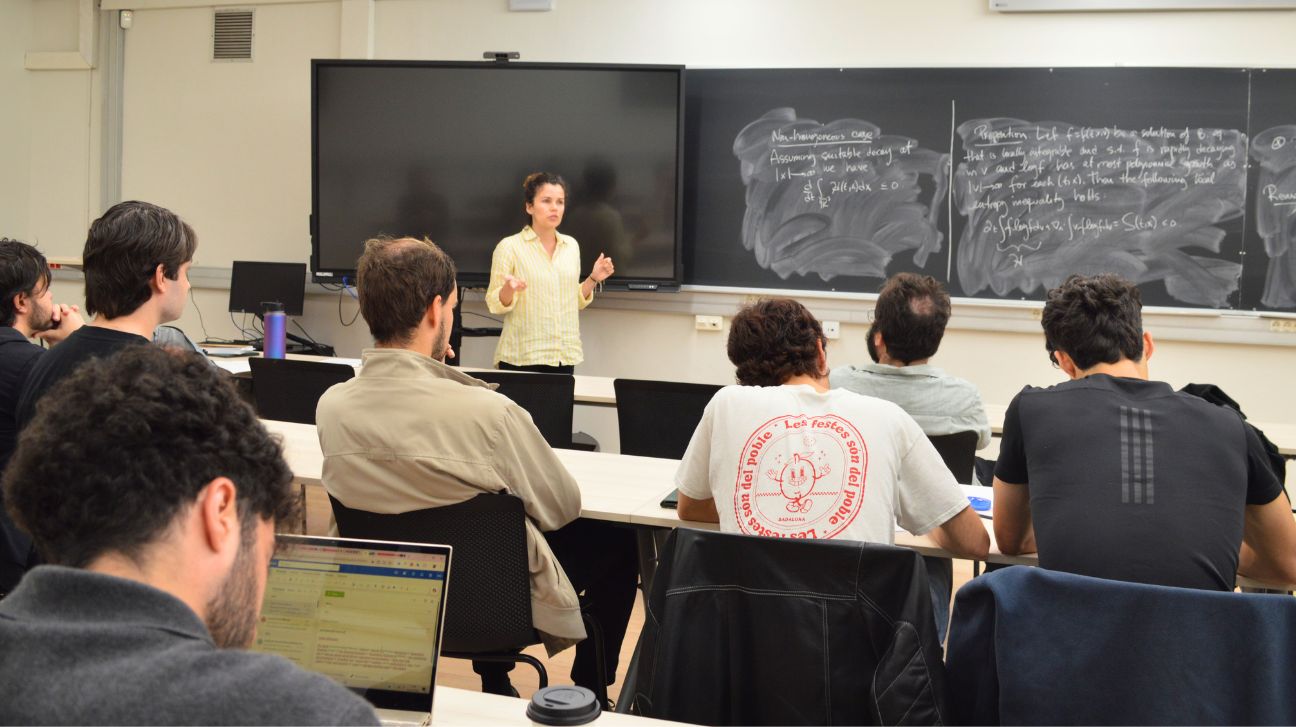
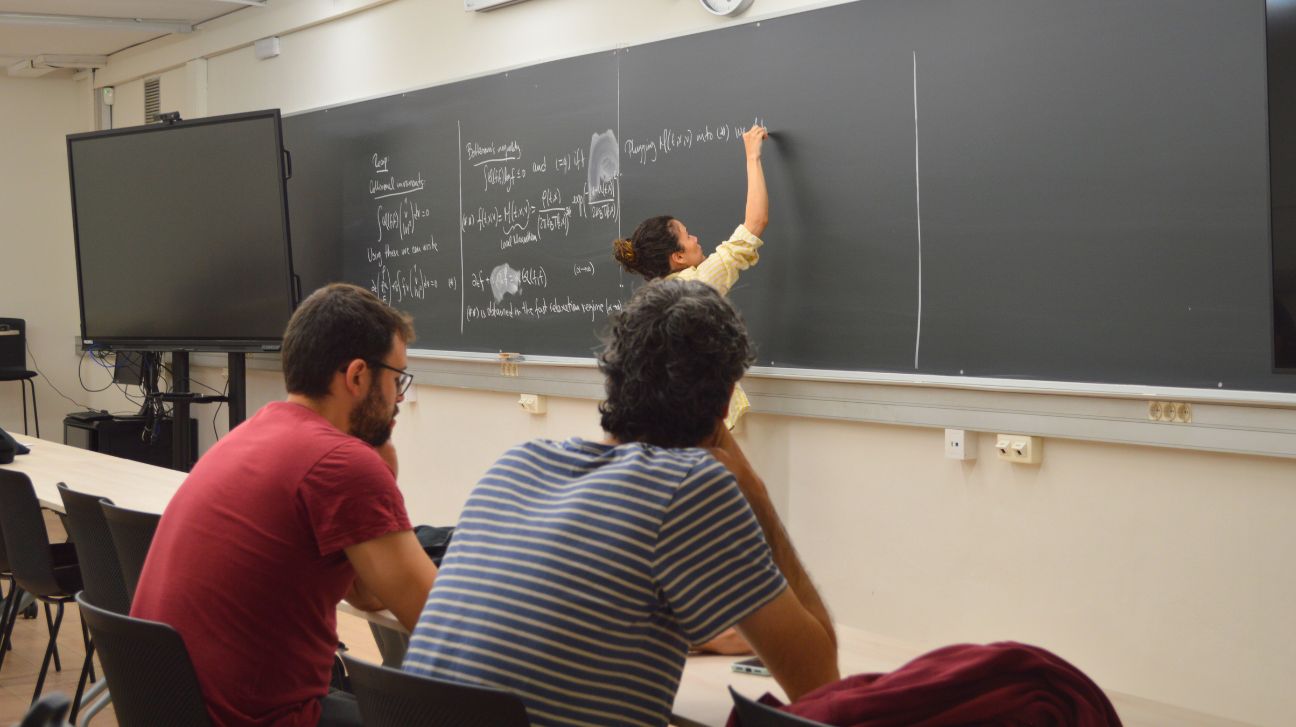
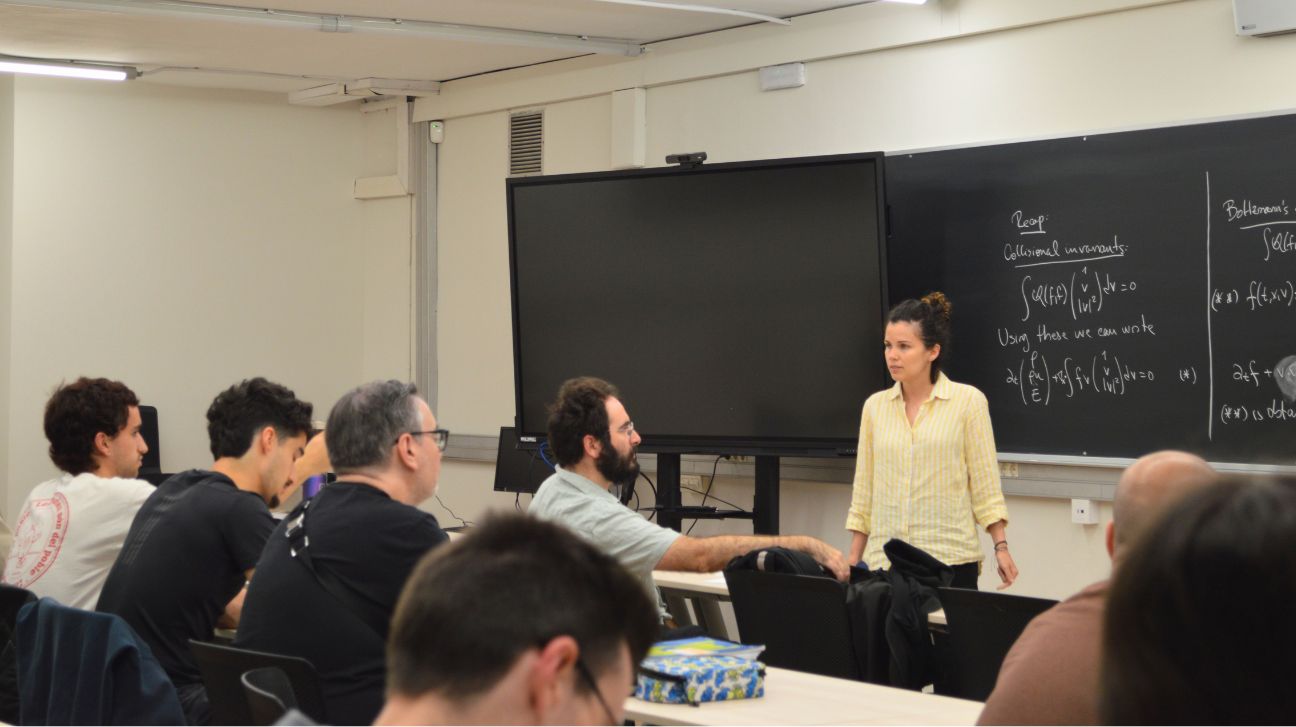
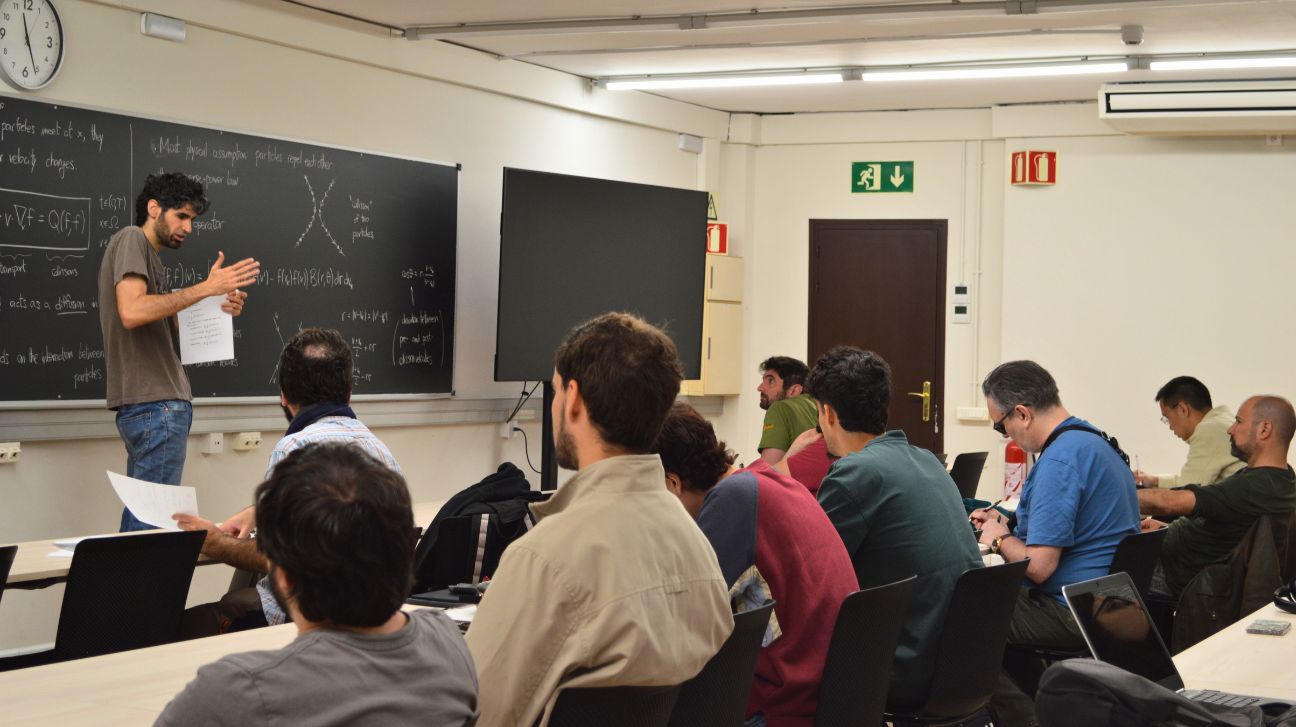
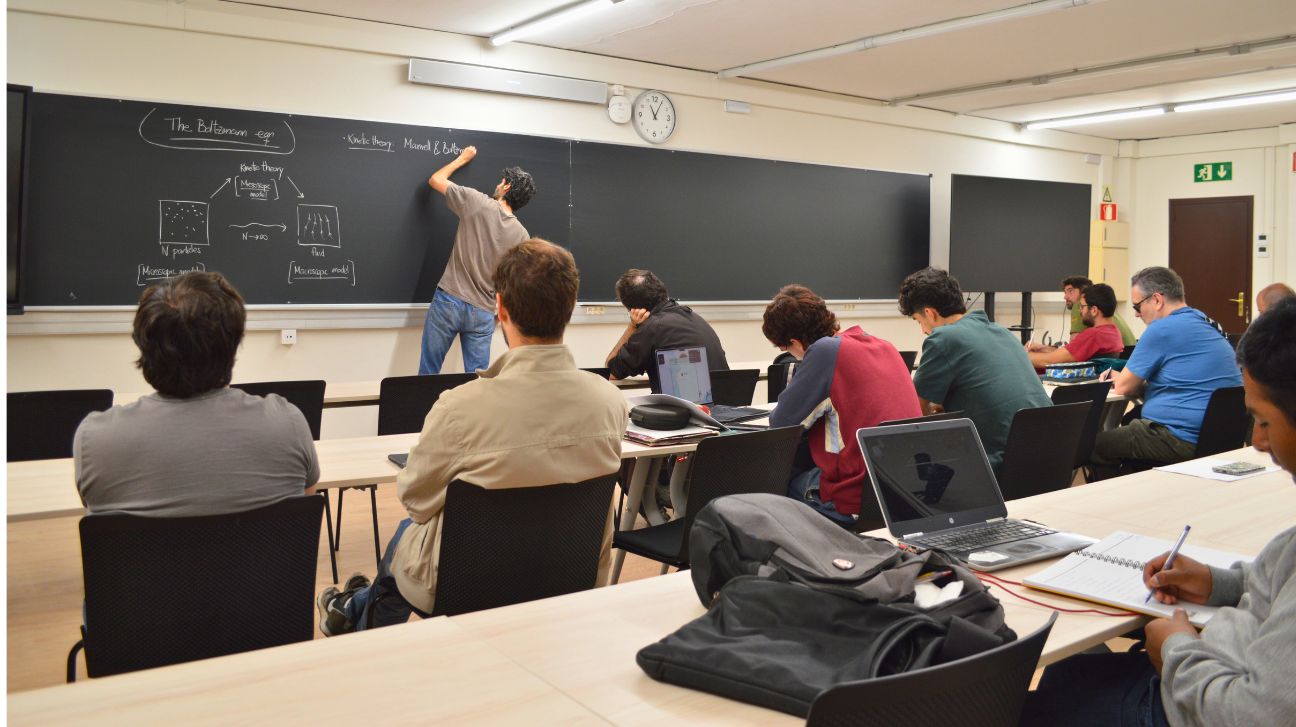
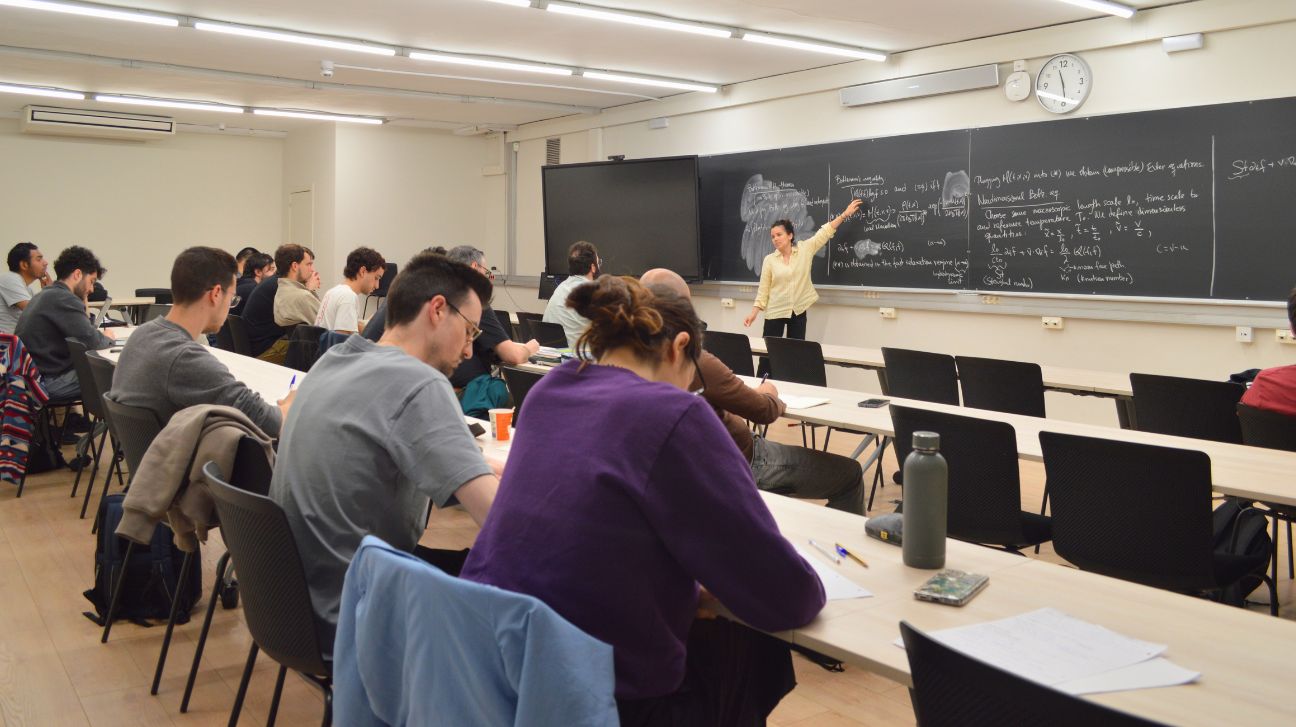
Between April 28 and May 14, 2026, the Faculty of Mathematics at the Universitat de Barcelona hosted the BGSMath course An introductory course to the Boltzmann equation. Over six sessions, the course brought together students and researchers interested in one of the fundamental equations of mathematical physics.
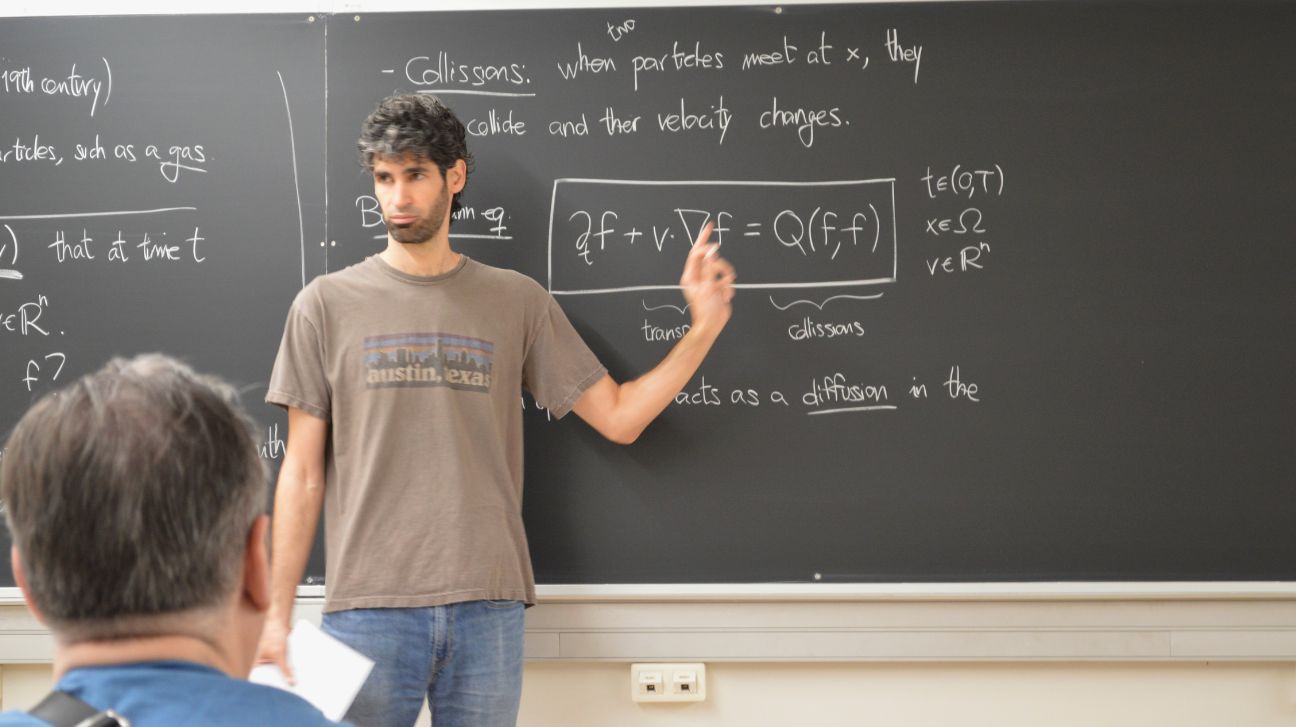
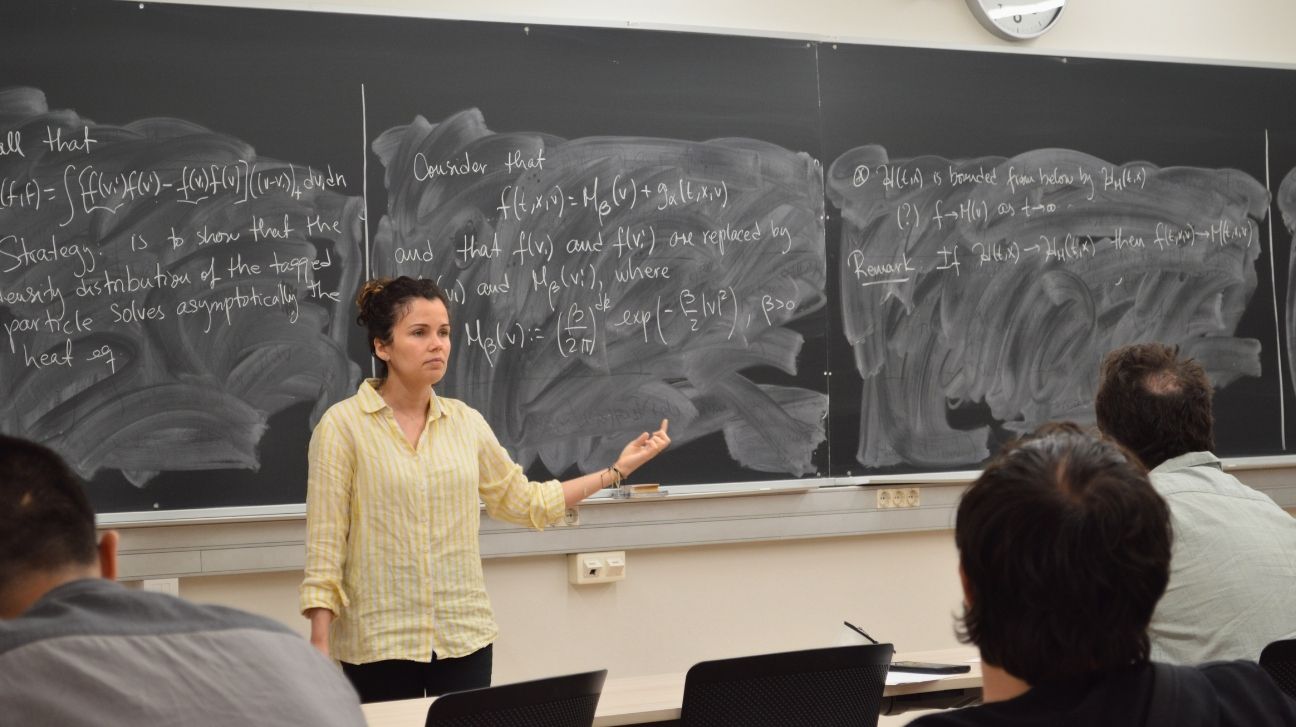
The sessions were led by Gissell Estrada (UPC–CRM), a specialist in the interaction between PDEs and kinetic theory and their interdisciplinary applications, and Xavier Ros-Oton (ICREA–UB–CRM), a renowned expert in partial differential equations, particularly known for his results on free boundary problems and integro-differential equations. Together, they offered an accessible yet rigorous introduction to a topic central to both physics and mathematics.
What is the Boltzmann equation?
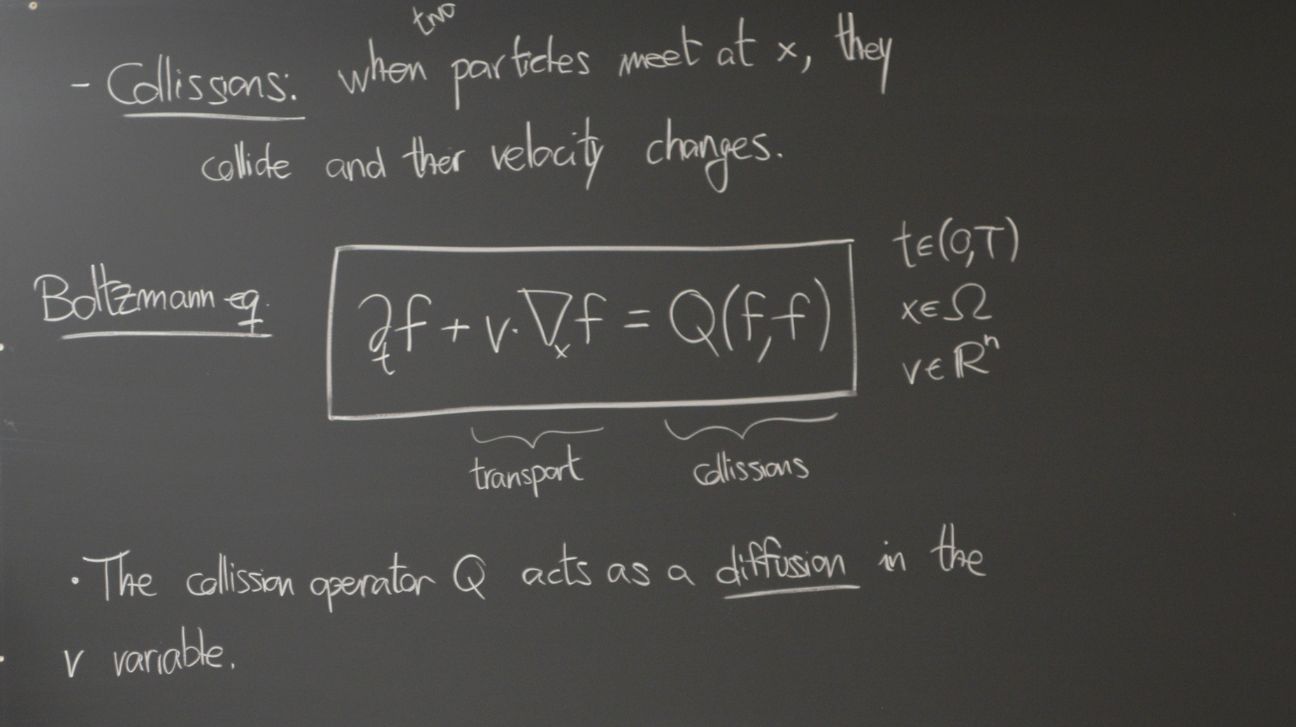
Although its name may sound technical, the Boltzmann equation arises from a very concrete question: how do millions—or even billions—of particles behave collectively when they interact with one another?
Boltzmann’s contribution was both deeply innovative and beautiful: he described the macroscopic world (temperature, pressure, equilibrium) by connecting it to the microscopic behavior (collisions between particles) through a statistical description of the whole system. In doing so, he was able to move from individual dynamics to a continuous description of the system—that is, to its macroscopic behavior.
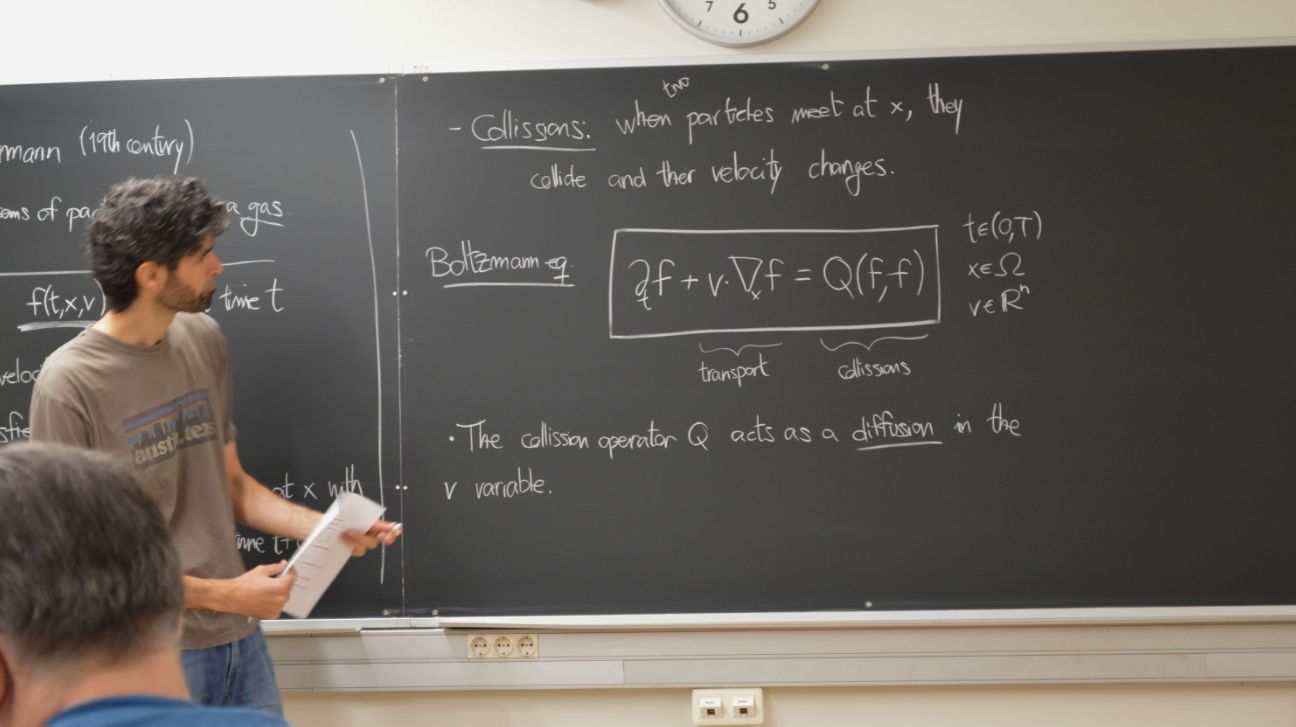
This equation allows us to answer questions such as: how does the distribution of particle velocities evolve? Why does a gas tend toward equilibrium? Where does the irreversibility of time come from in macroscopic systems, if the underlying microscopic laws are reversible? These are profound questions about physical systems that Boltzmann managed to address with remarkable clarity and elegance.
To better understand this idea, we can think of an analogy. Imagine a town. It is made up of individuals with changing, complex, and highly specific relationships: friendships, conflicts, reunions… each interaction is different. Let us focus, for instance, on the relationship between two inhabitants: they may be friends, stop being so for some reason, and later reconnect. This would be an example of an interaction at the microscopic level of the town.
However, when we observe the town from the outside, we do not describe it through each individual relationship, but rather as a whole: with its dynamics, traditions, festivals, and overall character…
The Boltzmann equation does something very similar: it takes the details of these interactions and describes them statistically in order to capture the global behavior of the system. It does not track each particle individually, but instead gathers this set of interactions in a statistical way to provide a coherent picture of the whole.
The core of the course
The course offered a conceptual journey through the main mathematical challenges posed by the Boltzmann equation.
First, its derivation was addressed, starting from systems composed of many interacting particles with a well-defined macroscopic behavior. This approach connects to the famous sixth problem of Hilbert, which seeks to rigorously derive macroscopic physical laws from microscopic dynamics.
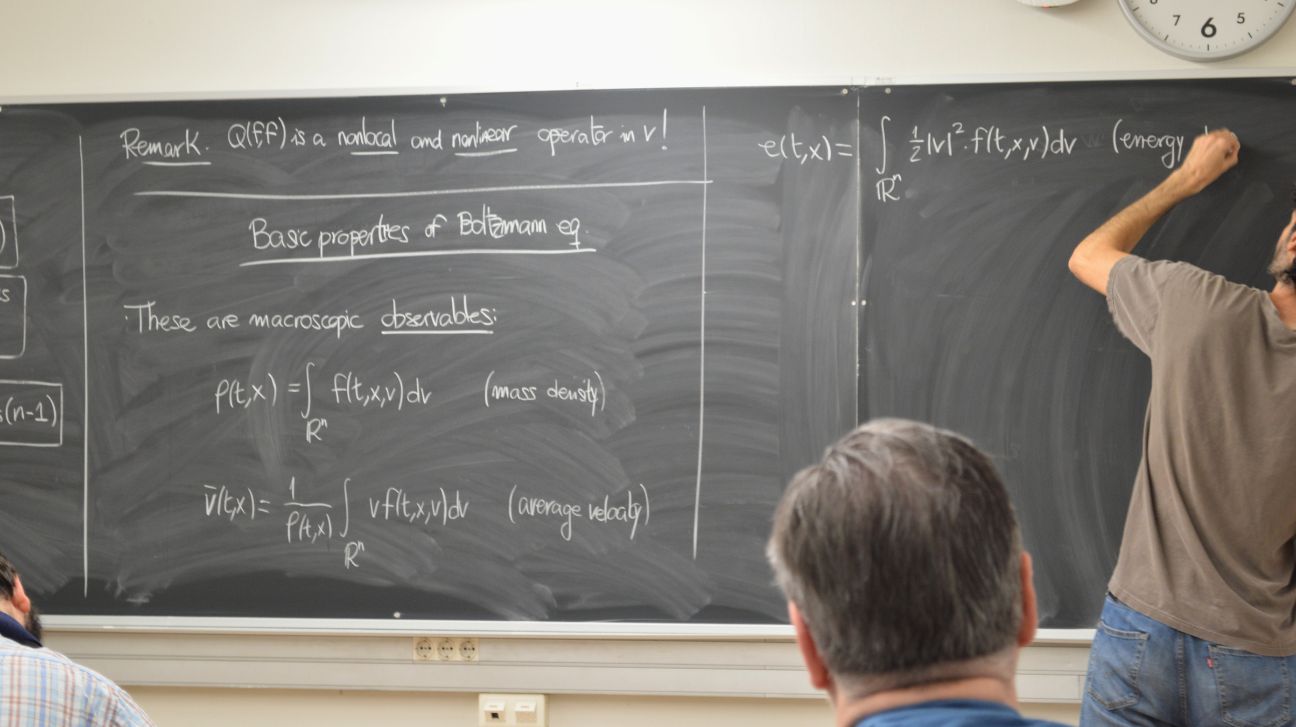
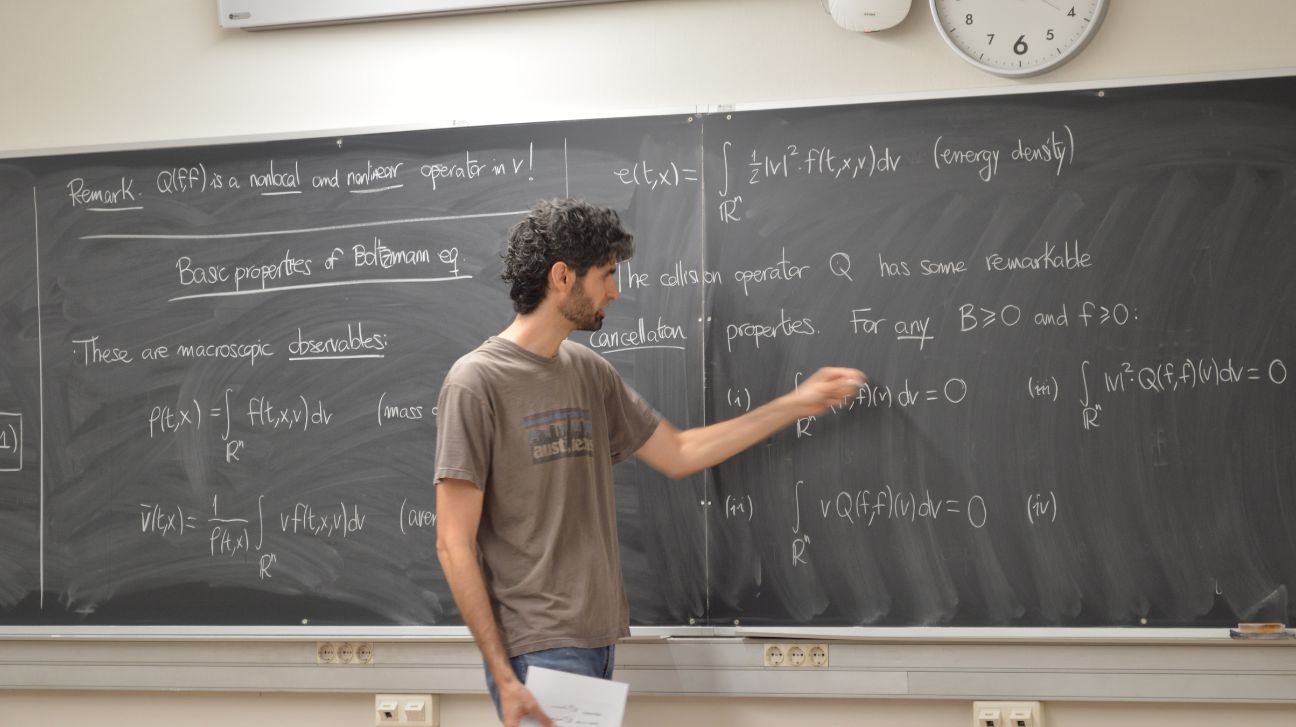
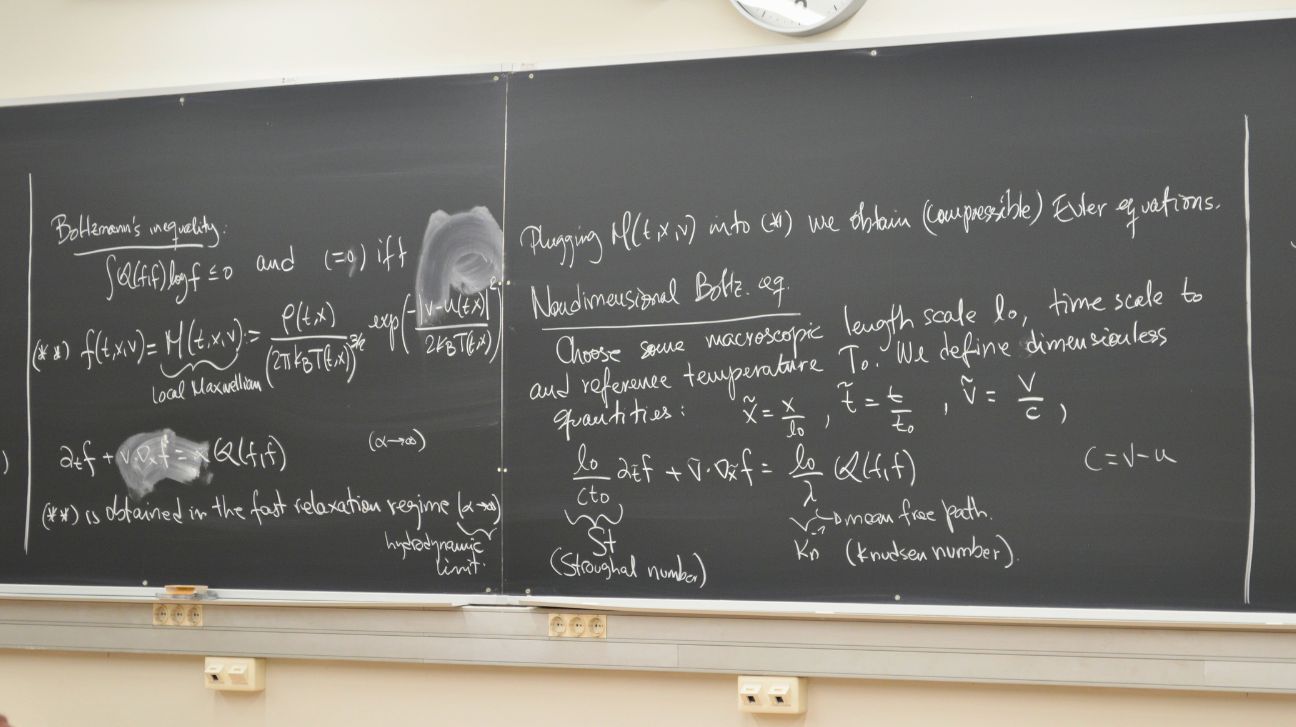
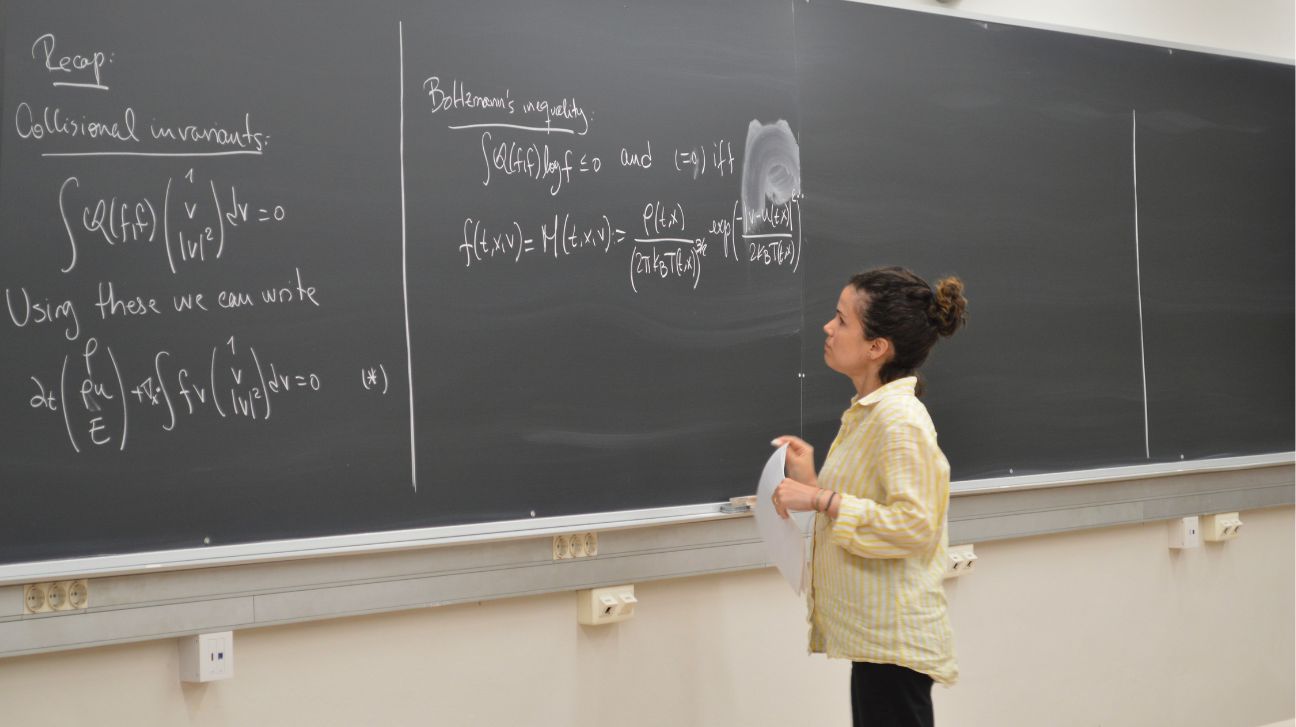
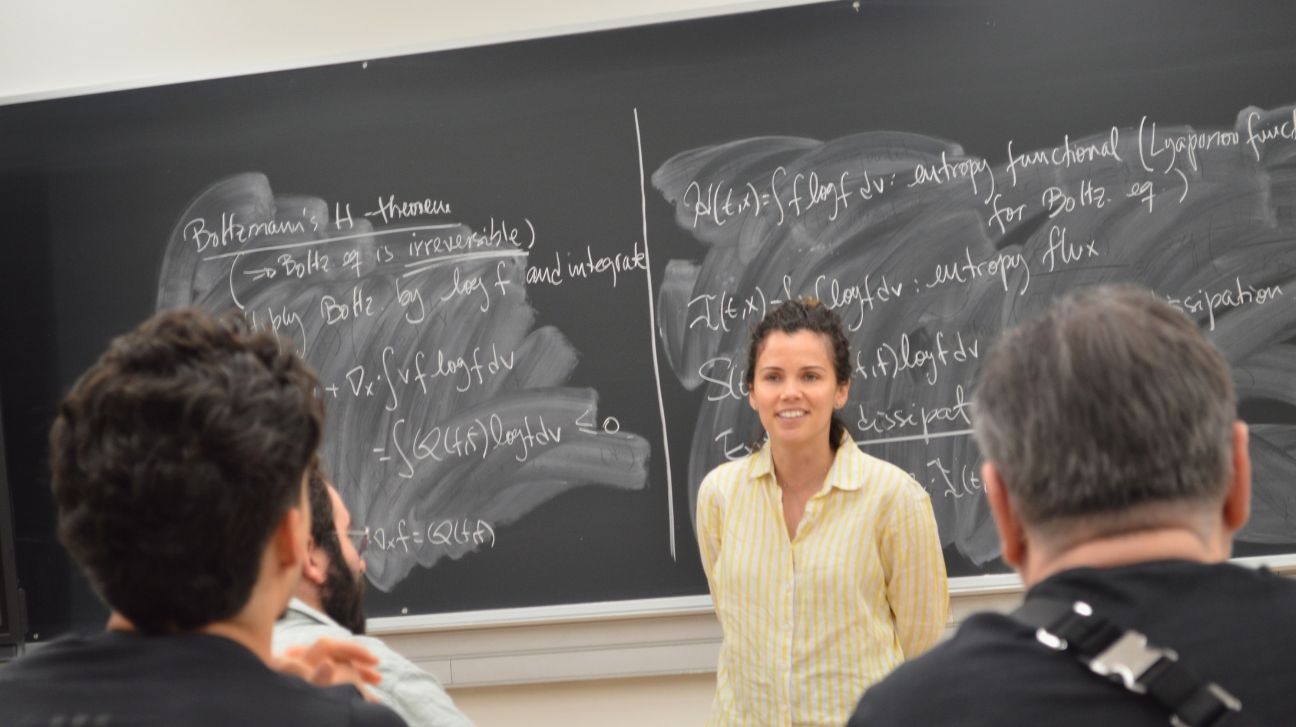
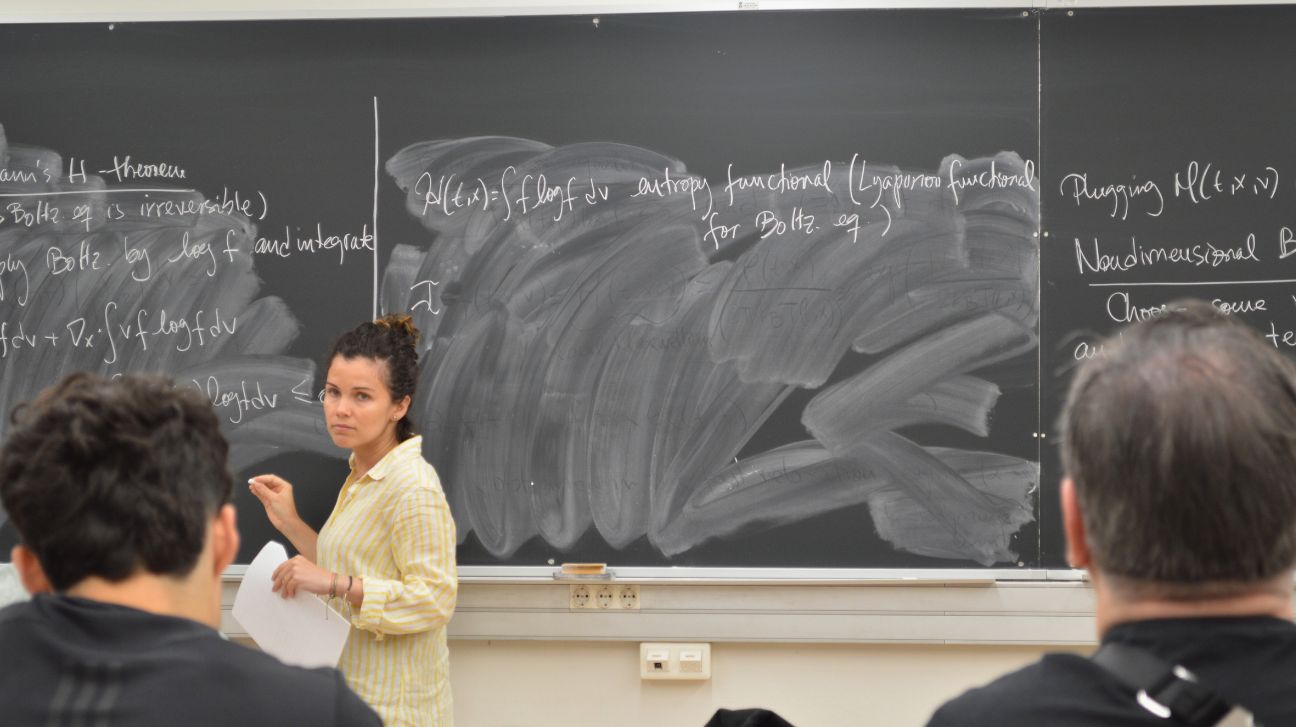
Next, some of its fundamental properties were presented: conservation laws, time irreversibility, the H-theorem—which describes how a system evolves toward equilibrium, independently of microscopic reversibility, introducing a preferred direction associated with the increase of entropy —the Boltzmann collision kernel, and simplified models such as the Kolmogorov equation.
Finally, key aspects of its mathematical analysis were explored: the Cauchy problem (existence, uniqueness, and long-time behavior), the regularity of solutions under certain macroscopic conditions, and some of the open problems that continue to drive research in this field.
Much more than an equation
Beyond its origins in gas physics, the Boltzmann equation now appears in surprising contexts: from biological models to network theory and collective dynamics.
In this sense, the course not only provided a technical introduction, but also an invitation to discover how an idea born in the 19th century remains a key tool for understanding complex systems in the 21st century.
Newsletter
Get the latest CRM news and activities delivered to your inbox
Subscribe now
Recent newsletters →
When the reward comes within reach, the brain changes what it compares
As the tokens piled up, choices got faster and more accurate at the same time. The yardstick for judging each offer had moved.CRM CommPau VarelaCRMComm@crm.catGet the latest CRM news and activities in your inbox.Recent newsletters →Two subjects...

Almost every automaton can be reset with a short word
For a random automaton with n states, a word of about √n log n letters is almost always enough to reset it.CRM CommPau VarelaCRMComm@crm.catGet the latest CRM news and activities in your inbox.Recent newsletters →Picture a conveyor belt carrying...

Exposició ‘Les matemàtiques de Gaudí’

CRM quod erat demonstrandum | 48

ADA: Decoding Brain Signals Misaligned in Time
The study addresses a key limitation of current brain decoding techniques: the difficulty of interpreting internal mental processes whose temporal dynamics vary from trial to trial.Decoding what is happening in a person’s mind from their brain activity is one of the...
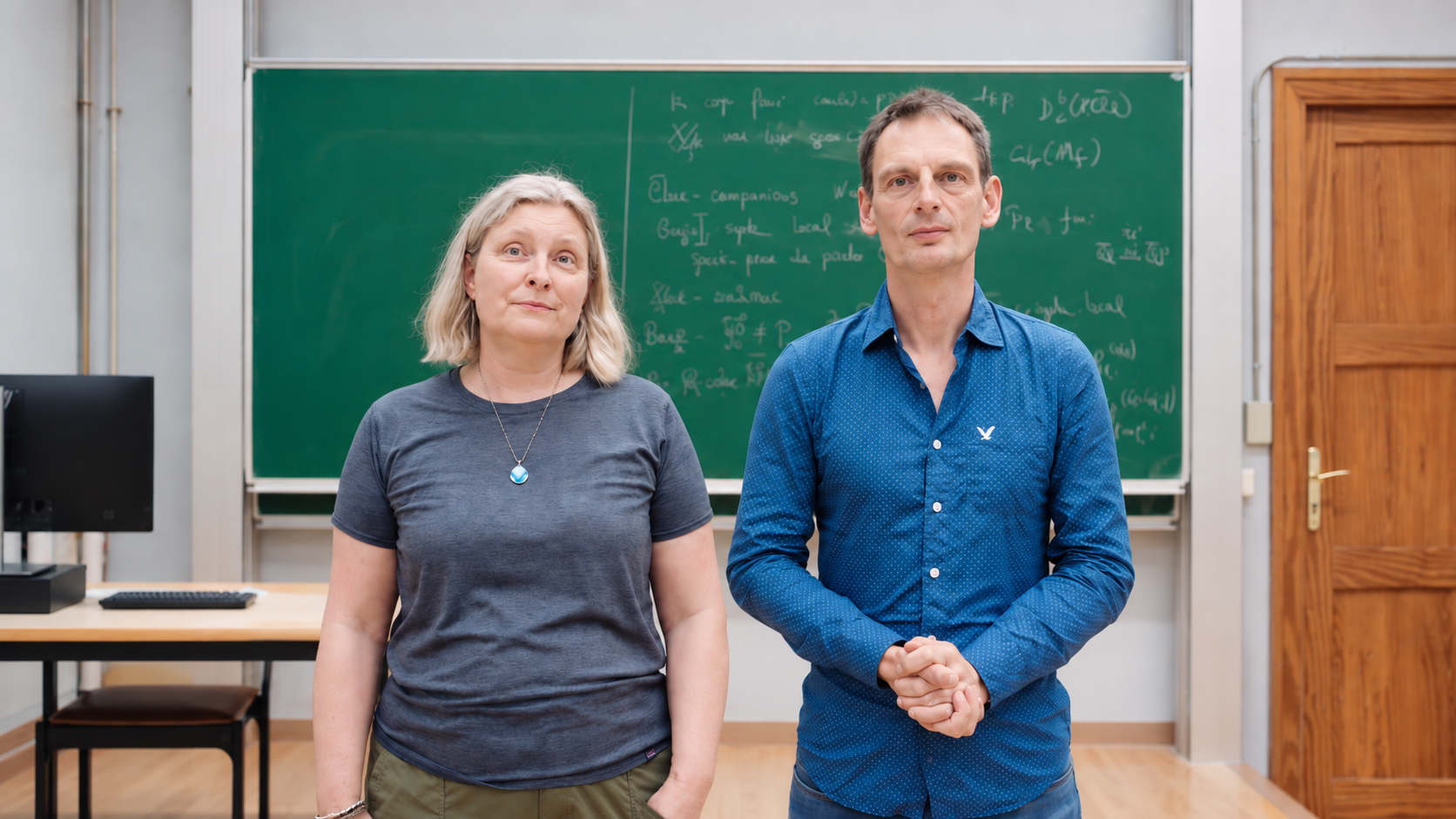
Rare curves, many points: Christophe Ritzenthaler and Rachel Pries on their research and the work around it
Christophe Ritzenthaler (Université de Rennes) and Rachel Pries (Colorado State University) both work on curves over finite fields: he hunts curves with as many points as possible, she hunts curves that almost never occur. In conversation with the CRM during their...
|
|
CRM CommNatalia Vallina
|