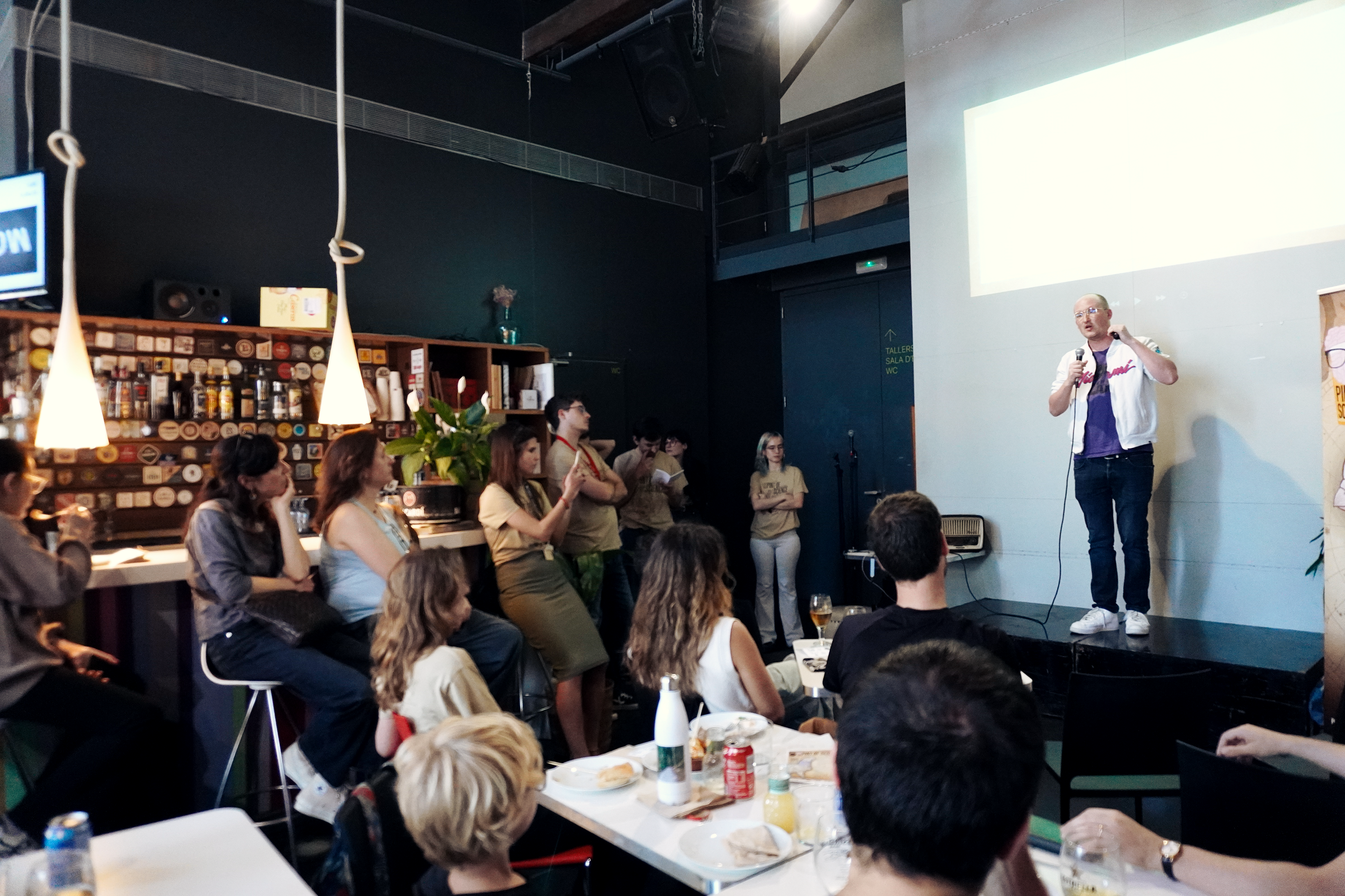
On 20 May, three researchers from the Centre de Recerca Matemàtica spent the evening at two bars in Sabadell, explaining their work to anyone who turned up for a drink. They were taking part in Pint of Science Sabadell 2026, the local edition of an international festival that moves research out of the seminar room and into the pub.
Jens-Bastian Eppler and Tássio Naia, both postdoctoral researchers at the CRM, spoke in the English-language session «Big Questions, Tiny Solutions: Science Across Scales» at L’Estruch Bar. David Romero, head of the CRM’s Knowledge Transfer Unit, joined the session «Connexions invisibles» at The Wild Geese.
The talks
Jens-Bastian’s talk, Why the Brain Loves Categories, started from something we do without noticing: to make sense of the world, the brain sorts it. We file what we see into categories before we have time to think about it. He showed that those categories shift with the situation. Faced with an animal, the brain doesn’t always ask which species it is; often, what matters is whether it’s dangerous. The useful category depends on what you need to know at that moment.
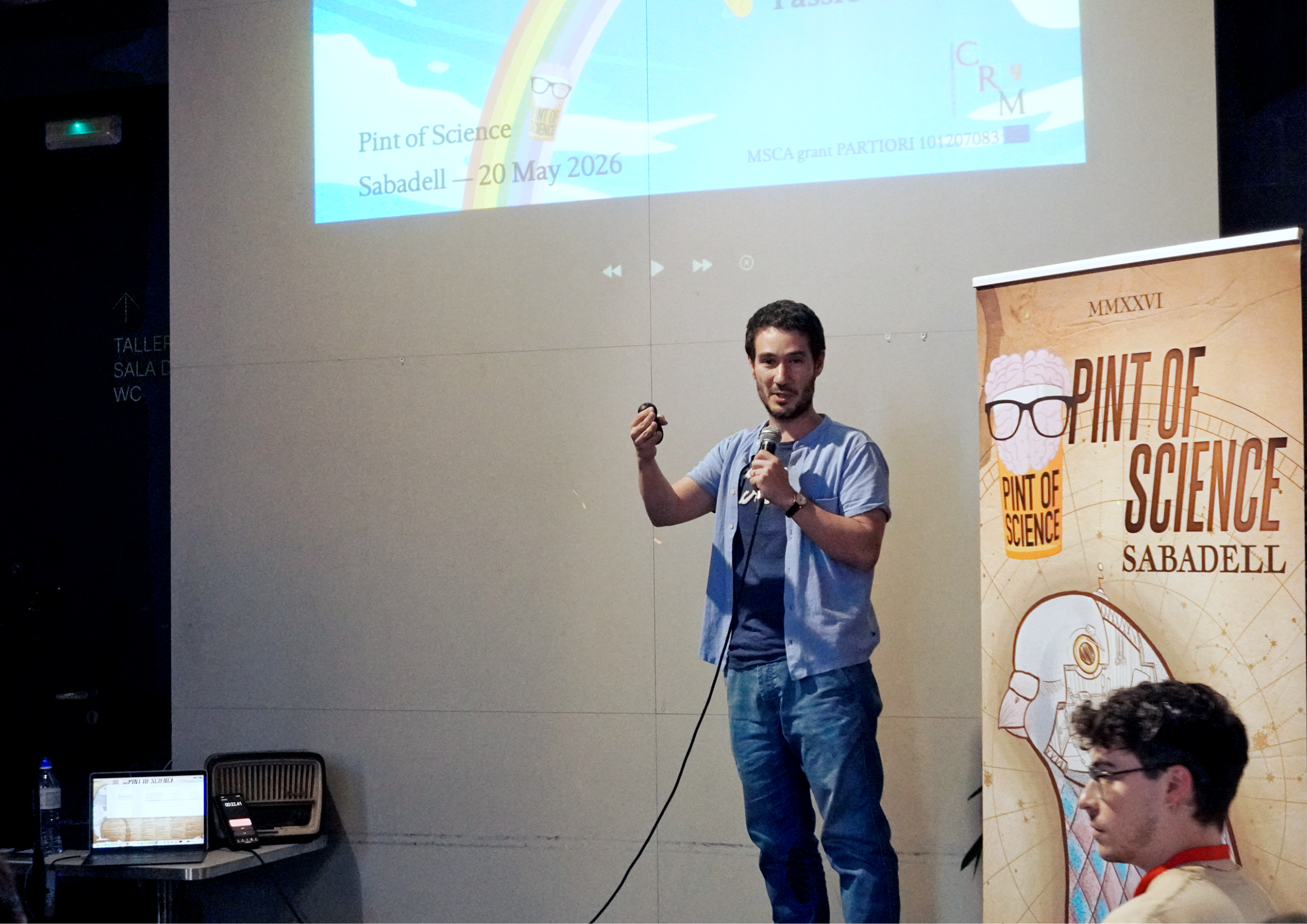
Tássio Tássio Naia during his talk «Colorful questions and seating plans» at L’Estruch Bar, Pint of Science Sabadell 2026.
Tássio’s talk, Colorful questions and seating plans, was about how mathematics describes the relationships between things. Graphs, he explained, help us search efficiently and solve problems of arrangement. One example was the Oberwolfach problem: how to seat a group of people at several round tables, over several dinners, so that everyone ends up sitting next to everyone else exactly once.
David’s talk, «Cuando la montaña decide: cerebro, riesgo y complejidad», presented the work the CRM is doing within NeuroMunt, a cross-border European project on decision-making in the mountains. Rescues in Catalonia’s natural areas have risen by around 20% since the pandemic. Working from EEG signals and from the mathematics of complexity and dynamical systems, he described how that data can reveal something about the way the brain weighs risk and how people decide in real situations.
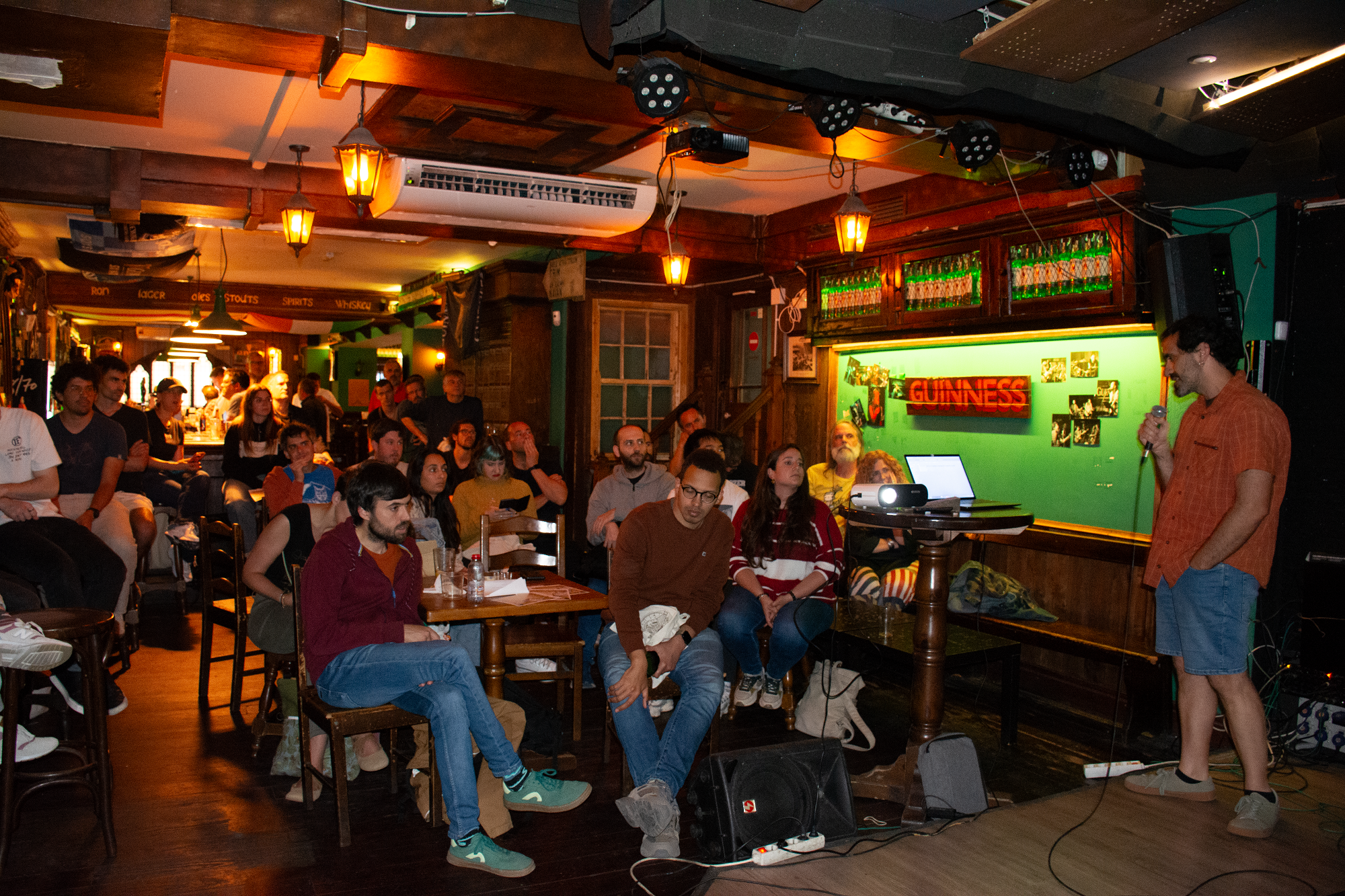
David Romero presenting «Cuando la montaña decide: cerebro, riesgo y complejidad» at The Wild Geese, Pint of Science Sabadell 2026.
Science in a bar tends to lean on the fields that tell easy stories, biology and physics above all. Mathematics is the rarer guest at these things. Three CRM researchers on the Sabadell bill meant it was on the menu, somewhere between the antimicrobial peptides and the energy communities. And moving research out of the seminar room and into a bar matters more than it used to: it puts science in the same room as people who would never sign up for a lecture.
About Pint of Science
The festival began with two neuroscientists at Imperial College London. In 2012, Michael Motskin and Praveen Paul ran an event called «Meet the Researchers», opening their labs to people living with neurodegenerative conditions such as Parkinson’s and Alzheimer’s. It worked well enough that they reversed the idea: if people will come to the lab to meet scientists, why not take the scientists to where the people already are? The first Pint of Science festival ran in May 2013, in three British cities.
By 2026, it reaches 27 countries across five continents, with Australia opening the three-day relay each May. In Spain, this was the eleventh edition: more than 1,300 researchers in 114 towns and cities, among them 29 rural areas taking part for the first time. Sabadell held its second edition, tripling its venues to three bars and putting on 43 talks, with a different language in each bar each night.
The Sabadell edition is run by a local committee, with the CRM among the collaborating institutions alongside the Universitat Autònoma de Barcelona (UAB), the Institut de Ciència de Materials de Barcelona (ICMAB-CSIC), the Institut Català de Nanociència i Nanotecnologia (ICN2), the Computer Vision Center (CVC), the ICTA-UAB and the Institut Català de Paleontologia (ICP). Full programme: pintofscience.es/events/sabadell
Newsletter
Get the latest CRM news and activities delivered to your inbox
Subscribe now
Recent newsletters →
When the reward comes within reach, the brain changes what it compares
As the tokens piled up, choices got faster and more accurate at the same time. The yardstick for judging each offer had moved.CRM CommPau VarelaCRMComm@crm.catGet the latest CRM news and activities in your inbox.Recent newsletters →Two subjects...

Almost every automaton can be reset with a short word
For a random automaton with n states, a word of about √n log n letters is almost always enough to reset it.CRM CommPau VarelaCRMComm@crm.catGet the latest CRM news and activities in your inbox.Recent newsletters →Picture a conveyor belt carrying...
Exposició ‘Les matemàtiques de Gaudí’
CRM quod erat demonstrandum | 48

ADA: Decoding Brain Signals Misaligned in Time
The study addresses a key limitation of current brain decoding techniques: the difficulty of interpreting internal mental processes whose temporal dynamics vary from trial to trial.Decoding what is happening in a person’s mind from their brain activity is one of the...
|
|
CRM CommPau Varela
|