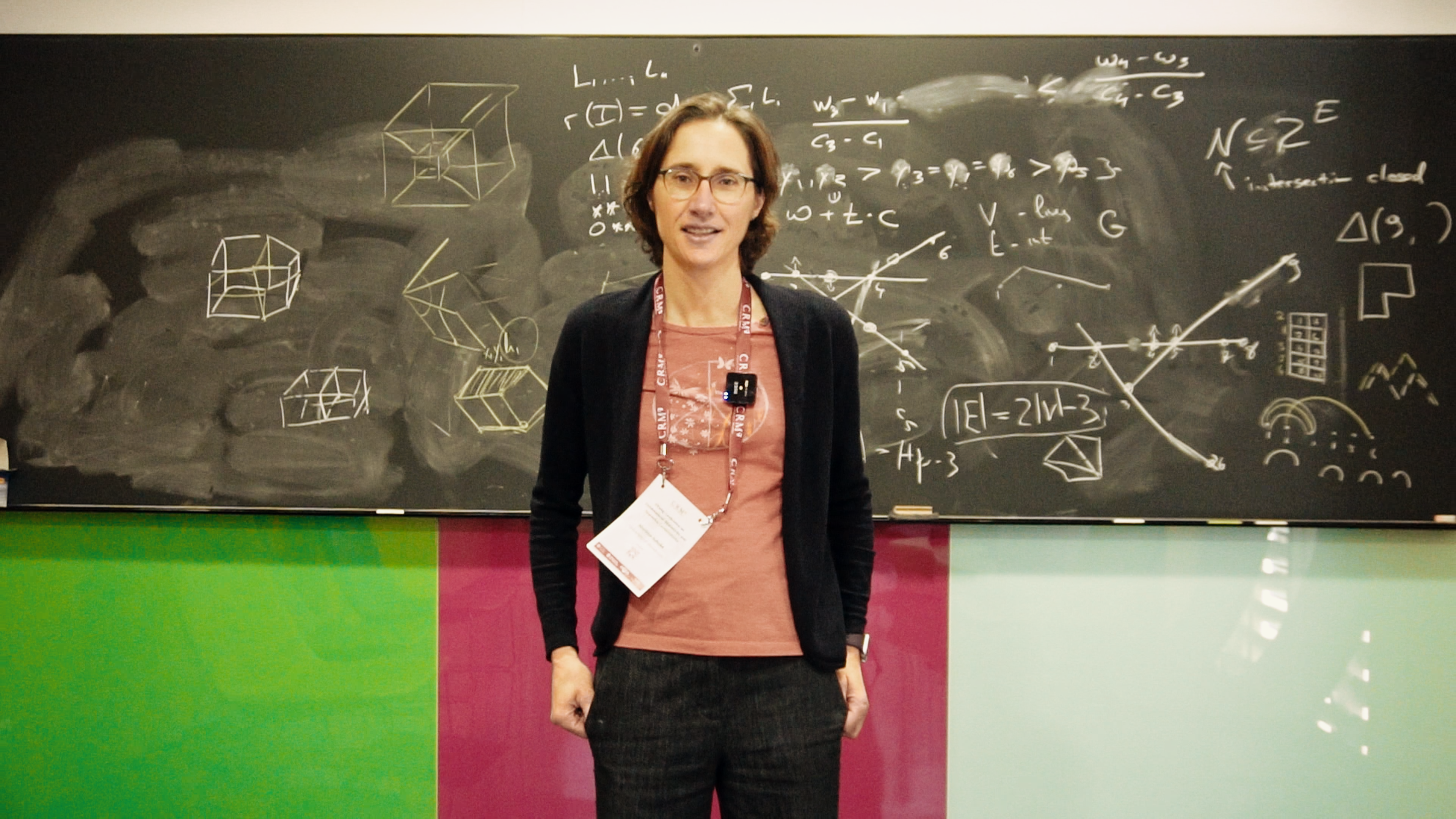
The Centre de Recerca Matemàtica recently hosted a research programme on Combinatorial Geometries and Geometric Combinatorics, focusing on the overlap between polytopes and matroids. Martina Juhnke, a member of the scientific committee, reflects on how this programme prioritized collaboration, allowing postdocs and students to build the professional networks and broad expertise required in a rapidly moving field.
Martina Juhnke still has friends from her first summer school. She meets them at conferences, years later, and the connection holds. It is a detail that anchors her view of this autumn at the Centre de Recerca Matemàtica (CRM); two months of research, collaboration, and the social architecture of mathematics.
From October through November, the CRM hosted an intensive research programme on Combinatorial Geometries and Geometric Combinatorics. Juhnke, a professor of discrete mathematics at the University of Osnabrück and member of the scientific committee, came to Barcelona for the closing conference. What she saw confirmed a long-held belief: research centres are not just venues for solving problems. They are where young mathematicians learn to work together, take on responsibility, and build the relationships that shape careers.
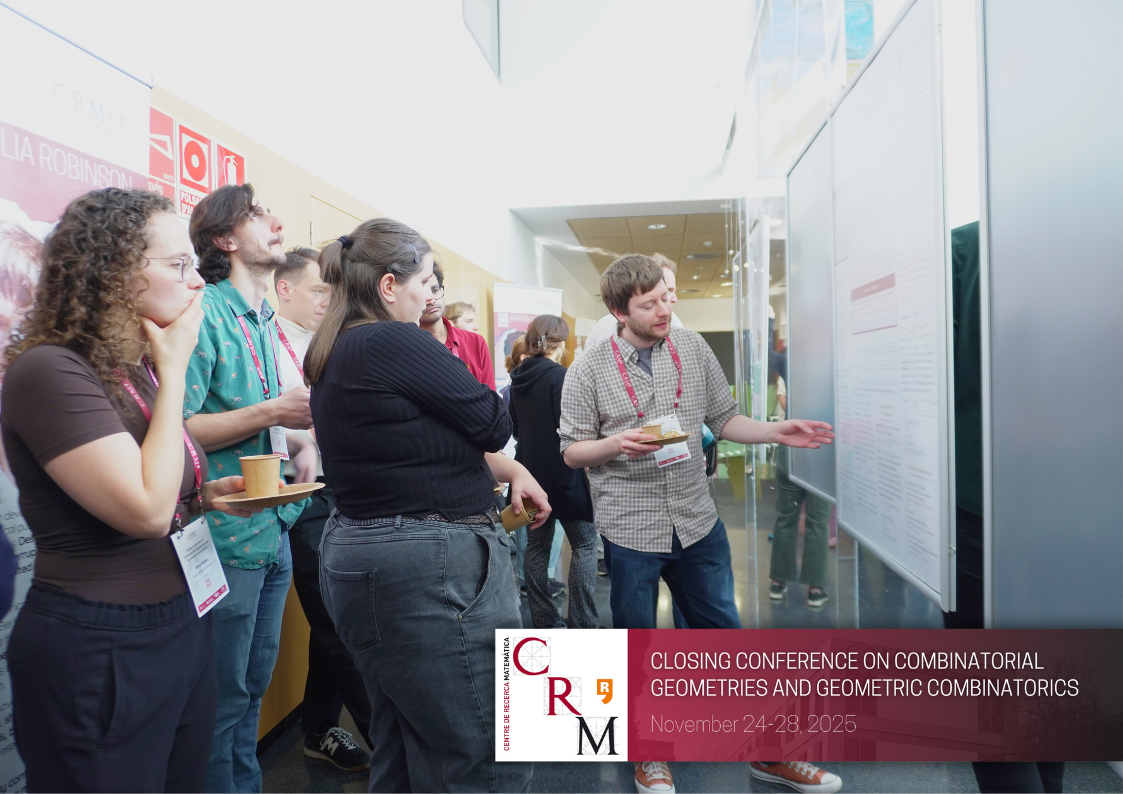
“The goal was to bring them together,” Juhnke says, describing the design. “To have time, to do research together, to have collaboration time, to get to know new projects, to have contact with senior researchers, and also just have a great time.” The structure was deliberate. After preliminary sessions on polytopes and oriented matroids, a two-week research school introduced the field’s core topics through advanced courses. Then came five weeks of collaborative research projects and seminars. The programme closed with a conference where participants presented their progress.
For the postdocs who led research groups, it was a chance to take responsibility for a team, a factor when applying for faculty positions. For PhD and master’s students, it was an immersion in how mathematics actually gets done: not alone in an office, but in conversation, at a blackboard, or over coffee.
“If someone comes who just wants to work alone, then maybe he’s at the wrong place.”
Juhnke is frank about the selection criteria. Scientific qualification mattered, but so did a willingness to collaborate. “If someone comes who just wants to work alone, then maybe they’re at the wrong place.” Gender balance and diversity were considered throughout for participants, visitors, and speakers. The mathematical focus reflected a shift Juhnke sees across combinatorics. The programme’s two branches, geometric combinatorics, where polytopes play a central role, and combinatorial geometries, which deal with matroids, used to feel more distinct.
“Basically, a matroid is a polytope with some specific properties.” The boundaries have blurred. Polytopes appear in optimization, algebra, statistics, theoretical physics, and topology. Juhnke notes a saying often attributed to the field: “Polytopes want to be everywhere.” Matroids generate combinatorial objects and give rise to geometry. “I don’t think that one can separate polytopes and matroids anymore,” Juhnke says. “Synergies just arise naturally.”
This naturalness showed up in the research projects. Topics had to be accessible but also current. The result was a programme responsive to where the field is moving. And the field is moving fast. Juhnke describes it as “a quickly emerging field,” which she sees as an opportunity for young mathematicians. There are plenty of open problems, and as they are solved, new directions open. But this requires a shift in how researchers prepare.
“It’s not enough to be a specialist in just one area,” she says. “It’s not enough to just know something about polytopes. You should also know a lot about matroids.” She cites work in theoretical physics where solving problems requires knowledge across multiple areas. “The younger generation really have to become broad and have broad knowledge.” This is where research centres like the Centre de Recerca Matemàtica become necessary. These spaces provide time to focus without teaching obligations and offer a community to researchers from smaller universities who might otherwise work in isolation.
Before the interview ended, Juhnke added: “I would like to congratulate the organizers, and also all the participants in this programme, for the huge success of this programme, because I think they really achieved a lot. I think everybody can just be proud of themselves.”
It loops back to the friends from that first summer school. The theorems and proofs matter, but so does the structure that supports them: the postdocs learning to lead and the students finding collaborators. If polytopes want to be everywhere, it seems mathematicians do too; at least the ones who have learned that the work goes better when you are not doing it alone.
|
|
CRM CommPau Varela
|
When the reward comes within reach, the brain changes what it compares
As the tokens piled up, choices got faster and more accurate at the same time. The yardstick for judging each offer had moved.CRM CommPau VarelaCRMComm@crm.catGet the latest CRM news and activities in your inbox.Recent newsletters →Two subjects...
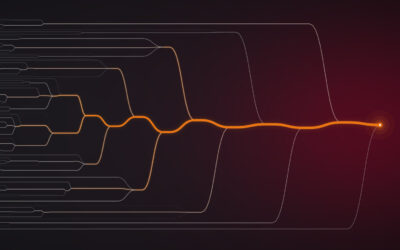
Almost every automaton can be reset with a short word
Guillaume Chapuy (Université Paris Cité, CNRS) and Guillem Perarnau (UPC, CRM) have shown that a random finite automaton with n states can, with high probability, be reset by a word of length of order √n log n. The result, published in ACM Transactions on Algorithms, pins the exponent at 1/2, the lower end of a decade of numerical estimates, and addresses the random version of the synchronization problem behind a conjecture Ján Černý posed in 1964 and which still remains open.
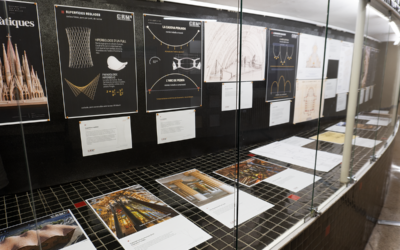
Exposició ‘Les matemàtiques de Gaudí’
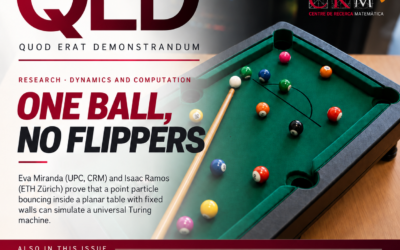
CRM quod erat demonstrandum | 48

ADA: Decoding Brain Signals Misaligned in Time
The study addresses a key limitation of current brain decoding techniques: the difficulty of interpreting internal mental processes whose temporal dynamics vary from trial to trial.Decoding what is happening in a person’s mind from their brain activity is one of the...
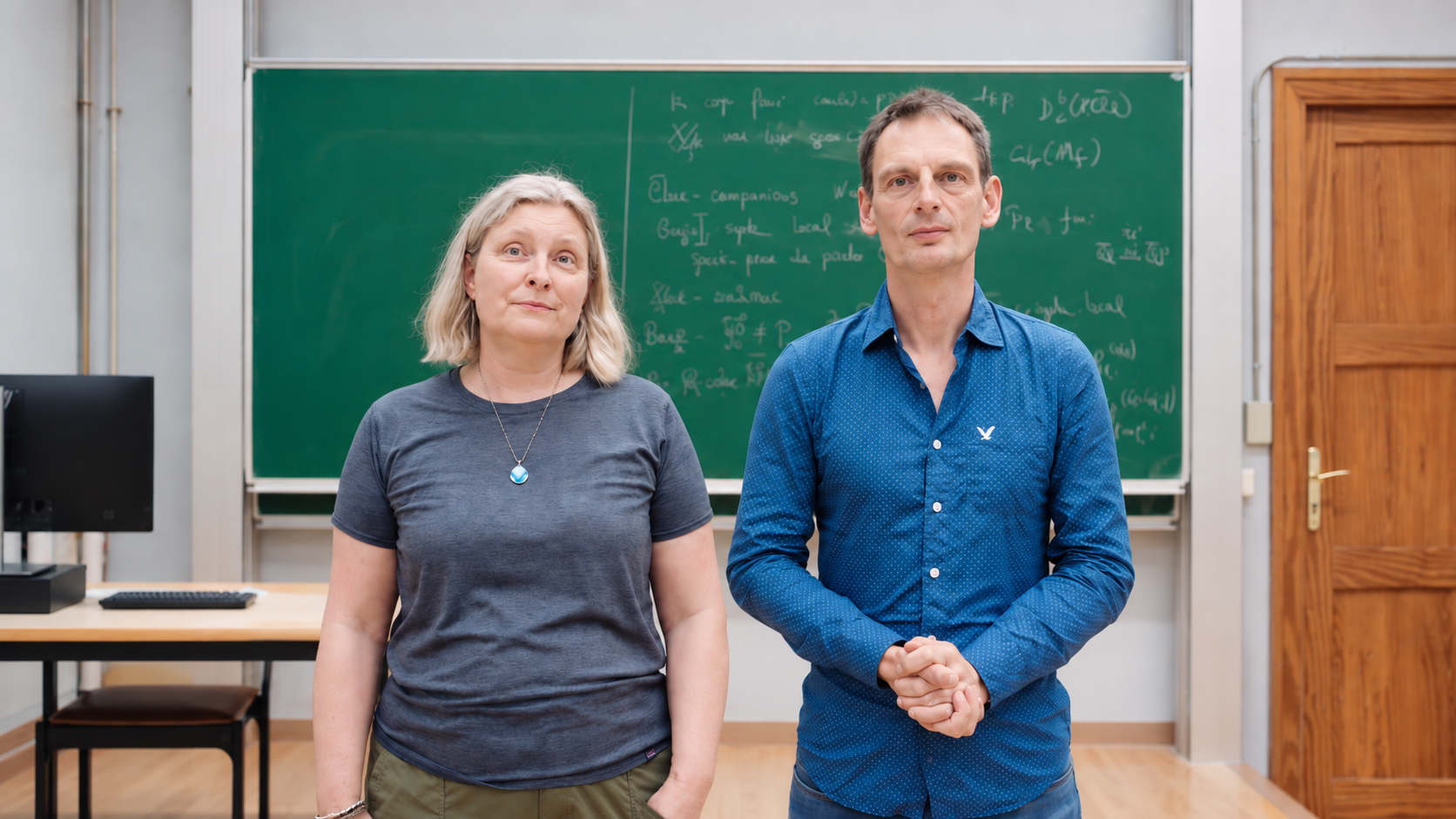
Rare curves, many points: Christophe Ritzenthaler and Rachel Pries on their research and the work around it
Christophe Ritzenthaler (Université de Rennes) and Rachel Pries (Colorado State University) both work on curves over finite fields: he hunts curves with as many points as possible, she hunts curves that almost never occur. In conversation with the CRM during their...

Call open for the 2027 Ferran Sunyer i Balaguer Prize
The Ferran Sunyer i Balaguer Foundation is accepting submissions for its 2027 prize, which awards 15,000 euros and publication in Birkhäuser's Progress in Mathematics series to an expository monograph on an active area of mathematical research. The deadline is 27...
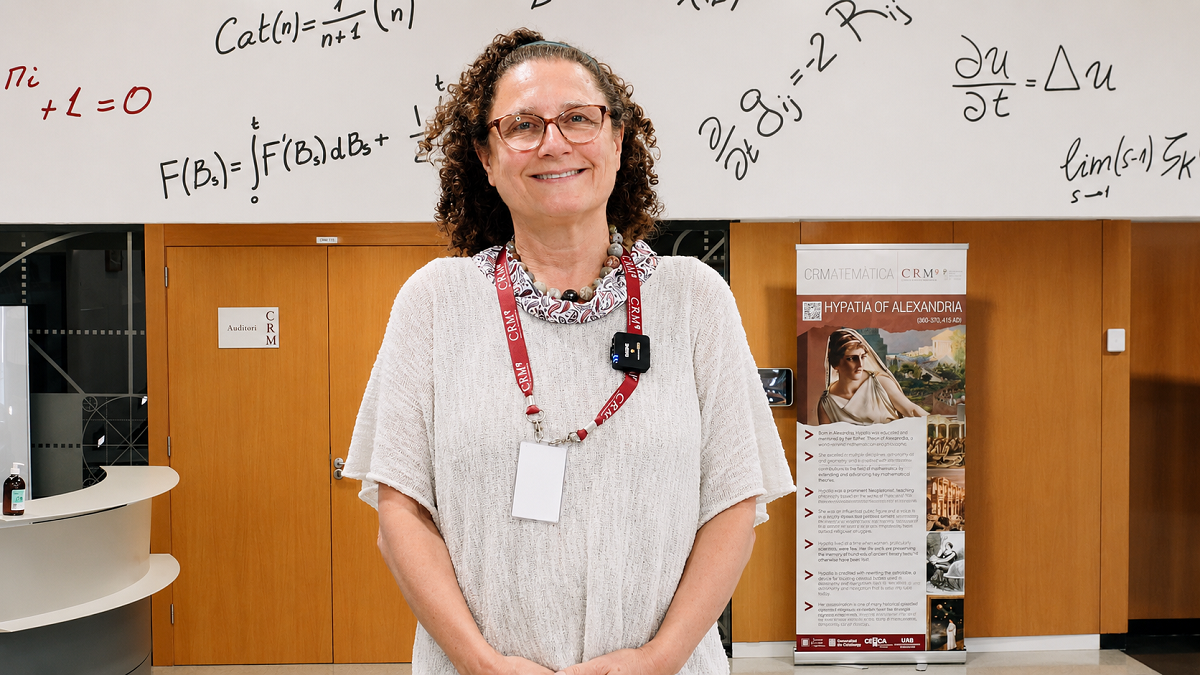
Susanna Terracini delivers the CRM Colloquium 2026
Susanna Terracini (Università di Torino) delivered the CRM Colloquium 2026 on 14 July, presenting a rigidity result for Kepler billiards obtained with Stefano Baranzini, Vivina Barutello and Irene De Blasi. She was at the centre as a member of the CRM Scientific...
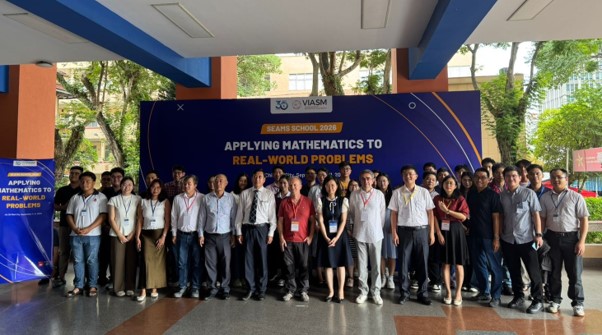
Ho Chi Minh City hosts the SEAMS School on applying mathematics to real-world problems
Students from across the region took courses and worked on group projects at a school co-organised by CRM researcher Tim Myers.CRM CommPau VarelaCRMComm@crm.catGet the latest CRM news and activities in your inbox.Recent newsletters →Between 4 and...

A single ball on a fixed table can compute: Eva Miranda and Isaac Ramos prove that two-dimensional billiards are Turing complete
Eva Miranda (UPC, CRM) and Isaac Ramos (ETH Zürich) show that a point particle bouncing inside a planar table with fixed walls can simulate a universal Turing machine, settling a question Cristopher Moore left open in 1990. The result grew out of a master’s project...
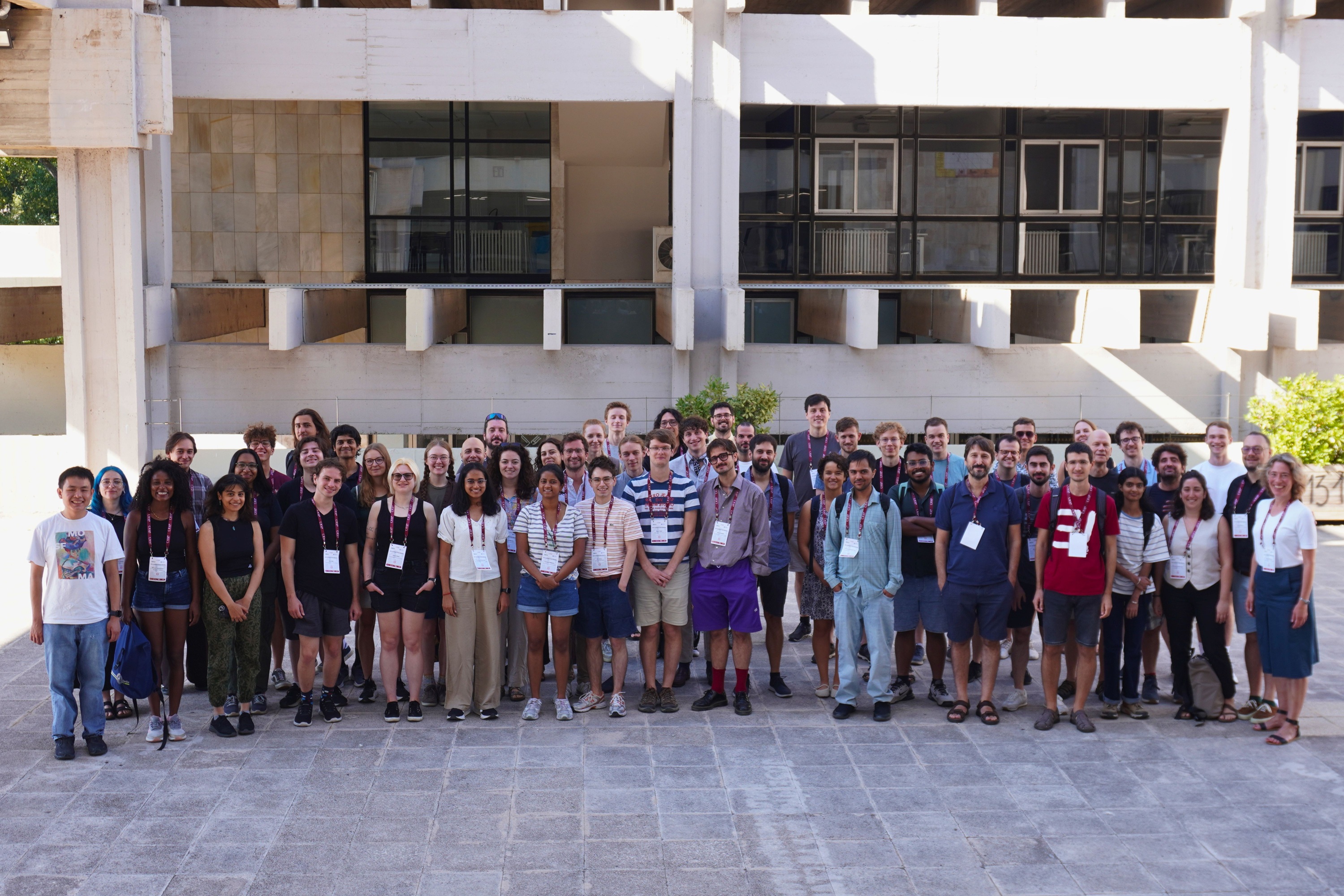
BMS-BGSMath Junior Meeting 2026: Barcelona and Berlin Strengthen Scientific Ties
From 2 to 4 September 2026, the Centre de Recerca Matemàtica (CRM) hosted the BMS-BGSMath Junior Meeting 2026, a three-day event jointly organised by the Berlin Mathematical School (BMS) and the Barcelona Graduate School of Mathematics (BGSMath), with the Centre de...
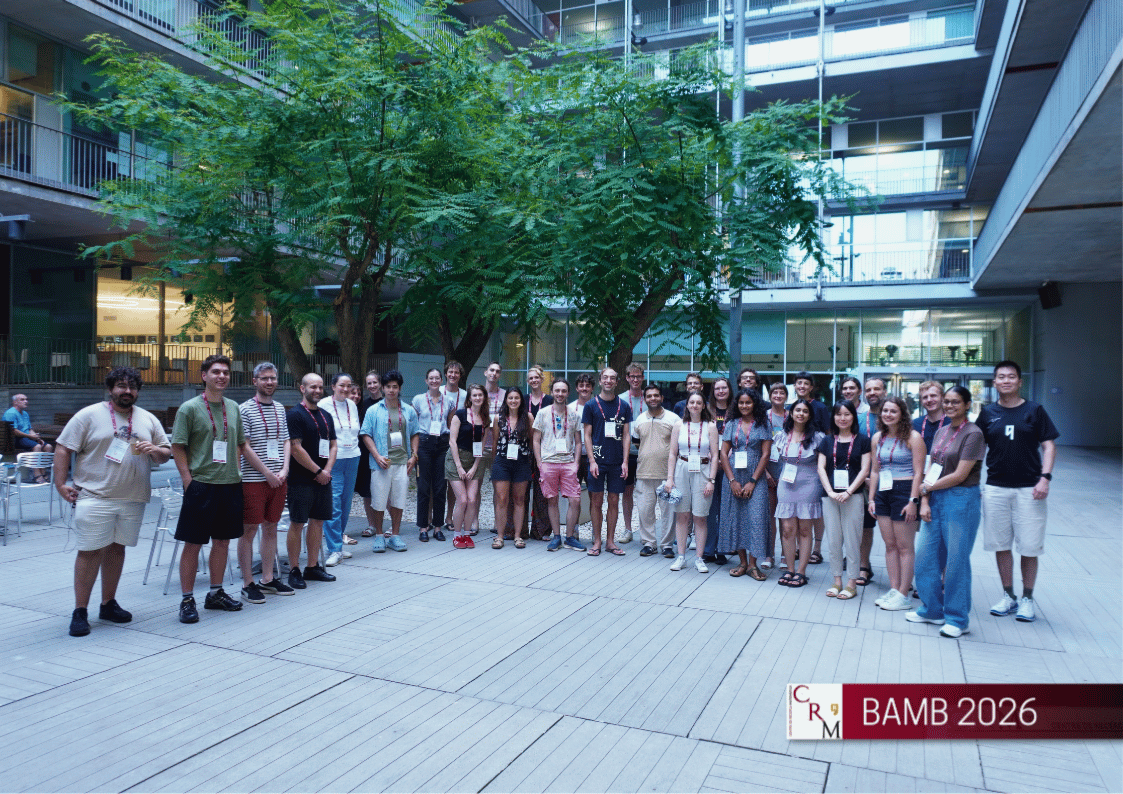
The CRM organises the 2026 Barcelona Summer School for Advanced Modeling of Behavior
The Centre de Recerca Matemàtica held the sixth edition of BAMB!, the Barcelona Summer School for Advanced Modeling of Behavior, from 12 to 23 July 2026 at the Parc de Recerca Biomèdica de Barcelona. Thirty early-career researchers from fourteen countries followed...