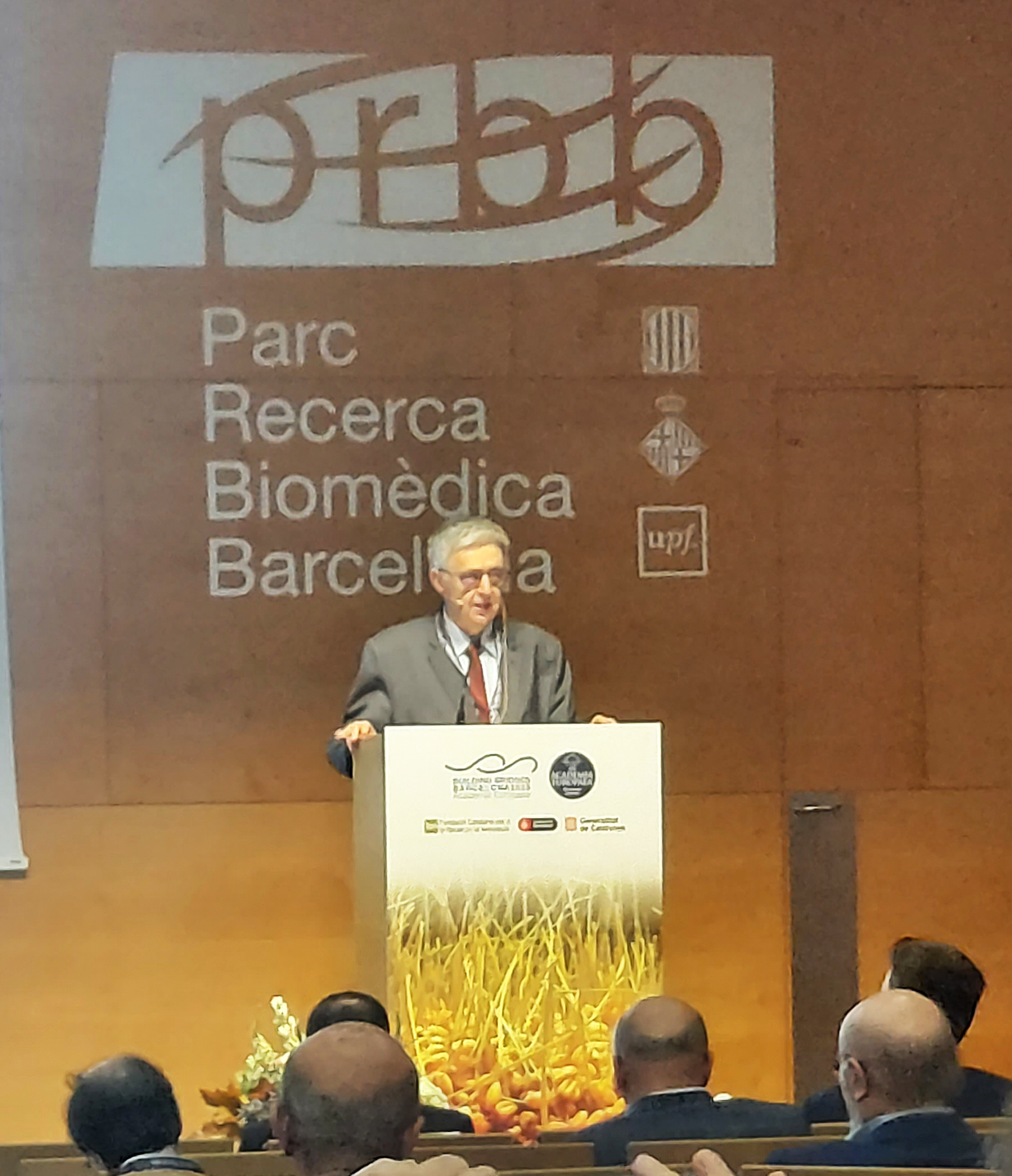
- Mathematician László Lovász received the 2025 Erasmus Medal from the Academia Europaea yesterday at the PRBB in Barcelona, where he delivered the lecture “The Beauty of Mathematics”.
-
This Wednesday, October 16, Hungarian mathematician László Lovász received the 2025 Erasmus Medal, the highest distinction awarded by the Academia Europaea, during a ceremony held at the Barcelona Biomedical Research Park (PRBB) as part of the annual Building Bridges 2025 conference.
The award recognises his exceptional career in discrete mathematics and computer science, as well as his significant contributions to European scientific culture. A former President of the Hungarian Academy of Sciences, Professor Emeritus at Eötvös Loránd University (ELTE), and Research Professor at the HUN-REN Alfréd Rényi Institute of Mathematics, Lovász is regarded as one of the most influential theorists of his generation.
The Erasmus Medal citation described Lovász as “a towering mathematician of our age”, whose work has transformed the landscape of discrete mathematics and its links with classical branches of pure and applied mathematics. Over six decades, his elegant and powerful ideas have solved major open problems and created entirely new subfields, from the Lovász Local Lemma and the proofs of the weak perfect graph and Kneser conjectures to the Lenstra–Lenstra–Lovász lattice reduction algorithm, the ellipsoid method in combinatorial optimisation, and the theory of graph limits.
The ceremony, introduced by Jaume Bertranpetit, Academic Director of the Academia Europaea Barcelona Hub, featured a laudation by János Pach (Rényi Institute and EPFL), who outlined Lovász’s long-standing influence across mathematics and computer science. The event concluded with Lovász’s Erasmus Lecture, titled “The Beauty of Mathematics”, a reflection on the inner elegance and coherence that connect seemingly distant branches of the mathematical sciences.
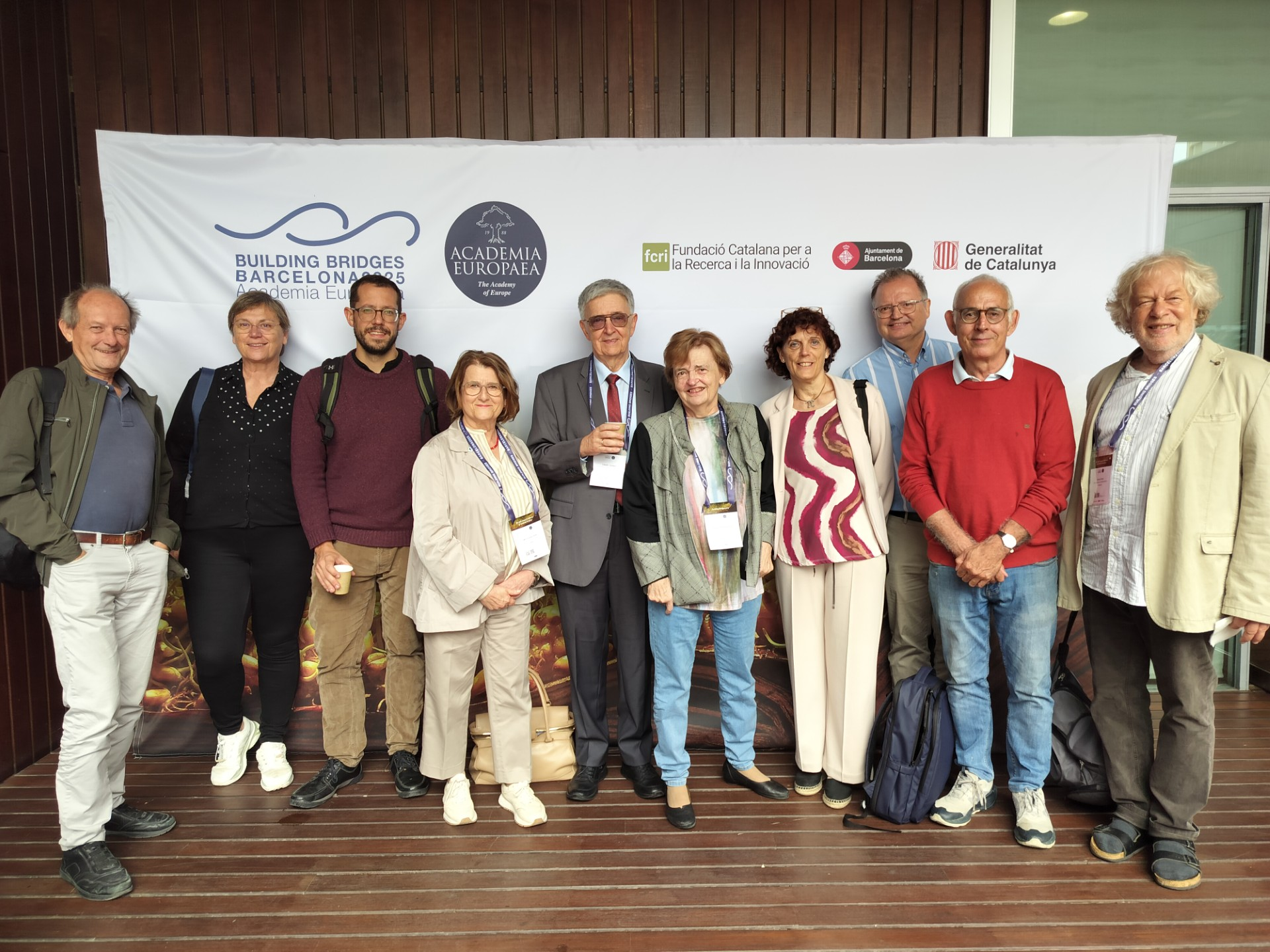
The event was attended by Guillem Perarnau, Marc Noy, and Oriol Serra, researchers at the Universitat Politècnica de Catalunya (UPC) and affiliated members of the CRM, along with Carme Cascante, Director of the CRM, who represented the centre at the ceremony.
The Erasmus Medal is one of the most prestigious honors granted by the Academia Europaea for outstanding scientific achievements. With this award, László Lovász joins a distinguished group of laureates who have strengthened the bridges between science, technology, the humanities, and society.
|
|
CRM CommPau Varela
|
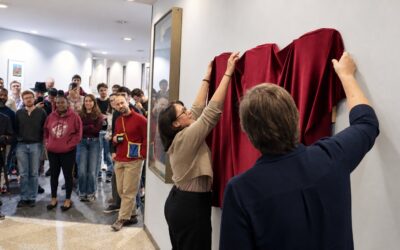
The CRM opens the academic year and unveils its Directors’ Gallery
A review of the year, the Communication Plan 2026–2030 and three research talks filled the morning of 19 October.The unveiling of the Directors’ Gallery.CRM CommPau VarelaCRMComm@crm.catGet the latest CRM news and activities in your inbox.Recent...
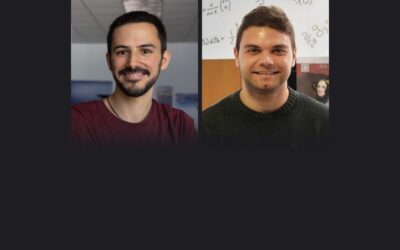
The CRM Mentoring Programme, as Told by One of Its Pairs
PhD student Joaquim Duran and mathematician Robert Cardona, one of the pairs in the CRM Mentoring ProgrammeJoaquim Duran (left) and Robert Cardona.CRM CommPau VarelaCRMComm@crm.catGet the latest CRM news and activities in your inbox.Recent...
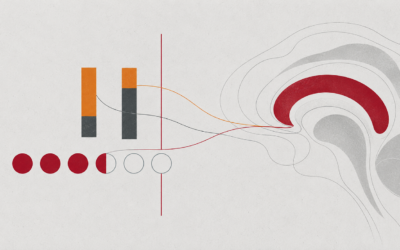
When the reward comes within reach, the brain changes what it compares
As the tokens piled up, choices got faster and more accurate at the same time. The yardstick for judging each offer had moved.CRM CommPau VarelaCRMComm@crm.catGet the latest CRM news and activities in your inbox.Recent newsletters →Two subjects...
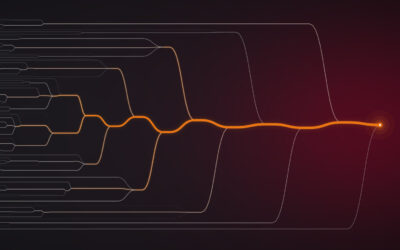
Almost every automaton can be reset with a short word
Guillaume Chapuy (Université Paris Cité, CNRS) and Guillem Perarnau (UPC, CRM) have shown that a random finite automaton with n states can, with high probability, be reset by a word of length of order √n log n. The result, published in ACM Transactions on Algorithms, pins the exponent at 1/2, the lower end of a decade of numerical estimates, and addresses the random version of the synchronization problem behind a conjecture Ján Černý posed in 1964 and which still remains open.
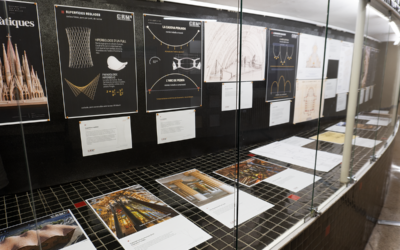
Exposició ‘Les matemàtiques de Gaudí’
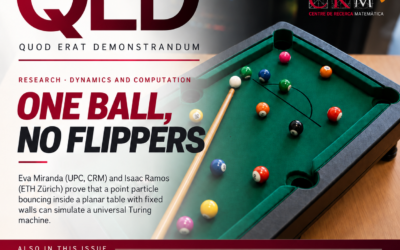
CRM quod erat demonstrandum | 48
ADA: Decoding Brain Signals Misaligned in Time
The study addresses a key limitation of current brain decoding techniques: the difficulty of interpreting internal mental processes whose temporal dynamics vary from trial to trial.Decoding what is happening in a person’s mind from their brain activity is one of the...
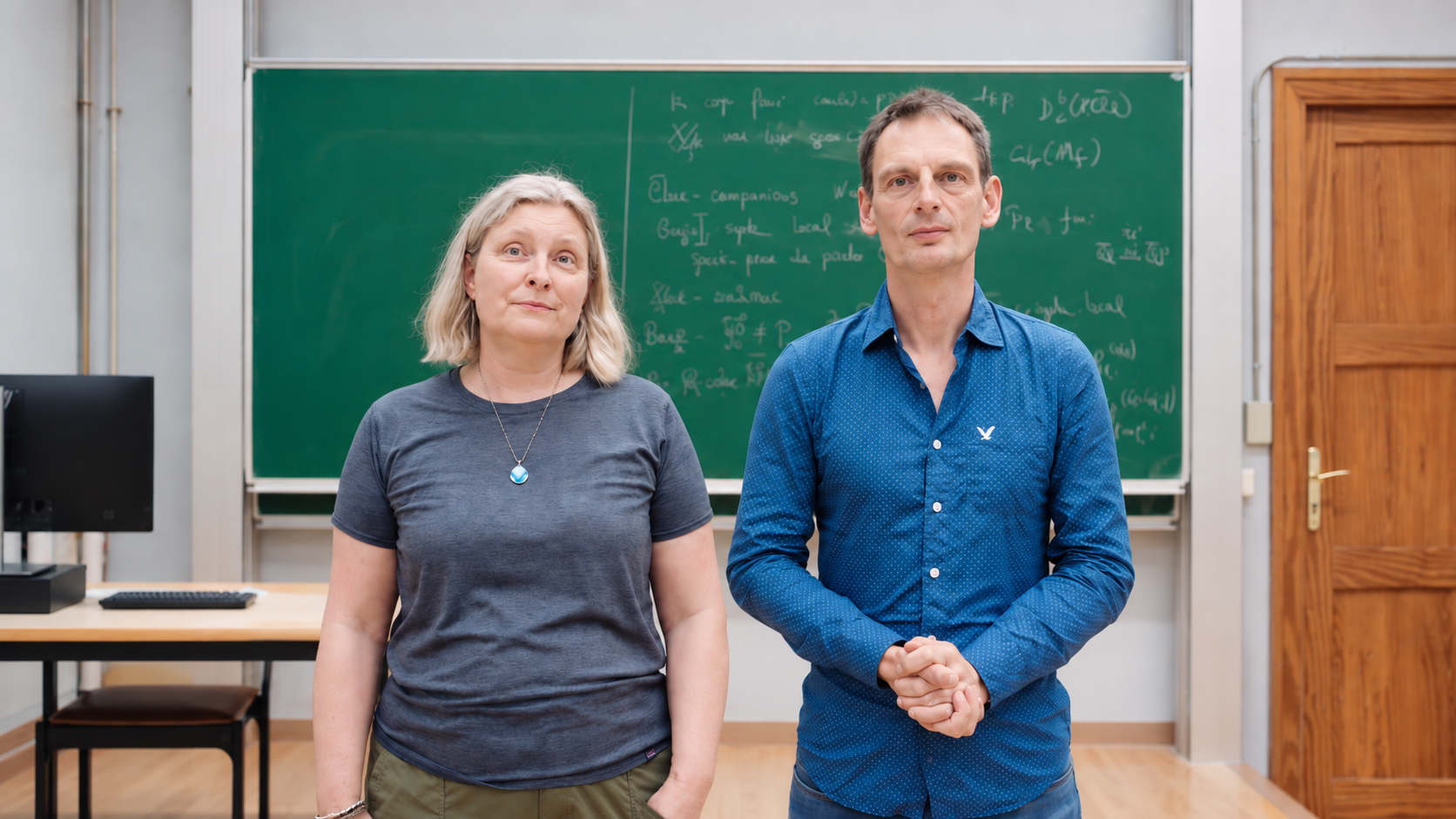
Rare curves, many points: Christophe Ritzenthaler and Rachel Pries on their research and the work around it
Christophe Ritzenthaler (Université de Rennes) and Rachel Pries (Colorado State University) both work on curves over finite fields: he hunts curves with as many points as possible, she hunts curves that almost never occur. In conversation with the CRM during their...

Call open for the 2027 Ferran Sunyer i Balaguer Prize
The Ferran Sunyer i Balaguer Foundation is accepting submissions for its 2027 prize, which awards 15,000 euros and publication in Birkhäuser's Progress in Mathematics series to an expository monograph on an active area of mathematical research. The deadline is 27...
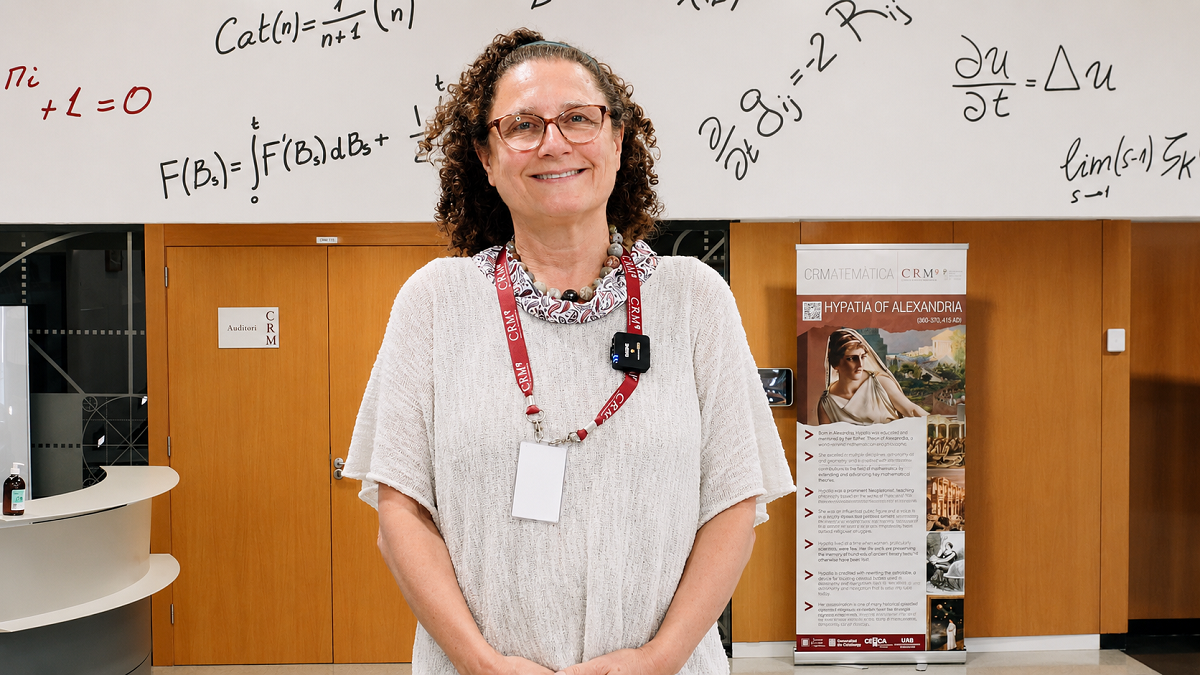
Susanna Terracini delivers the CRM Colloquium 2026
Susanna Terracini (Università di Torino) delivered the CRM Colloquium 2026 on 14 July, presenting a rigidity result for Kepler billiards obtained with Stefano Baranzini, Vivina Barutello and Irene De Blasi. She was at the centre as a member of the CRM Scientific...
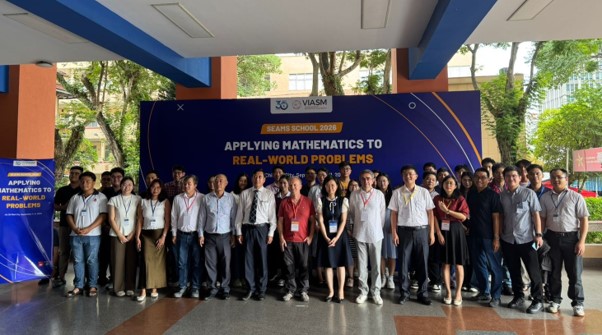
Ho Chi Minh City hosts the SEAMS School on applying mathematics to real-world problems
Students from across the region took courses and worked on group projects at a school co-organised by CRM researcher Tim Myers.CRM CommPau VarelaCRMComm@crm.catGet the latest CRM news and activities in your inbox.Recent newsletters →Between 4 and...

A single ball on a fixed table can compute: Eva Miranda and Isaac Ramos prove that two-dimensional billiards are Turing complete
Eva Miranda (UPC, CRM) and Isaac Ramos (ETH Zürich) show that a point particle bouncing inside a planar table with fixed walls can simulate a universal Turing machine, settling a question Cristopher Moore left open in 1990. The result grew out of a master’s project...