El CRM participa en el programa Magnet, a través de la seva aliança amb l’Escola Joaquim Blume, per difondre l’aprofundiment i la reflexió sobre el treball matemàtic orientat al canvi.

Lluís Alsedà, director del Centre de Recerca Matemàtica, ha fet balanç dels quatre anys de col·laboració del centre amb el programa MAGNET, que permet a centres i institucions de recerca desenvolupar projectes educatius a escoles. El programa, impulsat per la Fundació Jaume Bofill, el Departament d’Educació, el Consorci d’Educació de Barcelona i l’Institut de Ciències de l’Educació de la UAB, està inspirat en les Magnet Schools del Estats Units i compta amb la participació de més de 40 institucions de referència i excel·lència en un camp de coneixement específic (ciència, tecnologia, art, comunicació audiovisual, etc.).
 En el cas del CRM, el programa Magnet ha permès establir una aliança amb l’Escola Joaquim Blume de Sabadell sota l’eslògan ‘’Al Blume, tots comptem. Suma-t’hi!’’. Els projectes que s’han realitzat durant els quatre anys des de l’inici d’aquesta aliança han permès aprofundir en l’ensenyament de les matemàtiques de de una perspectiva més humana orientada a la comprensió del món que ens envolta i el desenvolupament del sentit crític.
“Per nosaltres, Magnet ha estat una oportunitat de canalitzar la nostra voluntat d’incidir en un sector de la societat al que no teníem accés, que són els nens i nenes en edat escolar” explica Lluís Alsedà a l’entrevista. “Això és especialment rellevant, perquè fer això des del món de les matemàtiques és més difícil que no pas des d’altres àrees. Les matemàtiques han estat víctimes d’un ensenyament poc imaginatiu i són poc “populars” i Magnet ens ha ajudat a acostar-les al món educatiu.”
Podeu llegir l’entrevista integra a https://magnet.cat/magnet-ens-ha-permes-entrar-al-mon-educatiu-de-primaria-lluis-alseda-director-del-crm/

CRM Comm Team
Anna Drou | Pau Varela
CRMComm@crm.cat
Subscribe for more CRM News
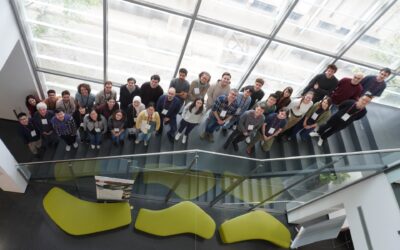
Jagged walls and unknown edges: a workshop on free boundary problems
From 2 to 6 November, the Workshop on Free Boundary Problems brought together more than fifty registered participants from institutions in eleven countries at the CRM. Over five days they heard 21 talks on elliptic and parabolic free boundaries and on geometric measure theory and harmonic analysis in rough domains, with speakers including Guy David, Svitlana Mayboroda, Susanna Terracini and Robin Neumayer. The workshop was the second intensive week of the Intensive Research Programme on Analysis of Free Boundary Problems, which continues at the CRM until 4 December.
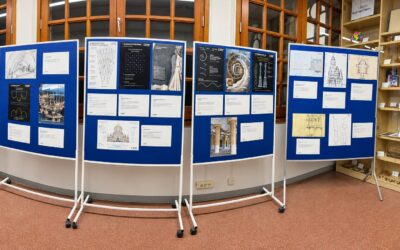
The CRM exhibition ‘Les matemàtiques de Gaudí’ moves to the University of Barcelona
After its October run at the UAB, the exhibition Les matemàtiques de Gaudí, produced by the CRM, can be seen at the University of Barcelona’s CRAI Biblioteca de Matemàtiques i Informàtica from 2 to 30 November 2026.
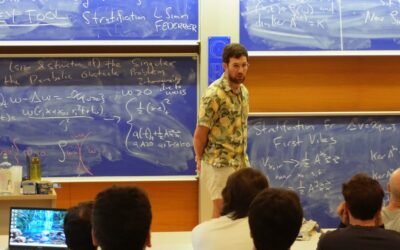
Advanced Course on Free Boundary Problems Opens the Intensive Weeks of the IRP
From 26 to 30 October, around forty researchers attended the Advanced Course on Free Boundary Problems at the CRM, three seven-hour mini-courses given by Bozhidar Velichkov (Università di Pisa), Max Engelstein (University of Minnesota) and Zihui Zhao (Johns Hopkins University). The course was the first of the two intensive weeks of the Intensive Research Programme on Analysis of Free Boundary Problems, which runs until 4 December.
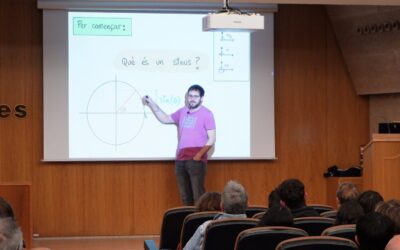
El CRM rep els estudiants de la prova de nivell de Bojos per les Matemàtiques 2027
Els aspirants a Bojos per les Matemàtiques 2027 van visitar el Centre de Recerca Matemàtica (CRM) dissabte 24 d’octubre, després de fer la prova de nivell a la Facultat de Ciències i Biociències de la UAB. En acabat, Tomás Sanz (UB-CRM) els va explicar què té a veure l’escalfament d’una barra de ferro amb els àudios de WhatsApp.
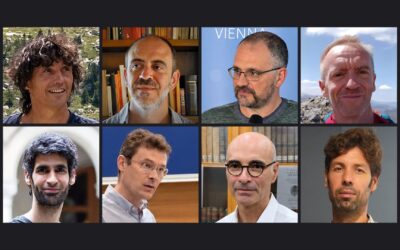
Eight CRM Researchers in the 2026 Stanford-Elsevier List of Highly Cited Scientists
The Centre de Recerca Matemàtica (CRM) has eight researchers in the 2026 update of the Stanford-Elsevier ranking of highly cited scientists, which John P. A. Ioannidis (Stanford University) and Jeroen Baas (Elsevier) compile from Scopus data. Xavier Cabré, Álvaro Corral, Tim Myers, Xavier Ros-Oton, Sergey Tikhonov and Xavier Tolsa appear both in the career-long ranking and in the one for 2025, and Diego Vidaurre and Simeon Ball in the 2025 ranking.
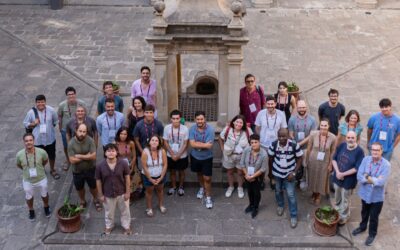
Fish schools and growing tissues: a workshop on how collective behaviour emerges
The Centre de Recerca Matemàtica (CRM) organised the Barcelona Workshop on Kinetic and Macroscopic Models in Biology with Friends II, held from 7 to 10 September at the Institut d’Estudis Catalans. More than thirty researchers discussed how order at the scale of tissues and animal groups arises from local interactions between individuals, in a programme that included talks by CRM researchers Daria Stepanova and Juan Arellano-Tintó. Two of the speakers, James Sharpe (EMBL Barcelona) and Chiara Villa (CNRS, Université Paris Cité), talked to the CRM about their research.