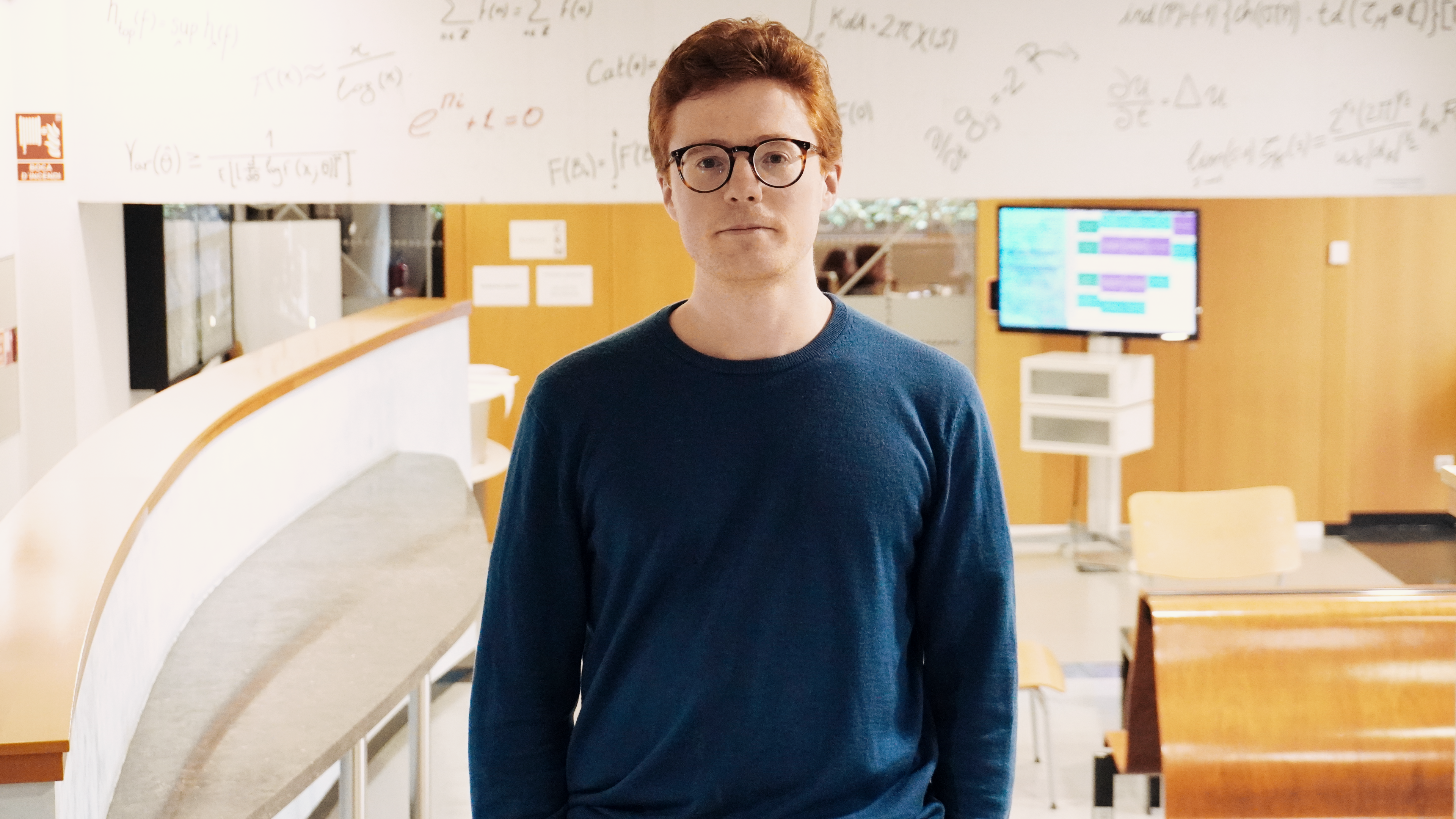
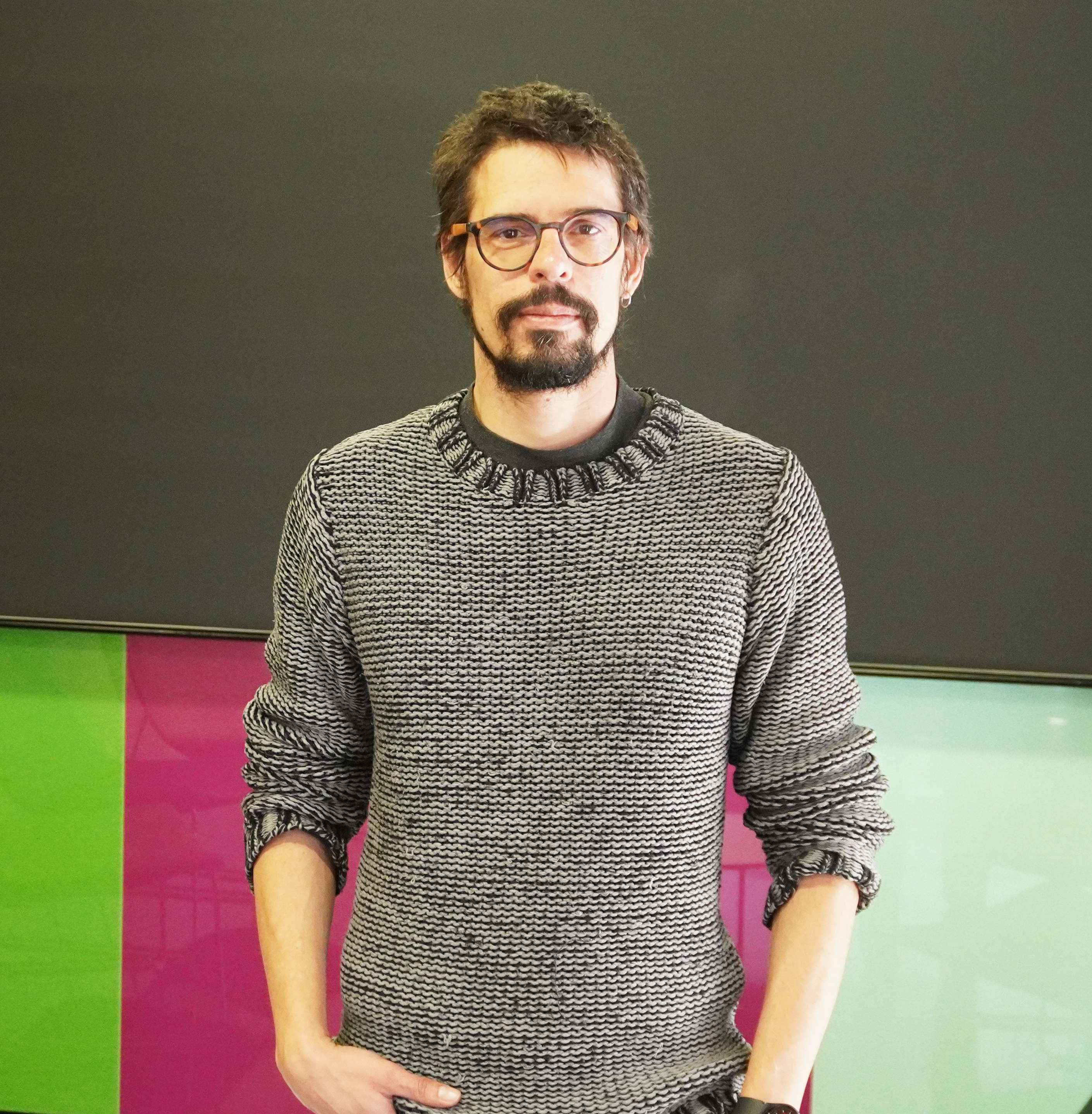
Ander Movilla has joined CRM as a Beatriu de Pinós postdoctoral fellow. Working with Tomás Alarcón, Movilla will develop mathematical models that capture not just the static architecture of DNA but its dynamic behaviour; how chromosome contacts shift as chemical marks on histones change over time.
Ander Movilla Miangolarra has joined the Centre de Recerca Matemàtica with a physicist’s training, a biologist’s curiosity, and a mathematician’s toolkit. His path here traces an unusual trajectory, from studying how droplets form inside cells to understanding how chromosomes fold in three dimensions, but the thread connecting it all is a fascination with how physical principles shape biological behaviour.
Movilla arrives at CRM as a Beatriu de Pinós postdoctoral fellow, a program funded by the Catalan Government’s AGAUR that brings international researchers to Catalonia for three-year research stays.
Working with CRM principal investigator Tomás Alarcón, he’ll join the Mathematical Biology research group at CRM to tackle one of molecular biology’s most intricate puzzles: how the three-dimensional architecture of chromosomes influences which genes get expressed.
A Physicist’s Entry into Biology
Movilla’s background is in physics, he completed his undergraduate degree at the University of the Basque Country, but his PhD at Institut Curie in Paris was already crossing disciplinary boundaries. He worked on reaction-diffusion equations, the mathematical framework that describes how substances spread and interact in space. But these weren’t the textbook versions.
“They weren’t the classic ones that you’d use for solutions where these things don’t happen,” Movilla explains. “They were for cases where, due to different interactions between the solutes, these droplets form.” He was studying liquid-liquid phase separation: how the cytoplasm inside cells spontaneously organises into distinct compartments, like oil separating from water in a vinaigrette. It’s a phenomenon that’s become central to understanding cellular organisation, especially under stress conditions when metabolic components aggregate into visible droplets.
“Describing that mathematically, especially in a way that’s intelligible to a human and not just a thousand-by-thousand matrix that only a computer can understand, that’s also an interesting question from a purely mathematical standpoint.”
The work was computationally driven but biologically motivated. Then, three months into his PhD, reality intervened. “The experimentalists said, well, this can’t actually be done in the end. And so, your project collapses,” he recalls. “You start thinking, okay, now what do we do?” It was an early lesson in research pragmatism. “I think in science, most of the things you try don’t work out,” Movilla says. “Of course, the ones that do work out get published, and everything goes well. But you try many things that don’t work. And I learned that in the first three months of my PhD.”
The Turn Toward Gene Regulation
During his postdoctoral work at the John Innes Centre in Norwich, UK, Movilla shifted his focus to gene regulation and epigenetics. The questions became more explicitly biological: How do cells with identical DNA differentiate into neurons, skin cells, or muscle? How do they maintain their identities across divisions?
The answers involve histones, proteins that bind to DNA and control whether a gene is expressed. Histone modifications form patterns: blocks with one type of modification, others without, and some stretches are empty in the middle. Tomás Alarcón has been working on mathematical models of these patterns for years, and lately he’s been focused on how they relate to chromosome folding. The patterns appear linear when you look at a genome browser, but in the cell nucleus, the DNA is folded in three dimensions, and that matters.
“When you look at the genome browser, as biologists typically do, it shows up as a line,” Movilla explains. “But then in the cell nucleus, it’s all folded.” Regions of the chromosome that are far apart on the linear sequence might be physically adjacent in three-dimensional space, and that proximity matters. “In zones where there are contacts between the chromosomes, it’s much more likely that those histone interactions happen, even if they’re far apart.”
Tomás Alarcón at CRM has been working on mathematical models of histone modifications for years, examining how these chemical patterns relate to chromosome folding. But most of that work has treated the structure as relatively static. Movilla’s project aims to make it dynamic.
Dynamic Networks and Adaptive Systems
When there’s a contact between two parts of the chromosome, you get a network of contacts. If the network is fixed, you know what it is, and how to describe it. But when that network becomes dynamic, the challenge changes entirely. “When that network is no longer static but adaptive, because the histones change due to their own dynamics, which then implies that the contacts change, that network is no longer static,” Movilla says. “And describing that mathematically, especially in a way that’s intelligible to a human and not just a thousand-by-thousand matrix that only a computer can understand, well, that’s also an interesting question from a purely mathematical standpoint.”
This is where the interdisciplinary work becomes essential. Movilla will be working with data from cell lines, clones of pluripotent embryonic cells that can be experimentally differentiated into various cell types. The datasets are massive: expression levels of 20,000 genes at the single-cell level, histone modifications mapped across the genome, and chromosome conformation capture experiments showing three-dimensional contacts. “You end up with gigabytes and gigabytes of data that’s very complicated to work with,” he says. “And I think one of the things that could help us understand it better would be these kinds of mathematical approaches, where you try to extract the most important things from that data.”
One of the aspects of the work Movilla finds compelling is the bidirectional exchange with experimentalists. Mathematical models don’t just analyse data, they generate hypotheses. “At the John Innes Centre, we often tried to encourage information to flow both ways,” he says. “They inform us on how to do the analyses and what would be important in these data. But then our model, based on these analyses, might suggest you could try this experiment, and you might observe this. This model perhaps tells you that this gene could be important.”
Sometimes the predictions are more tentative. “You tell them; I don’t have much confidence, so don’t invest too many resources in this. But I’ll leave it there as an idea.” Other times, given the data and the model’s assumptions, the direction is clearer. “That’s usually what ends up getting done, because experimentalists generally go for what they’re most confident in,” Movilla says.
The work calls for a steady relationship with uncertainty and failure. For Movilla, that feels inseparable from doing research. A project that collapsed three months into his PhD made the point clearly and early. The CRM now welcomes Ander Movilla as a Beatriu de Pinós postdoctoral fellow for the next three years.
About Ander Movilla
Ander Movilla trained as a physicist, earning a bachelor’s degree at the University of the Basque Country before completing a PhD in Paris at the Institut Curie, Université PSL. His doctoral work focused on reaction–diffusion equations, with particular attention to systems where components interact and solutions depart from ideal behaviour. During a postdoctoral stay at the John Innes Centre in Norwich, he turned his attention to gene regulation and epigenetics, developing stochastic models to make sense of data from genomics experiments. At the CRM, working with Tomás Alarcón, he builds on this line of work by studying models that capture the three-dimensional organization of chromosomes and its relationship with gene expression.
About the Beatriu de Pinós Programme
The Beatriu de Pinós fellowship, launched in 2005 and managed by the Catalan Agency for Management of University and Research Grants (AGAUR), is one of Catalonia’s flagship programs for attracting international postdoctoral talent. The fellowship provides three-year contracts and research funding to support early-career researchers as they develop independent research programs within Catalan institutions. The program is open to researchers from any country who have completed at least two years of postdoctoral work outside Spain and aims to strengthen Catalonia’s science and technology ecosystem through international mobility and interdisciplinary collaboration.
|
|
CRM CommPau Varela
|
CRM Awards Its Prize at Exporecerca Jove for the Third Time
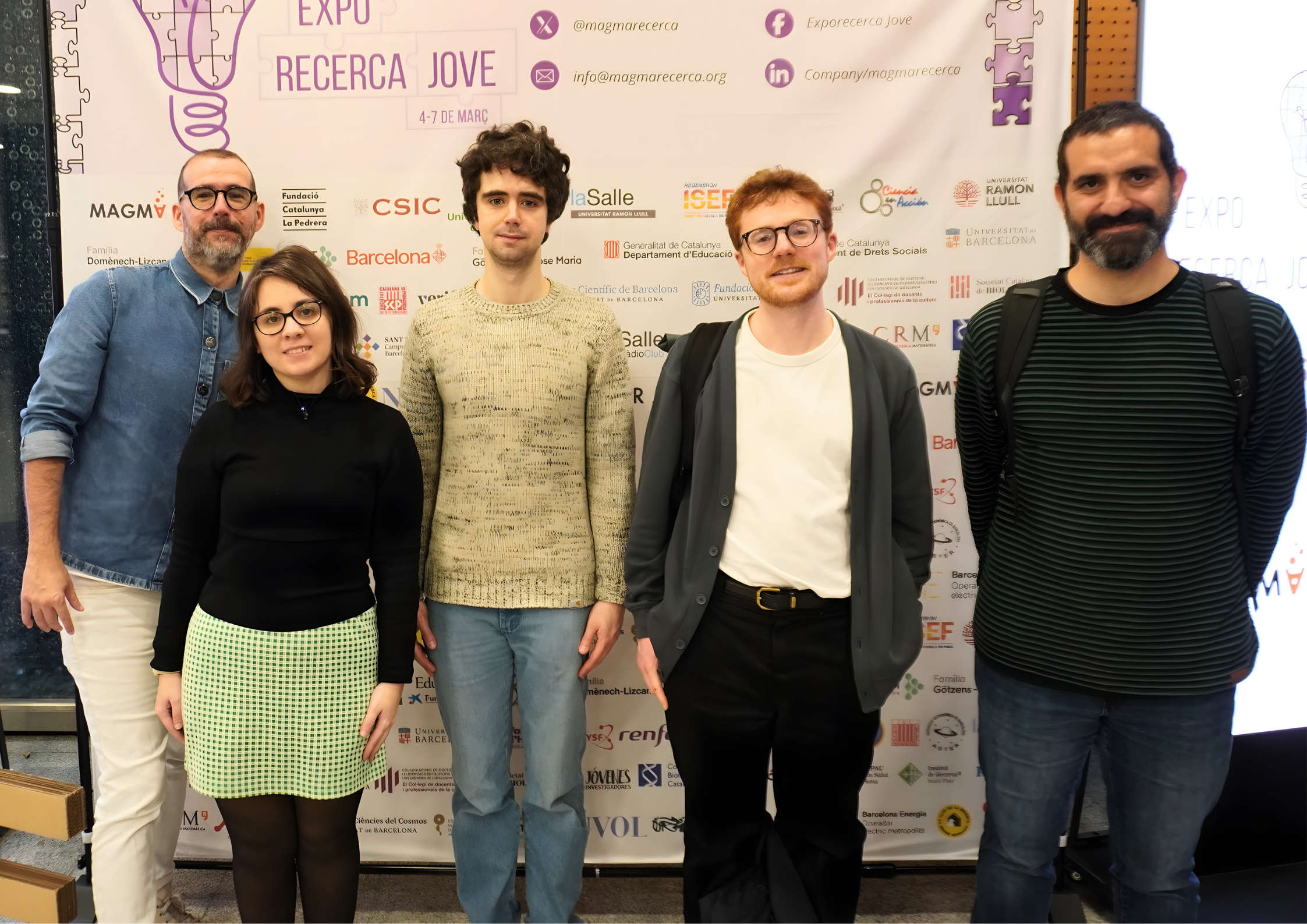
For the third year running, CRM visited Exporecerca Jove to award its prize to the student project with the strongest mathematical content. This edition, the jury selected two winners: Xavier Ortiz Quintana, who built a real-time 3D scanner using...

When Symmetry Breaks the Rules: From Askey–Wilson Polynomials to Functions
Researchers Tom Koornwinder (U. Amsterdam) and Marta Mazzocco (ICREA-UPC-CRM) published a paper in Indagationes Mathematicae exploring DAHA symmetries. Their work shows that these symmetries shift Askey–Wilson polynomials into a continuous functional setting,and...
Homotopy Theory Conference Brings Together Diverse Research Perspectives
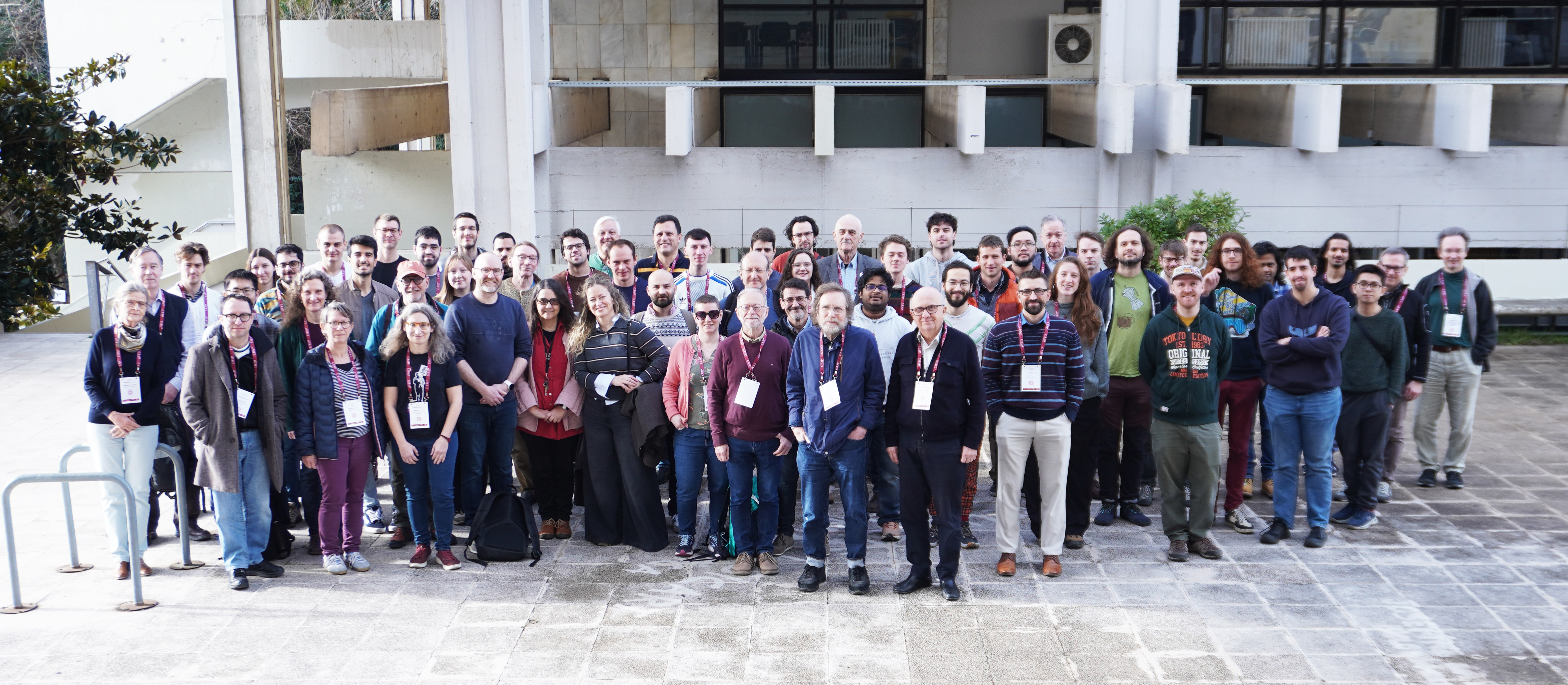
The Centre de Recerca Matemàtica hosted 75 mathematicians from over 20 countries for the Homotopy Structures in Barcelona conference, held February 9-13, 2026. Fourteen invited speakers presented research spanning rational equivariant cohomology theories, isovariant...
Three ICM speakers headline the first CRM Faculty Colloquium
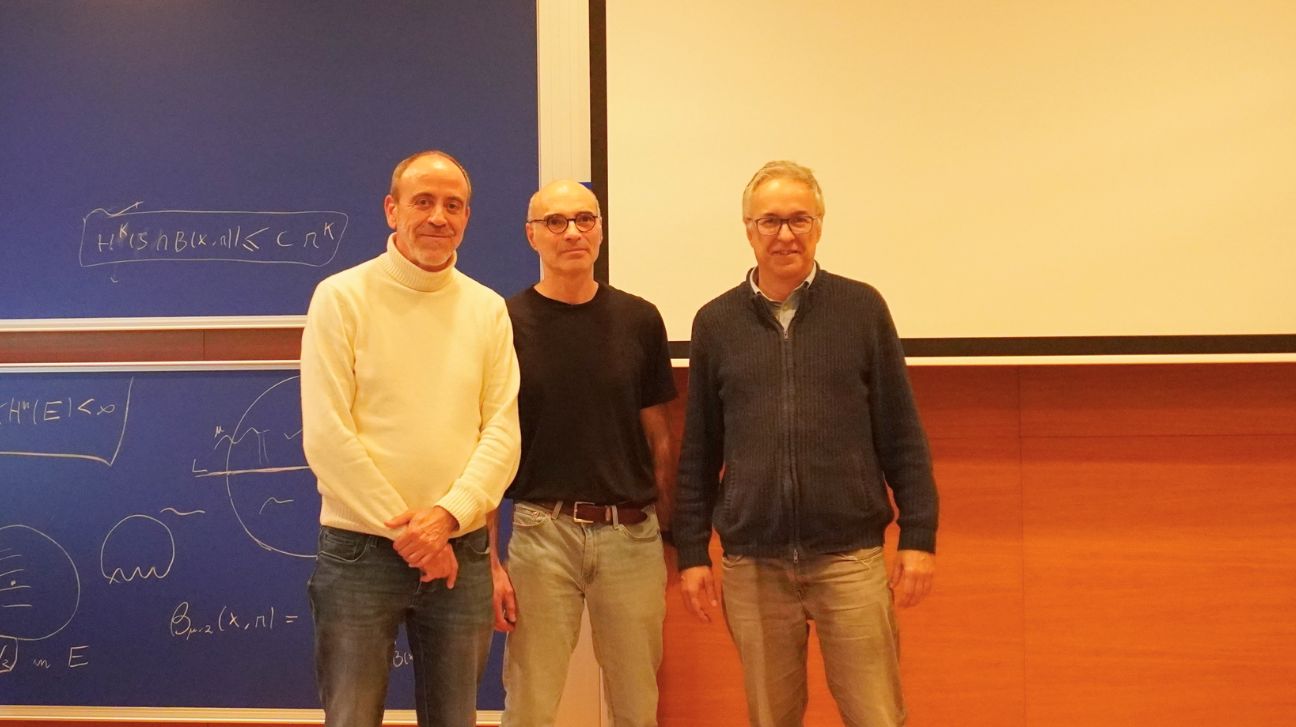
On 19 February 2026, the Centre de Recerca Matemàtica inaugurated its first CRM Faculty Colloquium, a new quarterly event designed to bring together the mathematical community around the research carried out by scientists affiliated with the Centre. The CRM auditorium...
Trivial matemàtiques 11F-2026
Rescuing Data from the Pandemic: A Method to Correct Healthcare Shocks
When COVID-19 lockdowns disrupted healthcare in 2020, insurance companies discarded their data; claims had dropped 15%, and patterns made no sense. A new paper in Insurance: Mathematics and Economics shows how to rescue that information by...
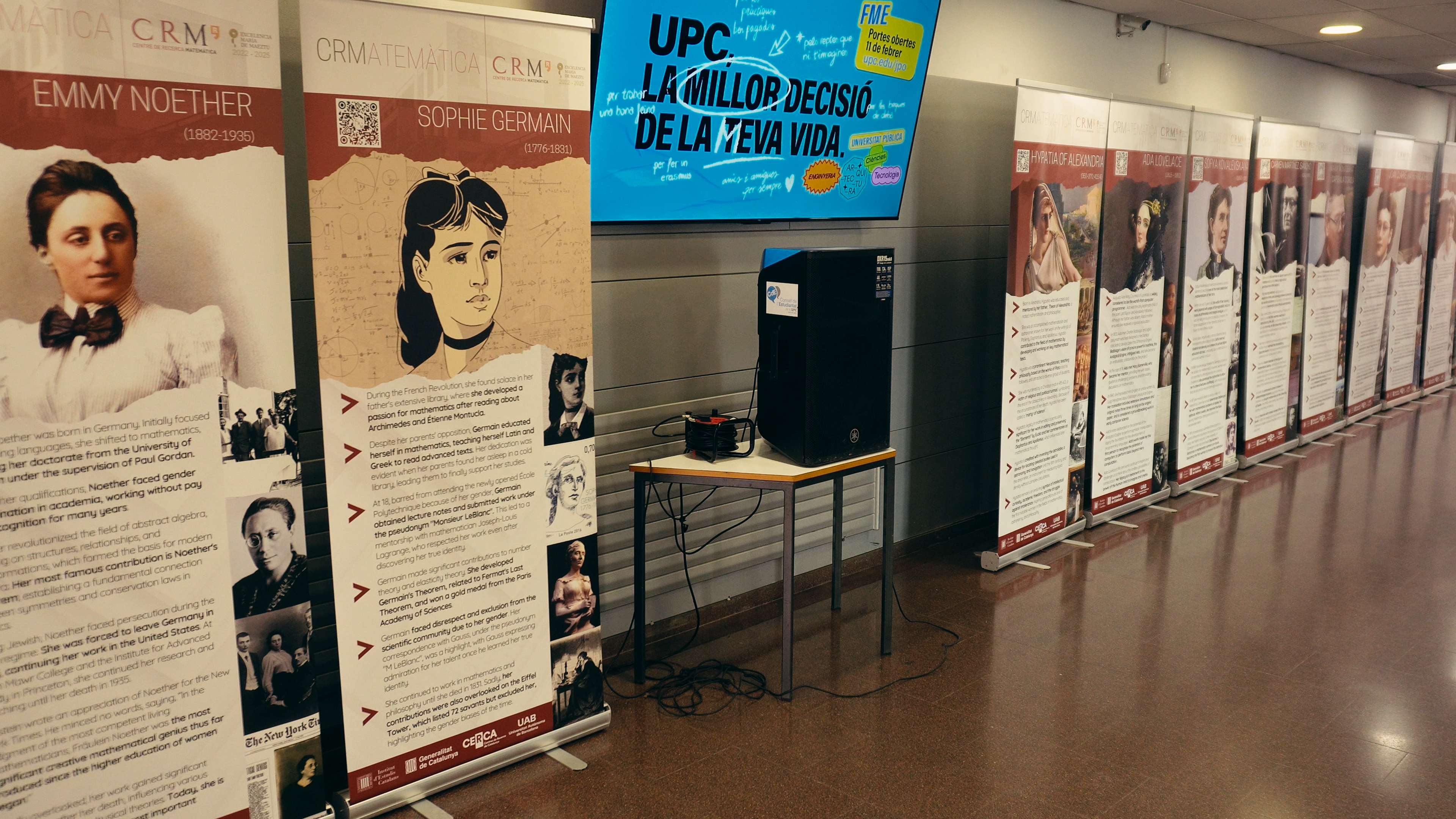
L’exposició “Figures Visibles” s’inaugura a la FME-UPC
L'exposició "Figures Visibles", produïda pel CRM, s'ha inaugurat avui al vestíbul de la Facultat de Matemàtiques i Estadística (FME) de la UPC coincidint amb el Dia Internacional de la Nena i la Dona en la Ciència. La mostra recull la trajectòria...
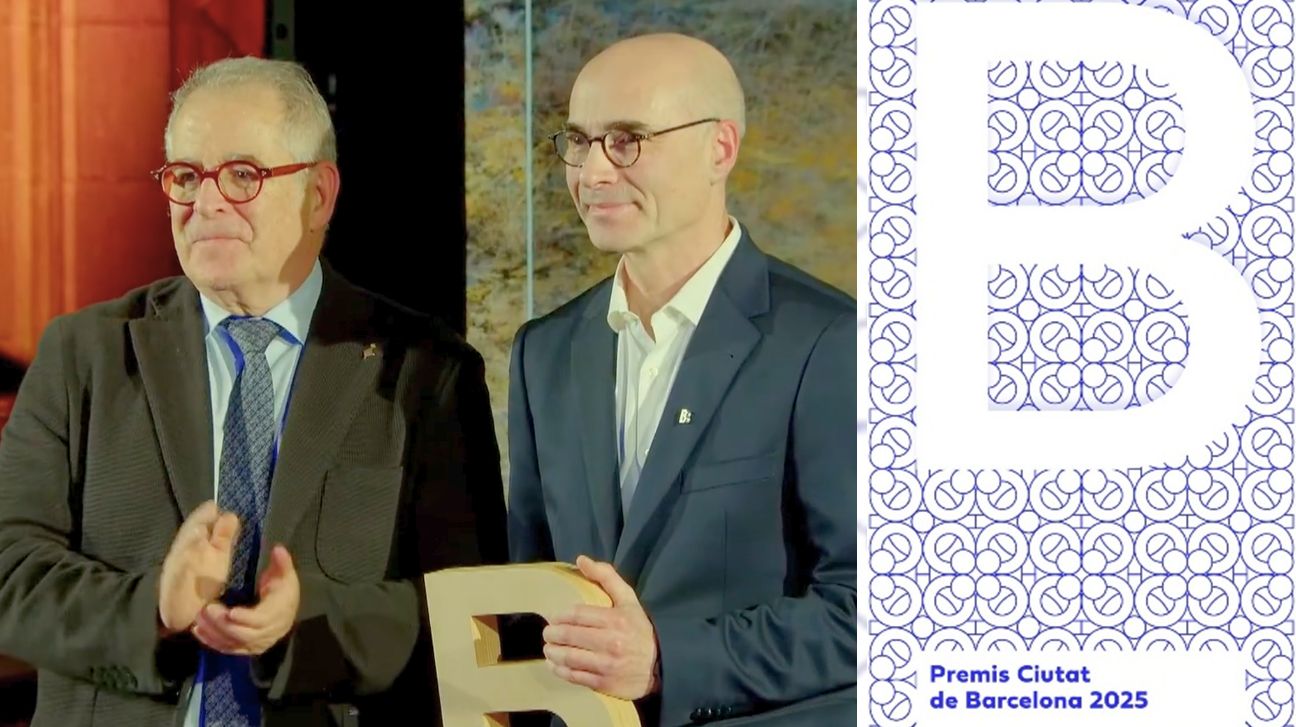
Xavier Tolsa rep el Premi Ciutat de Barcelona per un resultat clau en matemàtica fonamental
L’investigador Xavier Tolsa (ICREA–UAB–CRM) ha estat guardonat amb el Premi Ciutat de Barcelona 2025 en la categoria de Ciències Fonamentals i Matemàtiques, un reconeixement que atorga l’Ajuntament de Barcelona i que enguany arriba a la seva 76a edició. L’acte de...
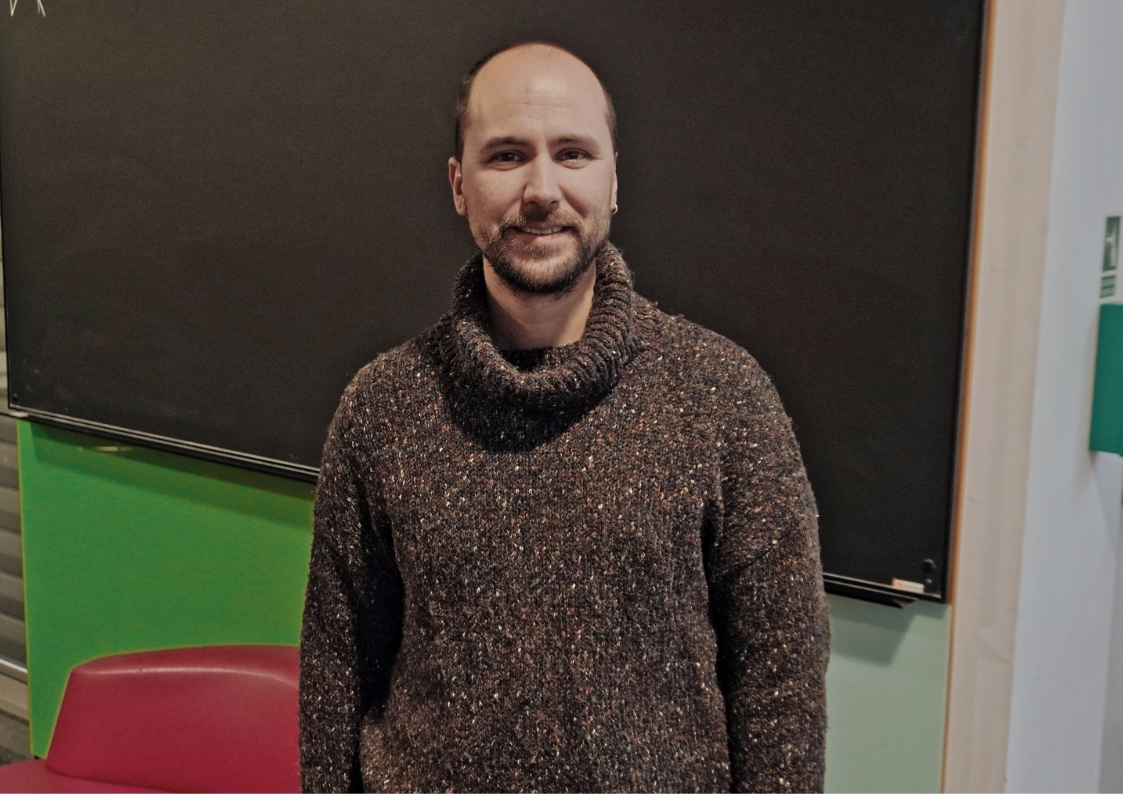
Axel Masó Returns to CRM as a Postdoctoral Researcher
Axel Masó returns to CRM as a postdoctoral researcher after a two-year stint at the Knowledge Transfer Unit. He joins the Mathematical Biology research group and KTU to work on the Neuromunt project, an interdisciplinary initiative that studies...
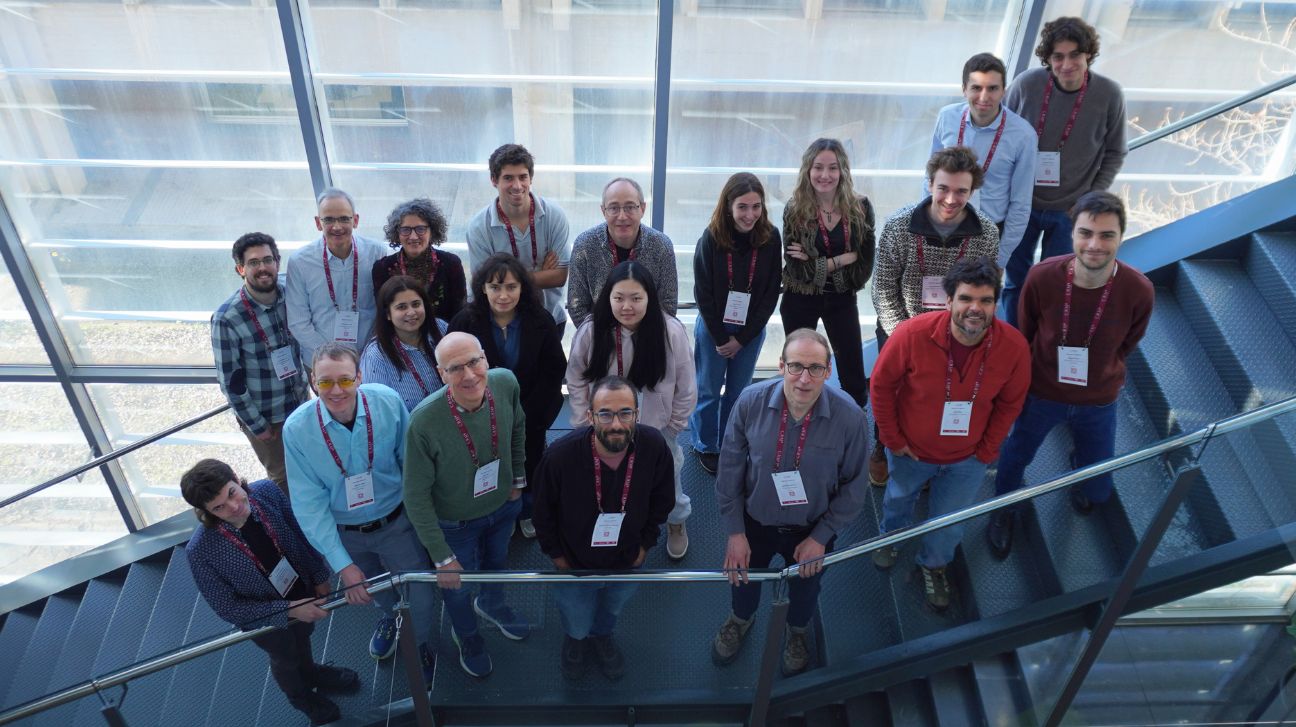
The 4th Barcelona Weekend on Operator Algebras: Open Problems, New Results, and Community
The 4th Barcelona Weekend on Operator Algebras, held at the CRM on January 30–31, 2026, brought together experts to discuss recent advances and open problems in the field.The event strengthened the exchange of ideas within the community and reinforced the CRM’s role...
Criteris de priorització de les sol·licituds dels ajuts Joan Oró per a la contractació de personal investigador predoctoral en formació (FI) 2026
A continuació podeu consultar la publicació dels criteris de priorització de les sol·licituds dels ajuts Joan Oró per a la contractació de personal investigador predoctoral en formació (FI 2026), dirigits a les universitats públiques i privades del...
Mathematics and Machine Learning: Barcelona Workshop Brings Disciplines Together
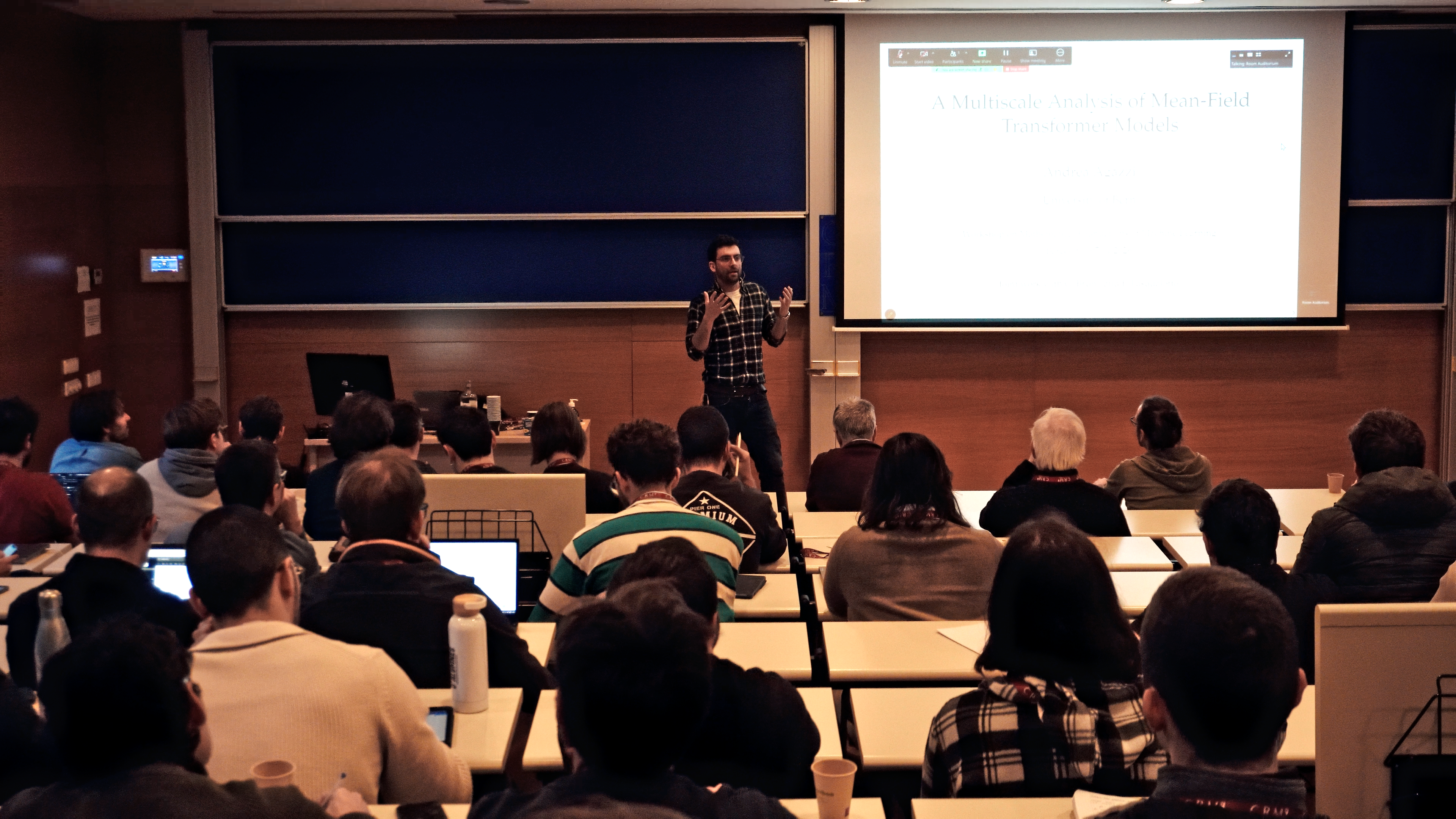
Over 100 researchers gathered at the Centre de Recerca Matemàtica to explore the mathematical foundations needed to understand modern artificial intelligence. The three-day workshop brought together mathematicians working on PDEs, probability, dynamical systems, and...