

Cambridge University Press has published Single and Multiple Number Series, volume 189 of its Encyclopedia of Mathematics and Its Applications. The book is the work of four authors: Alberto Debernardi Pinos (Universitat Autònoma de Barcelona), Elijah Liflyand (Bar-Ilan University), Sergey Tikhonov (ICREA, CRM) and Maria Zeltser (Tallinn University).
The theory of number series sits at the base of much of analysis. Deciding whether an infinite sum settles on a finite value or grows without bound is a question with two centuries of history behind it, and most of the classical convergence tests, from Cauchy’s condensation test to the integral test, answer it under one standing assumption: that the terms of the series decrease in an orderly, monotone way. In practice, that assumption often fails. The coefficient sequences that arise in Fourier analysis, for instance, tend to oscillate as they decay, and the classical tests, read strictly, do not apply to them.
A central line of the book examines how far this monotonicity condition can be relaxed while the classical results remain true. The authors work with two weaker notions. Weak monotonicity allows a term to exceed its neighbours within a fixed factor, and turns out to be enough for several of the recognised tests to survive. Where it does not suffice, the book turns to general monotone sequences, a class Tikhonov introduced in the mid-2000s that has since become a standard tool in Fourier and functional analysis. Rather than the size of the terms, the condition controls the total variation of the sequence against the magnitude of its own terms. Under these relaxed conditions, many convergence and divergence tests apply to a considerably wider set of series than the ones they were originally written for.
The second half of the book moves to higher dimensions. For double and multiple series the notion of convergence itself is no longer unique, since the partial sums can be ordered in several ways that do not always agree, a difficulty first examined systematically by Pringsheim around 1900. The volume treats the two-dimensional case in a survey form and then develops the theory in arbitrary dimension with full proofs. According to the authors, it is the first detailed book-length presentation of the theory of multiple number series.
The text is organised in three parts of three chapters, covering single, double and multiple series in turn. Each chapter closes with historical notes tracing the origin of its results, and the volume includes a table of correspondences between the one-dimensional theorems and their higher-dimensional counterparts. Power series and functional series are deliberately left outside its scope. The book is addressed to a wide readership, from undergraduate students to specialists in the field.
Sergey Tikhonov has been an ICREA Research Professor at the CRM since 2012. His research areas are Fourier analysis and approximation theory.
Single and Multiple Number Series. Alberto Debernardi Pinos, Elijah Liflyand, Sergey Tikhonov and Maria Zeltser. Encyclopedia of Mathematics and Its Applications 189, Cambridge University Press, 2026. DOI: 10.1017/9781009562973.
|
|
CRM CommPau Varela
|
Newsletter
Get the latest CRM news and activities delivered to your inbox
Subscribe now

The CRM Mentoring Programme, as Told by One of Its Pairs
PhD student Joaquim Duran and mathematician Robert Cardona, one of the pairs in the CRM Mentoring ProgrammeJoaquim Duran (left) and Robert Cardona.CRM CommPau VarelaCRMComm@crm.catGet the latest CRM news and activities in your inbox.Recent...
When the reward comes within reach, the brain changes what it compares
As the tokens piled up, choices got faster and more accurate at the same time. The yardstick for judging each offer had moved.CRM CommPau VarelaCRMComm@crm.catGet the latest CRM news and activities in your inbox.Recent newsletters →Two subjects...

Almost every automaton can be reset with a short word
For a random automaton with n states, a word of about √n log n letters is almost always enough to reset it.CRM CommPau VarelaCRMComm@crm.catGet the latest CRM news and activities in your inbox.Recent newsletters →Picture a conveyor belt carrying...
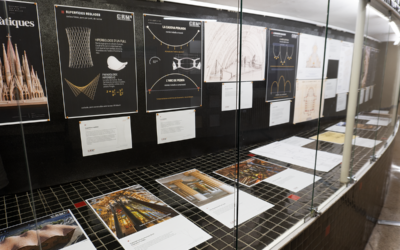
Exposició ‘Les matemàtiques de Gaudí’

CRM quod erat demonstrandum | 48

ADA: Decoding Brain Signals Misaligned in Time
The study addresses a key limitation of current brain decoding techniques: the difficulty of interpreting internal mental processes whose temporal dynamics vary from trial to trial.Decoding what is happening in a person’s mind from their brain activity is one of the...
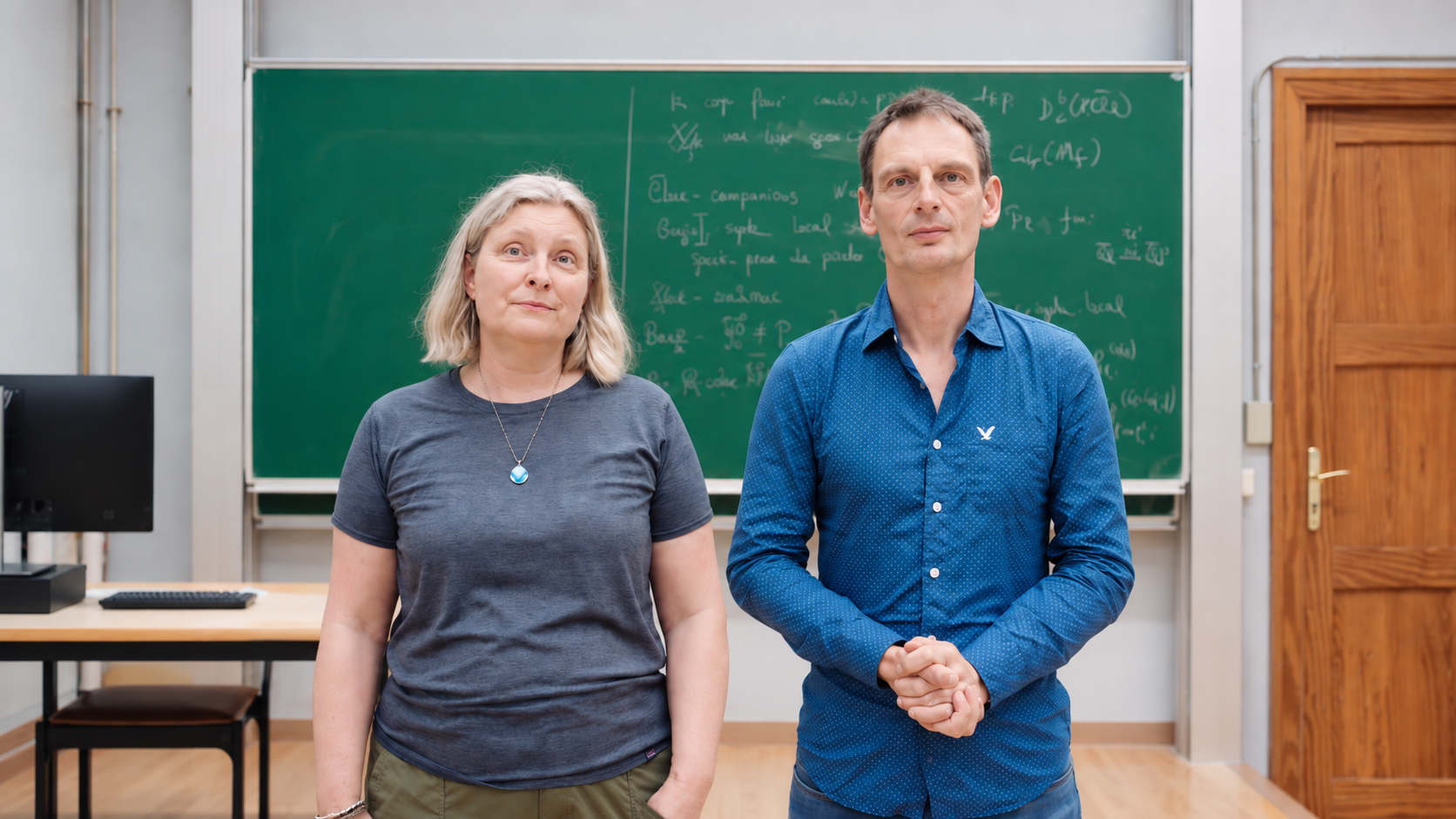
Rare curves, many points: Christophe Ritzenthaler and Rachel Pries on their research and the work around it
Christophe Ritzenthaler (Université de Rennes) and Rachel Pries (Colorado State University) both work on curves over finite fields: he hunts curves with as many points as possible, she hunts curves that almost never occur. In conversation with the CRM during their...

Call open for the 2027 Ferran Sunyer i Balaguer Prize
The Ferran Sunyer i Balaguer Foundation is accepting submissions for its 2027 prize, which awards 15,000 euros and publication in Birkhäuser's Progress in Mathematics series to an expository monograph on an active area of mathematical research. The deadline is 27...
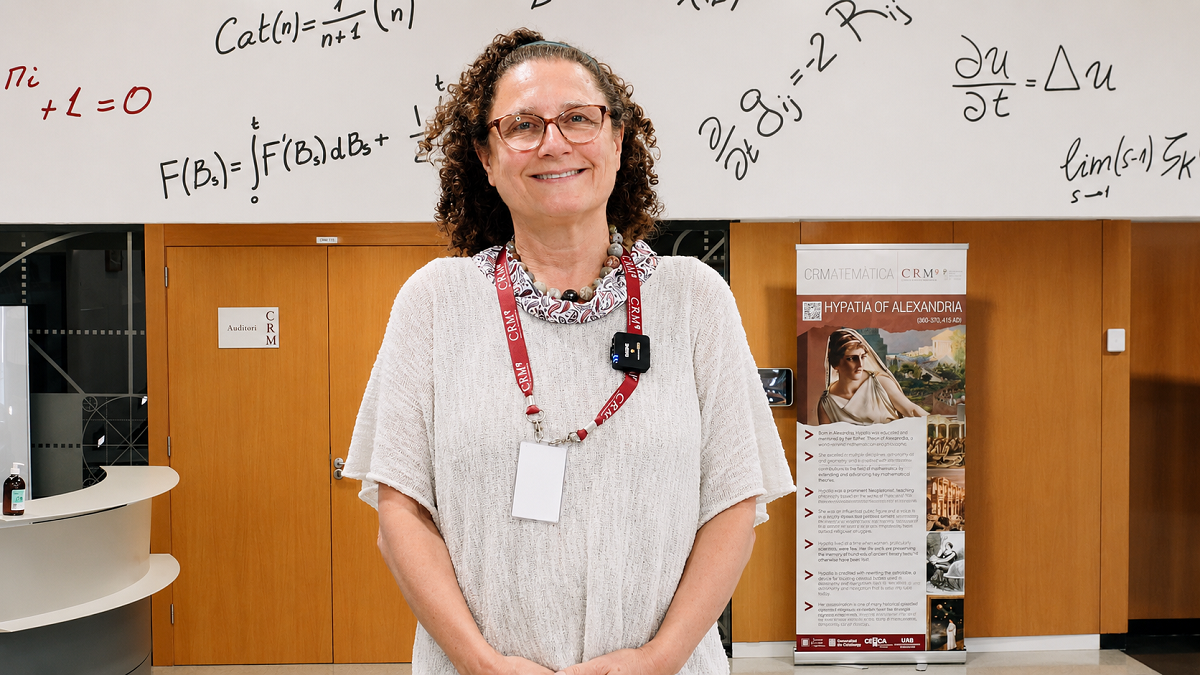
Susanna Terracini delivers the CRM Colloquium 2026
Susanna Terracini (Università di Torino) delivered the CRM Colloquium 2026 on 14 July, presenting a rigidity result for Kepler billiards obtained with Stefano Baranzini, Vivina Barutello and Irene De Blasi. She was at the centre as a member of the CRM Scientific...
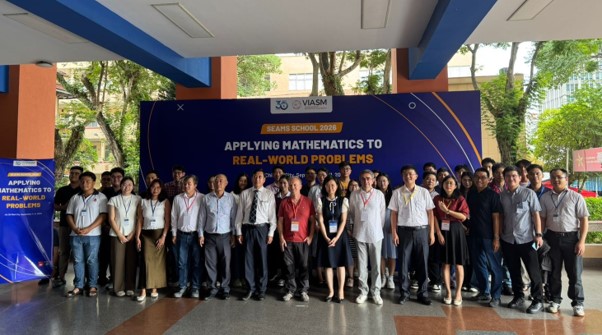
Ho Chi Minh City hosts the SEAMS School on applying mathematics to real-world problems
Students from across the region took courses and worked on group projects at a school co-organised by CRM researcher Tim Myers.CRM CommPau VarelaCRMComm@crm.catGet the latest CRM news and activities in your inbox.Recent newsletters →Between 4 and...

A single ball on a fixed table can compute: Eva Miranda and Isaac Ramos prove that two-dimensional billiards are Turing complete
Eva Miranda (UPC, CRM) and Isaac Ramos (ETH Zürich) show that a point particle bouncing inside a planar table with fixed walls can simulate a universal Turing machine, settling a question Cristopher Moore left open in 1990. The result grew out of a master’s project...
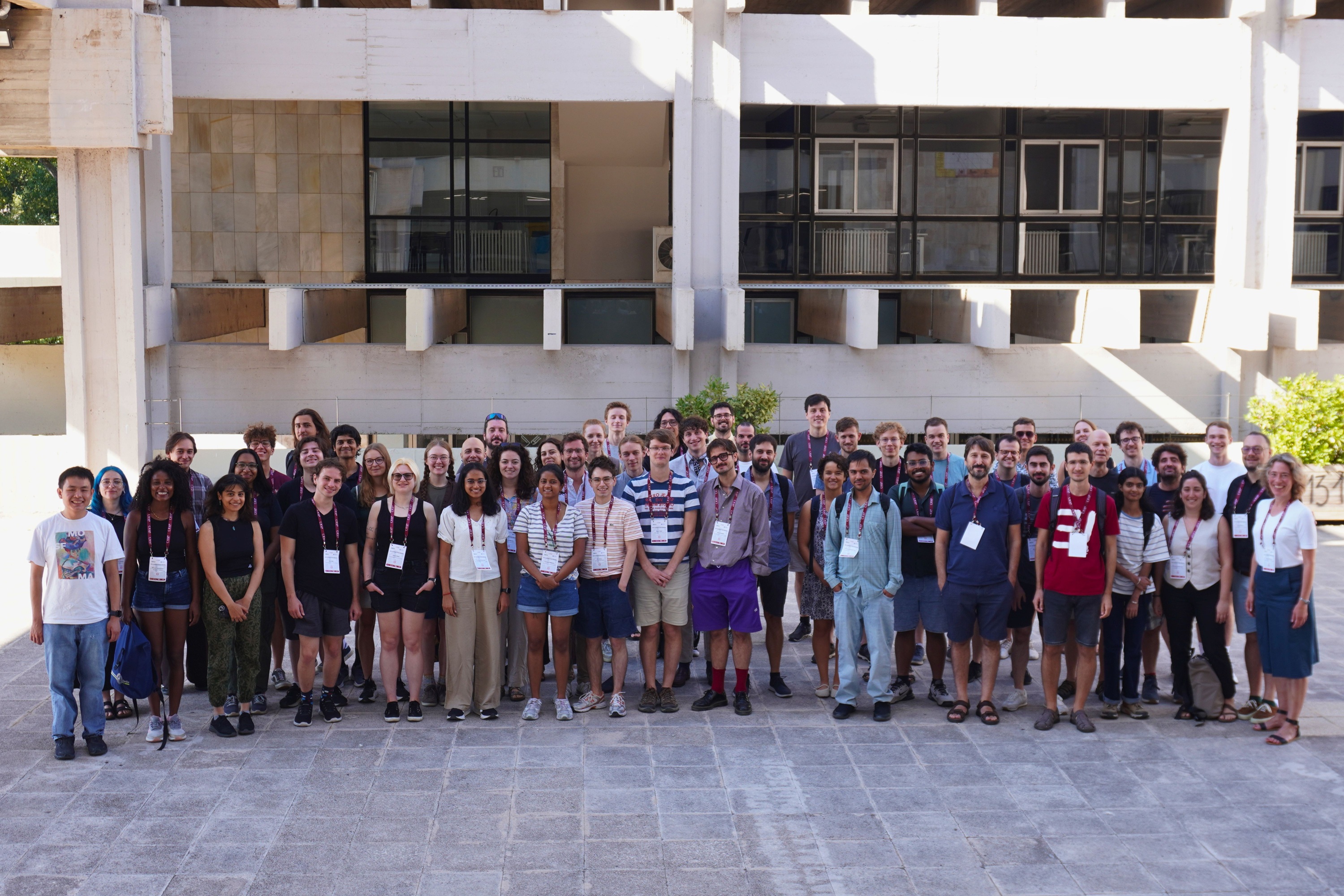
BMS-BGSMath Junior Meeting 2026: Barcelona and Berlin Strengthen Scientific Ties
From 2 to 4 September 2026, the Centre de Recerca Matemàtica (CRM) hosted the BMS-BGSMath Junior Meeting 2026, a three-day event jointly organised by the Berlin Mathematical School (BMS) and the Barcelona Graduate School of Mathematics (BGSMath), with the Centre de...