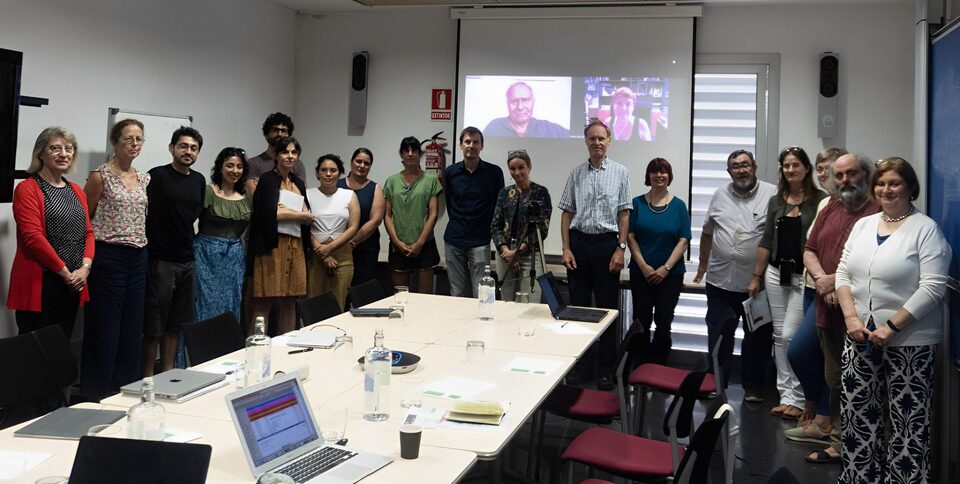
- The CRM Scientific Advisory Board (SAB), comprising distinguished international mathematicians, held its annual meeting from July 8th to 10th, coinciding with CRM’s 40th anniversary, focusing on advising CRM’s strategic direction and evaluating its research program.
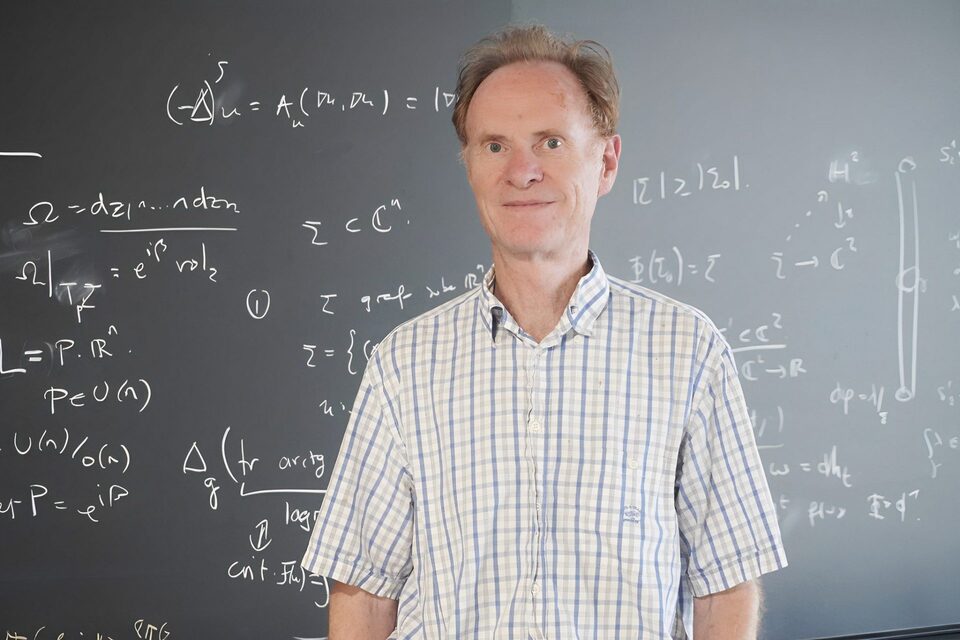
- We spoke with Robert MacKay, chair of the Scientific Advisory Board, about the changes and challenges that the CRM has experienced in recent years.
The Scientific Advisory Board (SAB) of the Centre de Recerca Matemàtica (CRM) held its annual meeting from July 8 to 10. As a key body in guiding the centre’s strategic direction and shaping its scientific programme, the SAB plays a crucial role in the CRM’s development. The board comprises distinguished scientists from prestigious institutions worldwide, including Professor Nicolas Brunel from Duke University, Professor Helen Byrne from Oxford University, Professor Albert Cohen from Université Pierre et Marie Curie, Professor Kathryn Hess from École Polytechnique Fédérale de Lausanne, Professor Ari Laptev from Imperial College London, Professor Gábor Lugosi from Universitat Pompeu Fabra, Professor Alessandra Micheletti from Università degli Studi di Milano, Professor Carmen Miguel from Universitat de Barcelona, Professor Peregrina Quintela from Universidad de Santiago de Compostela, Professor Mikhail Sodin from Tel Aviv University, and Professor Katrin Wendland from Trinity College Dublin.
This year’s meeting was particularly significant as it coincided with CRM’s 40th anniversary. Established in 1984, CRM has grown into a leading institution for mathematical research in Spain and beyond. Speaking with Professor Robert MacKay, Chair of the Scientific Advisory Board (SAB) for the past four years and a faculty member at the University of Warwick, he emphasized the board’s role in shaping CRM’s strategic direction.
“The role of the CRM Advisory Board is to advise the director and the management of the centre on its research agenda and to carry out evaluations of research done at CRM,” MacKay explained. He highlighted the recent shift towards a more structured assessment process, which now includes formal evaluations of research staff as well as approval of the affiliation of researchers from three of the universities in Barcelona: Universitat de Barcelona, Universitat Politècnica de Catalunya, and Universitat Autònoma de Barcelona.
Navigating Challenges and Embracing Change
CRM has faced numerous challenges in the last few years, particularly in aligning with local, national, and international funding systems. MacKay, who first visited the CRM as an invited researcher in 1987, pointed out that centre “has had to reinvent itself to fit with what the funding agencies would like to see, particularly through the affiliation process.” With over 80 affiliated researchers, CRM boasts a broad range of research topics as well. Balancing this diversity, from pure mathematics to applied fields, requires careful coordination.
MacKay stressed the importance of maintaining an open dialogue between different research groups to encourage interdisciplinary collaboration. “There is a big difference in approach between some of the more traditional “pure” mathematicians and those involved in real-world applications,” MacKay said. “Encouraging more integration is important, as mathematical tools developed for pure interest can often be applied to real-world problems and real-world problems can stimulate new mathematics.”
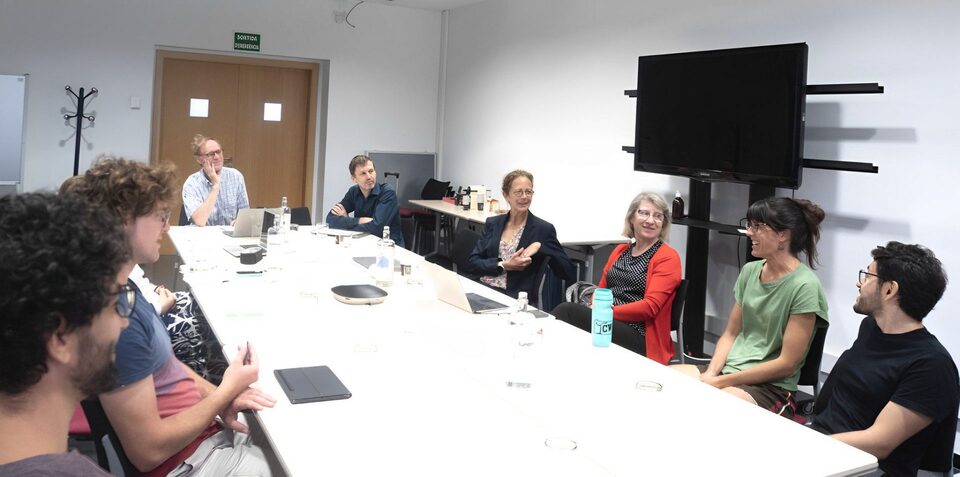
CRM’s capacity to attract international talent is a testament to its strong research groups and unique opportunities for PhD students and postdocs. The centre provides a distinctive experience compared to classical universities, making it an attractive destination for budding mathematicians. “We had the pleasure of speaking with some of the CRM PhD and Postdoctoral researchers during the SAB meeting. The strong research groups at CRM, including the broader CRM with the affiliations, make it an attractive place to be.” MacKay stated.
Looking to the future, “The opportunity is there to be a leading research centre for mathematics in Catalonia and internationally,” MacKay noted. “The challenges seem to be mainly at the bureaucratic level, in order to obtain funding and make the necessary agreements with agencies and other institutions needed for CRM’s effective operation.”
As CRM celebrates its 40th anniversary, it continues to build on its rich legacy, adapting to new scientific challenges and fostering a vibrant, interdisciplinary research community. The guidance from the Scientific Advisory Board and its members will be instrumental in navigating the path ahead and seizing the opportunities to further consolidate CRM’s standing in mathematical research.
Subscribe for more CRM News
|
|
CRM CommPau Varela & Mariona Fucho
|
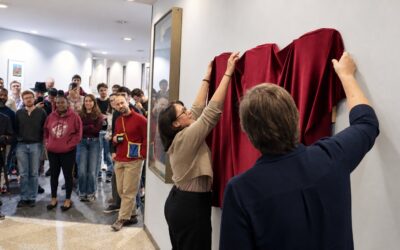
The CRM opens the academic year and unveils its Directors’ Gallery
A review of the year, the Communication Plan 2026–2030 and three research talks filled the morning of 19 October.The unveiling of the Directors’ Gallery.CRM CommPau VarelaCRMComm@crm.catGet the latest CRM news and activities in your inbox.Recent...
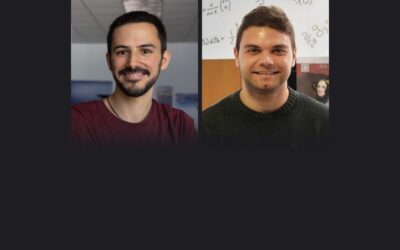
The CRM Mentoring Programme, as Told by One of Its Pairs
PhD student Joaquim Duran and mathematician Robert Cardona, one of the pairs in the CRM Mentoring ProgrammeJoaquim Duran (left) and Robert Cardona.CRM CommPau VarelaCRMComm@crm.catGet the latest CRM news and activities in your inbox.Recent...
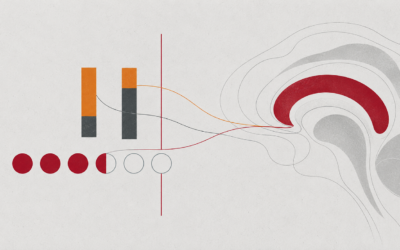
When the reward comes within reach, the brain changes what it compares
As the tokens piled up, choices got faster and more accurate at the same time. The yardstick for judging each offer had moved.CRM CommPau VarelaCRMComm@crm.catGet the latest CRM news and activities in your inbox.Recent newsletters →Two subjects...

Almost every automaton can be reset with a short word
Guillaume Chapuy (Université Paris Cité, CNRS) and Guillem Perarnau (UPC, CRM) have shown that a random finite automaton with n states can, with high probability, be reset by a word of length of order √n log n. The result, published in ACM Transactions on Algorithms, pins the exponent at 1/2, the lower end of a decade of numerical estimates, and addresses the random version of the synchronization problem behind a conjecture Ján Černý posed in 1964 and which still remains open.
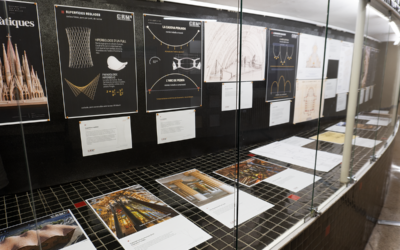
Exposició ‘Les matemàtiques de Gaudí’
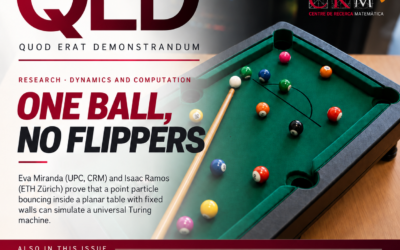
CRM quod erat demonstrandum | 48

ADA: Decoding Brain Signals Misaligned in Time
The study addresses a key limitation of current brain decoding techniques: the difficulty of interpreting internal mental processes whose temporal dynamics vary from trial to trial.Decoding what is happening in a person’s mind from their brain activity is one of the...
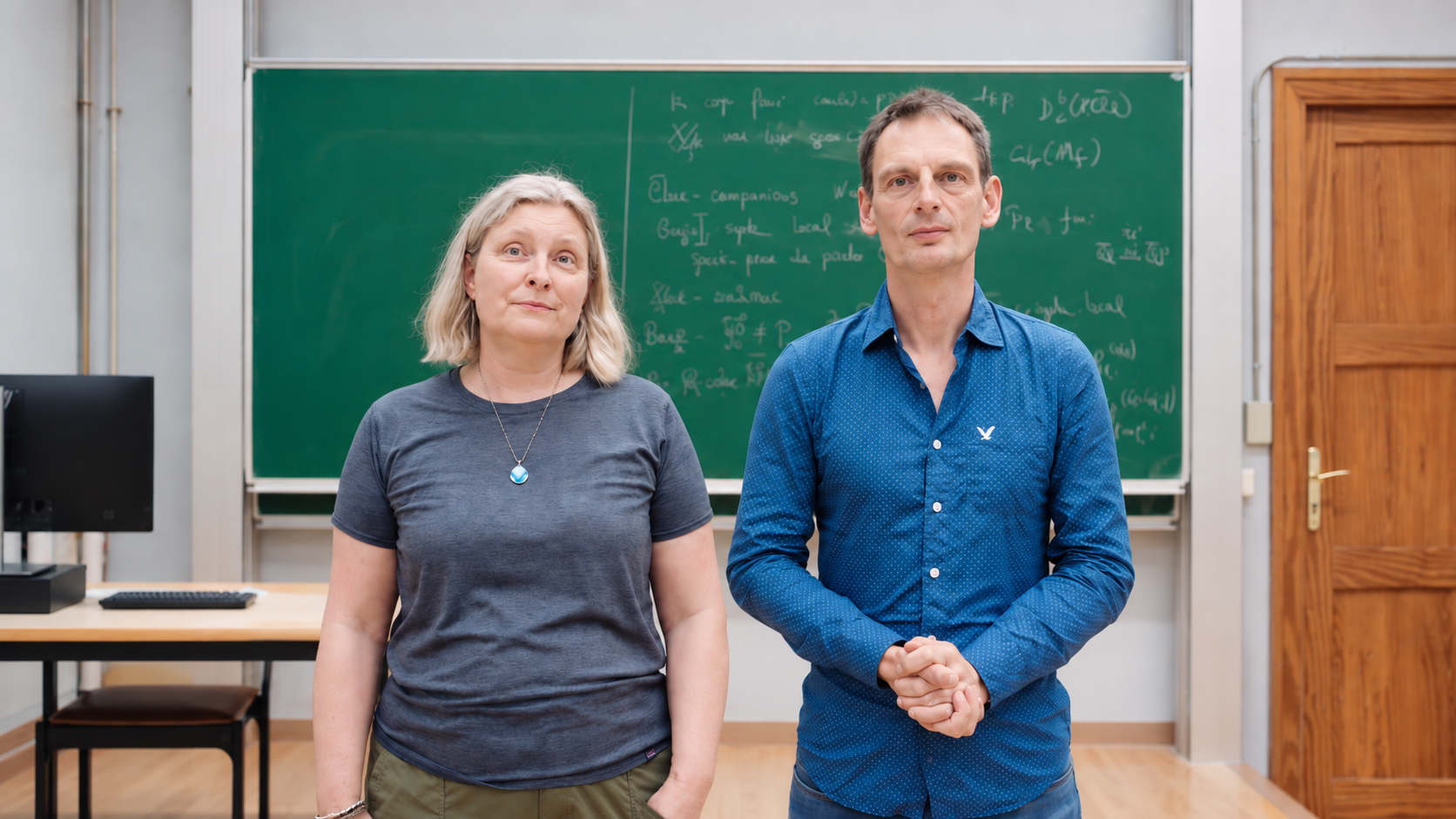
Rare curves, many points: Christophe Ritzenthaler and Rachel Pries on their research and the work around it
Christophe Ritzenthaler (Université de Rennes) and Rachel Pries (Colorado State University) both work on curves over finite fields: he hunts curves with as many points as possible, she hunts curves that almost never occur. In conversation with the CRM during their...
Call open for the 2027 Ferran Sunyer i Balaguer Prize
The Ferran Sunyer i Balaguer Foundation is accepting submissions for its 2027 prize, which awards 15,000 euros and publication in Birkhäuser's Progress in Mathematics series to an expository monograph on an active area of mathematical research. The deadline is 27...
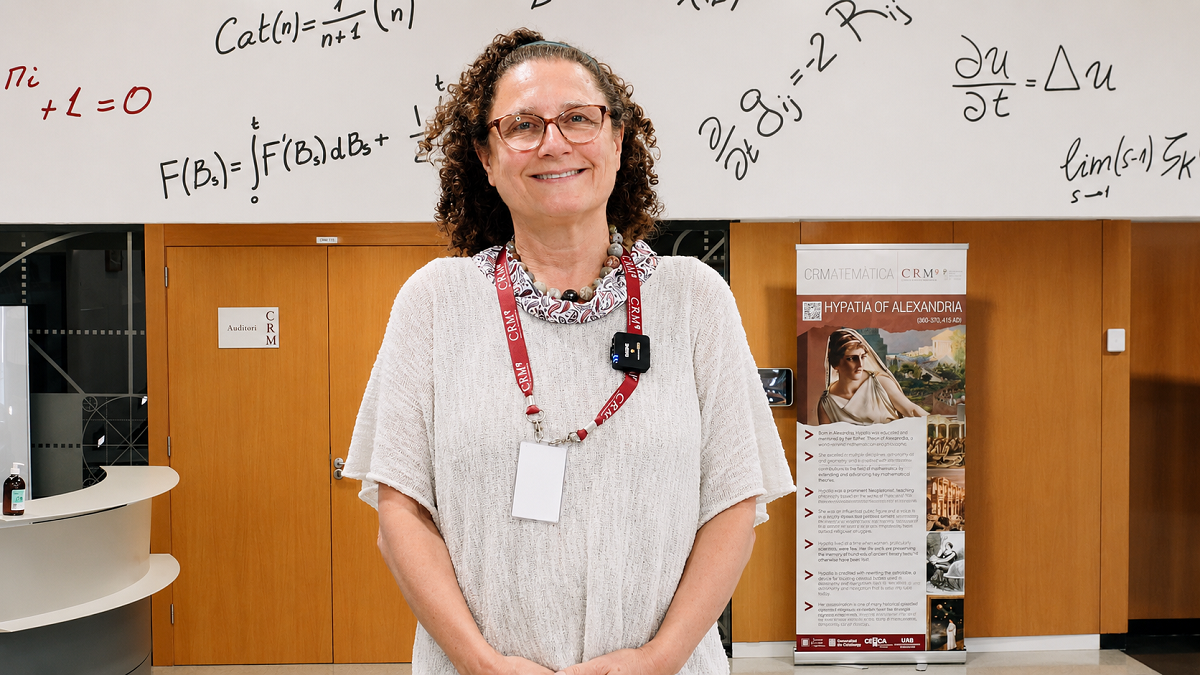
Susanna Terracini delivers the CRM Colloquium 2026
Susanna Terracini (Università di Torino) delivered the CRM Colloquium 2026 on 14 July, presenting a rigidity result for Kepler billiards obtained with Stefano Baranzini, Vivina Barutello and Irene De Blasi. She was at the centre as a member of the CRM Scientific...
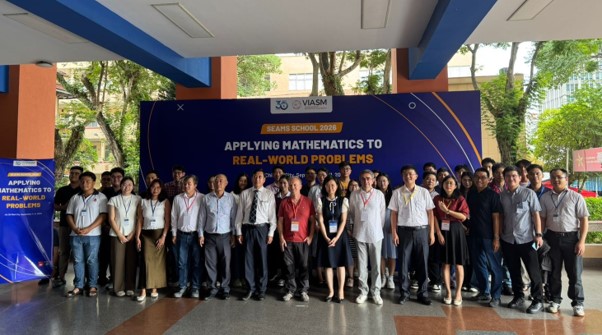
Ho Chi Minh City hosts the SEAMS School on applying mathematics to real-world problems
Students from across the region took courses and worked on group projects at a school co-organised by CRM researcher Tim Myers.CRM CommPau VarelaCRMComm@crm.catGet the latest CRM news and activities in your inbox.Recent newsletters →Between 4 and...

A single ball on a fixed table can compute: Eva Miranda and Isaac Ramos prove that two-dimensional billiards are Turing complete
Eva Miranda (UPC, CRM) and Isaac Ramos (ETH Zürich) show that a point particle bouncing inside a planar table with fixed walls can simulate a universal Turing machine, settling a question Cristopher Moore left open in 1990. The result grew out of a master’s project...