
El CRM rep els estudiants de la prova de nivell de Bojos per les Matemàtiques 2027
The CRM welcomes students from the Bojos per les Matemàtiques 2027 entrance test
Visita guiada al centre i xerrada de Tomás Sanz (UB-CRM) sobre les matemàtiques del so
A guided tour of the centre and a talk by Tomás Sanz (UB-CRM) on the mathematics of sound
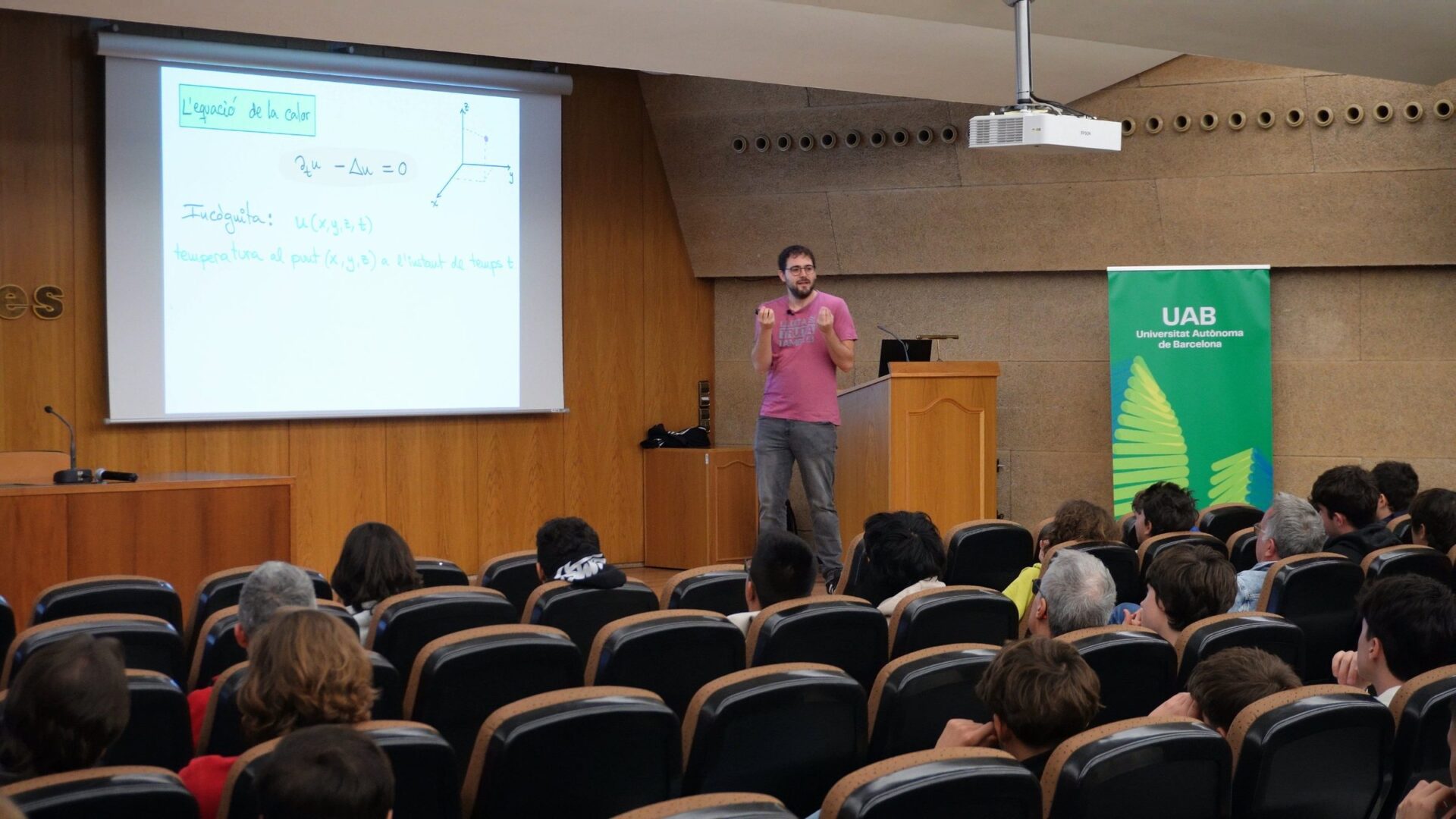
Tomás Sanz presenta l’equació de la calor durant la xerrada «Les matemàtiques del so».
Tomás Sanz presenting the heat equation during his talk on the mathematics of sound.
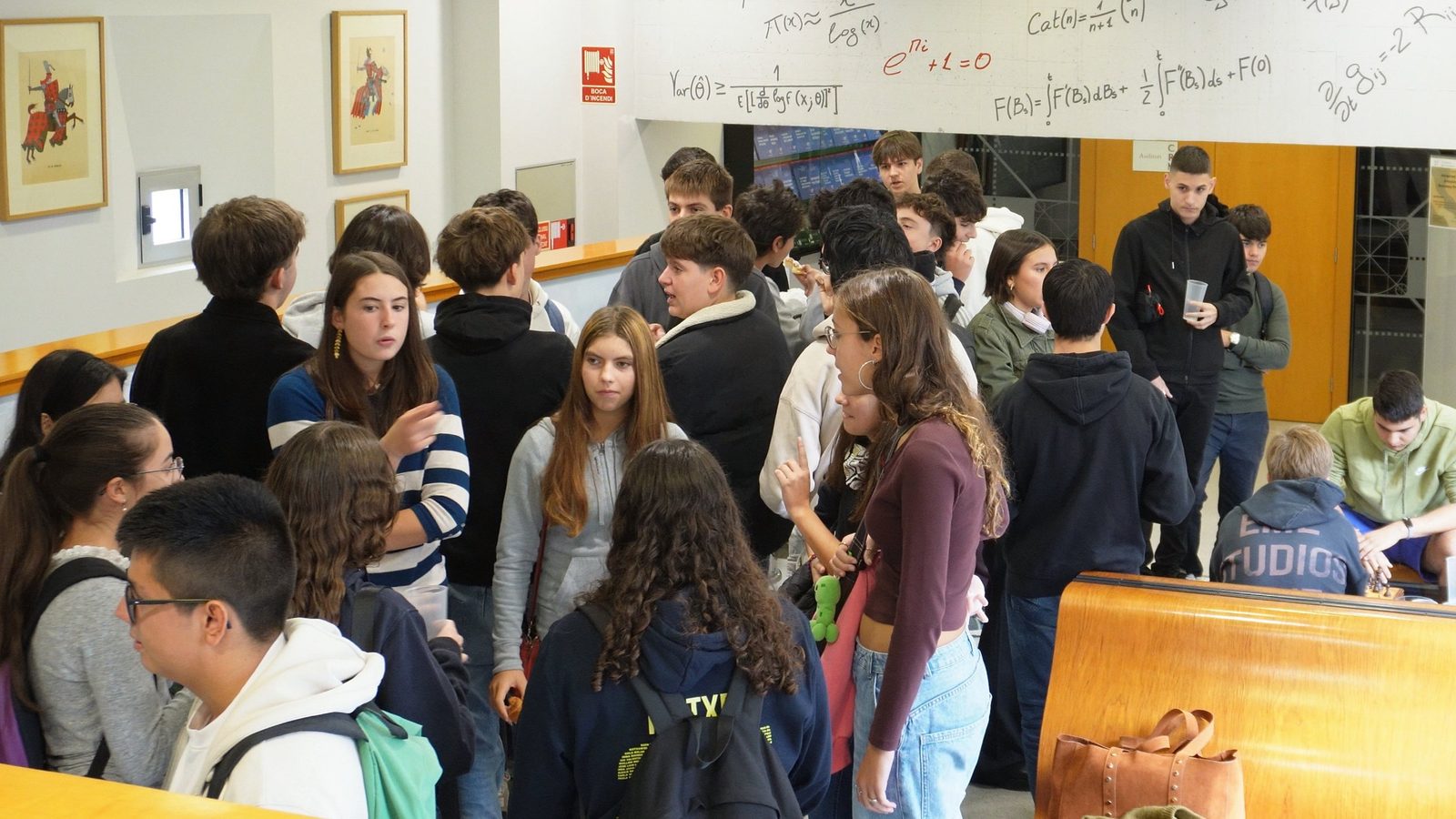
The candidates for Bojos per les Matemàtiques 2027 visited the Centre de Recerca Matemàtica (CRM) on Saturday 24 October, after sitting the entrance test at the UAB Faculty of Sciences and Biosciences. Afterwards, Tomás Sanz (UB-CRM) explained to them what heating an iron bar has to do with WhatsApp voice messages.
Dissabte 24 d’octubre, de deu a dotze, la Facultat de Ciències i Biociències de la UAB va acollir la prova de nivell de Bojos per les Matemàtiques 2027, el primer pas del procés de selecció. És el curs de matemàtiques de Bojos per la Ciència, el programa amb què la Fundació Catalunya La Pedrera acosta la recerca als estudiants de batxillerat, i l’organitza la Societat Catalana de Matemàtiques (SCM) amb la col·laboració del CRM, la UPC, la UAB i la UB.
En acabar la prova, els estudiants van fer una visita guiada al CRM amb Pau Varela, coordinador de comunicació del centre, que els va presentar la història del CRM i la recerca que s’hi fa.
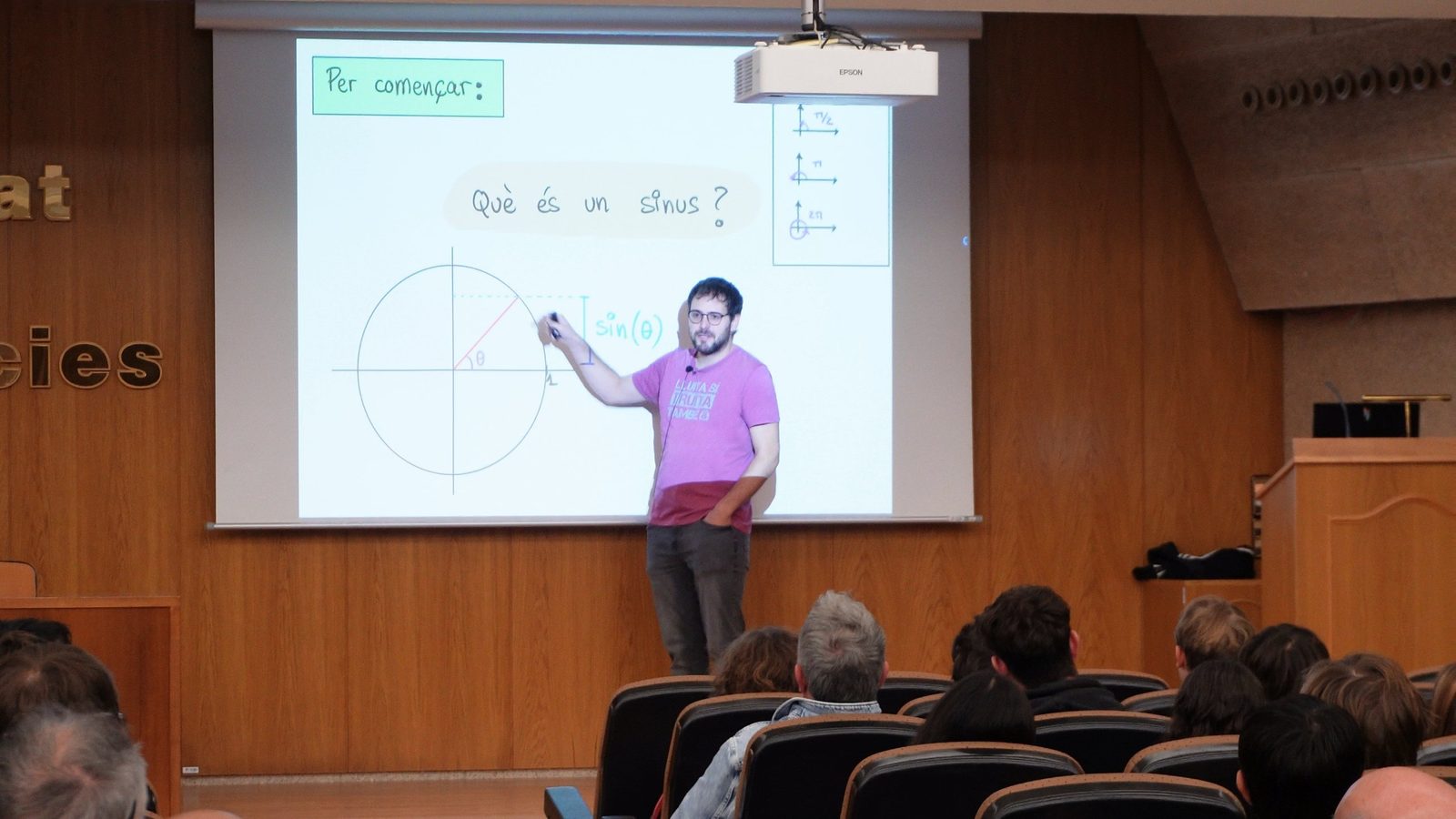
Després, Tomás Sanz (UB-CRM) va oferir la xerrada divulgativa «Les matemàtiques del so». Sanz va començar pels senyals més senzills i les seves característiques, i a continuació va explicar per què l’estudi de com s’escalfa una barra de ferro ha permès enviar àudios de WhatsApp de manera eficient, sense gastar gaires dades. L’origen d’aquesta connexió és el matemàtic francès Joseph Fourier. A principis del segle XIX, mentre estudiava com es propaga la calor, Fourier va proposar escriure una funció com una suma d’ones simples, sinus i cosinus, una idea que va topar amb l’escepticisme de Lagrange. Dos segles després, aquesta manera de descompondre un senyal és a la base de bona part del tractament del so, perquè un àudio es pot desar com el conjunt de les ones que el formen i les que l’oïda amb prou feines percep es poden descartar sense que es noti.
Sanz, professor lector del Departament de Matemàtiques i Informàtica de la UB i investigador adscrit al CRM, es va doctorar a la UPC i ha treballat de matemàtic en centres de recerca i universitats de Bilbao, Edimburg i Madrid. Investiga equacions en derivades parcials, la família a la qual pertany, precisament, l’equació de la calor. Al seu web, entre els temes que l’interessen, també hi ha la música i la modelització matemàtica.
Els seleccionats es coneixeran a partir del 23 de novembre i començaran el curs el 9 de gener. Segons el calendari provisional, seran dinou dissabtes fins al 5 de juny, a la Facultat de Matemàtiques i Estadística de la UPC, a la UAB, a la Facultat de Matemàtiques i Informàtica de la UB i, l’últim dia, al Museu del Tèxtil i l’Aigua de Manresa.
Cinc de les dinou sessions les faran quatre investigadors del CRM. Pablo Nicolás, doctorand del CRM, farà les dues de geometria no euclidiana, el 23 i el 30 de gener. Al febrer, Natàlia Castellana (UAB-CRM) els introduirà en la topologia i, una setmana després, Marc Masdeu (UAB-CRM) els parlarà dels nombres primers que fem servir cada dia sense saber-ho. La sessió de cloenda, el 5 de juny a Manresa, serà de Gemma Huguet (UPC-CRM), que presentarà els models matemàtics que ajuden a entendre com decideix el cervell quan la informació que rep és ambigua.
Al maig, Albert Granados, coordinador del curs, dedicarà dues sessions a les matemàtiques del so, el mateix tema de la xerrada de dissabte.
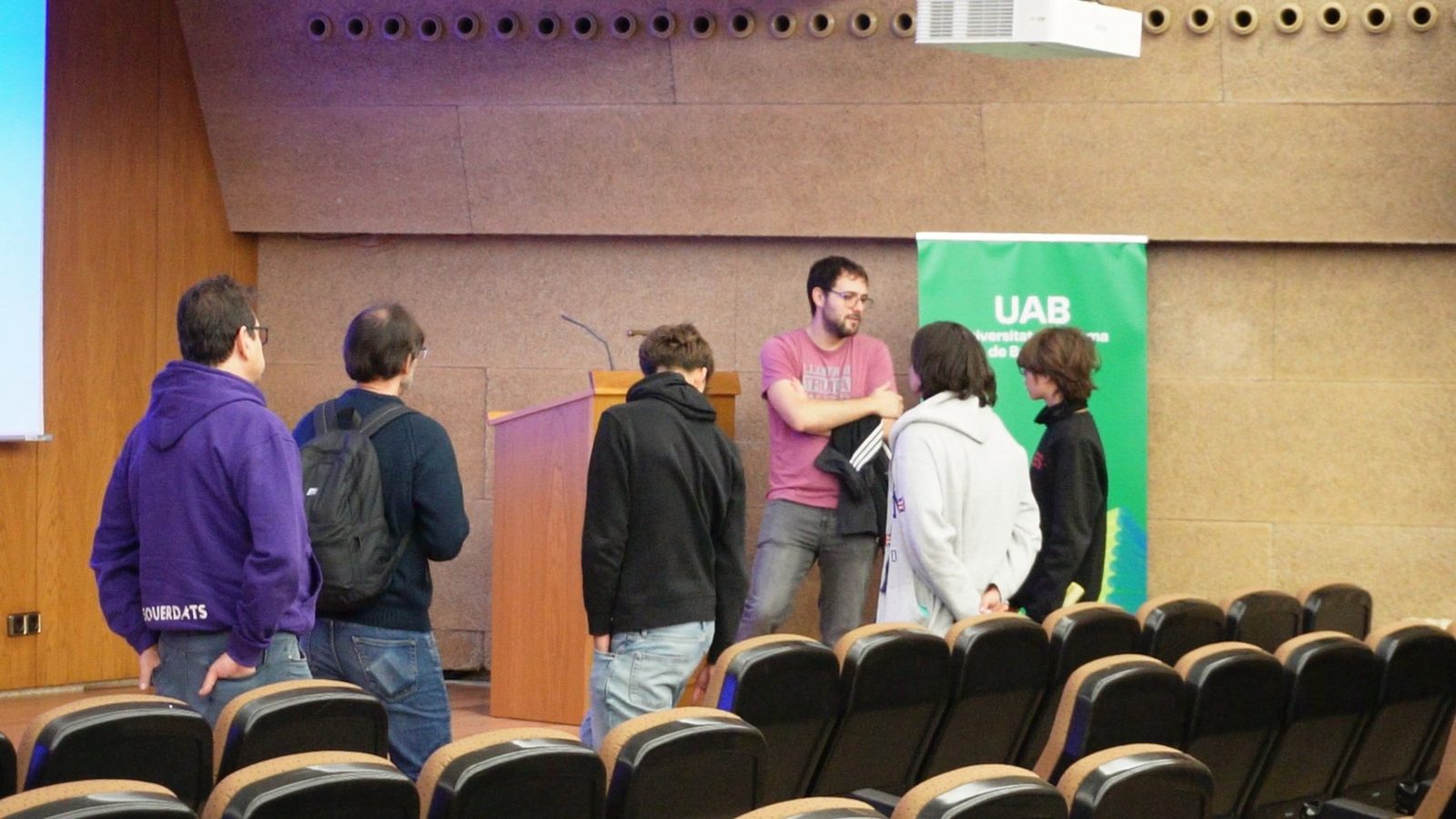
On Saturday 24 October, from 10 am to noon, the UAB Faculty of Sciences and Biosciences hosted the entrance test for Bojos per les Matemàtiques 2027, the first step in the selection process. Bojos per les Matemàtiques is the mathematics course of Bojos per la Ciència, the programme through which the Fundació Catalunya La Pedrera brings research closer to upper-secondary students. It is organised by the Societat Catalana de Matemàtiques (SCM) in collaboration with the CRM, the UPC, the UAB and the UB.
After the test, the students went on a guided tour of the CRM with Pau Varela, the centre’s communication coordinator, who introduced them to the history of the CRM and the research carried out there.
Then Tomás Sanz (UB-CRM) gave the outreach talk “Les matemàtiques del so” (The mathematics of sound). Sanz began with the simplest signals and their properties, and then explained why studying how an iron bar heats up has made it possible to send WhatsApp voice messages efficiently, without using much data. The connection goes back to the French mathematician Joseph Fourier. In the early nineteenth century, while studying how heat spreads, Fourier proposed writing a function as a sum of simple waves, sines and cosines, an idea that met with Lagrange’s scepticism. Two centuries later, this way of breaking down a signal underpins much of sound processing, because an audio file can be stored as the set of waves that make it up, and those the ear can barely perceive can be discarded without anyone noticing.
Sanz, a tenure-track lecturer in the Department of Mathematics and Computer Science at the UB and a researcher affiliated with the CRM, earned his PhD at the UPC and has worked as a mathematician at research centres and universities in Bilbao, Edinburgh and Madrid. His research is on partial differential equations, the very family the heat equation belongs to. On his website, music and mathematical modelling also appear among his interests.
The selected students will be announced from 23 November and will start the course on 9 January. According to the provisional calendar, the course will run over nineteen Saturdays until 5 June, at the UPC School of Mathematics and Statistics, the UAB, the UB Faculty of Mathematics and Computer Science and, on the last day, the Museu del Tèxtil i l’Aigua in Manresa.
Five of the nineteen sessions will be given by four CRM researchers. Pablo Nicolás, a PhD student at the CRM, will give the two on non-Euclidean geometry, on 23 and 30 January. In February, Natàlia Castellana (UAB-CRM) will introduce them to topology and, a week later, Marc Masdeu (UAB-CRM) will talk to them about the prime numbers we use every day without realising it. The closing session, on 5 June in Manresa, will be given by Gemma Huguet (UPC-CRM), who will present the mathematical models that help explain how the brain decides when the information it receives is ambiguous.
In May, Albert Granados, the course coordinator, will devote two sessions to the mathematics of sound, the same topic as Saturday’s talk.
More from the CRM
Eight CRM Researchers in the 2026 Stanford-Elsevier List of Highly Cited Scientists
The database ranks scientists by citation impact, over their whole careers and in 2025 aloneCRM CommPau VarelaCRMComm@crm.catGet the latest CRM news and activities in your inbox.Recent newsletters →The 2026 edition of the Stanford-Elsevier database...
Fish schools and growing tissues: a workshop on how collective behaviour emerges
Mathematicians and biologists met at the Institut d’Estudis Catalans to discuss how local interactions shape tissues and animal groups.A talk in the Pere i Joan Coromines room of the Institut d’Estudis Catalans. Image: CRMCRM CommPau...
The CRM opens the academic year and unveils its Directors’ Gallery
A review of the year, the Communication Plan 2026–2030 and three research talks filled the morning of 19 October.The unveiling of the Directors’ Gallery.CRM CommPau VarelaCRMComm@crm.catGet the latest CRM news and activities in your inbox.Recent...
The CRM Mentoring Programme, as Told by One of Its Pairs
PhD student Joaquim Duran and mathematician Robert Cardona, one of the pairs in the CRM Mentoring ProgrammeJoaquim Duran (left) and Robert Cardona.CRM CommPau VarelaCRMComm@crm.catGet the latest CRM news and activities in your inbox.Recent...
When the reward comes within reach, the brain changes what it compares
As the tokens piled up, choices got faster and more accurate at the same time. The yardstick for judging each offer had moved.CRM CommPau VarelaCRMComm@crm.catGet the latest CRM news and activities in your inbox.Recent newsletters →Two subjects...
Almost every automaton can be reset with a short word
For a random automaton with n states, a word of about √n log n letters is almost always enough to reset it.CRM CommPau VarelaCRMComm@crm.catGet the latest CRM news and activities in your inbox.Recent newsletters →Picture a conveyor belt carrying...
Exposició ‘Les matemàtiques de Gaudí’
CRM quod erat demonstrandum | 48
ADA: Decoding Brain Signals Misaligned in Time
The study addresses a key limitation of current brain decoding techniques: the difficulty of interpreting internal mental processes whose temporal dynamics vary from trial to trial.Decoding what is happening in a person’s mind from their brain activity is one of the...
Rare curves, many points: Christophe Ritzenthaler and Rachel Pries on their research and the work around it
Christophe Ritzenthaler (Université de Rennes) and Rachel Pries (Colorado State University) both work on curves over finite fields: he hunts curves with as many points as possible, she hunts curves that almost never occur. In conversation with the CRM during their...
Call open for the 2027 Ferran Sunyer i Balaguer Prize
The Ferran Sunyer i Balaguer Foundation is accepting submissions for its 2027 prize, which awards 15,000 euros and publication in Birkhäuser's Progress in Mathematics series to an expository monograph on an active area of mathematical research. The deadline is 27...