The H12 has run along Gran Via for years. What TMB switched on in July is the set of upgrades designed for it inside eBRT2030, a Horizon Europe project testing electric Bus Rapid Transit in six European cities. Behind it, forecasting passenger demand at every stop hour by hour and four days ahead, is a model built by the CRM’s Knowledge Transfer Unit.
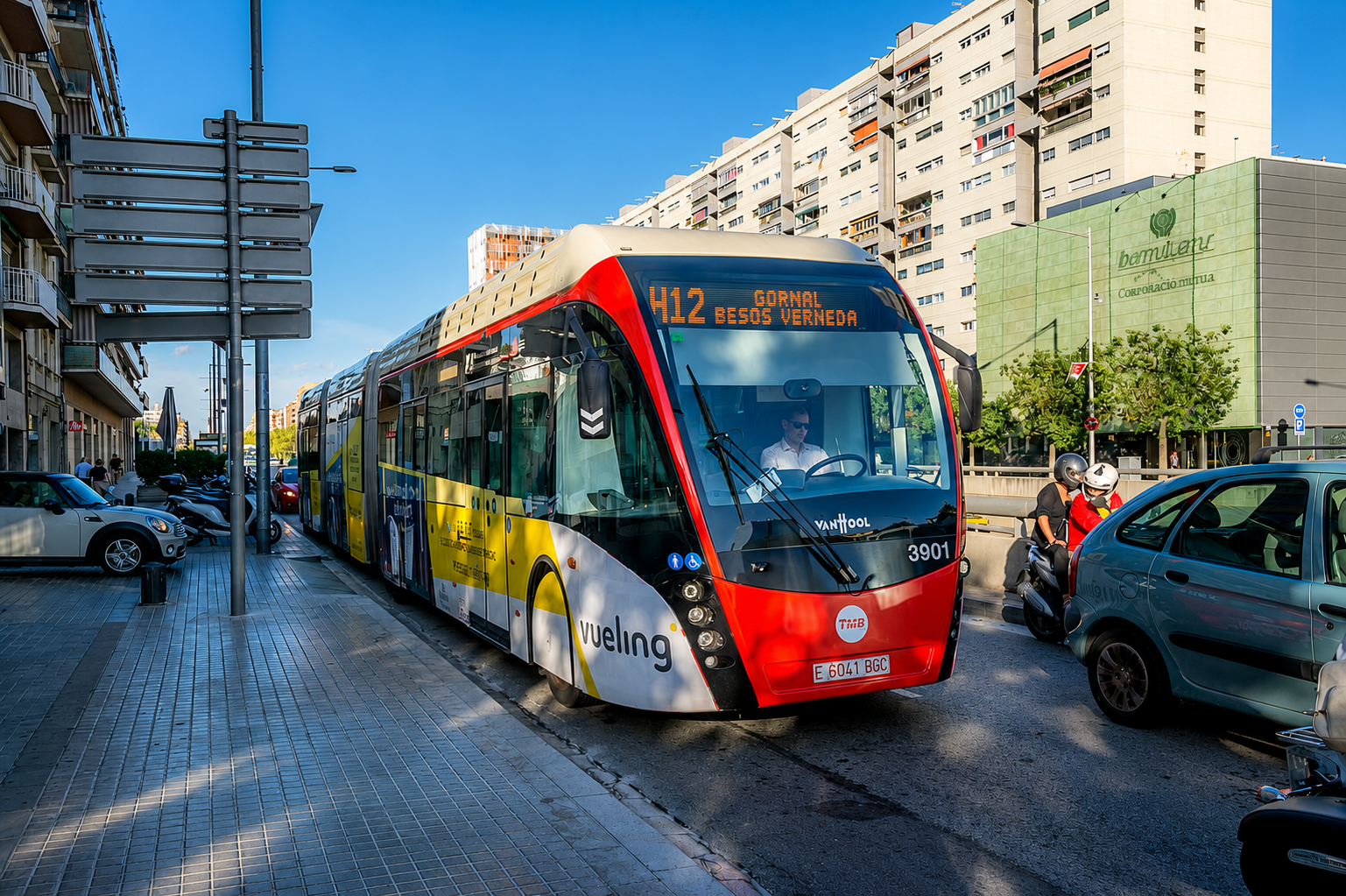
On 8 July, TMB launched the eBRT2030 demonstrator into service on the H12, a bus line that has been running along Gran Via de les Corts Catalanes for years. Among the systems now running on one of Barcelona’s busiest routes is a passenger demand forecasting model built by the CRM’s Knowledge Transfer Unit, which predicts, four days in advance, how many passengers will be at each stop of the line, hour by hour.
The launch caps months of preparation and turns a route that was already there into a live testing ground for electric, high-capacity public transport. eBRT2030 is a Horizon Europe project (grant agreement 101095882) that brings together 49 partners to develop and validate a new generation of electric Bus Rapid Transit systems in six European cities and one international cluster. The project tests new vehicles and charging infrastructure, but also the less visible layers, predictive maintenance and digital twins among them, to show that electric bus systems can be affordable and reliable at the scale a dense city demands. The CRM participates through its Knowledge Transfer Unit.
The collaboration with TMB predates the project. It began with a study on how to transform fixed neighbourhood bus lines, with vehicles circulating almost continuously, into more flexible demand-responsive services. “That first piece of work let us understand the real challenges of operating a network,” explains David Romero, director of the CRM’s Knowledge Transfer Unit, “and it opened the door to joining eBRT2030 as a partner.”
Within the project, the CRM team has built a model that estimates, for each day of the week, how many passengers will be at each stop of the H12 at every hour of service. The predictor starts from TMB’s time series of ticket validations per stop and combines them with weather data, the type of day, the school calendar, trade fairs, and other events. From all this it generates hourly demand forecasts for the four days ahead. Getting it to work has meant solving a long list of small but stubborn problems: stops moved by roadworks, validations that go missing or make no sense, and then the Tour de France coming through. The model is really a set of components that have to run in coordination and survive the irregularities of real life.
The phrase “demand model” makes it sound like one technique. Urban mobility throws up many more. “Behind these problems there is very diverse mathematics: data analysis, time series and statistical modelling, but also optimisation, both to fit the models and to find efficient routes and good operational decisions,” says Romero. Simulation and collective dynamics turn up as well. The unit has supervised master’s theses on how groups of people move through busy transfer areas, the Ernest Lluch interchange among them. “In mobility, almost any branch of mathematics can end up having a relevant role.”
The model’s forecasts serve two purposes. The first is to give the operator grounds for better decisions, such as adjusting service plans or redistributing vehicles before the busy stretches arrive. The second is to study how far passenger peaks can be anticipated, so that supply can adapt dynamically. The mathematics, Romero notes, has to remain workable on the street. “Maybe the model tells you that you’d need five more buses an hour, or one inserted mid-route. But resources are limited, even at TMB, and Barcelona’s traffic imposes very real constraints.”
What the pilot sends back
The H12 is one of the most demanding environments in the whole project: a high-frequency corridor crossing one of Europe’s densest cities, with congested intersections and competing road users, all of it under Mediterranean heat. The demonstration goes well beyond swapping diesel buses for electric ones. TMB has implemented traffic signal priority at 17 intersections along the corridor, and predictive maintenance tools now monitor battery health and energy consumption across the fleet.
“The blackboard can take anything; the city, not always.”
Demand and energy are connected here: more passengers mean more weight and more stops, and therefore higher consumption. Integrating demand, operation and energy into a single decision-making tool is what Barcelona can offer the other demonstration sites. “To my mind, Barcelona is one of the most advanced cities in implementing the project’s demonstrators,” says Romero. Which does not make it a template.
“Every city has a different network, a different urban morphology, different traffic conditions. Some of the measures in the Barcelona demonstrator, certain forms of traffic signal priority for instance, are not necessarily comparable or applicable in other contexts.” The technical visits do travel. Operators walk through another city’s installations, compare problems they recognise, and pick up practices they would probably never have identified from inside their own network.
The pilot also feeds the research back. Validating and refining the model with real operational data is an explicit objective of the demonstration. The team is already comparing what was forecast with what actually happened, and each gap goes back into the model so that it fits Barcelona a little better. Emerging factors are on the list too. “Some studies relate high temperatures and strong sunlight to changes in consumption patterns,” says Romero. “In episodes of extreme heat we will have to check whether mobility habits change as well, and how far that distorts the passenger forecast.”
And although the model was built for the H12, it can be extended to Barcelona’s other high-capacity corridor lines, where the same logic applies. “Nobody enjoys waiting for a bus under a punishing sun,” says Romero, “or travelling packed in like sardines.”
Newsletter
Get the latest CRM news and activities delivered to your inbox
Subscribe now
Recent newsletters →
Susanna Terracini delivers the CRM Colloquium 2026
Susanna Terracini (Università di Torino) delivered the CRM Colloquium 2026 on 14 July, presenting a rigidity result for Kepler billiards obtained with Stefano Baranzini, Vivina Barutello and Irene De Blasi. She was at the centre as a member of the CRM Scientific...
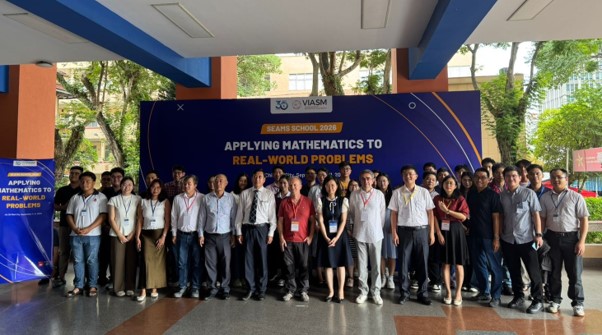
Ho Chi Minh City hosts the first SEAMS School on applying mathematics to real-world problems
More than fifty students from six countries spent a week at the University of Science, VNU-HCM, learning how mathematics gets used outside a mathematics department. CRM researcher Tim Myers co-organised the school and lectured on moving boundary problems. The...

A single ball on a fixed table can compute: Eva Miranda and Isaac Ramos prove that two-dimensional billiards are Turing complete
Eva Miranda (UPC, CRM) and Isaac Ramos (ETH Zürich) show that a point particle bouncing inside a planar table with fixed walls can simulate a universal Turing machine, settling a question Cristopher Moore left open in 1990. The result grew out of a master’s project...
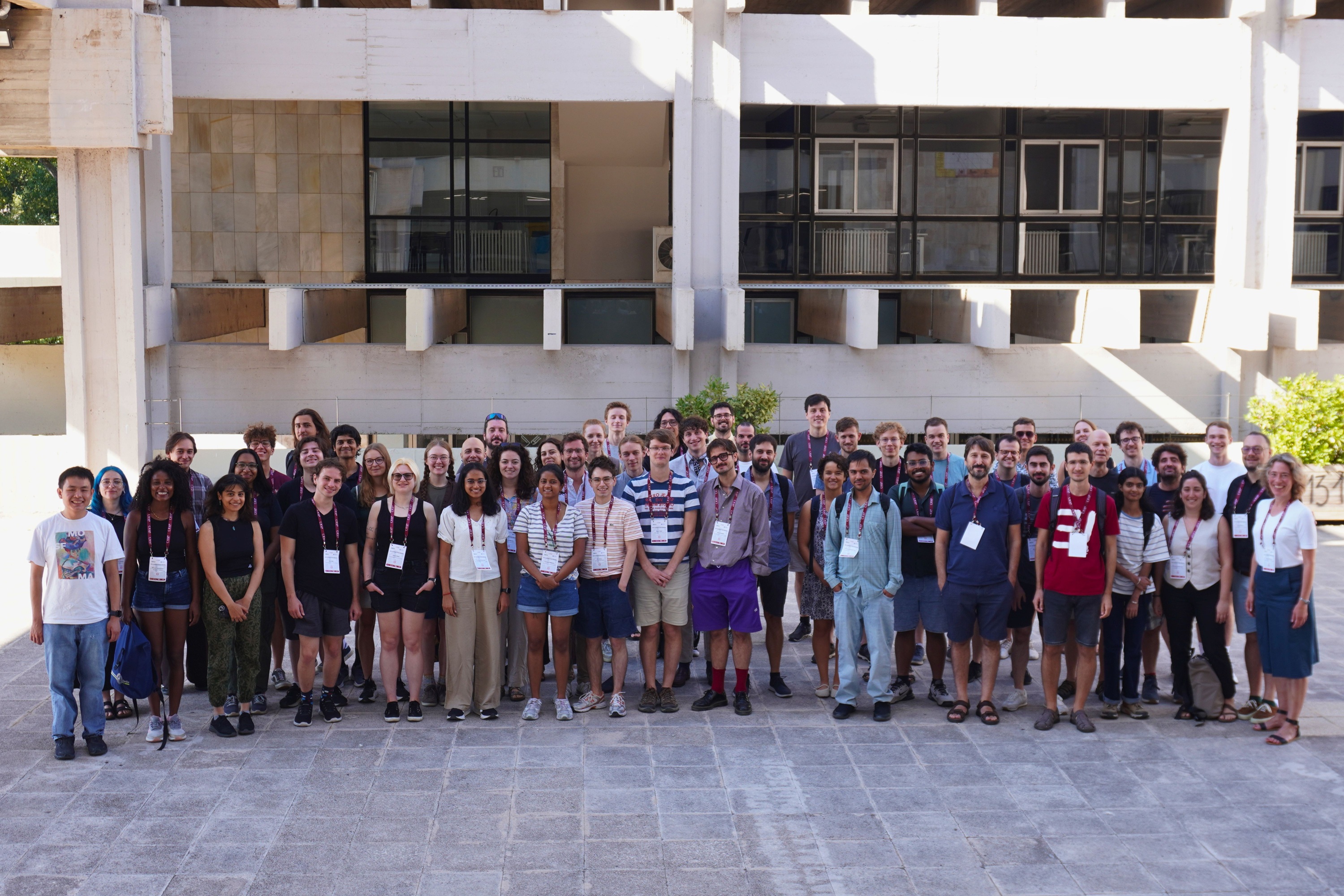
BMS-BGSMath Junior Meeting 2026: Barcelona and Berlin Strengthen Scientific Ties
From 2 to 4 September 2026, the Centre de Recerca Matemàtica (CRM) hosted the BMS-BGSMath Junior Meeting 2026, a three-day event jointly organised by the Berlin Mathematical School (BMS) and the Barcelona Graduate School of Mathematics (BGSMath), with the Centre de...
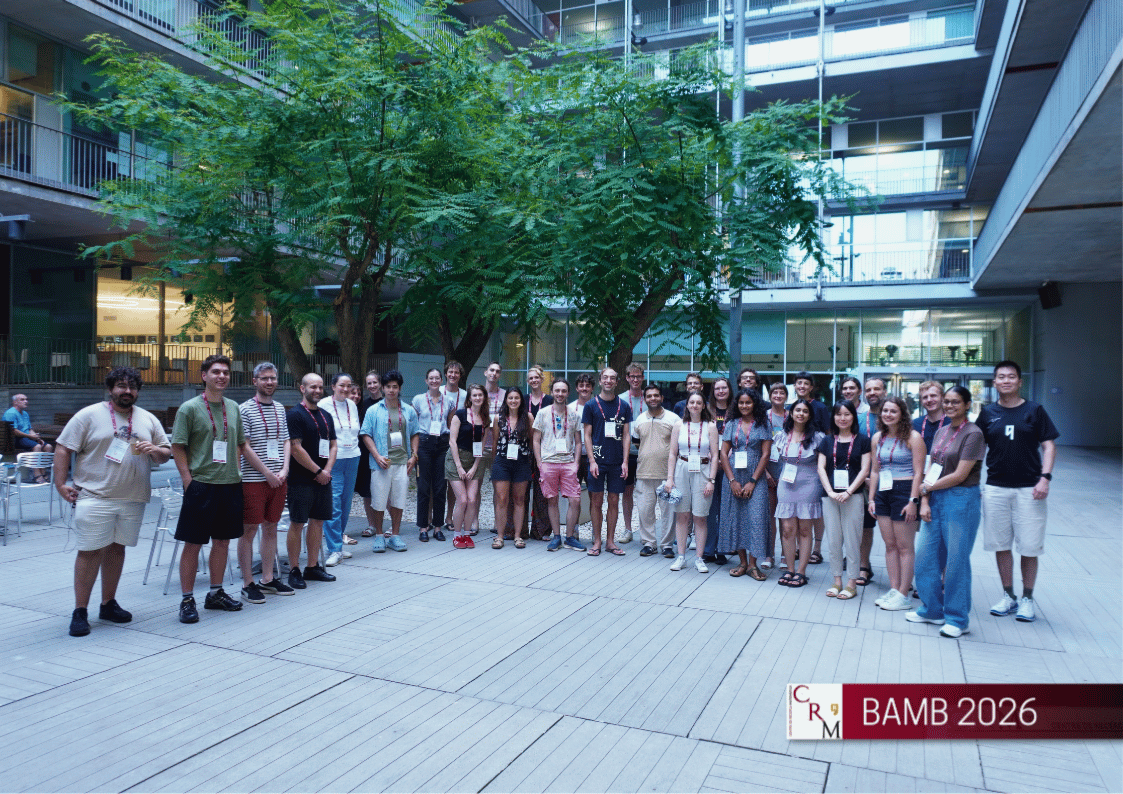
The CRM organises the 2026 Barcelona Summer School for Advanced Modeling of Behavior
The Centre de Recerca Matemàtica held the sixth edition of BAMB!, the Barcelona Summer School for Advanced Modeling of Behavior, from 12 to 23 July 2026 at the Parc de Recerca Biomèdica de Barcelona. Thirty early-career researchers from fourteen countries followed...
|
|
CRM CommPau Varela
|