
in Barcelona Conference
(HoStBCN)
REGISTRATION FEE
145 € (includes coffee breaks, lunches and gala dinner)
Homotopy Structures in Barcelona Conference (HoStBCN)
Sign into February 13, 2026
Venue: Centre de Recerca Matemàtica
Room: Auditorium
Introduction
Algebraic topology, by its very nature, lies at the intersection of many areas of mathematics. It draws on problems from geometry, topology, and even analysis, and approaches them through the lens of algebra. In turn, some of its central concepts—such as homotopy—have found surprising applications across diverse mathematical fields.
This conference will bring together both established experts and early-career researchers to share and learn about the latest progress in homotopy theory. We interpret homotopy theory in a broad sense, encouraging exchange between researchers of different backgrounds and interests, and fostering connections across mathematical disciplines.
ORGANISING committee
Carles Broto | Universitat Autònoma de Barcelona – CRM
Natàlia Castellana | Universitat Autònoma de Barcelona – CRM
Wolfgang Pitsch | Universitat Autònoma de Barcelona – CRM
Albert Ruiz | Universitat Autònoma de Barcelona
SCIENTIFIC COMMITTEE
Joana Cirici | Universitat de Barcelona – CRM
Joachim Kock | University of Copenhagen / Universitat Autònoma de Barcelona
Antonio A. Viruel | Universidad de Málaga
SPEAKERS
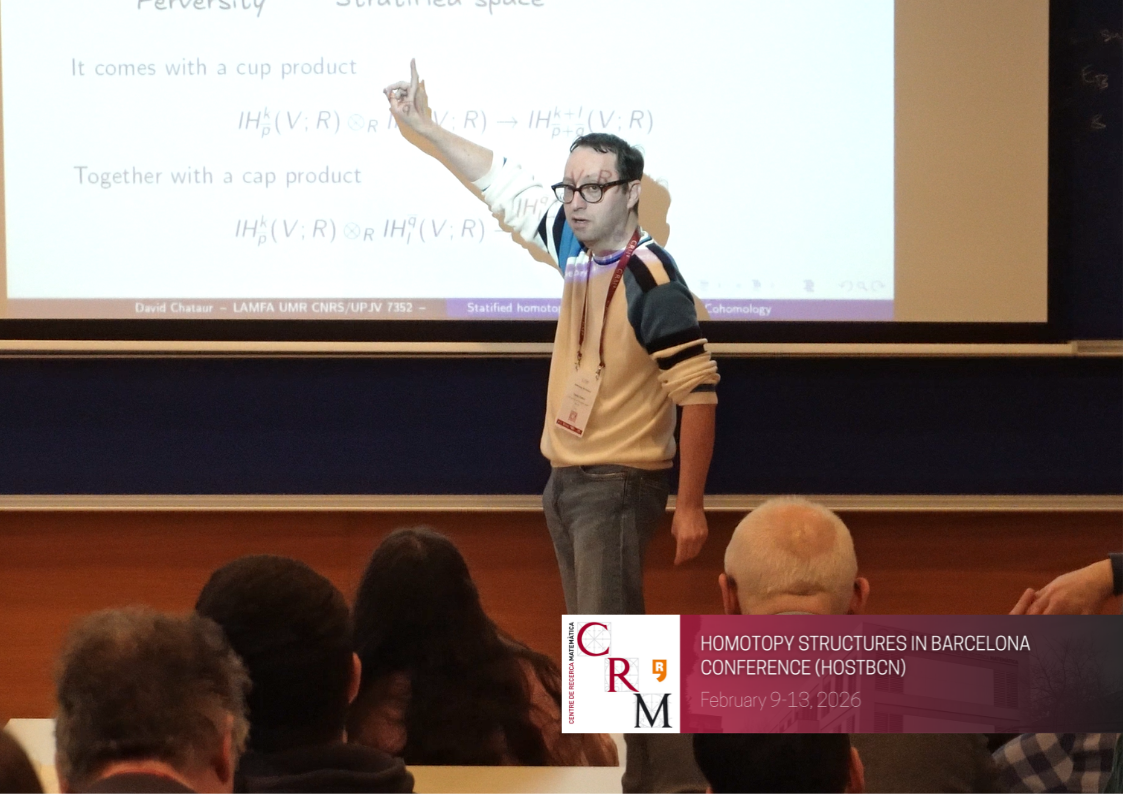
Stratified homotopy theory and intersection cohomology
David Chataur
Université de Picardie Jules Verne
Abstract
Which subsets of integers occur as mapping degree sets?
Cristina Costoya
Universidade de Santiago de Compostela
Abstract
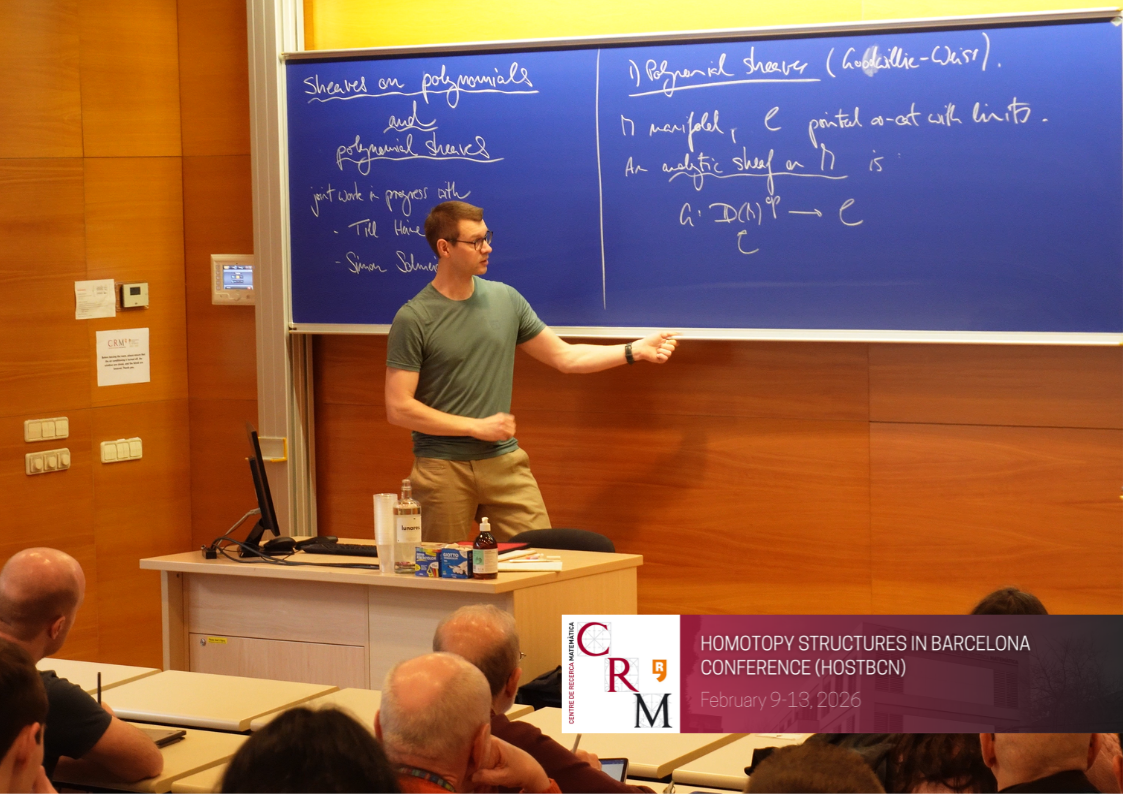
Sheaves on polynomials and polynomial sheaves
Tobias Dyckerhoff
Universität Hamburg
Abstract
Spaces of conjugacy classes of subgroups of compact Lie groups and rational equivarant cohomology theories
John Greenlees
University of Warwick
Abstract
Homotopy self-equivalences of manifolds
Ian Hambleton
McMaster University
Abstract
Bousfield classes via homological support
Drew Heard
NTNU
Abstract
Isovariant homotopy theory
Inbar Klang
Vrije Universitäait Amsterdam
Abstract
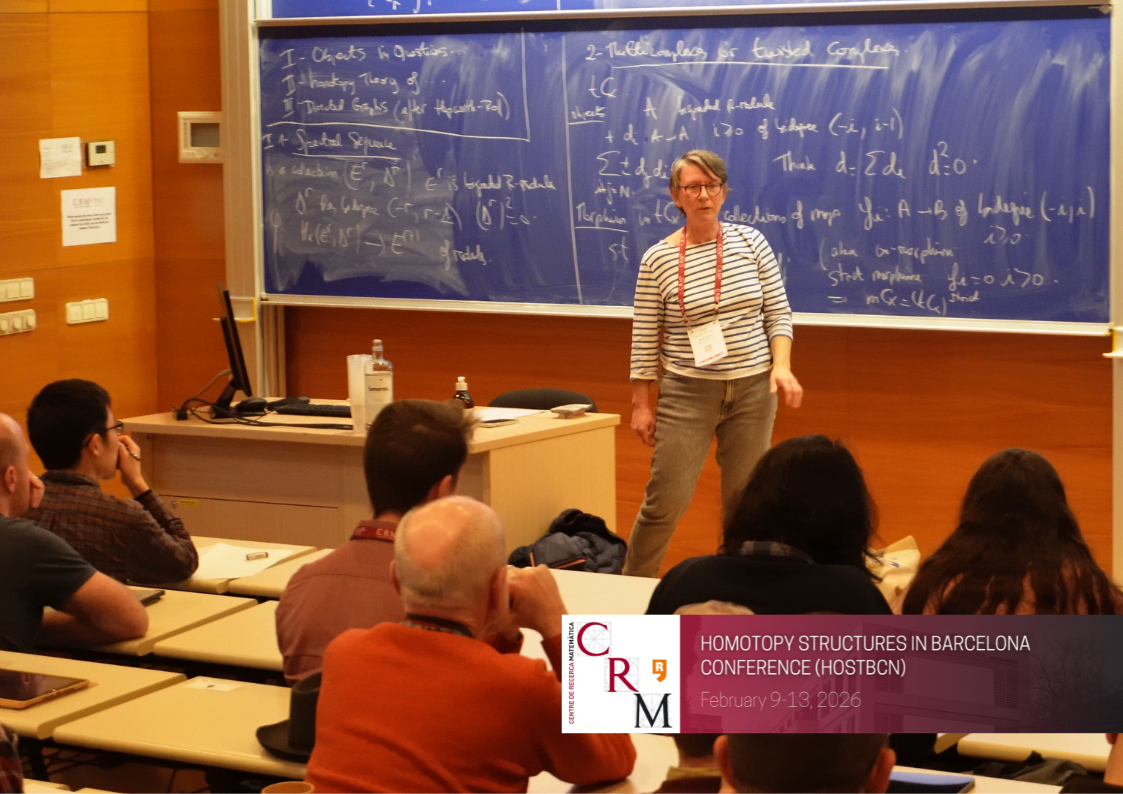
Multicomplexes: an efficient tool in homological algebra
Muriel Livernet
Université Paris Cité
Abstract
Higher Segal spaces and partial groups
Justin Lynd
University of Louisiana at Lafayette
Abstract
Uniqueness of rational equivariant K-theory
Clover May
University of Bristol
Abstract
Fusion systems of locally finite p-artinian groups
Bob Oliver
Université Sorbonne Paris Nord
Abstract
Higher groupoid cardinality
Maxime Ramzi
Universität Münster
Abstract
Real hochschild homology as an equivariant loday construction
Birgit Richter
Universität Hamburg
Abstract
Module Spaces over Homology Theories and Completion Towers
Jérôme Scherer
EPFL
Abstract
SCHEDULE
Monday February 9th | Tuesday February 10th | Wednesday February 11th | CANCELLED Thursday February 12th | Friday February 13th | ||||
09:30 - 10:30 | Bousfield classes via homological support Drew Heard NTNU | Which subsets of integers occur as mapping degree sets? Cristina Costoya Universidade de Santiago de Compostela | Higher Segal spaces and partial groups Justin Lynd University of Louisiana at Lafayette | 09:00 - 10:00 | Higher Segal spaces and partial groups Justin Lynd University of Louisiana at Lafayette | |||
10:30 - 11:00 | Group Picture + Coffee Break | Coffee Break | 10:00 - 11:00 | Uniqueness of rational equivariant K-theory Clover May University of Bristol | ||||
11:00 - 11:40 | Additivity and descent of constructible Victor Carmona Max Planck Institute for Mathematics in the Sciences | Towards a theory of characteristic classes for stratified spaces Bruno Gálvez University of Picardie Jules Verne | An inductive approach to the Diaz-Park sharpness conjecture Marco Praderio-Bova Dresden University of Technology | 11:00 - 11:30 | Coffee Break | |||
12:20 - 13:00 | Registration | 11:40 - 12:40 | Real hochschild homology as an equivariant loday construction Birgit Richter Universität Hamburg | Module Spaces over Homology Theories and Completion Towers Jérôme Scherer EPFL | Fusion systems of locally finite p-artinian groups Bob Oliver Université Sorbonne Paris Nord | 11:30 - 12:00 | ||
12:00 - 12:30 | ||||||||
13:00 - 14:30 | Lunch Break | 12:40 - 14:00 | Lunch Break | 12:30 - 13:30 | Fusion systems of locally finite p-artinian groups Bob Oliver Université Sorbonne Paris Nord | |||
14:30 - 15:30 | Tobias Dykerhoff Universität Hamburg | 14:00 - 15:00 | Stratified homotopy theory and intersection cohomology David Chataur Université de Picardie Jules Verne | 14:00 - 14:40 | 13:30 - 14:30 | Lunch Break | ||
15:30 - 16:00 | Coffee Break | 15:00 - 15:30 | Coffee Break | 14:40 - 15:40 | Spaces of conjugacy classes of subgroups of compact Lie groups and rational equivarant cohomology theories John Greenlees University of Warwick | Isovariant homotopy theory Inbar Klang Vrije Universitäait Amsterdam | 14:30 - 15:00 | An inductive approach to the Diaz-Park sharpness conjecture Marco Praderio-Bova Dresden University of Technology |
16:00 - 16:40 | 15:30 - 16:10 | Quillen-Barr-Beck cohomology for divided power algebras over an Sacha Ikonikoff University of Strasbourg | 15:00 - 16:00 | Isovariant homotopy theory Inbar Klang Vrije Universitäait Amsterdam | ||||
16:40 - 17:40 | Multicomplexes: an efficient tool in homological algebra Muriel Livernet Université Paris Cité | 16:10 - 17:10 | Higher groupoid cardinality Maxime Ramzi Universität Münster | 16:00 - 17:00 | Homotopy self-equivalences of manifolds Ian Hambleton McMaster University | |||
20:00 | Gala Dinner | |||||||
LIST OF PARTICIPANTS
| Name | Institution |
|---|---|
| Marco Praderio Bova | Dresden University of Technology |
| Fei Ren | University of Wuppertal |
| Isaac Moselle | University of Copenhagen |
| Nikola Tomic | University of Montpellier |
| Sacha Ikonicoff | University of Strasbourg |
| Jack Davidson | University of Sheffield |
| Ran Levi | University of Aberdeen |
| Rudradip Biswas | University of Warwick |
| Grigorii Taroian | University of Toronto |
| Pablo Sánchez Martínez | University of Liverpool |
| Surojit Ghosh | Indian Institute of Technology Roorkee |
| Urban Ogrinec | University of Ljubljana |
| Birgit Richter | University of Hamburg |
| Adrien Pautre | Université Grenoble Alpes |
| Maxime Ramzi | University of Münster |
| Jana Hartenstein | University of Hamburg |
| Rémi Molinier | Université Grenoble Alpes |
| Yannick Hoyer | University of Hamburg |
| Emanuele Pavia | University of Luxembourg |
| Marc Stephan | Dresden University of Technology |
| Abhinandan Das | Indian Statistical Institute |
| Alex Takeda | Uppsala University |
| Pedro Mayorga Pedraza | University of Bonn |
| Ming Ng | Nagoya University |
| Miika Tuominen | |
| Konstantin Roßberg | University of Oxford |
| Victor Carmona | Max Planck Institute for Mathematics in the Sciences |
| Nicholas Puthu Parackat Biosca | Utrecht University |
| Kensuke Arakawa | Kyoto University |
| Malthe Sporring | University of Edinburgh |
| Boris Chorny | University of Haifa |
| Francesca Pratali | Utrecht University |
| Kamil Smietaniak | Adam Mickiewicz University, Poznan |
| Bruno Galvez | University of Picardie Jules Verne |
| Cassia Edwards | University of Edinburgh |
| Hassan Abdallah | Wayne State University |
| Justin Lynd | University of Louisiana |
| Bob Oliver | Université Sorbonne Paris Nord |
| Tobias Dyckerhoff | University of Hamburg |
| Cristina Costoya | Universidad de Santiago de Compostela |
| Drew Heard | NTNU |
| David Chataur | University of Picardie Jules Verne |
| John Greenlees | University of Warwick |
| Jérôme Scherer | EPFL |
| Clover May | |
| Ian Hambleton | McMaster University |
| Inbar Klang | Vrije Universitäait Amsterdam |
| Muriel Livernet | Université Paris Cité |
| Antonio Viruel | Universidad de Málaga |
| Carles Broto | Universitat Autònoma de Barcelona |
| Wolfgang Pitsch | Universitat Autònoma de Barcelona |
| Jesper Moller | University of Copenhagen |
| Martí Parés Baraldés | |
| Giorgi Khimshiashvili | Ilia State University, Tbilisi, Georgia |
| Ramón Flores | Universidad de Sevilla |
| Daniel Solch | University of Aberdeen |
| Mario Fuentes Rumí | Universidad de Sevilla |
| Arnav Das | California Institute of Technology |
| Bianca Carvalho de Oliveira | VU University Amsterdam |
| Joachim Kock | Universitat Autònoma de Barcelona |
| Albert Ruiz Cirera | Universitat Autònoma de Barcelona |
| Roger Bergadà Batlles | Universitat Autònoma de Barcelona |
| Gabriel Martínez de Cestafe Pumares | Universitat Autònoma de Barcelona |
| Daria Pavlova | Charles University in Prague |
| Vignesh Subramanian | Utrecht University |
| Natàlia Castellana Vila | Universitat Autònoma de Barcelona |
| Kristoffer Rank Rasmussen | University of Hamburg |
| Jordi Garriga Puig | Universitat de Barcelona |
| Stefan Jackowski | University of Warsaw |
| Agnieszka Bojanowska | University of Warsaw |
| Haldun Ozgur Bayindir | Universitat de Barcelona |
contributed talks
Participants are encouraged to present their research results or open problems in a short talk format (30′). To apply, participants will find the relevant option during the registration process. You will be asked to attach the abstract (between 300 and 600 words) including the title, in .pdf format. The file name must follow the format: surname_name.
- Deadline for abstract submission: December 7,2025
- Resolutions: By this week
registration
Registration deadline: January 23, 2026
CRM User Account Creation
After creating your CRM user account, you can log in on the activity webpage to complete your registration, or by clicking the button and then selecting ‘Sign in’.
REGISTER
grants for accommodation
- Application deadline for grants is 07/12/2025
- Resolutions for accommodation grants are pending, they will be sent in the coming days.
INVOICE/PAYMENT INFORMATION
IF YOUR INSTITUTION COVERS YOUR REGISTRATION FEE: Please note that, in case your institution is paying for the registration via bank transfer, you will have to indicate your institution details and choose “Transfer” as the payment method at the end of the process.
UPF | UB | UPC | UAB
*If the paying institution is the UPF / UB/ UPC / UAB, after registering, please send an email to comptabilitat@crm.cat with your name and the institution internal reference number that we will need to issue the electronic invoice. Please, send us the Project code covering the registration if needed.
Paying by credit card
IF YOU PAY VIA CREDIT CARD but you need to provide the invoice to your institution to be reimbursed, please note that we will also need you to send an email to comptabilitat@crm.cat providing the internal reference number given by your institution and the code of the Project covering the registration (if necessary).
LODGING INFORMATION
ON-CAMPUS AND BELLATERRA
BARCELONA AND OFF-CAMPUS
acknowledgement
 |
For inquiries about this event please contact the Scientific Events Coordinator Ms. Núria Hernández at nhernandez@crm.cat
|
CRM Events code of conduct
All activities organized by the CRM are required to comply with the following Code of Conduct.
CRM Code of Conduct
scam warning
We are aware of a number of current scams targeting participants at CRM activities concerning registration or accommodation bookings. If you are approached by a third party (eg travellerpoint.org, Conference Committee, Global Travel Experts or Royal Visit) asking for booking or payment details, please ignore them.
Please remember:
i) CRM never uses third parties to do our administration for events: messages will come directly from CRM staff
ii) CRM will never ask participants for credit card or bank details
iii) If you have any doubt about an email you receive please get in touch
Given two connected closed oriented manifolds  and
and  of the same dimension, the mapping degree set is defined by
![\ \[\deg(M,N) = \{ \deg(f) \mid f : M \to N \} \subseteq \mathbb Z.\]](https://www.crm.cat/wp-content/ql-cache/quicklatex.com-b12cc1a92a67b83a9cdcae05a38751ec_l3.png "Rendered by QuickLaTeX.com")
A central question is to determine which subsets of integers (necessarily containing  )) can arise as mapping degree sets.
In this talk, we give a complete answer in the finite case: we prove that every finite subset of  , containing
  , can be realised as the mapping degree set of suitable manifolds and . Although a complete classification in the infinite case remains open, we present recent progress and exhibit several families of infinite sets that can also be realised in this way.
The classical Dold-Kan correspondence and its variations are typically studied from a purely combinatorial point of view. In this talk, we explain how symmetric products provide a natural habitat to understand various aspects of Dold-Kan type correspondences geometrically.
Multicomplexes can be viewed as deformations of complexes from an operadic point of view. To each multicomplex, one can associate its total complex, which is a filtered complex and thus gives rise to a spectral sequence. The aim of this presentation is to provide an overview of the results obtained with Sarah Whitehouse (and other collaborators, including J. Cirici, X. Fu, A. Guan, D.E. Santander, and S. Ziegenhagen) concerning homotopy theories of multicomplexes, involving a given page of the associated spectral sequence. We will also present some applications of multicomplexes to complex geometry and to the homology theories of directed graphs, a work in progress with E. Roff.
This is joint work with W. Chacholski and W. Pitsch. To any coaugmented functor  one can associate its “modules”, i.e., spaces X which are retracts of
  . This notion has been studied by Libman. When
  is ordinary homology, this functor is the infinite symmetric product and modules are generalized Eilenberg-Mac Lane spaces (GEMs). Given two such functors
  and
and  we introduce a new one, we denote by a bracket
 ![\ [E, F]](https://www.crm.cat/wp-content/ql-cache/quicklatex.com-745a5526b57e13aab76191aa23bc5e32_l3.png "Rendered by QuickLaTeX.com") , as a pullback of two natural transformations
, as a pullback of two natural transformations  and
and  . We study modules over such brackets and construct two towers in the case
  by bracketing systematically either on the left or the right. For ordinary homology we obtain two well-known towers: the Bousfield-Kan completion tower and the modified one as introduced by Dror Farjoun.
Using rational algebraic models, we look at commutative ring structures on real and complex equivariant K-theory. Joint work with Bohmann, Hazel, Ishak, and Kędziorek showed uniqueness of both the naive and the genuine commutative ring structures on rational  for G finite abelian. In joint work in progress with Bohmann and Kędziorek, we aim to extend these results to KOG.
A symmetric (simplicial) set is a presheaf on the category of nonempty finite sets and all functions. The Segal symmetric sets are just the nerves of groupoids. We consider two weakenings of the Segal condition for symmetric sets. The first defines partial groupoids, first thought up and studied by Chermak in p-local finite group theory. The second defines the d-Segal spaces of Dyckerhoff–Kapranov and (for d = 2) Gálvez-Carrillo–Kock–Tonks. This talk is about some useful tools to understand “how higher Segal” a partial group is. They are based on the discrete geometry of partial group actions and ultimately involve solving Helly type problems in abstract closure spaces. I’ll explain some of the computations we’ve done to compute the degree of Segality of interesting partial groups, including some computations that are still in progress for partial groups arising in p-local finite group theory. This is joint work with Philip Hackney.
For topological spaces with an action of a group G, an isovariant map is an equivariant map which preserves isotropy subgroups. Isovariant maps play an important role in equivariant surgery theory and equivariant h-cobordism theory. In this talk, I will discuss joint work with Sarah Yeakel, in which we study the homotopy theory of G-spaces with isovariant maps. Results discussed may include an isovariant Whitehead’s theorem, an application to isovariant fixed point theory, and the beginnings of isovariant stable homotopy theory.
 of (finite) p-power index such that
  for some r ≥ 0. In an earlier paper by the same three authors, we studied fusion systems
  over discrete p-toral groups and defined their classifying spaces. As examples, we constructed the fusion system of a compact Lie group G and of a p-compact group X, and showed that their classifying spaces give nice discrete models for the p-completed classifying spaces
  and
and  .
.A discrete group G is
- locally finite if every finitely generated subgroup of G is finite;
- a p-group (p prime) if every element of G has p-power order; and
- artinian if descending chains of subgroups of G become constant.
For a prime p, we say that G is p-artinian if every p-subgroup of G is artinian. If G is locally finite and p-artinian, then every p-subgroup of G is locally finite and artinian, and hence is discrete p-toral by standard results.
After recalling some of this background on fusion systems and their classifying spaces, I will describe some of our recent work, where we showed how to associate a fusion system to each locally finite p-artinian group G. The first problem was that such groups need not have Sylow p-subgroups, at least not in the strong sense: there need not be a p-subgroup of G that contains all others up to conjugacy. Instead, we defined the concept of a “weakly Sylow p-subgroup” of G, and showed it is unique up to an appropriately defined relation of “local” conjugacy. We then showed that if G is locally finite and p-artinian and S ≤ G is a weakly Sylow p-subgroup, then there is a saturated fusion system  over S (explicitly defined), and its classifying space
  has the homotopy type of
  . The definitions of and
  are similar to those used for finite groups, but with extra complications caused by the weaker definitions of Sylow subgroups and conjugacy. To prove that
  , we needed to apply a recent theorem of Alex Gonzalez: a “stable elements theorem” that describes
  as a subgroup of
  .
.
We study homological and cohomological Bousfield classes in Bousfield localizations of rigidly-compactly generated tensor–triangulated categories via the homological spectrum. When applied to chromatic homotopy theory, our work gives a negative answer to a question of Wolcott.
In the 1980s, after having introduced Intersection Cohomology, M. Goresky and R. MacPherson proposed a number of problems and conjectures regarding homotopical foundations for this cohomological theory. Such an homotopical enhancement will have some potential applications to the study of singular sopaces in geometry.
In this talk I will give a survey of such an enhancement based on a simplicial approach to Intersection Cohomology and on stratified homotopy theory. In particular I will discuss a “motivic like” approach to the subject developped in collaboration with S. Douteau.
For a closed, topological $n$-manifold $M$, let $E(M)$ denote its space of pointed self-homotopy equivalences. In [Hambleton-Kreck, 2004] a braid of interlocking exact sequences was established in order to obtain new information about $Aut(M):=\pi_0(E(M))$, assuming that $M$ is a closed, oriented $4$-manifold and the self-equivalences are orientation-preserving. It seemed clear to the authors at the time that a similar braid should exist for higher dimensional manifolds.
In this project we carry out the details of this extension (at the space-level), and construct a homotopy (highly) cartesian square relating the space of homotopy self-equivalences of $M$ to an infinite loop space model for the associated bordism theory of the normal $k$-type of $M$.
This leads to a conceptual explanation for the existence of the Hambleton—Kreck braid in the $4$-manifold setting, and to a broad generalization of this tool to include information about the higher homotopy groups $\pi_k(E(M))$ and related variants.
This is joint work with Kursat Sozer (McMaster) and Robin Sroka (Muenster).
Baez and Dolan introduced in the late 90’s the notion of groupoid cardinality of finite groupoids, and more generally of π-finite spaces. Analogously to the Euler characteristic of finite spaces, which behaves “additively” under
finite (homotopy) colimits, the groupoid cardinality of π-finite spaces behaves multiplicatively under finite (homotopy) limits.
However, while the Euler characteristic of finite spaces can be seen as the shadow of a higher invariant (a map of spaces from the space of finite spaces to the algebraic K-theory space of finite spaces, aka the A-theory space of a point), Baez and Dolan’s groupoid cardinality has not been “homotopized”.
In this talk, I will propose a definition of higher groupoid cardinality, which would be to classical groupoid cardinality what the refinement to a point in the A-theory space of a point is to classical Euler characteristics, and show that this definition, while a priori “higher” actually produces a discrete object: there is no higher groupoid cardinality (and I will explain how this is relatively “robust”, i.e. not so dependent on the precise definition of higher groupoid cardinality).
Time permitting, I will discuss some speculations and conjectures about combining higher groupoid cardinality and euler characteristics in a single object.
Equivariant Loday constructions are a means to providing geometric interpretations of equivariant homology theories such as topological Real Hochschild homology. For the family of dihedral groups Angelini-Knoll, Gerhardt and Hill defined Real D2m-Hochschild homology groups for discrete Eσ-rings. In joint work with Ayelet Lindenstrauss and Foling Zou we show that these have an interpretation as the homotopy groups of an equivariant Loday construction where we consider a D2m-action on the 1-skeleton of a regular 2m-gon. To that end we need to generalize equivariant Loday constructions so that they only take into account the isotropy subgroups of the G-simplicial set. If time permits, we will also present a family of examples related to the symmetric group actions on permutohedra.
The Balmer spectrum of finite rational G-spectra is a space X(G) of conjugacy classes of subgroups. The space X(G) is a disjoint union of blocks V(G,H) of subgroups dominated by H, and there is a growing list of groups for which this known explicitly (for example 18 blocks when G=SU(3)). There are many cases where the algebraic model for rational G-spectra is known to be a category of sheaves over X(G). The talk will describe the general shape of V(G,H) and make it explicit in some examples. The algebraic models will be also be described in various cases.