-
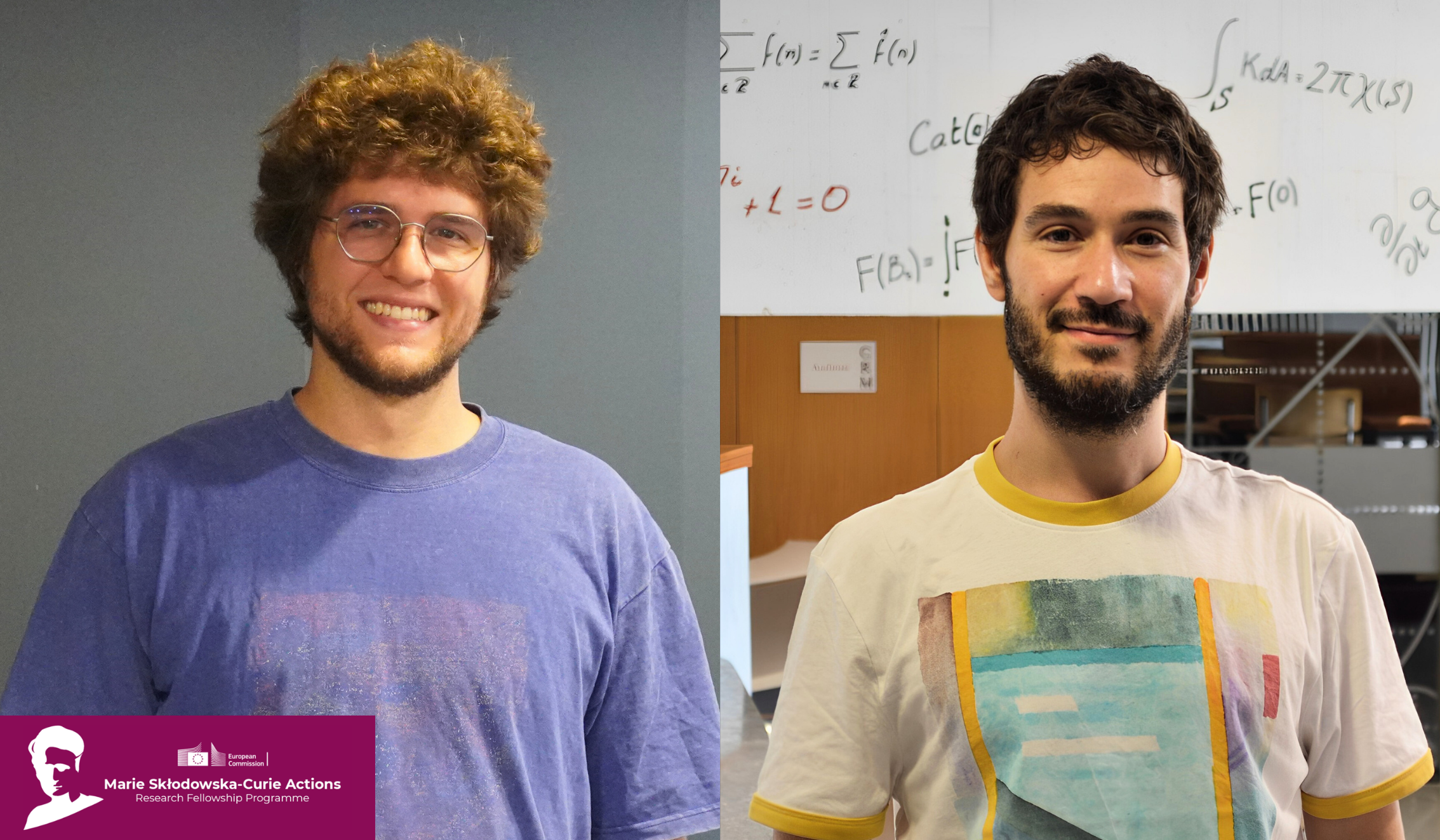
Gustavo Ferreira and Tássio Naia, who joined the CRM in 2023 through the María de Maeztu programme, have started their Marie Skłodowska-Curie postdoctoral fellowships this September.
-
Their projects explore key questions in complex dynamics and probabilistic combinatorics.
Two postdoctoral researchers at the Centre de Recerca Matemàtica (CRM), Gustavo Ferreira and Tássio Naia, began their Marie Skłodowska-Curie postdoctoral fellowships in September. Both joined the CRM in 2023 through the María de Maeztu Unit of Excellence programme and are now launching independent projects that explore the frontiers of complex dynamics and probabilistic combinatorics.
Gustavo Ferreira: understanding the unknown within complex dynamics
Ferreira’s project, HyCoWanDoCoDyn (Hyperbolic Components and Wandering Domains in Complex Dynamics), aims to shed light on one of the most intriguing questions in the field: what happens inside hyperbolic components when the systems under study are no longer of finite type.
“In dynamics, we like what’s called hyperbolic dynamics; these are the things we understand best,” he explains. “But when you move from finite to infinite type, the behaviour of the system changes a lot, and it’s not clear what’s going on inside the hyperbolic components themselves. Those bits that were so well understood before are now less clear. So the project is trying to make sense of what is going on inside these components.”
“The Marie Curie is a huge opportunity to bring together all the work I’ve done in bits and pieces and put it into a cohesive whole.”
His research connects two areas that have long puzzled mathematicians: hyperbolicity and wandering domains. “There are two big obstacles to understanding them in this new context, and they are bigger domains and wandering domains,” Ferreira says. “Wandering domains, in particular, are something I’ve worked on before, and we’re finally in a place where we can try to understand them in this context.”
After two short postdoctoral positions in the UK, Ferreira highlights the importance of having long-term support to consolidate a line of research: “The Marie Curie really is a huge chance to drive the nail home on this project. It’s the opportunity to bring together all the work I’ve done in bits and pieces in different places and put it all together into a cohesive whole.”
Ferreira has already been part of the CRM and Barcelona’s mathematical community for two years. “It’s been a huge plus, honestly,” he says. “There’s a very strong dynamics and analysis community here in Barcelona. There’s always someone to knock on the door and ask, ‘Hey, do you know anything about this?’ And even if you don’t find the help you need right now in Barcelona, there’s always someone coming for a conference or a research visit.”
Tássio Naia: rainbow structures and the power of probability
Naia’s project, PARTIORI (Rainbow partitions and oriented structures in random graphs), explores the intersection of combinatorial design theory, Ramsey theory, and probabilistic combinatorics. “I’m studying questions about ‘rich’ networks, whose connections are classified or oriented,” he explains. “In such networks one can ask whether they necessarily contain large substructures of a certain type, or whether it is possible to decompose the network’s connections into layers, each exhibiting a specific behaviour of interest.”
His research focuses on decompositions of coloured networks into a few “rainbow” substructures (paths or cycles) under different colouring regimes, and on the existence of large oriented structures in random graphs. “Recently, very powerful tools have been developed to address this kind of problem, combining algorithmic, algebraic and semirandom approaches,” he says. “While most research has focused on rigid decompositions, I’m adapting and developing these techniques toward a more flexible framework, hoping to obtain more detailed results by taking advantage of this extra room to manoeuvre.”
“It’s very rewarding to receive positive feedback on a research plan that you’ve been building over time.”
Naia views the Marie Skłodowska-Curie fellowship as both an opportunity and a motivation: “Besides funding my research, the fellowship provides a framework to develop other aspects of my professional training. I plan to make the most of it. It’s also very rewarding to receive positive feedback on a research plan that you’ve been building over time.”
Reflecting on his experience at the CRM and in Barcelona, Naia underlines the value of collaboration and exposure: “The last two years have been enriching in many ways. I’ve interacted with researchers from other areas, gained practical experience in organising meetings, classes, and courses, and even in drafting proposals and budgets for scientific events. It’s been a fantastic experience, and I’m glad to continue what I hope will be many more years working with the CRM team.”
The fellowships mark an important milestone for both researchers and the CRM itself, which continues to strengthen its international research community through the European funding schemes. As Ferreira and Naia begin the next stage of their careers, their work highlights the breadth and vitality of mathematics being done in Barcelona, from the intricate geometry of complex dynamics to the hidden order of random networks.
Gustavo Rodrigues Ferreira is a postdoctoral researcher who has joined the Centre de Recerca Matemàtica to collaborate with Núria Fagella. He studied molecular sciences at the Universidade de Sao Paulo, obtaining an M. Sc. in dynamical systems at the Instituto de Matemática e Estatística of the Universidade de São Paulo (IME-USP) and a PhD from The Open University (UK).
His previous experience includes roles as an LMS Early Career Fellow at Imperial College London and, most recently, a Postdoctoral Research Associate at the University of Liverpool.
Tássio Naia is a Marie Skłodowska-Curie research fellow at the Centre de Recerca Matemàtica, where he works with Guillem Perarnau and the GAPCOMB-UPC group.
Before joining CRM, he held postdoctoral positions at LaBRI (Université de Bordeaux) and IME–USP, collaborating with Marthe Bonamy and Yoshiharu Kohayakawa.
He obtained his PhD from the University of Birmingham under the supervision of Richard Mycroft and Deryk Osthus.
His research interests lie in combinatorics, probability, and algorithms.
|
|
CRM CommPau Varela
|
When the reward comes within reach, the brain changes what it compares
As the tokens piled up, choices got faster and more accurate at the same time. The yardstick for judging each offer had moved.CRM CommPau VarelaCRMComm@crm.catGet the latest CRM news and activities in your inbox.Recent newsletters →Two subjects...

Almost every automaton can be reset with a short word
Guillaume Chapuy (Université Paris Cité, CNRS) and Guillem Perarnau (UPC, CRM) have shown that a random finite automaton with n states can, with high probability, be reset by a word of length of order √n log n. The result, published in ACM Transactions on Algorithms, pins the exponent at 1/2, the lower end of a decade of numerical estimates, and addresses the random version of the synchronization problem behind a conjecture Ján Černý posed in 1964 and which still remains open.
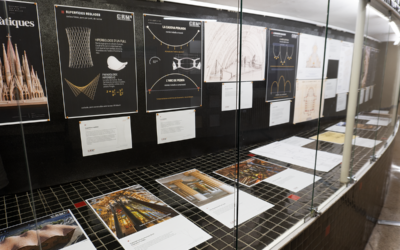
Exposició ‘Les matemàtiques de Gaudí’
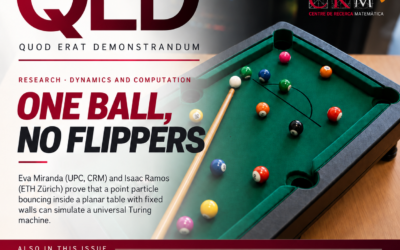
CRM quod erat demonstrandum | 48

ADA: Decoding Brain Signals Misaligned in Time
The study addresses a key limitation of current brain decoding techniques: the difficulty of interpreting internal mental processes whose temporal dynamics vary from trial to trial.Decoding what is happening in a person’s mind from their brain activity is one of the...
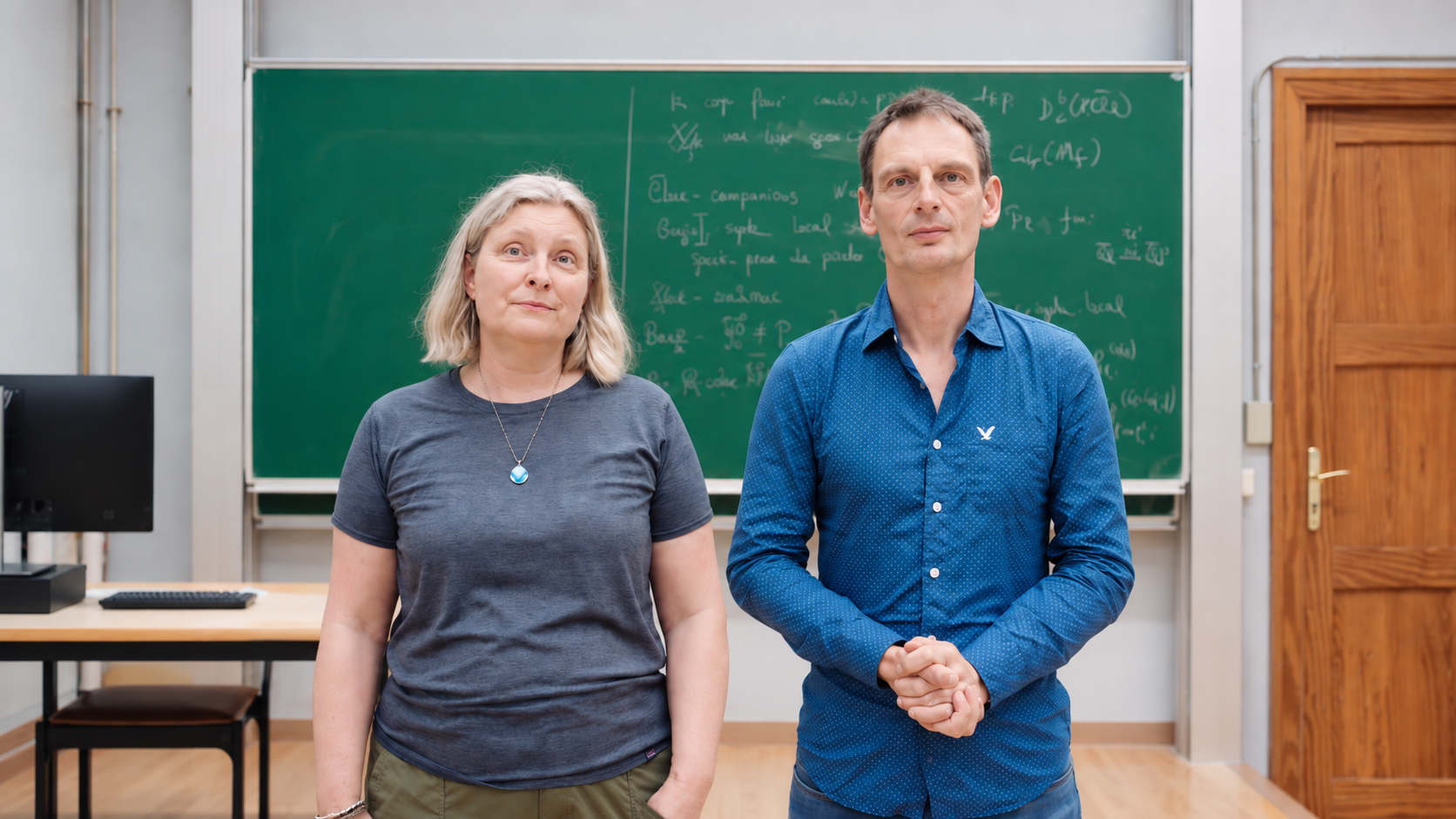
Rare curves, many points: Christophe Ritzenthaler and Rachel Pries on their research and the work around it
Christophe Ritzenthaler (Université de Rennes) and Rachel Pries (Colorado State University) both work on curves over finite fields: he hunts curves with as many points as possible, she hunts curves that almost never occur. In conversation with the CRM during their...
Call open for the 2027 Ferran Sunyer i Balaguer Prize
The Ferran Sunyer i Balaguer Foundation is accepting submissions for its 2027 prize, which awards 15,000 euros and publication in Birkhäuser's Progress in Mathematics series to an expository monograph on an active area of mathematical research. The deadline is 27...
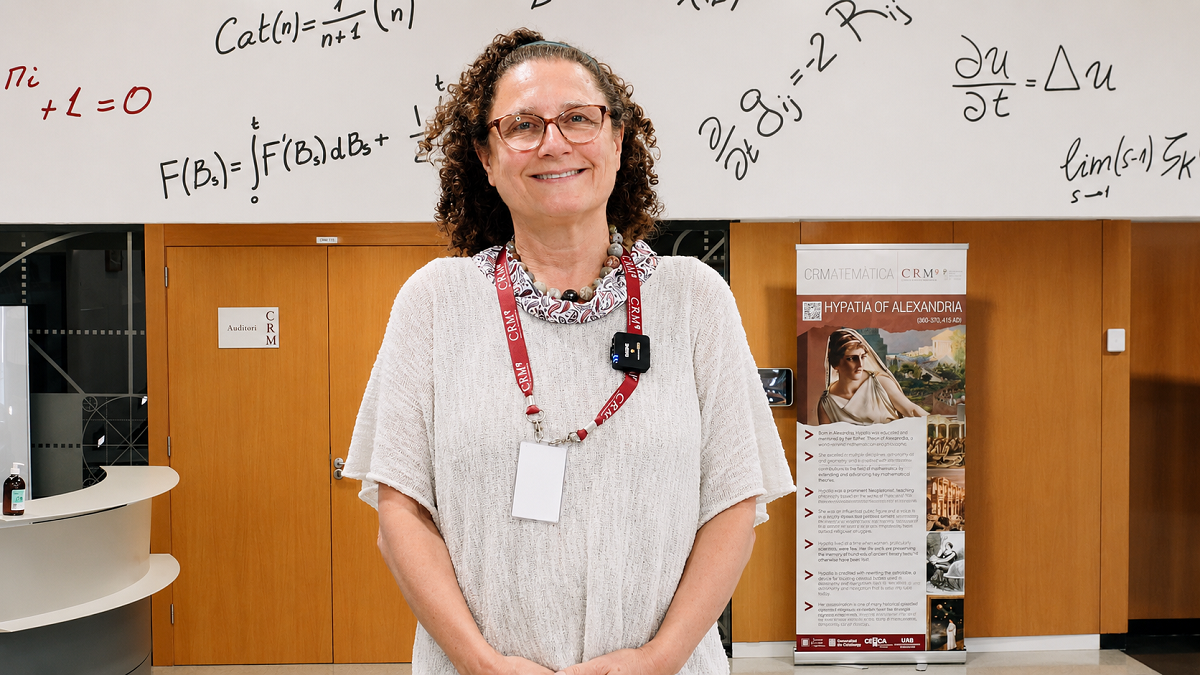
Susanna Terracini delivers the CRM Colloquium 2026
Susanna Terracini (Università di Torino) delivered the CRM Colloquium 2026 on 14 July, presenting a rigidity result for Kepler billiards obtained with Stefano Baranzini, Vivina Barutello and Irene De Blasi. She was at the centre as a member of the CRM Scientific...
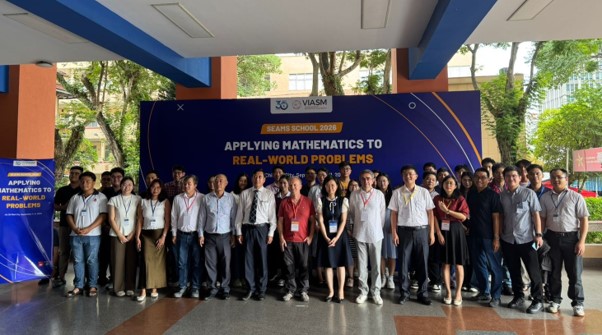
Ho Chi Minh City hosts the SEAMS School on applying mathematics to real-world problems
Students from across the region took courses and worked on group projects at a school co-organised by CRM researcher Tim Myers.CRM CommPau VarelaCRMComm@crm.catGet the latest CRM news and activities in your inbox.Recent newsletters →Between 4 and...

A single ball on a fixed table can compute: Eva Miranda and Isaac Ramos prove that two-dimensional billiards are Turing complete
Eva Miranda (UPC, CRM) and Isaac Ramos (ETH Zürich) show that a point particle bouncing inside a planar table with fixed walls can simulate a universal Turing machine, settling a question Cristopher Moore left open in 1990. The result grew out of a master’s project...
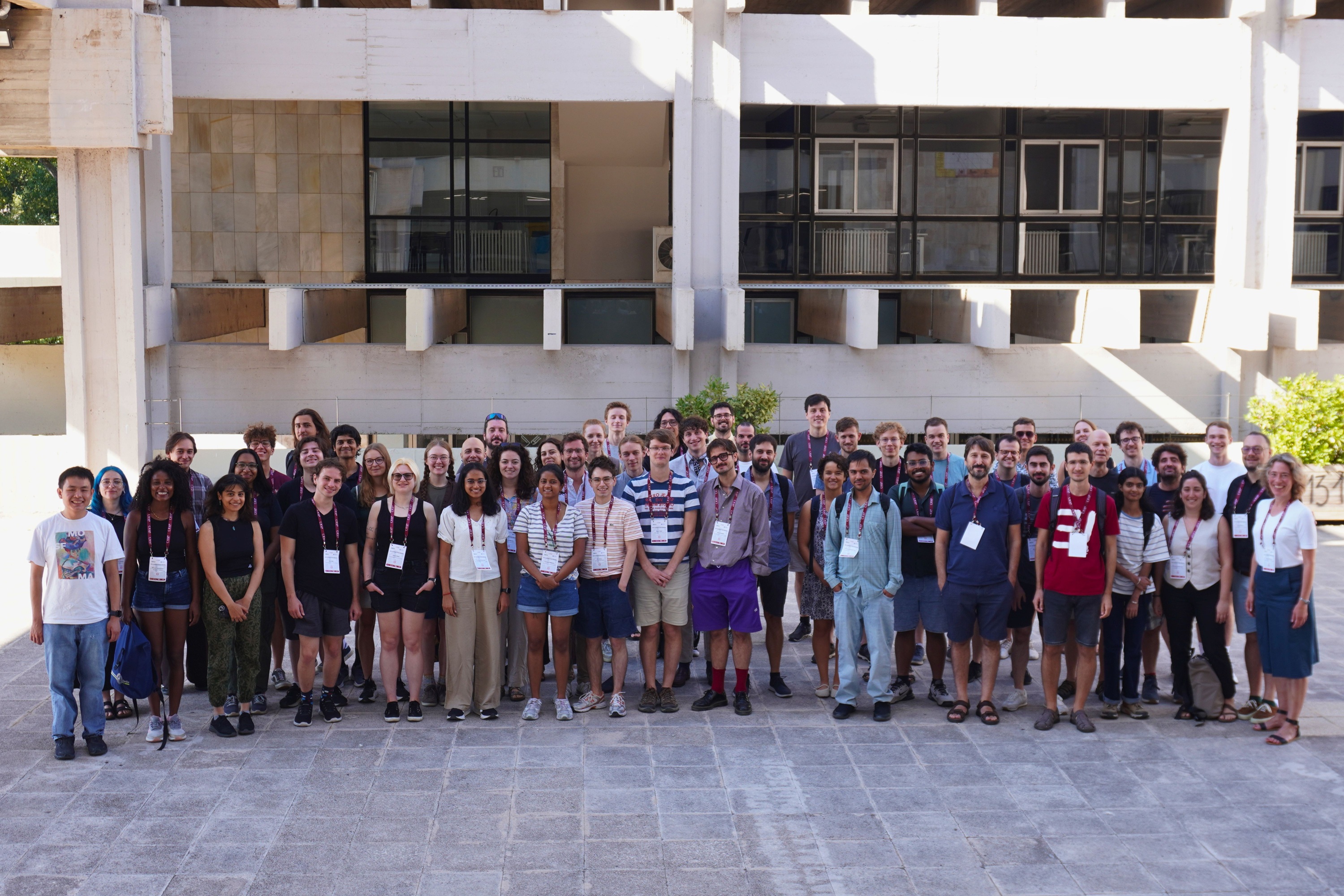
BMS-BGSMath Junior Meeting 2026: Barcelona and Berlin Strengthen Scientific Ties
From 2 to 4 September 2026, the Centre de Recerca Matemàtica (CRM) hosted the BMS-BGSMath Junior Meeting 2026, a three-day event jointly organised by the Berlin Mathematical School (BMS) and the Barcelona Graduate School of Mathematics (BGSMath), with the Centre de...
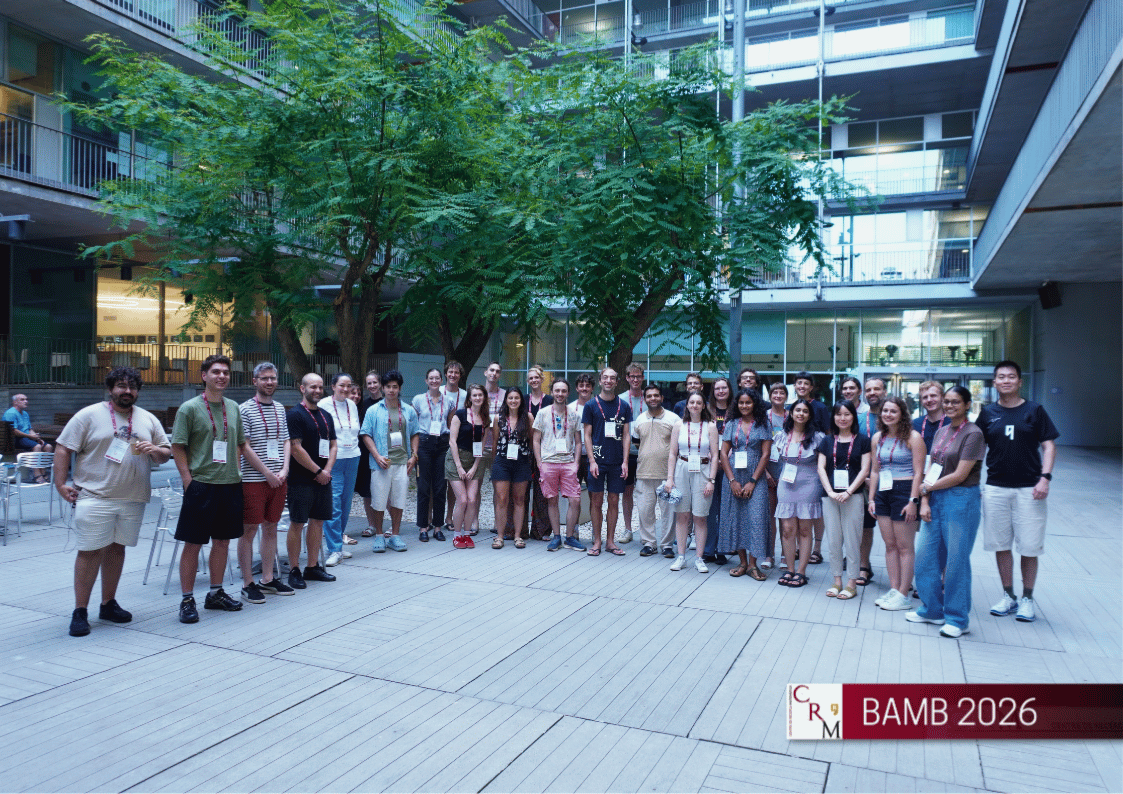
The CRM organises the 2026 Barcelona Summer School for Advanced Modeling of Behavior
The Centre de Recerca Matemàtica held the sixth edition of BAMB!, the Barcelona Summer School for Advanced Modeling of Behavior, from 12 to 23 July 2026 at the Parc de Recerca Biomèdica de Barcelona. Thirty early-career researchers from fourteen countries followed...