Graduate Summer School
HYPATIA 2027
21 June – 2 July 2027
Centre de Recerca Matemàtica, Bellaterra
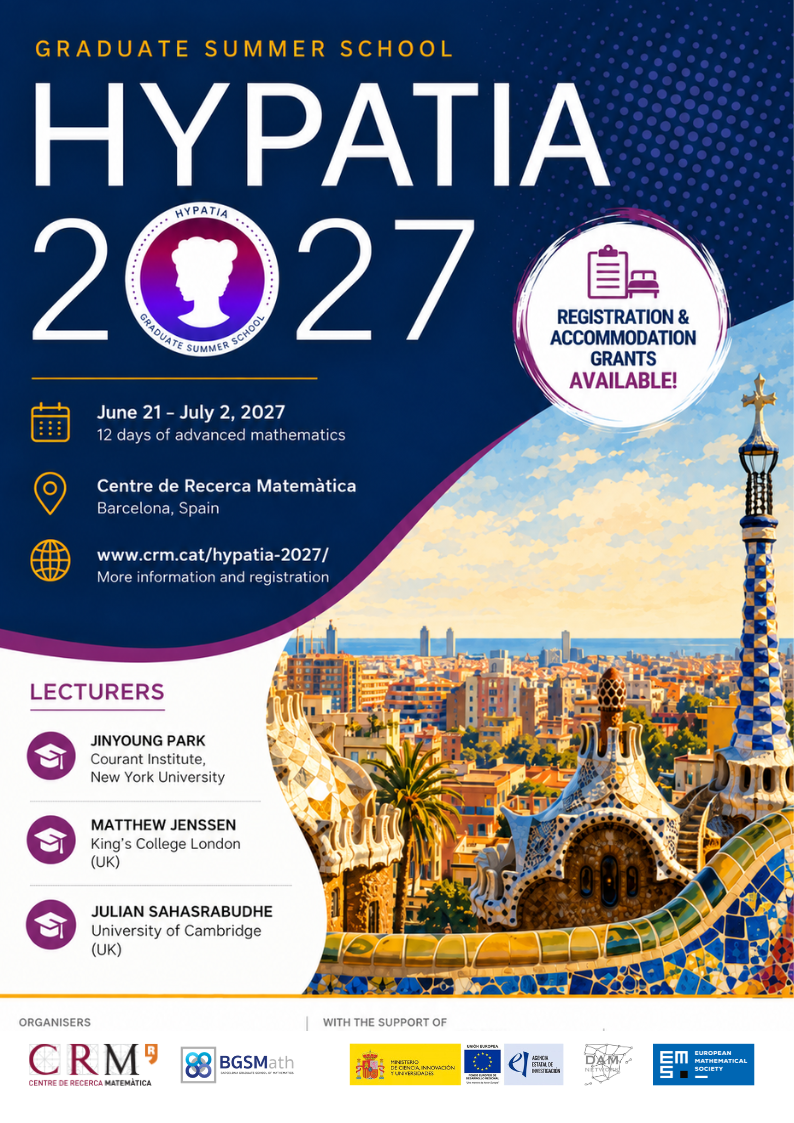
Hypatia Graduate Summer School 2027
Sign into July 02, 2027
Venue: Centre de Recerca Matemàtica
Room: Auditorium
Places are limited to a maximum of 40 participants. To keep the school working well, places are not allocated on a first-come, first-served basis. Candidates apply for a place, and the organising committee will review the applications and make the final selection.
Introduction
Extremal and probabilistic combinatorics studies how dense or sparse a combinatorial structure can be before a particular pattern emerges. It lies at the intersection of graph theory, probability, geometry, number theory, and theoretical computer science, and is one of the most active and rapidly developing areas in discrete mathematics. Over the past decade, the field has witnessed a remarkable series of breakthroughs on longstanding open problems, together with the development of powerful new techniques that continue to shape research across mathematics.
This summer school will provide an introduction to several central themes in extremal and probabilistic combinatorics through courses delivered by leading researchers in the field. The programme is aimed primarily at PhD students and early-career researchers, and will combine lectures with exercise sessions, student talks, and opportunities for informal discussion and collaboration. The topics covered will reflect both the classical foundations of the subject and some of its most exciting recent developments.
The school takes place at the Centre de Recerca Matemàtica (CRM), Bellaterra (Barcelona). One of the sessions will be held at the Institut d’Estudis Catalans, Carrer del Carme 47, Barcelona.
Courses
Thresholds
Jinyoung Park
Courant Institute, New York University (USA)
About Jinyoung Park
Jinyoung Park is an Assistant Professor of Mathematics at the Courant Institute, NYU. Her research interests include extremal and probabilistic combinatorics. She earned her PhD in mathematics from Rutgers University in 2020, under the supervision of Jeff Kahn. Following her PhD, she was a postdoctoral researcher at the Institute for Advanced Study (IAS) and Stanford University before joining the faculty of the Courant Institute at NYU in 2023. She has received several honours and awards, including the AMS Conant Prize, the Dénes König Prize, and the Maryam Mirzakhani New Frontiers Prize.
Six ways to look at a sum (of independent random variables)
Matthew Jenssen
King’s College London (UK)
Julian Sahasrabudhe
University of Cambridge (UK)
Abstract
In this series of lectures, we will explore the rich theory that surrounds a deceptively simple object: sums of independent random variables. We will start with the basics of central limit theorems and large deviation theory, before moving on to “universality” phenomena and Littlewood-Offord theory. This will then set us up nicely to touch on further topics such as random matrices, discrepancy theory and random polynomials.
These lectures will not assume any prior knowledge in the area, beyond familiarity with undergraduate probability and combinatorics.
About Matthew Jenssen
Matthew Jenssen is a Reader in Probability in the Department of Mathematics at King’s College London and a UKRI Future Leaders Fellow. His research lies at the interface of combinatorics, statistical physics, and theoretical computer science, with particular interests in discrete probability, probabilistic and extremal combinatorics, algorithms, and random matrix theory. Much of his work aims to understand how large-scale structures emerge in systems governed only by local interactions.
He completed his PhD in Mathematics at the London School of Economics in 2017 under the supervision of Professor Jozef Skokan and Professor Julia Böttcher, where his doctoral work earned him the LSE PhD Prize for Outstanding Academic Performance. Following his PhD, Jenssen held a two-year postdoctoral position at the University of Oxford. In 2020, he joined the University of Birmingham as a Lecturer in Probability before moving to King’s College London as a Reader in January 2023.
About Julian Sahasrabudhe
Julian Sahasrabudhe is a Professor of Mathematics in the Department of Pure Mathematics and Mathematical Statistics (DPMMS) at the University of Cambridge. His research interests lie in extremal and probabilistic combinatorics, along with their intersections with probability, analysis, and combinatorial number theory, with a recent focus on Ramsey theory on graphs, random polynomials, and random matrices. He earned his PhD in mathematics from the University of Memphis in 2017 under the supervision of Béla Bollobás. Following his PhD, he was a post-doc at the Instituto de Matemática Pura e Aplicada (IMPA) in Rio de Janeiro, Brazil and Junior Research Fellow at Peterhouse, University of Cambridge.
He has received numerous prestigious honours and awards for his research, including the European Prize in Combinatorics (2021), the Salem Prize (2023), a European Research Council (ERC) Starting Grant (2024), the LMS Whitehead Prize (2024), the Mathematical Congress of the Americas (MCA) Prize (2025), and the Adams Prize (2026). He has been a speaker at the International Congress of Mathematicians (ICM) in Philadelphia.
Organising committee
- Richard Lang
UPC–CRM - Patrick Morris
UPC - Tássio Naia
CRM - Guillem Perarnau
UPC–CRM - Juanjo Rué
UPC–CRM - Lluís Vena
UPC–CRM
Schedule
This programme is preliminary and subject to change.
Morning lectures run from 09:30 to 13:00 and include a 30-minute coffee break. Afternoon sessions run from 15:00 to 18:00 and are given over to exercise sessions, student talks, and a colloquium.
Week 1 · 21–25 June 2027
Monday 21 June 2027
Tuesday 22 June 2027
Wednesday 23 June 2027
Thursday 24 June 2027
Friday 25 June 2027
Week 2 · 28 June – 2 July 2027
Monday 28 June 2027
Tuesday 29 June 2027
Wednesday 30 June 2027, at the Institut d’Estudis Catalans
Thursday 1 July 2027
Friday 2 July 2027
Registration
Registration covers participation in all school activities, as well as coffee breaks, lunches, event dinner and other social activities.
Places are limited to a maximum of 40 participants. To keep the school working well, places are not allocated on a first-come, first-served basis. Candidates apply for a place, and the organising committee then makes a selection. All applicants will be notified of the outcome.
How to apply and register
-
Apply
Submit your application through the application form. You will be asked to upload your CV and a motivation letter, and you can also request an accommodation grant in the same form. There are two calls for applications, with the dates above.
-
Register
Successful candidates will receive instructions to complete their registration and payment.
Before registering for the activity, you will be asked to create a CRM web user account through the following link. Please note that both personal and academic information must be completed in the web user intranet.
After creating your CRM user account, you can log in on the activity webpage to complete your registration, or by clicking the button and then selecting ‘Sign in’.
Accommodation grants
In order to increase the number of young researchers participating in this activity, the CRM offers grants to cover the accommodation during the activity.
You can request one in the application form, in step 1 above.
- Resolutions for accommodation grants will be included in the decisions.
List of participants
| Name | Institution |
|---|
Practical information
Venue
Centre de Recerca Matemàtica
Edifici C, Campus de Bellaterra
08193 Bellaterra, Barcelona
Wednesday 30 June: Institut d’Estudis Catalans, Carrer del Carme 47, Barcelona.
Centre de Recerca Matemàtica
Accommodation
Where to stay, with the options the CRM keeps up to date.
Contact
For enquiries about this event, please contact the Head of Scientific Events, Ms Núria Hernández, at nhernandez@crm.cat.
Acknowledgement



Policies and commitments
CRM Events Code of Conduct
Scam warning
We are aware of a number of current scams targeting participants at CRM activities concerning registration or accommodation bookings. If you are approached by a third party (eg travellerpoint.org, Conference Committee, Global Travel Experts or Royal Visit) asking for booking or payment details, please ignore them.
Please remember:
i) CRM never uses third parties to do our administration for events: messages will come directly from CRM staff
ii) CRM will never ask participants for credit card or bank details
iii) If you have any doubt about an email you receive please get in touch
Sustainable events

We are committed to organising sustainable events that minimise environmental impact and create a positive legacy for the host community. We support organisers in designing events aligned with the UN 2030 Sustainable Development Goals, reducing negative environmental impacts and promoting responsible practices.
All materials provided during our activities are responsibly sourced, including recycled pens and plastic-free badges. We work with responsible suppliers, and our catering partners use fully compostable materials while offering vegetarian and vegan options, with at least one event day being fully vegetarian.
After the activity
TBP

[CAPTION TBP]