
junior meeting
BMS-BGSMath Junior Meeting
Sign into September 04, 2026
Effective June 15th, 2026, bank transfer payments will no longer be accepted for any CRM activity. All registration fees must be paid by card to complete the registration process.
If your institution requires an invoice for reimbursement or administrative purposes, you can request it during the registration process. Once your registration fee has been paid, please send the proof of payment to comptabilitat@crm.cat. The invoice will be issued after the payment has been received and verified.
VENUE: Centre de Recerca Matemàtica (CRM)
ROOM: Auditorium
Centre de Recerca Matemàtica
Introduction
The Berlin Mathematical School (BMS) and the Barcelona Graduate School of Mathematics (BGSMath) share the common goal of striving for excellence in their doctoral and postdoctoral training programs.
In 2016, a memorandum of understanding was signed by both graduate schools in order to boost collaborative work between young researchers from both institutions. The schools declared their intention to cooperate in initiatives aimed at promoting the mobility of and exchange between students and faculty members by way of events such as the Junior Meeting; joint summer schools, mutual visits by advanced students and postdocs of each institution, and other scientific activities.
The ultimate goal is to create a strong scientific exchange, strengthen research collaboration between the respective math communities, and enhance the multicultural environment of both graduate schools.


Plenary speakers
Bridging scales to learn cell–cell adhesion from partial trajectory data
Gissell Estrada
Universitat Politècnica de Catalunya and Centre de Recerca Matemàtica
Abstract
The complex zeta function of a singularity
Guillem Blanco
Universitat Politècnica de Catalunya and Centre de Recerca Matemàtica
Abstract
Geometric Learning & Inference on Manifolds
Christoph von Tycowicz
Zuse Institute Berlin
Abstract
SPEAKERS
Chiara Amorino | Universitat Pompeu Fabra
Sofiya Burova | Universitat Politècnica de Catalunya and Universitat Pompeu Fabra
Jordi Castellví Foguet | Centre de Recerca Matemàtica
Ana Damnjanovic | Freie Universität Berlin
Søren Dyhr | Centre de Recerca Matemàtica
Alberto Espuny Díaz | Universitat de Barcelona
Pablo García Arias | Universitat de Barcelona
Sascha Gaudlitz | Humboldt-Universität zu Berlin
Laura González | Universitat Politècnica de Catalunya
Roberto Gualdi | Universitat Politècnica de Catalunya
Roser Homs | Universitat Politècnica de Catalunya
Erica Ipocoana | Freie Universität Berlin
Anna Jové | Universitat de Barcelona
Georgios Karelas | Universitat Pompeu Fabra
Katarina Krivokuća | Freie Universität Berlin
Raphael Kuess | Humboldt-Universität zu Berlin
Alejandro Martínez | Universitat de Barcelona
Janike Oldekop | Technische Universität Berlin
Guillermo Olicón-Méndez | Freie Universität Berlin
Marco Olivieri | Universitat Politècnica de Catalunya
Andrés Rojas | Universitat de Barcelona
Francesco Romor | Weierstraß-Institut für Angewandte Analysis und Stochastik
Tomás Sanz | Universitat de Barcelona – CRM
Donato Scarcella | Universitat Politècnica de Catalunya
Viktor Stein | Technische Universität Berlin
Thomas Wagenhofer | Technische Universität Berlin
Willem van Zuijlen | Weierstraß-Institut für Angewandte Analysis und Stochastik
Marwa Zainelabdeen | Weierstraß-Institut für Angewandte Analysis und Stochastik
Sebastian Zimper | Zuse-Institut Berlin
Bálint Zsigri | Freie Universität Berlin
SCHEDULE
| 14:30 → 15:00 | Registration & Welcome |
| 15:00 → 16:00 |
Plenary - Auditorium
Gissell Estrada
Universitat Politècnica de Catalunya and Centre de Recerca Matemàtica |
| 16:00 → 16:30 | Coffee break |
| 16:30 → 18:30 |
Session A
A1 - Auditorium
Chiara Amorino UPF
Sascha Gaudlitz HU Berlin
A2 - Room A1
Tomás Sanz UB
Erica Ipocoana FU Berlin
|
| 09:30 → 10:30 |
Plenary - Auditorium
Christoph von Tycowicz
Zuse Institute Berlin |
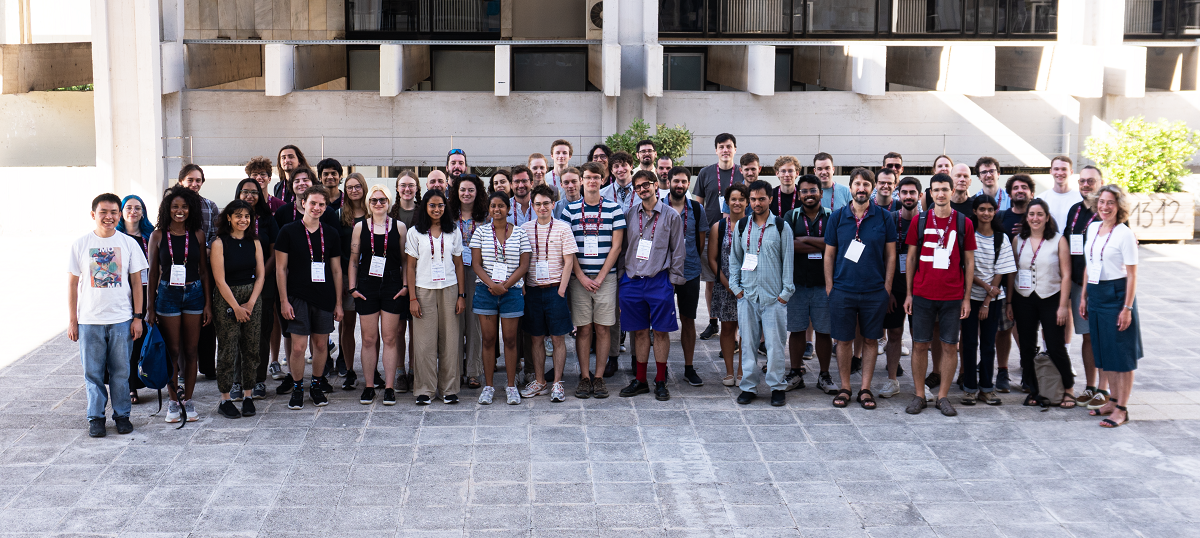
| 10:30 → 11:00 | Group photo & Coffee break |
| 11:00 → 13:00 |
Session B
B1 - Auditorium
Víctor Navas Portella UAB
Roberto Gualdi UPC
Andrés Rojas UB
B2 - Room A1
Anna Jové UB
Donato Scarcella UPC
Guillermo Olicón-Méndez FU Berlin
|
| 13:00 → 14:30 | Lunch break (Free time) |
| 14:30 → 16:00 |
Session D
D1 - Auditorium
Laura González UPC
Søren Dyhr UPC
Katarina Krivokuća FU Berlin
D2 - Room A1
Sofiya Burova UPF-UPC
Jordi Castellví Foguet UPC
Bálint Zsigri FU Berlin
|
| 16:00 → 16:30 | Coffee break |
| 16:30 → 18:30 |
Session E
E1 - Auditorium
Gerard Bargalló-Gómez HU Berlin
Pablo García Arias UB
Marwa Zainelabdeen WIAS
Ana Damnjanovic FU Berlin
E2 - Room A1
Georgios Karelas UPF
Janike Oldekop TU Berlin
Sebastian Zimper ZIB
|
| 19:00 | Social Dinner (Pizzas) |
| 09:30 → 10:30 |
Plenary - Auditorium
Guillem Blanco
Universitat Politècnica de Catalunya and Centre de Recerca Matemàtica |
| 10:30 → 11:00 | Coffee break |
| 11:00 → 13:00 |
Session C
C1 - Auditorium
Francesco Romor WIAS
Thomas Wagenhofer TU Berlin
C2 - Room A1
Viktor Stein TU Berlin
Willem van Zuijlen WIAS
Closing - Auditorium
Alberto Espuny Díaz UB
|
| 13:00 → 13:30 | Closing Session |
Organising Committee
Barcelona Team
Jens-Bastian Eppler | Centre de Recerca Matemàtica
Marina Garrote López | Universitat Pompeu Fabra
Tássio Naia dos Santos | Centre de Recerca Matemàtica
Leticia Pardo Simón | Universitat de Barcelona and Centre de Recerca Matemàtica
Domènec Ruiz-Balet | Universitat de Barcelona and Centre de Recerca Matemàtica
Berlin Team
Georgi Mitsov | Humboldt-Universität zu Berlin
Max Orteu Capdevila | Freie Universität Berlin
André-Alexander Zepernick | Freie Universität Berlin
LIST OF PARTICIPANTS
Raghda Abdellatif | Humboldt-Universität zu Berlin
Josep Alvarez | Universitat Politècnica de Catalunya – CRM
Chiara Amorino | Universitat Pompeu Fabra
Gerard Bargalló | Humboldt-Universität zu Berlin
Cara Bennett | Technische Universität Berlin
Guillem Blanco | Universitat Politècnica de Catalunya – CRM
Sofiya Burova | Universitat Politècnica de Catalunya
Jordi Castellví | Centre de Recerca Matemàtica
Apratim Choudhury | Humboldt-Universität zu Berlin
Ana Damnjanovic | Freie Universität Berlin
Srinwanti Debgupta | Centre de Recerca Matemàtica
Søren Dyhr | Centre de Recerca Matemàtica
Jens-Bastian Eppler | Centre de Recerca Matemàtica
Paul Erchinger | Humboldt-Universität zu Berlin
Alberto Espuny Díaz | Universitat de Barcelona
Gissell Estrada | Universitat Politècnica de Catalunya – CRM
Pablo García | Universitat de Barcelona
Marina Garrotte | Universitat Pompeu Fabra
Sascha Gaudlitz | Humboldt-Universität zu Berlin
Laurin Geyer | Technische Universität Berlin
Roger Gómez | Universitat Politècnica de Catalunya
Laura González | Universitat Politècnica de Catalunya
Johanna Grell | Freie Universität Berlin
Roberto Gualdi | Universitat Politècnica de Catalunya
Roser Homs | Universitat Politècnica de Catalunya
Erica Ipocoana | Freie Universität Berlin
Anna Jové | Universitat de Barcelona
Georgios Karelas | Universitat Pompeu Fabra
Jus Kocutar | Technische Universität Berlin
Balazs Kossovics | Freie Universität Berlin
Katarina Krivokuća | Freie Universität Berlin
Raphael Kuess | Humboldt-Universität zu Berlin
Anmol Kumar | Humboldt-Universität zu Berlin
Pedro López | Universitat Politècnica de Catalunya
Parinitha Manjunath | Humboldt-Universität zu Berlin
Alejandro Martínez | Universitat de Barcelona
Julian Masliah | Freie Universität Berlin
Georgi Mitsov | Humboldt-Universität zu Berlin
Tássio Naia dos Santos | Centre de Recerca Matemàtica
Janike Oldekop | Technische Universität Berlin
Guillermo Olicón-Méndez | Freie Universität Berlin
Marco Olivieri | Universitat Politècnica de Catalunya
Max Orteu | Freie Universität Berlin
Leticia Pardo | Universitat de Barcelona
Nils Pfahl | Technische Universität Berlin
Xavier Povill | Universitat Politècnica de Catalunya
Annika Preuß-Vermeulen | Technische Universität Berlin
Qasim Raja | Humboldt-Universität zu Berlin
Harini Rammohan | Technische Universität Berlin
Holger Reich | Freie Universität Berlin
Adelina Riehl | Technische Universität Berlin
Andrés Rojas | Universitat de Barcelona
Francesco Romor | Weierstrass Institute
Domènec Ruiz-Balet | Universitat de Barcelona – CRM
Tomás Sanz | Universitat de Barcelona – CRM
Donato Scarcella | Universitat Politècnica de Catalunya
David Schmaling | Technische Universität Berlin
Martyna Stawna | Freie Universität Berlin
Viktor Stein | Technische Universität Berlin
Kevin Tang | Humboldt-Universität zu Berlin
Veljko Toljic | Freie Universität Berlin
Marc Torrecillas | Universitat Politècnica de Catalunya
Csenge Urszuly | Freie Universität Berlin
Willem van Zuijlen | Weierstrass Institute
Christoph von Tycowicz | Zuse Institut Berlin
Thomas Wagenhofer | Technische Universität Berlin
Nadja Wisniewski | Technische Universität Berlin
Medha Yelimeli | Humboldt-Universität zu Berlin
Marwa Zainelabdeen | Weierstrass Institute
André Zepernick | Freie Universität Berlin
Sebastian Zimper | Zuse Institut Berlin
Bálint Zsigri | Freie Universität Berlin
LODGING INFORMATION
ON-CAMPUS AND BELLATERRA
BARCELONA AND OFF-CAMPUS
CRM Events code of conduct
All activities organized by the CRM are required to comply with the following Code of Conduct.
CRM Code of Conduct
 |
For inquiries about this event please contact the Scientific Events Coordinator Ms. Núria Hernández at nhernandez@crm.cat
|
scam warning
We are aware of a number of current scams targeting participants at CRM activities concerning registration or accommodation bookings. If you are approached by a third party (eg travellerpoint.org, Conference Committee, Global Travel Experts or Royal Visit) asking for booking or payment details, please ignore them.
Please remember:
i) CRM never uses third parties to do our administration for events: messages will come directly from CRM staff
ii) CRM will never ask participants for credit card or bank details
iii) If you have any doubt about an email you receive please get in touch

Sustainable Events
We are committed to organising sustainable events that minimise environmental impact and create a positive legacy for the host community. We support organisers in designing events aligned with the UN 2030 Sustainable Development Goals, reducing negative environmental impacts and promoting responsible practices.
All materials provided during our activities are responsibly sourced, including recycled pens and plastic-free badges. We work with responsible suppliers, and our catering partners use fully compostable materials while offering vegetarian and vegan options, with at least one event day being fully vegetarian.
Bridging scales to learn cell–cell adhesion from partial trajectory data
This work presents a mathematical and computational framework for estimating parameters in cell–cell adhesion models. The study builds upon a
macroscopic, nonlocal PDE model involving two interacting cell populations influenced by attractive and repulsive forces, incorporating both adhesion dynamics and volume exclusion effects. Starting from a stochastic particle system, the nonlinear PDE system for the cell densities is formally derived through mean-field limits. The parameter estimation problem is addressed by minimising an error functional that combines macroscopic densities and individual trajectories.
The model parameters are estimated using a Bayesian approach, which involves sampling from the posterior distribution of the parameters given observed data. To efficiently sample from this distribution, the pre-conditioned Crank–Nicolson (pCN) Markov Chain Monte Carlo method is used. This algorithm is derivative-free, well-suited for high-dimensional spaces, and has a single tunable parameter to optimize performance.
Geometric Learning & Inference on Manifolds
The success of modern machine learning has renewed interest in the role of geometry for statistical inference. While classical learning algorithms assume Euclidean data representations, many applications naturally involve nonlinear spaces such as Riemannian manifolds, Lie groups, and shape spaces. Developing learning algorithms that respect these structures requires combining ideas from differential geometry, statistics, and machine learning.
This talk surveys recent developments in geometric learning, including intrinsic regression models for manifold-valued data and graph neural networks on nonlinear feature spaces. A common theme is the use of geometric structure as an inductive bias, enabling learning algorithms that are mathematically consistent, computationally efficient, and applicable to challenging problems in medical imaging, computational anatomy, and archaeology. I will discuss current perspectives on the interplay between geometric modeling and data-driven learning, a rapidly developing research area that may shape the next generation of learning methods.
How can we build graphs more efficiently in random environments?
For several decades now, researchers have considered different randomised processes for generating denser and denser graphs. Studying these processes allows us to understand how the characteristics of the resulting graphs evolve as they become denser. Crucially, these processes generate graphs autonomously, with only randomness dictating the outcome of the process. For this reason, it could well be that, when the resulting random graphs satisfy a property which we are interested in, many of their edges are unnecessary for this property. In what ways can we interfere with the process in order to improve the resulting graphs in this sense?
In this talk, I will present the classical random graph process and discuss what happens when we introduce an intelligent agent who wants to optimise the resources used throughout the process. We will discuss several optimal results about the necessary resources required to achieve different properties and present a host of open problems.
Lyapunov exponents in complex dynamics
Lyapunov exponents measure the average exponential rate of expansion of a map with respect to a given measure, making them a fundamental tool for understanding the long-term behaviour of dynamical systems. In this talk, I will introduce the notion of Lyapunov exponent in the setting of complex dynamics, discuss some of its key properties, and explain how it can be used to study the dependence of the dynamics on parameters.
This talk is based on joint work with Matthieu Astorg.
Intersection patterns via homotopy colimits
Given a family of subsets of a fixed space, it is often of importance to describe the collection of subfamilies having a nonempty intersection. Both the Nerve Theorem and the well-known results about convex sets due to Helly, Berge, and Breen are concerned with such questions. Among others, the work of Meshulam, Montejano, and Meunier & Montejano shows that these theorems have homological analogues, where the assumptions and sometimes also the conclusions are replaced by the statements they would imply about homology groups.
We provide a systematic approach to these latter results, leading to further generalizations with weaker assumptions than previously. For this, we use the toolkit of homotopy colimits, which we extend by homologically flavored lemmas, relating homotopy colimits to order- and nerve complexes. This is joint work with Imre Bárány and Pavle Blagojević.
Chaotic Phenomena in the Restricted Planar Circular Three-Body Problem Beyond the Routh Mass Ratio
The Lagrangian equilibrium points L4 and L5 of the restricted planar circular three-body problem (PCR3BP) undergo a bifurcation at the critical value of the mass ratio known as the Routh mass ratio. For smaller values of the mass ratio, these equilibria are elliptic, whereas for larger values they become complex saddles. This is an example of a Hamiltonian–Hopf bifurcation.
In this setting, the existence of transverse homoclinic orbits to L4 (or L5) yields highly intricate dynamics, including a plethora of horseshoes and the so-called blue-sky catastrophe.
We prove that, for every mass ratio sufficiently close to and larger than the Routh mass ratio, the stable and unstable manifolds of L4 intersect transversely along a homoclinic orbit, provided that an explicit non-degeneracy constant does not vanish.
This is a joint work with I. Baldomá and P. Martín.
Phase-field models across biology and physics
We study diffuse-interface phase-field systems of Cahn-Hilliard and Allen-Cahn type. These models provide a flexible framework for describing a wide range of physical and biological phenomena. In particular, we discuss applications to tumor growth and the dynamics of saline droplets.
Our first aim is the thermodynamically consistent derivation of the governing PDE systems, for which we tailor the strategy to the specific features of each problem. We then address the mathematical analysis of these models, focusing on well-posedness. The main ingredients of the analysis are the construction of suitable discretization schemes, the derivation of a priori estimates, and the passage to the limit to establish the existence of solutions.
Shape uncertainty quantification via conditional LDDMM flow matching
Along with conditional flow matching and rectifying flows, stochastic interpolants have emerged as a versatile framework for generative modelling. While these methodologies demonstrate exceptional performance in applications involving images or snapshots on Cartesian grids, their extension to more complex domains, such as shapes or surfaces, poses significant challenges. Furthermore, the implementation of mini-batch optimal transport for kinetic energy density minimisation, while relatively straightforward on Cartesian grids, becomes computationally prohibitive and less practical when applied to general three-dimensional meshes with varying geometries. To address these limitations, we propose a novel approach based on graph neural networks and Large Deformation Diffeomorphic Metric Mapping (LDDMM) for conditional flow matching, building upon prior work. We present applications in the context of time-dependent cardiovascular simulations and shape-informed reduced-order modelling. This methodology facilitates data augmentation for three-dimensional biomedical shapes and also enables the generation of random perturbations of prescribed magnitudes for given shapes. Such capabilities are pivotal for quantifying the impact of uncertainties in the definition of computational domains from medical images on the estimation of relevant biomarkers. Inter-patient surrogate modelling for time-dependent cardiovascular simulations is also demonstrated through autoregressive conditional stochastic interpolants.
Navigating Random Games: Convergence and Cycles in Best Response Dynamics
Best response dynamics (BRD) represent arguably the most intuitive heuristic for repeated play in multi-agent systems. Players independently and sequentially update their strategies to maximize individual utility based on the immediate past action of their opponent. It is considered a fundamental mechanism for modeling strategic updates and learning in game theory. However, when applied to random games, the behavior of these dynamics reveals a rich, probabilistic landscape. This talk provides an overview of the research area surrounding BRD in random games, combining established literature with some of our most recent theoretical results. We begin by going through the established results on the converging behavior of BRD, e.g. the expected number of pure Nash equilibria. Because convergence is not always guaranteed, we will also discuss the non-converging behavior of these dynamics. We characterize the absorbing cycles (sink equilibria) that BRD frequently collapses into, discussing structural insights into their expected size, number etc. In the presence of n players, we introduce two distinct variants: Random and Cyclic BRD, and we compare their respective efficiencies and limitations in identifying Nash equilibria.
Algebraic Statistics of Discrete Statistical Models
Maximum likelihood (ML) estimation is an important method in statistics and data analysis. In this talk, we study the associated optimization problem from an algebraic perspective, with particular emphasis on the ML degree, an algebraic complexity measure of the estimation problem. We focus on discrete statistical models described by toric varieties. In this setting, the ML degree depends on the embedding of the underlying variety. For generic embeddings, the ML degree coincides with the degree of the variety, whereas the locus of non-generic embeddings is given by the principal A-determinant. We present several illustrative examples and discuss recent developments and current research directions.
Spectral problems for many body systems: energy of one- and two-component Bose gases
In a famous 1947 paper, Bogoliubov developed a theory for the spectral analysis of Hamiltonians describing the microscopic behavior of dilute quantum Bose gases. Since then, a major line of research in mathematical physics has been the rigorous justification for, and refinement of, Bogoliubov’s theory. In this talk, we review historical milestones regarding the research on thermodynamic energy of dilute Bose gases and present recent developments. Specifically, we derive a two-term energy expansion for a two-component Bose gas subject to repulsive, pairwise intra- and inter-species interactions. We compare this result to the single-component case, demonstrating its correspondence with the celebrated Lee-Huang-Yang formula and highlighting its universality with respect to the interaction potentials.
Equidistribution of Random Normal Matrices’ eigenvalues
Determinantal Point Processes are a class of point processes characterized by a built-in repulsion among the points. Such point processes are used by physicists to model fermionic systems, and to produce uniformly distributed points. An example is the spectrum of the Random Normal Matrix model.
As the number of eigenvalues increases, they accumulate in a certain compact subset called the droplet, making the empirical measure converge weakly to the equilibrium measure. This talk will focus on quantifying the equidistribution using the expected 2-Wasserstein distance, a metric on the space of finite measures defined via optimal transport. The main tool developed is a regularization using the heat equation with Neumann boundary conditions on a suitable subset of the droplet. This scheme can also be applied to Stationary point processes.
Equidistribution: from points to cycles
The equidistribution of points of small height is a strong result in Arakelov geometry that predicts the behaviour of a sequence of arithmetically simple points in a variety X defined over a number field. Applications can be found in diophantine geometry and dynamics, among others.
In this short talk, after recalling the classical statement for points, we will explore the higher dimensional situation. In particular, given a sequence of d-dimensional cycles in X with prescribed arithmetical features, we describe what is true and what can fail for the asymptotic of the corresponding integration currents.
Optimal Metrics in Odd-Dimensional Geometry
We consider an energy functional on the space of metrics compatible with certain odd-dimensional geometric structures (including contact, cosymplectic, and stable Hamiltonian structures). In dimension 3, or under additional assumptions, we show that structures with optimal metrics either have energy 0 or they are covered by left-invariant structures on certain Lie groups.
To prove this, we first describe the local structure (essentially only using calculus and linear algebra) and then use hyperbolic dynamics and Lie theory to obtain global results.
Joint work with Ángel González-Prieto, Eva Miranda, and Daniel Peralta-Salas.
On Payne-Weinberger inequalities
In this talk, I will first review the classical Payne–Weinberger inequality, which provides an upper bound on the difference between the first Dirichlet eigenvalue of a domain and that of the disk with the same volume. The bound depends only on the isoperimetric deficit of the domain. I will briefly discuss the main ideas behind its proof and explain how the same approach yields analogous inequalities for other operators, including Robin Laplacians and quantum dot Dirac operators.
Statistical Inference Under Privacy Constraints
Our research investigates the trade-off between preserving privacy and retaining statistical accuracy when working with multivariate data subject to componentwise local differential privacy (CLDP). Under CLDP, each component of the private data is released through an individual privacy channel, allowing for different levels of privacy protection across components or enabling each to be privatized by different entities with distinct privacy policies.
This framework also reflects practical scenarios in which joint privatization of all components is infeasible. We develop general techniques to establish minimax bounds that characterize the statistical cost of privacy in terms of the componentwise privacy levels α1, …, αd for d-dimensional data.
We showcase the power and flexibility of these methods through several statistical applications. In particular, the talk will focus on nonparametric density estimation, with and without privacy constraints. We derive matching upper and lower bounds (up to constants) and propose a corresponding adaptive, data-driven procedure. Additionally, we present an in-depth analysis of the effective privacy level, examining how private characteristics of individuals may be inferred from publicly released features of the same individuals.
Maximum likelihood thresholds for colored Gaussian graphical models
Colored Gaussian graphical models are statistical models arising from graphs with a coloring in its vertices and edges. We study maximum likelihood thresholds (MLT) for these models: the minimum number of observations that ensure existence of the maximum likelihood estimator. We extend known results for MLT to the colored setting, determine thresholds for certain families graphs and implement algorithms that exploit the underlying algebraic geometry.
Bayesian inference in stochastic reaction-diffusion equations using spatial information
We consider the Bayesian nonparametric estimation of the reaction term in a stochastic reaction-diffusion equation. Posterior contraction rates are proven by making use of the spatial ergodicity of the stochastic reaction-diffusion equation while the time horizon is fixed. We additionally prove a non-parametric Bernstein- von Mises Theorem for the posterior distribution. The analysis of the posterior requires new concentration results for spatial averages of transformation of the stochastic reaction-diffusion equation, which are based the combination of the Clark-Ocone formula with bounds on the marginal densities.
Minimal Covering Bodies
We study convex bodies that are inclusion minimal with the property that their integer translates cover ℝd, which we call minimal covering bodies. It was observed by Xue and Zong (2017) that such convex bodies are not necessarily translative tiles.
In this talk, we will see that minimal covering bodies are polytopes with at least 2d facets, which further implies that every convex covering body contains a polytopal (but not necessarily convex) translative tile. Further, we extend the method of Xue and Zong to obtain a large family of examples of minimal covering bodies which are not tiles, relating this class of bodies to covering properties of Minkowski combinations of convex bodies. This talk is based on joint work with Giulia Codenotti and Ansgar Freyer.
The temporal stochastic block model
Motivated by the need to understand infection spreading in inhomogeneous populations, we consider a temporal version of the stochastic block model, where each edge is equipped with a random label, interpreted as a timestamp. We study the size and structure of reachable sets via increasing paths (that is, paths whose edge timestamps are strictly increasing) where the connections per node are of the order of log n. We prove tight results for the first order asymptotics of the size of the reachable set from a typical vertex, and the proportions of reached vertices in each community.
Joint work with G. Lugosi and G. Perarnau
Enumeration of unlabeled graph classes
Counting graphs is a classical theme in combinatorics and graph theory. For instance, Cayley’s formula, which dates back to 1860, famously establishes that the number of labeled trees on n vertices is nn−2. However, the problem of counting the number of unlabeled trees on n vertices is much more difficult and in fact it was not solved until 1948 by Otter.
The striking contrast between the labeled and unlabeled settings stems from the presence of symmetries, which makes the latter considerably more challenging. This talk will provide an introduction to the enumeration of unlabeled graph classes, focusing on the techniques used to account for automorphisms. Central to this approach is Pólya’s enumeration theory, together with generating functions, which provide powerful tools for counting non-isomorphic combinatorial structures.
Using trees as a motivating example, we will discuss how these ideas can be extended to more general graph classes, particularly some families of chordal graphs. This is joint work with Michael Drmota and Clément Requilé.
Particle Correlations and Noise in Conservative SPDEs: Analysis and Numerics
This talk explores how correlations between particles affect the noise in equations describing their collective density. The first examples concern particles exposed to the same random motion, first through a common Brownian shift and then through a random environment that varies in space. In this setting, particles at different positions can be correlated in different ways, leading to conservative stochastic heat equations whose noise depends linearly on the density. This is contrasted with particles driven separately, where the resulting density fluctuations lead to the nonlinear noise in the Dean–Kawasaki equation. Alongside these examples, we discuss some of the analytical and numerical difficulties of conservative SPDEs, particularly whether simulations can retain basic properties of the original equations, such as conservation of total mass and nonnegativity. The talk is intended to serve as an introduction to the topic and includes numerical perspectives motivated by ongoing work.
Mean-field optimal control with stochastic leaders
We study the stochastic optimal control of populations influenced by a small number of leaders, considering both finite-agent systems and their mean-field limits. The limiting dynamics are described by a conditional McKean-Vlasov SDE coupled with the leaders’ dynamics, which we show to be equivalent to a nonlinear Fokker-Planck PDE/SDE system. Optimal controls for the mean-field system provide approximate strategies for the corresponding finite agent-based models, but their computation is challenging as the control acts on the space of probability measures. We develop a numerical method for approximating optimal controls of the limiting PDE/SDE system and demonstrate its effectiveness in steering agents towards consensus in a prototypical opinion dynamics model.
Microstructural Foundations of Rough Log-Normal Volatility Models
When modelling financial markets, we mathematicians like to use continuous-time models to approximate the discrete nature of real-world trading. In these continuous-time models, stock movements are driven by random noise. However, the behaviour of these markets is influenced by market participants buying and selling assets. This is known as market microstructure.
In this talk, we introduce such a market microstructure model, where orders to buy or sell an asset arrive according to a Poisson process and have a long-lasting impact on volatility. Under an appropriate scaling, we show that this discrete model converges to a popular continuous-time model, the so-called rough Bergomi model.
Mathematically, we discuss weak convergence in Skorokhod space, the space of right-continuous functions. In addition to establishing weak convergence, we also provide an explicit upper bound for the convergence rate and present numerical simulations and visualisations to illustrate the behaviour of the model.
Moving Mass, Decreasing Energy: Learning Probability Distributions with Wasserstein Gradient Flows
Many problems in machine learning require approximating a complicated probability distribution, for example, in Bayesian inference, variational inference, and generative modeling. In this talk, I will describe a gradient-flow perspective on this problem. A gradient flow describes how a point evolves to decrease an energy as rapidly as possible relative to a chosen geometry. But what does this mean when the evolving object is not a point in Euclidean space, but an entire probability distribution?
I will explain how optimal transport equips the space of probability measures with the so-called Wasserstein geometry, allowing notions such as velocity and steepest descent to be transferred to this infinite-dimensional setting. I will conclude by discussing how kernel regularization turns these gradient flows into interacting particle algorithms for learning complex target distributions.
The singular Φ4 equation on ℝ3, a simple construction
The dynamical Φ4 equation is a stochastic partial differential equation that is motivated by quantum field theory, as it describes the natural reversible dynamics for the Euclidean Φ4 quantum field model. Because the driving space-time white noise is highly irregular, the solution is expected to be distribution-valued, and the cubic nonlinearity is not classically well-defined. The equation is therefore singular and has to be interpreted through a suitable renormalisation procedure. In the past decade, there have been many developments dealing with singular SPDEs including the Φ4 equations. We discuss a relatively simple construction of a solution by means of an exponential transformation often called a partial Cole–Hopf transformation and explain how this construction can be adapted from the three-dimensional torus to the unbounded space. This is joint work with Oscar Junge.
Title: Hyperkähler manifolds and where to find them
Abstract: Hyperkähler (HK) manifolds are higher-dimensional generalizations of K3 surfaces, appearing naturally in the classification of manifolds with trivial canonical bundle. Despite their rich general theory developed along the last decades, examples are scarce and geometric constructions of (locally complete) families of projective HK manifolds remain a challenging open problem. After introducing the basic definitions, in this talk we will give an overview of what is known about this problem. Time permitting, we will also explain some recent progress in it (obtained in joint works with B. Piroddi, Á. Ríos and J. Song, and with F. Giovenzana and J. Song).
Títol: How to find minimal system of generators for variants of Moh-type ideals.
Abstract:
The existence of families of prime ideals with an unbounded minimal number of generators is a classical subject in commutative algebra. This problem is closely linked to Sally’s conjecture regarding the existence of a uniform upper bound for the minimal number of generators of all ideals in Noetherian rings. In this context, Macaulay and Moh provided counterexamples to the existence of such a bound with families of prime ideals in polynomial and power series rings, respectively.
This talk focuses on the construction of new variants of Moh-type ideals in the power series ring k[[x,y,z]]. The main goal is to explain how to determine their minimal systems of generators, which is fundamental for future generalizations. To achieve this, the process links commutative algebra with linear algebra, numerical semigroups, and binomial matrices.
Title: The nearby Lagrangian conjecture for pinwheels
Abstract: Symplectic topology is a garden where differential topology, algebraic geometry and dynamical systems grow together. I would like to convey this through the story of Lagrangian pinwheels: cell complexes in symplectic 4-manifolds that are Lagrangian and that arise as vanishing cycles of “good smoothings” of cyclic quotient singularities. These exhibit interesting properties, for example, which pinwheels embed in the complex projective plane turns out to be governed by the solutions of the Markov equation $a^2+b^2+c^2=3abc$. Lagrangians have a standard neighbourhood, modelled after their cotangent bundle. The nearby Lagrangian conjecture claims that such a Lagrangian is “essentially unique” in that neighbourhood. In joint work with N. Adaoglou and J. Hauber, we prove the analogous statement for pinwheels. The talk is aimed at graduate students and assumes no prior symplectic geometry.
Title: Gradient-robust finite element-finite volume scheme for the compressible Navier-Stokes equations
Abstract:
We study the steady compressible Navier–Stokes equations in primitive variables, assuming a barotropic flow with an exponential (isentropic) pressure–density law. We present a numerical scheme for the compressible Stokes equations coupling a finite element discretization of the momentum equation with a finite volume method for the continuity equation. The scheme guarantees stability, mass conservation, density non-negativity, and gradient-robustness — addressing the locking phenomenon known from high-Reynolds-number incompressible flow, which carries over to the compressible setting, via reconstruction onto H(div)-conforming spaces. Numerical benchmarks confirm these properties.
Title: Rare events, bifurcations, and tipping in random dynamical systems with bounded noise
Abstract:
In this talk we consider a large class of one-dimensional dynamical systems in discrete time perturbed with random noise at each time step, where the amplitude of this perturbation is bounded (for instance, a deterministic map with additive uniform noise). As opposed to the classical theory of SDEs with unbounded noise, here the trajectories typically remain confined in invariant compact intervals. By changing the parameters of the system, these invariant sets may exhibit discontinuous changes – they can merge into a single invariant set, or they can even disappear. Statistically speaking, this corresponds to a discontinuous change in the stationary distributions of the stochastic process, which is anticipated in the shape of the tail of their density functions. On the other hand, after the bifurcation, the system now has quasi-invariant regions from which the trajectories almost surely escape eventually, but after a really long time.
We address the following questions: how is the tail of the stationary densities related to the dynamics of the system? How can we use the time series to estimate how close we are to a bifurcation? If the bifurcation occurs, how long is a trajectory expected to remain in the formerly invariant set before escaping?
This is joint work with M. Rasmussen, J. S.W. Lamb, and W. H. Tey
Title: Iteratively Regularized Structure-Exploiting Quasi-Newton Methods for Inverse Problems with Applications to Piezoelectricity
Abstract:
Inverse problems are fundamental to many scientific and industrial applications and are often formulated as optimization problems in infinite-dimensional Hilbert spaces. Their inherent ill-posedness leads to instability and strong sensitivity to model errors and initialization, limiting the effectiveness of conventional optimization methods. Beyond the need for fast and robust solution methods, many applications benefit from insights into the interactions and dependencies between different components of the object to be reconstructed.
In this talk, we introduce a regularized and structure-exploiting Powell-Symmetric-Broyden (RSE-PSB) method under modified secant conditions. The proposed approach leverages the advantages of Quasi-Newton (QN) methods while incorporating Tikhonov-type regularization and structural exploitation of the second-order Fréchet derivative. Additionally, this circumvents the approximation error of the Levenberg-Marquardt method, which neglects the second-order term in the Hessian of the regularized objective. We provide a convergence analysis in the Hilbert space setting, establishing local Q-linear convergence and proving local Q-super-linear convergence under Hilbert-Schmidt assumptions. Furthermore, we discuss a globalization strategy governed by the dynamic control of the regularization parameter, which ensures stability and global convergence in discretized settings. Finally, the proposed methodology is applied to an industrial PDE-driven inverse problem, namely the identification of piezoelectric material parameters.