The CRM Mentoring Programme, as Told by One of Its Pairs
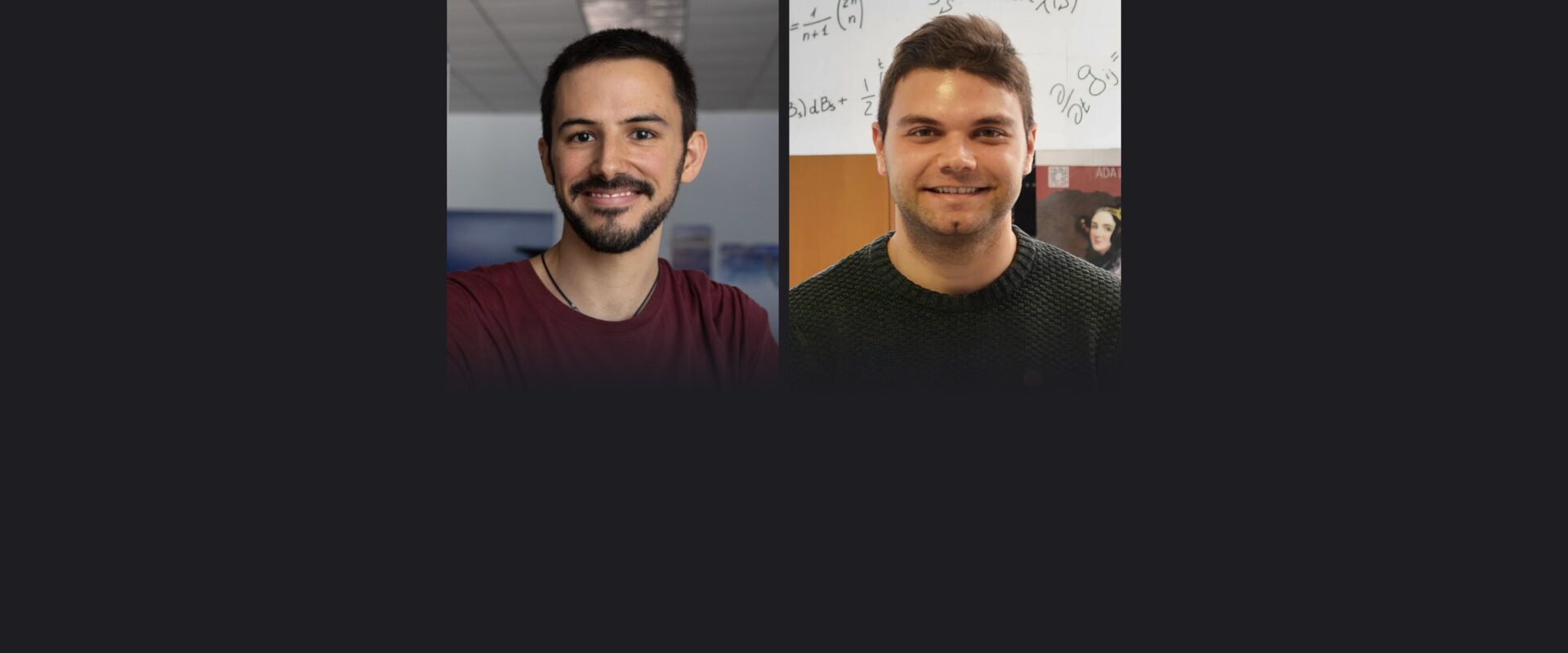
PhD student Joaquim Duran and mathematician Robert Cardona, one of the pairs in the CRM Mentoring Programme
Joaquim Duran (left) and Robert Cardona.
Joaquim Duran went into the CRM Mentoring Programme expecting little. “Before I knew who my mentor would be, I had the preconception that I wouldn’t get much out of it,” he says. Telling a stranger about personal worries felt odd to him, and he assumed their conversations would never go very deep. The stranger turned out to be Robert Cardona. “I was actually glad, and my attitude towards the programme changed completely,” Joaquim says. “Whoever paired us must have known that Robert and I are fond of each other.”
The CRM launched the programme in 2023. In its latest edition, the mentees were PhD students funded by the María de Maeztu programme who weren’t in the final year of their thesis. Each was paired with a more experienced researcher from outside their supervision, and it’s one of the ways the CRM looks after the careers of its early-career researchers, part of the work behind the HR Excellence in Research award the centre has held since 2015.
Whoever paired us must have known that Robert and I are fond of each other.
Joaquim Duran
Joaquim began his PhD at the CRM and the Universitat Politècnica de Catalunya (UPC) in 2024, supervised by Albert Mas and Tomás Sanz-Perela and funded by a María de Maeztu FPI contract. Before that he studied mathematics and physics at the Universitat de Barcelona (UB), where he won the August Palanques award for the best academic record in mathematics, and took a master’s at the UPC. His bachelor’s thesis in mathematics started from Mark Kac’s well-known question “Can one hear the shape of a drum?”, that is, whether the notes a drum can play are enough to work out its shape.
His PhD deals with a relative of that question. He studies Dirac operators, which come from the equation for relativistic quantum particles such as the electron and also describe, in the plane, the electrons of materials like graphene. His focus is the case in which the particle is trapped in a small region, a so-called quantum dot. The problem behind his thesis is one of shape: among all regions with the same area, finding the one that makes the particle’s lowest positive energy level as small as possible. For an ordinary drum, the equivalent question was settled a century ago. Of all shapes with the same area, the circle plays the lowest note.
Robert has been an assistant professor at the UB’s Faculty of Mathematics since 2023 and is an affiliated researcher at the CRM. He did his PhD at the UPC under Eva Miranda, as a student of the Barcelona Graduate School of Mathematics (BGSMath), and finished it in 2021. The thesis later won him the Vicent Caselles award, given by the Royal Spanish Mathematical Society and the BBVA Foundation, as well as the Institut d’Estudis Catalans’ prize for the best PhD thesis in mathematics. His research sits where geometry and topology meet dynamical systems, with a particular interest in how fluids and mechanical systems move. With Miranda, Daniel Peralta-Salas and Francisco Presas, he showed that an ideal fluid can behave like a computer. Some steady fluid flows can simulate any algorithm, which means certain questions about where a particle of that fluid will end up have no computable answer. Since 2024 he has also been an elected member of the European Mathematical Society’s Young Academy.
Mathematically, then, the two work a long way apart. “That Robert works in a different area of mathematics doesn’t make much difference when it comes to talking about personal experiences, worries, life,” says Joaquim. “What does make a difference is feeling confident and open enough to talk to someone about these things. Because we’re close, Robert is exactly the right person to make me feel that way.”
I find it useful to have a third person involved.
Robert Cardona
Robert’s reasons for taking part go back to his own doctorate. “I thought it was a very good idea,” he says. “I remembered colleagues from my PhD years who had been through delicate situations with their thesis supervisors, and I find it useful to have a third person involved.” He never had a mentor as such. The closest thing, he recalls, was someone doing a PhD with the same supervisor who had been there longer and “more or less played that role.”
The two already knew each other and, as Robert explains, had talked quite a lot about the challenges of a thesis and what comes after it. In March they met in person as mentor and mentee. “I was so happy Robert was my mentor that when we met, I invited him for a coffee,” says Joaquim. “So our mentoring took place in a bar across from Plaça Universitat.” The square faces the UB’s historic building, where Robert works. Joaquim adds: “Beyond the conversation itself, that’s the memory I keep with the most affection.”
The subject they’ve talked about most is the postdoc. “The way I am, the thought of living away from home, far from the people I love, makes me anxious,” Joaquim says. Robert told him about his own experience and about options that don’t involve being away for so long, or so far. It’s also the conversation Robert remembers best: “Discussing one of the most typical worries for students close to finishing their thesis: the postdoc, moving abroad and what that involves.”
Asked what mentoring has taught him, Robert doesn’t single out a lesson. “Personally, it’s been a chance to get to know Joaquim better, and to try to accompany him through his doubts.”
Joaquim still isn’t sure whether getting Robert as a mentor was luck or a calculated decision. He leans towards the second, so his advice for anyone joining the programme next year is to go in with a good attitude. “And in case it was the first,” he adds, “I might suggest they drop a list of names of people they wouldn’t mind having a conversation with over a coffee.”
More from the CRM
When the reward comes within reach, the brain changes what it compares
As the tokens piled up, choices got faster and more accurate at the same time. The yardstick for judging each offer had moved.CRM CommPau VarelaCRMComm@crm.catGet the latest CRM news and activities in your inbox.Recent newsletters →Two subjects...
Almost every automaton can be reset with a short word
For a random automaton with n states, a word of about √n log n letters is almost always enough to reset it.CRM CommPau VarelaCRMComm@crm.catGet the latest CRM news and activities in your inbox.Recent newsletters →Picture a conveyor belt carrying...
Exposició ‘Les matemàtiques de Gaudí’
CRM quod erat demonstrandum | 48
ADA: Decoding Brain Signals Misaligned in Time
The study addresses a key limitation of current brain decoding techniques: the difficulty of interpreting internal mental processes whose temporal dynamics vary from trial to trial.Decoding what is happening in a person’s mind from their brain activity is one of the...
Rare curves, many points: Christophe Ritzenthaler and Rachel Pries on their research and the work around it
Christophe Ritzenthaler (Université de Rennes) and Rachel Pries (Colorado State University) both work on curves over finite fields: he hunts curves with as many points as possible, she hunts curves that almost never occur. In conversation with the CRM during their...
Call open for the 2027 Ferran Sunyer i Balaguer Prize
The Ferran Sunyer i Balaguer Foundation is accepting submissions for its 2027 prize, which awards 15,000 euros and publication in Birkhäuser's Progress in Mathematics series to an expository monograph on an active area of mathematical research. The deadline is 27...
Susanna Terracini delivers the CRM Colloquium 2026
Susanna Terracini (Università di Torino) delivered the CRM Colloquium 2026 on 14 July, presenting a rigidity result for Kepler billiards obtained with Stefano Baranzini, Vivina Barutello and Irene De Blasi. She was at the centre as a member of the CRM Scientific...
Ho Chi Minh City hosts the SEAMS School on applying mathematics to real-world problems
Students from across the region took courses and worked on group projects at a school co-organised by CRM researcher Tim Myers.CRM CommPau VarelaCRMComm@crm.catGet the latest CRM news and activities in your inbox.Recent newsletters →Between 4 and...
A single ball on a fixed table can compute: Eva Miranda and Isaac Ramos prove that two-dimensional billiards are Turing complete
Eva Miranda (UPC, CRM) and Isaac Ramos (ETH Zürich) show that a point particle bouncing inside a planar table with fixed walls can simulate a universal Turing machine, settling a question Cristopher Moore left open in 1990. The result grew out of a master’s project...
BMS-BGSMath Junior Meeting 2026: Barcelona and Berlin Strengthen Scientific Ties
From 2 to 4 September 2026, the Centre de Recerca Matemàtica (CRM) hosted the BMS-BGSMath Junior Meeting 2026, a three-day event jointly organised by the Berlin Mathematical School (BMS) and the Barcelona Graduate School of Mathematics (BGSMath), with the Centre de...