

The Centre de recherches mathématiques (CRM – Montréal) and the Centre de Recerca Matemàtica (CRM – Barcelona) began a collaborative partnership on July 1, 2024, to enhance mathematical research and knowledge exchange between Quebec, Canada, and Catalonia, Spain, featuring mirror conferences and research exchange programs, with the first activity being an Exploratory Workshop on algebra, combinatorics, and proof formalization held on July 15, 2024.
The Centre de recherches mathématiques (CRM – Montréal) and the Centre de Recerca Matemàtica (CRM – Barcelona) have initiated a collaboration starting July 1, 2024. This partnership is set for an initial duration of two years, with the possibility of extension, aiming to enhance mathematical research and knowledge exchange between Quebec, Canada, and Catalonia, Spain.
Founded in 1968, CRM-Montréal is a premier Canadian research institute dedicated to advancing mathematical sciences. It fosters interdisciplinary collaboration and supports cutting-edge research through workshops, conferences, and visitor programs. Established in 1984, CRM-Barcelona is a leading Spanish research centre focusing on a broad spectrum of mathematical disciplines. It promotes high-level research activities, international collaborations, and the dissemination of mathematical knowledge.
This collaboration includes mirror conferences taking place simultaneously at both CRM centers to facilitate research sharing and discussion, and small teams research programs that promote exchanges between Catalan and Spanish researchers and CRM members. These initiatives aim to develop joint research projects and strengthen academic ties.
First Activity under the Agreement
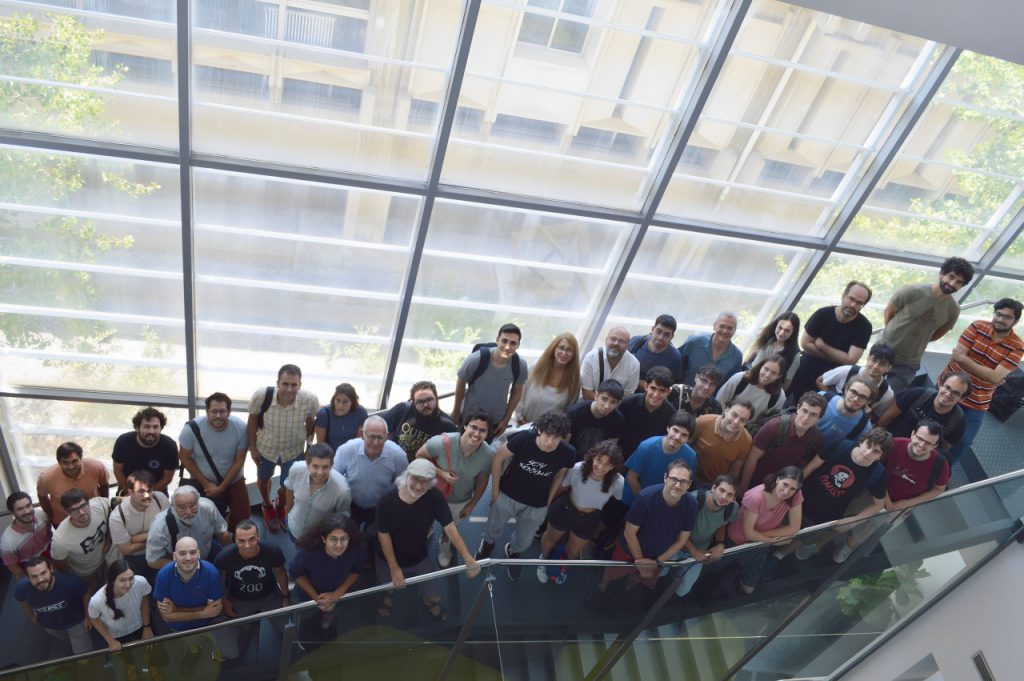
The first notable activity under this agreement was the Exploratory Workshop on the interplays between algebra, combinatorics, and proof formalization. Held on July 15 at CRM Barcelona, this workshop addressed key topics such as matroid theory, polytopes, tropical geometry, and the use of Lean for formalizing mathematical proofs. Organized by Marc Masdeu and Juanjo Rué, the workshop featured prominent speakers and aimed to set a high standard for future collaborative events. Researchers from CRM Montreal were able to follow the talks and participate online in the workshop.
This collaborative agreement marks a significant step forward in the internationalization of mathematical research, underscoring the commitment of both CRM-Montréal and CRM-Barcelona to advancing the field on a global scale.
Subscribe for more CRM News
|
|
CRM CommPau Varela & Mariona Fucho
|

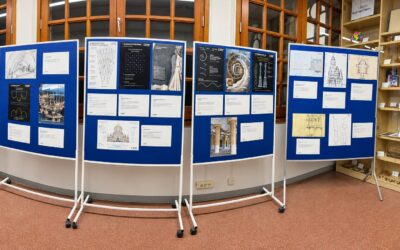
The CRM exhibition ‘Les matemàtiques de Gaudí’ moves to the University of Barcelona
After its October run at the UAB, the exhibition Les matemàtiques de Gaudí, produced by the CRM, can be seen at the University of Barcelona’s CRAI Biblioteca de Matemàtiques i Informàtica from 2 to 30 November 2026.
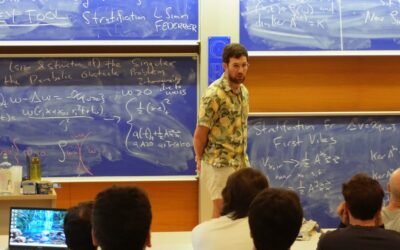
Advanced Course on Free Boundary Problems Opens the Intensive Weeks of the IRP
From 26 to 30 October, around forty researchers attended the Advanced Course on Free Boundary Problems at the CRM, three seven-hour mini-courses given by Bozhidar Velichkov (Università di Pisa), Max Engelstein (University of Minnesota) and Zihui Zhao (Johns Hopkins University). The course was the first of the two intensive weeks of the Intensive Research Programme on Analysis of Free Boundary Problems, which runs until 4 December.
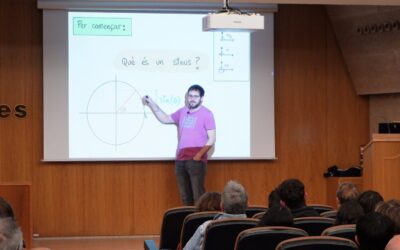
El CRM rep els estudiants de la prova de nivell de Bojos per les Matemàtiques 2027
Els aspirants a Bojos per les Matemàtiques 2027 van visitar el Centre de Recerca Matemàtica (CRM) dissabte 24 d’octubre, després de fer la prova de nivell a la Facultat de Ciències i Biociències de la UAB. En acabat, Tomás Sanz (UB-CRM) els va explicar què té a veure l’escalfament d’una barra de ferro amb els àudios de WhatsApp.

Eight CRM Researchers in the 2026 Stanford-Elsevier List of Highly Cited Scientists
The Centre de Recerca Matemàtica (CRM) has eight researchers in the 2026 update of the Stanford-Elsevier ranking of highly cited scientists, which John P. A. Ioannidis (Stanford University) and Jeroen Baas (Elsevier) compile from Scopus data. Xavier Cabré, Álvaro Corral, Tim Myers, Xavier Ros-Oton, Sergey Tikhonov and Xavier Tolsa appear both in the career-long ranking and in the one for 2025, and Diego Vidaurre and Simeon Ball in the 2025 ranking.
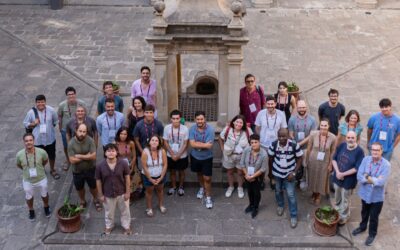
Fish schools and growing tissues: a workshop on how collective behaviour emerges
The Centre de Recerca Matemàtica (CRM) organised the Barcelona Workshop on Kinetic and Macroscopic Models in Biology with Friends II, held from 7 to 10 September at the Institut d’Estudis Catalans. More than thirty researchers discussed how order at the scale of tissues and animal groups arises from local interactions between individuals, in a programme that included talks by CRM researchers Daria Stepanova and Juan Arellano-Tintó. Two of the speakers, James Sharpe (EMBL Barcelona) and Chiara Villa (CNRS, Université Paris Cité), talked to the CRM about their research.
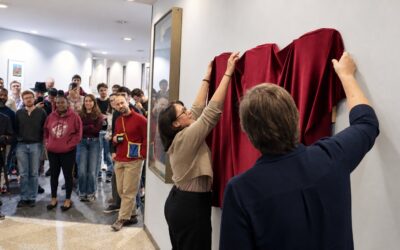
The CRM opens the academic year and unveils its Directors’ Gallery
A review of the year, the Communication Plan 2026–2030 and three research talks filled the morning of 19 October.The unveiling of the Directors’ Gallery.CRM CommPau VarelaCRMComm@crm.catGet the latest CRM news and activities in your inbox.Recent...

The CRM Mentoring Programme, as Told by One of Its Pairs
PhD student Joaquim Duran and mathematician Robert Cardona, one of the pairs in the CRM Mentoring ProgrammeJoaquim Duran (left) and Robert Cardona.CRM CommPau VarelaCRMComm@crm.catGet the latest CRM news and activities in your inbox.Recent...
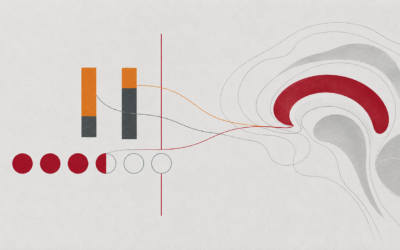
When the reward comes within reach, the brain changes what it compares
As the tokens piled up, choices got faster and more accurate at the same time. The yardstick for judging each offer had moved.CRM CommPau VarelaCRMComm@crm.catGet the latest CRM news and activities in your inbox.Recent newsletters →Two subjects...

Almost every automaton can be reset with a short word
Guillaume Chapuy (Université Paris Cité, CNRS) and Guillem Perarnau (UPC, CRM) have shown that a random finite automaton with n states can, with high probability, be reset by a word of length of order √n log n. The result, published in ACM Transactions on Algorithms, pins the exponent at 1/2, the lower end of a decade of numerical estimates, and addresses the random version of the synchronization problem behind a conjecture Ján Černý posed in 1964 and which still remains open.
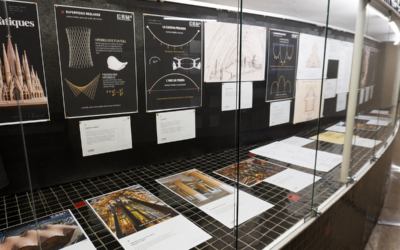
Exposició ‘Les matemàtiques de Gaudí’
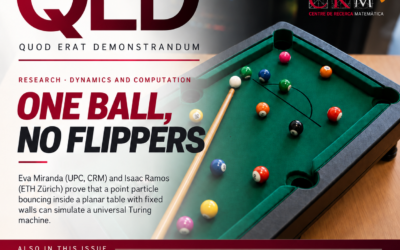
CRM quod erat demonstrandum | 48

ADA: Decoding Brain Signals Misaligned in Time
The study addresses a key limitation of current brain decoding techniques: the difficulty of interpreting internal mental processes whose temporal dynamics vary from trial to trial.Decoding what is happening in a person’s mind from their brain activity is one of the...