
- The roundtable titled “And after the Degree, What?” held at the Universidad de La Rioja, during the Conference of Deans of Mathematics, explored various career options for mathematics graduates, such as academia and industry.
- David Romero, head of the Knowledge Transfer Unit (KTU) at CRM, discussed the unique aspects of industrial PhDs, emphasizing their value in producing highly qualified professionals.
David Romero, the head of the Knowledge Transfer Unit at the Centre de Recerca Matemàtica (CRM), took part in the roundtable titled And after the Degree, What? held at Universidad de La Rioja. This discussion was part of the Conference of Deans of Mathematics (CDM) meeting, focusing on post-graduation pathways for mathematics students, including academia, industry, and more.
The CDM is a nonprofit association operating in Spain, involving universities, departments, and associations related to Mathematics. The CDM aims to continuously improve the quality of Mathematics education by coordinating initiatives, exchanging experiences, and proposing educational reforms at various levels. It seeks to enhance the professional integration of graduates and promote mathematics in society, particularly in non-university education.
During his participation in the roundtable, Romero, who is also a Board member of the Spanish Mathematics-Industry Network (math-in), highlighted the similarities and unique benefits of industrial PhDs compared to traditional academic ones. “In an industrial PhD, a good understanding between the student, the academic advisor, and the industrial director is crucial. However, this understanding is not much different from that in the academic PhD between the student and their academic advisor. The main difference is the additional industrial element,” explained Romero.
He further addressed potential challenges within the host organisation of an industrial PhD, such as industries or municipalities, noting that they are not too dissimilar to those encountered in academic settings. Romero emphasized the significant value industrial PhDs bring to companies: “The industrial PhD remains a very valuable training for the company because it ultimately produces a highly qualified professional who thoroughly understands the challenges the organisation faces.”
Moreover, Romero pointed out the additional benefits of such programs, including networking and professional development opportunities. “Given the nature of the PhD, which includes stays abroad and attendance at conferences, the organisation’s network of contacts, via the PhD student, grows enormously,” he added.
The panel for the roundtable also included Pilar Benito of Universidad de La Rioja, José Luis Pancorbo from AERTIC, and was moderated by David Alonso of Universidad de Zaragoza. The roundtable offered an interesting insight into the different pathways available to mathematics undergraduate students to continue with their professional careers, including industrial PhDs. Fostering a practical application of mathematical research and enhancing collaboration between academia and industry in Spain is one of the tenets of organizations such as Math-In.
Subscribe for more CRM News
|
|
CRM CommPau Varela & Mariona Fucho
|
Jagged walls and unknown edges: a workshop on free boundary problems
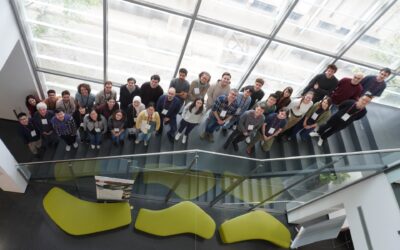
From 2 to 6 November, the Workshop on Free Boundary Problems brought together more than fifty registered participants from institutions in eleven countries at the CRM. Over five days they heard 21 talks on elliptic and parabolic free boundaries and on geometric measure theory and harmonic analysis in rough domains, with speakers including Guy David, Svitlana Mayboroda, Susanna Terracini and Robin Neumayer. The workshop was the second intensive week of the Intensive Research Programme on Analysis of Free Boundary Problems, which continues at the CRM until 4 December.
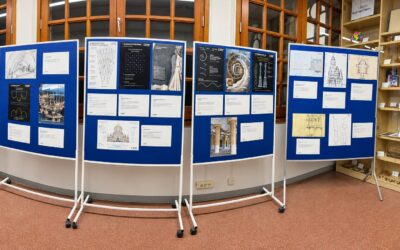
The CRM exhibition ‘Les matemàtiques de Gaudí’ moves to the University of Barcelona
After its October run at the UAB, the exhibition Les matemàtiques de Gaudí, produced by the CRM, can be seen at the University of Barcelona’s CRAI Biblioteca de Matemàtiques i Informàtica from 2 to 30 November 2026.
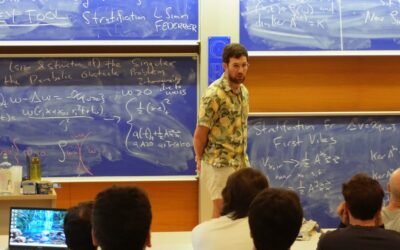
Advanced Course on Free Boundary Problems Opens the Intensive Weeks of the IRP
From 26 to 30 October, around forty researchers attended the Advanced Course on Free Boundary Problems at the CRM, three seven-hour mini-courses given by Bozhidar Velichkov (Università di Pisa), Max Engelstein (University of Minnesota) and Zihui Zhao (Johns Hopkins University). The course was the first of the two intensive weeks of the Intensive Research Programme on Analysis of Free Boundary Problems, which runs until 4 December.
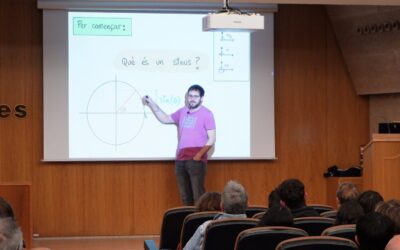
El CRM rep els estudiants de la prova de nivell de Bojos per les Matemàtiques 2027
Els aspirants a Bojos per les Matemàtiques 2027 van visitar el Centre de Recerca Matemàtica (CRM) dissabte 24 d’octubre, després de fer la prova de nivell a la Facultat de Ciències i Biociències de la UAB. En acabat, Tomás Sanz (UB-CRM) els va explicar què té a veure l’escalfament d’una barra de ferro amb els àudios de WhatsApp.
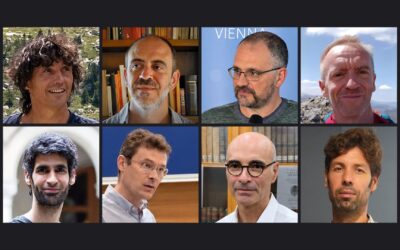
Eight CRM Researchers in the 2026 Stanford-Elsevier List of Highly Cited Scientists
The Centre de Recerca Matemàtica (CRM) has eight researchers in the 2026 update of the Stanford-Elsevier ranking of highly cited scientists, which John P. A. Ioannidis (Stanford University) and Jeroen Baas (Elsevier) compile from Scopus data. Xavier Cabré, Álvaro Corral, Tim Myers, Xavier Ros-Oton, Sergey Tikhonov and Xavier Tolsa appear both in the career-long ranking and in the one for 2025, and Diego Vidaurre and Simeon Ball in the 2025 ranking.
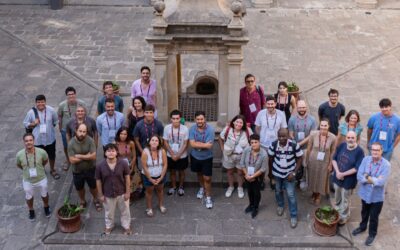
Fish schools and growing tissues: a workshop on how collective behaviour emerges
The Centre de Recerca Matemàtica (CRM) organised the Barcelona Workshop on Kinetic and Macroscopic Models in Biology with Friends II, held from 7 to 10 September at the Institut d’Estudis Catalans. More than thirty researchers discussed how order at the scale of tissues and animal groups arises from local interactions between individuals, in a programme that included talks by CRM researchers Daria Stepanova and Juan Arellano-Tintó. Two of the speakers, James Sharpe (EMBL Barcelona) and Chiara Villa (CNRS, Université Paris Cité), talked to the CRM about their research.
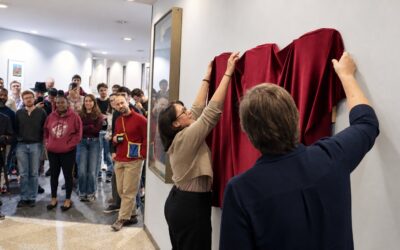
The CRM opens the academic year and unveils its Directors’ Gallery
A review of the year, the Communication Plan 2026–2030 and three research talks filled the morning of 19 October.The unveiling of the Directors’ Gallery.CRM CommPau VarelaCRMComm@crm.catGet the latest CRM news and activities in your inbox.Recent...
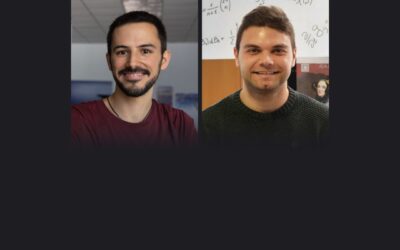
The CRM Mentoring Programme, as Told by One of Its Pairs
PhD student Joaquim Duran and mathematician Robert Cardona, one of the pairs in the CRM Mentoring ProgrammeJoaquim Duran (left) and Robert Cardona.CRM CommPau VarelaCRMComm@crm.catGet the latest CRM news and activities in your inbox.Recent...
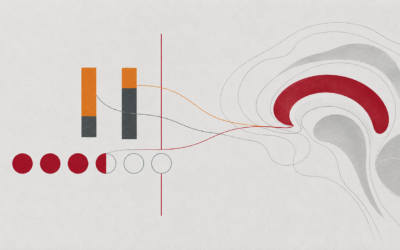
When the reward comes within reach, the brain changes what it compares
As the tokens piled up, choices got faster and more accurate at the same time. The yardstick for judging each offer had moved.CRM CommPau VarelaCRMComm@crm.catGet the latest CRM news and activities in your inbox.Recent newsletters →Two subjects...

Almost every automaton can be reset with a short word
Guillaume Chapuy (Université Paris Cité, CNRS) and Guillem Perarnau (UPC, CRM) have shown that a random finite automaton with n states can, with high probability, be reset by a word of length of order √n log n. The result, published in ACM Transactions on Algorithms, pins the exponent at 1/2, the lower end of a decade of numerical estimates, and addresses the random version of the synchronization problem behind a conjecture Ján Černý posed in 1964 and which still remains open.
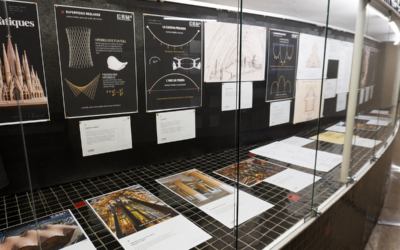
Exposició ‘Les matemàtiques de Gaudí’