
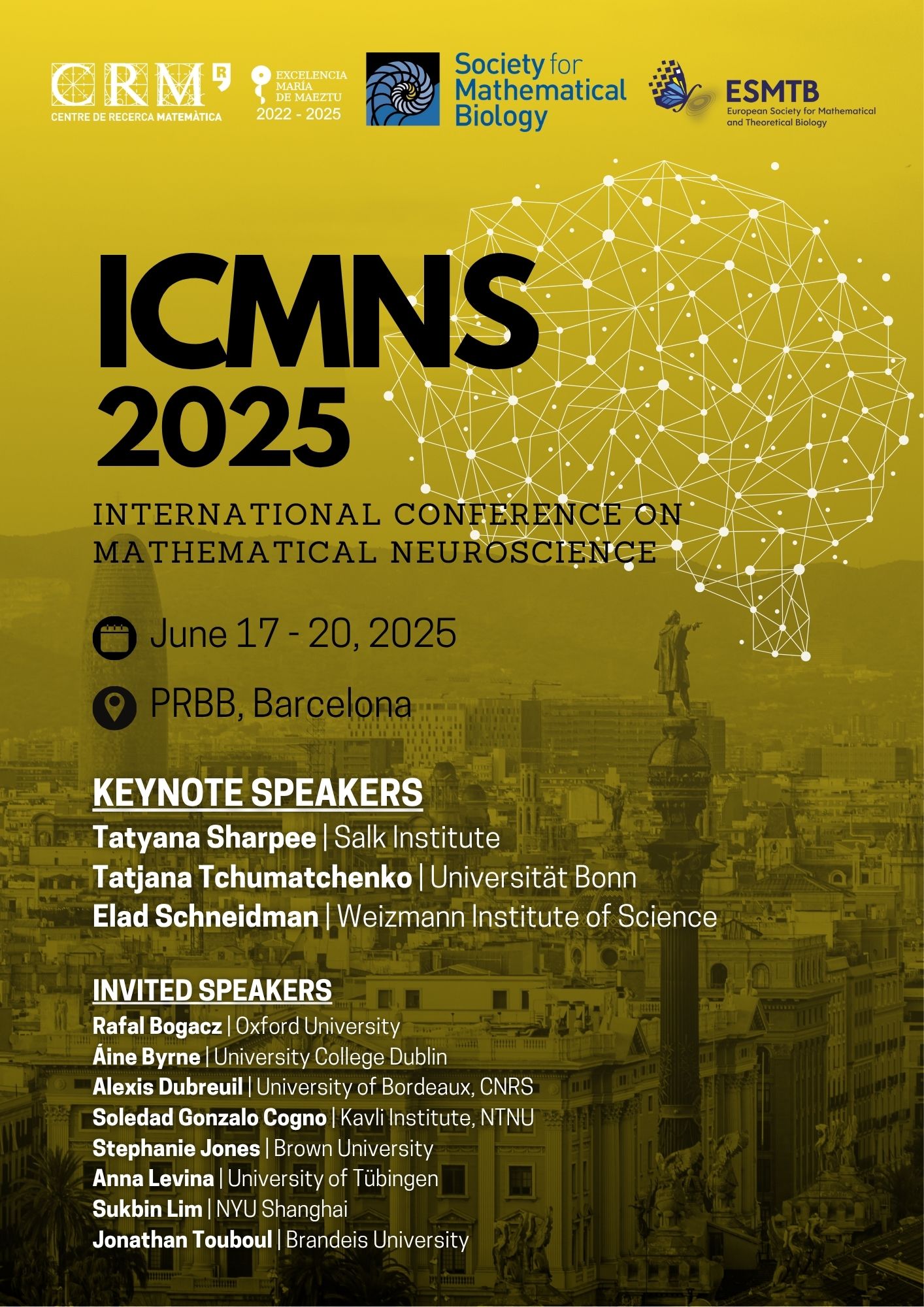
ICMNS 2025
International Conference on Mathematical Neuroscience
REGISTRATION FEE
(Includes attendance to the congress, gala dinner, coffee breaks and a sandwich from Tuesday to Thursday)
300€ Standard registration
250€ Registration for postdocs
170€ Registration for students
SCHEDULE
ABSTRACTS CONTRIBUTED TALKS & POSTERS
International Conference on Mathematical Neuroscience (ICMNS 2025)
Sign into June 20, 2025
Venue: PRBB, Barcelona - Rooms: Auditorium / Marie Curie
To register, please, click on the SIGN IN button on the left.
*Please note that presenting a contribution does not exempt participants from paying the registration fee.
PRBB Parc de Recerca Biomèdica de Barcelona
PRBB Parc de Recerca Biomèdica de Barcelona
PRBB Parc de Recerca Biomèdica de Barcelona (visit)
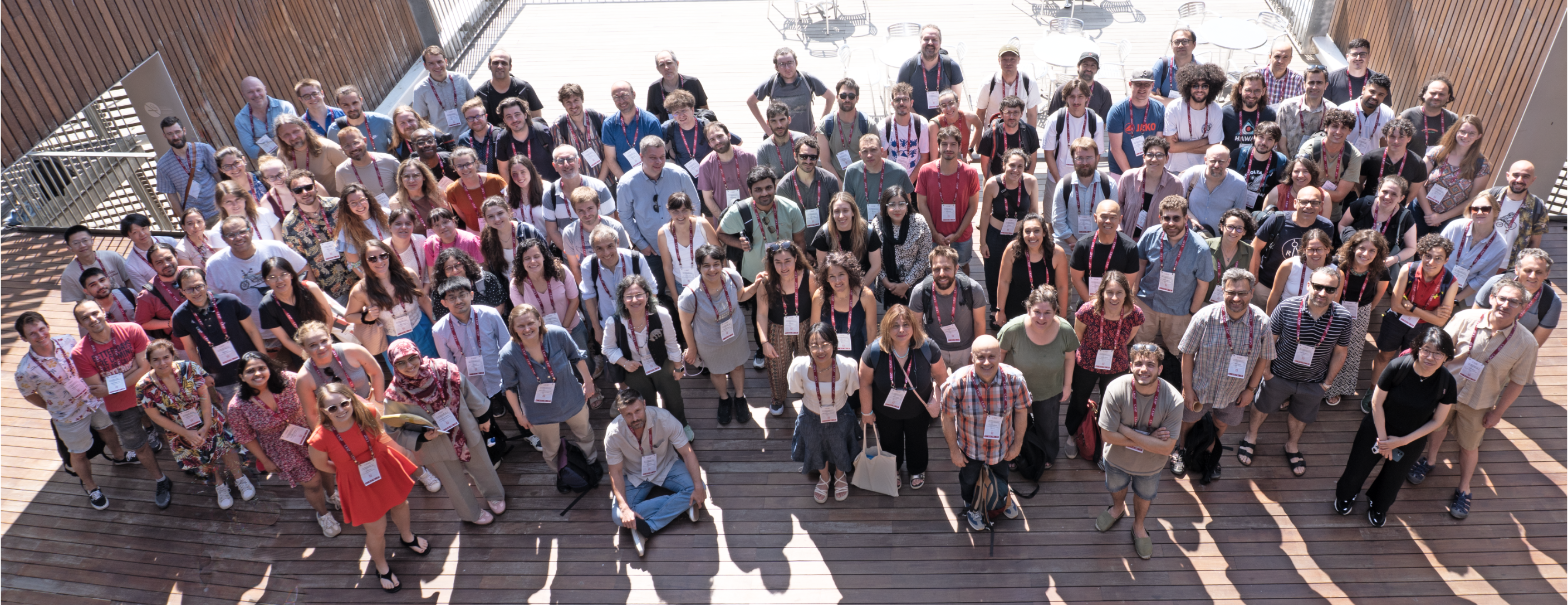
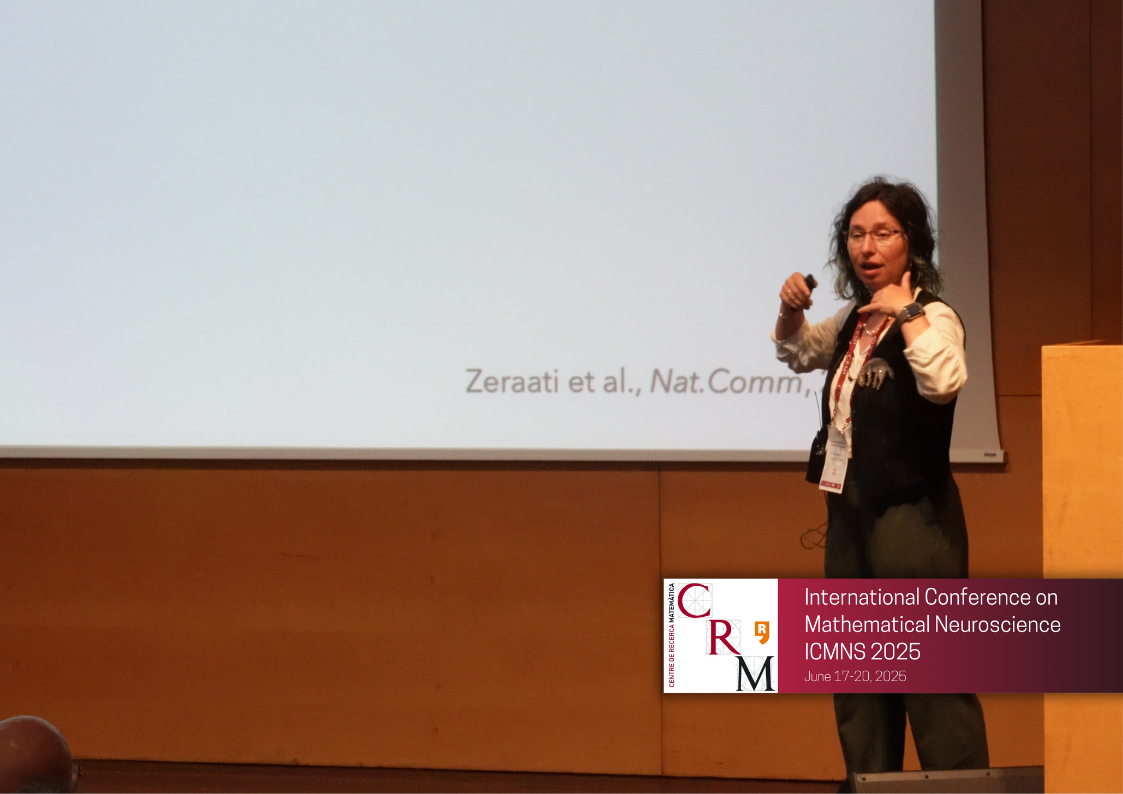
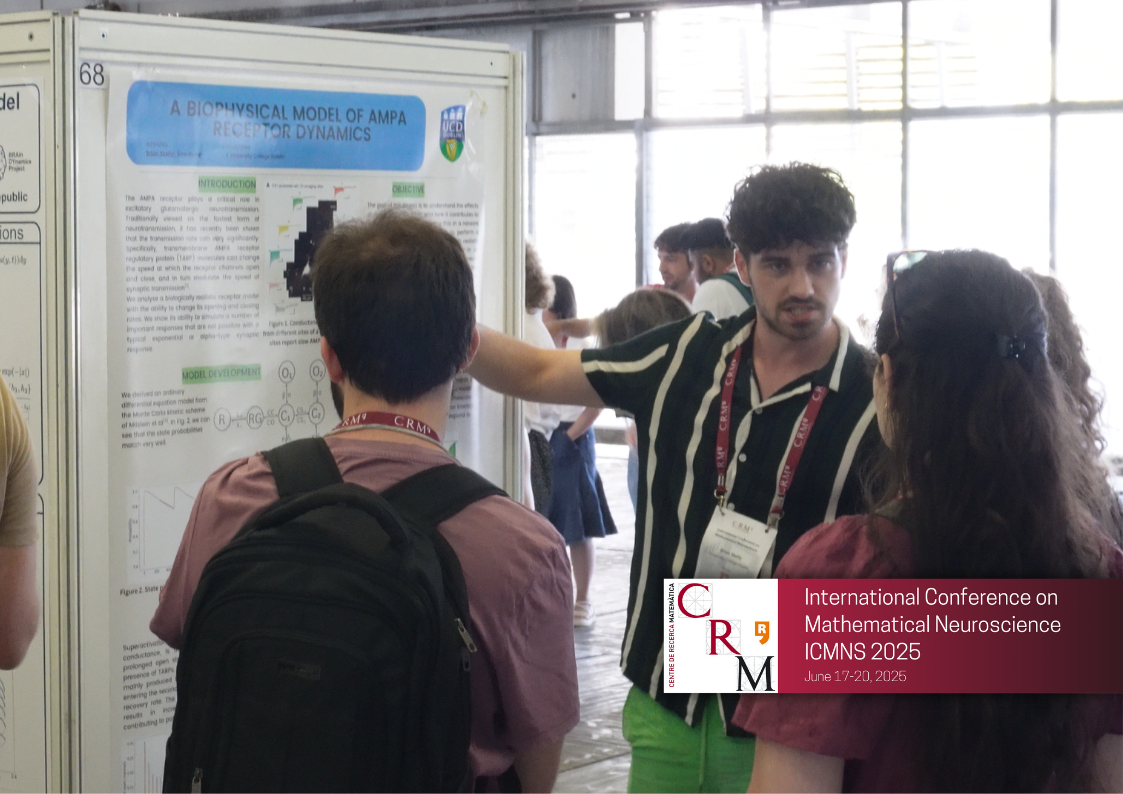
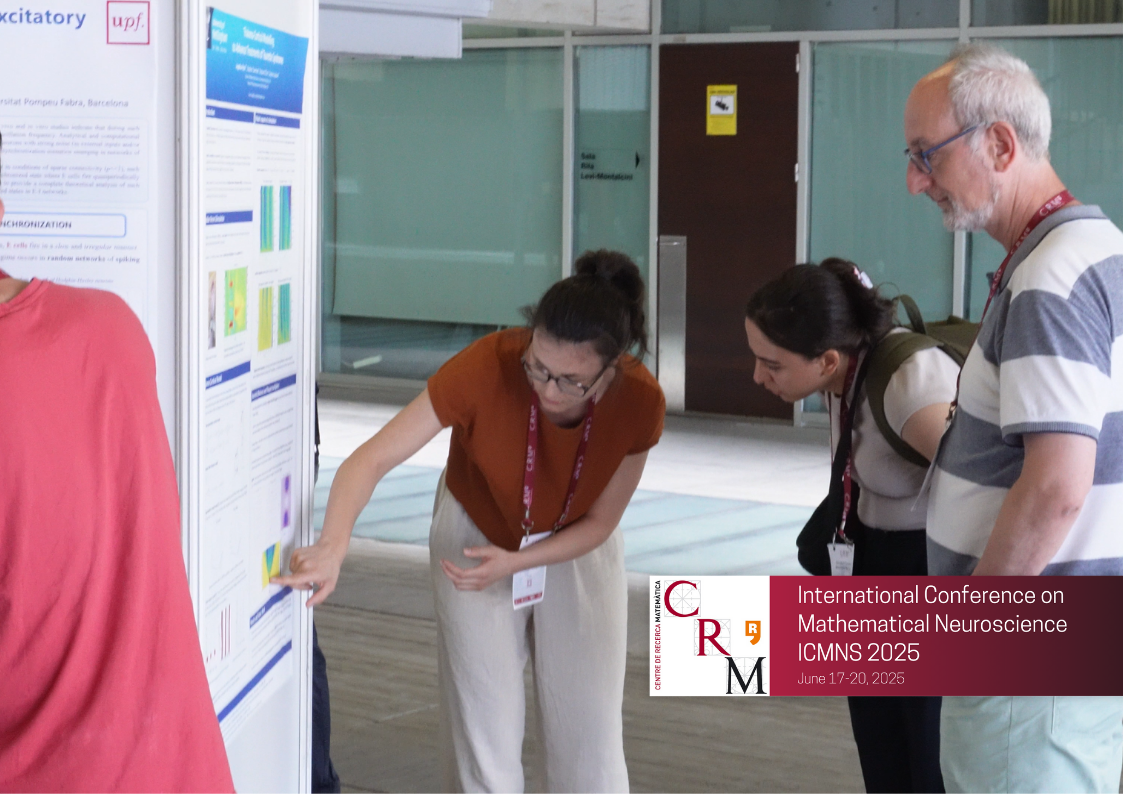
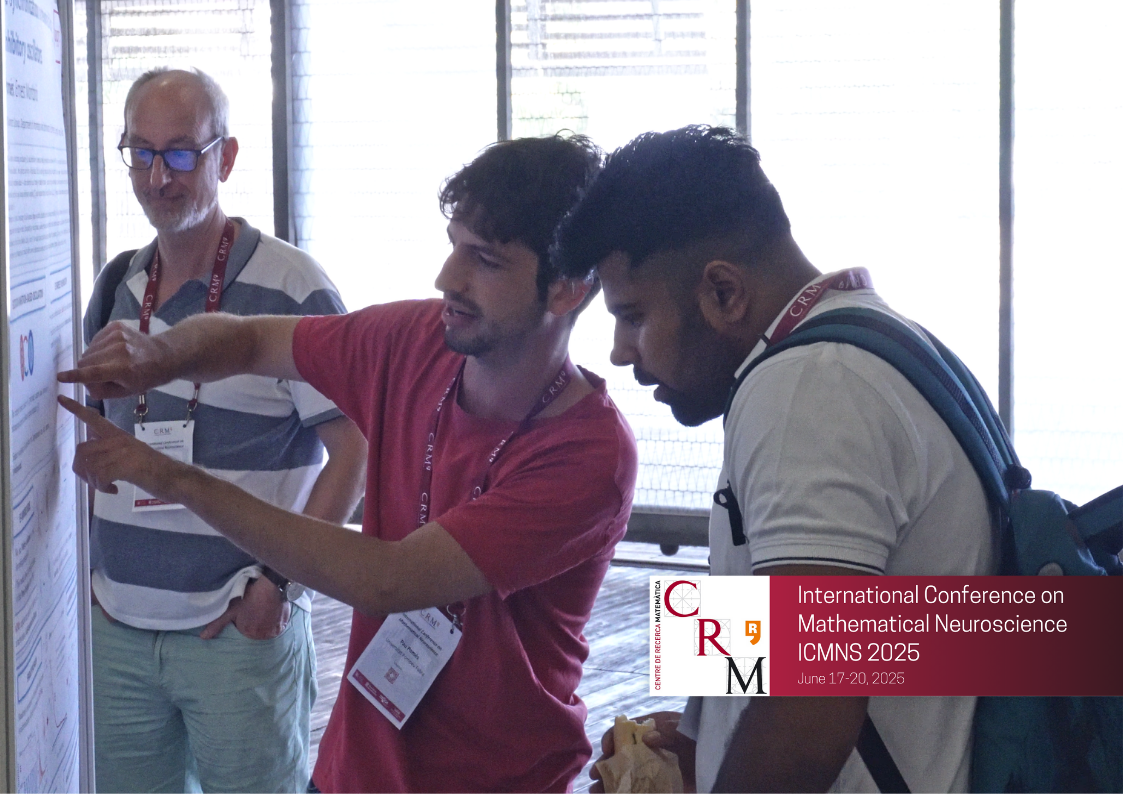
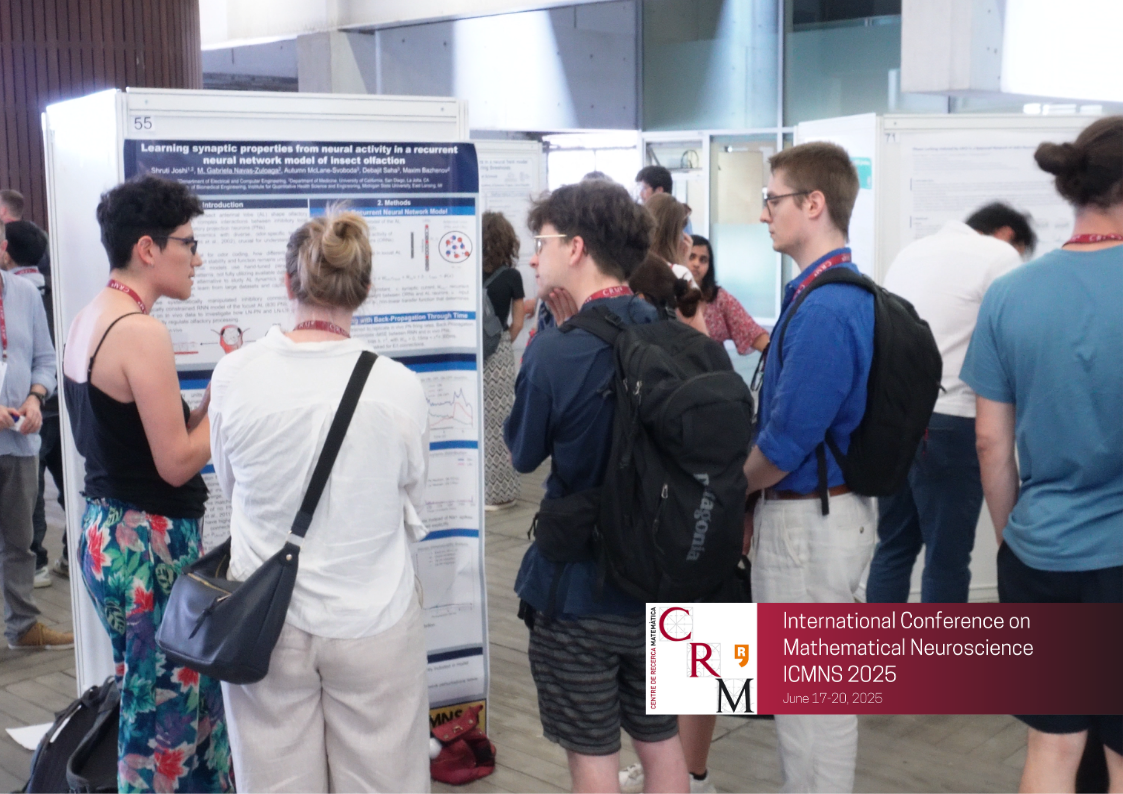
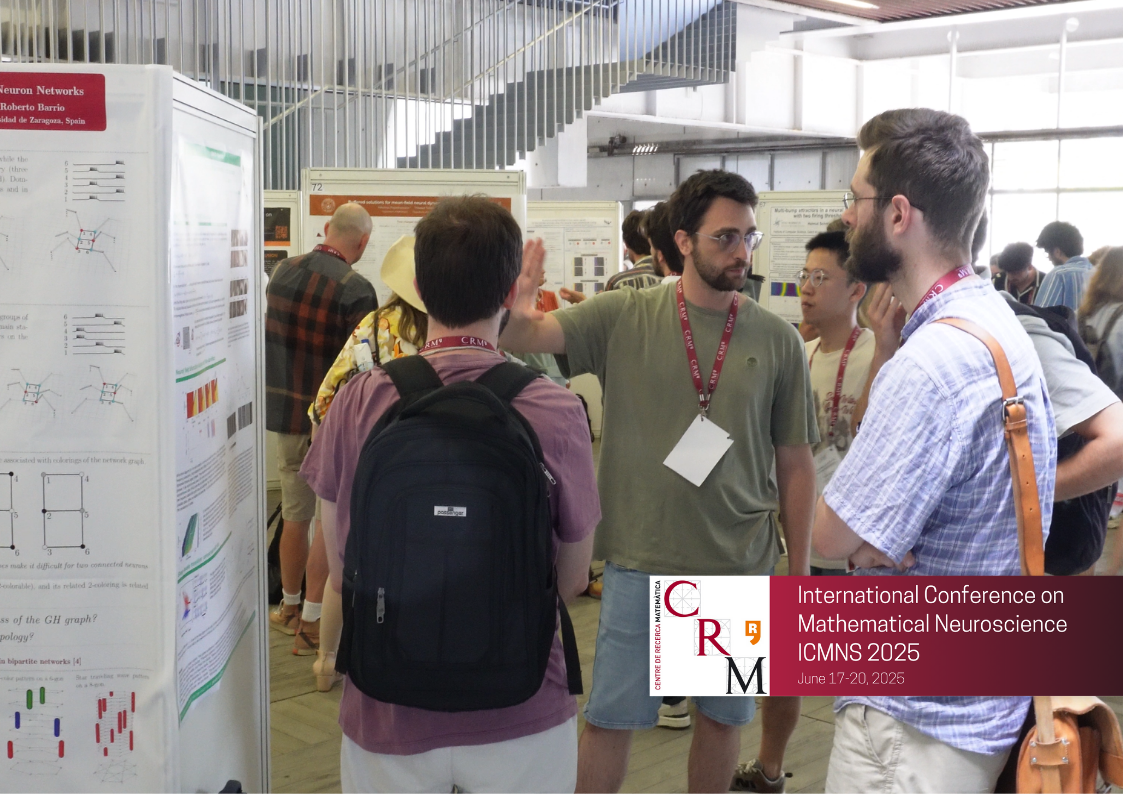
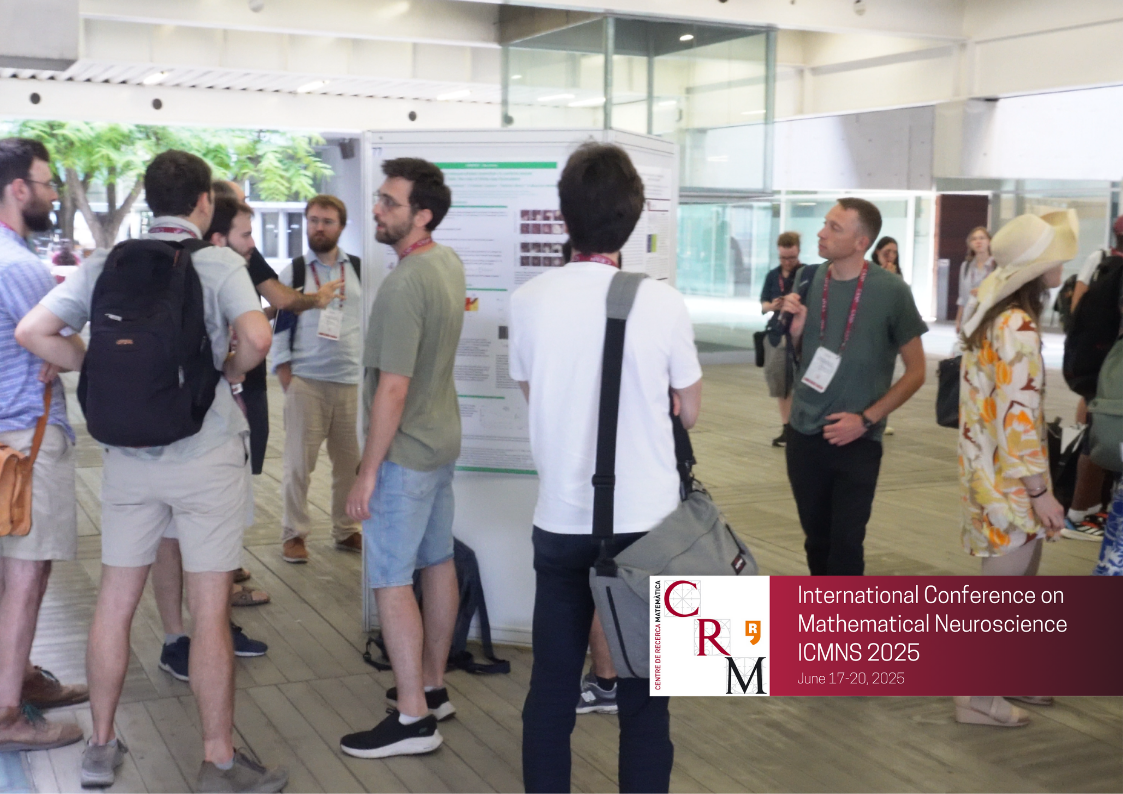
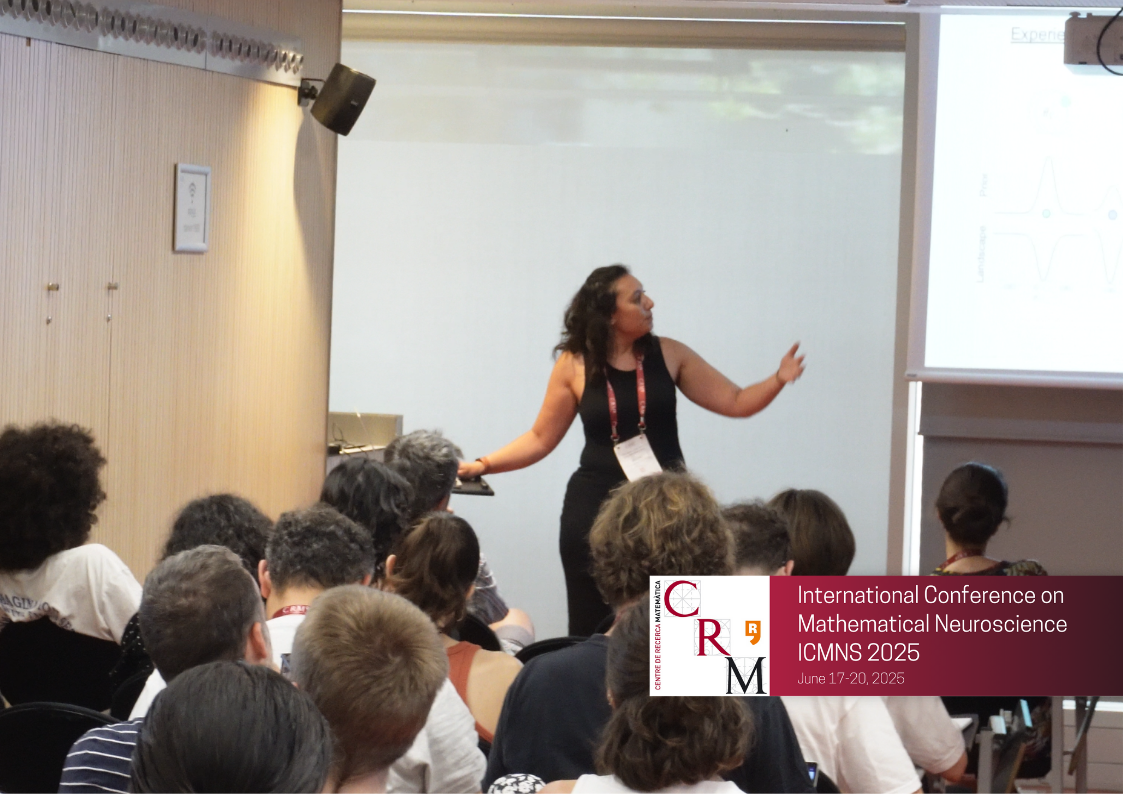
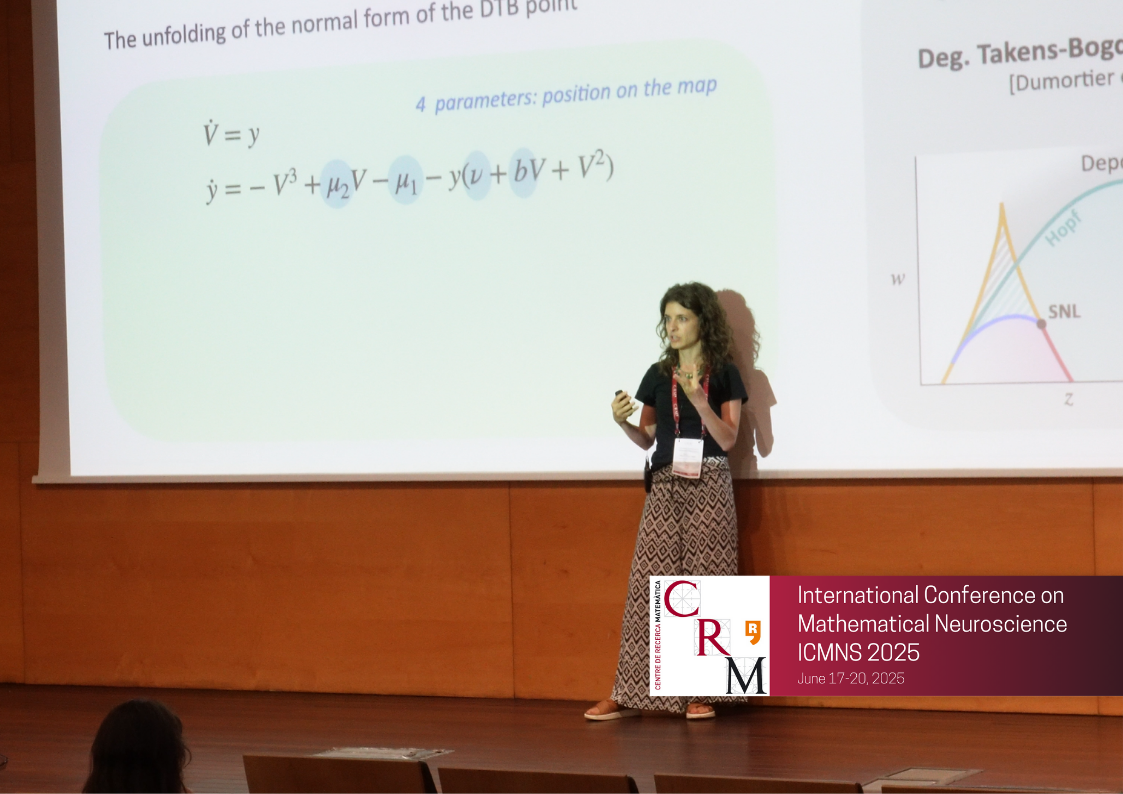
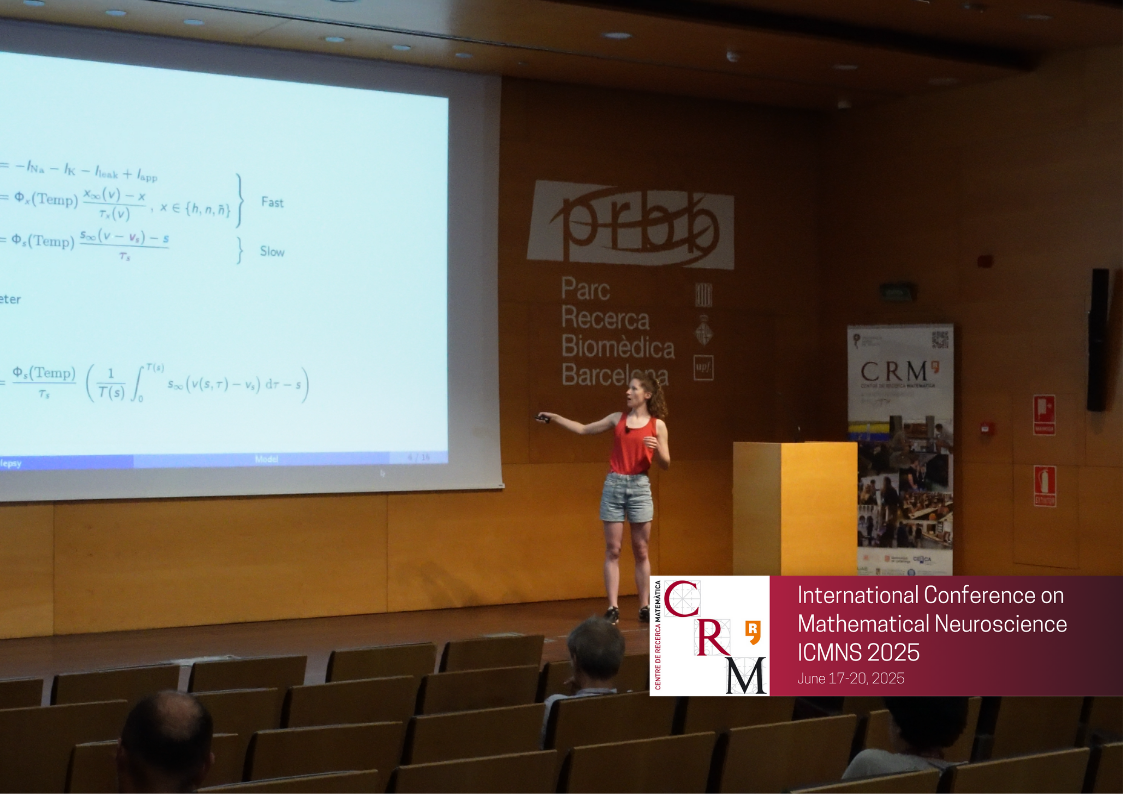
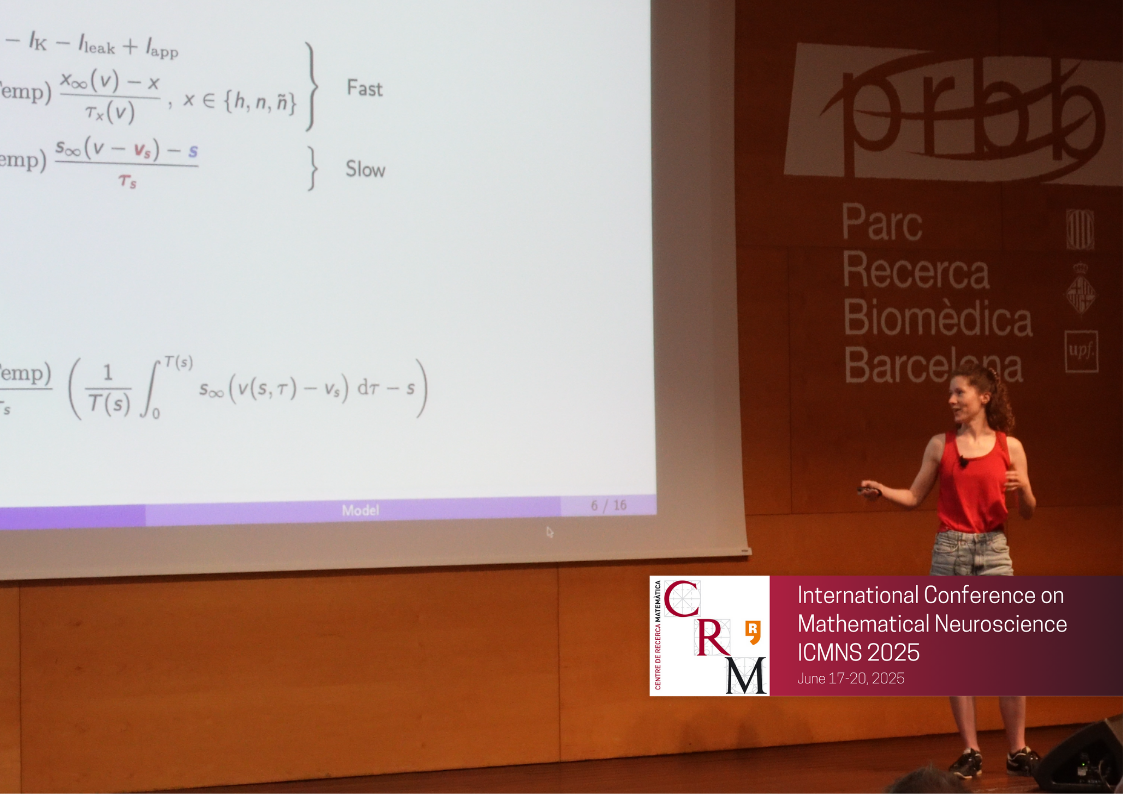
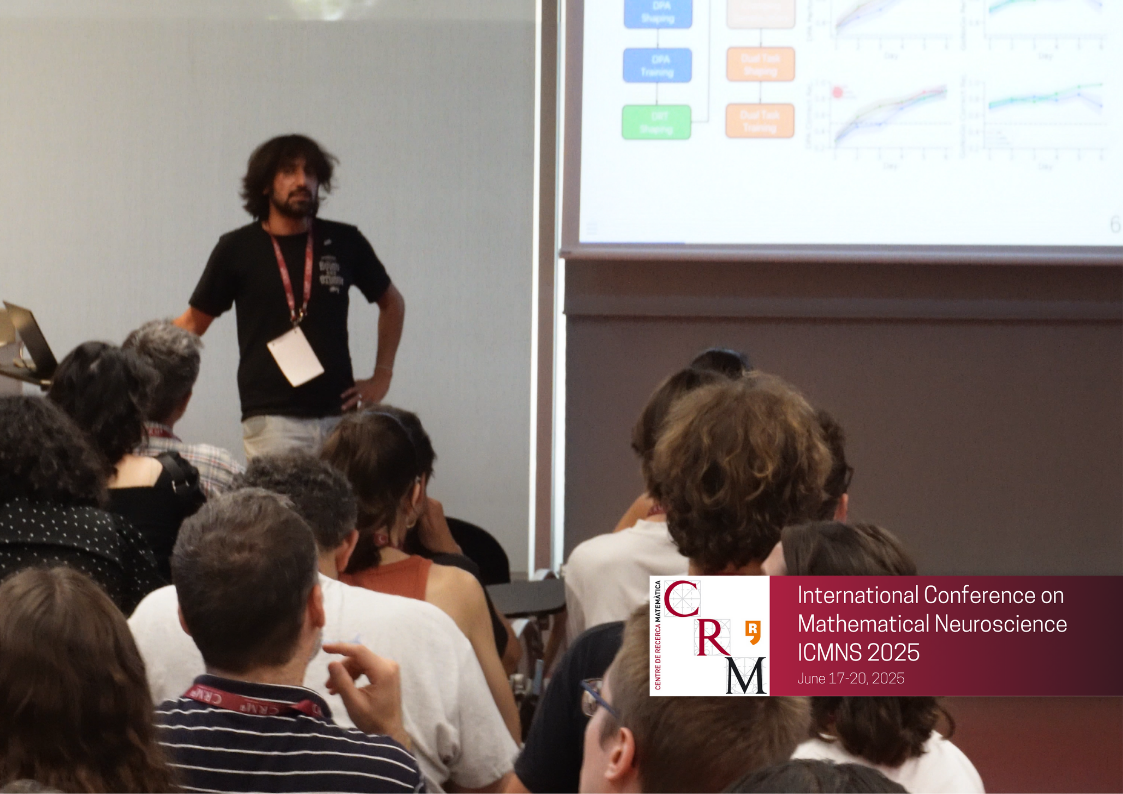
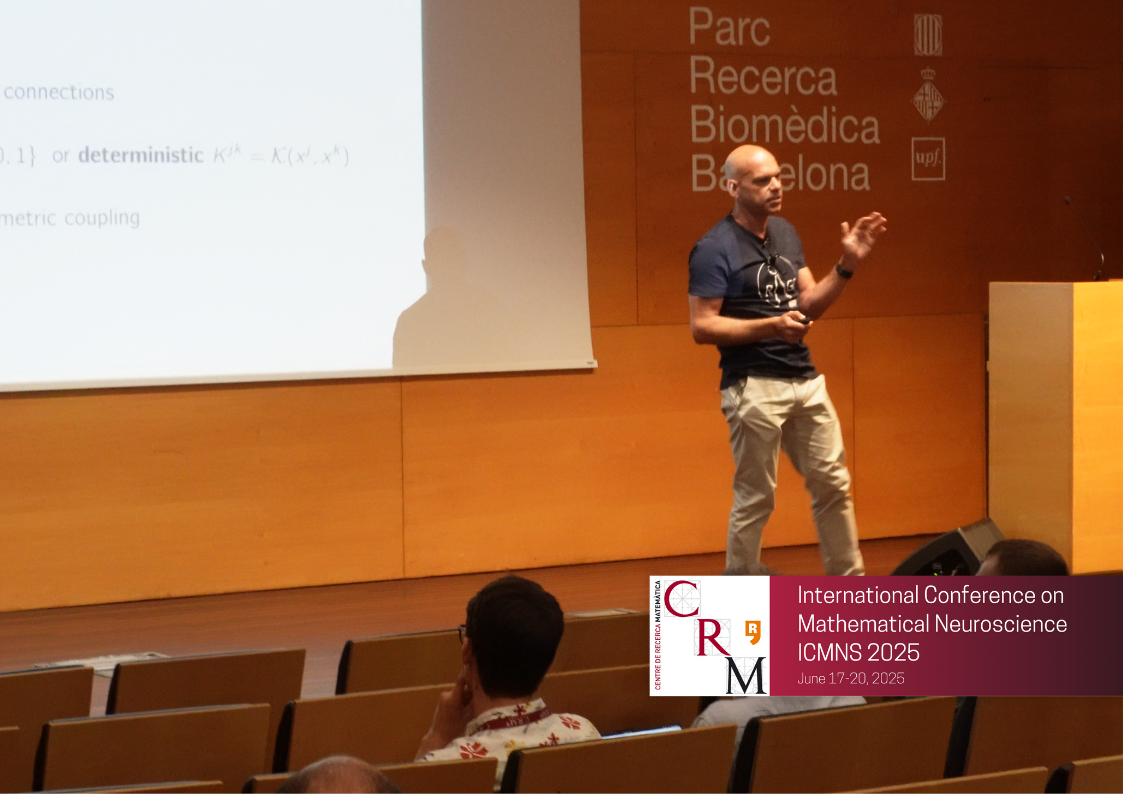
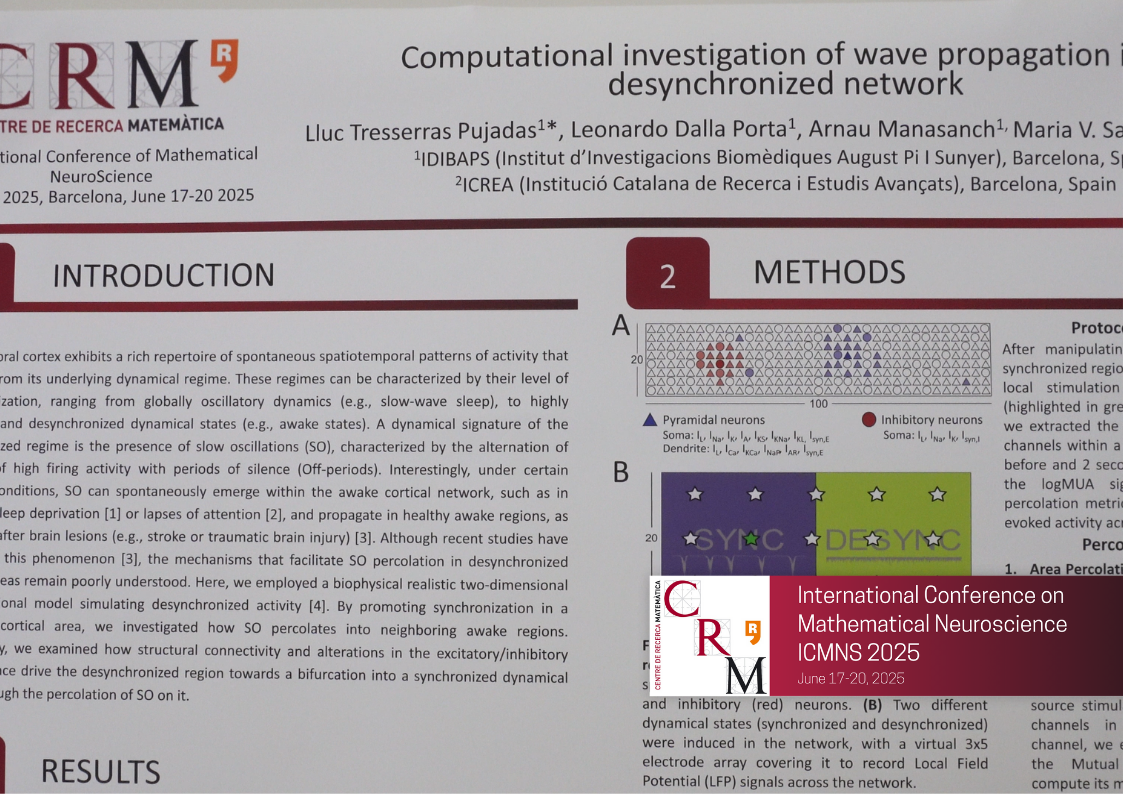
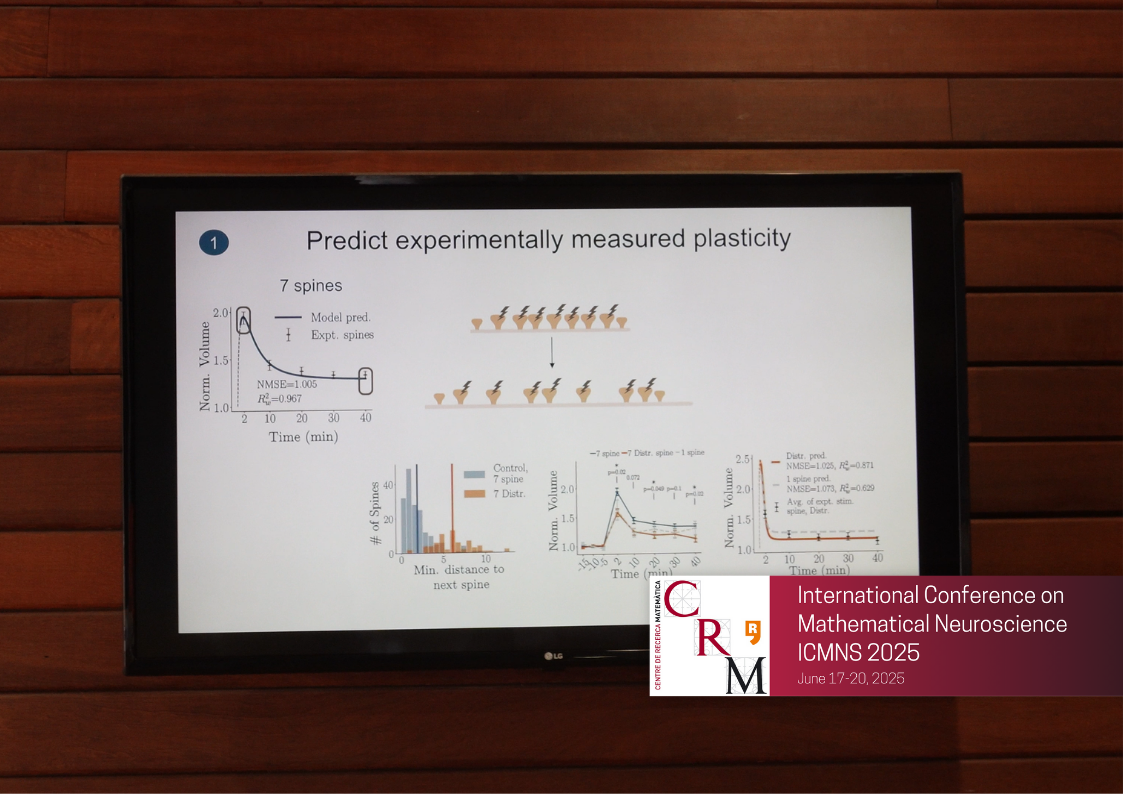
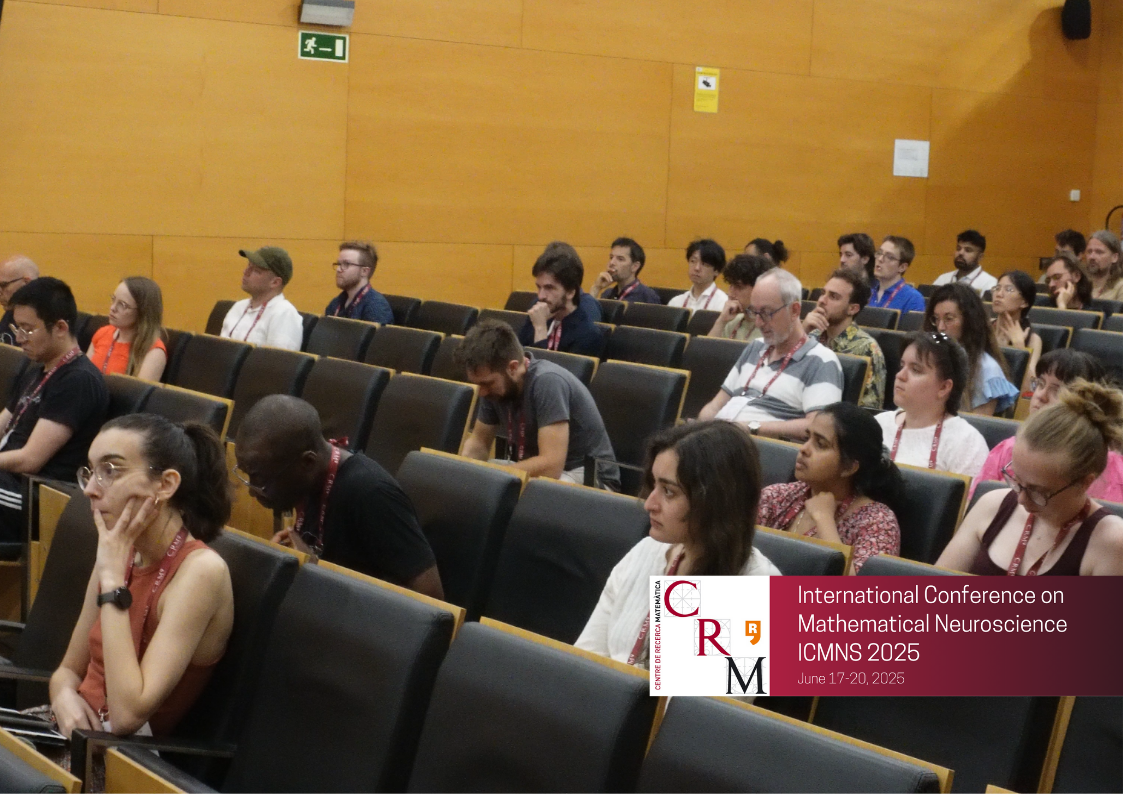
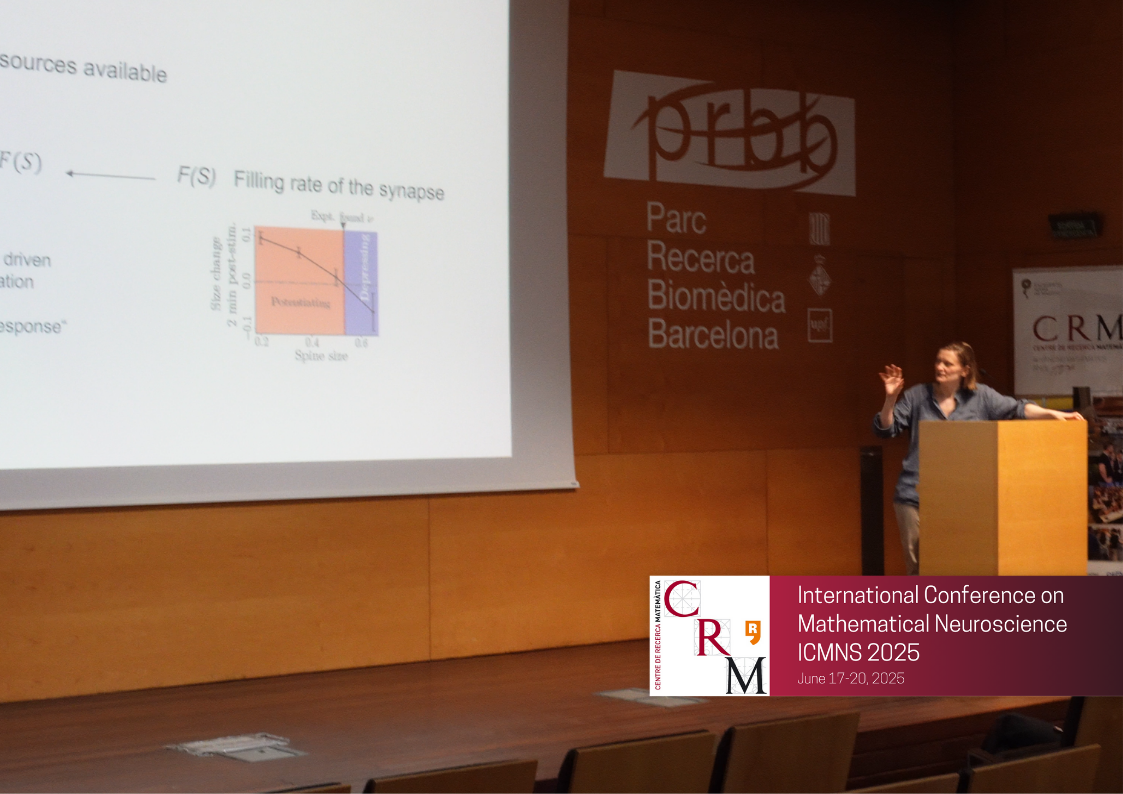
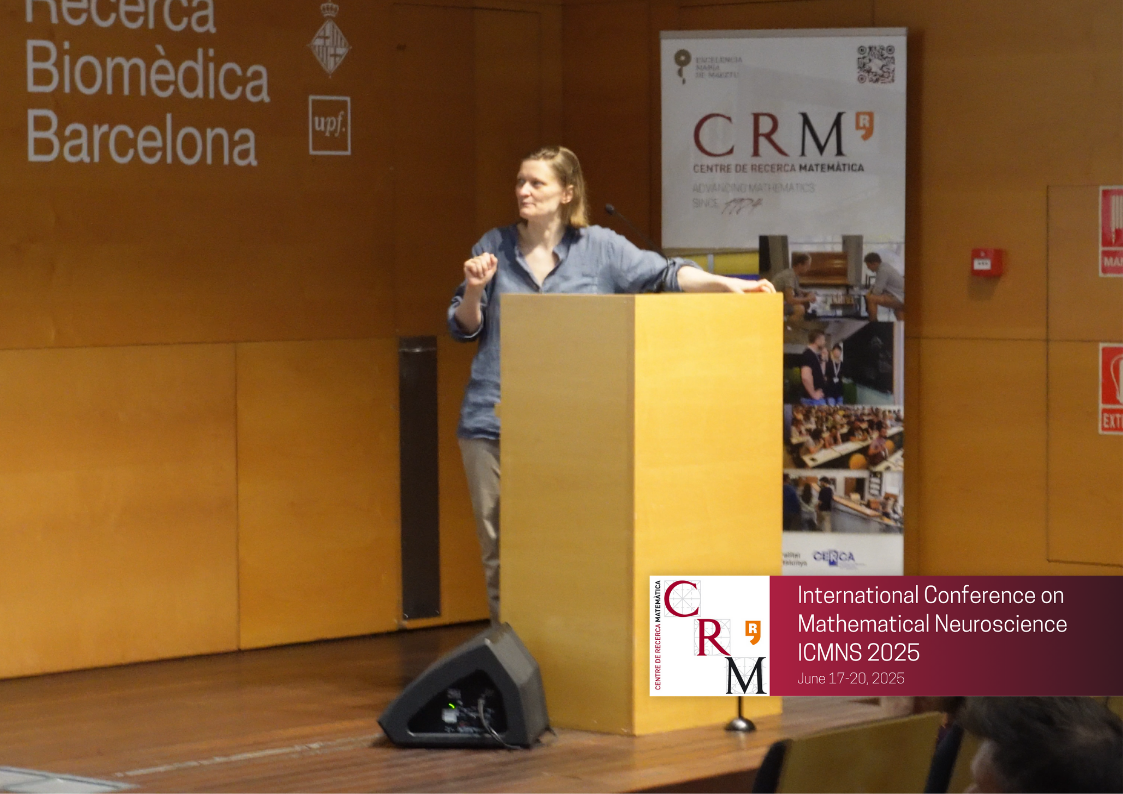
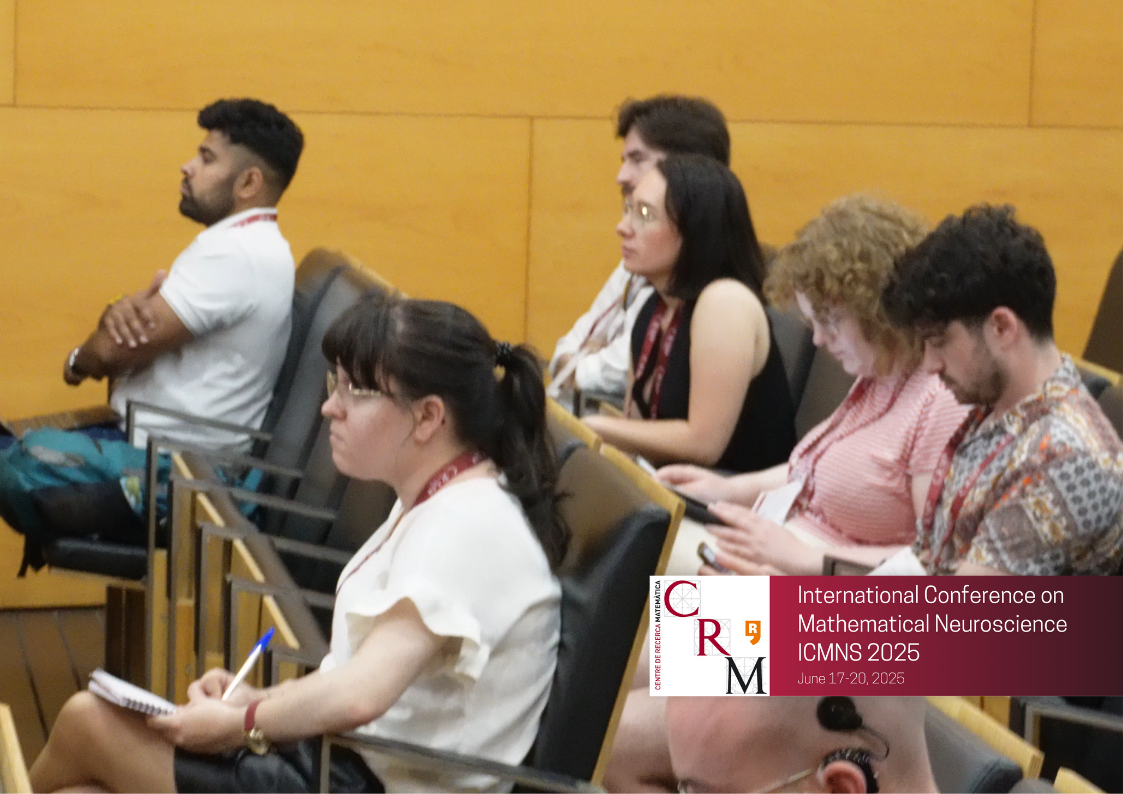
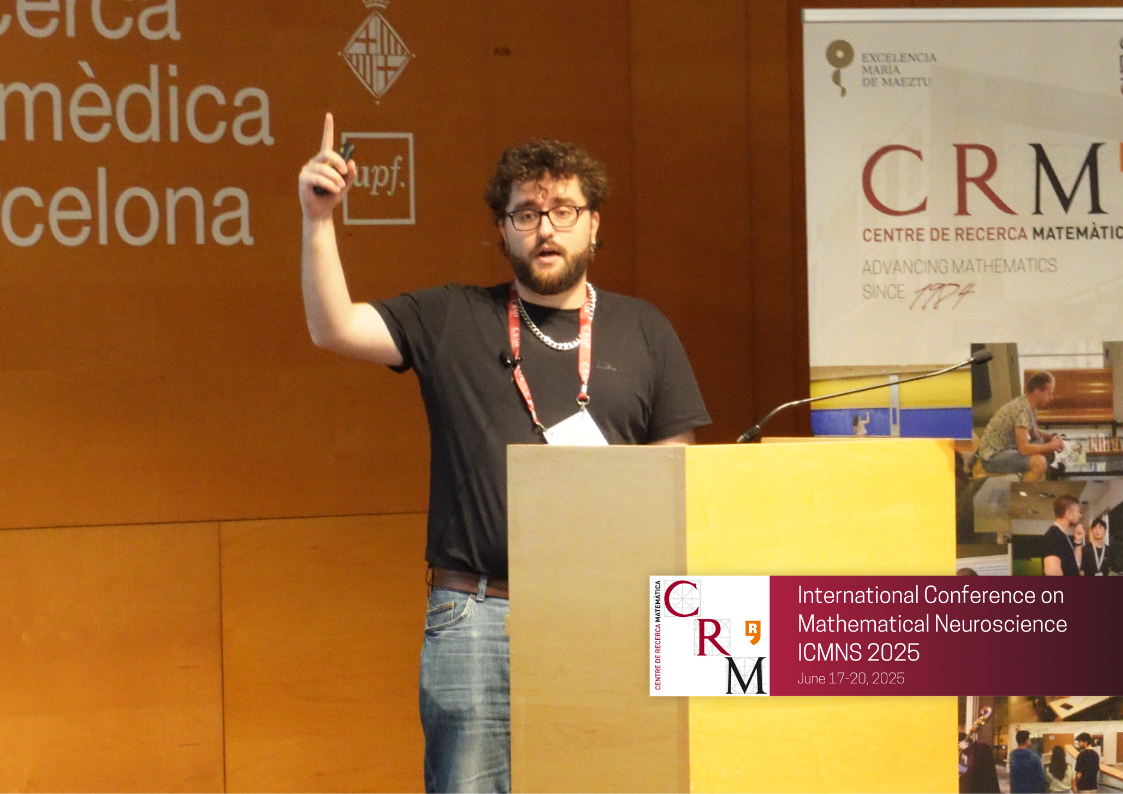
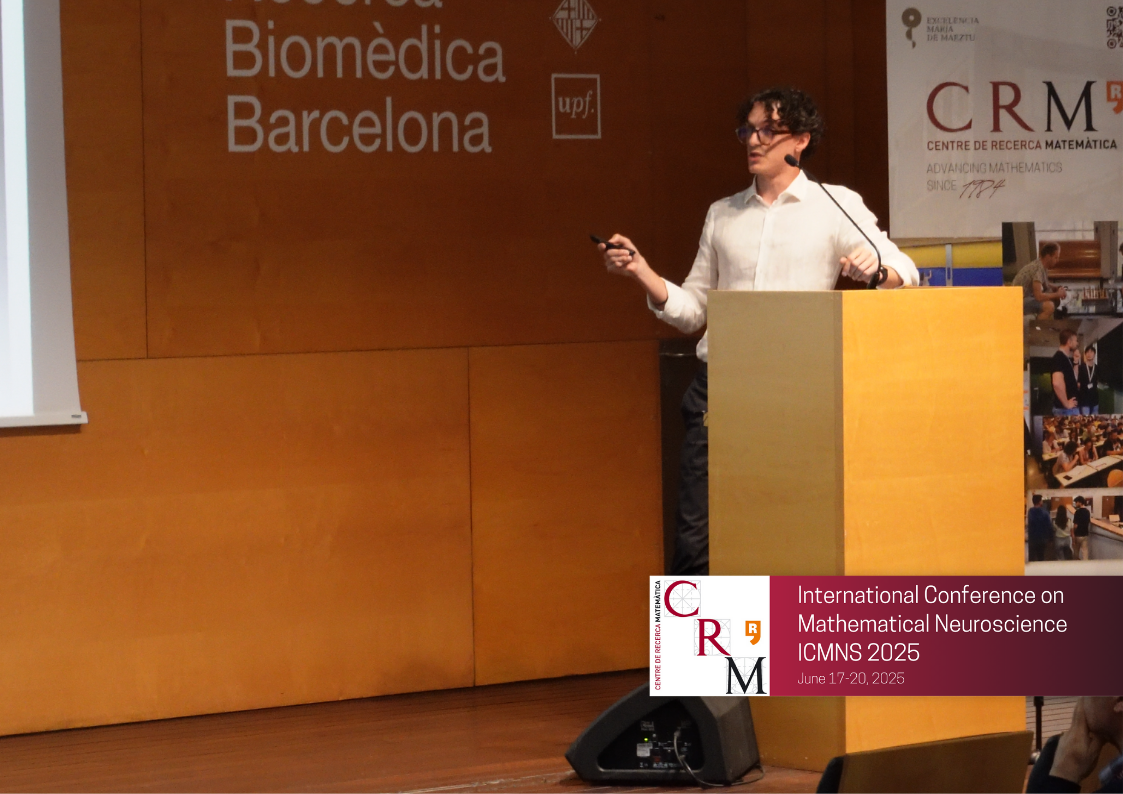
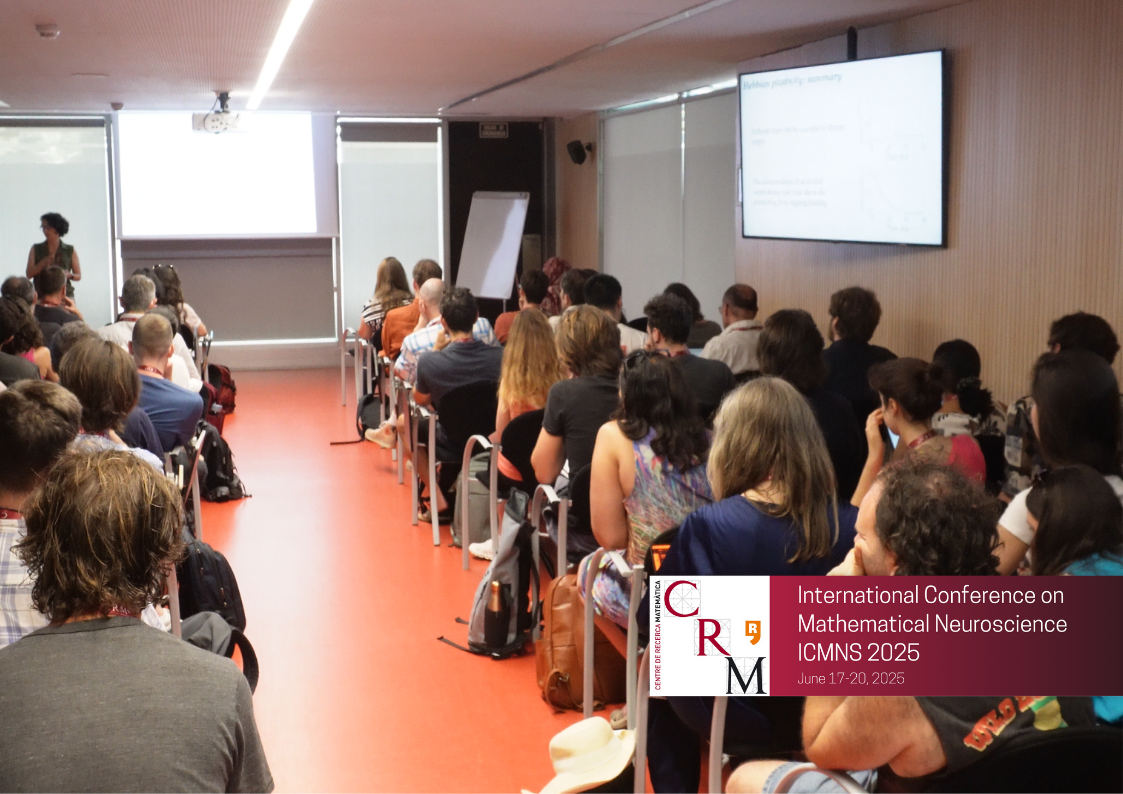
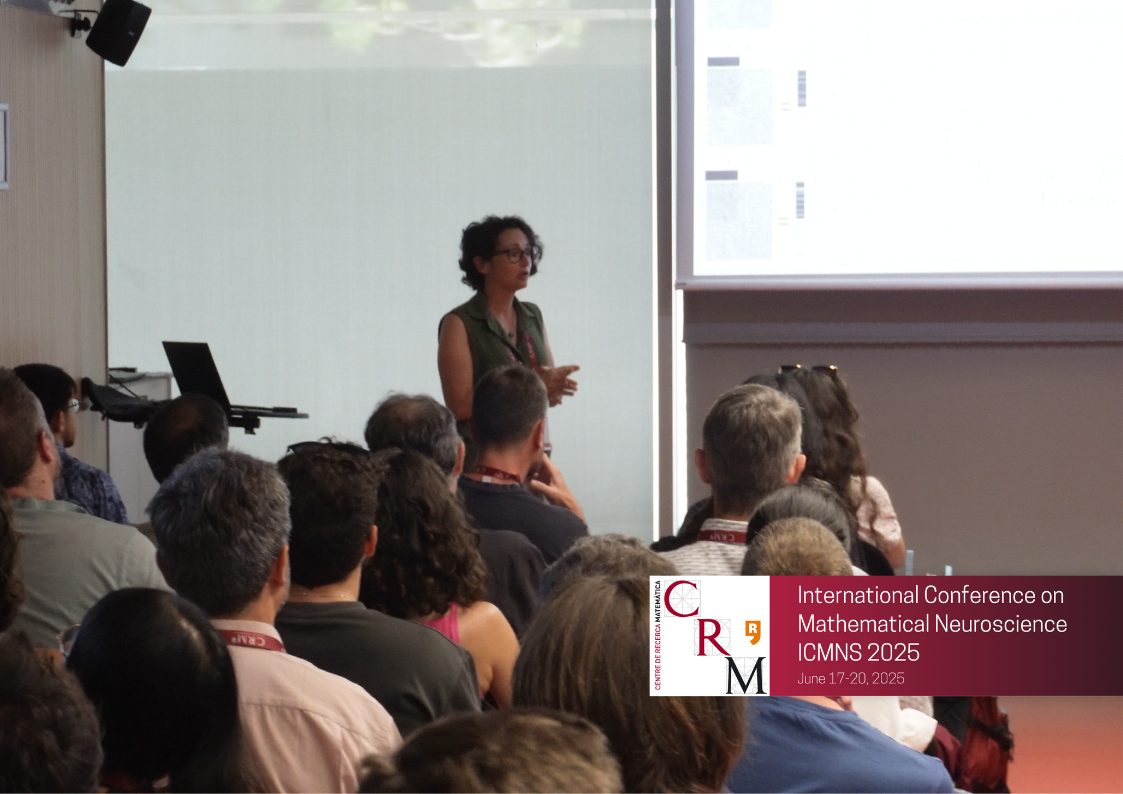
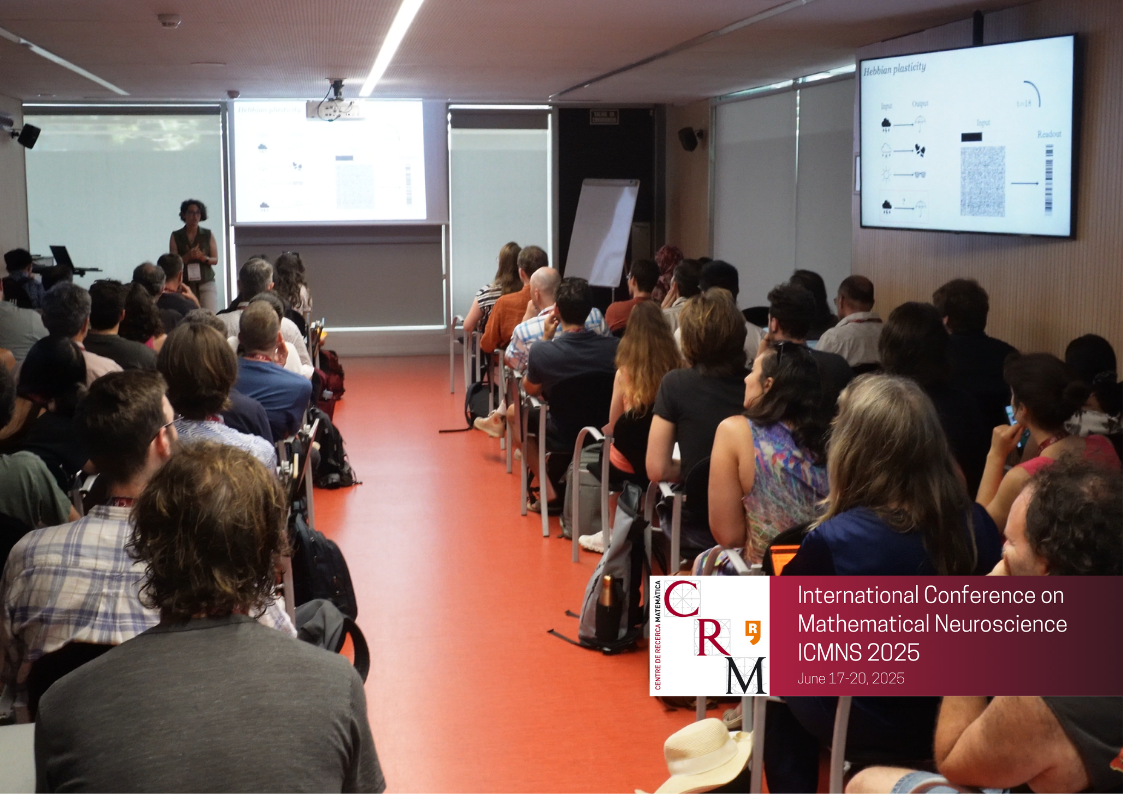
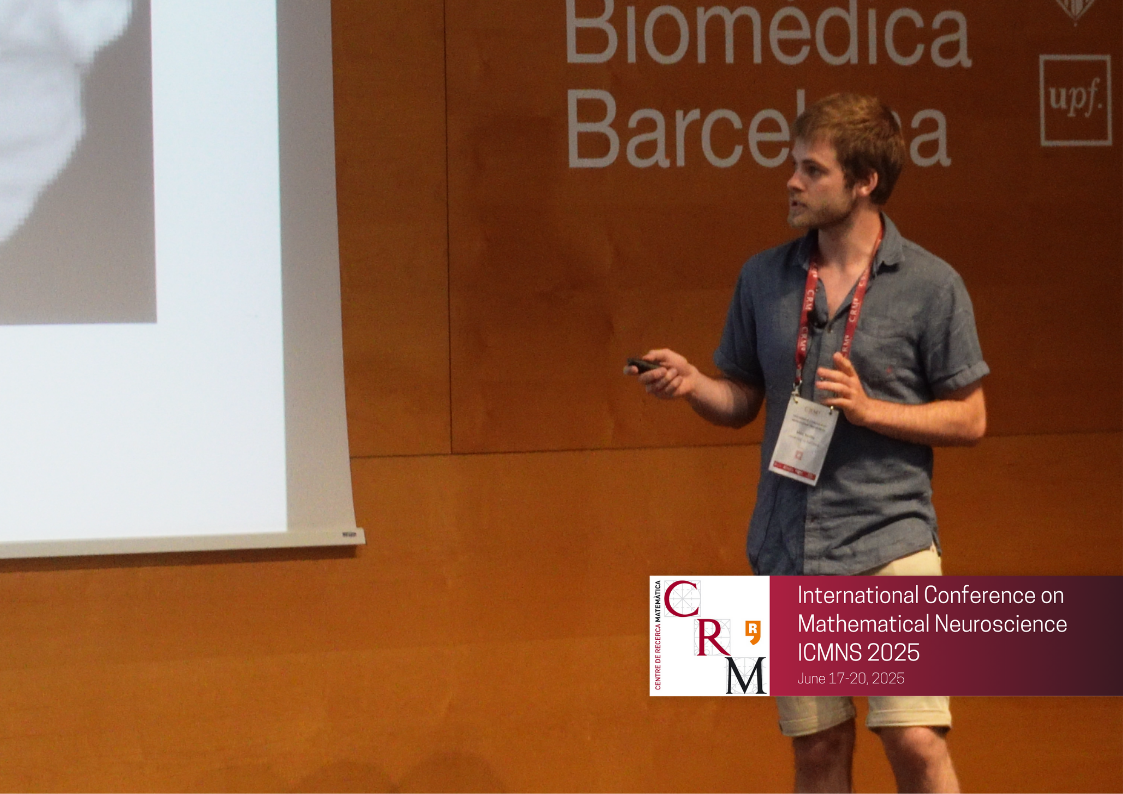
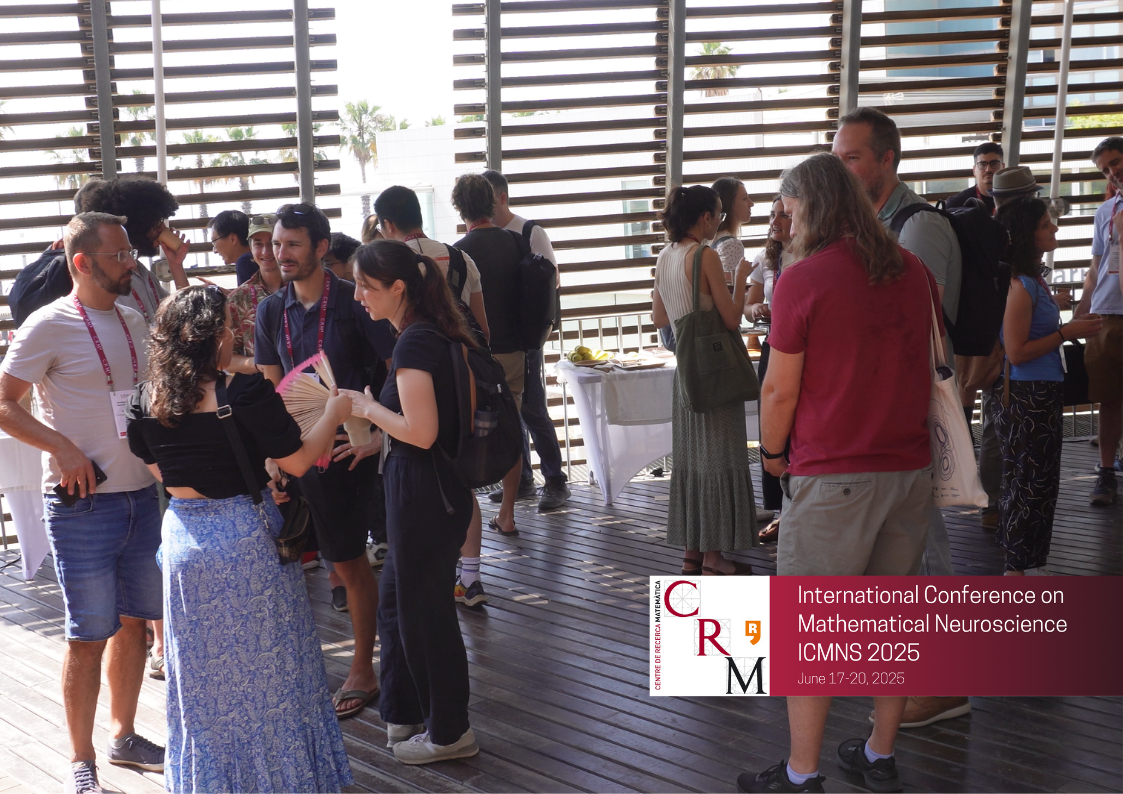
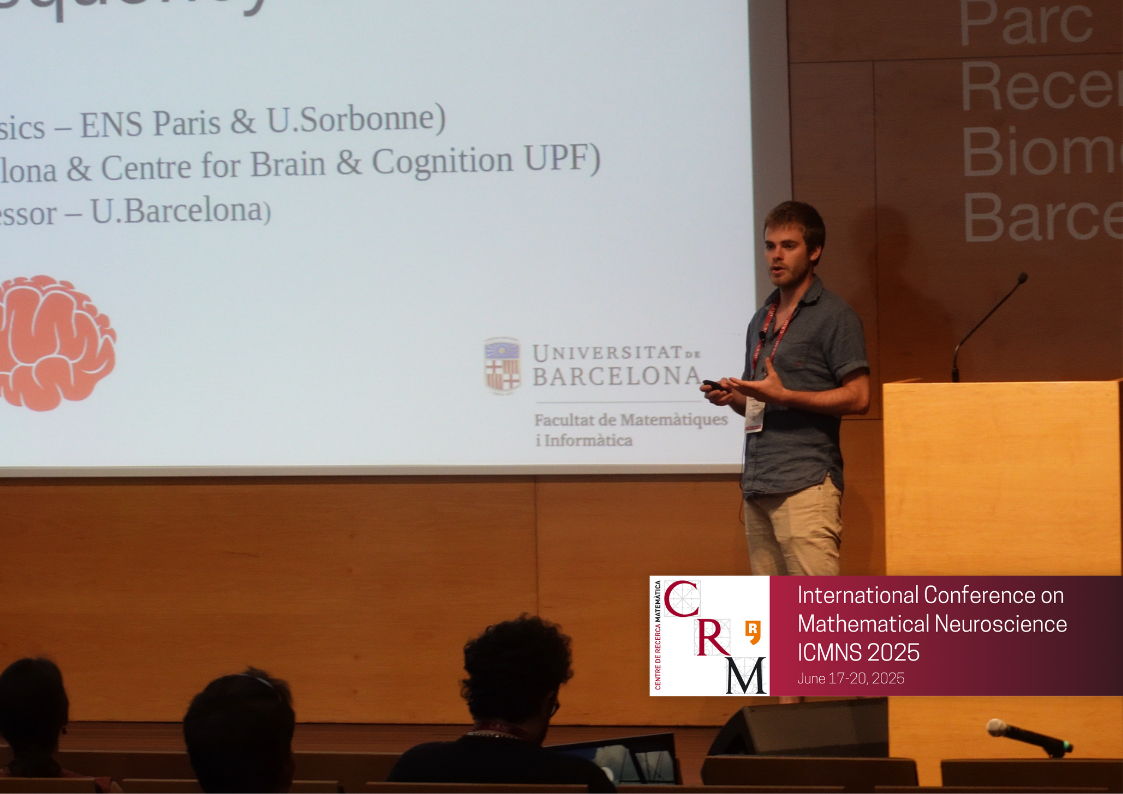
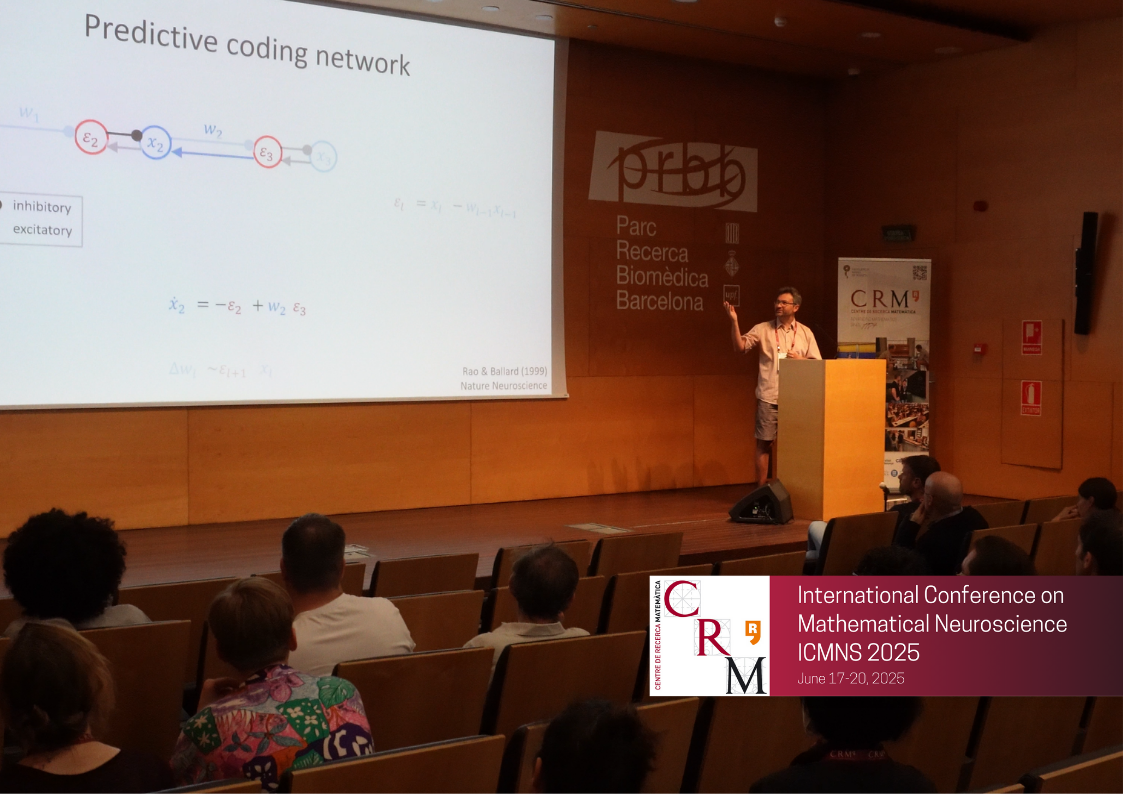
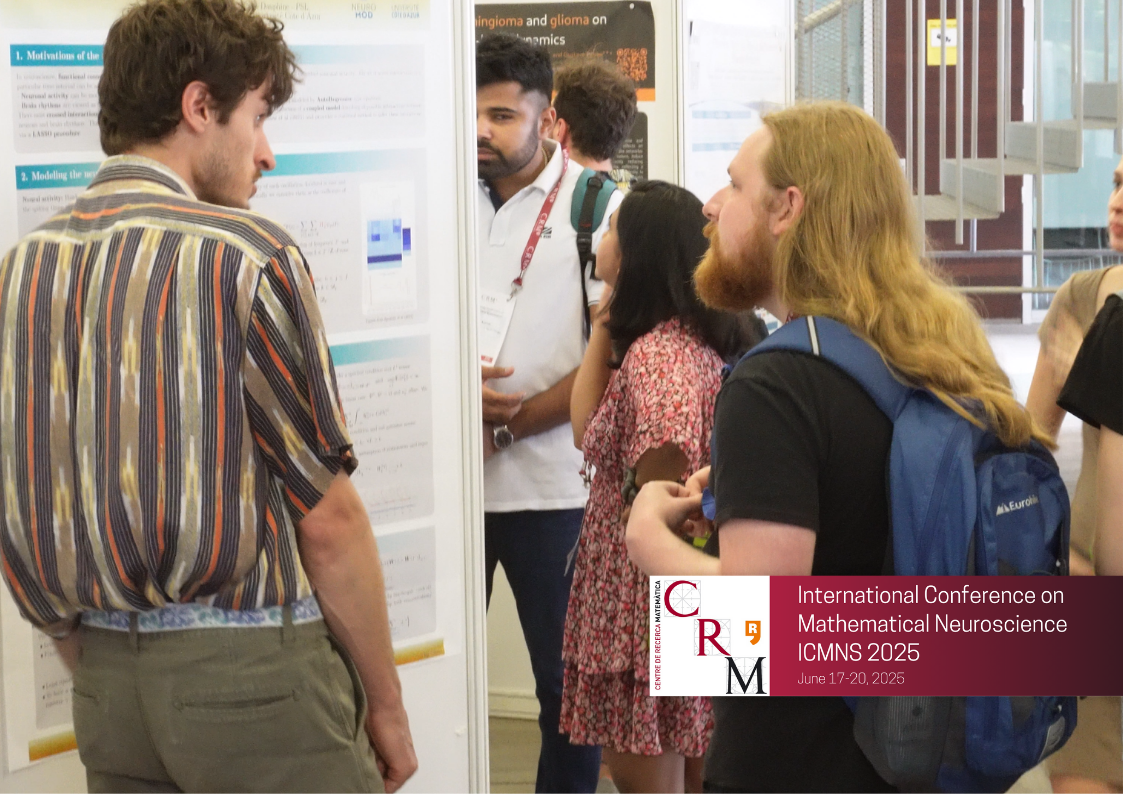
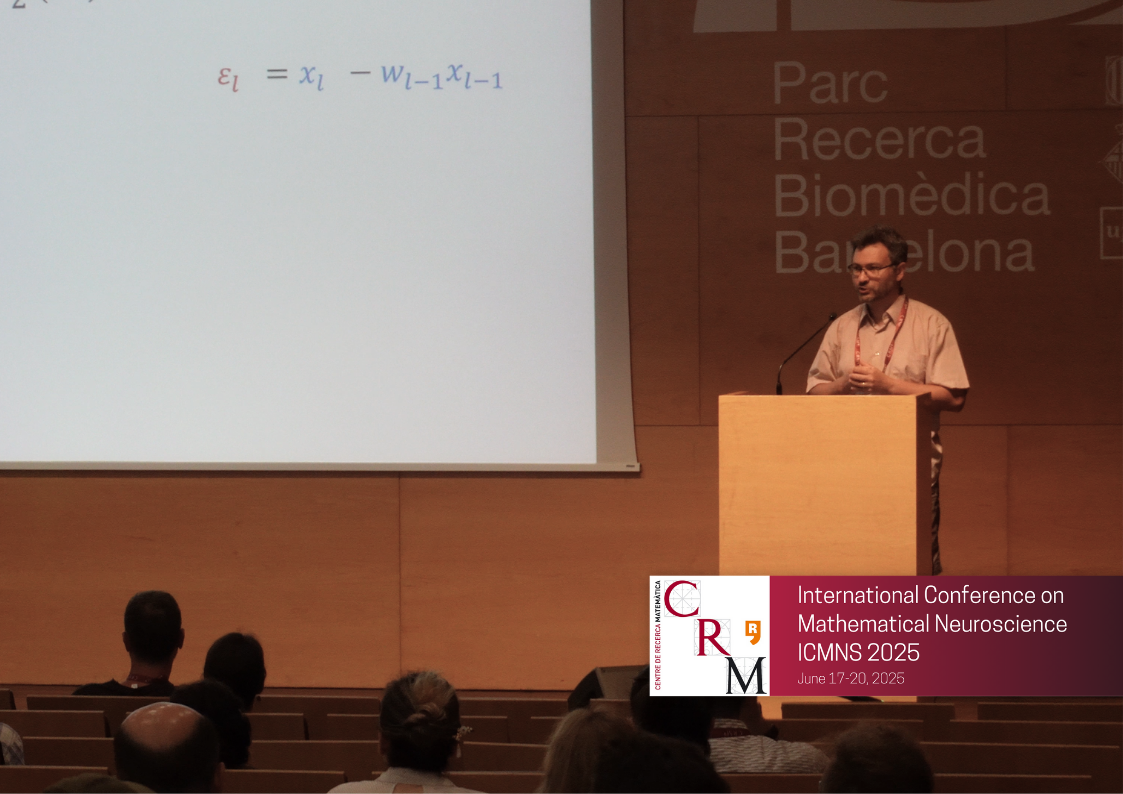
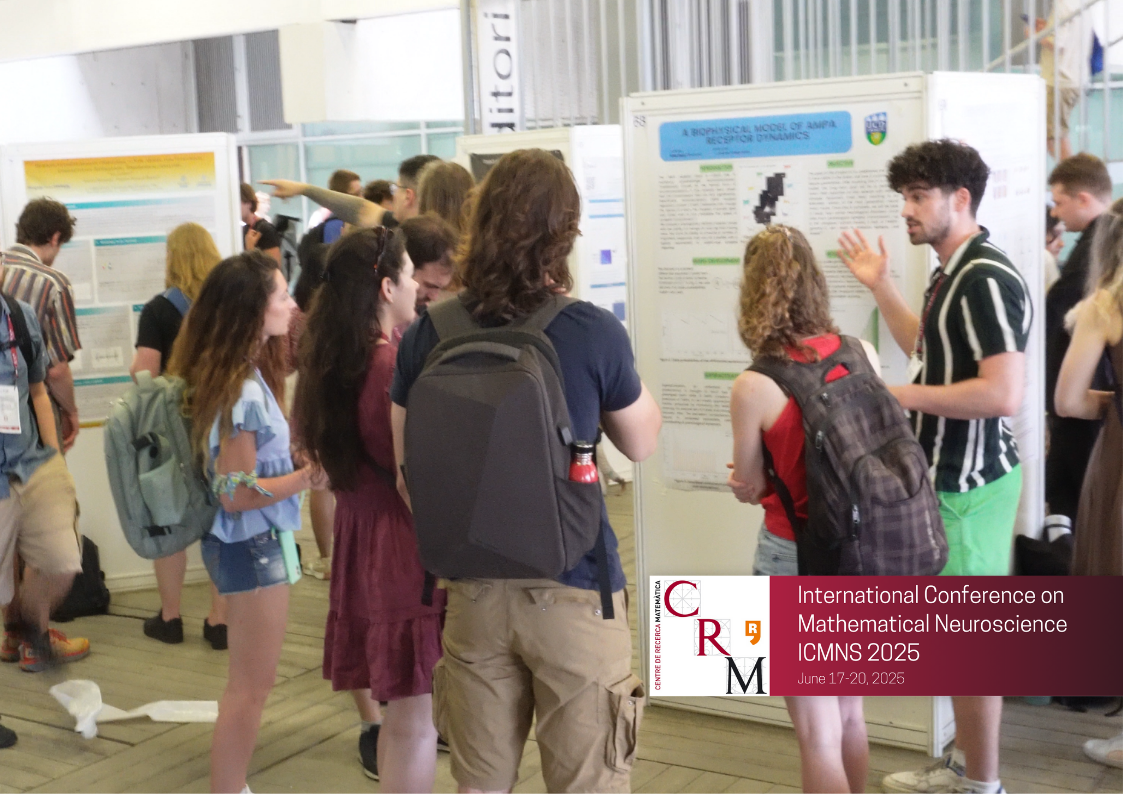
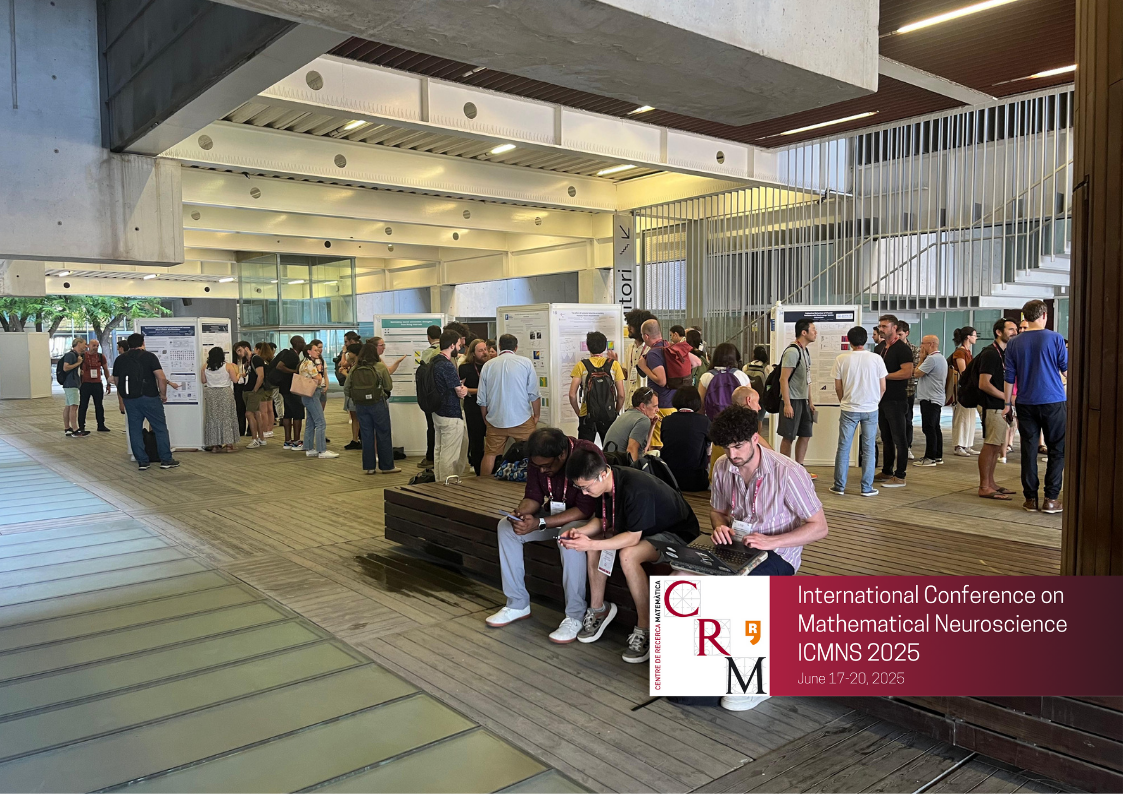
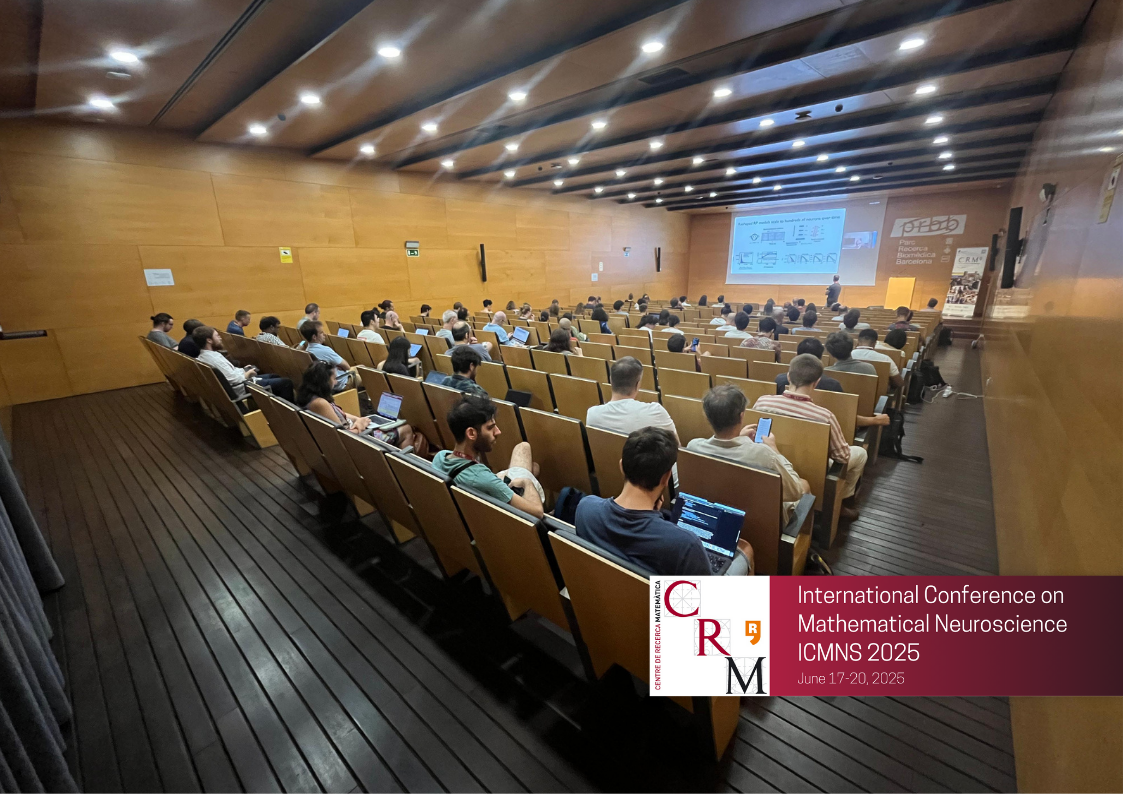
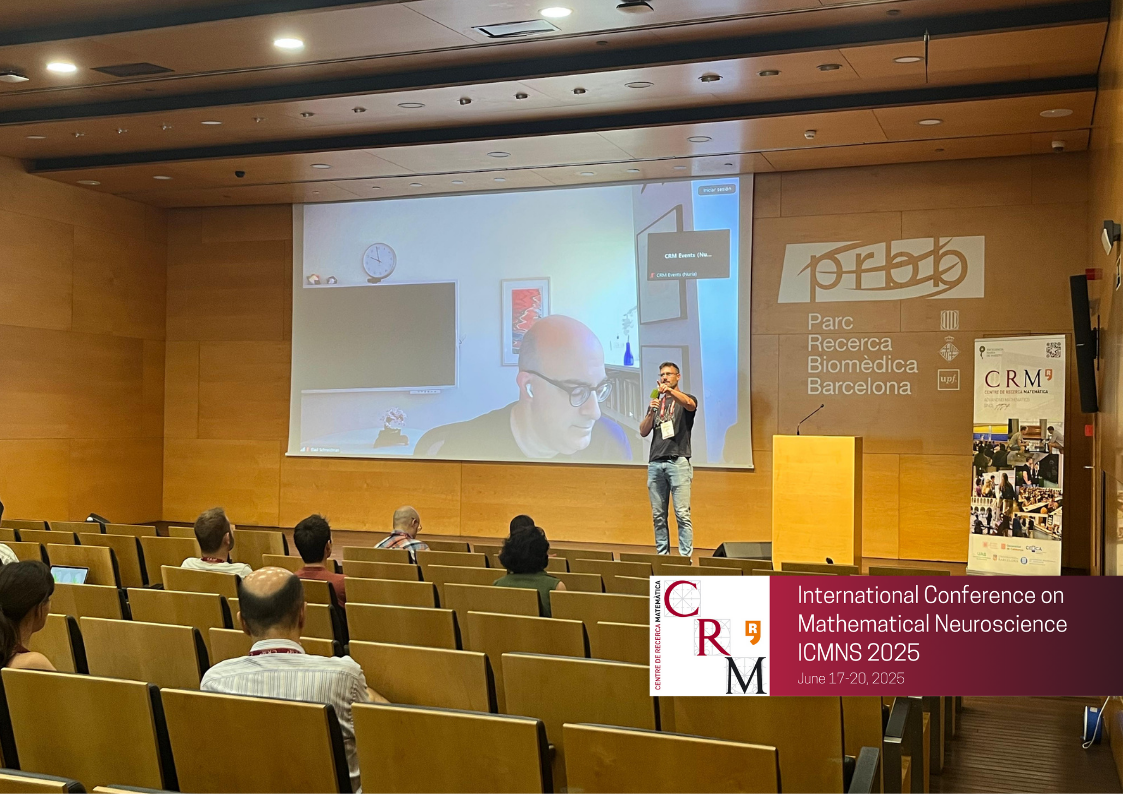
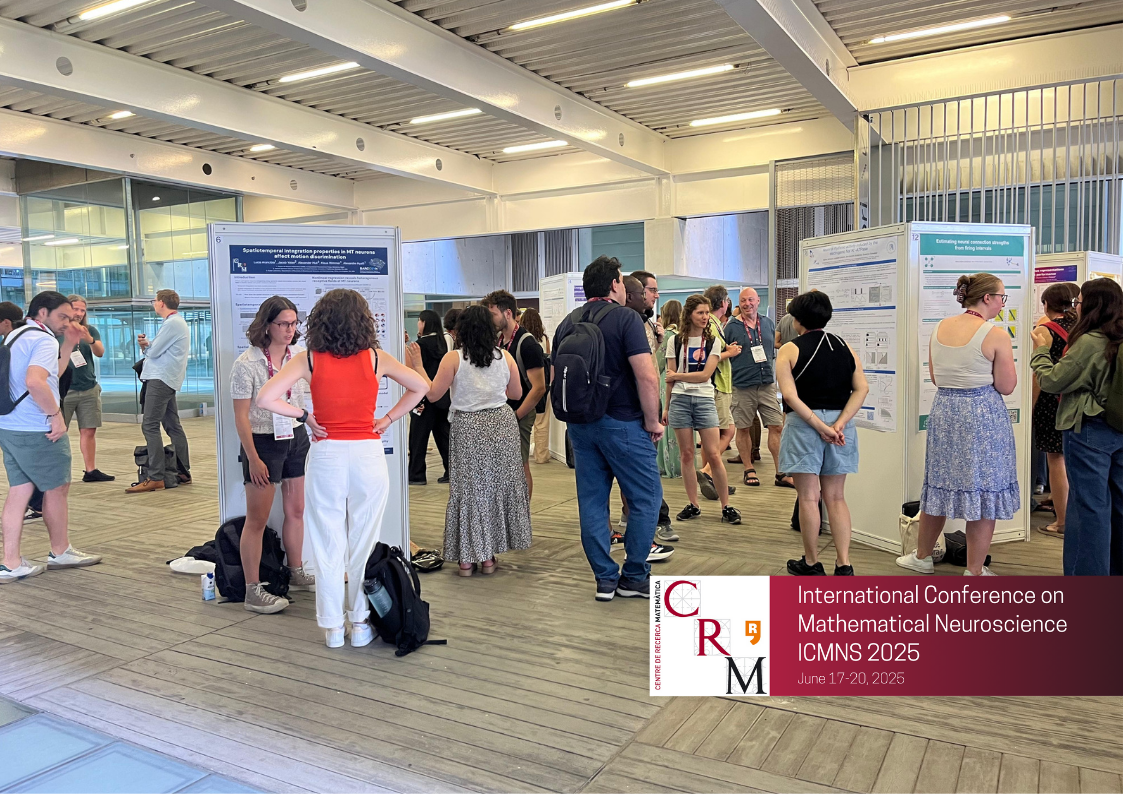
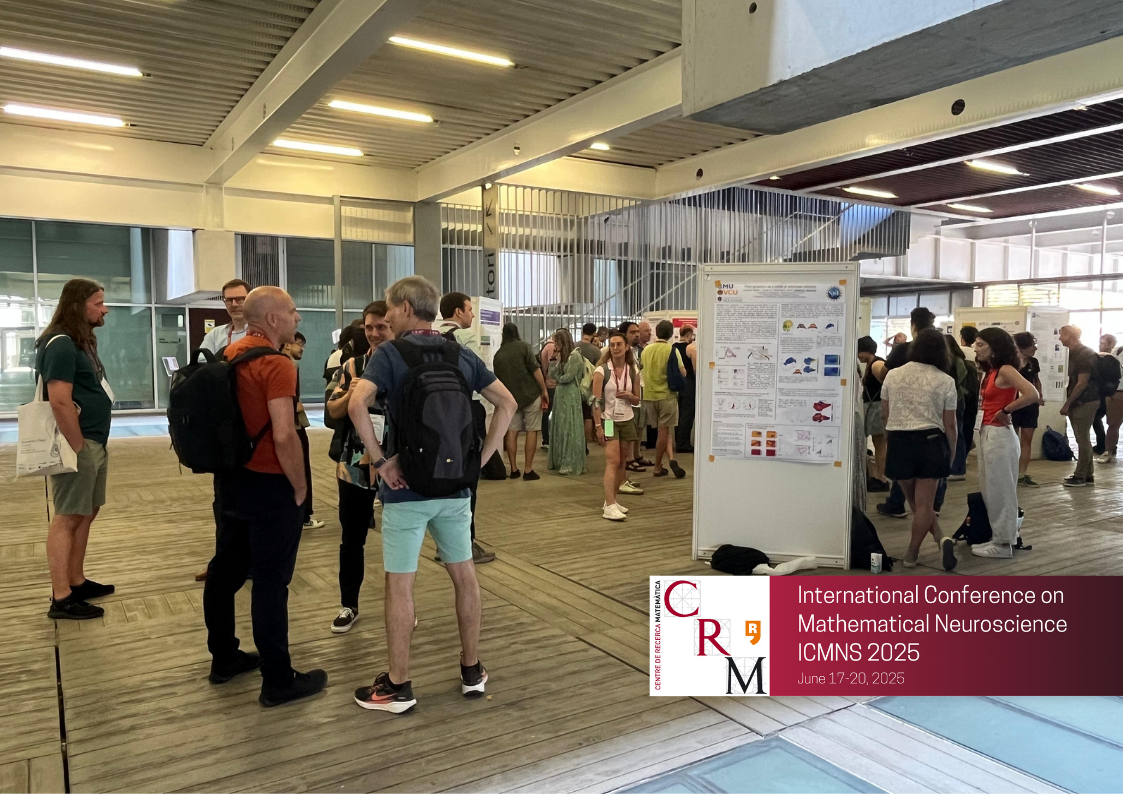
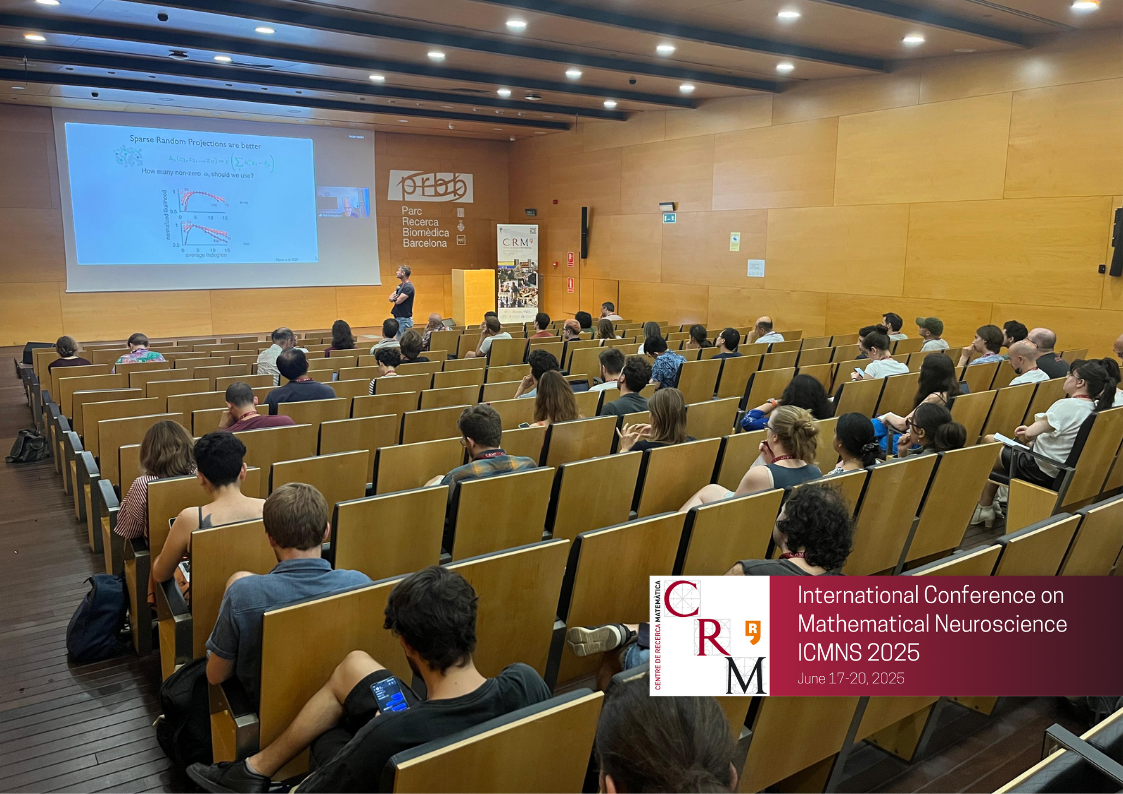
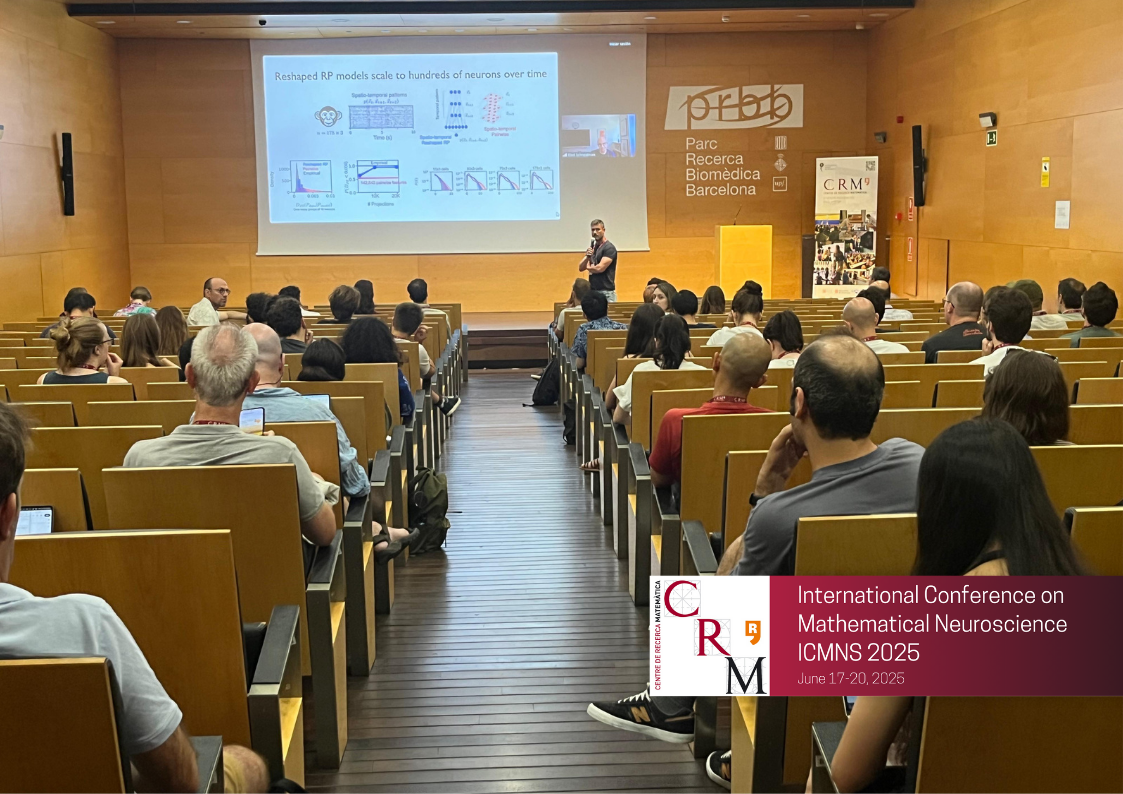
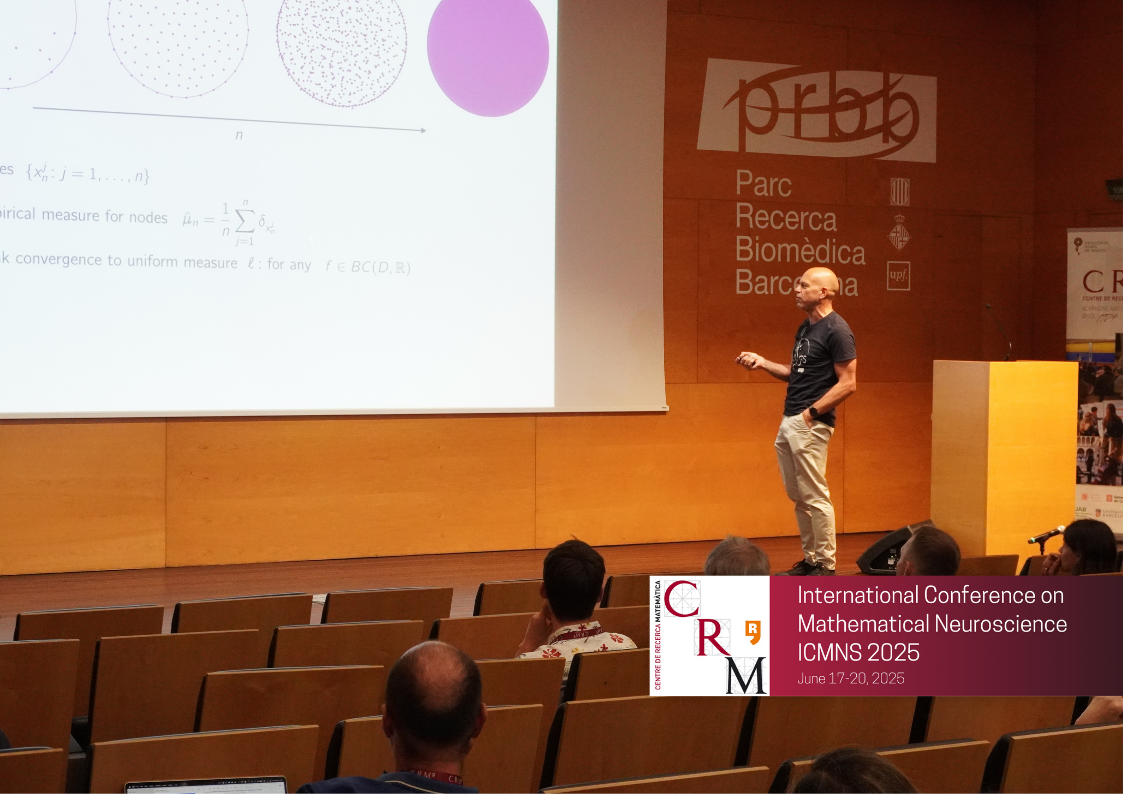
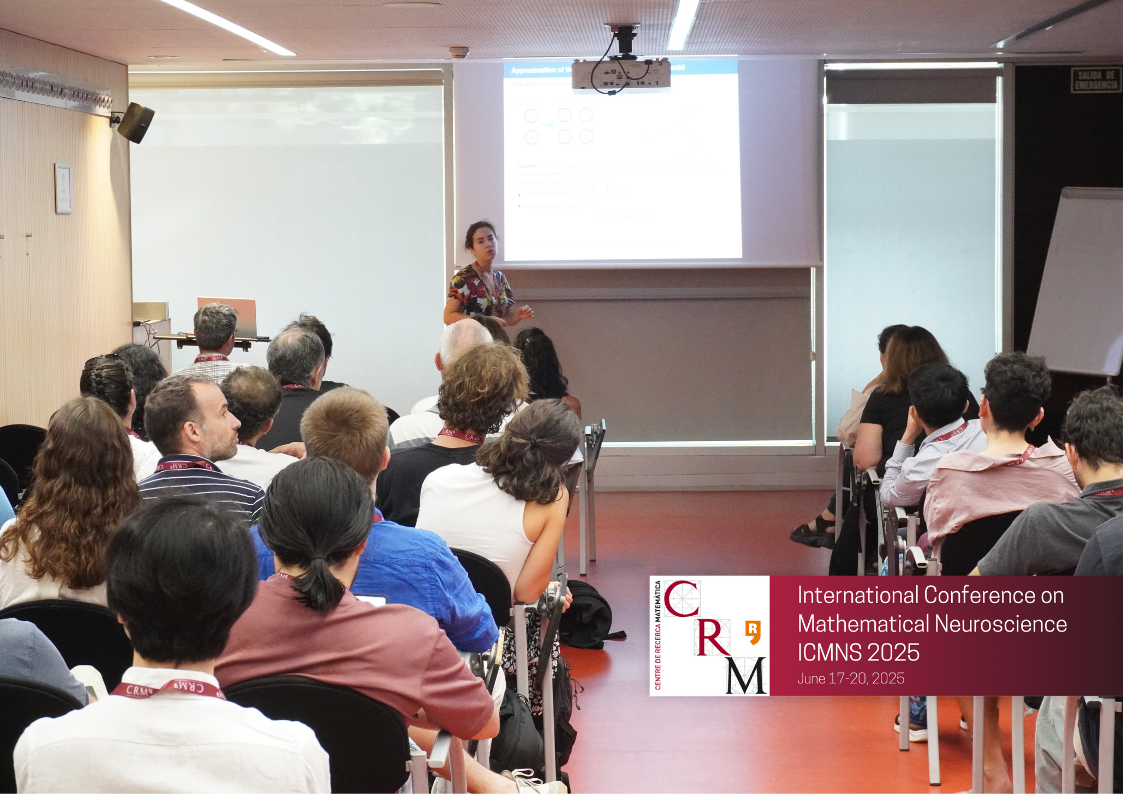
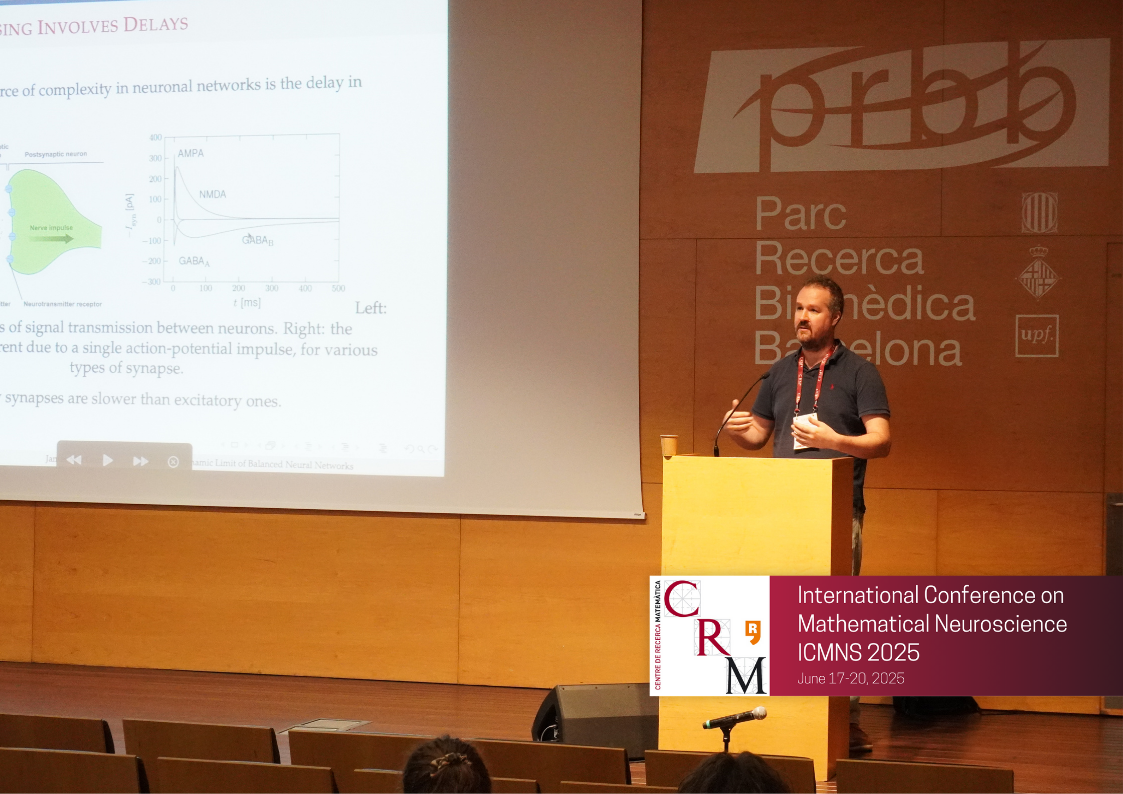
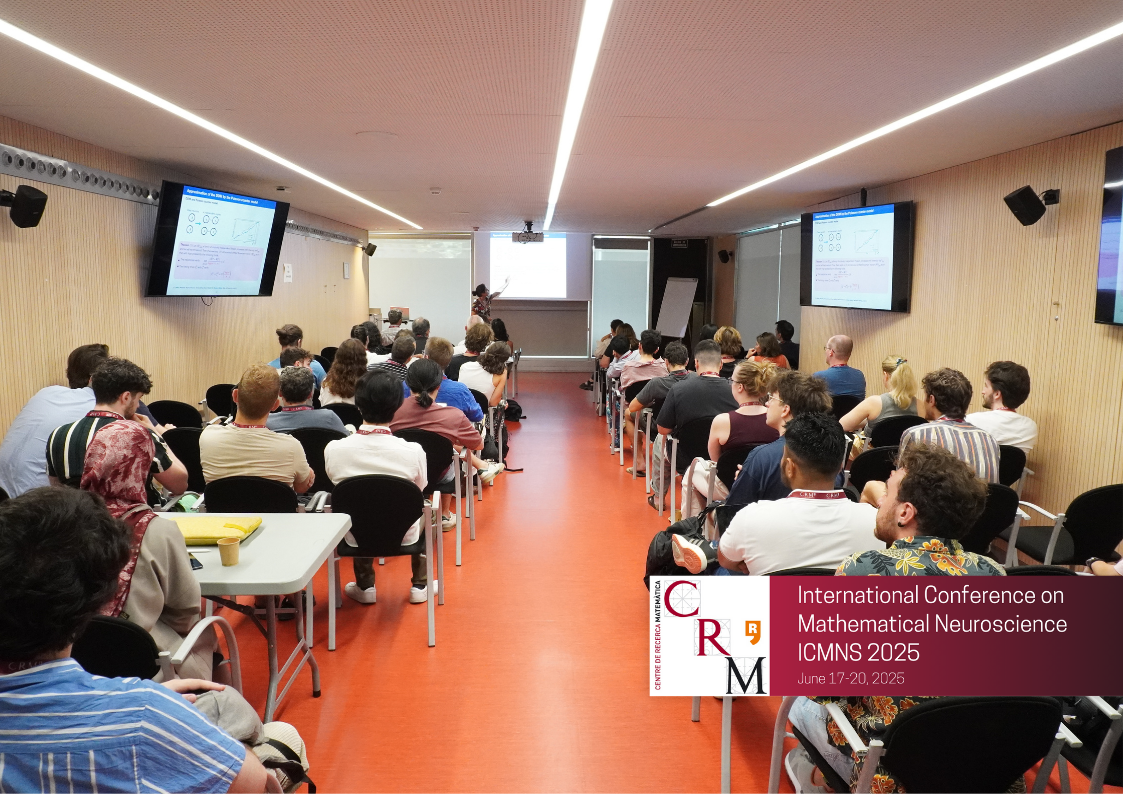
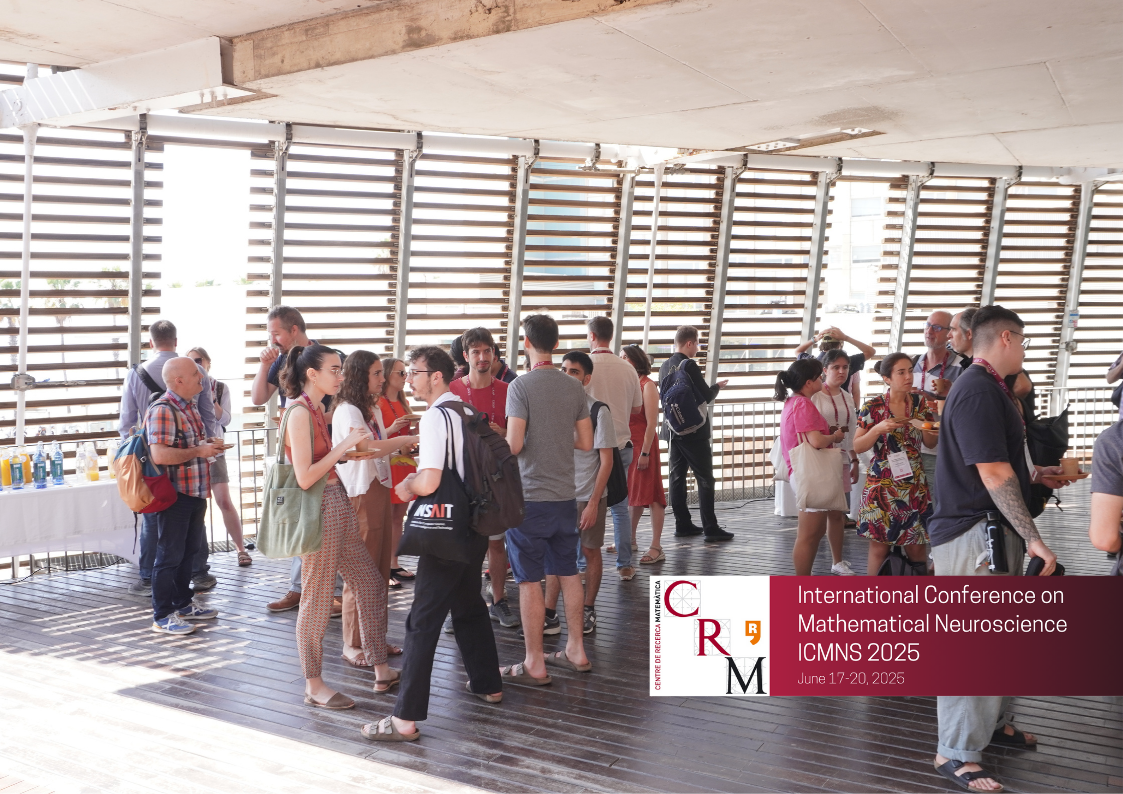
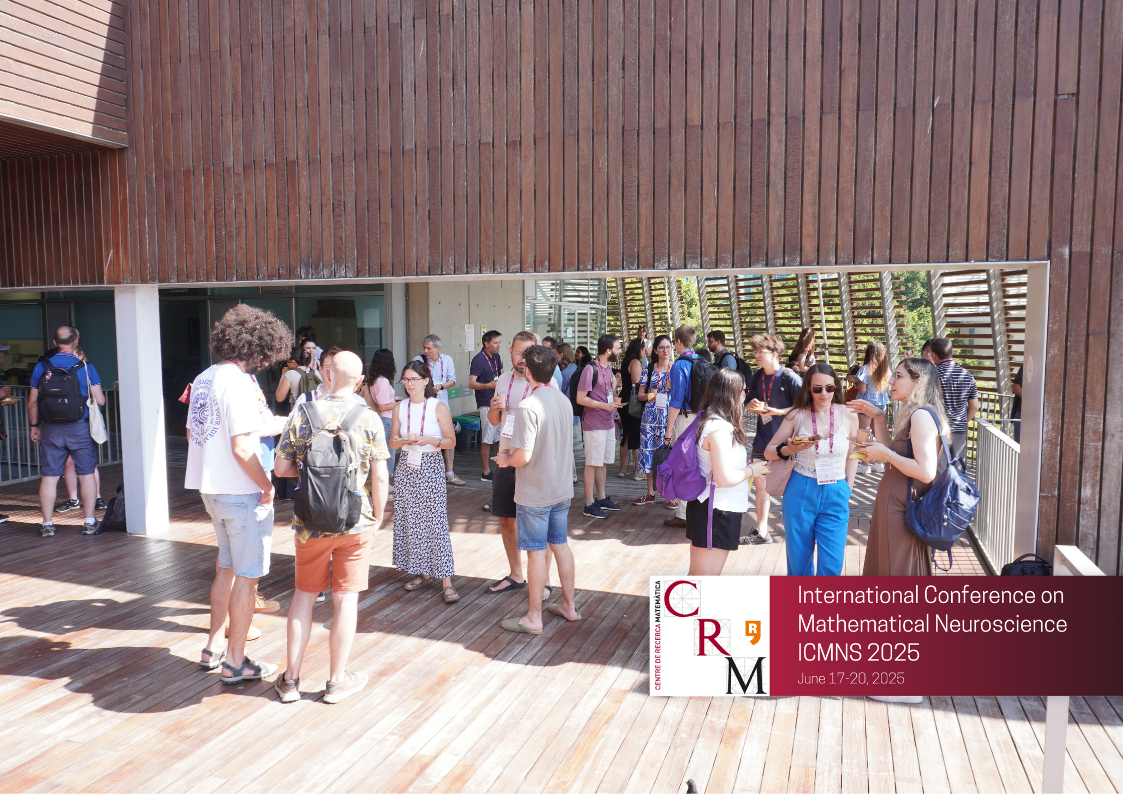
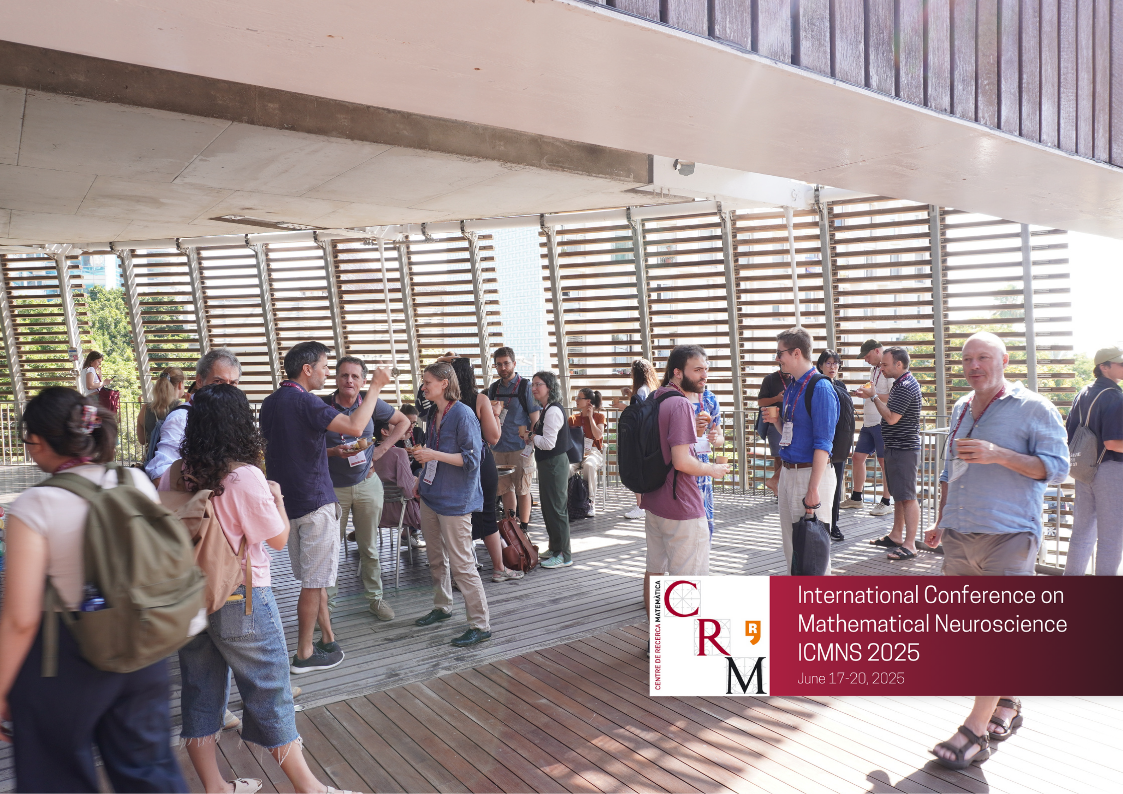
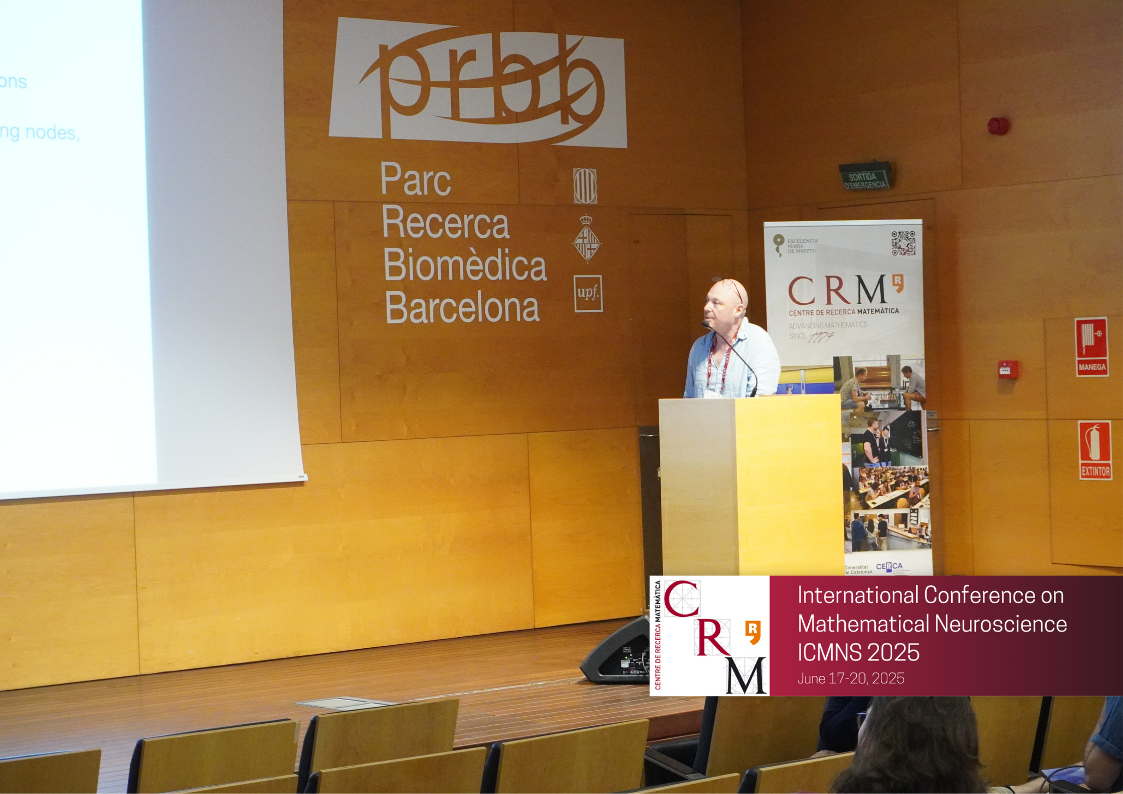
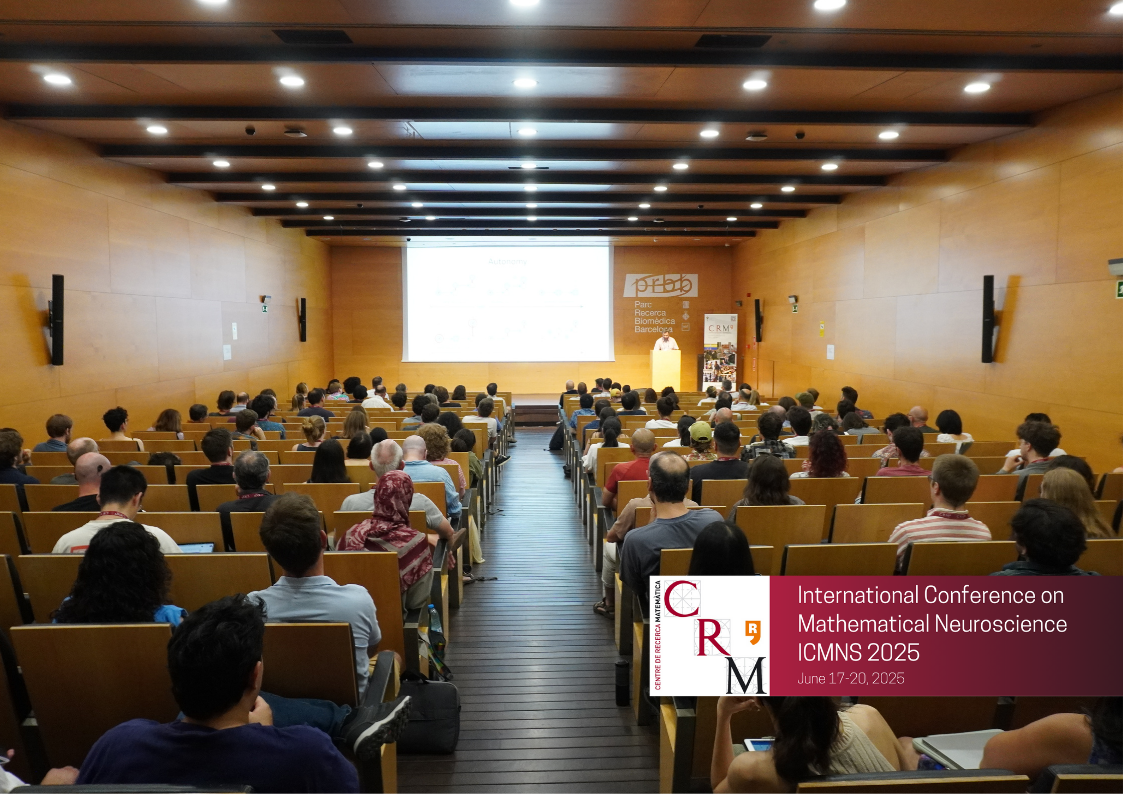
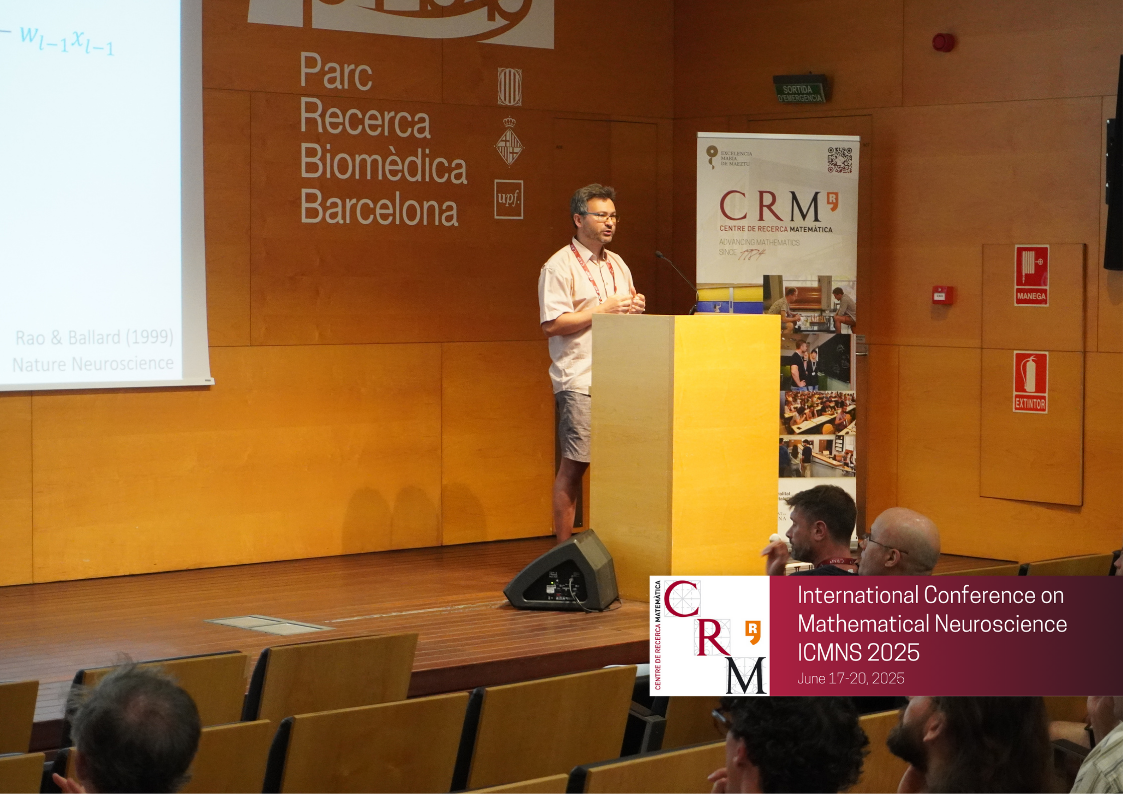
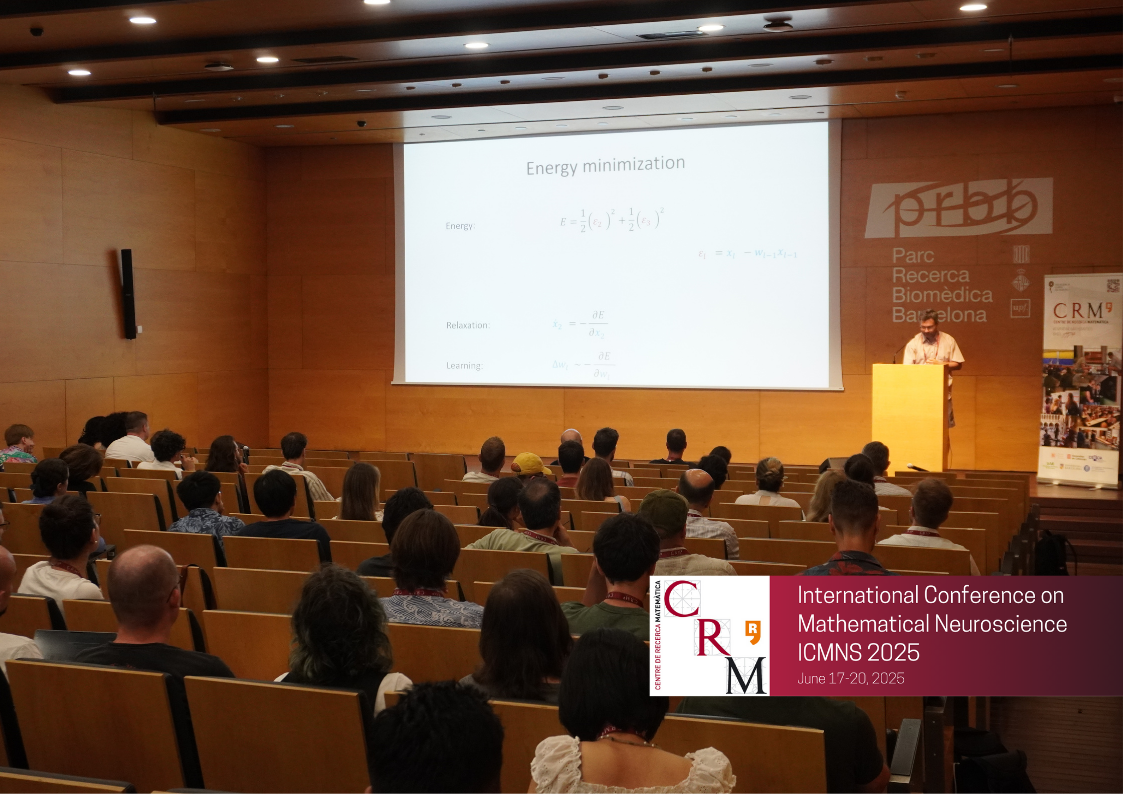
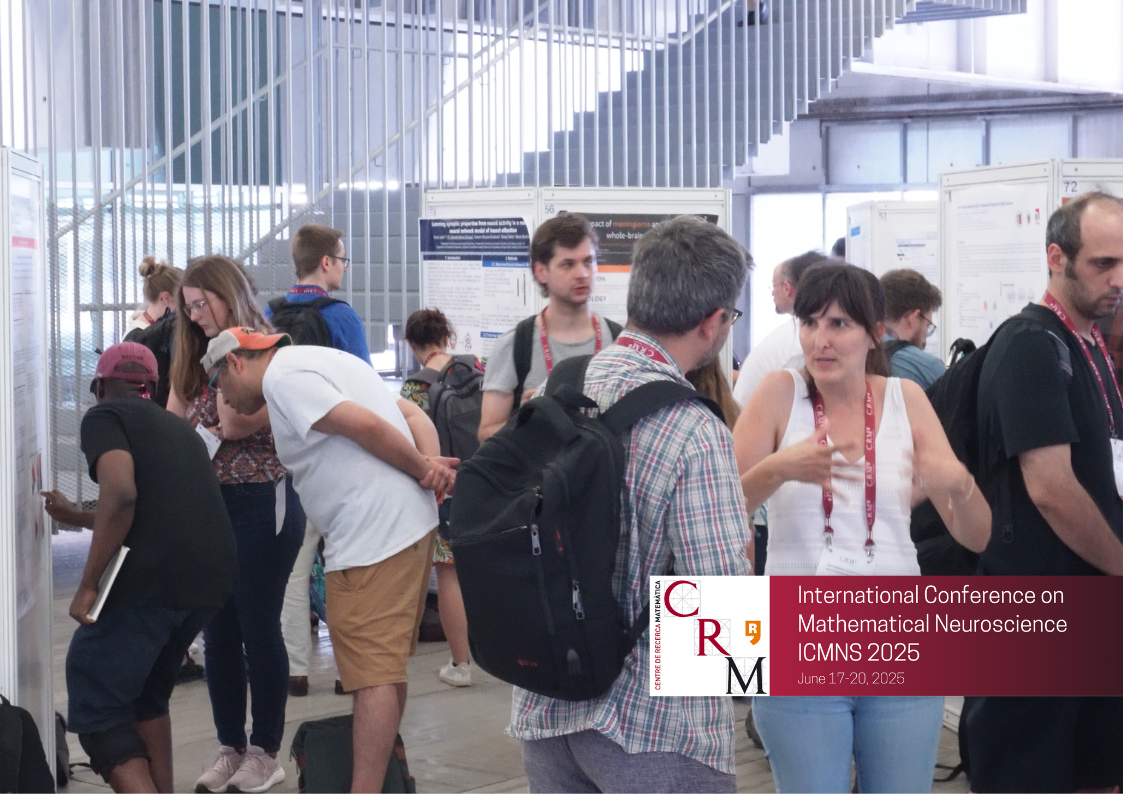
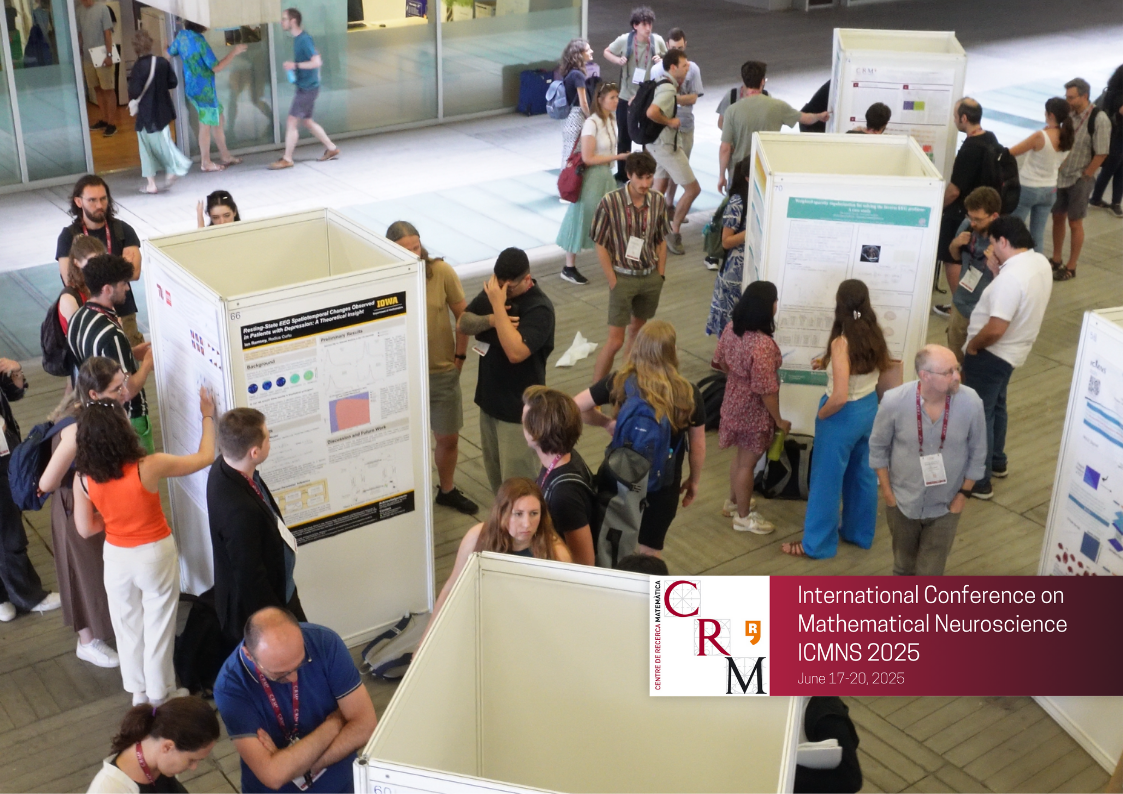
The International Conference on Mathematical Neuroscience (ICMNS) is an inter-disciplinary conference series, bringing together theoretical/computational neuroscientists and mathematicians. The conferences are aimed at scientists interested in using or developing mathematical techniques for neuroscience problems. ICMNS 2025 will be the tenth annual conference. ICMNS 2024 was held in Dublin, whereas previous editions were held in Copenhagen, Juan les Pins and Boulder, Colorado.
KEYNOTE SPEAKERS
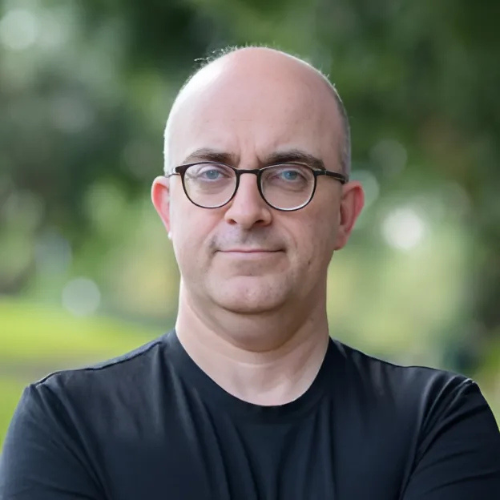
Elad Schneidman
Weizmann Institute of Science
Personal Website
Learning the code of large neural populations using sparse random projections
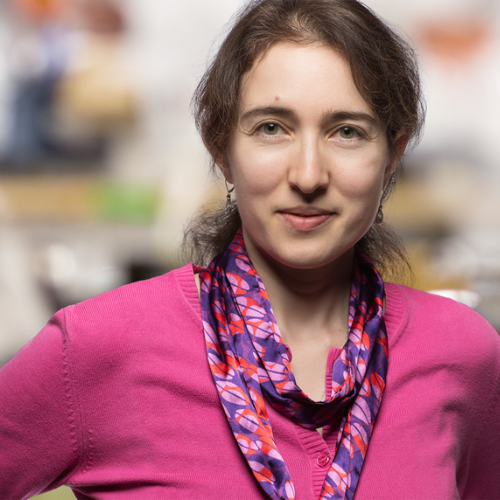
Tatyana Sharpee
Salk Institute
Personal Website
How neural manifolds change with learning
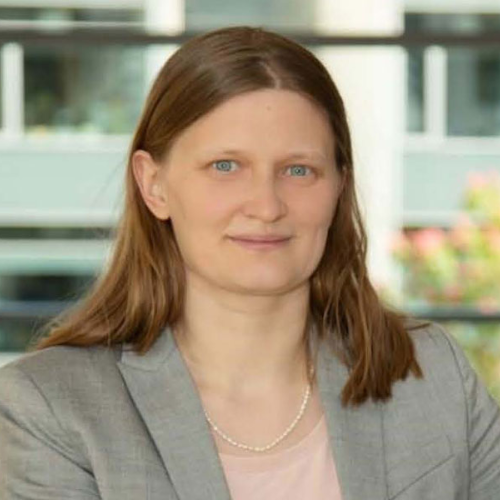
Tatjana Tchumatchenko
Universität Bonn
Personal Website
Energy minimization as an organizing principle for neural proteins
INVITED SPEAKERS
Rafal Bogacz | Oxford University
Abstract
Áine Byrne | University College Dublin
Abstract
Alexis Dubreuil | University of Bordeaux, CNRS
Abstract
Soledad Gonzalo Cogno | Kavli Institute, NTNU
Abstract
Stephanie Jones | Brown University
Abstract
Anna Levina | University of Tübingen
Abstract
Sukbin Lim | NYU Shanghai
Abstract
Jonathan Touboul | Brandeis University
Abstract
Jonathan Touboul | Brandeis University
Gemma Huguet | Universitat Politècnica de Catalunya (UPC) – CRM
Ernest Montbrió | University Pompeu Fabra (UPF)
Alex Roxin | Centre de Recerca Matemàtica (CRM)
Victoria Booth | U. Michigan, USA
Alla Borisyuk | U. Utah, USA
Carina Curto | U. Brown, USA
Rodica Curtu | U. Iowa, USA
Silvia Daun | U. Cologne, Germany
Boris Gutkin | Ecole Normale Supérieure, Paris, France
Vivien Kirk | University of Auckland
Elif Koksal | INRIA, Rennes, France
Songting Li | Shanghai Jiao Tong University
André Longtin | U. Ottowa, Canada
Gianluigi Mongillo | CNRS, Paris, France
Simona Olmi | Istituto dei Sistemi Complessi, CNR, Florence, Italy
Horacio Rotstein | NJIT, USA
Tilo Schwalger | TU, Berlin, Germany
Susanne Schreiber | HU-Berlin, Germany
Kyle Wedgwood | U. Exeter, England
Cati Vich | UiB, Mallorca
SCHEDULE
ICMNS 2025 — Programme
International Conference on Mathematical Neuroscience · 17–20 June 2025, Barcelona
| Time | Auditorium | Marie Curie |
|---|---|---|
| 08:50→ 09:50 |
Welcome
Elad Schneidman
Weizmann Institute of Science
Learning the code of large neural populations using sparse random projections
|
|
| 09:50→ 10:30 |
Àine Byrne
University College Dublin
The importance of model selection when studying gap junctions: A cautionary tale
|
|
| 10:30→ 11:00 | Coffee Break | |
| 11:00→ 11:30 |
Auditorium
Bastian Pietras
Universitat Pompeu Fabra
Beyond Synchrony: The Role of Electrical Synapses in Neural Pattern Formation
|
Marie Curie
Jakub Vohryzek
Universitat Pompeu Fabra
Human brain dynamics are shaped by rare long-range connections over and above cortical geometry
|
| 11:30→ 12:00 |
Auditorium
Victor Buendía Ruiz-Azuaga
Bocconi University
A mesoscopic theory for coupled stochastic oscillators
|
Marie Curie
Janus Rønn Lind Kobbersmed
Aarhus Universitet
One-shot normative modelling of whole-brain functional connectivity
|
| 12:00→ 12:30 |
Auditorium
Gabriele Casagrande
Institut de Neurosciences des Systèmes
Classification of Neural Mass Models based on codimension-2 bifurcations
|
Marie Curie
Yang Qi
Fudan University
Optimal signal transmission and timescale diversity in a model of human brain operating near criticality
|
| 12:30→ 13:00 |
Auditorium
Damien Depannemaecker
Institut de Neuroscience des Systèmes
A Neural Mass Model with Neuromodulation for Whole-Brain Modeling in Parkinson's Disease
|
Marie Curie
Xenia Kobeleva
Ruhr University Bochum
Towards translation of whole-brain neural mass models to clinical practice: finding the right level of model complexity
|
| 13:00→ 14:50 | Lunch | |
| 14:50→ 15:30 |
Stephanie Jones
Brown University
Interpreting the Mechanisms and Meaning of Human MEG/EEG signals with the Human Neocortical Neurosolver (HNN) Neural Modeling Software
|
|
| 15:30→ 16:00 |
Auditorium
Akke Mats Houben
Universitat de Barcelona
Neural fields with auto-associative memories: collective activity, pattern formation, and memory dynamics
|
Marie Curie
Cheng Ly
Virginia Commonwealth University
Parkinsonian patients have a broader range of time-scales of EEG motor cortex activity than healthy subjects
|
| 16:00→ 16:30 |
Auditorium
Zhuo-Cheng Xiao
New York University Shanghai
Minimizing information loss reduces spiking neuronal networks to differential equations
|
Marie Curie
Borja Mercadal
Neuroelectrics
tDCS montage optimization for the treatment of epilepsy using Neurotwins
|
| 16:30→ 18:30 |
Poster Session 1
From 1 (M. Acevedo) to 27 (N. Fennelly)
|
|
| 18:30 | ||
| Time | Auditorium | Marie Curie |
|---|---|---|
| 08:50→ 09:50 |
Tatjana Tchumatchenko
Universität Bonn
Energy minimization as an organizing principle for neural proteins
|
|
| 09:50→ 10:30 |
Rafal Bogacz
Oxford University
Predictive coding: Effective learning with local plasticity
|
|
| 10:30→ 11:00 | Coffee Break | |
| 11:00→ 11:30 |
Auditorium
Marc Burillo Garcia
Universitat de Barcelona – Sorbonne Université
An analysis of the temporal component of motor preparation and execution in High Frequency Local Field Potentials: A Theoretical Approach
|
Marie Curie
Gloria Cecchini
CRM
Balanced inhibition allows for robust learning of input-output associations in feedforward networks with Hebbian plasticity
|
| 11:30→ 12:00 |
Auditorium
Horacio G. Rotstein
NJIT & Rutgers University
Interaction of segregated resonant mechanisms along the dendritic axis in CA1 pyramidal cells: Interplay of cellular biophysics and spatial structure
|
Marie Curie
Lindsay Stolting
Indiana University
Activity-Dependent Homeostatic Plasticity Maintains Circuit-Level Dynamic Properties with Local Activity Information
|
| 12:00→ 12:30 |
Auditorium
Matteo Martin
University of Padova
Transitions in cartwheel cell electrical activity: bifurcations of super-slow equilibria explain effects of ion current blockers
|
Marie Curie
Mohadeseh Shafiei Kafraj
University College London
A Biologically Plausible Associative Memory Network
|
| 12:30→ 13:00 |
Auditorium
Kevin Martínez Anhom
CRM
Optimal control over damped oscillations via response curves
|
Marie Curie
Jakob Stubenrauch
BCCN Berlin
Dynamics of synaptic weights under spike-timing-dependent plasticity
|
| 13:00→ 14:50 | Lunch | |
| 14:50→ 15:30 |
Alexis Dubreuil
University of Bordeaux, CNRS
The role of population structure in computations through neural dynamics
|
|
| 15:30→ 16:00 |
Auditorium
Justyna Signerska-Rynkowska
Dioscuri Centre in TDA
Understanding neuronal responses to transient inputs: a dynamical systems approach
|
Marie Curie
Jonathan Rubin
University of Pittsburgh
Distinct dopaminergic spike-timing-dependent plasticity rules are suited to different functional roles
|
| 16:00→ 16:30 |
Auditorium
Kasper Smeets
École Polytechnique Fédérale de Lausanne
Rate-like dynamics of memory-dependent spiking neural networks
|
Marie Curie
Jyotika Bahuguna
Laboratoire des Neurosciences Cognitives et Adaptatives
Three-factor cortico-striatal plasticity shifts activity of cortico-basal ganglia-thalamic subnetworks towards optimal performance in decision-making tasks
|
| 16:30→ 18:30 |
Poster Session 2
From 28 (L. Forbes) to 53 (M. Miller)
|
|
| 20:00 |
Cangrejo Loco — Moll de Gregal 29, Local 4, Sant Martí, Barcelona
|
|
| Time | Auditorium | Marie Curie |
|---|---|---|
| 08:50→ 09:50 |
Tatyana Sharpee
Salk Institute
How neural manifolds change with learning
|
|
| 09:50→ 10:30 |
Sukbin Lim
NYU Shanghai
Exploring Perception and Working Memory: Circuit Models with Modular Sensory-Memory Interaction
|
|
| 10:30→ 11:00 | Coffee Break + Group Picture | |
| 11:00→ 11:30 |
Auditorium
James MacLaurin
New Jersey Institute of Technology
The Hydrodynamic Limit of Neural Networks with Balanced Excitation and Inhibition
|
Marie Curie
Sophie Jaffard
Université Côte d'Azur
A Spiking Neural Network Model for Categorization Task
|
| 11:30→ 12:00 |
Auditorium
Daniele Avitabile
Vrije Universiteit Amsterdam
Noise-induced pattern formation in networks of spatially-dependent neural networks
|
Marie Curie
Alexandre Mahrach
IDIBAPS
Fine-tuning of attractors on a ring underlies the learning of robust working memory in mice
|
| 12:00→ 12:30 |
Auditorium
Louisiane Lemaire
University of Montpellier
Altered slow inactivation of sodium channels carrying an epilepsy mutation promotes depolarization block
|
Marie Curie
Lou Zonca
Universitat Pompeu Fabra
Modeling disorders of consciousness at the patient level reveals the network's influence on the diagnosis vs the local node parameters role in prognosis
|
| 12:30→ 13:00 |
Auditorium
Marisa Saggio
INS, Aix-Marseille University
Paths to depolarization block: modeling neuron dynamics during spreading depolarization events
|
Marie Curie
Tahra Eissa
University of Colorado Boulder
Uncertainty in stimulus dynamics drives asymmetries in evidence integration
|
| 13:00→ 14:50 | Lunch | |
| 14:50→ 15:30 |
Anna Levina
University of Tübingen
Timescales of neural activity and their determinants in spatially connected model
|
|
| 15:30→ 16:00 |
Auditorium
Virginia Bolelli
Université Paris-Saclay
Modeling cyclic-sequential brain activity via biologically plausible dynamics
|
Marie Curie
Uros Sutulovic
University of Trento
gPC-based robustness analysis of neural systems through probabilistic recurrence metrics
|
| 16:00→ 16:30 |
Auditorium
Amira Meddah
Institut für Stochastik
A stochastic hierarchical model for low grade glioma evolution
|
Marie Curie
Kamyar Tavakoli
Neural Signal Prediction and Demixing via Multi-Time Delay Reservoir Computing
|
| 16:30→ 18:30 |
Poster Session 3
From 54 (F. Nadim) to 80 (D. Zakharov)
|
|
| Time | Auditorium | Marie Curie |
|---|---|---|
| 08:50→ 09:50 |
Soledad Gonzalo Cogno
Kavli Institute, NTNU
Ultraslow periodic sequences of neural population activity
|
|
| 09:50→ 10:30 |
Gregory Handy
University of Minnesota
Glial ensheathment of inhibitory synapses drives hyperactivity and increases correlations
|
|
| 10:30→ 11:00 | Coffee Break | |
| 11:00→ 11:30 |
Auditorium
Gabriel Koch Ocker
Boston University
Fluctuations in strongly coupled soft-threshold integrate-and-fire networks
|
|
| 11:30→ 12:00 |
Auditorium
Daniel Trotter
University of Ottawa
Homeostatic gain modulation drives changes in heterogeneity expressed by neural populations
|
Marie Curie
Shoshana Chipman
University of Chicago
Dynamic Mean Field Theories for Correlated Strong Noise in Nonlinear Gain
|
| 12:00→ 12:30 |
Auditorium
Daniil Radushev
Higher School of Economics
Metric Framework of Synchronous States Identification in Spiking Neural Networks
|
Marie Curie
Pierre Houzelstein
École Normale Supérieure PSL University
Koopman analysis of stochastic oscillator networks
|
| 12:30→ 13:00 |
Auditorium
Lena Schadow
University of Lübeck
Neuronal field model analysis from a mathematical point of view
|
Marie Curie
Luca Falorsi
Istituto Superiore di Sanità
Interspike Interval dynamics in neuronal populations
|
| 13:00→ 13:40 |
Jonathan Touboul
Brandeis University
Beyond the uniform coverage hypothesis: coding without a map, or with fluctuating maps
|
|
Resolutions: Sent
The available poster boards at the venue measure 1 meter wide by 2 meters high. Posters within these dimensions are acceptable. There will be four poster sessions throughout the event. Please visit the conference website regularly for updates and to find out when your poster is scheduled
Printing Services in Barcelona
If you need to print your poster once you arrive in Barcelona, you can do so at TPI Copisteria. They offer both cardboard and photographic paper printing services.
You can contact them via email to arrange the printing and provide them with the details of what you want to print. The prices are approximately as follows:
- €25 for printing on cardboard
- €45 for printing on photographic paper
Payment can be made either via bank transfer or in person when you pick up the printed materials at the shop. The shop is located just a 10-minute walk from the venue.
To place your order or for more information, you can contact them via email at: copisteria@tpicopi.com
For further details, visit their website: https://tpicopi.com/
ABSTRACTS CONTRIBUTED TALKS & POSTERS
registration
You will be asked to create a CRM web user account before registering to the activity through the following link (please note that it will be necessary to fill in both the personal and academic requested information in the web user intranet):
CRM USER CREATION
Once you have created your CRM user, you can sign in on the activity web page to complete your registration or click on the following link.
REGISTER
LIST OF PARTICIPANTS
| Name | Institution |
|---|---|
| Tatjana Tchumatchenko | University of Bonn |
| Tatyana Sharpee | Salk Institute |
| Rafal Bogacz | University of Oxford |
| Áine Byrne | University College Dublin |
| Alexis Dubreuil | University of Bordeaux |
| Soledad Gonzalo Cogno | Norwegian University of Science and Technology |
| Pablo Vizcaíno | Universidad Complutense de Madrid |
| Rubén Vigara | Universidad de Zaragoza |
| Amira Meddah | Johannes Kepler University of Linz |
| Sophie Jaffard | Université Côte d'Azur |
| Niranjana Sudheer | Norwegian University of Life Sciences |
| Encarnación Marcos Sanmartín | Universitat Pública Miguel Hernández |
| Angelica Pozzi | University of Nottingham |
| Niamh Fennelly | University College Dublin |
| Janus Rønn Lind Kobbersmed | Aarhus University |
| Saeed Taghavi | The Zapata-Briceño Institute of Neuroscience for Research on Human Intelligence |
| Daniele Avitabile | VU University Amsterdam |
| Louis Pezon | Swiss Federal Institute of Technology in Lausanne |
| Dirk Doorakkers | VU University Amsterdam |
| Gustavo Patow | Universitat de Girona |
| Victor Buendia Ruiz-Azuaga | Bocconi University |
| Mayu Ohira | Saitama University |
| Albert Juncà | Universitat de Girona |
| Louisiane Lemaire | Inria Branch at the University of Montpellier |
| Pau Clusella | Universitat Politècnica de Catalunya |
| Gregory Handy | University of Minnesota |
| Akke Mats Houben | Universitat de Barcelona |
| Sarah Gaubi | Pasteur Institute, Paris |
| Jonathan Rubin | University of Pittsburgh - Pittsburgh Campus |
| Olesia Dogonasheva | Institut de l'Audition, Pasteur Institute |
| Lou Zonca | Universitat Pompeu Fabra |
| Justyna Signerska-Rynkowska | Gdansk University of Technology |
| Marco Cafiso | University of Pisa |
| Maren Bråthen Kristoffersen | Norwegian University of Life Sciences |
| James Maclaurin | New Jersey Institute of Technology |
| Alexandre Garcia-Duran | Centre de Recerca Matemàtica |
| Marc Burillo Garcia | Universitat de Barcelona |
| Lindsay Stolting | Indiana University - Bloomington |
| Alina Podschun | Humboldt University of Berlin |
| Bastian Pietras | Universitat Pompeu Fabra |
| Eddy Kwessi | Trinity University |
| Diletta Bartolini | University of Pavia |
| Uros Sutulovic | University of Trento |
| SeyedKamyar Tavakoli | University of Ottawa |
| Gengshuo Tian | University of Chicago |
| Yang Qi | Fudan University |
| Jacopo Epifanio | Universitat Pompeu Fabra |
| Rosa Maria Delicado Moll | Universitat de Les Illes Balears |
| Gloria Cecchini | Centre de Recerca Matemàtica |
| Ana Mayora-Cebollero | Universidad de Zaragoza |
| Carmen Mayora-Cebollero | Universidad de Zaragoza |
| Marius Yamakou | University of Erlangen-Nuremberg |
| Daniil Radushev | National Research University Higher School of Economics |
| Camille Godin | University of Ottawa |
| Jakob Stubenrauch | Humboldt University of Berlin |
| Gemma Huguet Casades | Universitat Politècnica de Catalunya |
| Antoni Guillamon Grabolosa | Universitat Politècnica de Catalunya |
| Jonathan Touboul | Brandeis University |
| Stephanie Jones | Brown University |
| Anna Levina | University of Tübingen |
| Mohadeseh Shafiei Kafraj | University College London |
| Gabriela Navas | University of California |
| Sukbin Lim | New York University Shanghai |
| Ece Kuru | Humboldt University of Berlin |
| Jyotika Bahuguna | University of Strasbourg |
| Zhuo-Cheng Xiao | New York University |
| Zachary Friedenberger | University of Ottawa |
| Axel Hutt | Institute National de Recherche en Informatique et Automatique |
| Alex O'Hare | Universitat de Les Illes Balears |
| Ignacio Martín | Universitat de Girona |
| Théo Leblanc | Université Paris Dauphine PSL |
| Pierre Houzelstein | École normale supérieure - Paris |
| Ernest Montbrió | Universitat Pompeu Fabra |
| Tahra Eissa | University of Colorado Boulder |
| Alexandra Antoniadou | Centre de Recerca Matemàtica |
| Damien Depannemaecker | Aix-Marseille University |
| Grace Jolly | University of Nottingham |
| Louis Köhler | University of Nice Sophia Antipolis |
| Shoshana Chipman | University of Chicago |
| Kevin Martínez Añón | Centre de Recerca Matemàtica |
| Yutaka Shimada | Saitama University |
| Lucía Arancibia | Centre de Recerca Matemàtica |
| Kasper Smeets | Swiss Federal Institute of Technology in Lausanne |
| Francesca Castaldo | Neuroelectrics |
| Alex Roxin | Centre de Recerca Matemàtica |
| Pau Pomés | Universitat Pompeu Fabra |
| Daniel Trotter | University of Ottawa |
| Francesco Damiani | Universitat Pompeu Fabra |
| Enrica Pirozzi | University of Campania Luigi Vanvitelli |
| Wei Qin | University of Melbourne |
| Catalina Vich | Universitat de Les Illes Balears |
| Mahraz Behbood | Humboldt University of Berlin |
| Lena Schadow | University of Lübeck |
| Louise Martineau | University of Strasbourg |
| Zhenxing Hu | FEMTO-ST Institute |
| Lauren Forbes | Boston University |
| Daniele Andrean | University of Padua |
| Maria Luisa Saggio | Aix-Marseille University |
| Matteo Martin | University of Padua |
| Gabriele Casagrande | Aix-Marseille University |
| Morten Gram Pedersen | University of Padua |
| Lluc Tresserras Pujadas | Universitat Politècnica de Catalunya |
| Borja Mercadal | Neuroelectrics |
| Gabriel Ocker | Boston University |
| Oliver Cattell | University of Nottingham |
| Luca Falorsi | Sapienza University of Rome |
| Leyla Roksan Caglar | Icahn School of Medicine at Mount Sinai |
| Noah Marko Mesic | University of Zagreb |
| Alberto Pérez Cervera | Universitat Politècnica de Catalunya |
| Konstantinos Chatzimichail | IDIBAPS |
| Alexandre Mahrach | IDIBAPS |
| Ronja Strömsdörfer | Technical University of Berlin |
| Helmut Schmidt | Institute of Computer Science, Czech Academy of Sciences |
| Cheng Ly | Virginia Commonwealth University |
| Michelle Miller | University of Chicago |
| Edmundo Lopez-Sola | Neuroelectrics Barcelona |
| Jorge Jaramillo | University of Chicago |
| Ian Ramsey | University of Iowa |
| Roser Sanchez-Todo | Neuroelectrics |
| Raul de Palma Aristides | Universitat Pompeu Fabra |
| Giulio Ruffini | Neuroelectrics Barcelona SL |
| Congcong Du | Beijing Normal University |
| Virginia Bolelli | Université Paris-Saclay |
| Jakub Vohryzek | Universitat Pompeu Fabra |
| Gianni Valerio Vinci | Istituto Superiore di Sanità |
| Thibaud Taillefumier | University of Texas at Austin |
| Ajay Kumar | Indian Institute of Technology Jodhpur |
| Adrià Tauste Campo | Universitat Politècnica de Catalunya |
| Xenia Kobeleva | Ruhr University Bochum |
| Klaus Wimmer | Centre de Recerca Matemàtica |
| Roberto Barrio | Universidad de Zaragoza |
| Gregorio Rebecchi | University of Nice Sophia Antipolis |
| Kanaan Mousaei | University of Bonn |
| Denis Zakharov | HSE University |
| Zahra Aminzare | University of Iowa |
| Martina Acevedo | Hospital del Mar Research Institute (IMIM) |
| Albert Compte | IDIBAPS |
| Alexandre Hyafil | Centre de Recerca Matemàtica |
| Jens-Bastian Eppler | Centre de Recerca Matemàtica |
| Etienne Tanré | Université Côte d'Azur |
| Jaime de la Rocha | IDIBAPS |
| Songting Li | Shanghai Jiao Tong University |
| Yuxiu Shao | Beijing Normal University |
| Simon Déjean | University of Bordeaux |
| Thi Quynh Nga Nguyen | École normale supérieure - Paris |
| jeremie lefebvre | University of Ottawa |
| Diego Vidaurre | Aarhus University |
| Elif Köksal | Inria Lyon Centre |
| Pablo Oyarzo | Aarhus University |
| Andrea Barreiro | Southern Methodist University |
| Julien Corbo | Rutgers |
| Marian Martínez Marín | Universitat Pompeu Fabra |
| Amir Abbas Ahmad Khanbeigi | University of Manchester |
| Guillaume Girier | Institute of computer science of Prague |
| Brian Skelly | University College Dublin |
| Sofia Gil-Rodrigo | Universitat Pompeu Fabra |
| Petros Evgenios Vlachos | Frankfurt Institute for Advanced Studies |
| Dmytro Grytskyy | Universitat Pompeu Fabra |
| Manuel Molano-Mazón | UPC |
| Rubén Moreno Bote | Universitat Pompeu Fabra |
| Tilo Schwalger | Technical University of Berlin |
| Jawad Ali | University of Bologna |
| Gulistan Iskenderoglu | University of Nottingham |
| Alla Borisyuk | University of Utah |
| Cornelius Bergmann | University of Bonn |
| Silvana Silva Pereira | Universitat Autònoma de Barcelona |
| Michael Yartsev | UC Berkeley |
| Manaoj Aravind Vivekanandan | Institut FEMTO-ST |
| Elad Schneidman | Weizmann Institute of Science |
| Boris Gutkin | École normale supérieure - Paris |
| Anna Wilson Ganzabal | Centre de Recerca Matemàtica |
| Horacio Rotstein | New Jersey Institute of Technology |
| Rainer Engelken | Columbia University |
| Gabriel Mel de Fontenay | Centre de Recerca Matemàtica |
UPF | UB | UPC | UAB
Paying by credit card
ON-CAMPUS AND BELLATERRA
BARCELONA AND OFF-CAMPUS
Travel support
https://www.esmtb.org/Travel-Support
acknowledgement


 |
For inquiries about this event please contact the Scientific Events Coordinator Ms. Núria Hernández at nhernandez@crm.cat
|
We present a new class of accurate, efficient, and scalable models for the activity patterns of large neural populations. These models rely on sparse, random, and nonlinear projections and are highly accurate in representing the codebook of populations of hundreds of neurons, requiring surprisingly small amounts of training data, while also being scalable and computationally efficient. Interestingly, these models have a biologically plausible implementation via shallow, simple neural circuits that use random, sparse, and nonlinear projections, and can learn using a simple, noise-driven learning rule. We further show that homeostatic synaptic scaling enhances both the efficiency and accuracy of learning such models for very large neural populations. Finally, we discuss how these models may enable the brain to perform Bayesian decoding and to learn metrics over the space of neural codes and external stimuli.
I will describe results showing that neural responses in the hippocampus have a low-dimensional hyperbolic geometry and that their hyperbolic size is optimized for the number of available neurons. It was also possible to analyze how neural representations change with experience. In particular, neural representations continued to be described by a low-dimensional hyperbolic geometry as the animal explored the environment but the radius increased logarithmically with time. This time dependence matches the maximal rate of information acquisition by a maximum entropy discrete Poisson process, further implying that neural representations continue to perform optimally as they change with experience. I will also discuss how and why these results generalize to other levels of biological organization including viral evolution and cell differentiation processes.
Dendritic spines carry thousands of synaptic spines and every spine harbours hundreds of protein species. Hereby, the necessary number of proteins must be maintained at all spines and times to keep synaptic homeostasis and to provide the molecular basis for synaptic plasticity. At the same time, the task to distribute molecules with limited lifespans along the widespread and complex dendritic morphologies is highly demanding. Today, it is not clear which rules determine how neurons approach this task. Here, we provide theoretical and experimental evidence showing that energy minimisation is a strong candidate for such a rule. To this end we use a diffusion reaction model to simulate the distribution of mRNAs and proteins at the soma, dendrites and spines. Our model allows us to calculate neuronal mRNA and protein numbers and to predict which mRNA species are more likely to localize in dendrites based on energetic efficiency. Our model predictions are supported by the experimentally measured neuronal translatomes and proteomes comprising tens of thousands of molecular species.