May 12 marks the International Day of Women in Mathematics, a day to recognise the contributions of women in the field and to inspire the next generation. To celebrate the occasion, the Centre de Recerca Matemàtica (CRM) presents a video featuring six women mathematicians affiliated with the centre: Marta Casanellas, Marta Mazzocco, Gissell Estrada, Núria Fagella, Joana Cirici, and Gloria Cecchini. Each of them reflects on their journey: why they chose mathematics, what they love most about their work, which concept they find most fascinating, and what advice they’d offer to girls who are thinking of studying math.
Marta Casanellas, full professor at the Universitat Politècnica de Catalunya (UPC) and researcher at CRM, applies algebraic geometry to biology. “What I love most about my job as a mathematician is the creative side,” she says. “Because the research we do is about creating.” She also emphasises the joy she finds in university teaching.
Also at the UPC is Marta Mazzocco, ICREA research professor and expert in integrable systems. “What I enjoy most is discovery; learning something new every day,” she says. Though she admits the work can be daunting sometimes, she adds that “it’s very rewarding when I sit down and start reading, thinking, and trying.” For her, one of the most fascinating things in mathematics is when “something in one place looks like something else in another. It may seem like a coincidence, but often there’s a deeper structure behind it.”
Gissell Estrada, a lecturer at the UPC, focuses on applied partial differential equations. She describes research as her true passion: “Research is what gives me freedom. It’s what drives me; being curious about new topics, new tools, new problems.” Coming from a family of mathematicians, she explains: “I never saw myself doing anything else. I’ve always been quite sure about that.” Her message to aspiring mathematicians is clear: “Don’t be afraid of making mistakes, or of mathematics in general. It’s flexible, it’s versatile.”
Núria Fagella, full professor at the Universitat de Barcelona (UB) and CRM researcher, works on complex dynamical systems. “I decided to study mathematics early on, because it was the subject I liked most,” she says. She speaks about enjoying both research and teaching, admitting she couldn’t choose between the two. Among the concepts that captivate her are fractals: “Fractals are a constant in my research… The idea that a structure repeats itself regardless of the scale is something I’ve always found fascinating.” Her advice: “Keep going as long as you enjoy it, take every opportunity, and follow the path that unfolds. It’s never too early or too late.”
Joana Cirici, associate professor at the UB’s Faculty of Mathematics and Computer Science, specialises in topology and geometry. Initially drawn to physics, everything changed when she took a course in algebraic topology: “I walked out of that class thinking, ‘I want to be a topologist’, and here I am.” For Joana, one of the most powerful aspects of mathematics is how “fields that seem far apart (different goals, different languages) suddenly interact and give rise to new theories. I find that fascinating.” To young girls considering math, she says: “Do it for yourself. Don’t be afraid. You don’t have to be a superstar, you just need motivation and determination.”
Finally, Gloria Cecchini, a postdoctoral researcher in the CRM’s neuroscience group, recalls her early interest in mathematics: “I wanted to become a doctor, but in high school I realised that doctors had to memorise a lot, and that wasn’t my strength. I was good at math, and I loved it.” Today, she applies mathematics to computational neuroscience, and what excites her most is “describing natural processes like neural dynamics using equations. That’s fascinating.” Her advice: “If you love math, go for it. Studying mathematics is a fantastic path. It teaches you how to think—and that’s useful in any job you pursue.”
With this video, the CRM joins the celebration of May 12 by highlighting the talent, passion, and diversity of the women who are shaping mathematics today. Six different journeys, one shared drive to understand the world through the most precise language we have: mathematics.
|
|
CRM CommPau Varela
|
When the reward comes within reach, the brain changes what it compares
As the tokens piled up, choices got faster and more accurate at the same time. The yardstick for judging each offer had moved.CRM CommPau VarelaCRMComm@crm.catGet the latest CRM news and activities in your inbox.Recent newsletters →Two subjects...

Almost every automaton can be reset with a short word
Guillaume Chapuy (Université Paris Cité, CNRS) and Guillem Perarnau (UPC, CRM) have shown that a random finite automaton with n states can, with high probability, be reset by a word of length of order √n log n. The result, published in ACM Transactions on Algorithms, pins the exponent at 1/2, the lower end of a decade of numerical estimates, and addresses the random version of the synchronization problem behind a conjecture Ján Černý posed in 1964 and which still remains open.
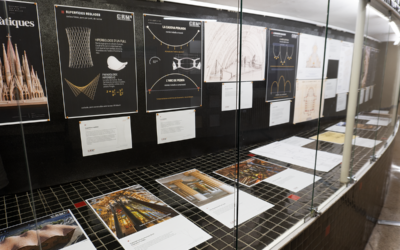
Exposició ‘Les matemàtiques de Gaudí’
CRM quod erat demonstrandum | 48

ADA: Decoding Brain Signals Misaligned in Time
The study addresses a key limitation of current brain decoding techniques: the difficulty of interpreting internal mental processes whose temporal dynamics vary from trial to trial.Decoding what is happening in a person’s mind from their brain activity is one of the...
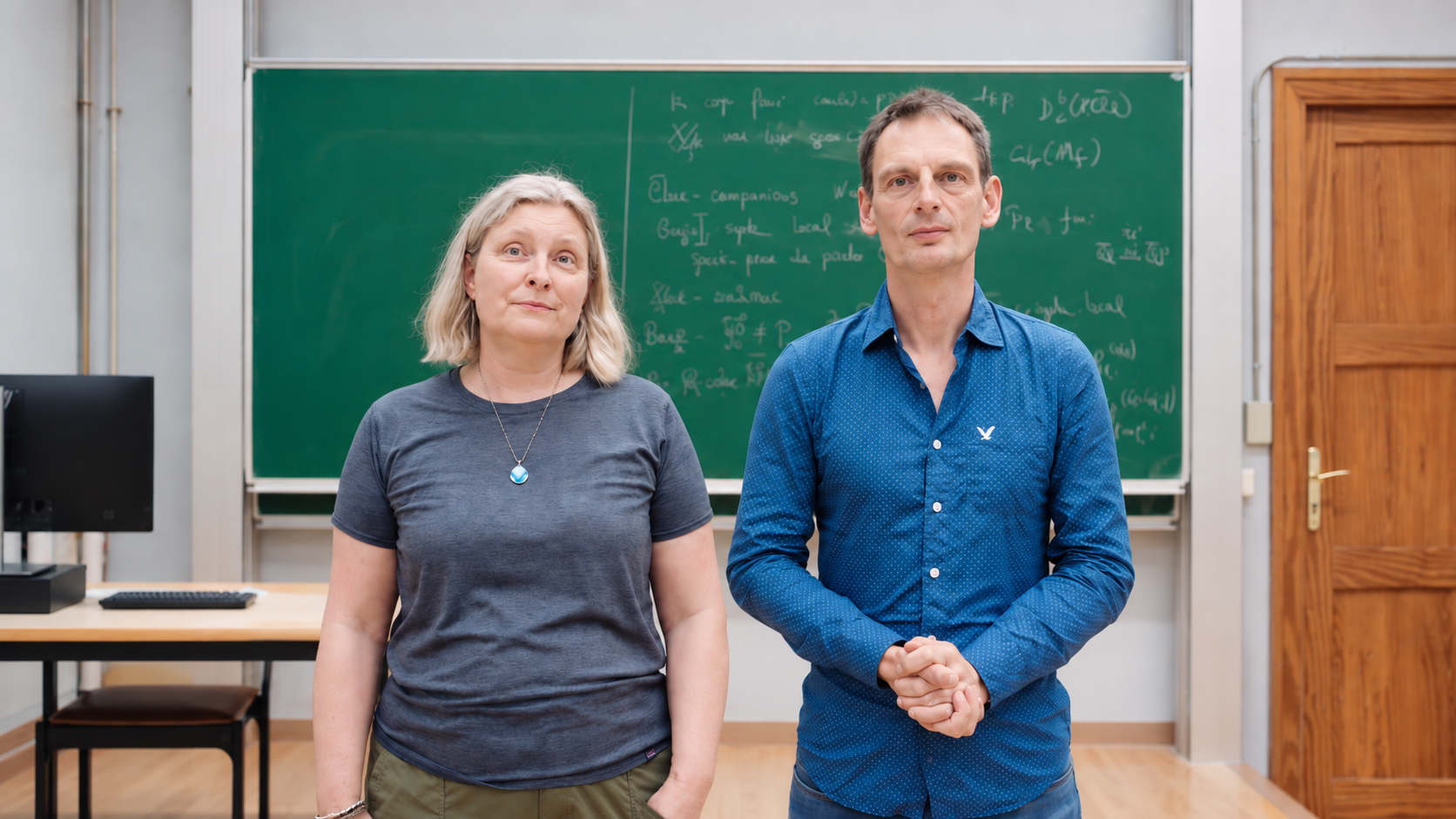
Rare curves, many points: Christophe Ritzenthaler and Rachel Pries on their research and the work around it
Christophe Ritzenthaler (Université de Rennes) and Rachel Pries (Colorado State University) both work on curves over finite fields: he hunts curves with as many points as possible, she hunts curves that almost never occur. In conversation with the CRM during their...

Call open for the 2027 Ferran Sunyer i Balaguer Prize
The Ferran Sunyer i Balaguer Foundation is accepting submissions for its 2027 prize, which awards 15,000 euros and publication in Birkhäuser's Progress in Mathematics series to an expository monograph on an active area of mathematical research. The deadline is 27...
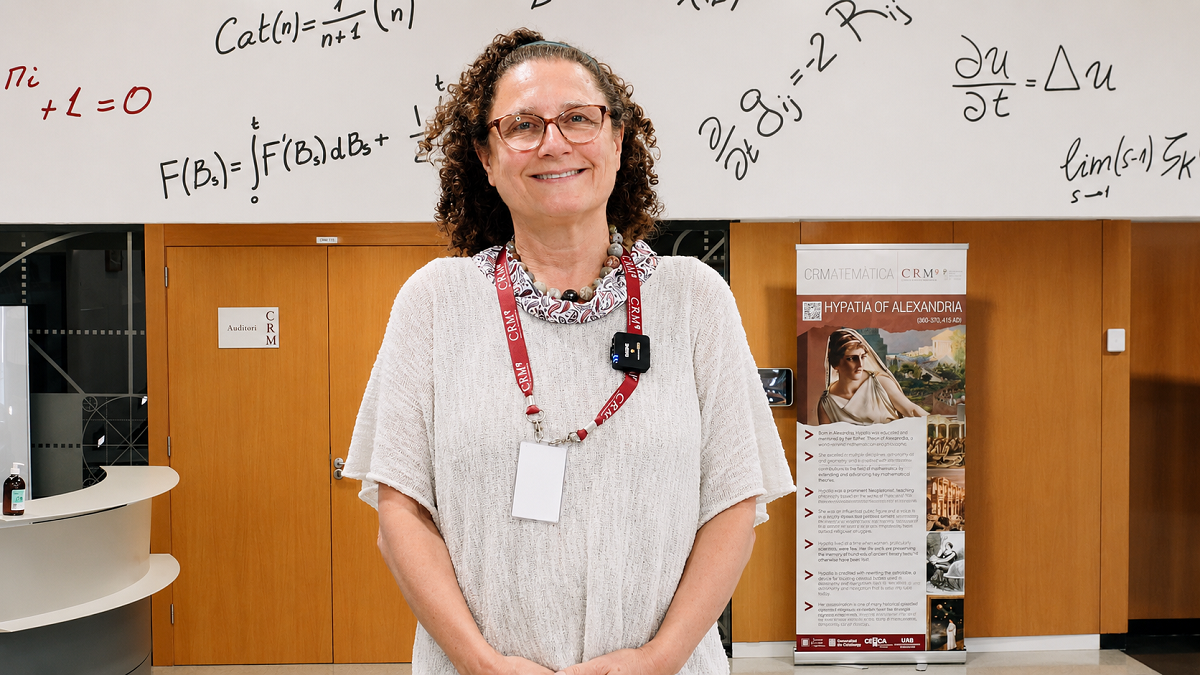
Susanna Terracini delivers the CRM Colloquium 2026
Susanna Terracini (Università di Torino) delivered the CRM Colloquium 2026 on 14 July, presenting a rigidity result for Kepler billiards obtained with Stefano Baranzini, Vivina Barutello and Irene De Blasi. She was at the centre as a member of the CRM Scientific...
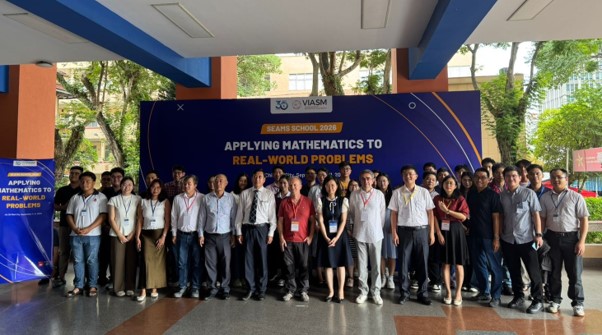
Ho Chi Minh City hosts the SEAMS School on applying mathematics to real-world problems
Students from across the region took courses and worked on group projects at a school co-organised by CRM researcher Tim Myers.CRM CommPau VarelaCRMComm@crm.catGet the latest CRM news and activities in your inbox.Recent newsletters →Between 4 and...

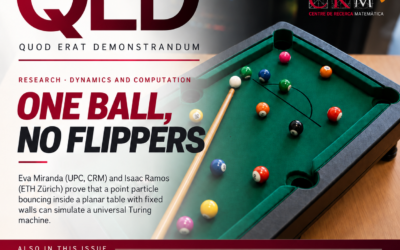
A single ball on a fixed table can compute: Eva Miranda and Isaac Ramos prove that two-dimensional billiards are Turing complete
Eva Miranda (UPC, CRM) and Isaac Ramos (ETH Zürich) show that a point particle bouncing inside a planar table with fixed walls can simulate a universal Turing machine, settling a question Cristopher Moore left open in 1990. The result grew out of a master’s project...
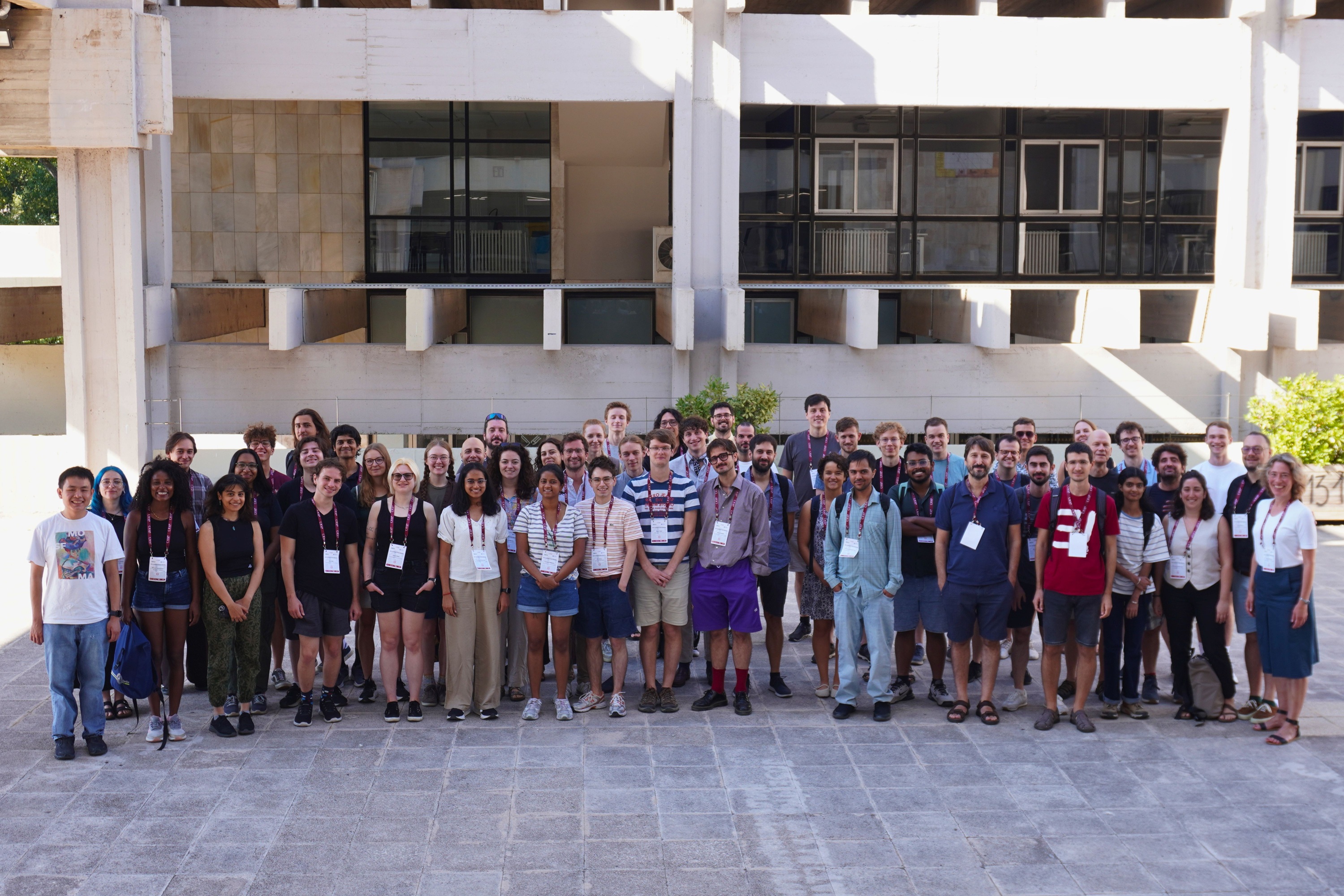
BMS-BGSMath Junior Meeting 2026: Barcelona and Berlin Strengthen Scientific Ties
From 2 to 4 September 2026, the Centre de Recerca Matemàtica (CRM) hosted the BMS-BGSMath Junior Meeting 2026, a three-day event jointly organised by the Berlin Mathematical School (BMS) and the Barcelona Graduate School of Mathematics (BGSMath), with the Centre de...
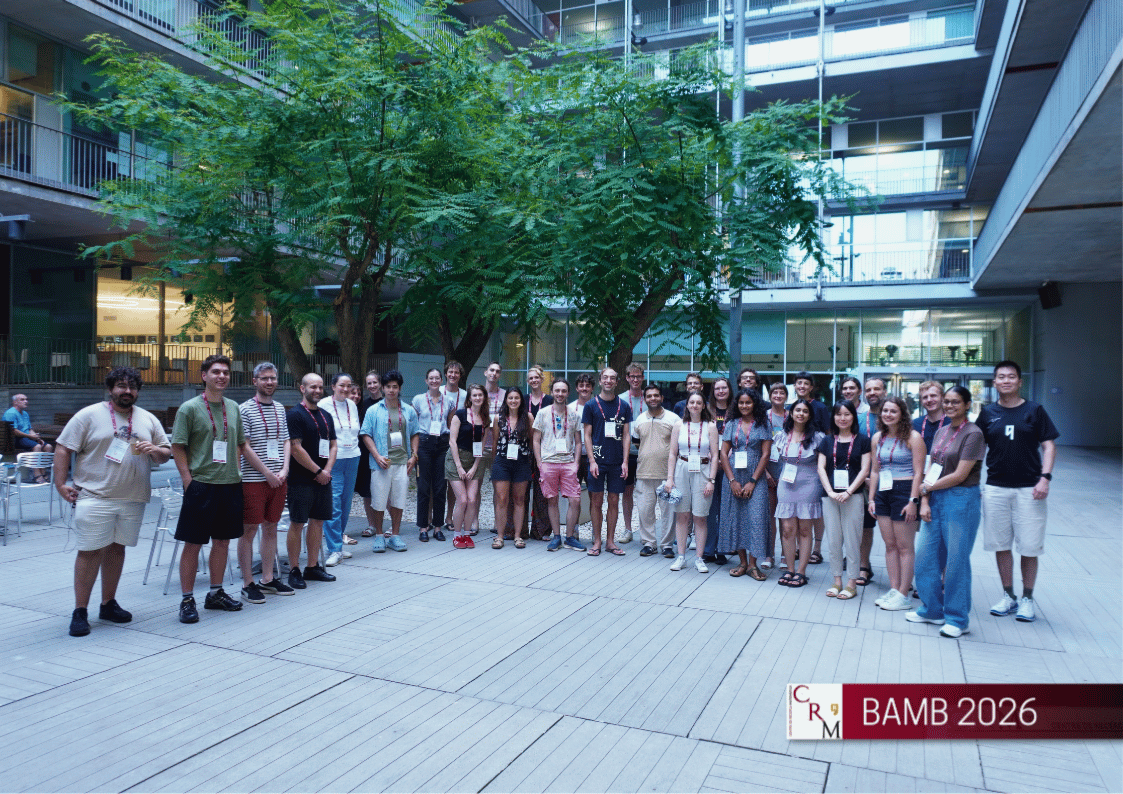
The CRM organises the 2026 Barcelona Summer School for Advanced Modeling of Behavior
The Centre de Recerca Matemàtica held the sixth edition of BAMB!, the Barcelona Summer School for Advanced Modeling of Behavior, from 12 to 23 July 2026 at the Parc de Recerca Biomèdica de Barcelona. Thirty early-career researchers from fourteen countries followed...