The 4th Barcelona Weekend on Operator Algebras, held at the CRM on January 30–31, 2026, brought together experts to discuss recent advances and open problems in the field.
The event strengthened the exchange of ideas within the community and reinforced the CRM’s role as a key meeting point for research in C*-algebras and related areas.
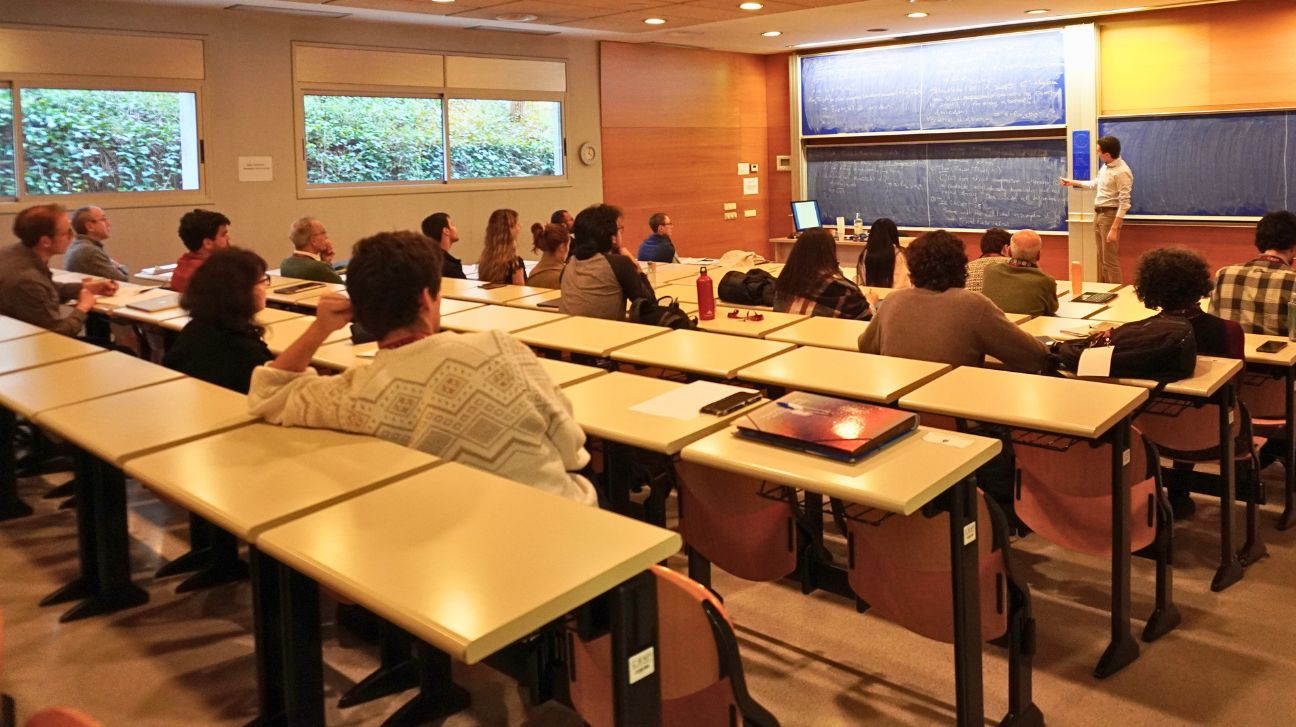
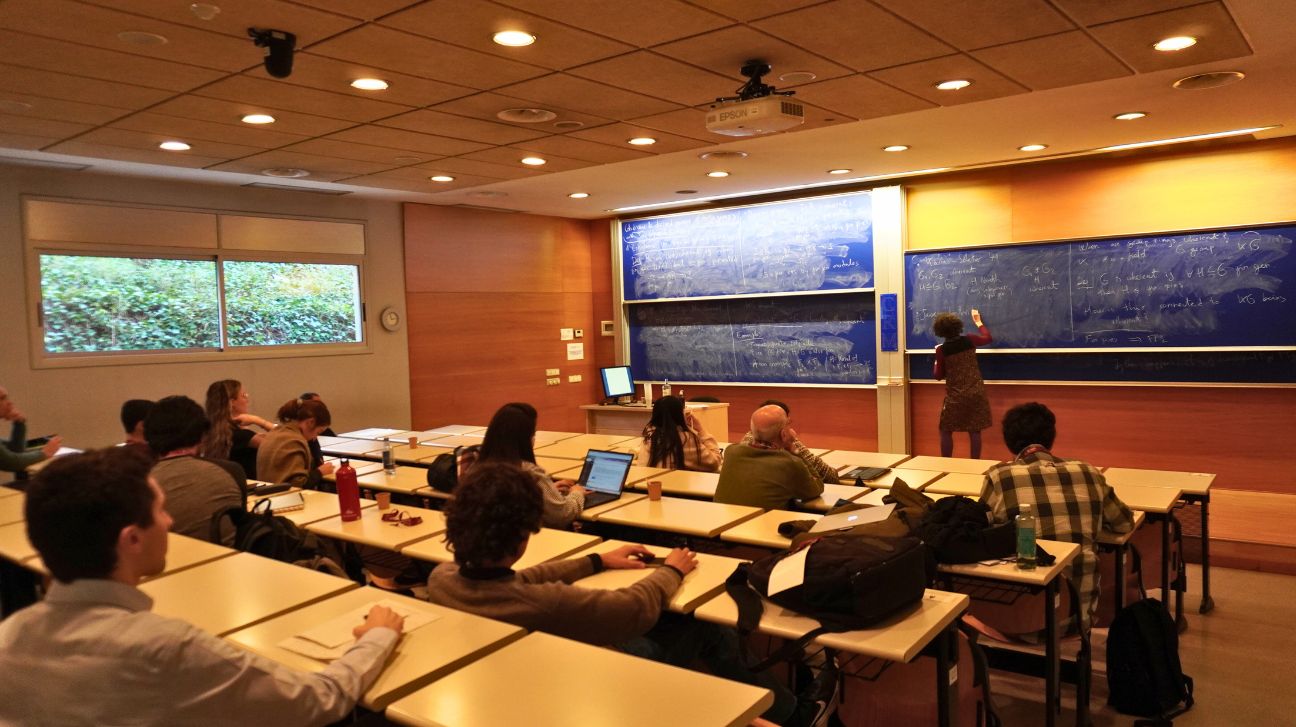
The Centre de Recerca Matemàtica (CRM) hosted the 4th Barcelona Weekend on Operator Algebras on January 30–31, 2026. The meeting was devoted to the algebraic theory of operator algebras, with a particular focus on C*-algebras, their invariants, and their interactions with group theory, dynamics, and mathematical logic.
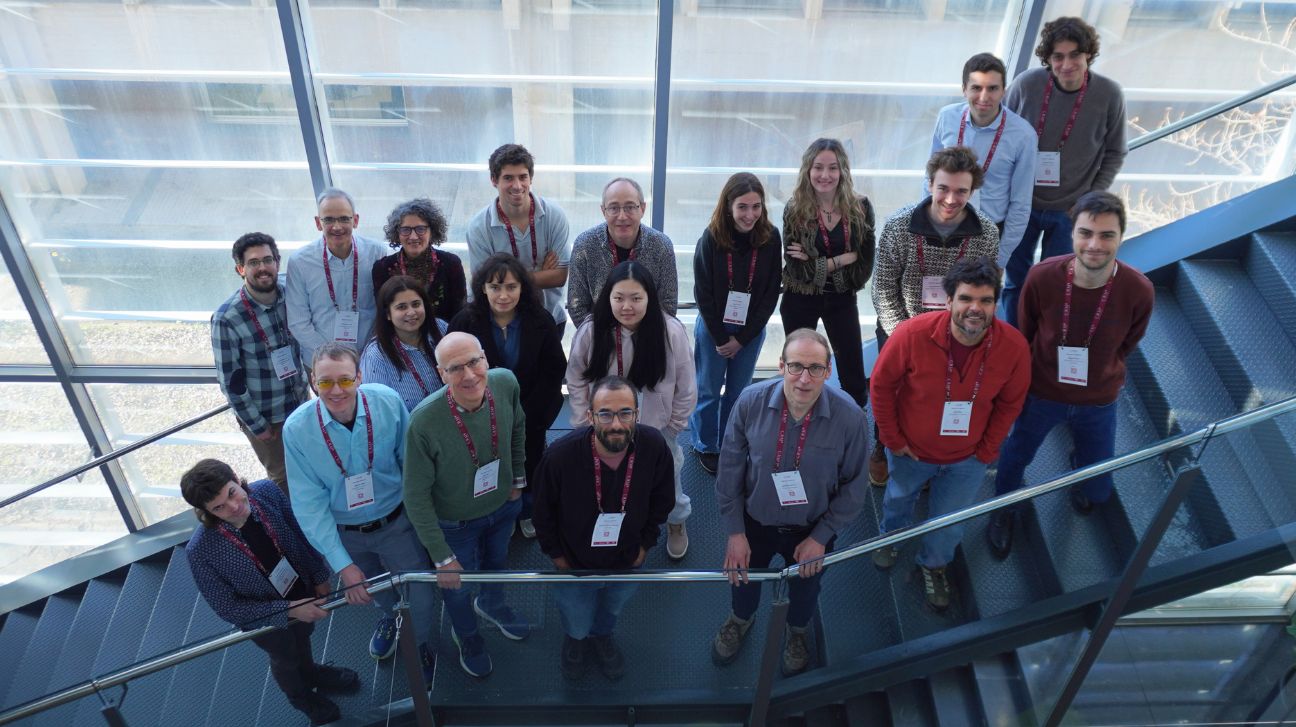
The aim of the event was to bring together international experts and early-career researchers to share recent advances, foster new connections between research lines, and further consolidate this workshop as a reference meeting point for the operator algebras community.
Talks and speakers
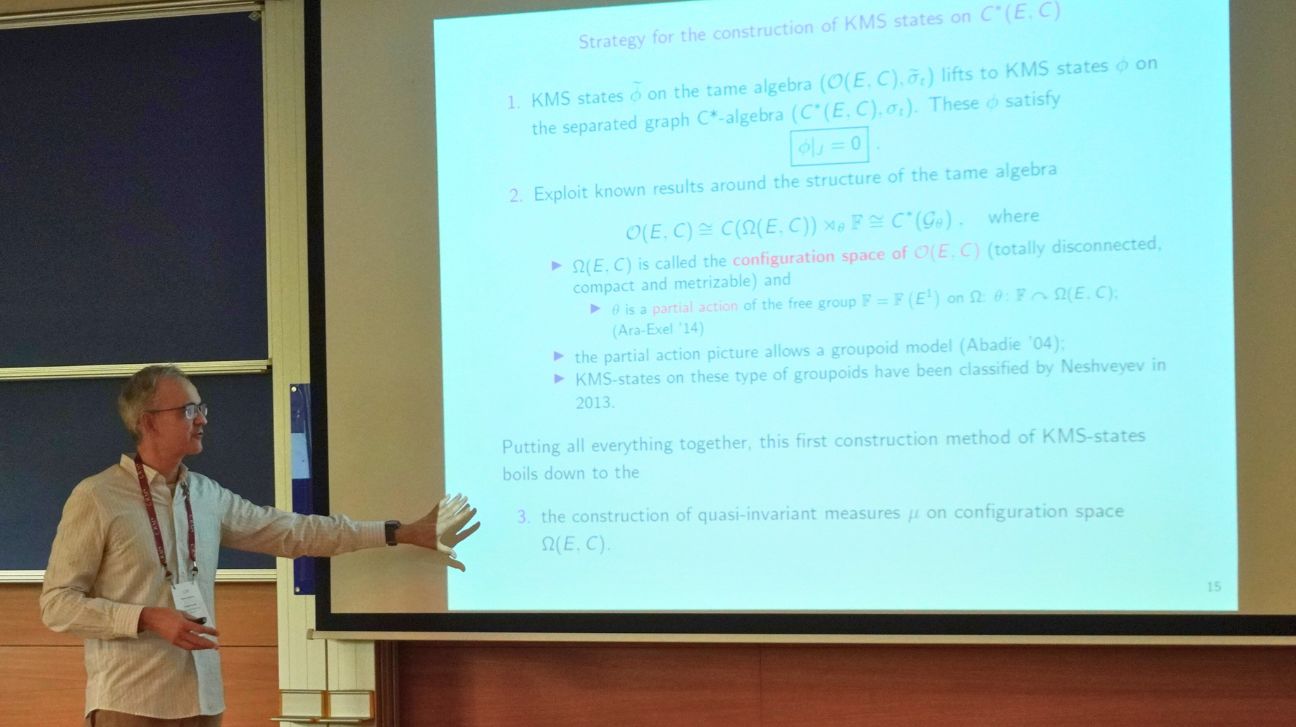
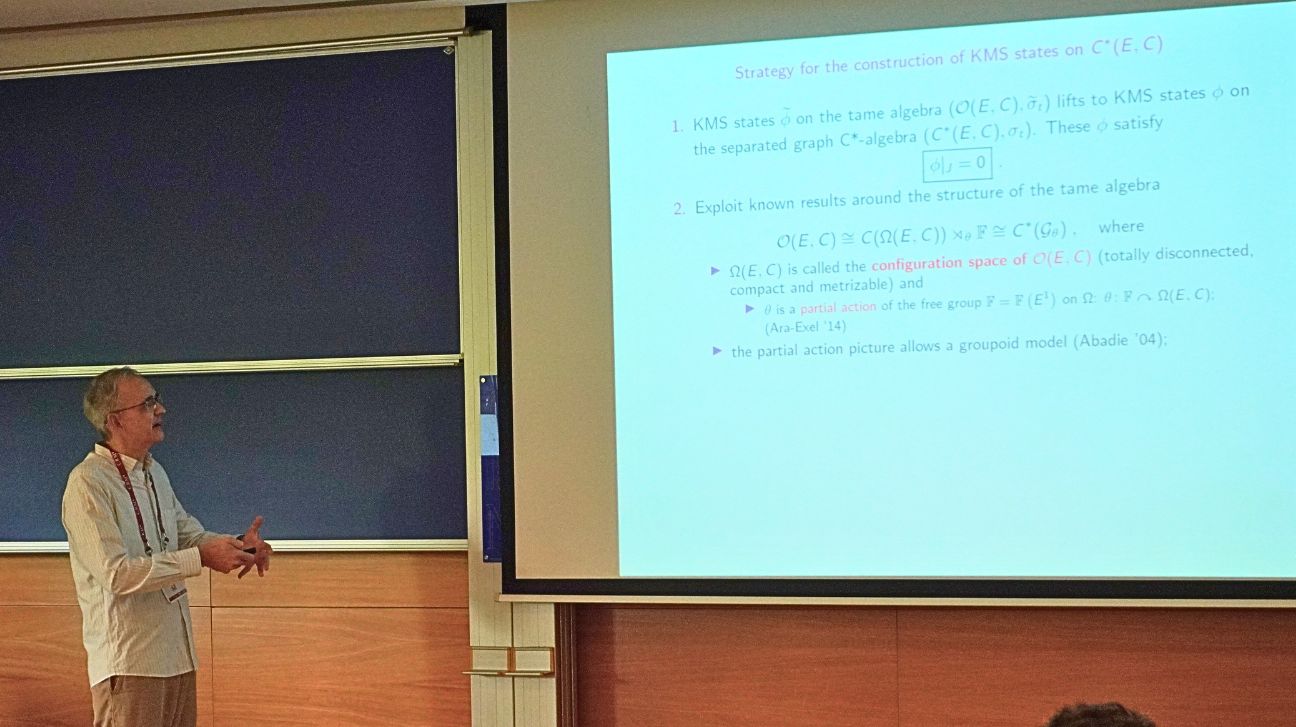
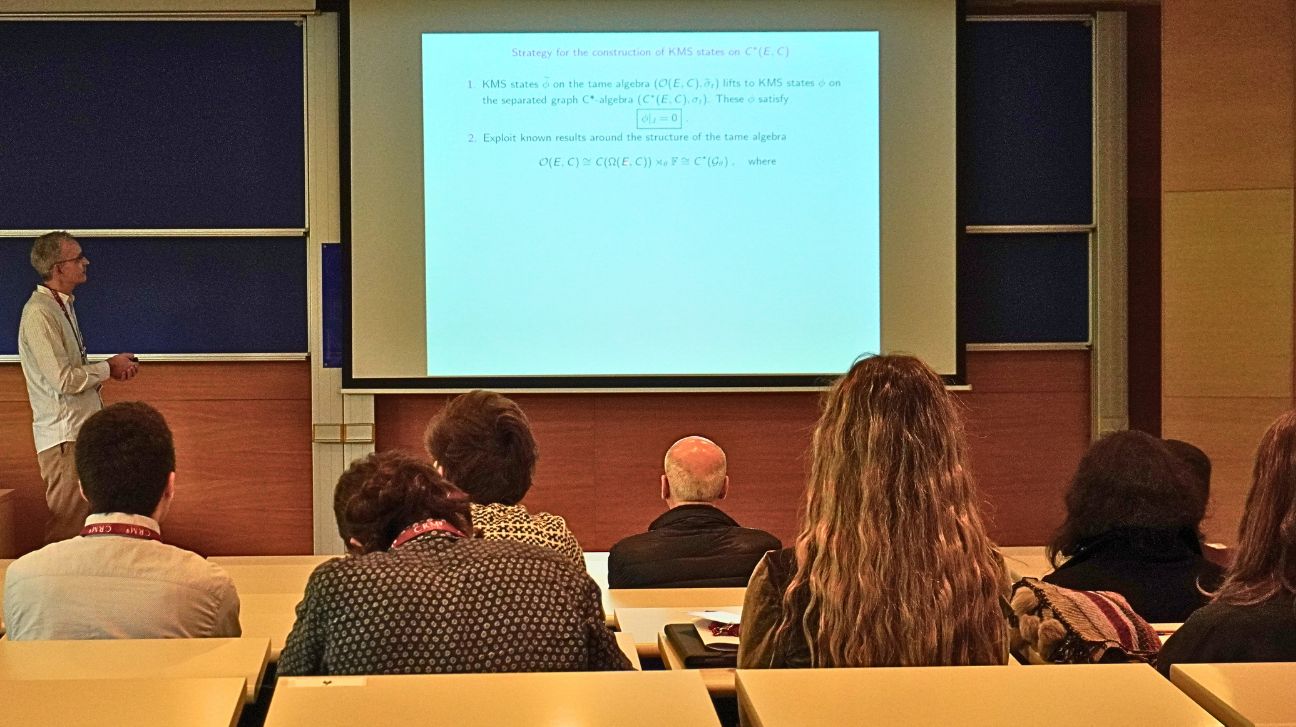
- Fernando Lledó (Universidad Carlos III de Madrid) opened the program with KMS States for Separated Graph Algebras – I, introducing a measure-theoretic approach to equilibrium states and laying the conceptual foundations for the topic.
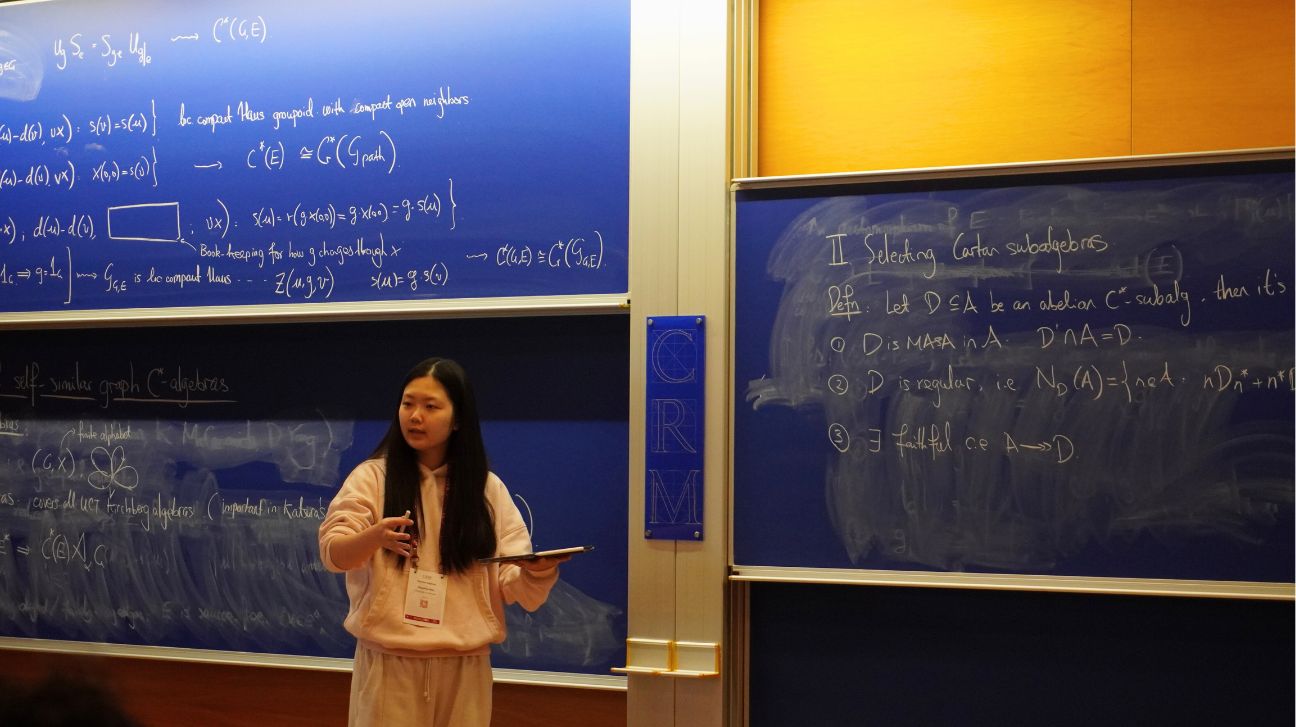
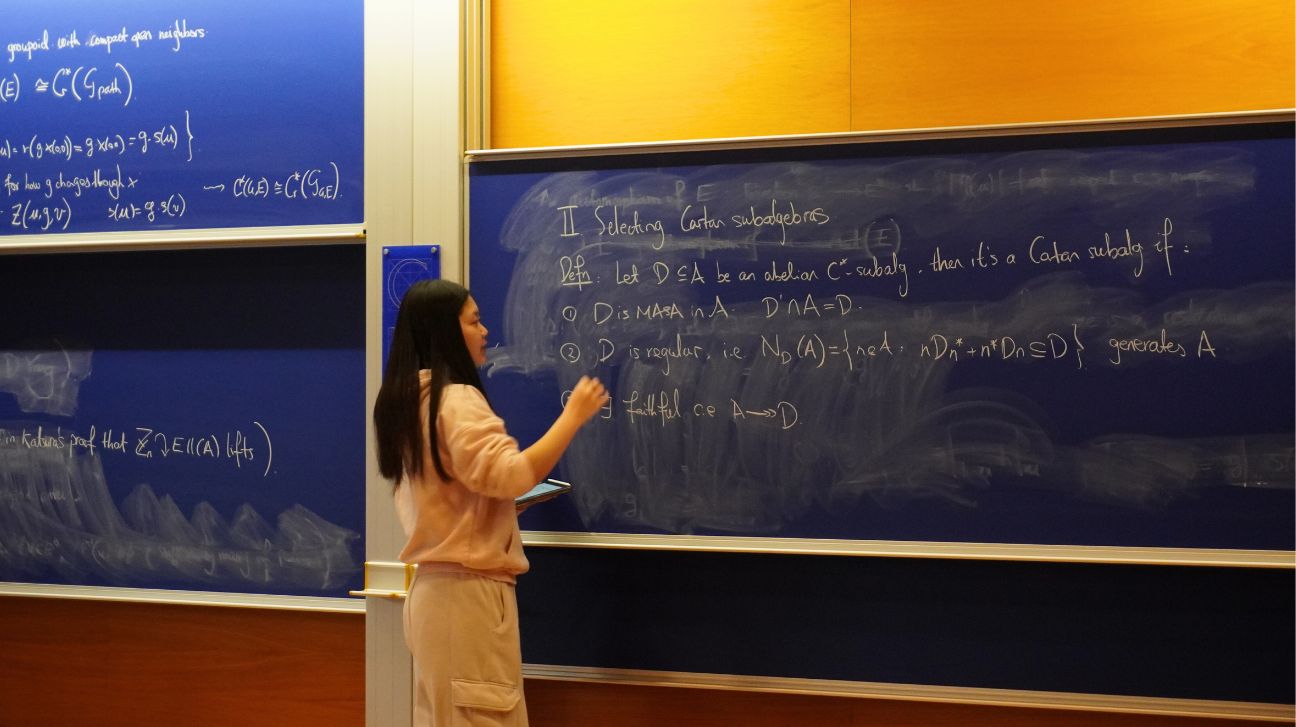
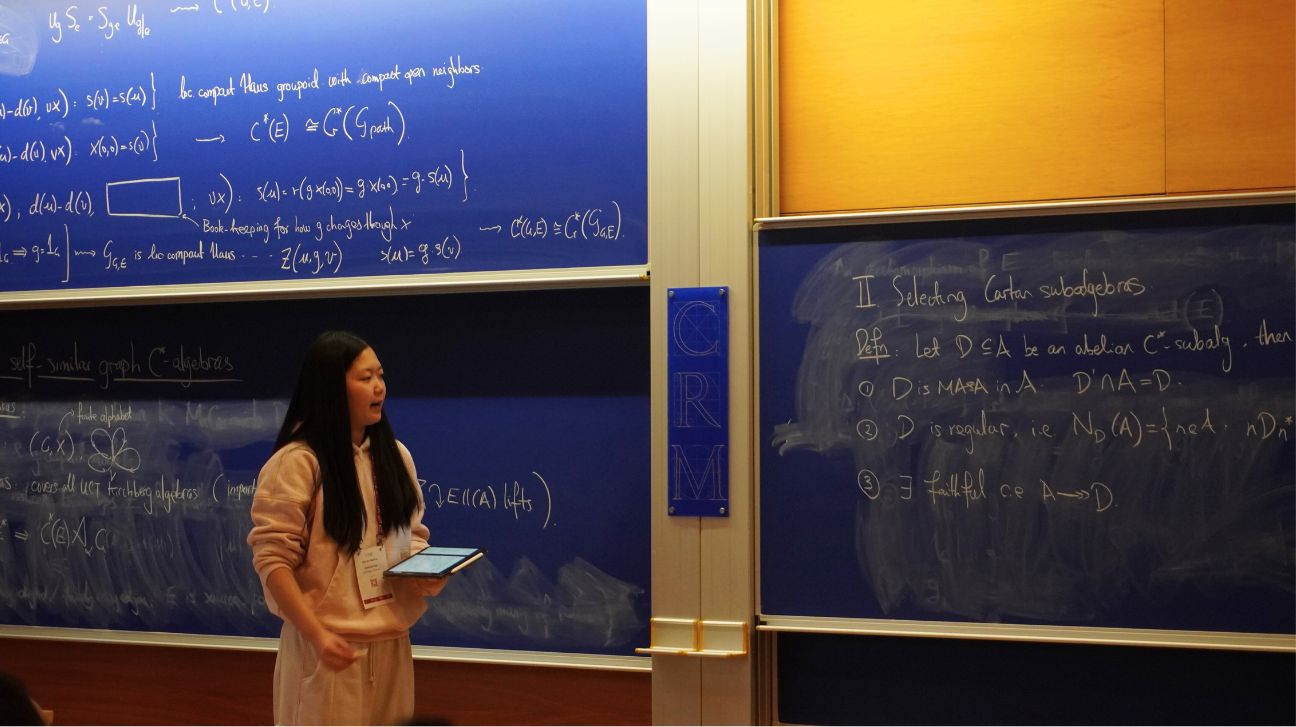
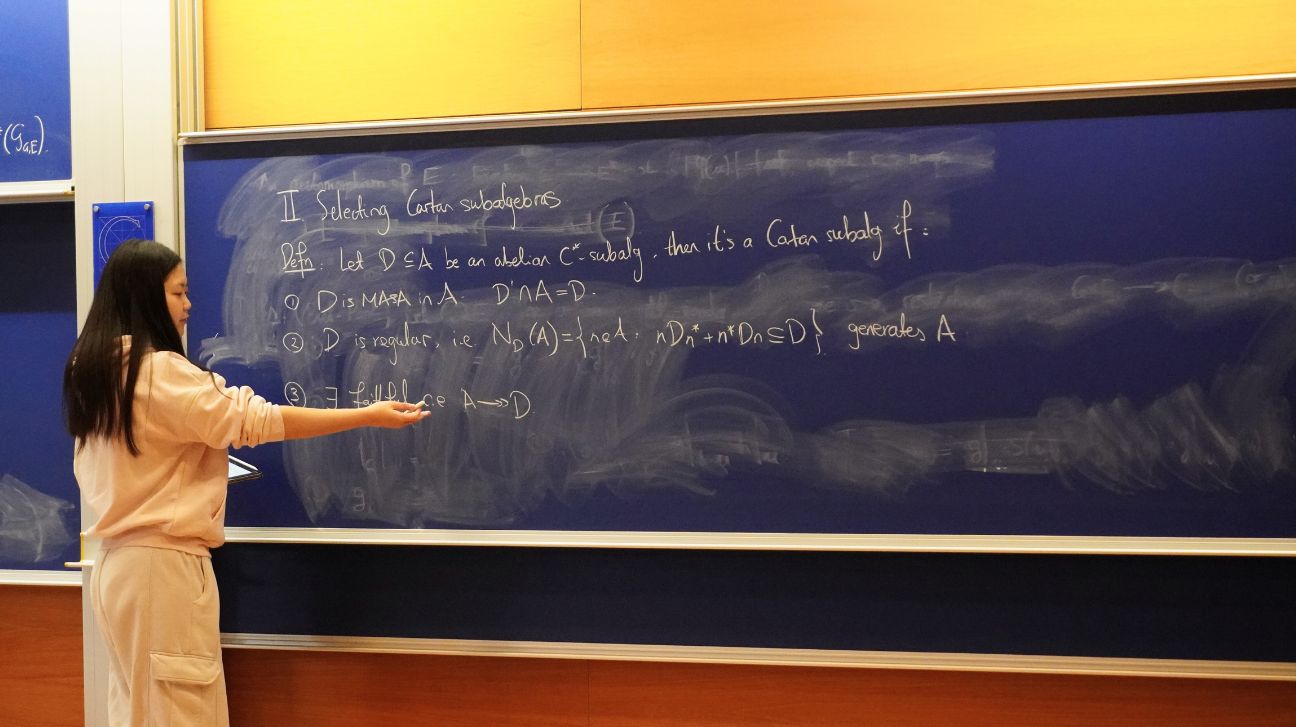
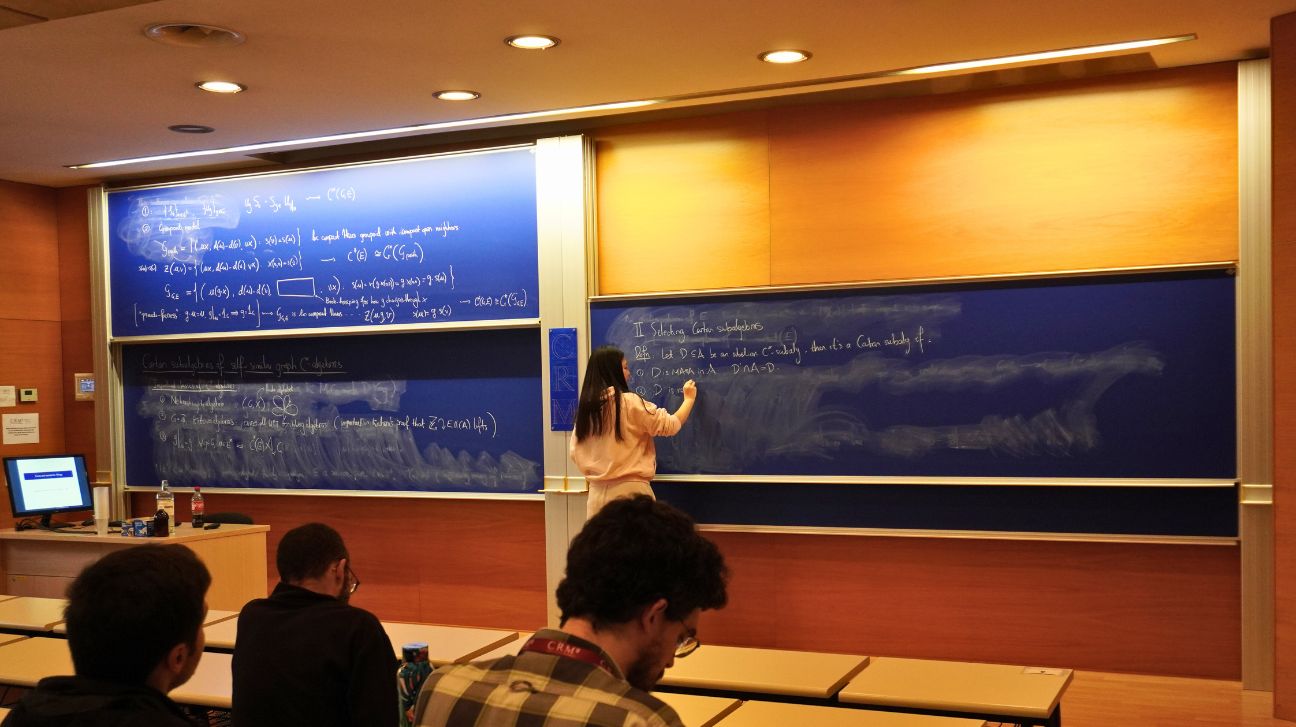
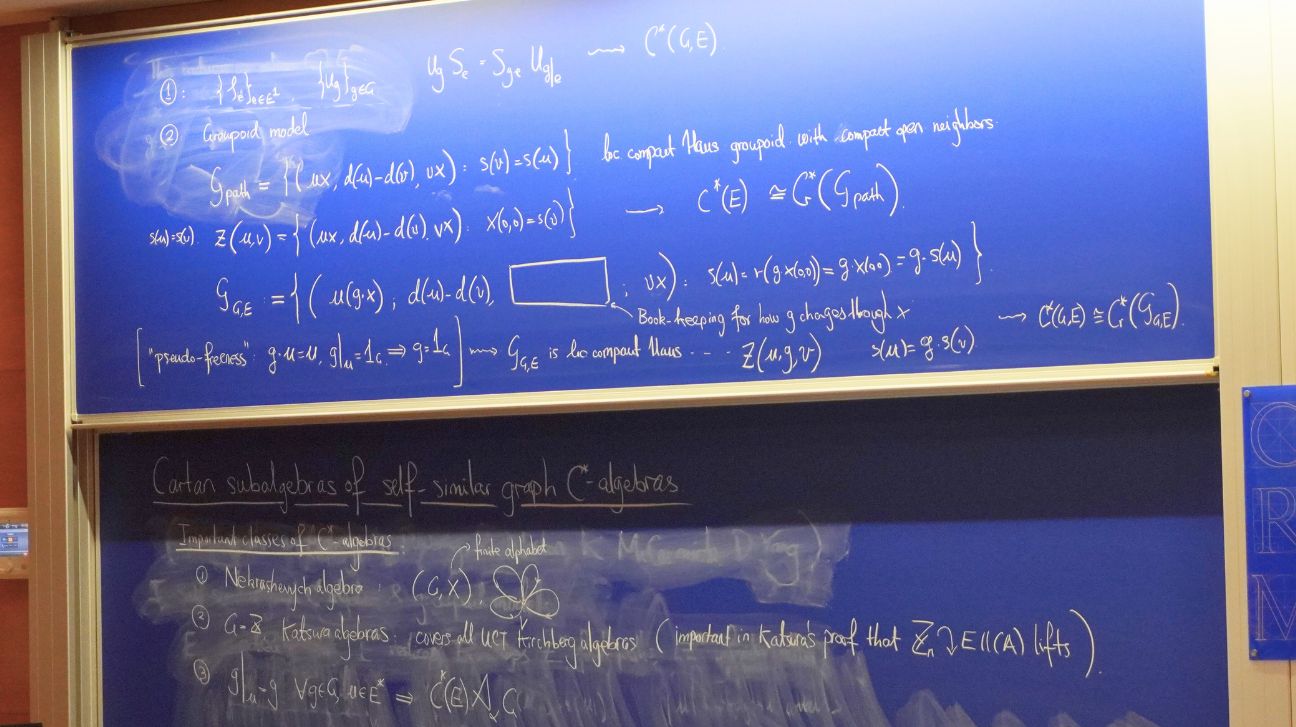
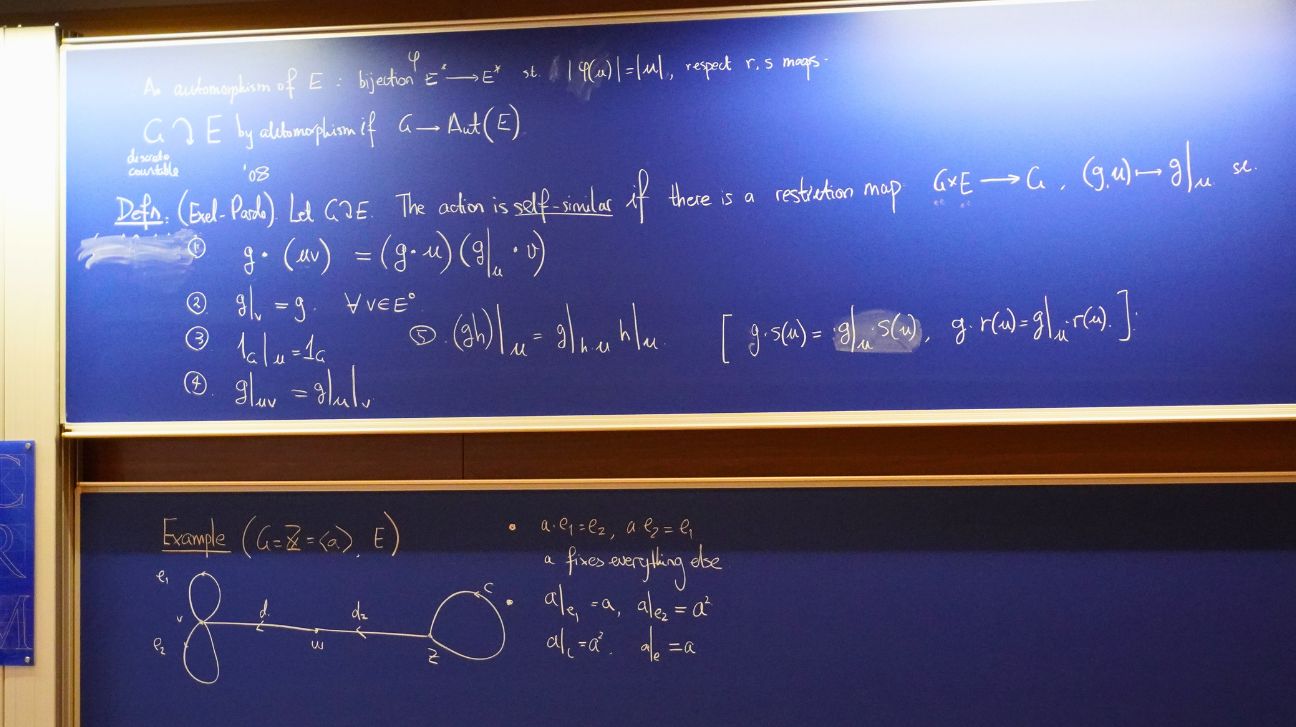
- Shanshan Hua (University of Münster) examined Cartan Subalgebras of Self-Similar Graph Algebras, extending known descriptions beyond the locally faithful setting and constructing new groupoid models that recover part of the original self-similar dynamics.
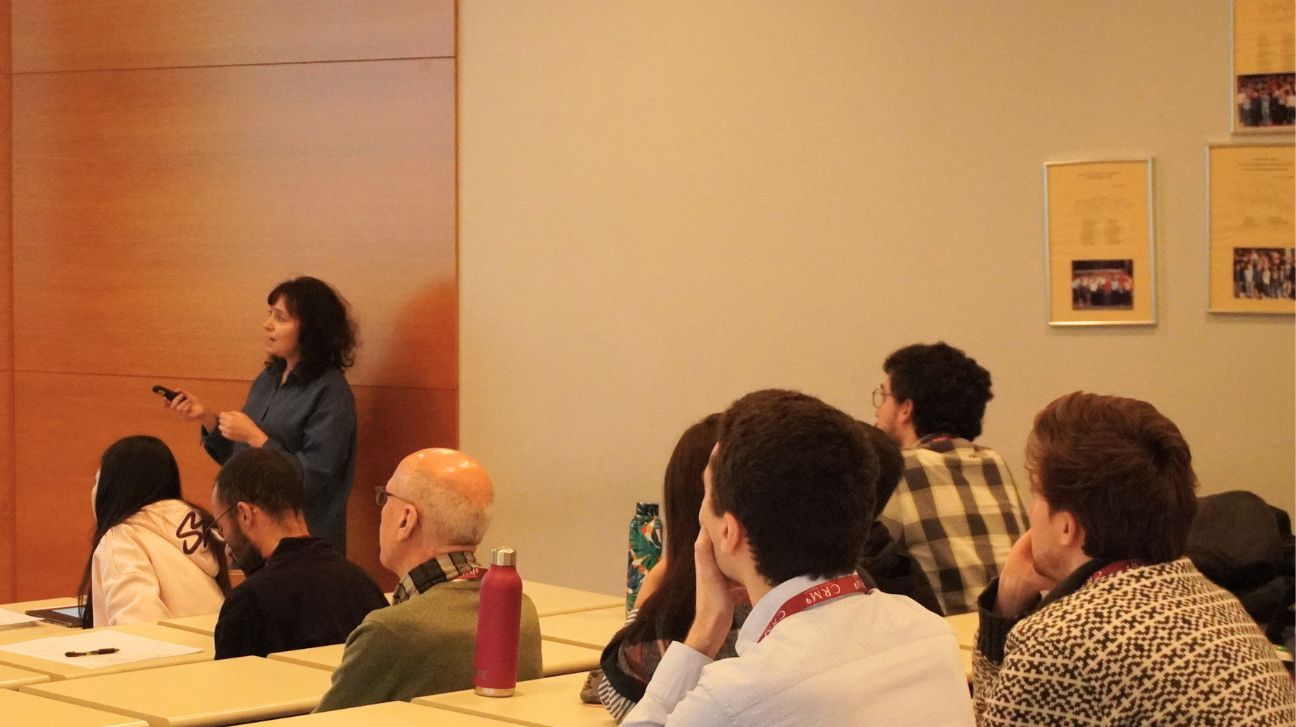
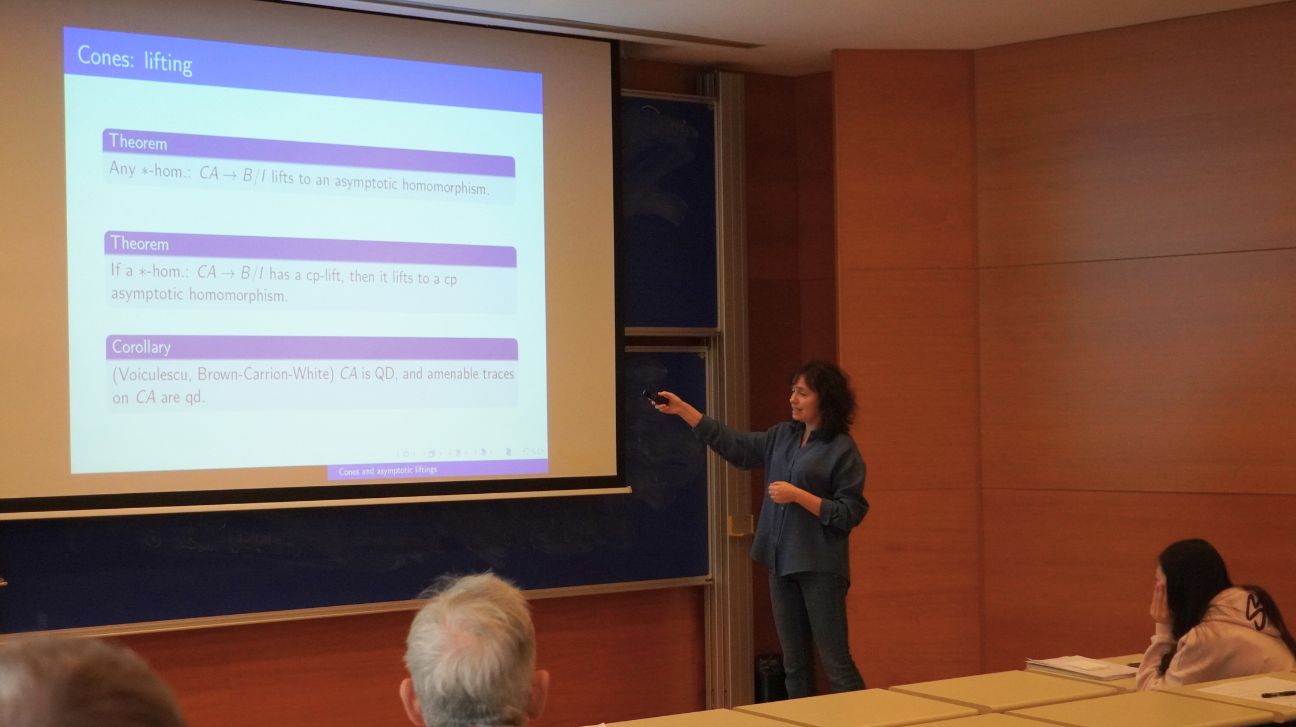
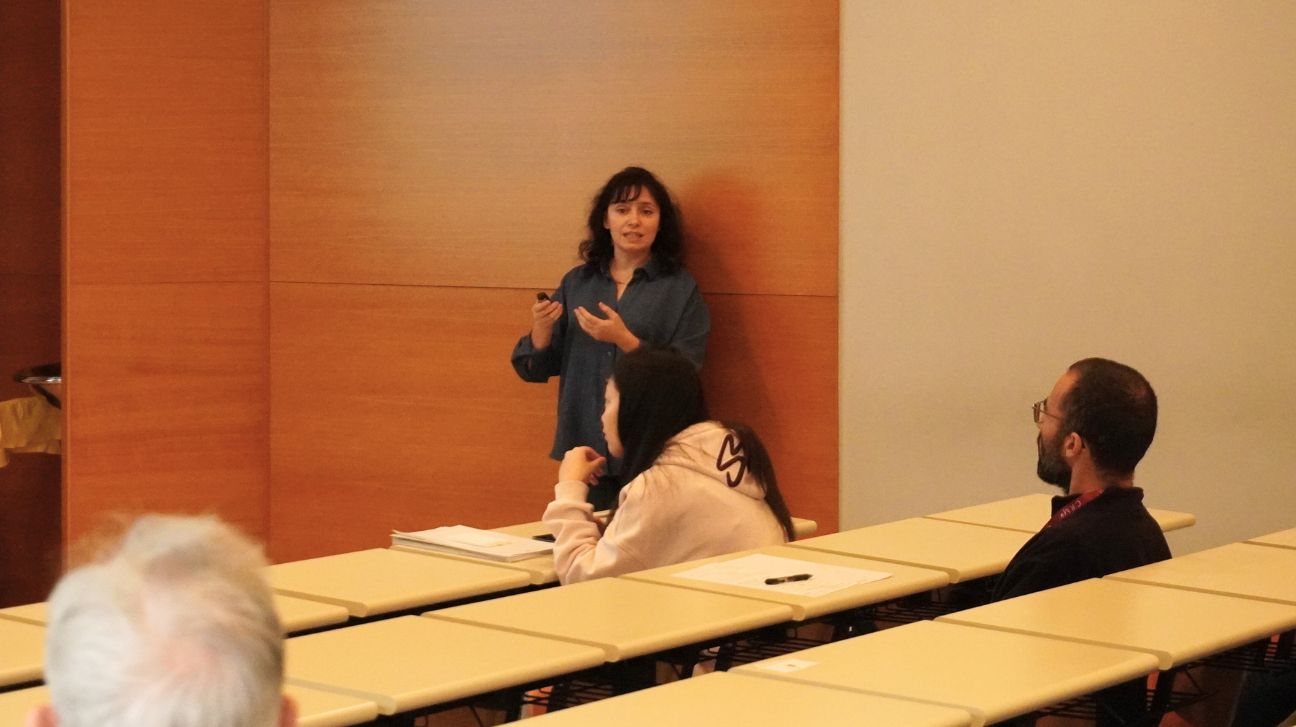
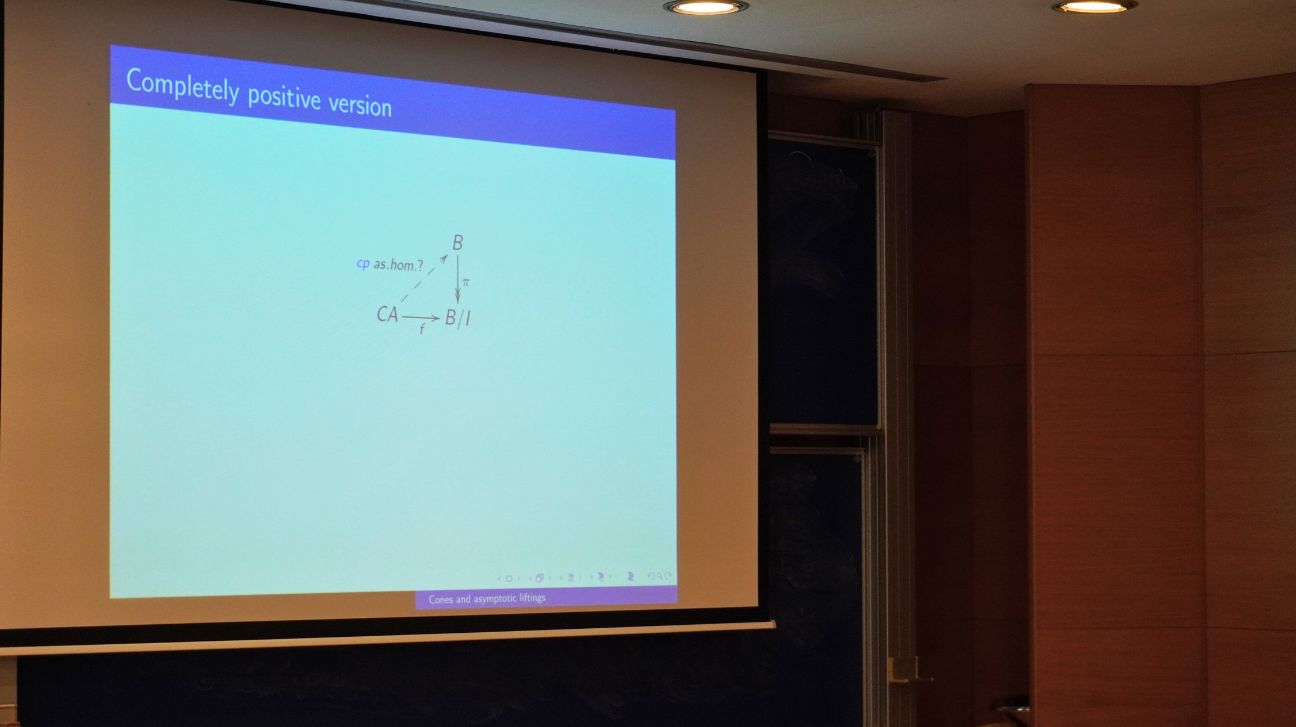
- Tatiana Shulman (University of Gothenburg) spoke on Cones and Asymptotic Liftings, focusing on cone C*-algebras and analysing both established and new properties—such as quasidiagonality and homotopy invariance—and their role in understanding deep algebraic phenomena.
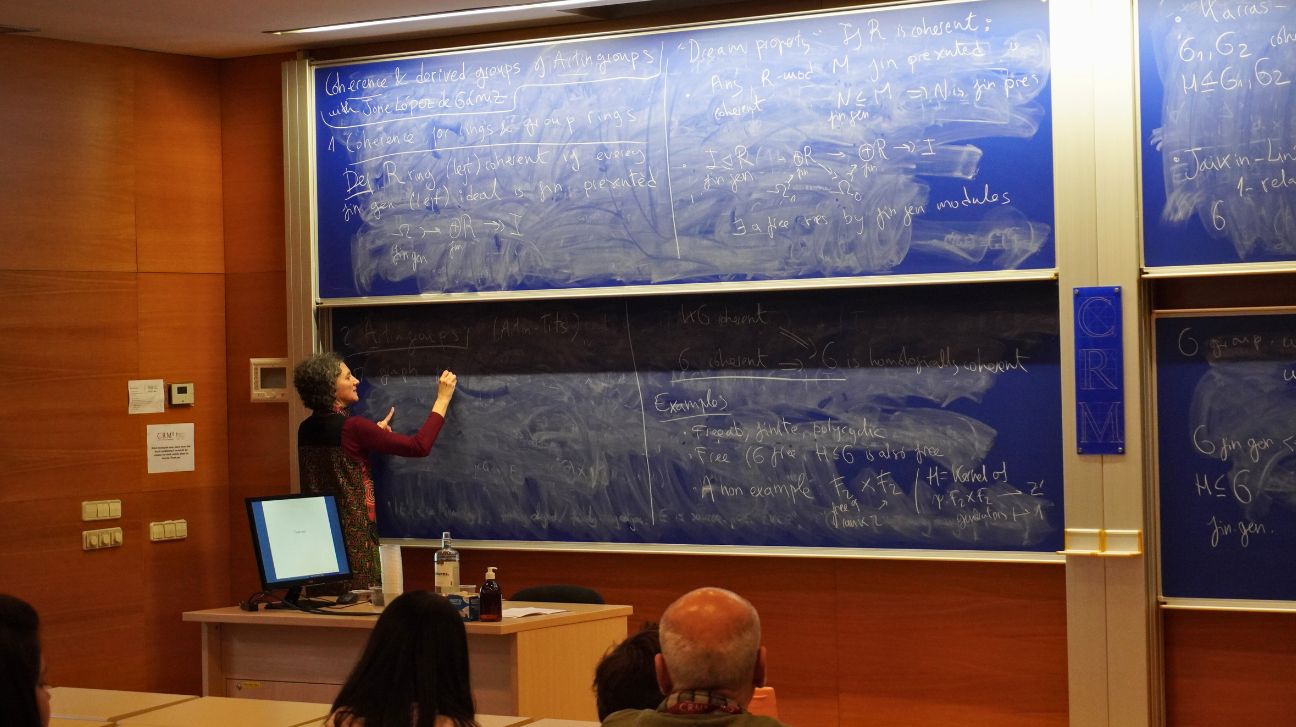
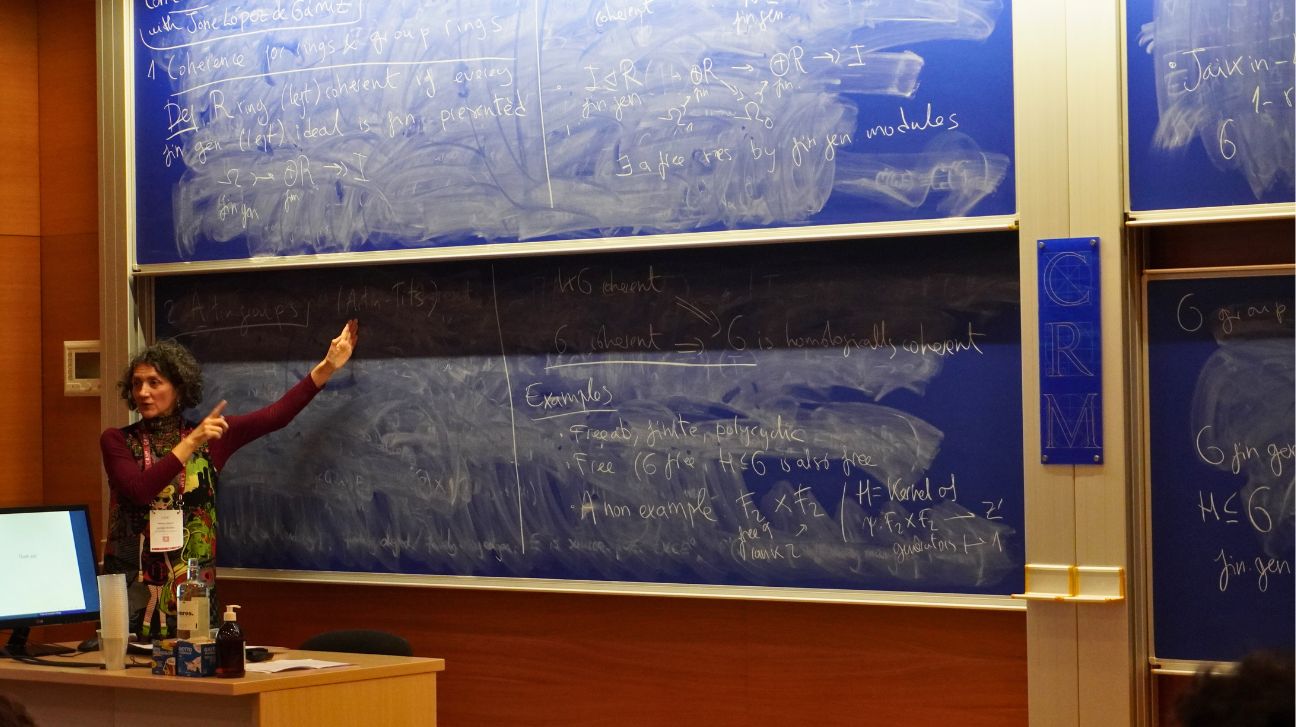
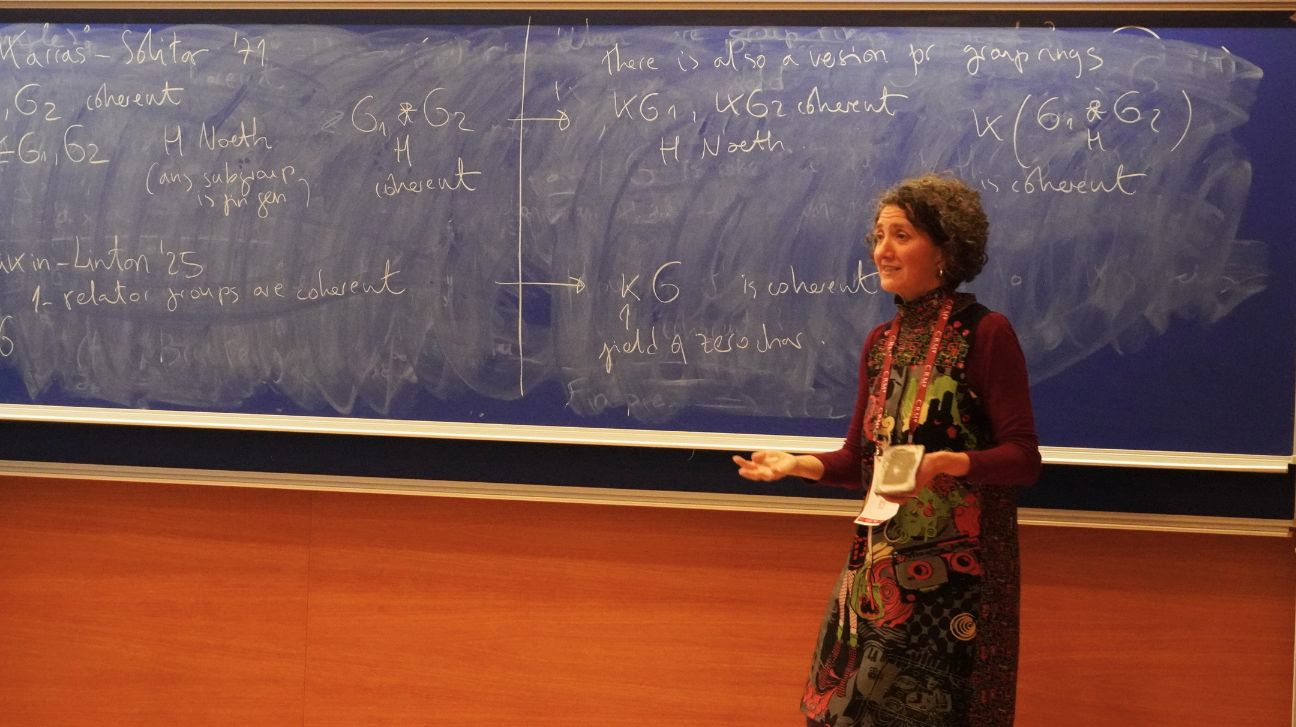
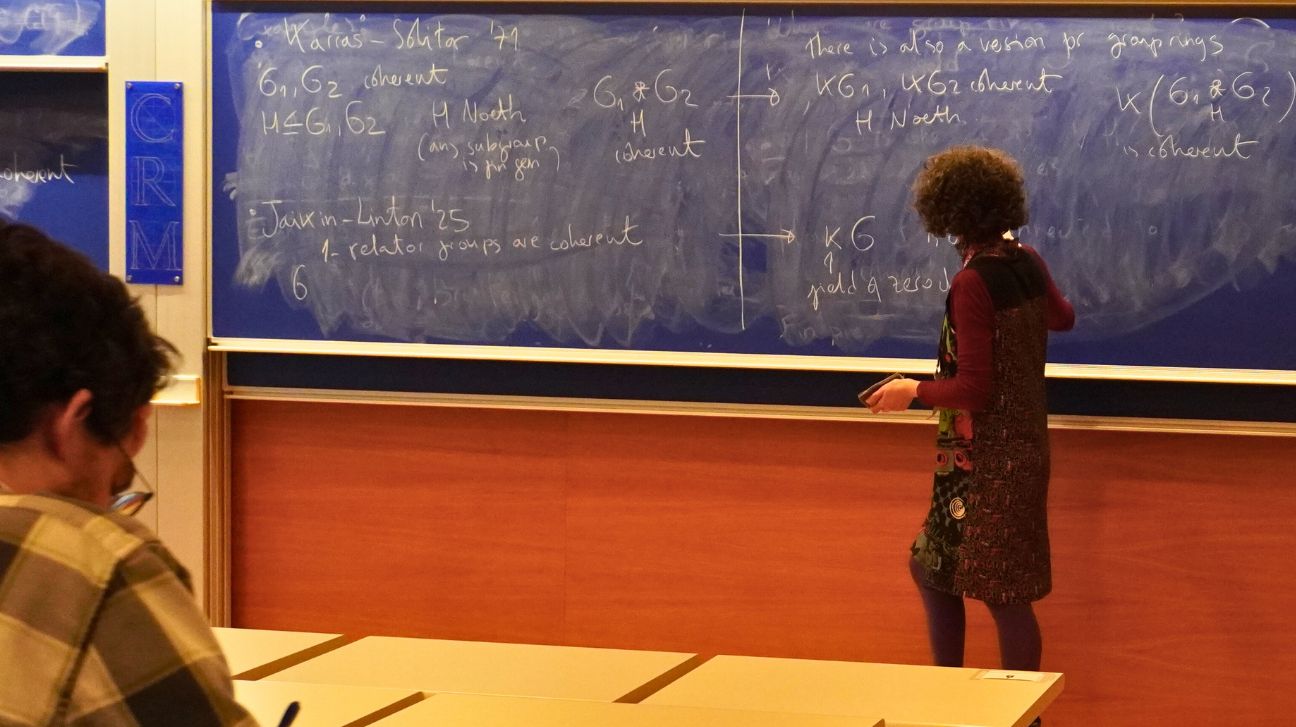
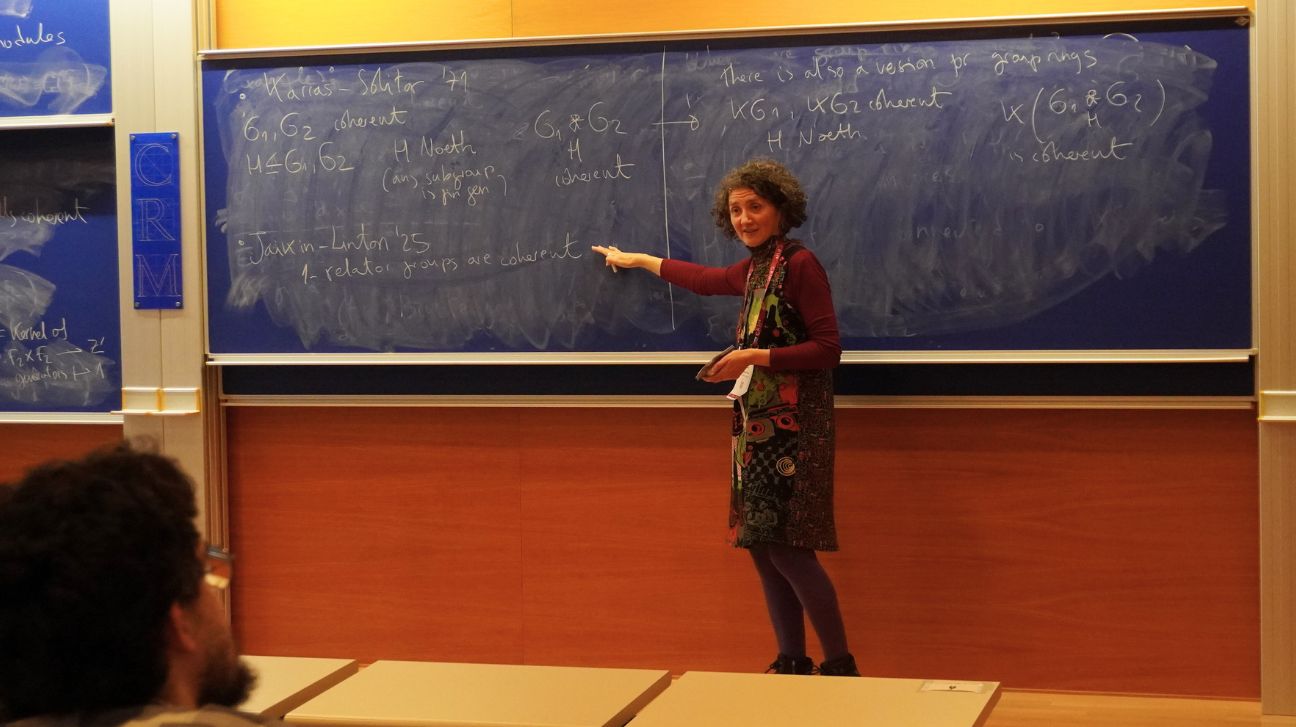
- Conchita Martínez (Universidad de Zaragoza) addressed Coherence and Derived Groups of Artin Groups, showing that the characterization of coherence in terms of the derived group holds in full generality and discussing its still poorly understood relationship with the coherence of group rings.
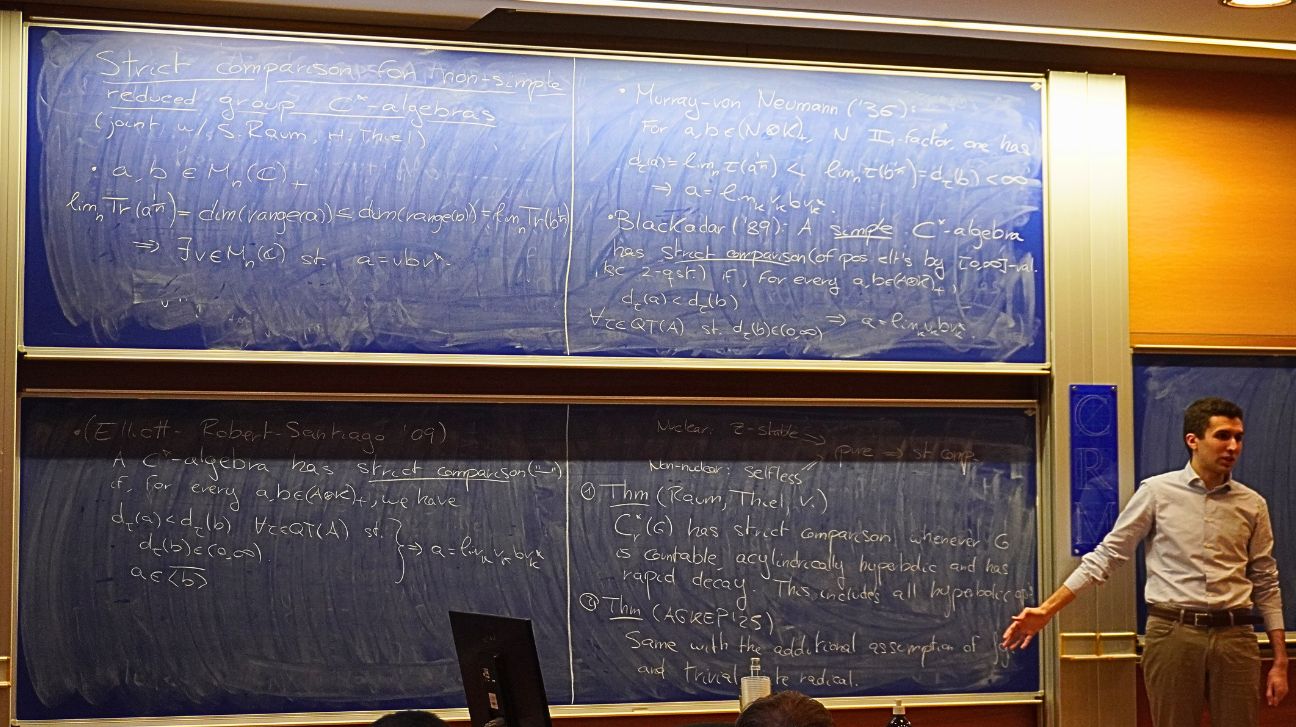
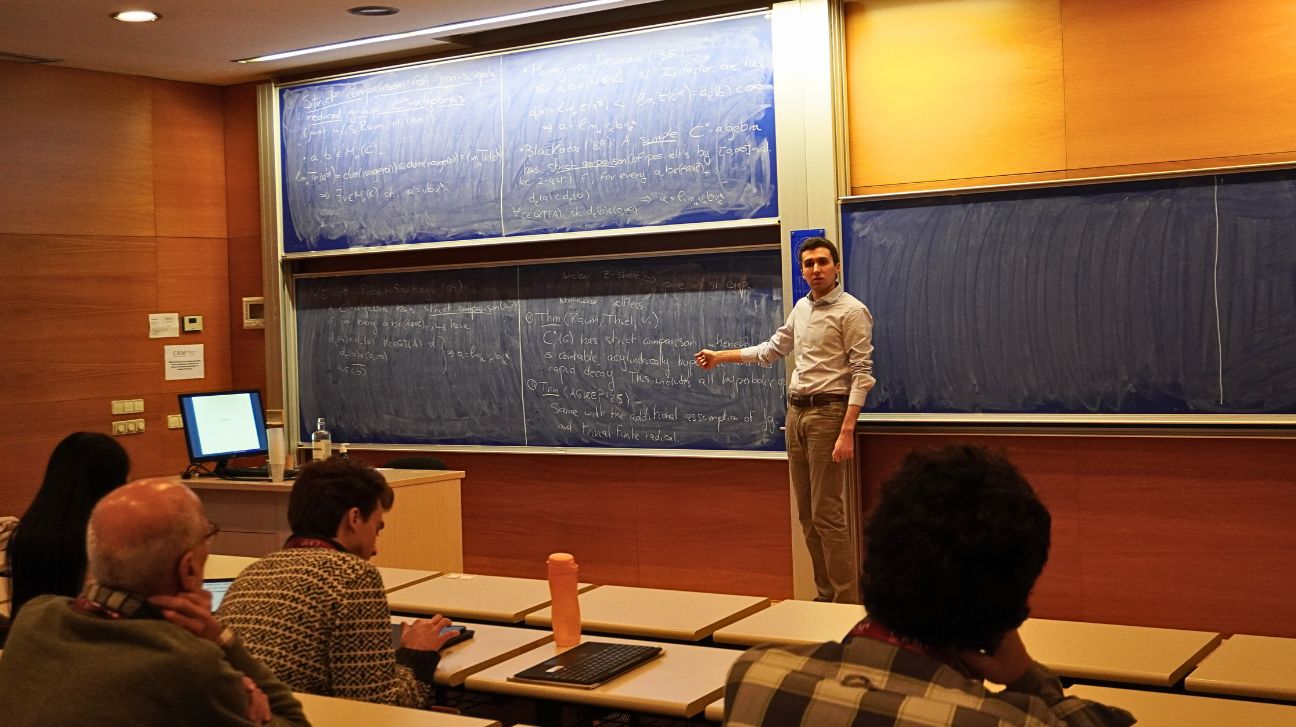
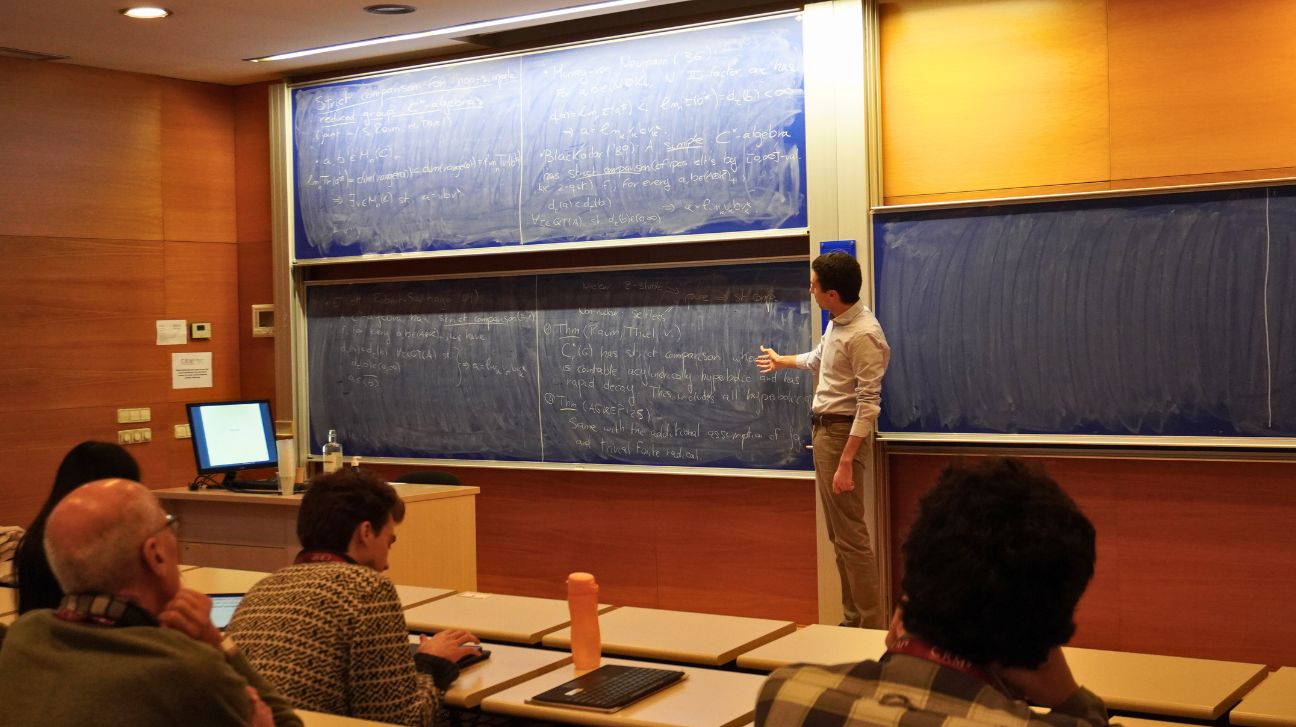
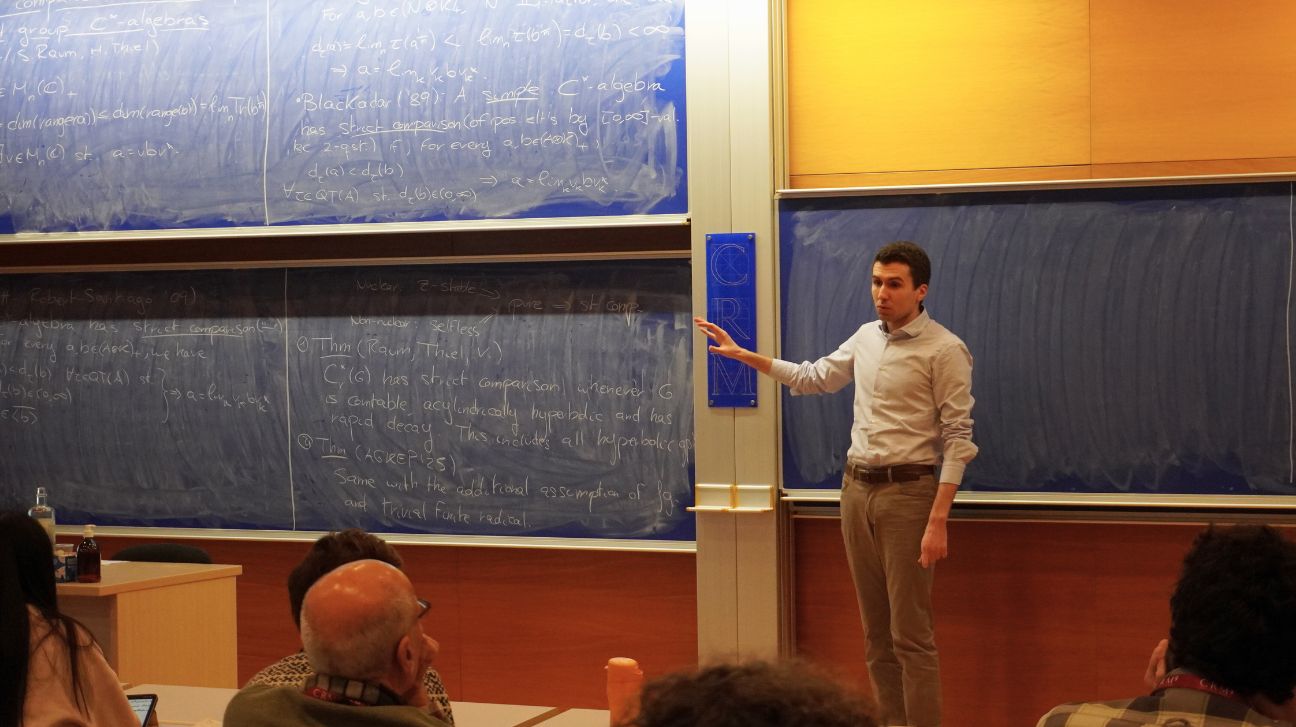
- Eduard Vilalta (Universitat Politècnica de Catalunya) presented Strict Comparison for Twisted Group C*-Algebras, highlighting recent progress on strict comparison and its versatility, with applications ranging from classification results to classical problems in group theory.
- Guillem Quingles (Universitat Autònoma de Barcelona) focused on The Cuntz Semigroup of Rings of Continuous Functions on One-Dimensional Spaces, describing this invariant in terms of monoids of intervals and revealing notable differences between real-valued and complex-valued function rings.
- Apurva Seth (University of Oxford) concluded the first day with The Radius of Comparison for Actions on Simple AH Algebras, constructing explicit actions of on simple C*-algebras that allow precise control of the radius of comparison before and after forming crossed products.
- Joachim Zacharias (University of Glasgow) reported on AF-Embeddability for Decomposition Rank One Algebras, addressing key structural questions relevant to the classification program for C*-algebras.
- Ben Bouwen (Czech Academy of Sciences) discussed Embeddings into the Ultrapower of the Jiang–Su Algebra, a central problem in the model theory of C*-algebras related to existential closure, showing that cones over separable C*-algebras embed into the ultrapower of the Jiang–Su algebra and proposing this embeddability as a new regularity property.
- Joan Claramunt (Universitat Politècnica de Catalunya) closed the event with KMS States for Separated Graph Algebras – II, presenting a second method to construct KMS states for general separated graph C*-algebras and broadening the range of available techniques for studying these systems.
A space for mathematical exchange
The CRM is particularly pleased to have hosted this fourth edition of the Barcelona Weekend on Operator Algebras, which has strengthened its role as a high-level forum for scientific exchange, encouraged dialogue across different algebraic perspectives, and reinforced the ties of an active, diverse, and steadily growing international research community.
|
|
CRM CommNatalia Vallina
|
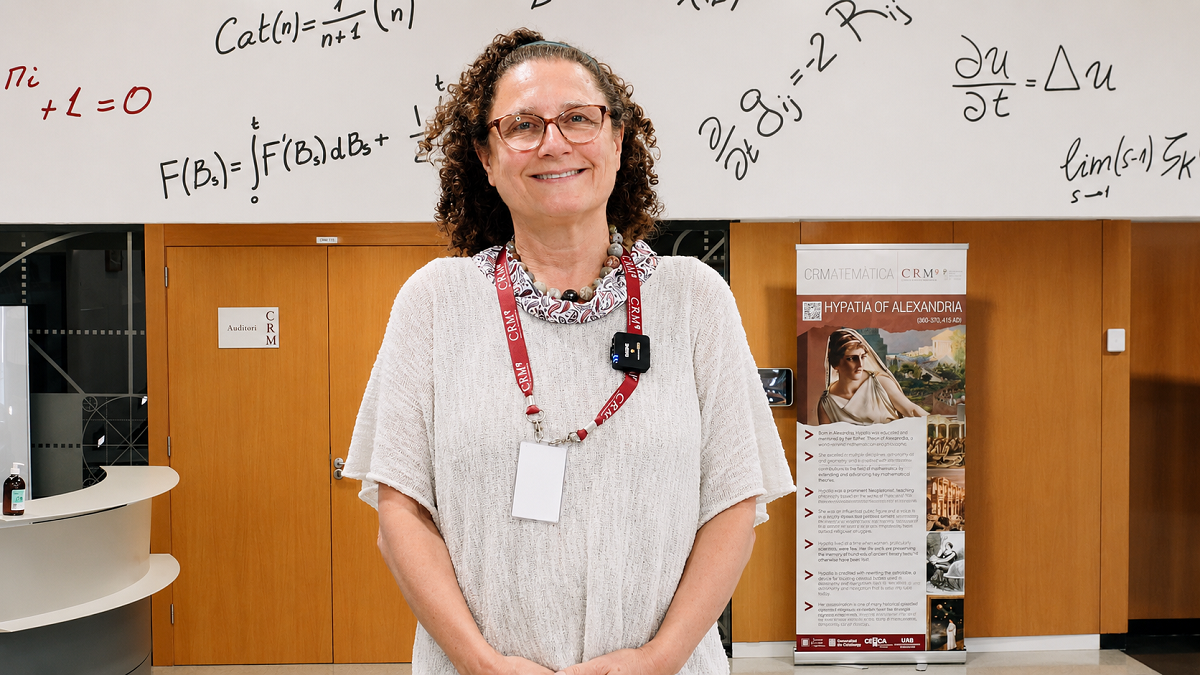
Susanna Terracini delivers the CRM Colloquium 2026
Susanna Terracini (Università di Torino) delivered the CRM Colloquium 2026 on 14 July, presenting a rigidity result for Kepler billiards obtained with Stefano Baranzini, Vivina Barutello and Irene De Blasi. She was at the centre as a member of the CRM Scientific...
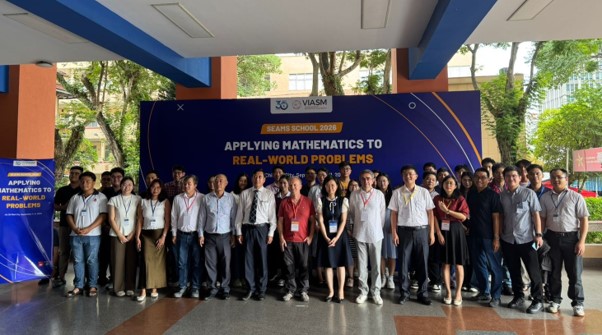
Ho Chi Minh City hosts the first SEAMS School on applying mathematics to real-world problems
More than fifty students from six countries spent a week at the University of Science, VNU-HCM, learning how mathematics gets used outside a mathematics department. CRM researcher Tim Myers co-organised the school and lectured on moving boundary problems. The...

A single ball on a fixed table can compute: Eva Miranda and Isaac Ramos prove that two-dimensional billiards are Turing complete
Eva Miranda (UPC, CRM) and Isaac Ramos (ETH Zürich) show that a point particle bouncing inside a planar table with fixed walls can simulate a universal Turing machine, settling a question Cristopher Moore left open in 1990. The result grew out of a master’s project...
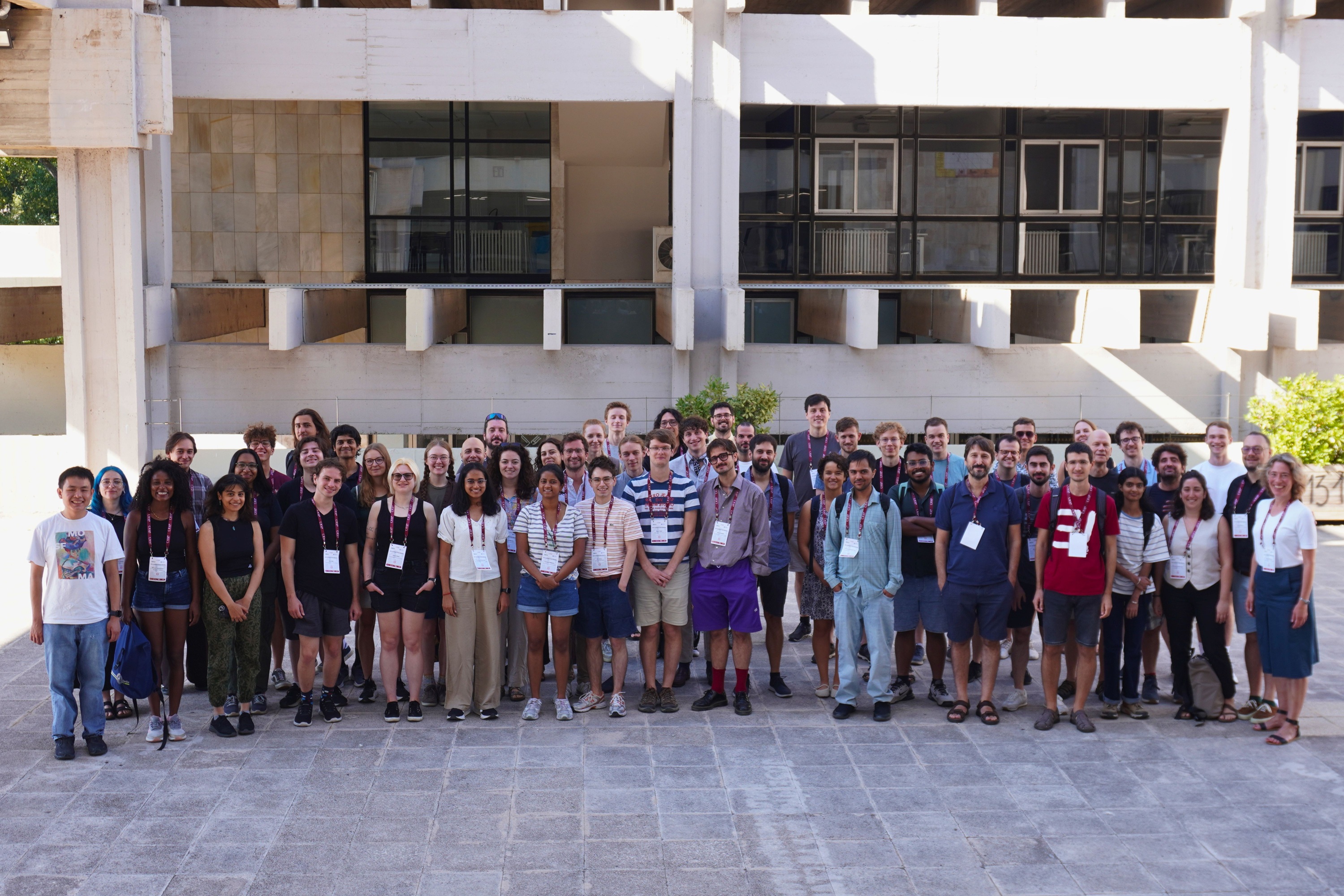
BMS-BGSMath Junior Meeting 2026: Barcelona and Berlin Strengthen Scientific Ties
From 2 to 4 September 2026, the Centre de Recerca Matemàtica (CRM) hosted the BMS-BGSMath Junior Meeting 2026, a three-day event jointly organised by the Berlin Mathematical School (BMS) and the Barcelona Graduate School of Mathematics (BGSMath), with the Centre de...
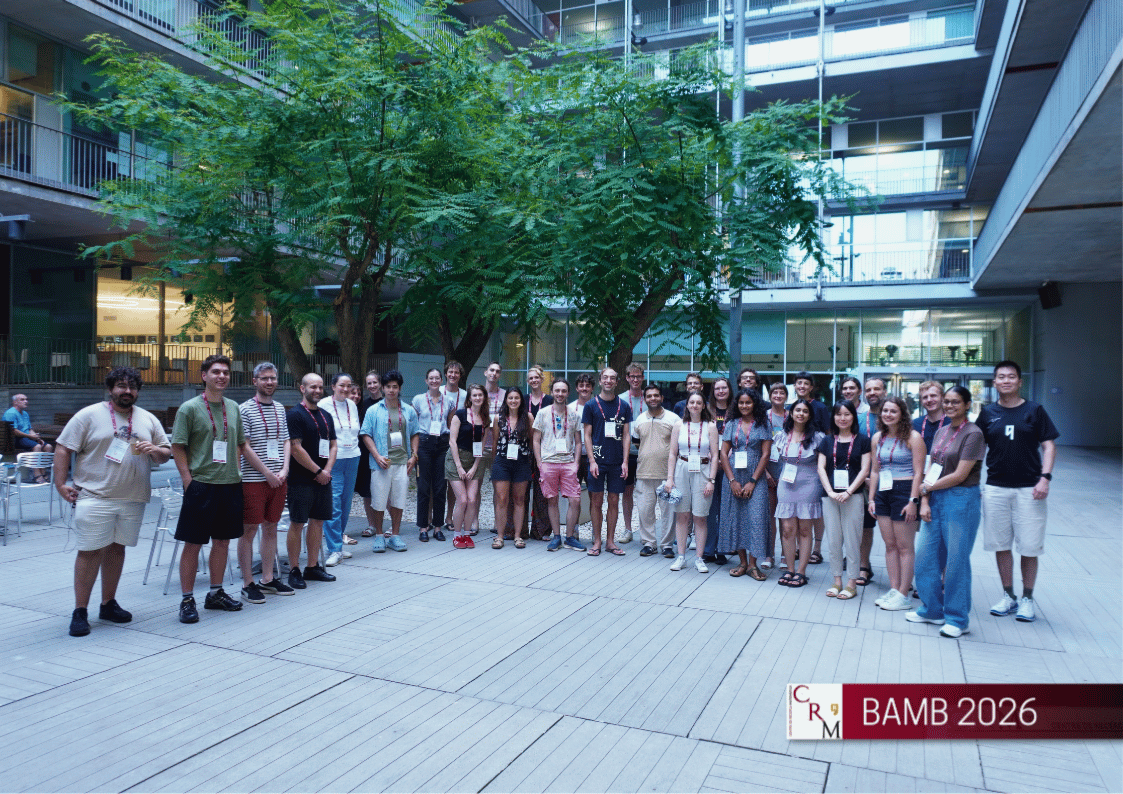
The CRM organises the 2026 Barcelona Summer School for Advanced Modeling of Behavior
The Centre de Recerca Matemàtica held the sixth edition of BAMB!, the Barcelona Summer School for Advanced Modeling of Behavior, from 12 to 23 July 2026 at the Parc de Recerca Biomèdica de Barcelona. Thirty early-career researchers from fourteen countries followed...
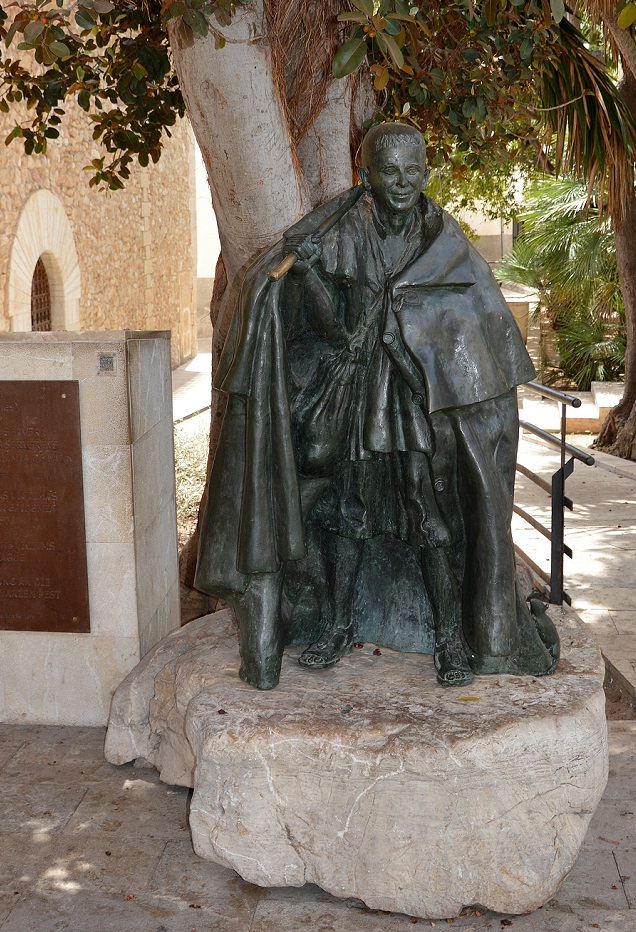
Mallorca’s 1820 plague did not behave like a classic bubonic outbreak, study finds
A study in PNAS by Pere Puig (UAB, CRM) and Joana Maria Pujadas-Mora (UOC, ICREA) reports what happens when the daily health records kept in Son Servera and Capdepera during the 1820 outbreak are analysed with a Bayesian epidemiological model: an unusually short...
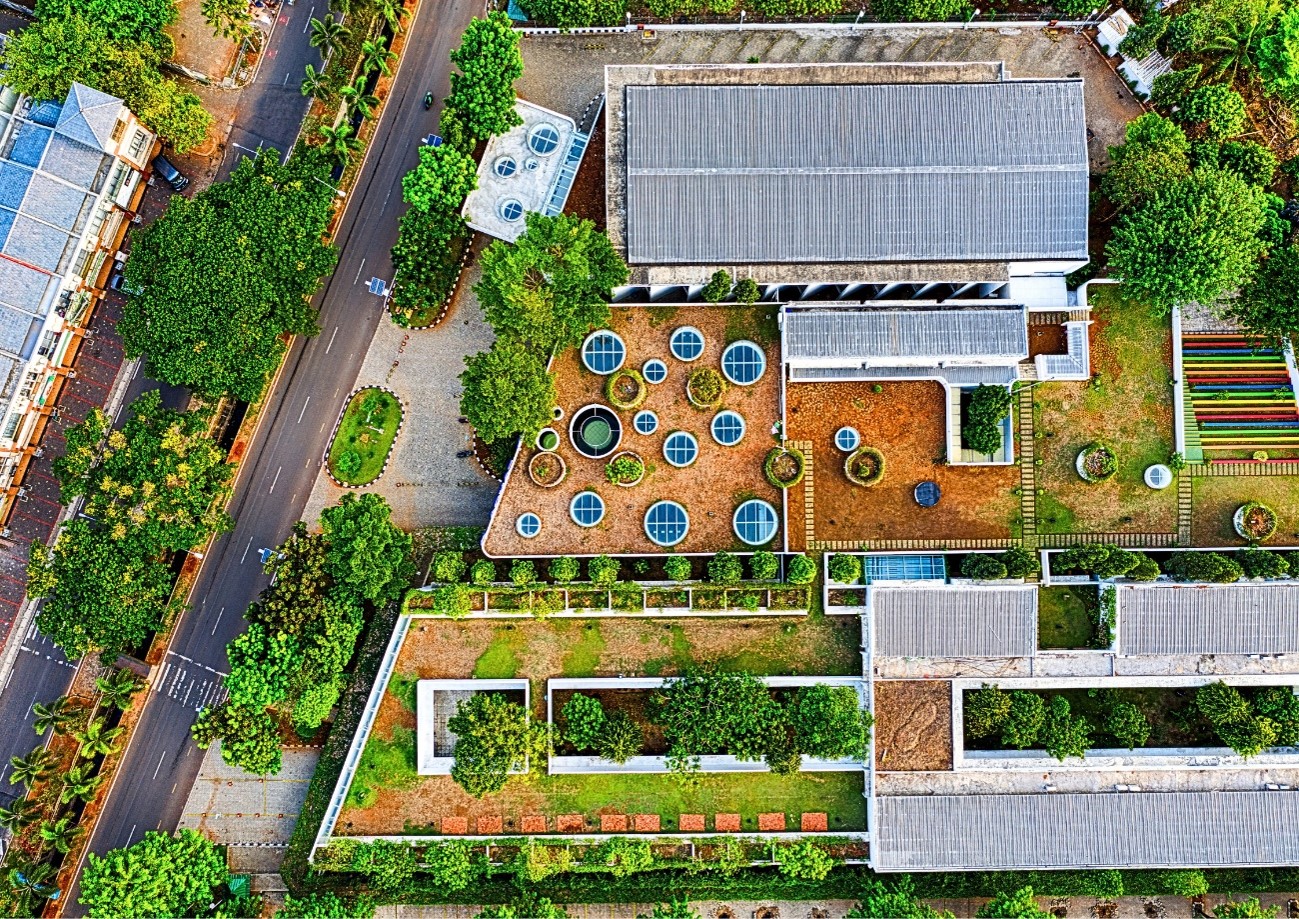
A recent study quantifies the vegetable production potential of Barcelona’s rooftops
A study published in Cities by researchers at ICTA-UAB, with collaboration from the CRM's Knowledge Transfer Unit, estimates that 65 hectares of municipal rooftop could supply 31% of the tomatoes consumed in Barcelona each year.Barcelona has 65 hectares of rooftop...
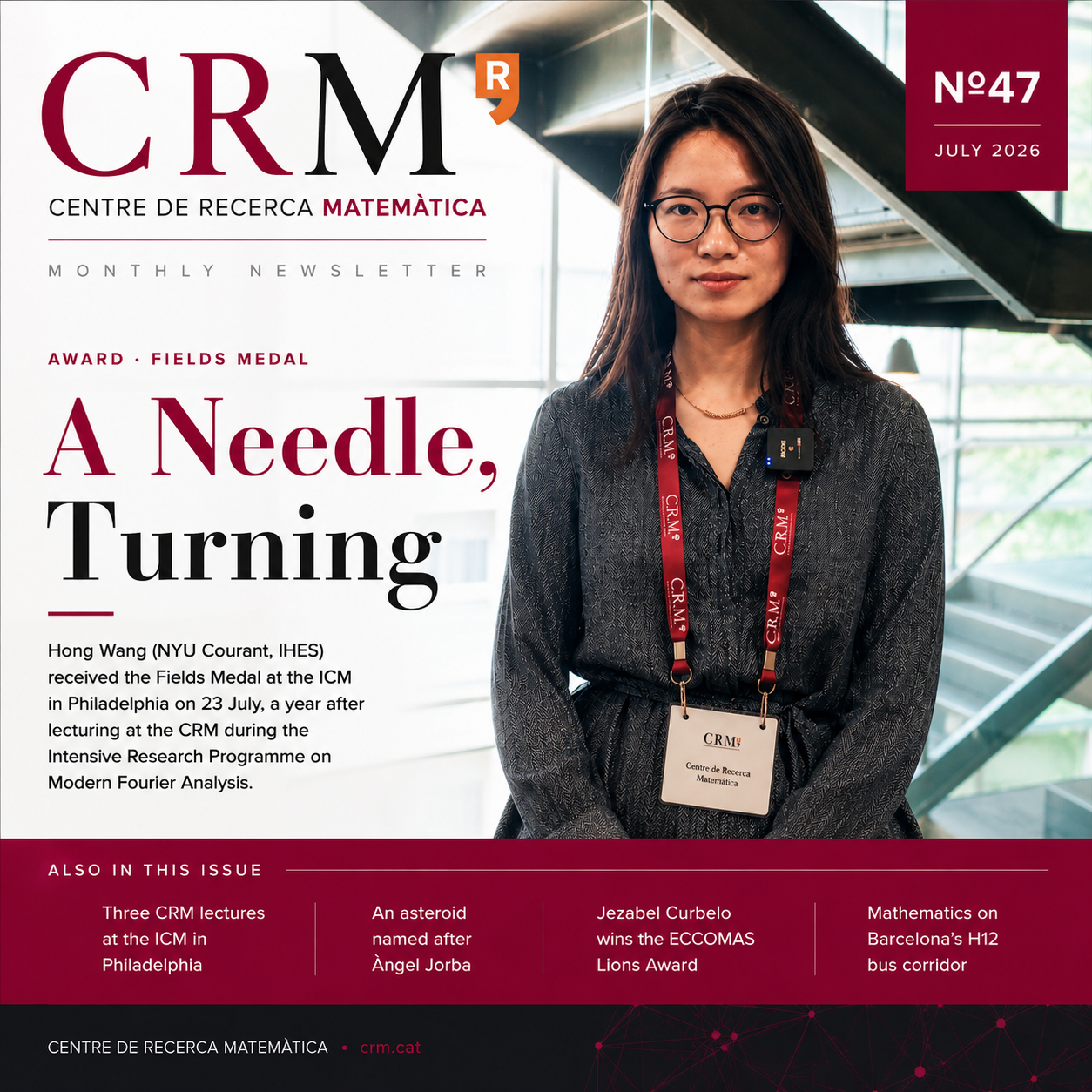
CRM July Newsletter
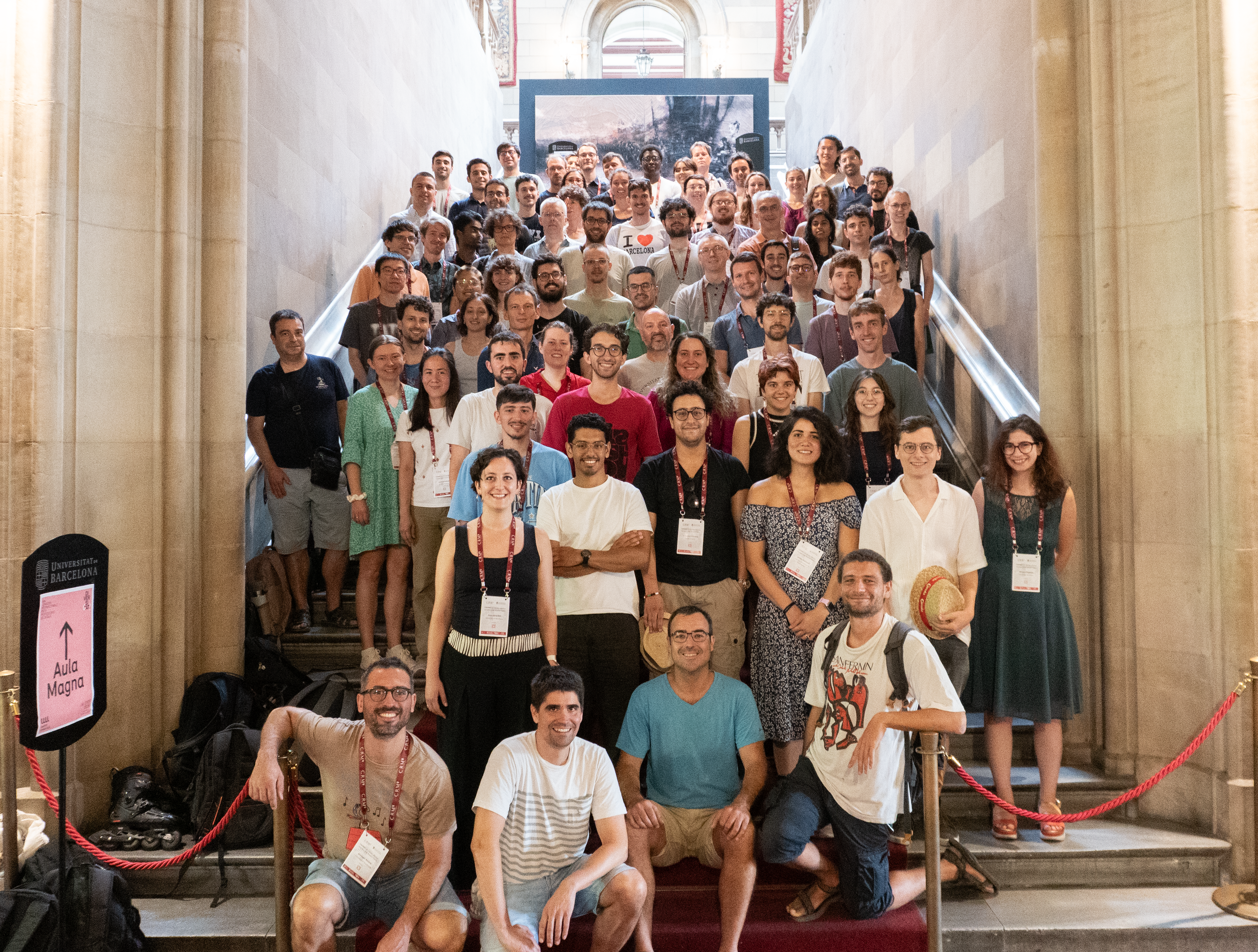
CAVARET 2 brings together 83 researchers on curves and abelian varieties at the Universitat de Barcelona
The second edition of CAVARET, "Curves, Abelian VArieties and RElated Topics", took place at the Faculty of Mathematics and Computer Science of the Universitat de Barcelona from 13 to 17 July 2026. Sixteen invited lectures and ten posters brought together 83...
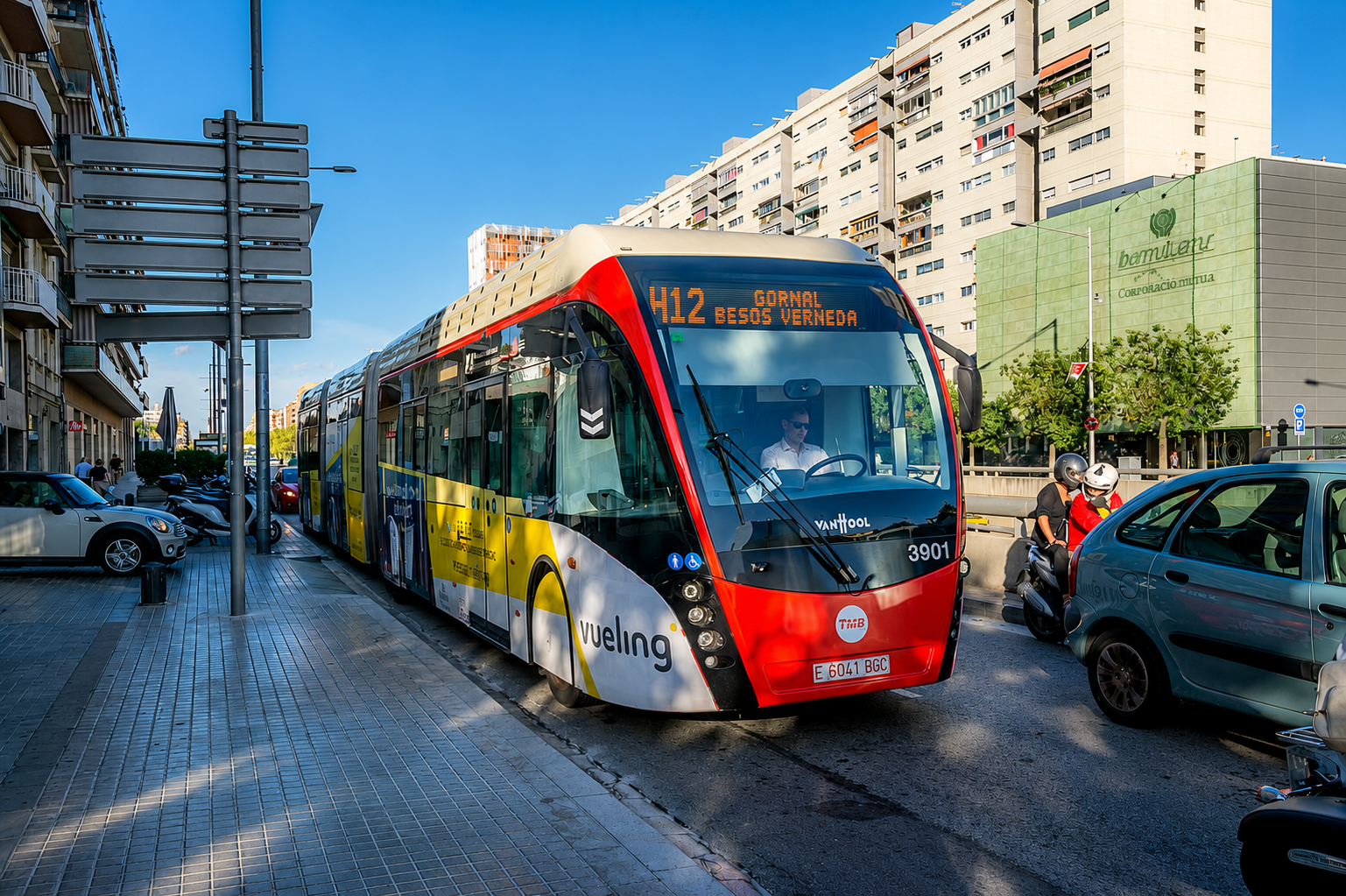
Mathematics on board: CRM’s demand forecasting model enters service on Barcelona’s H12 corridor
The H12 has run along Gran Via for years. What TMB switched on in July is the set of upgrades designed for it inside eBRT2030, a Horizon Europe project testing electric Bus Rapid Transit in six European cities. Behind it, forecasting passenger demand at every stop...
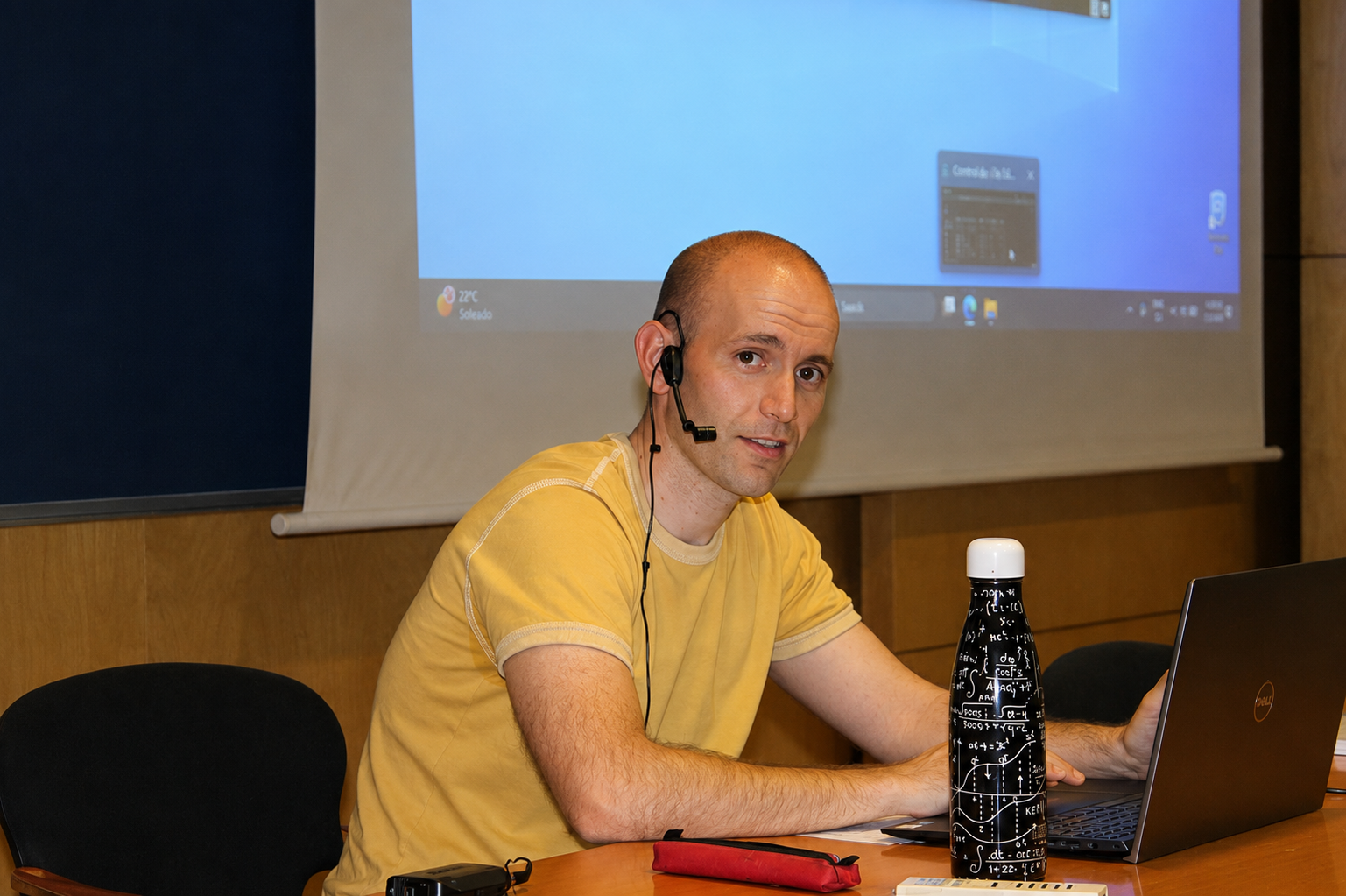
Dídac Gil Rams defends his doctoral thesis on the splitting of separatrices in generalized standard maps
Supervised by Inmaculada Baldomá and Pau Martín, the thesis proves the existence of chaotic dynamics in a broad family of area-preserving maps and combines classical analysis with computer-assisted proof. The defence took place on 3 July 2026 at the FME (UPC).Dídac...
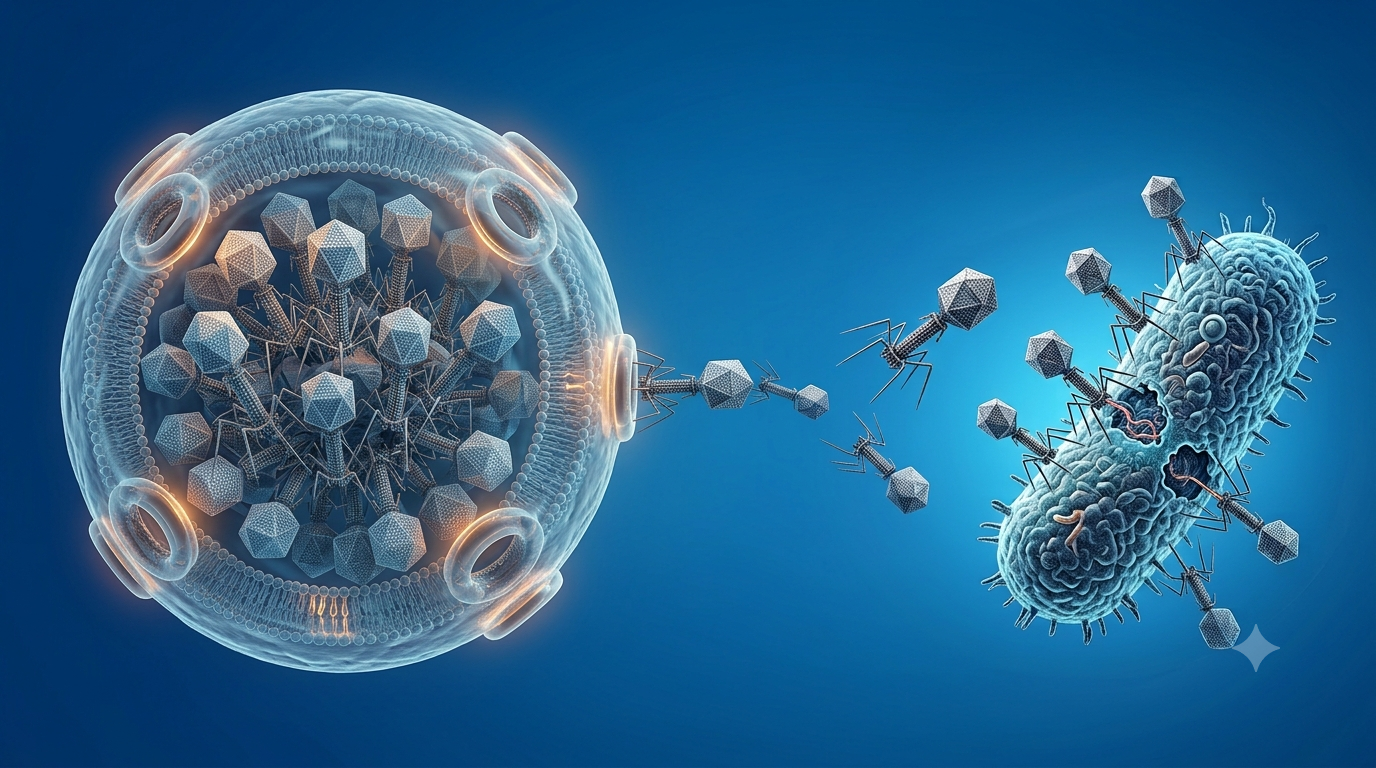
How to Protect Bacteriophages Without Trapping Them? Mathematics to Improve an Alternative to Antibiotics
Bacteriophages — viruses capable of infecting and destroying bacteria — are considered one of the most promising alternatives to tackle the growing problem of antibiotic resistance. However, for these treatments to work, phages must overcome several obstacles before...