The 22nd School on Interactions between Dynamical Systems and Partial Differential Equations (JISD) is taking place at the Centre de Recerca Matemàtica from 29 June to 3 July 2026. Four advanced courses and a poster session gather researchers in dynamical systems and partial differential equations, most of them from outside Spain. The school has been held in Barcelona every summer since 2002.
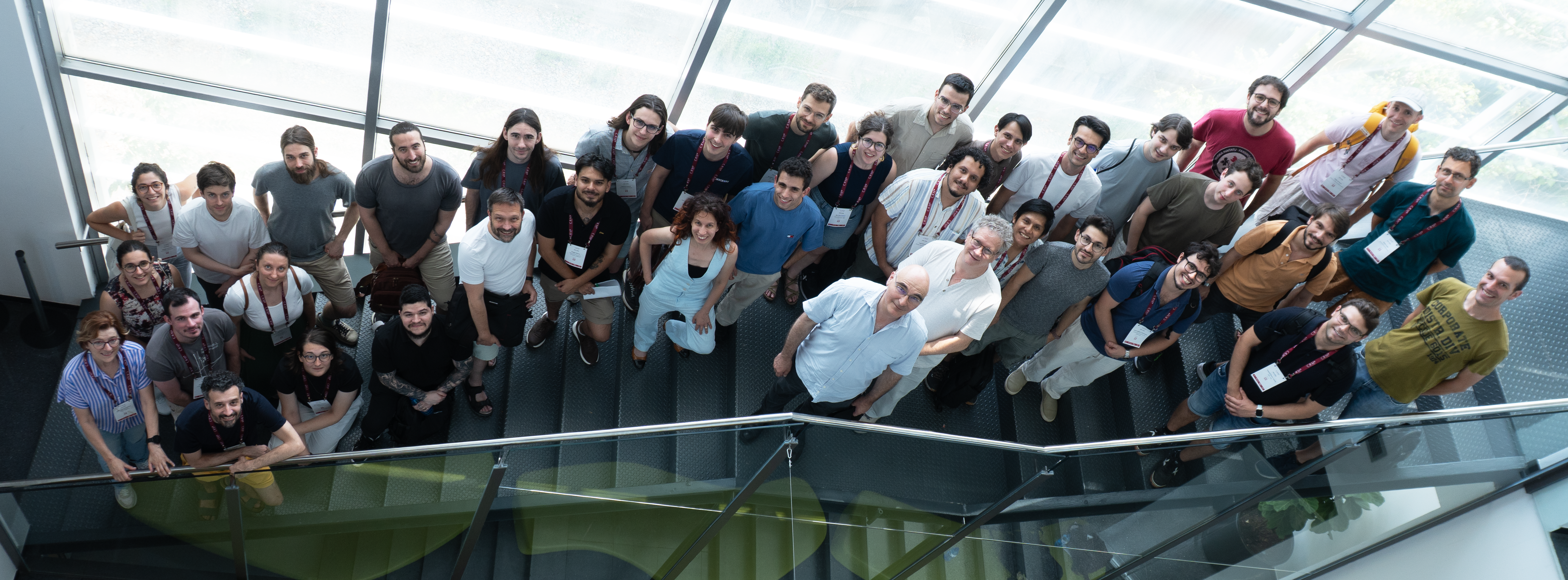
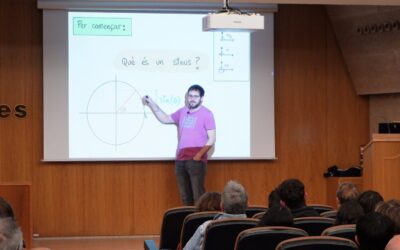
The 22nd edition of the JISD ran at the CRM Auditorium from 29 June to 3 July. The school has been running since 2002, first at the School of Mathematics and Statistics of the Universitat Politècnica de Catalunya (UPC) and, since 2017, at the CRM. It works as an annual meeting point between established experts and young researchers in two closely related fields, dynamical systems and partial differential equations (PDEs), built around four advanced courses of about six hours each and complemented by a poster session.
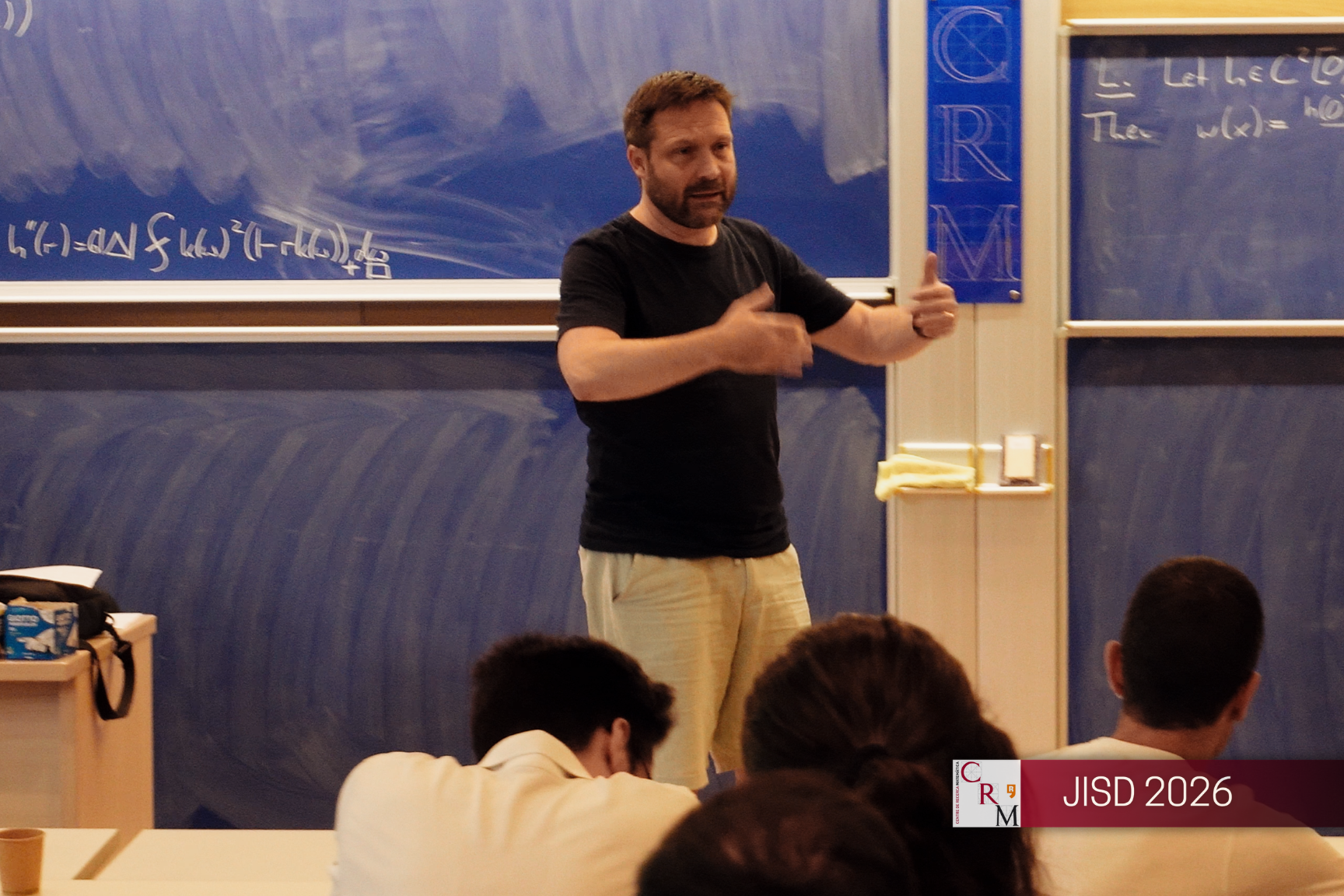
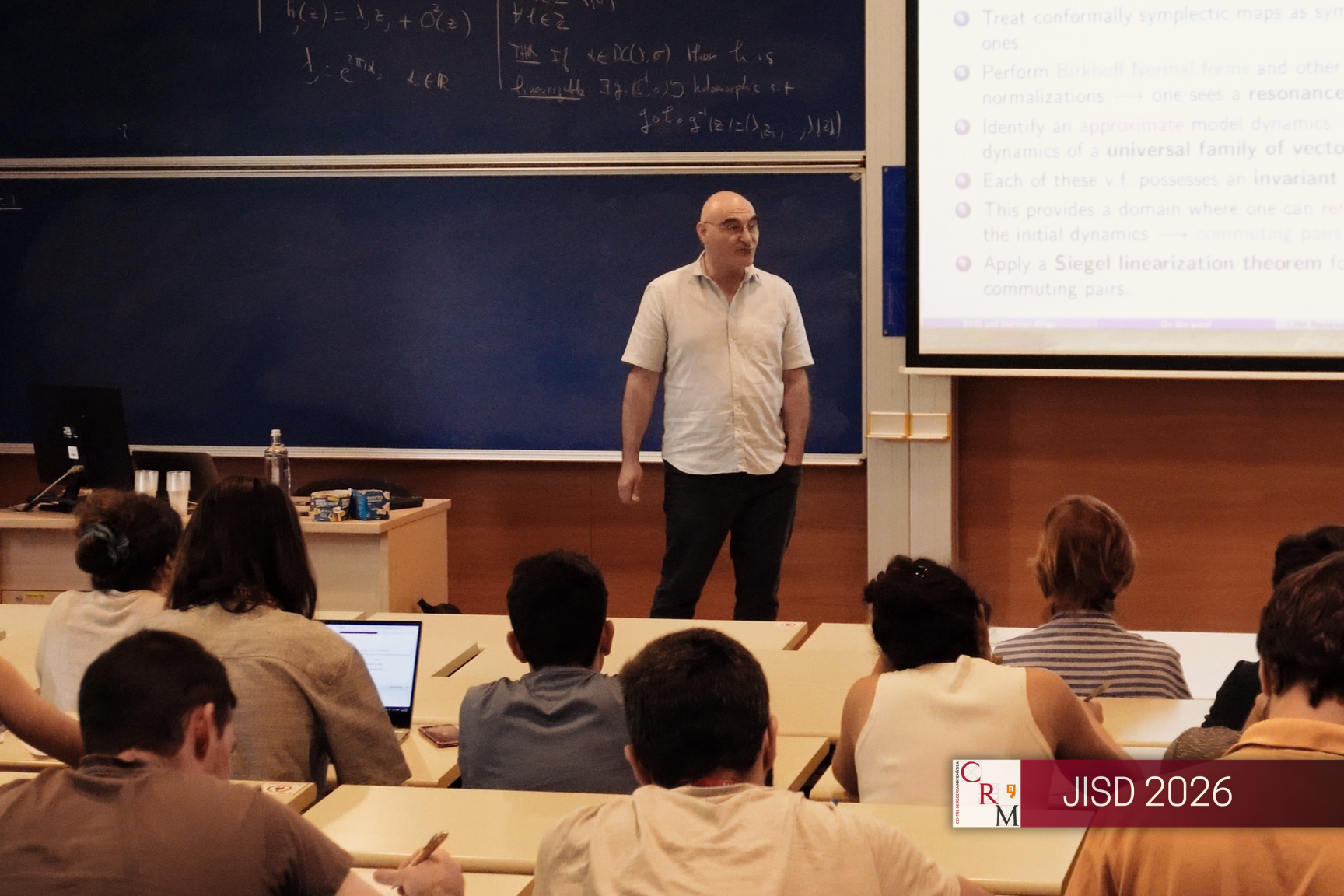
The courses covered a wide span of the two areas. Rupert Frank (Ludwig Maximilian University of Munich) gave an introduction to the liquid drop model, a construction first proposed in nuclear physics in 1930 and now studied with tools from the calculus of variations, geometric analysis and PDE. His lectures included an isoperimetric-type question that remains open in general, together with an application to the nuclear pasta phases that arise in astrophysics. Raphaël Krikorian (École Polytechnique and CY Cergy Paris Université) presented Birkhoff normal forms, KAM theory and renormalisation, applied to quadratic complex Hénon maps and to the existence of so-called exotic rotation domains and attracting Herman rings, phenomena observed numerically before they could be explained.
Alessandra Pluda (Università di Pisa) worked through several geometric flows, from mean curvature flow and curve-shortening flow to network flow and the inverse mean curvature flow, the last of these connected to a proof of the Riemannian Penrose inequality. Laurent Stolovitch (CNRS & Université Côte d’Azur) closed the programme with CR singularities, points where the Cauchy-Riemann structure of a real surface in C² degenerates, and their link to the dynamics of holomorphic maps near a fixed point.
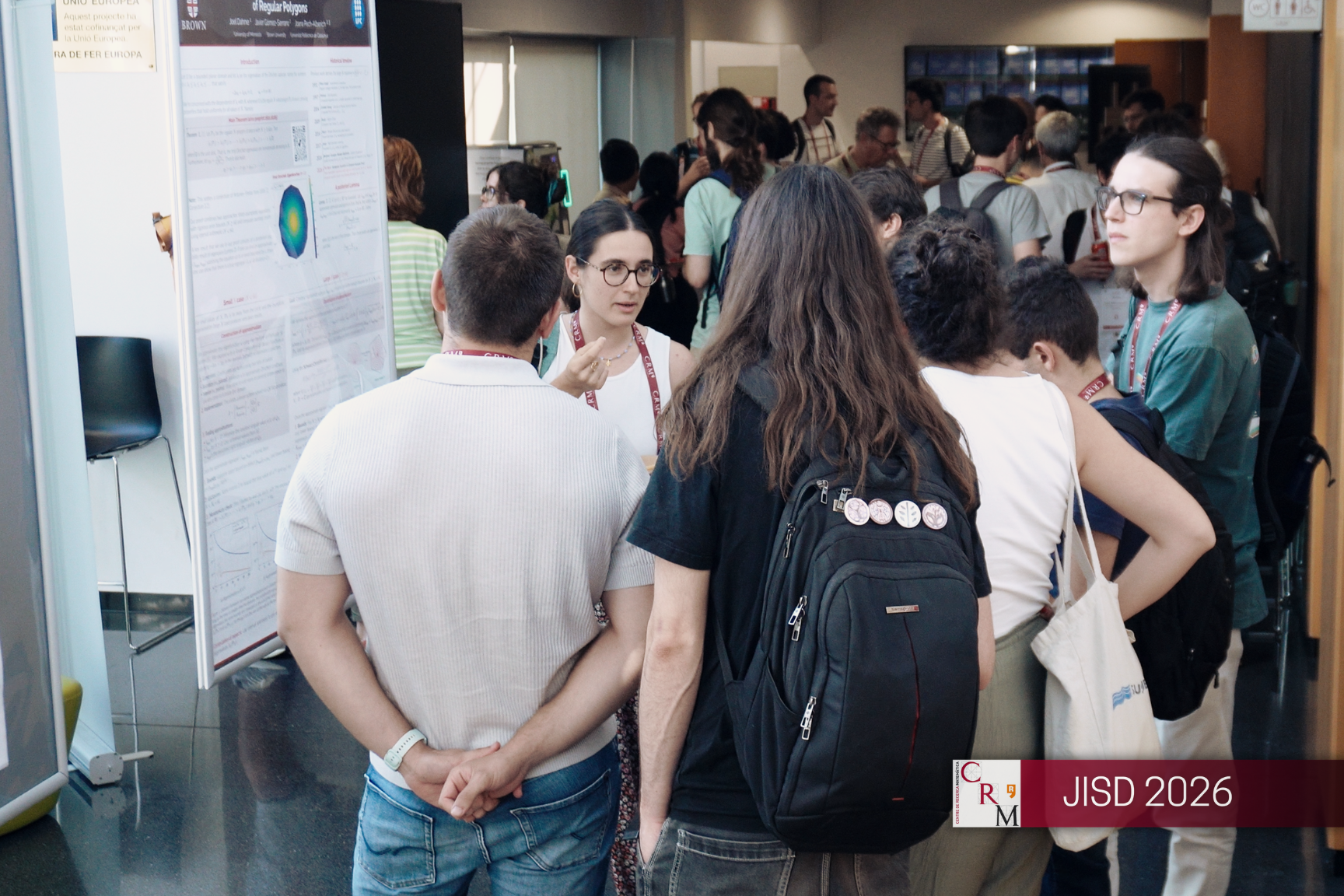
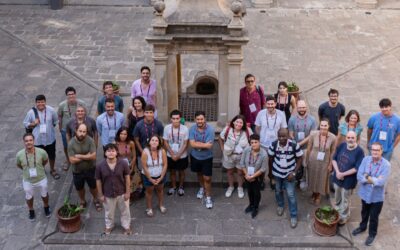
The list of registered participants counted forty-seven names. Beyond the local community at the UPC, the Universitat de Barcelona, the Universitat Autònoma de Barcelona and the CRM, researchers travelled from across Europe, the Americas, Asia and North Africa, with institutions including UNAM (Mexico), IMPA and the Federal University of Minas Gerais (Brazil), the Universidad del Bío-Bío (Chile), Kyushu University (Japan), Dalian University of Technology (China), the École Supérieure en Sciences Appliquées de Tlemcen (Algeria), Imperial College London, the University of Vienna, and several universities in the United States. The strong international presence and a sustained effort to support PhD students and postdocs who might otherwise struggle to attend have been part of the school’s purpose since its early editions.
The poster session, held on Monday alongside a reception, gathered eight contributions by young researchers. They ranged from heteroclinic connections in a solar-sail version of the three-body problem (Adrian Arriaga, UNAM) to slow dynamics in coupled neural oscillators (Brayan Guerra, UNAM) and the fractal dimension of Lagrange and Markov spectra for holomorphic horseshoes (Victor Medeiros, IMPA). Among them, Joana Pech Alberich (UPC) presented a proof that settles a 2006 conjecture of Antunes and Freitas on the first Dirichlet eigenvalue of regular polygons, joint work with Joel Dahne and Javier Gómez-Serrano.
The 22nd JISD was organised by Xavier Cabré (ICREA – UPC – CRM), Mar Giralt (LTE, Observatoire de Paris), Marcel Guàrdia (Universitat de Barcelona – CRM), Pau Martín (UPC – CRM), Tomás Sanz (Universitat de Barcelona – CRM), Tere M. Seara (UPC – CRM) and Frank Trujillo (CRM). The scientific committee was formed by Scott Armstrong (Courant Institute, New York University), Jean-Pierre Eckmann (Université de Genève), Jean-Michel Roquejoffre (Université Paul Sabatier) and Susanna Terracini (Università di Torino).
Newsletter
Get the latest CRM news and activities delivered to your inbox
Subscribe now
Recent newsletters →
The CRM exhibition ‘Les matemàtiques de Gaudí’ moves to the University of Barcelona
L'exposició del CRM «Les matemàtiques de Gaudí» es trasllada a la Universitat de BarcelonaEight posters on the mathematics behind Gaudí's architecture, on display at the UB until 30 NovemberVuit pòsters sobre les matemàtiques que hi ha darrere l'arquitectura de Gaudí,...
Advanced Course on Free Boundary Problems Opens the Intensive Weeks of the IRP
Three mini-courses by Bozhidar Velichkov, Max Engelstein and Zihui Zhao, from 26 to 30 October at the CRMParticipants in the Advanced Course on Free Boundary Problems.CRM CommPau VarelaCRMComm@crm.catGet the latest CRM news and activities in your...
El CRM rep els estudiants de la prova de nivell de Bojos per les Matemàtiques 2027
The CRM welcomes students from the Bojos per les Matemàtiques 2027 entrance testVisita guiada al centre i xerrada de Tomás Sanz (UB-CRM) sobre les matemàtiques del soA guided tour of the centre and a talk by Tomás Sanz (UB-CRM) on the mathematics of soundTomás Sanz...

Eight CRM Researchers in the 2026 Stanford-Elsevier List of Highly Cited Scientists
The database ranks scientists by citation impact, over their whole careers and in 2025 aloneCRM CommPau VarelaCRMComm@crm.catGet the latest CRM news and activities in your inbox.Recent newsletters →The 2026 edition of the Stanford-Elsevier database...
Fish schools and growing tissues: a workshop on how collective behaviour emerges
Mathematicians and biologists met at the Institut d’Estudis Catalans to discuss how local interactions shape tissues and animal groups.A talk in the Pere i Joan Coromines room of the Institut d’Estudis Catalans. Image: CRMCRM CommPau...
|
|
CRM CommPau Varela
|