
Systems and Partial Differential Equations
REGISTRATION FEE
€275 General Registration
€75 for participants receiving a lodging grant
€0 for participants receiving a registration grant
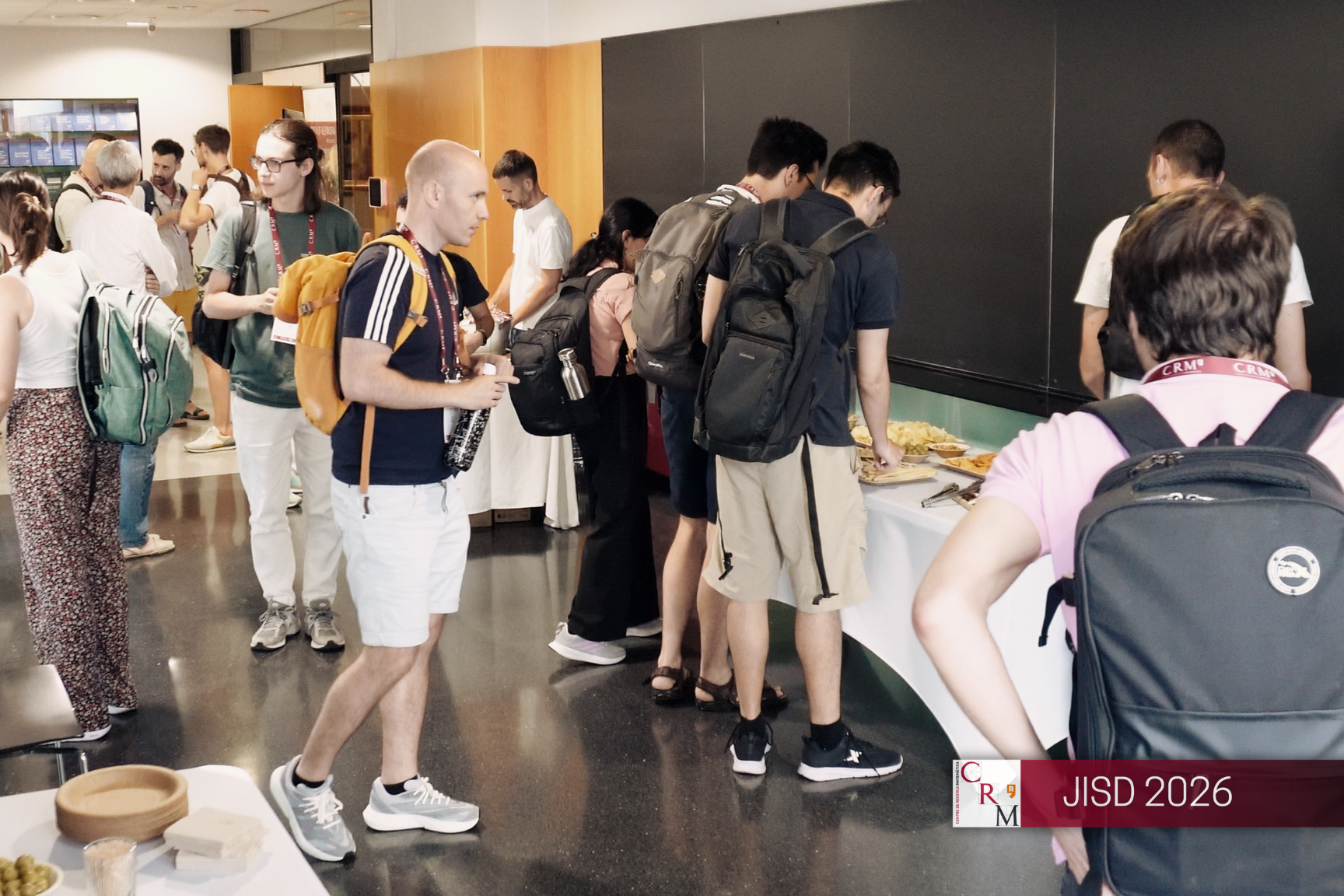
(Coffee breaks and lunch included)
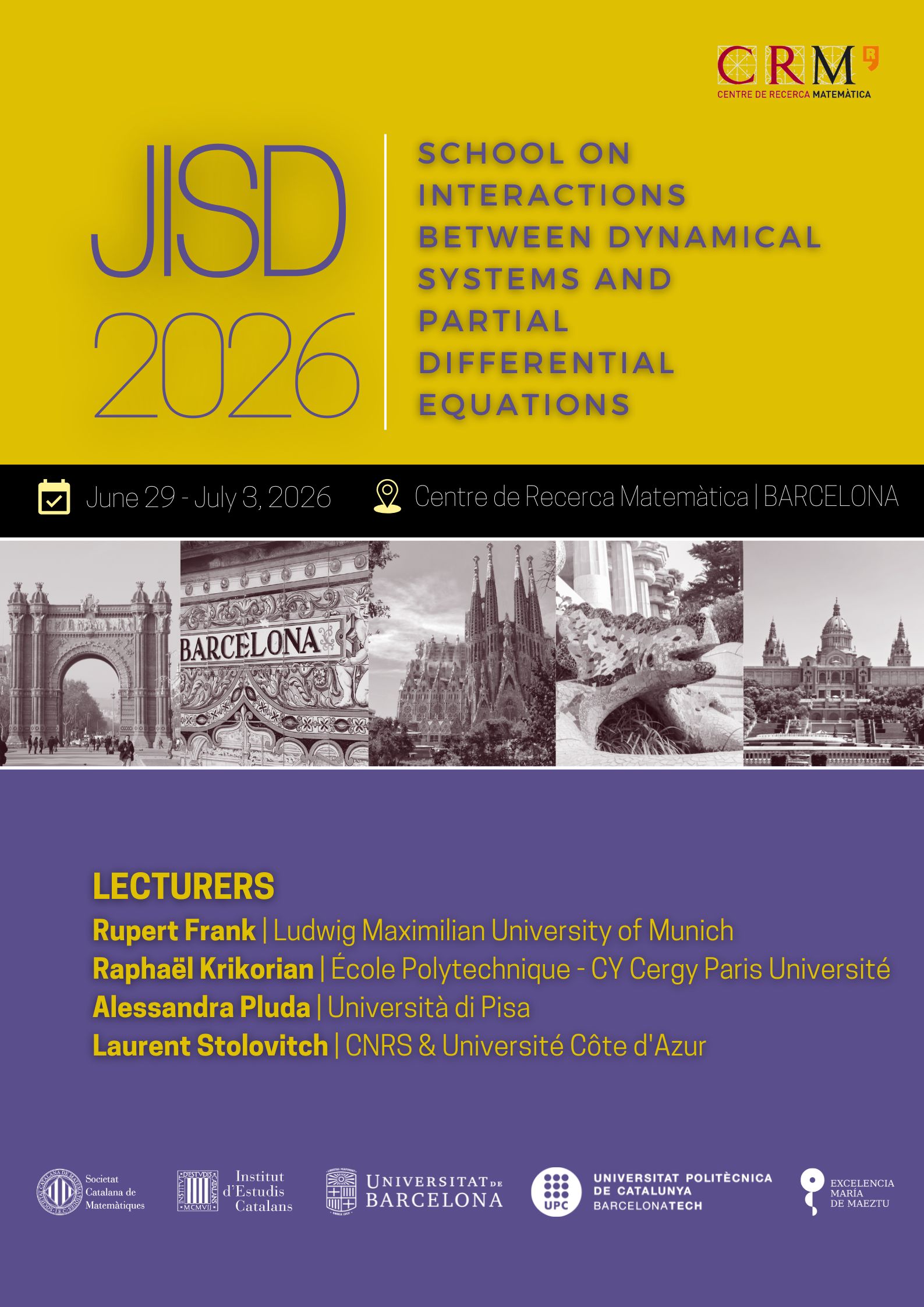
22nd School on Interactions between Dynamical Systems and Partial Differential Equations (JISD 2026)
Sign into July 03, 2026
Venue: Centre de Recerca Matemàtica (CRM)
Room: Auditorium
Effective June 15th, 2026, bank transfer payments will no longer be accepted for any CRM activity. All registration fees must be paid by card to complete the registration process.
If your institution requires an invoice for reimbursement or administrative purposes, you can request it during the registration process. Once your registration fee has been paid, please send the proof of payment to comptabilitat@crm.cat. The invoice will be issued after the payment has been received and verified.
LECTURERS
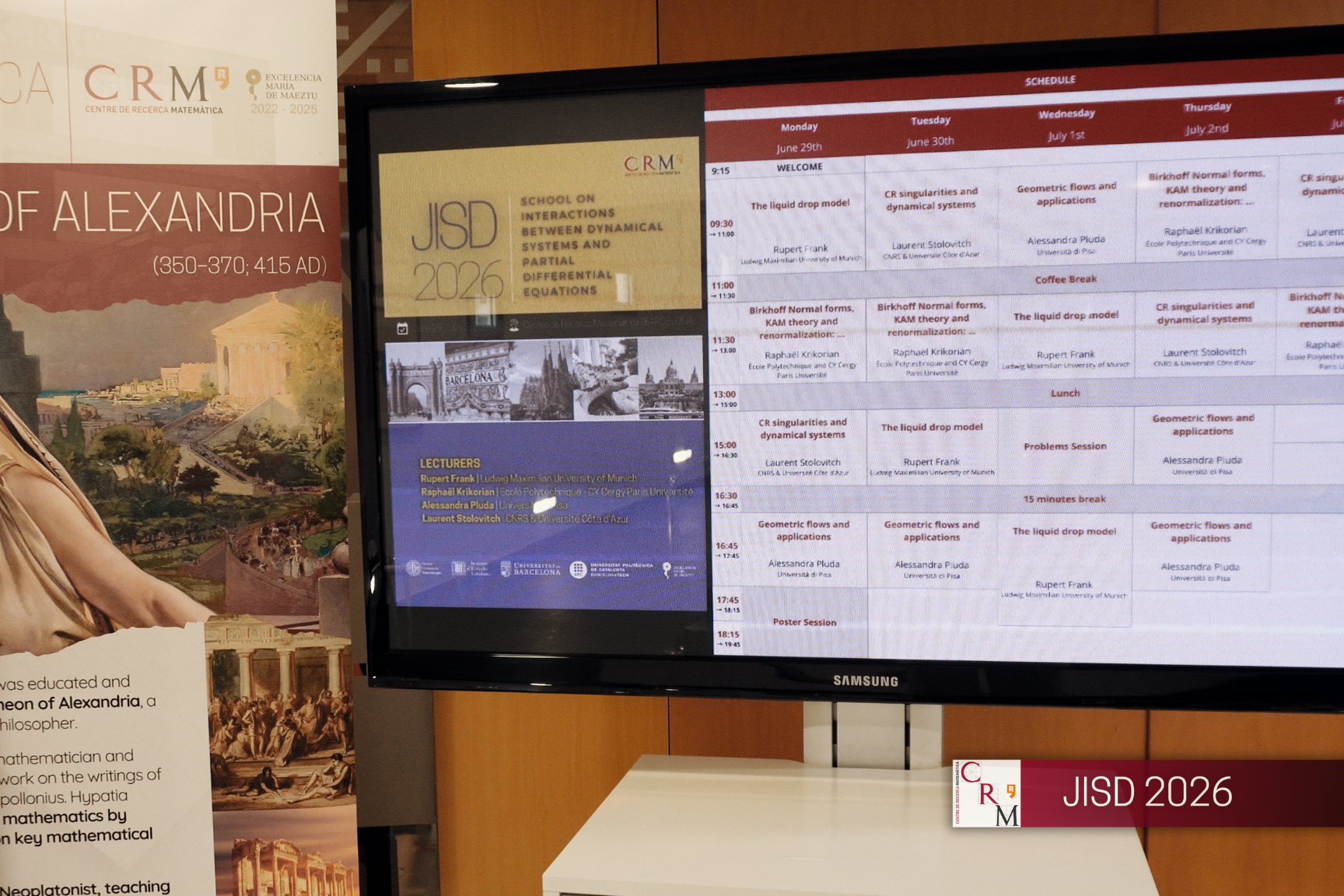
SCHEDULE
POSTER SESSION
Introduction
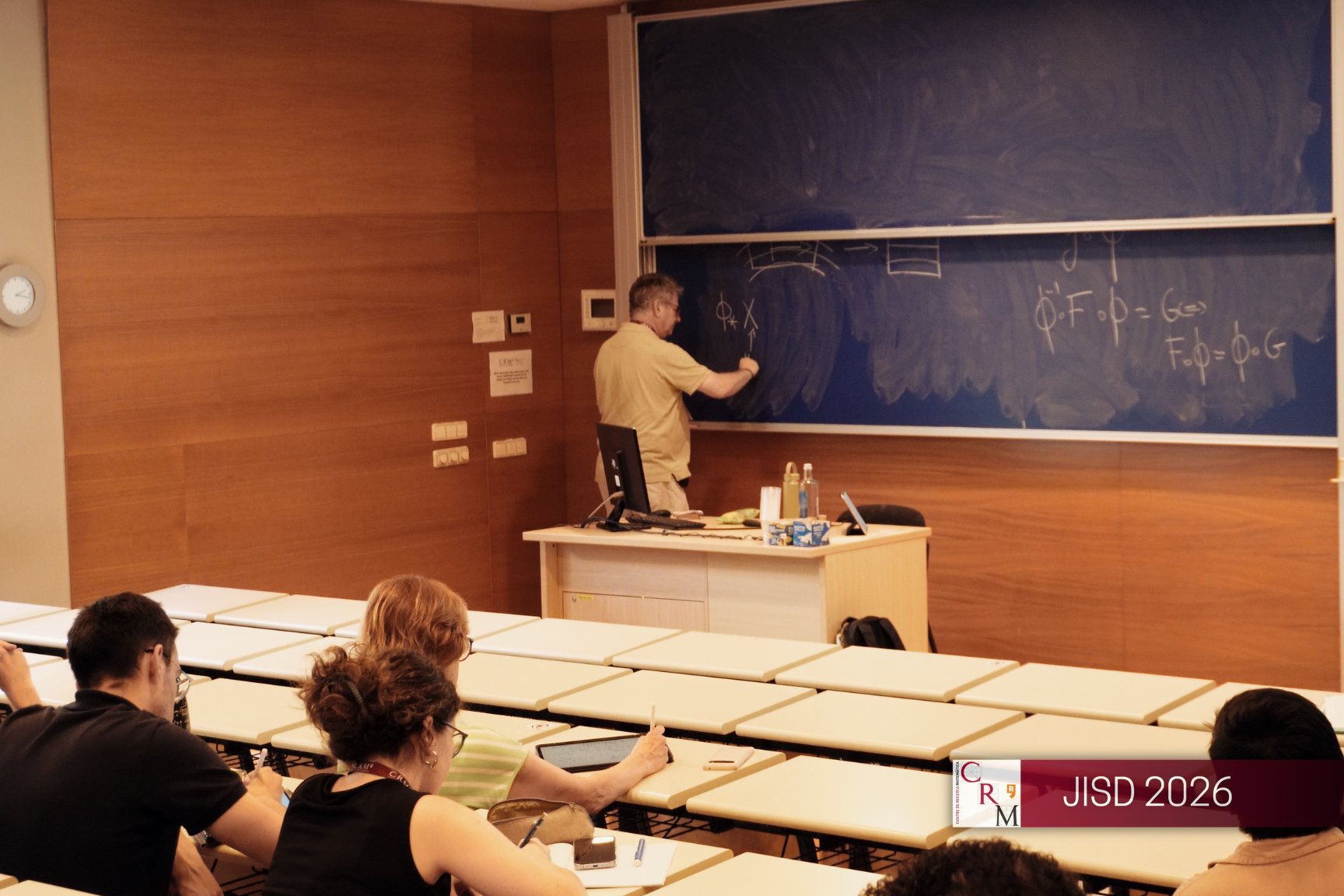
The School on Interactions between Dynamical Systems and Partial Differential Equations (JISD) is an international summer school that takes place in Barcelona since 2002. It was held at the School of Mathematics and Statistics of the Universitat Politècnica de Catalunya (UPC) until 2016 and at the Centre de Recerca Matemàtica (CRM) since 2017.
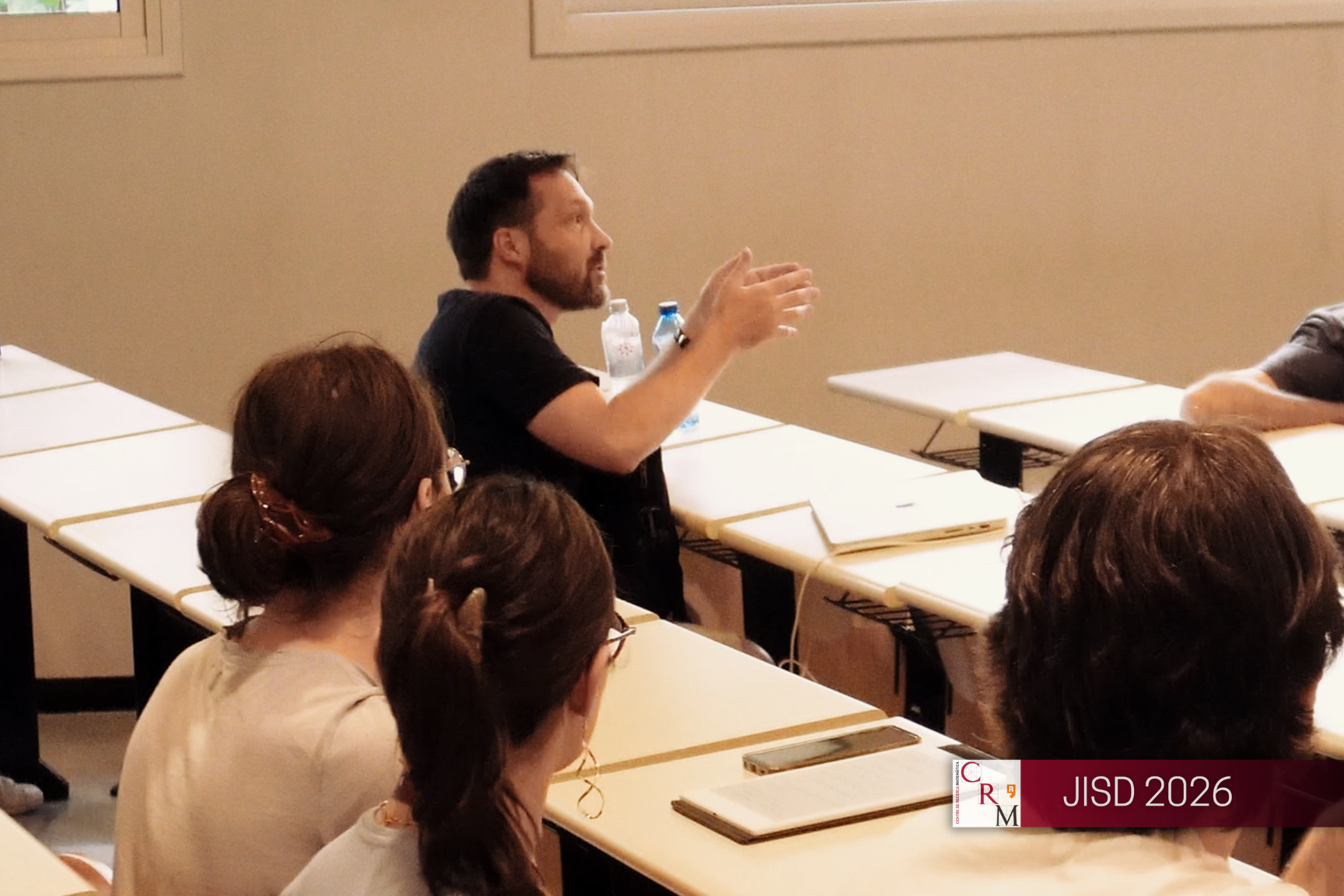
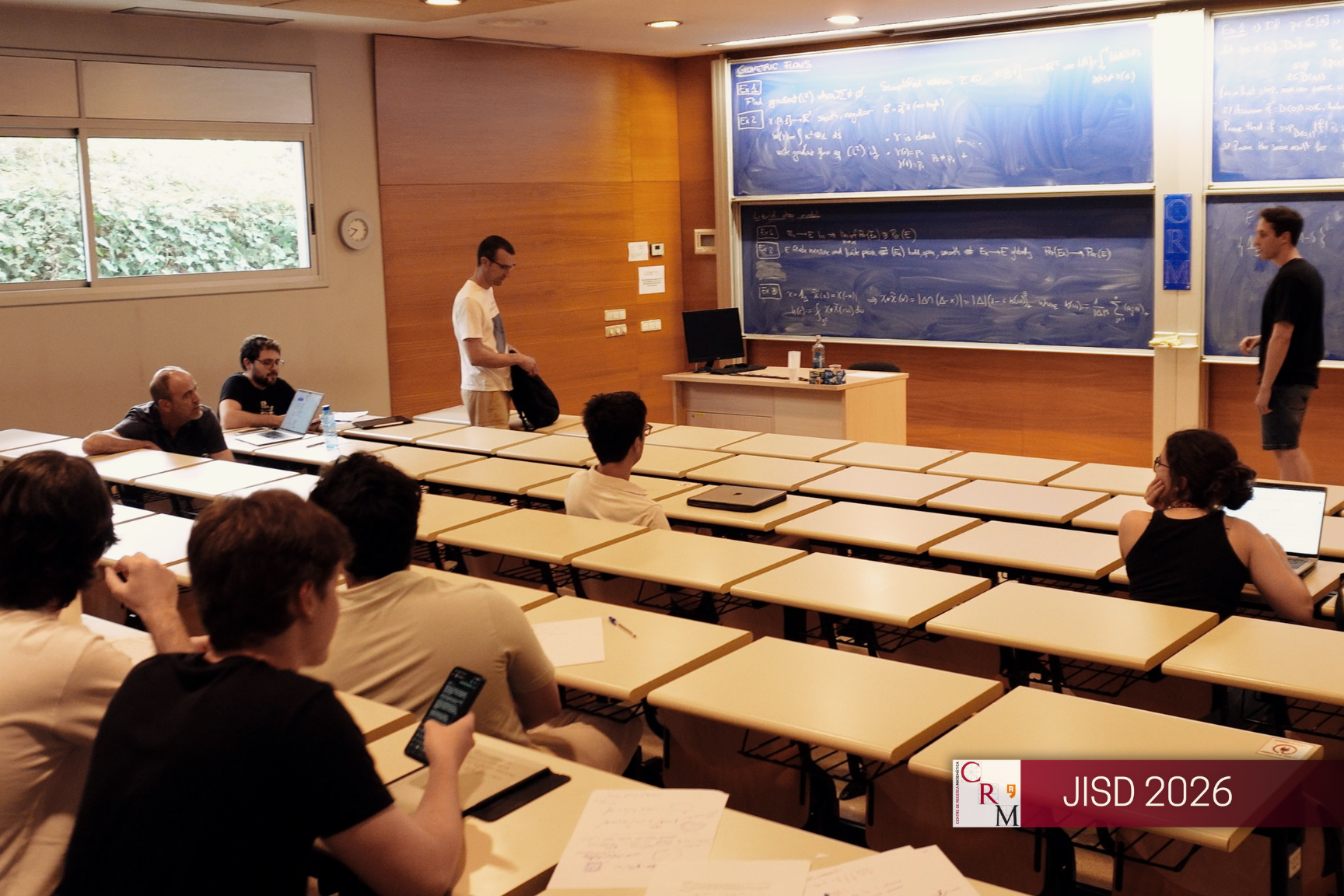
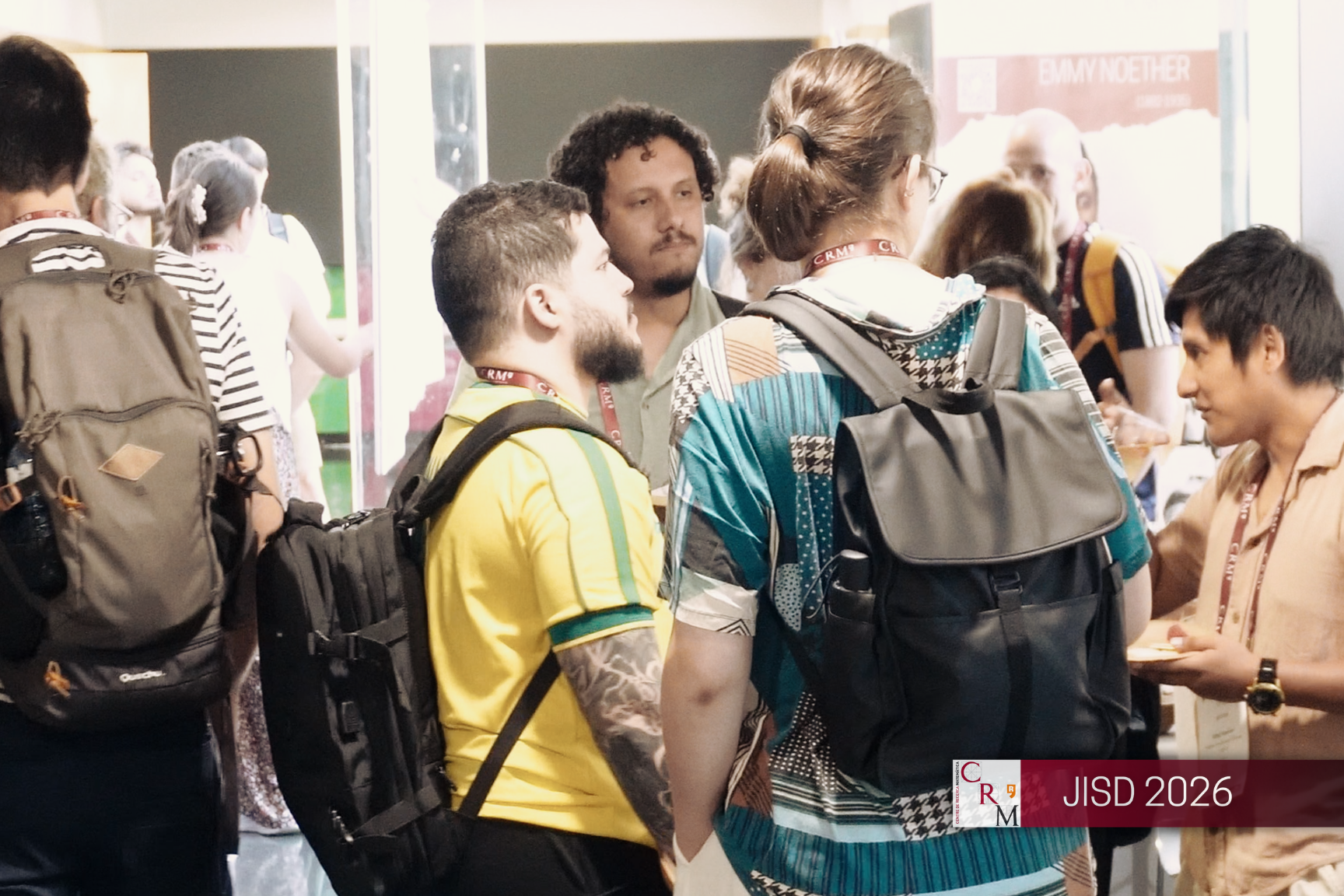
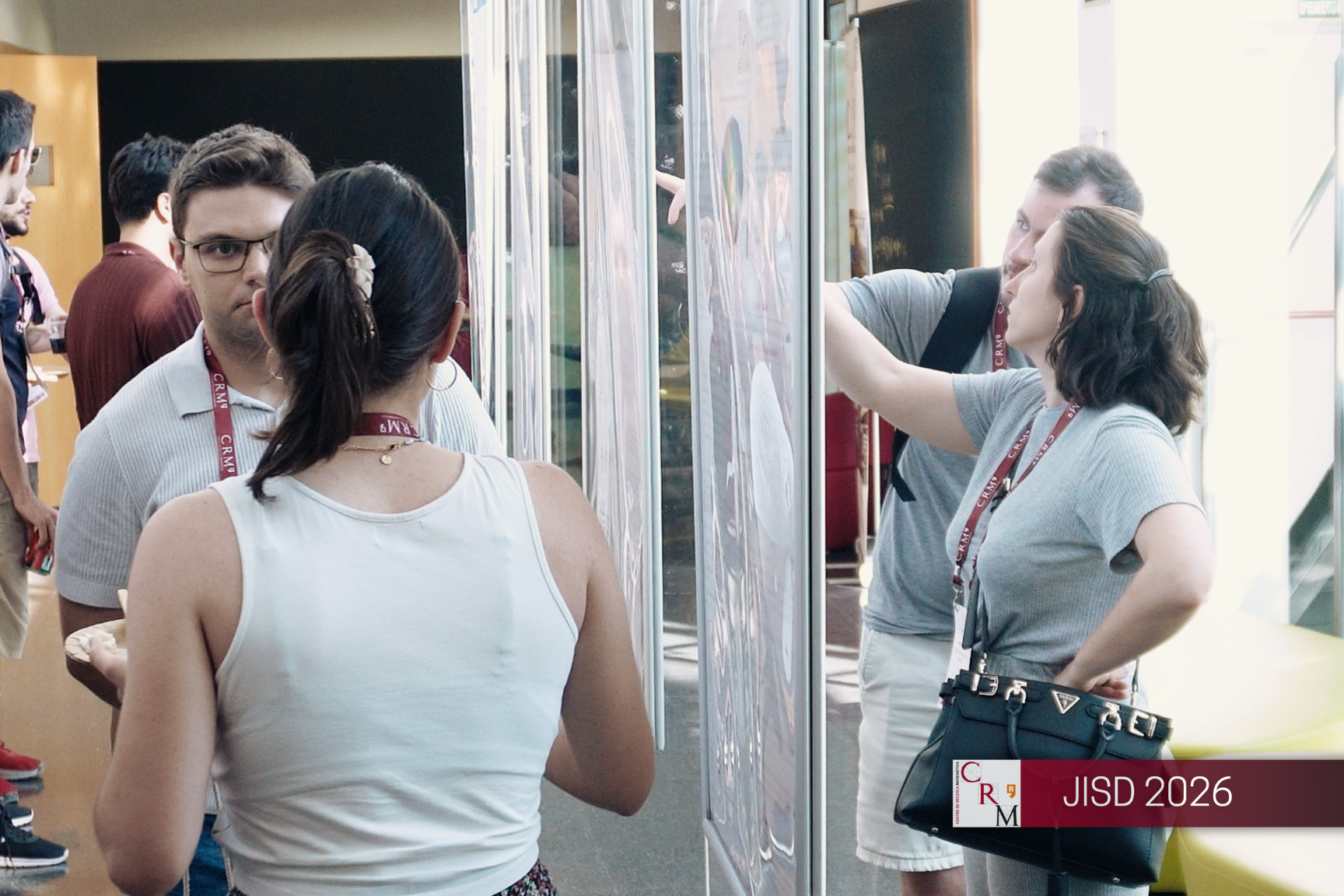
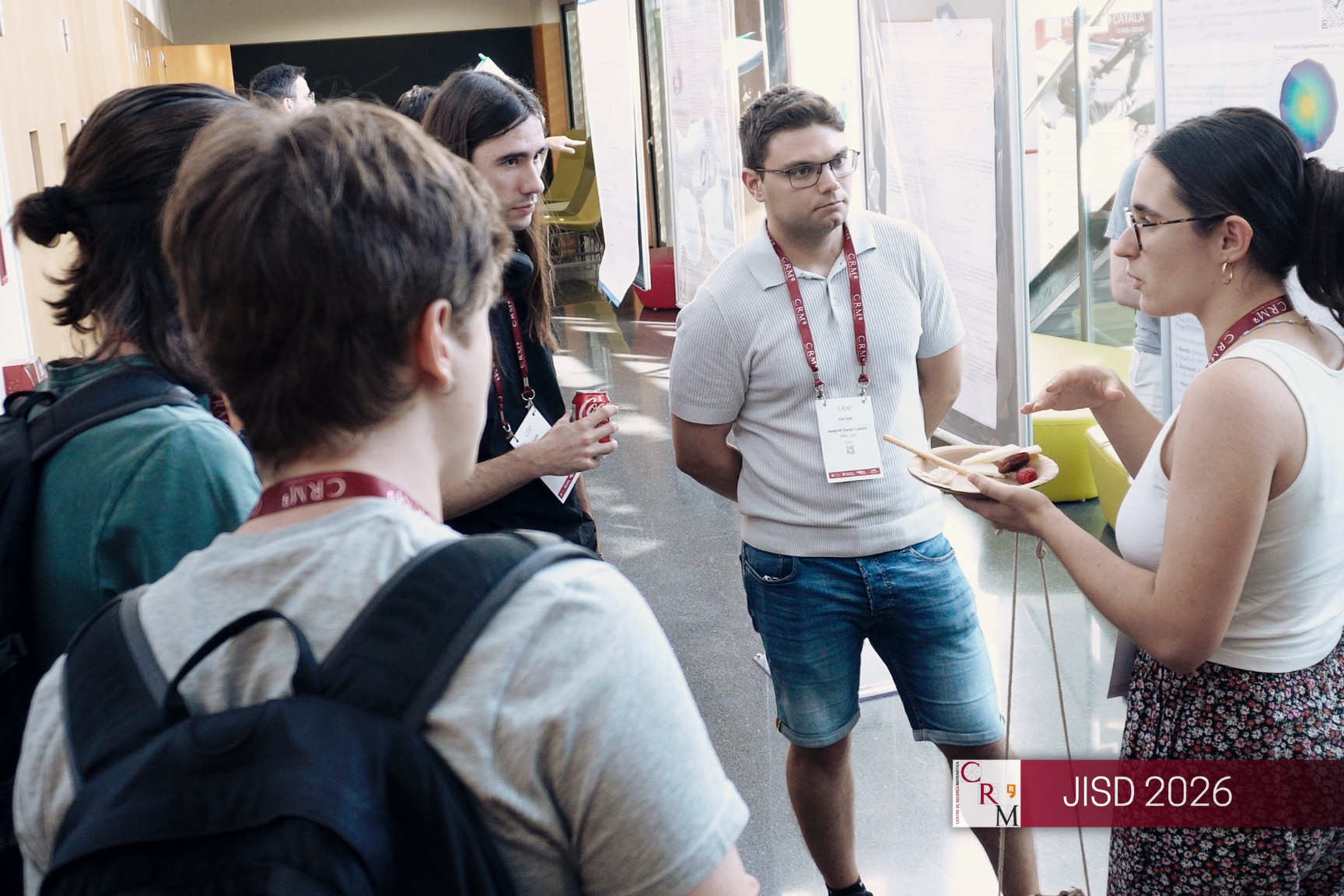
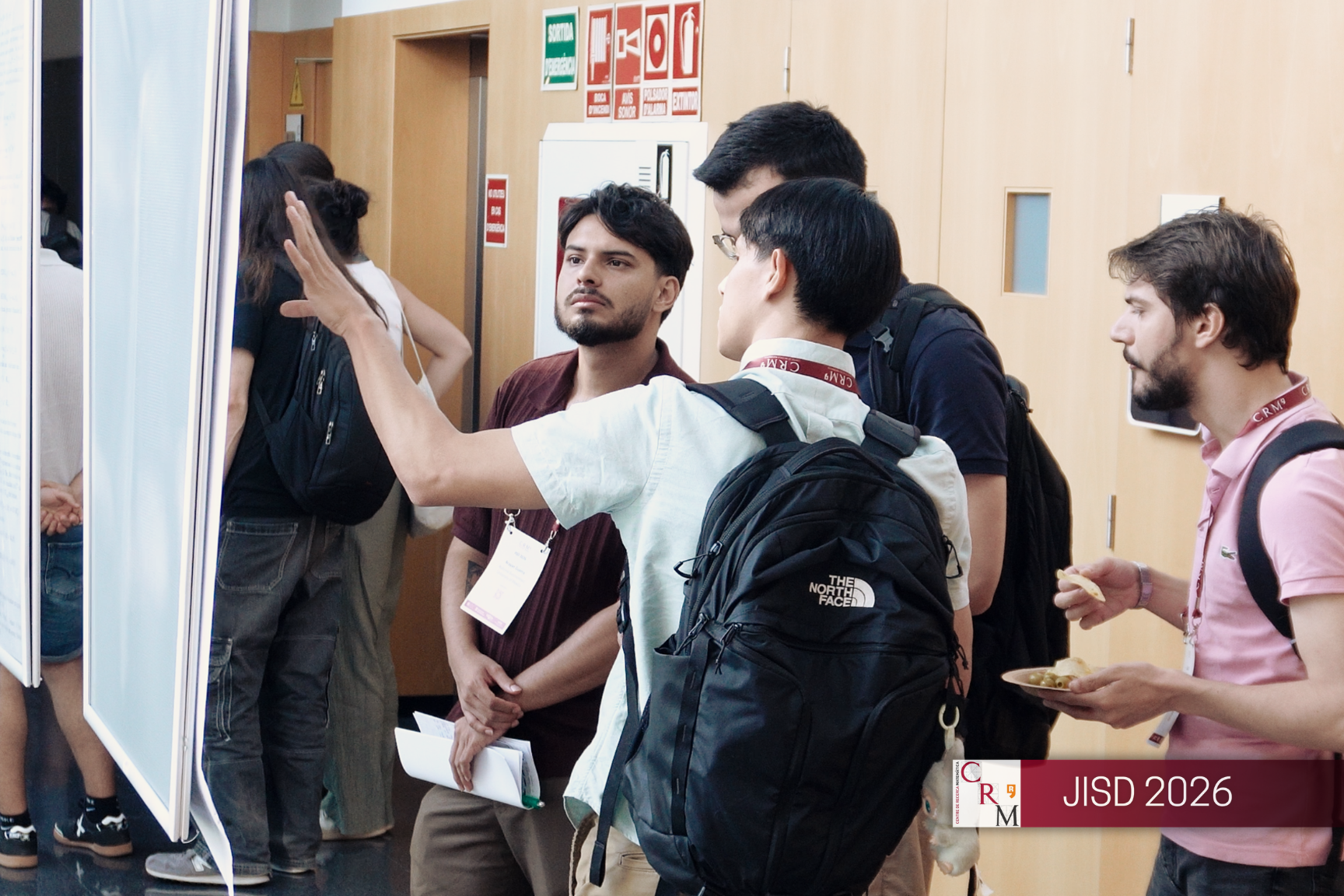
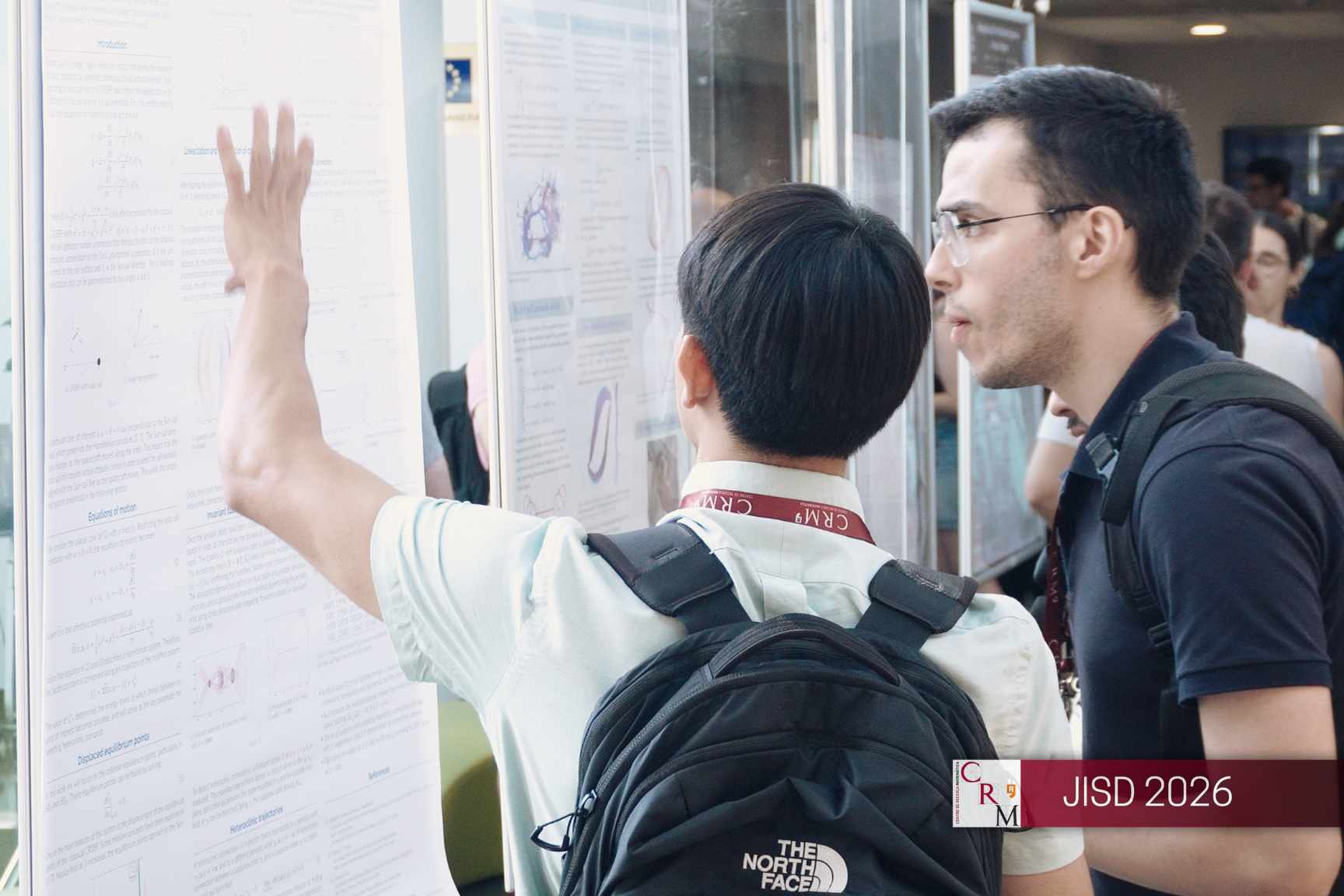
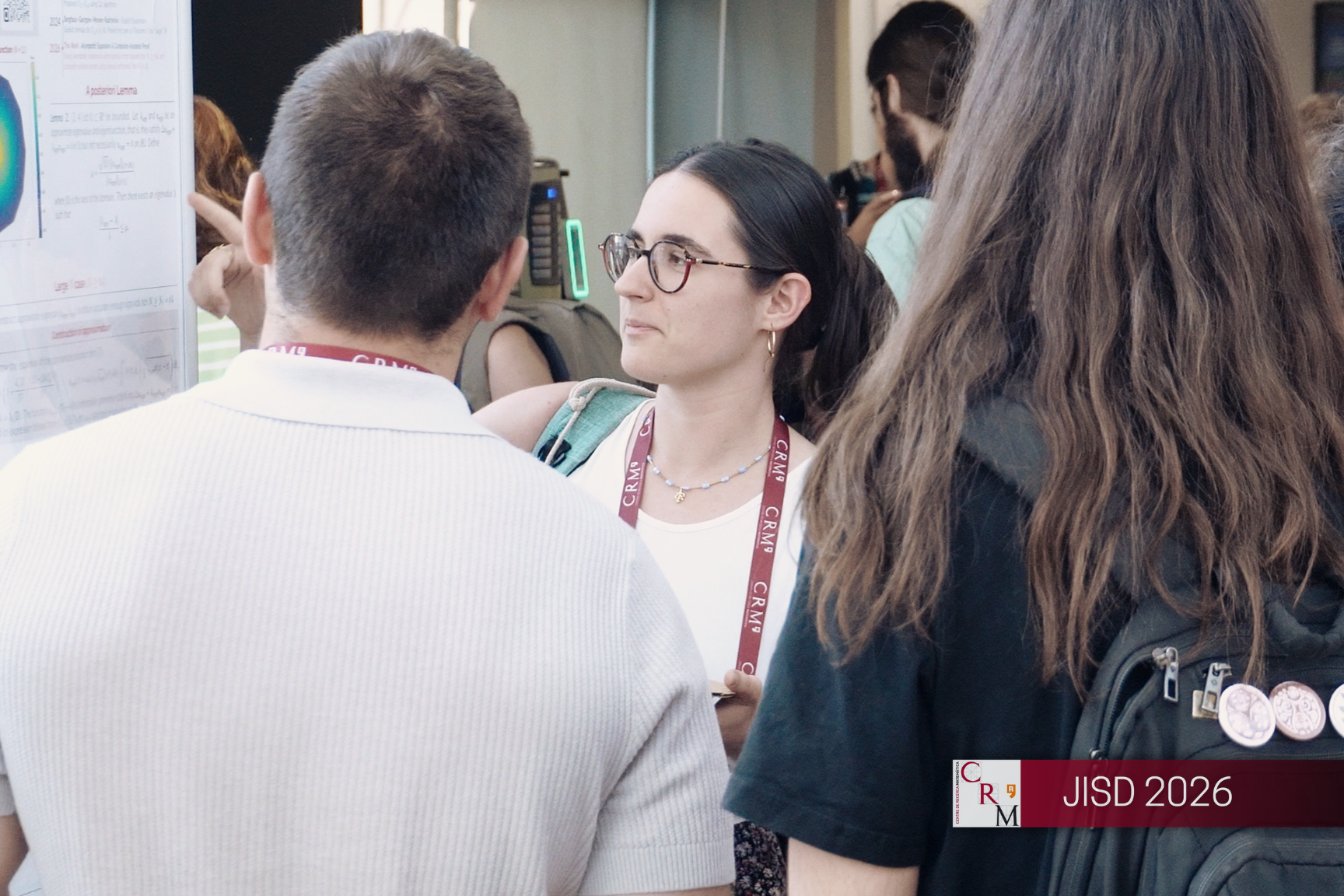
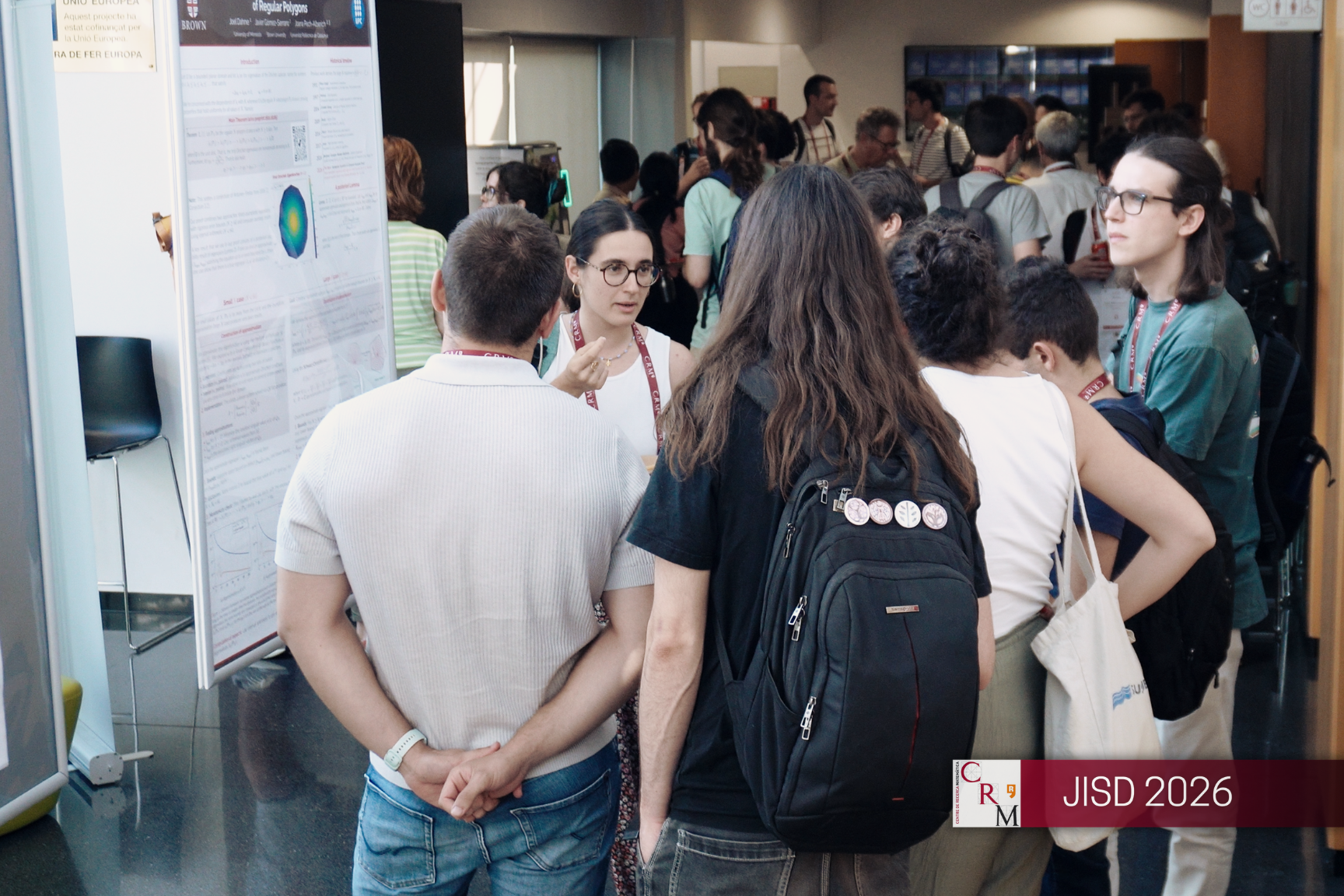
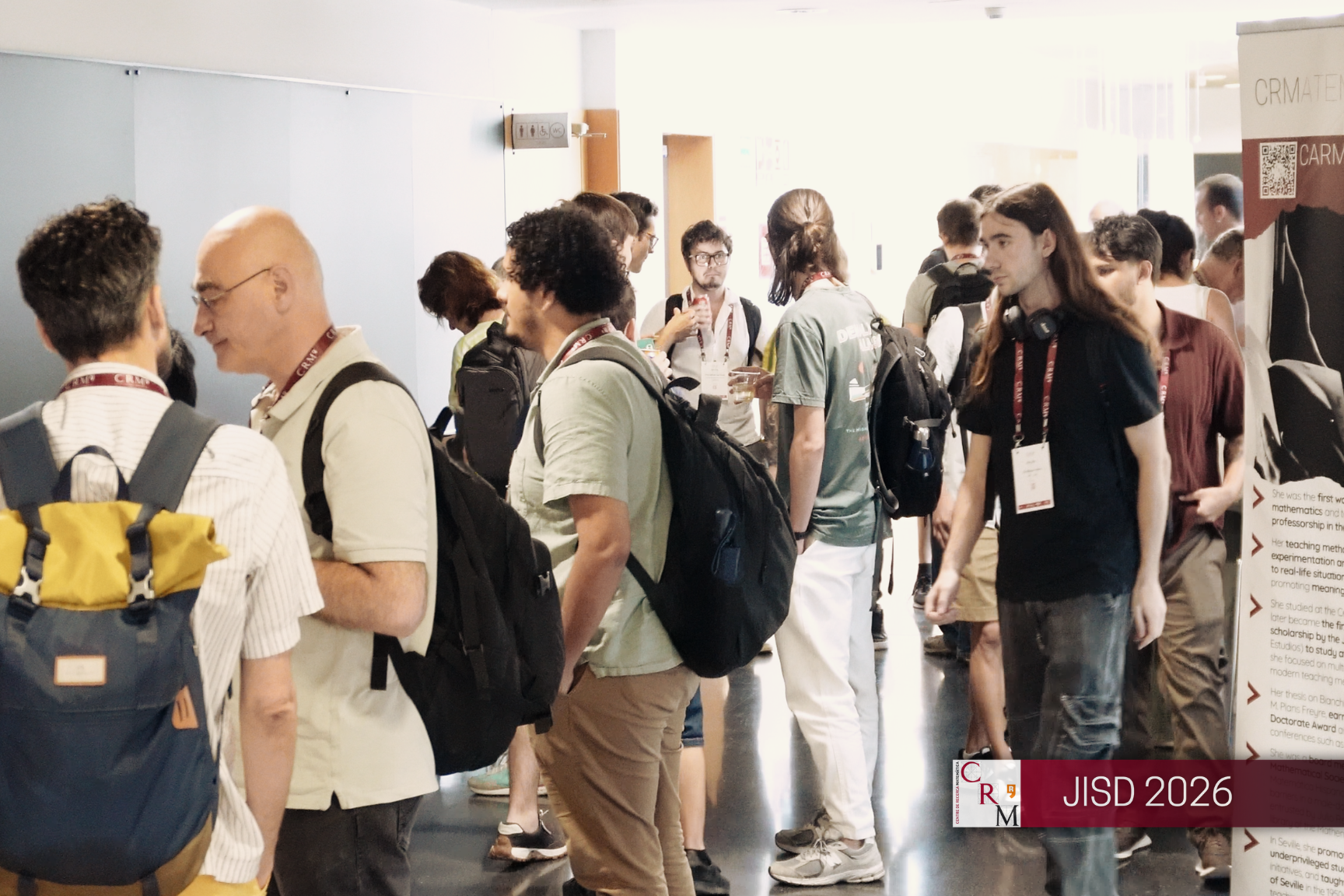
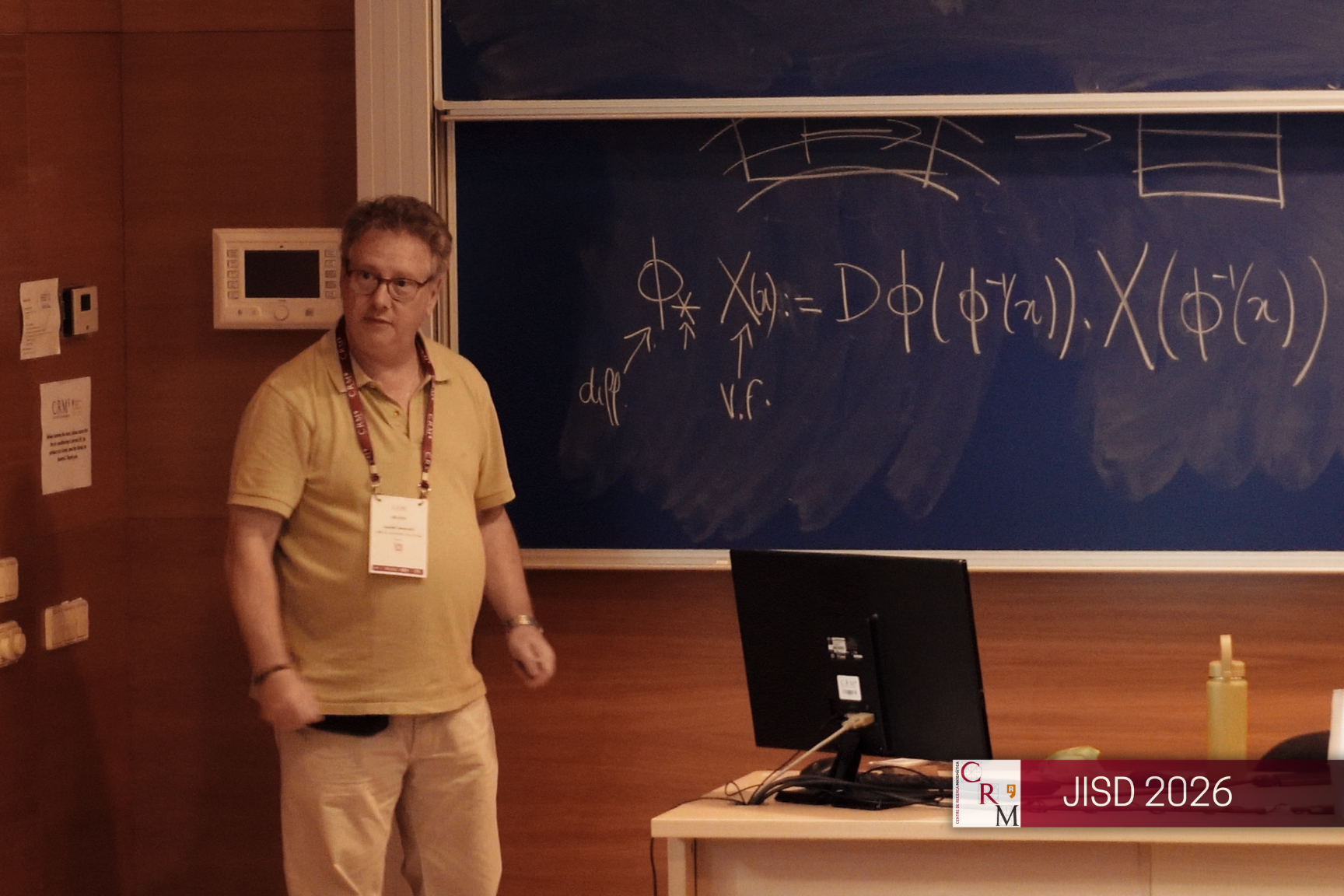
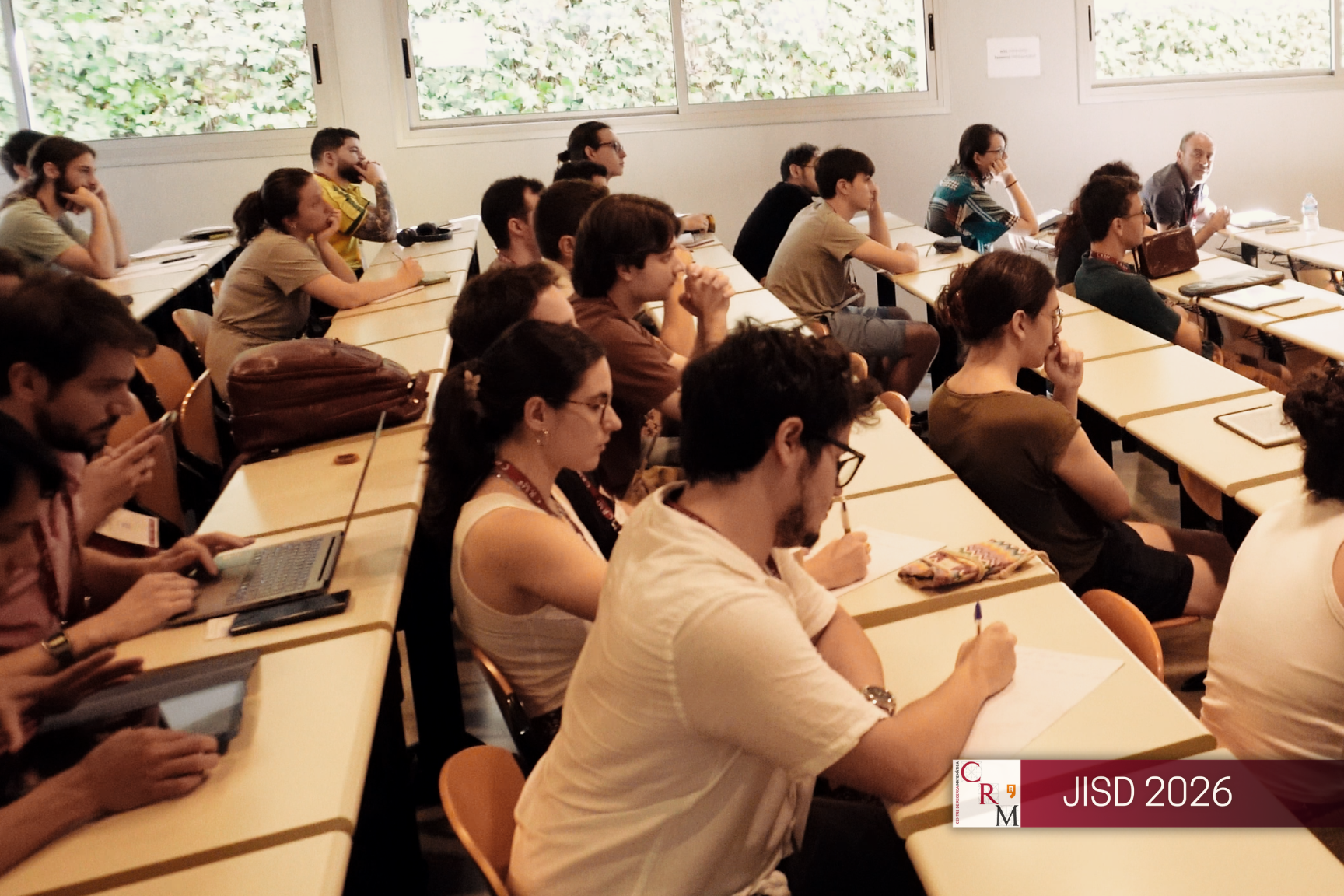
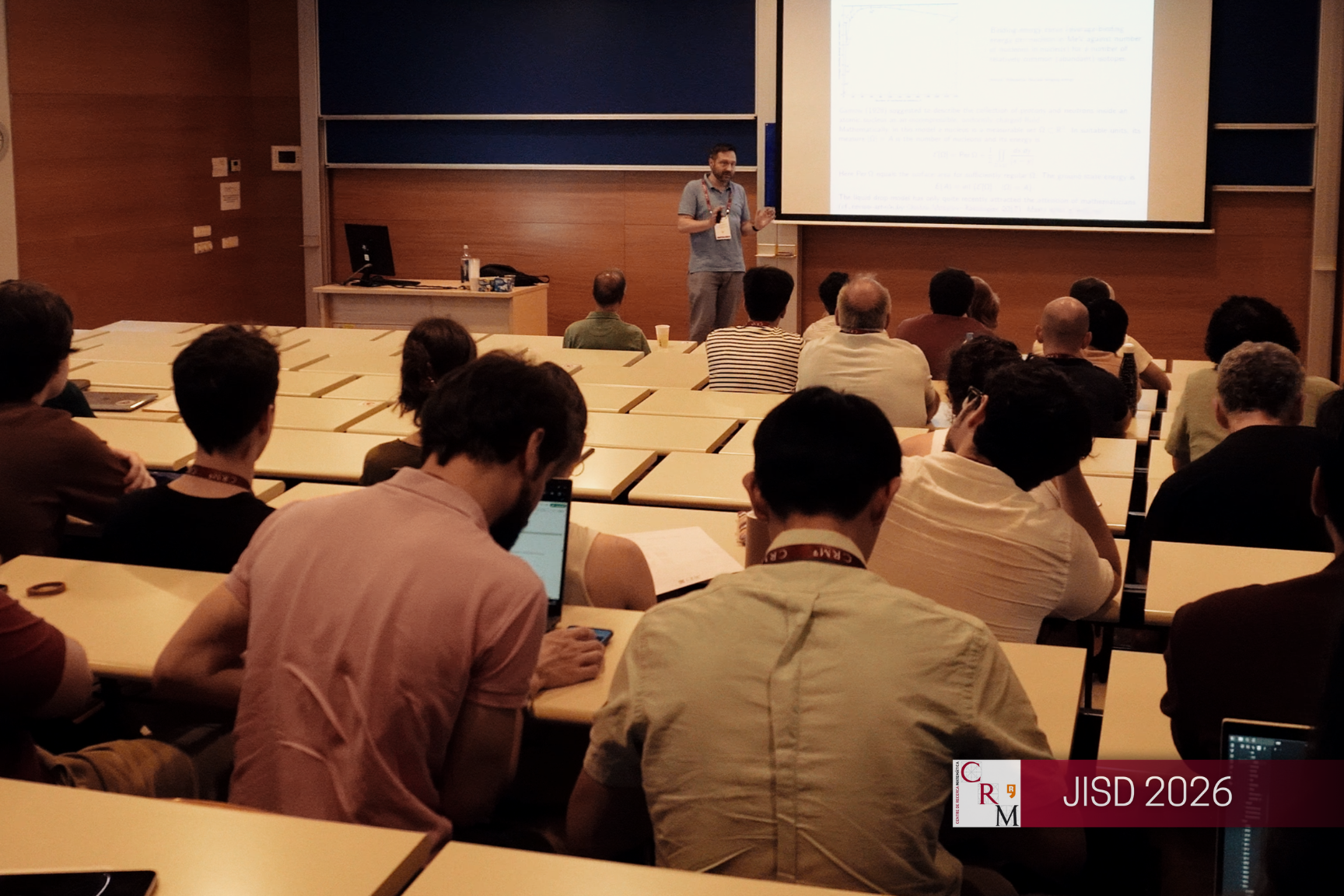
The JISD is an annual meeting between experts and young researchers in Dynamical Systems and Partial Differential Equations (PDEs). It is designed to encourage and enhance exchange of knowledge and methods, with the goal of advancing the study of cutting edge problems in the aforesaid fields of mathematics and with the aim of fostering the interaction among the participants. The symposium is aimed at local researchers, as well as scientists from the rest of Spain and foreign countries. It is organized into four advanced courses of about 6 hours and complemented by a poster session by young researchers. Throughout the latest editions the attendance numbers have ranged between 50 and 90 participants, mostly internationals.
A primary objective of the JISD is to attract talented young researchers who can present a poster to put them in condition to benefit from the exposure to world-leading experts and help them establish working relationships that could prove critical for their short- and long-term success. An especially strong effort has been devoted in past years to encourage the participation of undergraduates, PhDs and postdocs from developing countries and, more generally, young researchers who may encounter difficulties in accessing an adequate financial support.
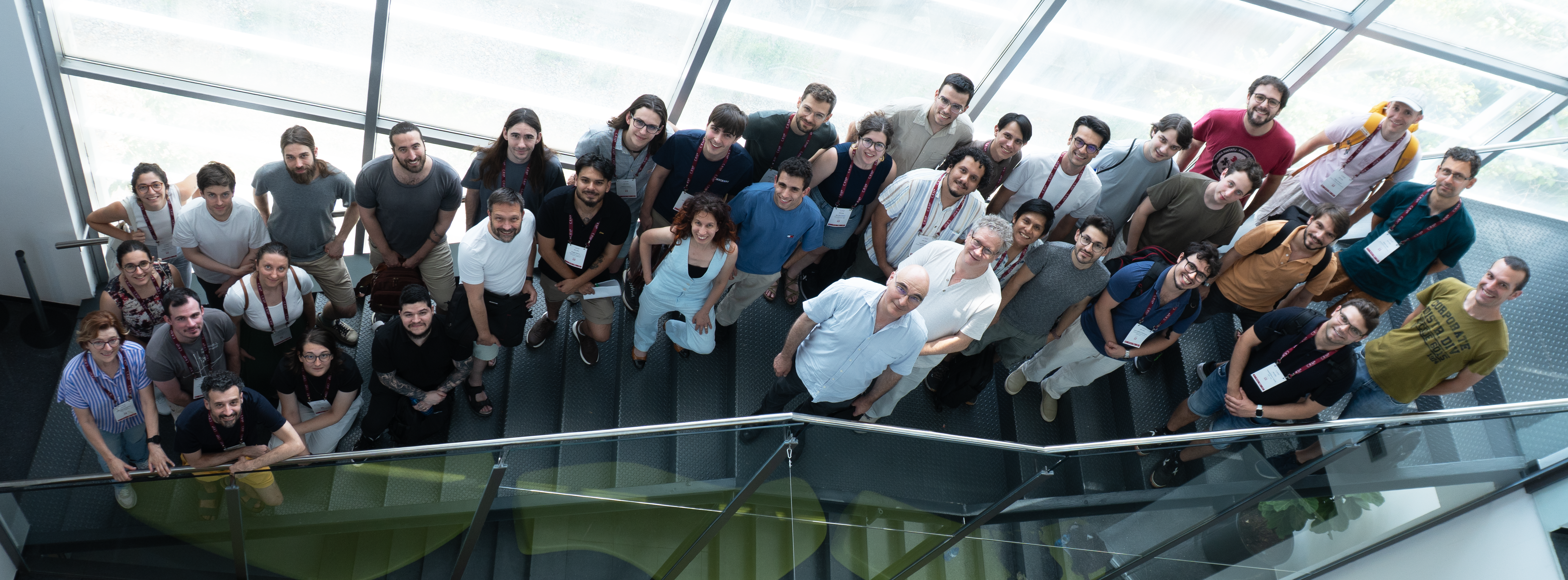
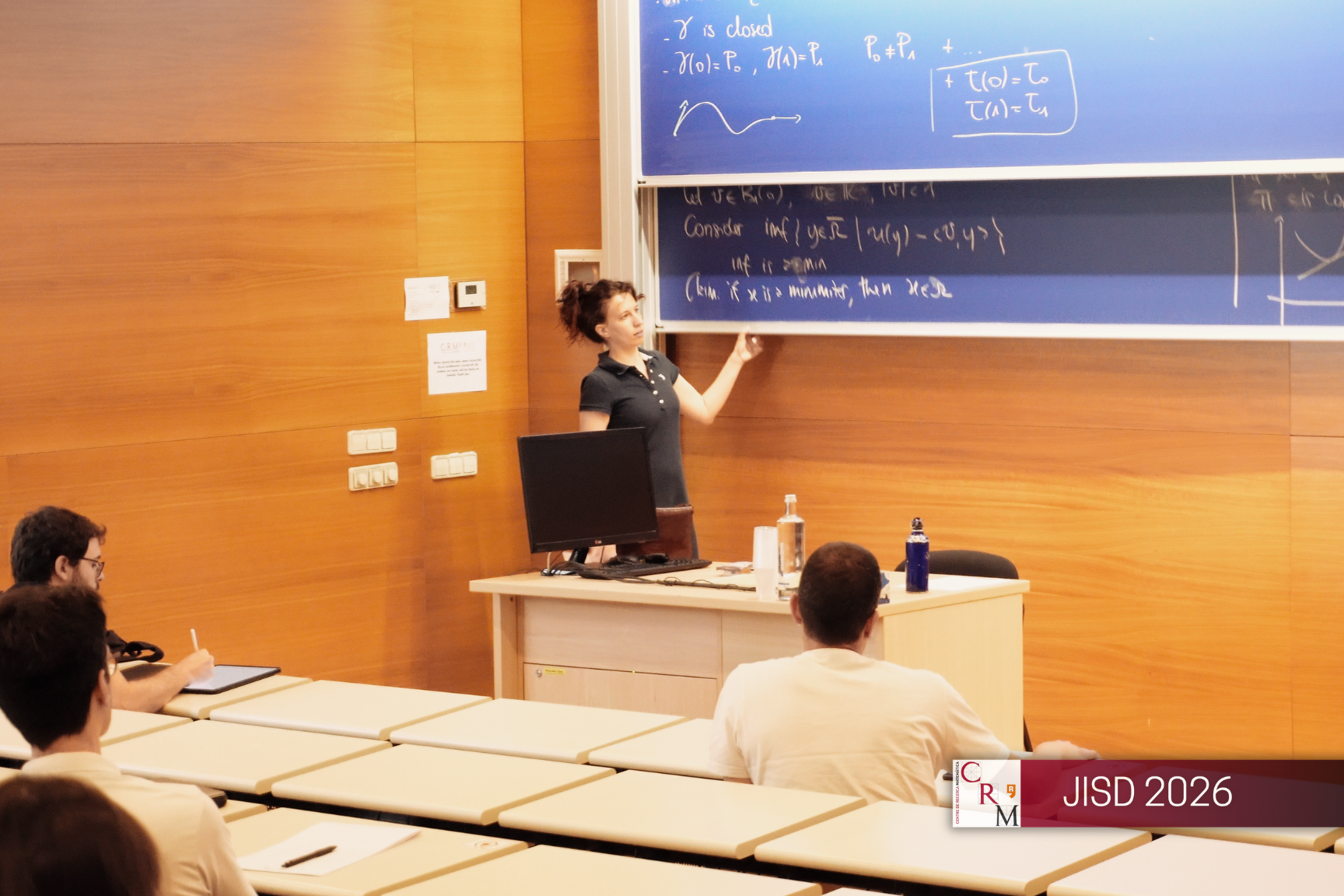
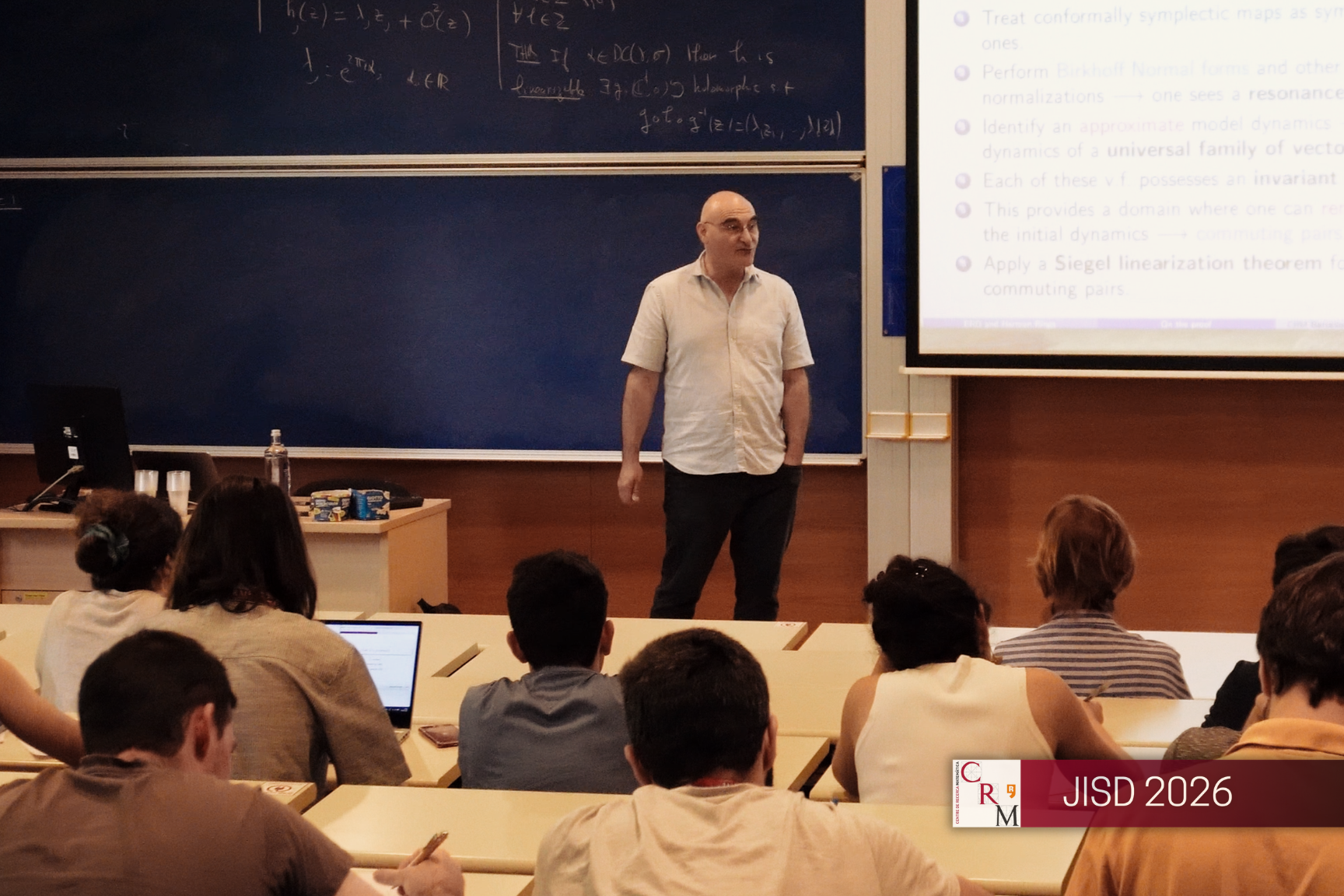
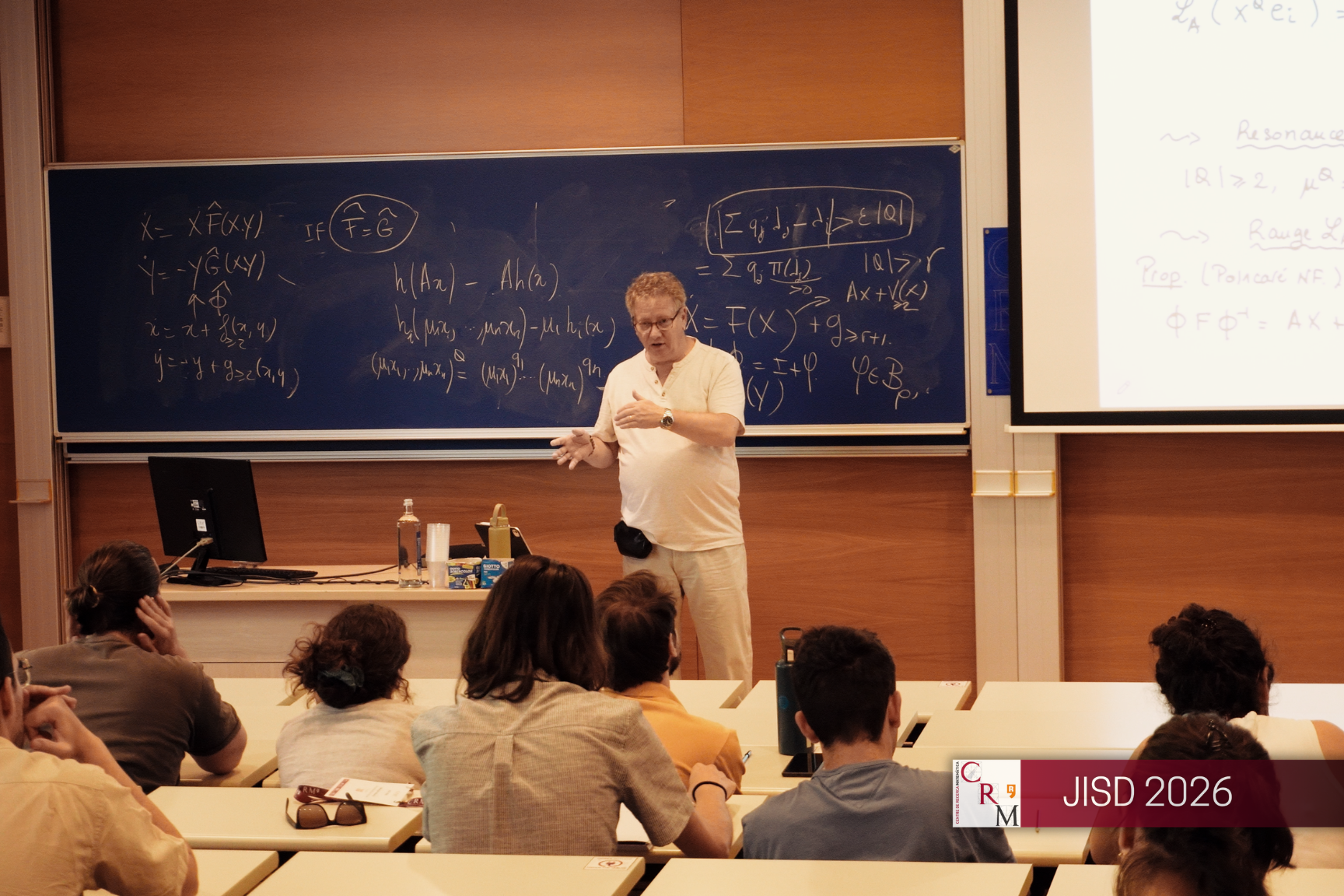
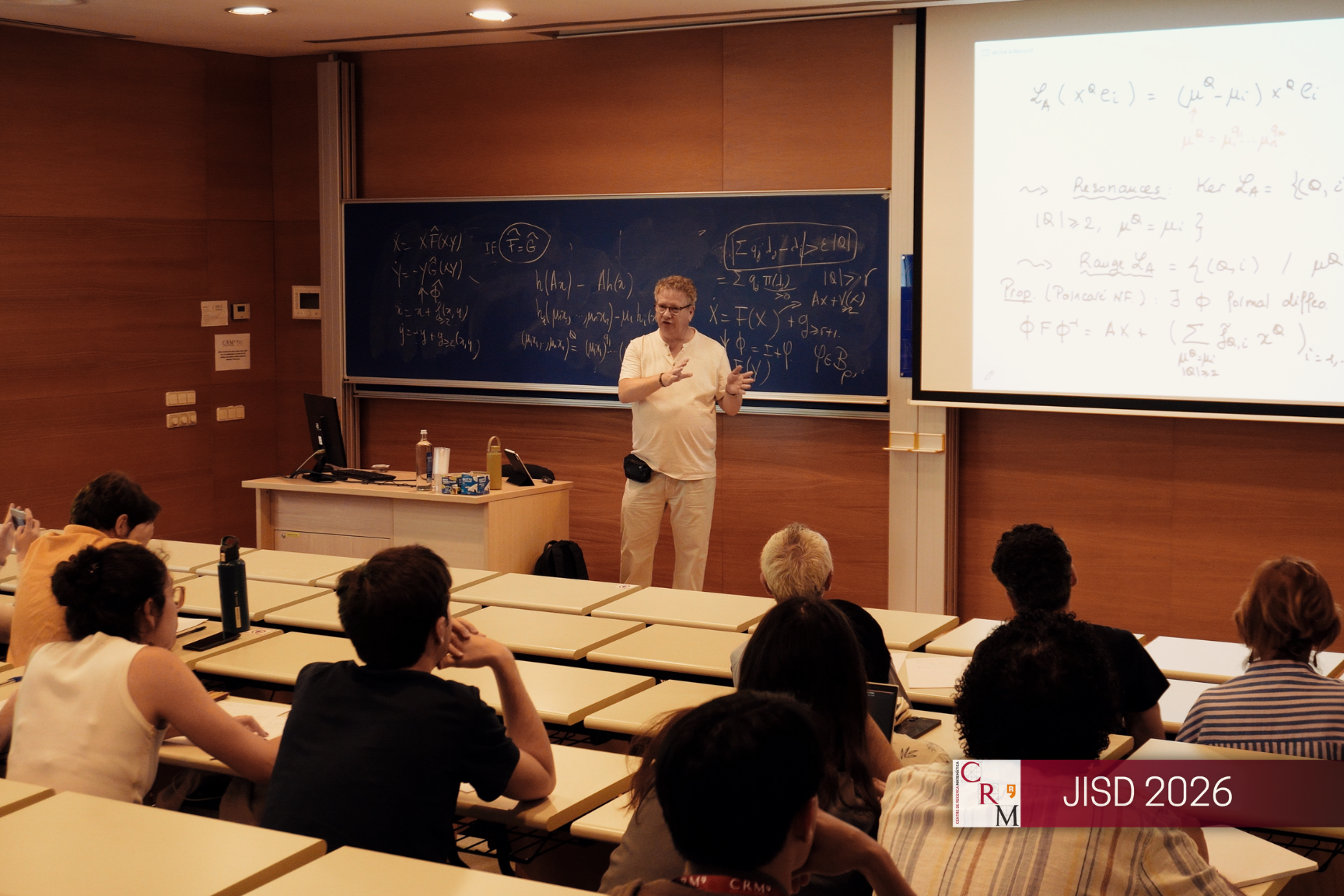
JISD PAST EDITIONS
The liquid drop model
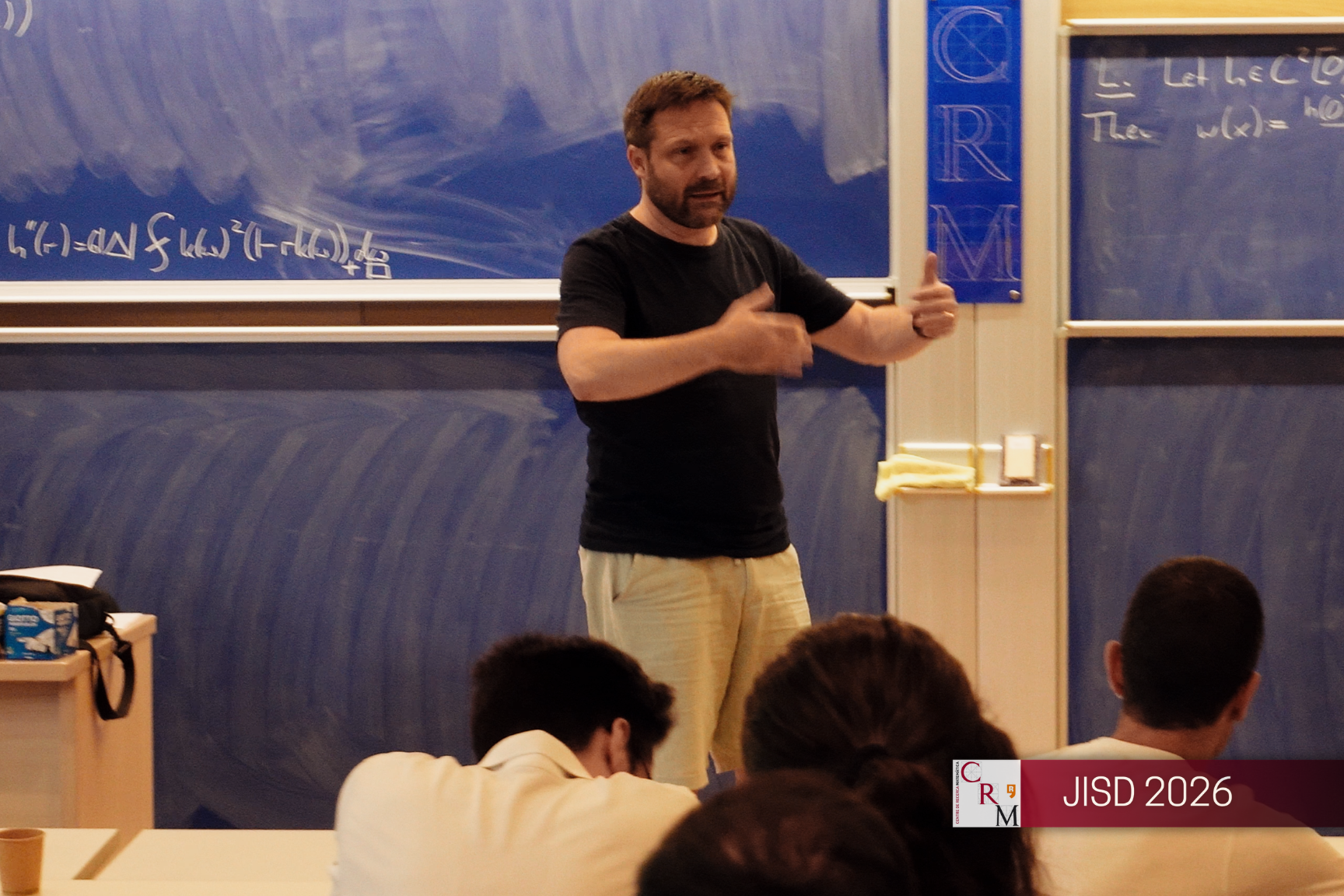
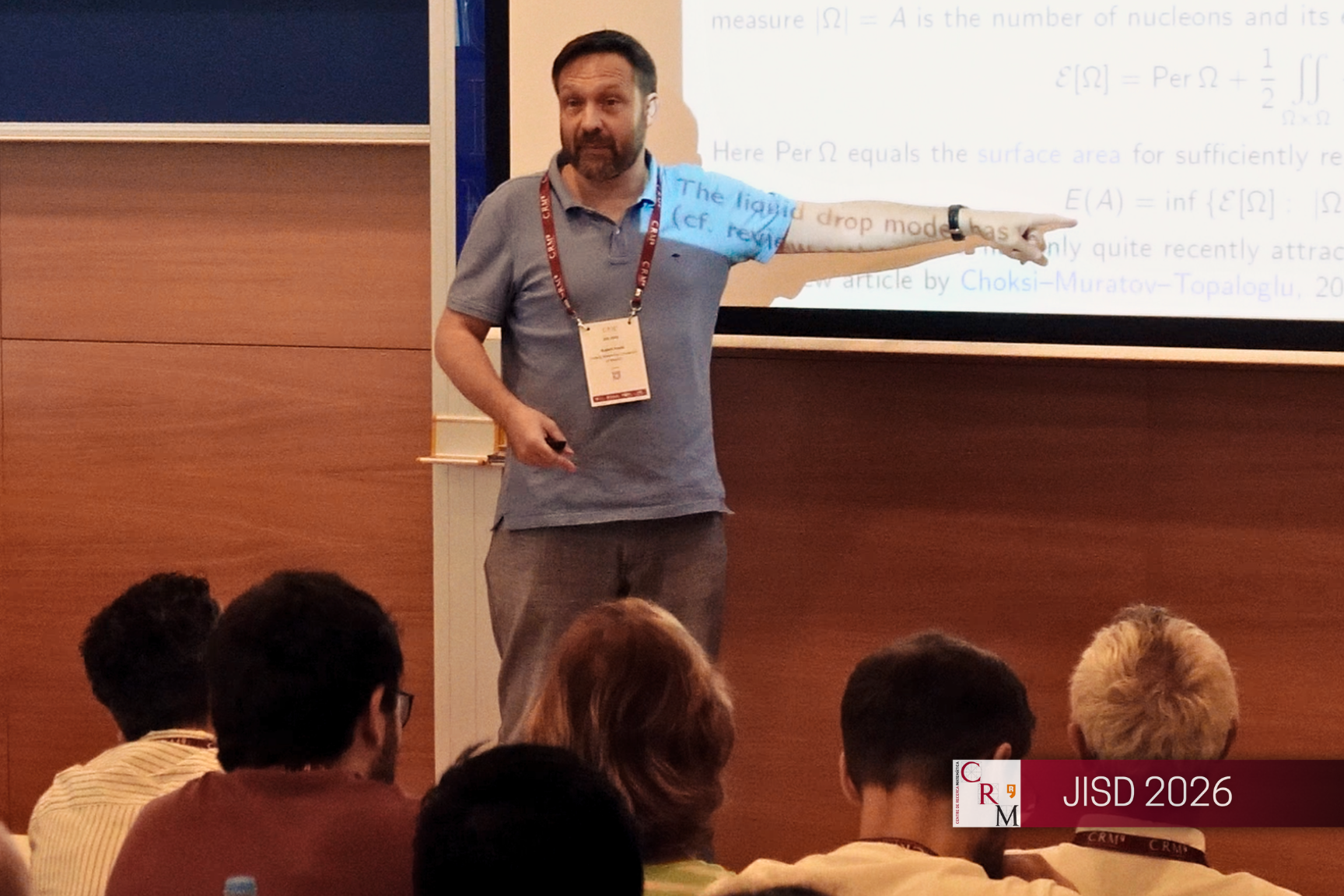
Rupert Frank
Ludwig Maximilian University of Munich
Abstract: The liquid drop model was originally introduced in the nuclear physics literature in 1930 and has recently been studied extensively using techniques from the calculus of variations, geometric analysis, PDE and mathematical physics. The course will provide a gentle introduction to this topic. Among the topics that will be covered are a certain isoperimetric-type question, which is still open in general. We will also discuss an application of the liquid drop model in astrophysics, including a rigorous proof of one of the nuclear pasta phases.
Birkhoff Normal forms, KAM theory and renormalization: an application to the existence of Exotic rotation domains and Herman rings for quadratic complex Hénon maps
Raphaël Krikorian
École Polytechnique and CY Cergy Paris Université
Abstract: A quadratic Hénon map is an automorphism of  of the form
  . It has a constant Jacobian equal to
  and has two fixed points. If is on the unit circle (one says h is conservative) these fixed points can be both elliptic or both hyperbolic. In the elliptic case, under an additional Diophantine condition, a simple application of Siegel Theorem shows that h admits quasi-periodic orbits with two frequencies in the neighborhood of its fixed points. Surprisingly, in some hyperbolic cases, Shigehiro Ushiki observed numerically what seems to be quasi-periodic orbits belonging to some “Exotic rotation domains” though no Siegel disk is associated to the fixed points. The aim of these series of lectures is to develop a theoretical frame work that explains and proves the existence of these “Exotic rotation domains’’. This framework also applies to the dissipative case (
 ) and allows to prove the existence of attracting Herman rings.
The main tools that we shall use are: Birkhoff normal forms techniques, approximation by vector fields, KAM theory, renormalization.
Geometric flows and applications
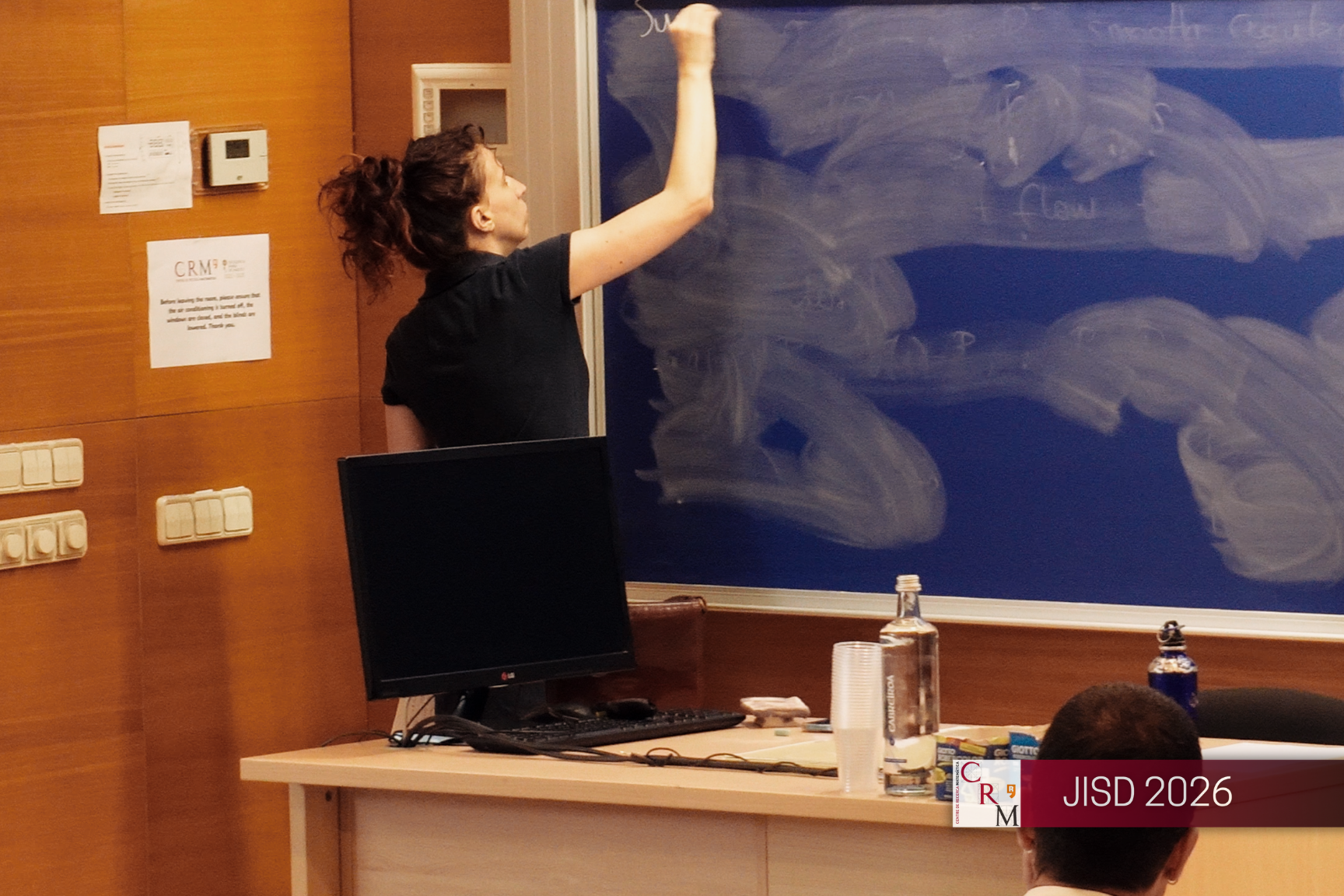
Alessandra Pluda
Università di Pisa
Abstract: This course provides an introduction to intrinsic geometric flows and their applications in various mathematical contexts. It begins with the derivation of Mean Curvature Flow, from the area functional to the associated partial differential equation that govern its dynamics. Next, we will conduct a comprehensive analysis of Curve-Shortening Flow, examining its properties and implications in geometric evolution. The course will also cover Network Flow and its relationship to grain boundaries. Finally, we will present the Inverse Mean Curvature Flow, highlighting its original application in proving the Riemannian Penrose Inequality.
CR singularities and dynamical systems
Laurent Stolovitch
CNRS & Université Côte d’Azur
Abstract: : In this serie of lectures, we’ll survey some recent results done since the seminal work of Moser and Webster about smooth real analytic surfaces in  which are totally real everywhere but at a point where the tangent space is a complex line. Such a point is called a singularity of the Cauchy-Riemann structure. We are interested in the holomorphic classification and the geometry of these surfaces near this singularity. It happens that there is a deep connection with holomorphic classification of some holomorphic dynamical systems near a fixed point so that new results for the later provide new result for the former. In particular, we will present new recent results on KAM-like theory for holomorphic diffeomorphisms at a fixed point, parabolic dynamics in dimension 2 and integrable holomorphic dynamics in higher dimension.
schedule
| Time | Monday29 June | Tuesday30 June | Wednesday1 July | Thursday2 July | Friday3 July |
|---|---|---|---|---|---|
| 09:15 → 09:30 | Welcome |
||||
| 09:30 → 11:00 | The liquid drop model Rupert Frank Ludwig Maximilian University of Munich |
CR singularities and dynamical systems Laurent Stolovitch CNRS & Université Côte d'Azur |
Geometric flows and applications Alessandra Pluda Università di Pisa |
Birkhoff Normal forms, KAM theory and renormalization: an application to the existence of Exotic rotation domains and Herman rings for quadratic complex Hénon maps Raphaël Krikorian École Polytechnique and CY Cergy Paris Université |
CR singularities and dynamical systems Laurent Stolovitch CNRS & Université Côte d'Azur |
| 11:00 → 11:30 | Coffee break |
Group photo & Coffee break |
Coffee break |
||
| 11:30 → 13:00 | Birkhoff Normal forms, KAM theory and renormalization: an application to the existence of Exotic rotation domains and Herman rings for quadratic complex Hénon maps Raphaël Krikorian École Polytechnique and CY Cergy Paris Université |
Birkhoff Normal forms, KAM theory and renormalization: an application to the existence of Exotic rotation domains and Herman rings for quadratic complex Hénon maps Raphaël Krikorian École Polytechnique and CY Cergy Paris Université |
The liquid drop model Rupert Frank Ludwig Maximilian University of Munich |
CR singularities and dynamical systems Laurent Stolovitch CNRS & Université Côte d'Azur |
Birkhoff Normal forms, KAM theory and renormalization: an application to the existence of Exotic rotation domains and Herman rings for quadratic complex Hénon maps Raphaël Krikorian École Polytechnique and CY Cergy Paris Université |
| 13:00 → 15:00 | Lunch |
||||
| 15:00 → 16:30 | CR singularities and dynamical systems Laurent Stolovitch CNRS & Université Côte d'Azur |
The liquid drop model Rupert Frank Ludwig Maximilian University of Munich |
Problems session |
Geometric flows and applications Alessandra Pluda Università di Pisa |
|
| 16:30 → 16:45 | 15 min break |
||||
| 16:45 → 17:45 | Geometric flows and applications Alessandra Pluda Università di Pisa |
Geometric flows and applications Alessandra Pluda Università di Pisa |
16:45 → 18:15 The liquid drop model Rupert Frank Ludwig Maximilian University of Munich |
Geometric flows and applications Alessandra Pluda Università di Pisa |
|
| 17:45 → 18:45 | |||||
| Xavier Cabré | ICREA – Universitat Politècnica de Catalunya – CRM |
| Mar Giralt | LTE at Observatoire de Paris |
| Marcel Guàrdia | Universitat de Barcelona – CRM |
| Pau Martín | Universitat Politècnica de Catalunya – CRM |
| Tomás Sanz | Universitat de Barcelona – CRM |
| Tere M. Seara | Universitat Politècnica de Catalunya – CRM |
| Frank Trujillo | CRM |
| Scott Armstrong | Courant Institute, New York University |
| Jean Pierre Eckmann | Université de Genève |
| Jean-Michel Roquejoffre | Paul Sabatier University |
| Susanna Terracini | Università de Torino |
| Name | Institution |
|---|---|
| Dídac Gil Rams | Centre de Recerca Matemàtica |
| Gerard Codina | Universitat Politècnica de Catalunya |
| Dmitrii Mints | Imperial College London |
| Miquel Saucedo | Centre de Recerca Matemàtica |
| Maria Luísa Pasinato | Paul Sabatier University - Toulouse III |
| Manuel Mateos | Universidad de Oviedo |
| Edhin Mamani | Federal University of Minas Gerais |
| Gyula Csato | Universitat de Barcelona |
| Jose Tomás Lázaro Ochoa | Universitat Politècnica de Catalunya |
| Raul Corzo Serrano | Universidad de Oviedo |
| Stephan Schneider | University of Vienna |
| Frank William Hammond | Universitat Politècnica de Catalunya |
| Joaquim Duran i Lamiel | Centre de Recerca Matemàtica |
| Albert Mas Blesa | Universitat Politècnica de Catalunya |
| Xavier Cabré Vilagut | UPC-CRM-ICREA |
| Juan Miranda | Florida Atlantic University |
| Iñigo U. Erneta | Universitat Politècnica de Catalunya |
| Calatayud Mateu | Universitat Autònoma de Barcelona |
| Pau Blasco i Roca | Universitat Politècnica de Catalunya |
| Pau Mac an Mhaoir | Universitat de Barcelona |
| Elena Pilar Ochoa Ochoa | Universidad del Bío-Bío |
| Rafael Martínez Vergara | Universitat de Barcelona |
| José Lamas Rodríguez | Dalian University of Technology |
| Joana Pech Alberich | Universitat Politècnica de Catalunya |
| Joan Font Perelló | Universitat de Barcelona |
| Mohammed HABCHI | Ecole Supérieure en Sciences Appliquées de Tlemcen |
| Adrian Arriaga | National Autonomous University of Mexico |
| Brayan Guerra | National Autonomous University of Mexico |
| Mar Giralt Miron | Universitat Politècnica de Catalunya |
| Victor Medeiros | IMPA |
| Maxime Chatal | Kyushu University |
| Rupert Frank | Ludwig Maximilian University of Munich |
| Raphaël Krikorian | École Polytechnique and CY Cergy Paris Université |
| Alessandra Pluda | University of Pisa |
| Andriana Karuk | Universitat Politècnica de Catalunya |
| Marc Jorba-Cuscó | Universitat Politècnica de Catalunya |
| Donato Scarcella | Universitat de Barcelona |
| Frank Trujillo | École Polytechnique |
| Miriam Lorenzo | University of Maryland |
| Laurent Stolovitch | CNRS & Université Côte d'Azur |
| Kostiantyn Drach | Universitat de Barcelona |
| Joan Domingo Pasarin | Universitat de Barcelona |
| Matteo Pandolfi | Universitat Politècnica de Catalunya |
| Pau Martín de la Torre | Universitat Politècnica de Catalunya |
| Maria Teresa Martinez-Seara Alonso | Universitat Politècnica de Catalunya |
| Tomás Sanz Perela | Universitat de Barcelona |
| Marcel Guardia Munárriz | Universitat de Barcelona |
| Vanessa Ramírez Bis | Universitat de Barcelona |
The registration fee ( 275€ / 75€ for granted) includes coffee breaks and lunch.
- You will be asked to create a CRM web user account before registering to the activity through the following link:
ON-CAMPUS AND BELLATERRA
BARCELONA AND OFF-CAMPUS





 |
For inquiries about this event, please contact the Head of Scientific Events, Ms Núria Hernández, at nhernandez@crm.cat
|
scam warning
We are aware of a number of current scams targeting participants at CRM activities concerning registration or accommodation bookings. If you are approached by a third party (eg travellerpoint.org, Conference Committee, Global Travel Experts or Royal Visit) asking for booking or payment details, please ignore them.
Please remember:
i) CRM never uses third parties to do our administration for events: messages will come directly from CRM staff
ii) CRM will never ask participants for credit card or bank details
iii) If you have any doubt about an email you receive please get in touch

Sustainable Events
We are committed to organising sustainable events that minimise environmental impact and create a positive legacy for the host community. We support organisers in designing events aligned with the UN 2030 Sustainable Development Goals, reducing negative environmental impacts and promoting responsible practices.
All materials provided during our activities are responsibly sourced, including recycled pens and plastic-free badges. We work with responsible suppliers, and our catering partners use fully compostable materials while offering vegetarian and vegan options, with at least one event day being fully vegetarian.