Susanna Terracini (Università di Torino) delivered the CRM Colloquium 2026 on 14 July, presenting a rigidity result for Kepler billiards obtained with Stefano Baranzini, Vivina Barutello and Irene De Blasi. She was at the centre as a member of the CRM Scientific Advisory Board, which met from 13 to 15 July. The CRM spoke with her that morning about the tension between order and chaos that runs through her research, and about what an international board brings to a centre that works in a local context.
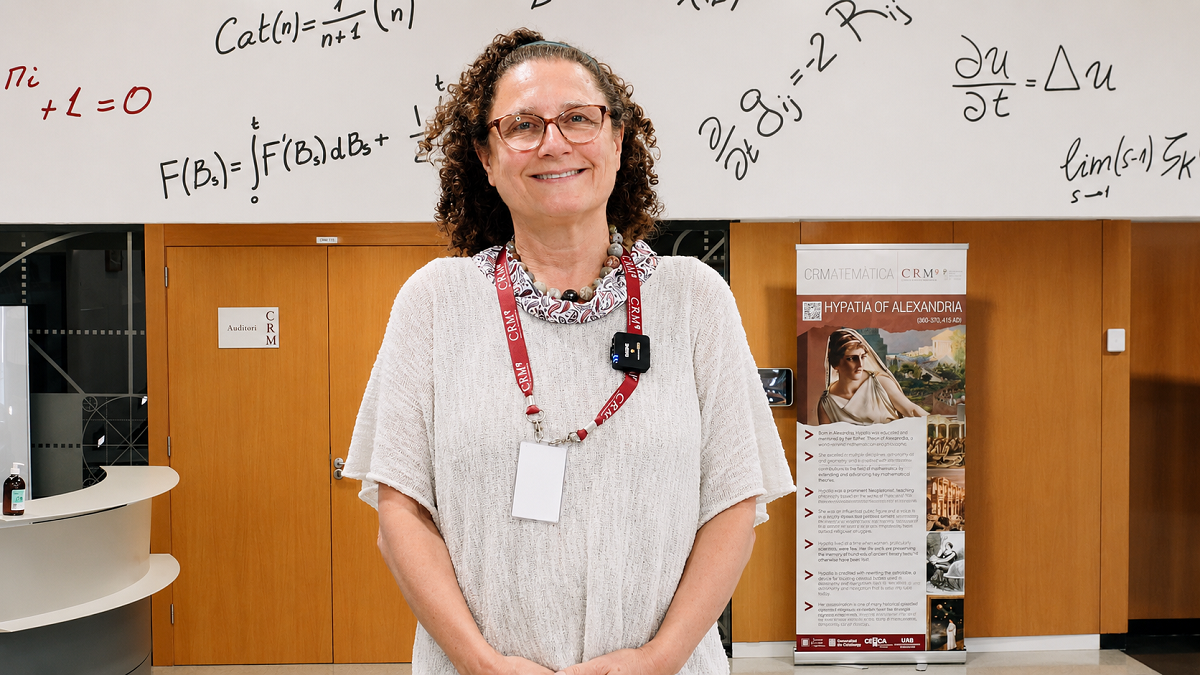
Susanna Terracini (Università di Torino) came to the CRM on 14 July to talk about what happens when you make the problem harder on purpose. “With my research group, we complicated the problem a bit, putting a black hole in the table,” she said in an interview recorded at the centre that morning. Formally, a fixed gravitational mass sitting inside the domain. The ball still bounces off the wall according to the same optical law, but between bounces it no longer travels in a straight line. It falls. A black hole curves light, and the trajectories curve with it, tracing arcs of ellipses, parabolas and hyperbolas instead of segments. The interaction that governs the system is now between the geometry of the boundary and the optics of a curved ray.
These are Kepler billiards, and Terracini’s colloquium [TK: confirm URL], Rigidity for Kepler billiards, presented a result about which ones stay predictable. Among analytic, centrally symmetric, compact convex domains, only two survive: the circle with the mass at its centre, and the ellipse with the mass at a focus. Nothing else is analytically integrable at high energies. The proof runs through an explicit construction of a symbolic dynamics for the system, and it’s joint work with Stefano Baranzini, Vivina Barutello and Irene De Blasi, available as a preprint under the title On the Birkhoff conjecture for Kepler billiards.
Rigidity results have a particular flavour. They don’t tell you what exists. They tell you that the short list you already have is the whole list, and that no amount of cleverness will extend it.
The only breach
Terracini works across territory that looks, from outside, like three or four different careers: the N-body problem, spatial pattern formation in PDEs, regularity of free boundaries, spiralling solutions in competition-diffusion systems. Asked what holds it together, she named a single tension.
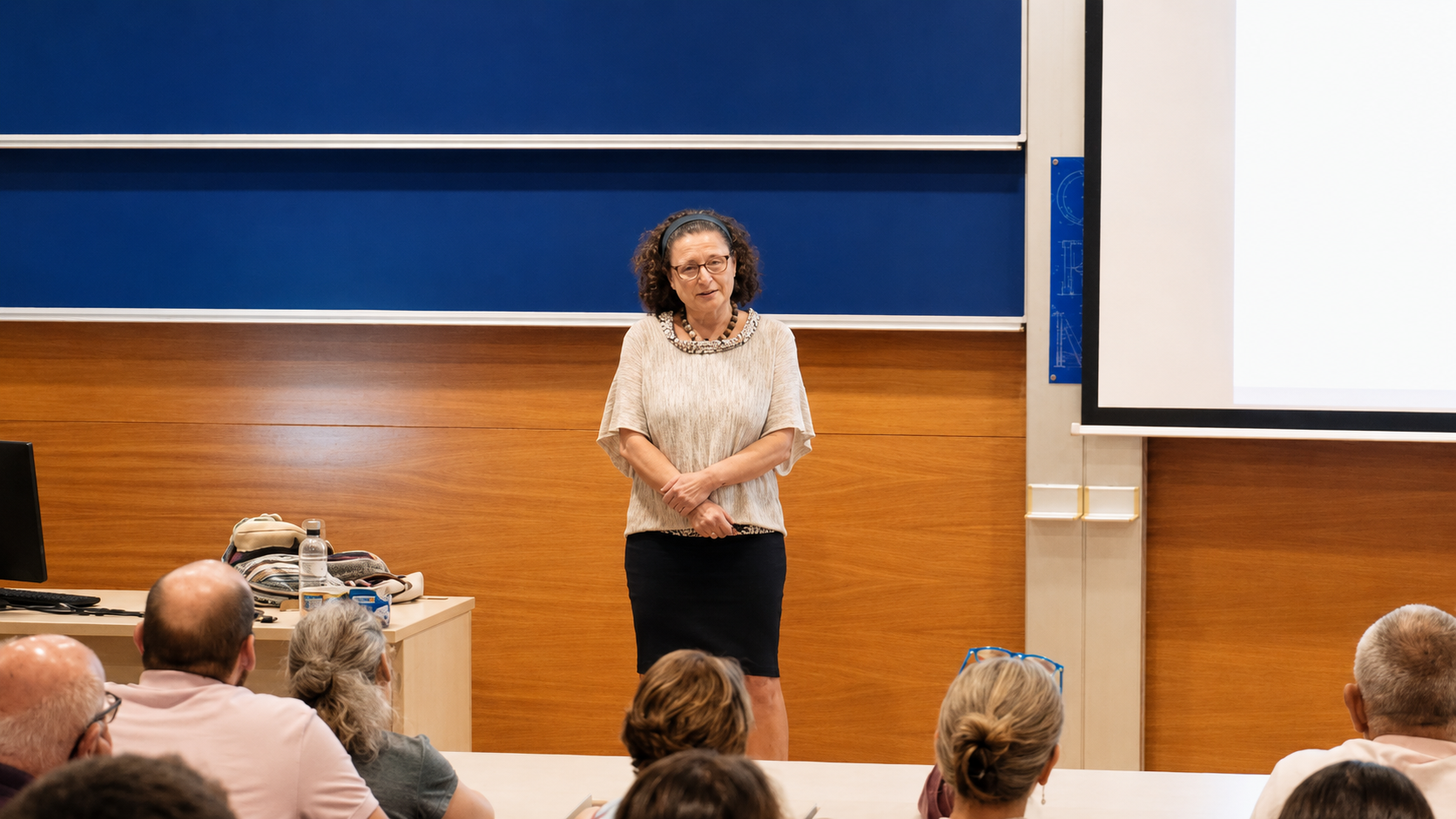
“Regularity can be seen as something good, an advantage, but it’s also a bit boring,” she said. “Things which are too regular may not be useful when you wish either to catch, but also to exploit, the complexity of the world.”
“Regularity can be seen as something good, an advantage, but it’s also a bit boring.”
What she looks for is the balance point: solutions complicated enough to be interesting and simple enough to be described. And the historical warrant for that strategy comes from Poincaré, who wrote in Les méthodes nouvelles de la mécanique céleste that periodic orbits are the only breach through which we might enter the chaos of the three-body problem.
Terracini’s version of that idea is more concrete, and better. The set of periodic solutions is dense. Which means you can connect any two configurations by stringing together pieces of them, with small error. So the periodic orbits behave like a network of public transport, a subway you can ride from one region of configuration space to another, changing lines as you go.
It also explains why the same person ends up working on planets and on reaction-diffusion equations. The common thread is methodological, she says: build the simple solutions, understand their symmetries, then concatenate them into something complex. Variational methods and the least action principle transfer between fields that otherwise share nothing.
What the board is for
Terracini was at the CRM as a member of its Scientific Advisory Board, which met at the centre from 13 to 15 July. The board is the body responsible for defining the centre’s strategic direction and advising on its scientific programme, and its members are appointed by the Governing Board on the Director’s proposal. It’s chaired by Ari Laptev (Imperial College London) and includes Afonso Bandeira (ETH Zürich), Victoria Gould (University of York), Boris Gutkin (École Normale Supérieure), Kathryn Hess (EPFL), Philippe Michel (EPFL), Alessandra Micheletti (Università degli Studi di Milano), Mikhail Sodin (Tel Aviv University), Juan Soler (University of Granada), Katrin Wendland (Trinity College Dublin) and Terracini herself.
She described the board’s job as bringing an international perspective into a place that necessarily operates in a local one. “As a mathematical community, we are one international community,” she said. “So we have a rather broad common view on what mathematics is. On the other hand, each mathematical centre has to cope with its own local government and its own socio-economic framework.”
That gap is where an external board earns its keep. Comparing policies across countries, she noted, tends to be constructive precisely because mathematics institutions aren’t really competing with one another. “We actually wish to build mathematics institutions all over the world. We share a common aim. So we are really here to help.”
Terracini joined the board recently, though she’s been coming to the CRM for years and regularly sends her students and collaborators to its activities. Asked what she’d change, she declined the premise. “I don’t see real weakness that could endanger the future of the centre. I think it will continue to grow.”
Newsletter
Get the latest CRM news and activities delivered to your inbox
Subscribe now
Recent newsletters →
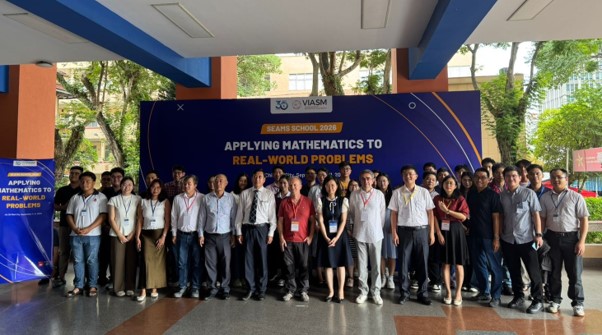
Ho Chi Minh City hosts the first SEAMS School on applying mathematics to real-world problems
More than fifty students from six countries spent a week at the University of Science, VNU-HCM, learning how mathematics gets used outside a mathematics department. CRM researcher Tim Myers co-organised the school and lectured on moving boundary problems. The...

A single ball on a fixed table can compute: Eva Miranda and Isaac Ramos prove that two-dimensional billiards are Turing complete
Eva Miranda (UPC, CRM) and Isaac Ramos (ETH Zürich) show that a point particle bouncing inside a planar table with fixed walls can simulate a universal Turing machine, settling a question Cristopher Moore left open in 1990. The result grew out of a master’s project...
BMS-BGSMath Junior Meeting 2026: Barcelona and Berlin Strengthen Scientific Ties
From 2 to 4 September 2026, the Centre de Recerca Matemàtica (CRM) hosted the BMS-BGSMath Junior Meeting 2026, a three-day event jointly organised by the Berlin Mathematical School (BMS) and the Barcelona Graduate School of Mathematics (BGSMath), with the Centre de...
The CRM organises the 2026 Barcelona Summer School for Advanced Modeling of Behavior
The Centre de Recerca Matemàtica held the sixth edition of BAMB!, the Barcelona Summer School for Advanced Modeling of Behavior, from 12 to 23 July 2026 at the Parc de Recerca Biomèdica de Barcelona. Thirty early-career researchers from fourteen countries followed...
Mallorca’s 1820 plague did not behave like a classic bubonic outbreak, study finds
A study in PNAS by Pere Puig (UAB, CRM) and Joana Maria Pujadas-Mora (UOC, ICREA) reports what happens when the daily health records kept in Son Servera and Capdepera during the 1820 outbreak are analysed with a Bayesian epidemiological model: an unusually short...
|
|
CRM CommPau Varela
|