
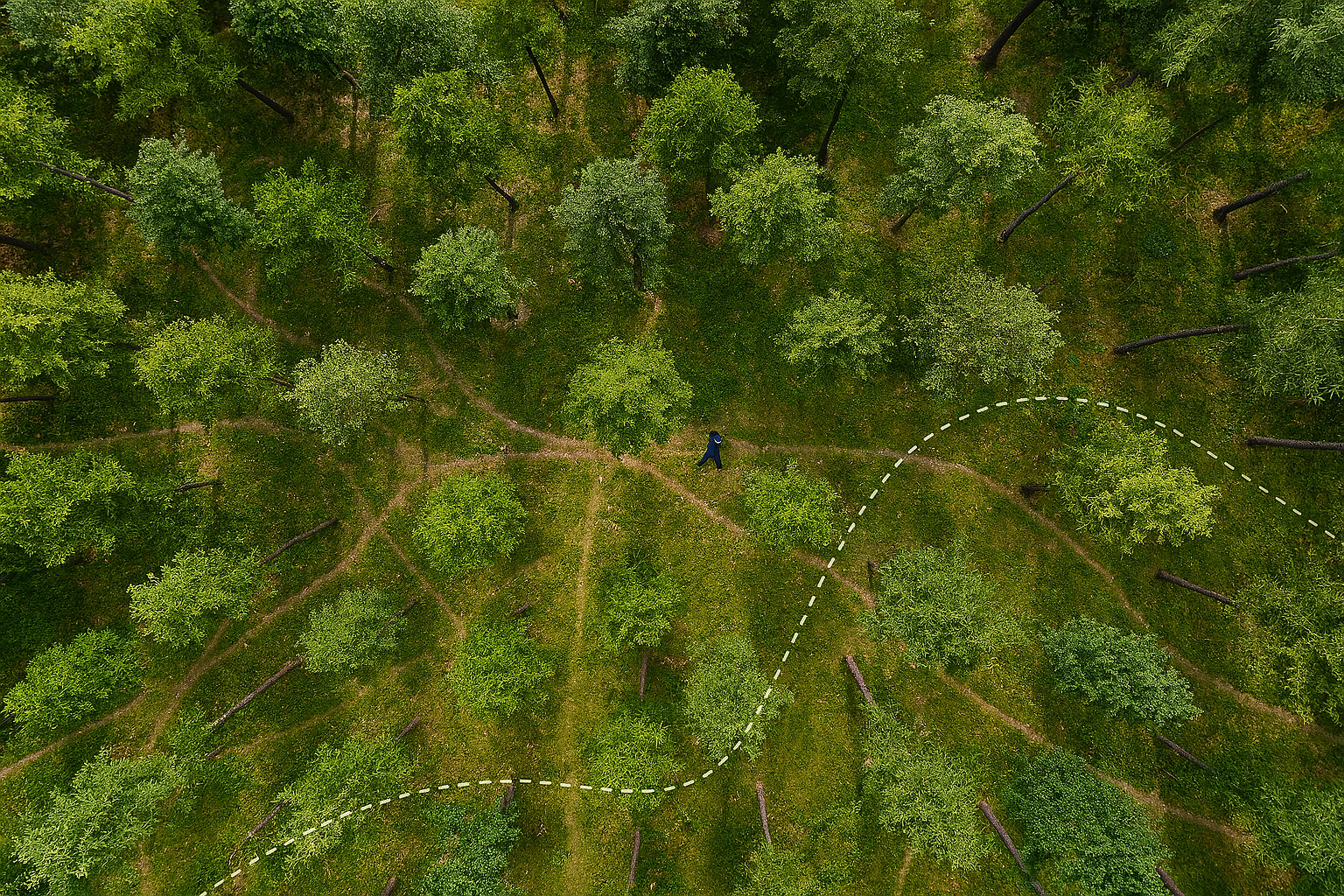
Obstacle problems are a fundamental class of questions in the analysis of partial differential equations. They describe situations in which a quantity can evolve freely, but is subject to a restriction that prevents it from crossing a certain barrier. One intuitive way to think about them is to imagine walking through a forest: you can move freely inside it, but you cannot cross its boundary. Such problems arise naturally in models of elastic contact, diffusion under constraints, and in various applications of mathematical physics.
In the thin obstacle problem (also known as the Signorini problem), the restriction does not occupy the whole boundary of the domain. Instead, it acts only on a lower‑dimensional subset, like an invisible boundary inside the forest that becomes apparent only when one tries to cross it in certain directions. Despite this apparently mild geometric constraint, the behavior of solutions near the obstacle and near the free boundary—the interface separating the region where the solution touches the obstacle from where it does not—is remarkably subtle. In particular, the fully nonlinear thin obstacle problem is not just a difficult equation: it is a setting where geometry, direction, and anisotropy play a central role.
The challenge of the fully nonlinear case
The article Optimal regularity for the fully nonlinear thin obstacle problem, by Maria Colombo (EPFL), Xavier Fernández‑Real (EPFL), and Xavier Ros‑Oton (ICREA – UB- CRM), studies this problem in one of its most challenging regimes: when the governing equation involves a fully nonlinear operator, meaning that it depends nonlinearly on the second derivatives of the solution.
Many classical advances in obstacle problems rely on linear operators such as the Laplacian, for which powerful analytical tools are available. In contrast, fully nonlinear operators arise naturally in more general models, but in this setting many of those tools—most notably monotonicity formulas—are no longer applicable. As a result, even small local variations may have global effects that are difficult to control. Continuing the metaphor, one no longer walks along smooth, predictable paths, but moves through irregular terrain, full of twists and turns, where the route cannot be inferred from simple rules.
Before this work, it was known that solutions to the fully nonlinear thin obstacle problem are sufficiently regular. However, the optimal regularity—the best possible degree of smoothness that can be expected in general—remained an open question.
What “optimal regularity” means
“In mathematics we often have a known property in a particular setting, and we want if such a property is specific to that particular setting, or instead it is something very general with a deep reason behind it. In free boundary problems, the optimal regularity for the thin obstacle problem had been known for decades, but all known proofs strongly used some very specific properties of that model. Our result shows for the first time that the same regularity holds for a very large class of thin free boundary problems, as long as we have a certain assumption on radial symmetry. The theorem is somehow telling us what is the real reason behind this regularity, and provides a completely new proof even for the classical thin obstacle problem..”
— Xavier Ros-Oton (ICREA – Universitat de Barcelona – Centre de Recerca Matemàtica)
In analysis, the regularity of a function is often described using spaces of the form  . Saying that a function is
  means that it is differentiable and that its derivatives vary in a controlled way, with Hölder continuity of exponent
  . The larger the exponent
  , the smoother the function.
The main result of the article shows that there exists an optimal regularity exponent, denoted by  and depending on the operator, such that solutions to the fully nonlinear thin obstacle problem are of class
  on both sides of the obstacle. This exponent is optimal in a strong sense: in general, it cannot be improved, as it reflects the maximal smoothness compatible with the nonlinear nature of the problem.
Moreover, this exponent may capture the anisotropy of the operator, since it can depend on the local orientation of the free boundary. In this way, the work settles the question of optimal regularity in the fully nonlinear setting and places it on the same conceptual footing as the classical linear case—albeit through completely different techniques.
The article also shows that this optimal regularity depends crucially on the homogeneous structure of the operator, and in particular on a key assumption of 1‑homogeneity. Without it, optimal regularity may fail, precisely delineating the scope of the result.
The fine structure of solutions
To achieve these results, the authors carry out a detailed analysis of how solutions behave near regular points of the free boundary. A central ingredient is the proof of uniqueness of blow‑ups: rescaled limits of the solution that describe its shape at smaller and smaller scales. At regular points, these limiting profiles are unique and do not depend on how the rescaling is performed.
This uniqueness makes it possible to obtain precise expansions of solutions near the free boundary, offering a detailed picture of their local structure. In the forest metaphor, this corresponds to zooming in near specific points of the invisible boundary to understand precisely how movement is possible in its vicinity. Beyond their technical role, these results provide a deep geometric understanding of the problem and strengthen the link between solution regularity and the structure of the free boundary. The analysis involved is particularly delicate in this boundary regime.
A particularly important case: rotational invariance
The article also highlights a striking result in an especially relevant situation. When the operator is rotationally invariant, the authors show that the optimal exponent satisfies  which implies that solutions are always of class
  .
.
This matches the optimal regularity known for the linear thin obstacle problem. It shows that, under natural symmetry assumptions, the fully nonlinear problem can exhibit the same degree of smoothness as its classical linear counterpart.
A conceptual advance
“In addition to understanding free boundary problems, the question we solve in our paper is motivated by a long-standing open problem in nonlinear PDE: to understand if all solutions to fully nonlinear PDE in 3D are smooth or, instead, they may have singularities. One of the results we prove in our paper has important analogies with such an open problem, and we hope our ideas can be used to tackle it.”
— Xavier Ros-Oton (ICREA – Universitat de Barcelona – Centre de Recerca Matemàtica)
Overall, this work represents a significant advance in the theory of free boundary problems for fully nonlinear equations. It not only resolves a fundamental question about optimal regularity, but also introduces new methods that avoid reliance on classical tools such as monotonicity formulas.
The ideas developed open new avenues for studying nonlinear problems with geometric constraints and free boundaries—an area of ongoing and growing importance within modern analysis of partial differential equations. The article also makes clear how far regularity can extend in the fully nonlinear setting, showing that without additional structural assumptions on the operator, no smoother behavior can be expected.
Newsletter
Get the latest CRM news and activities delivered to your inbox
Subscribe now
Recent newsletters →
When the reward comes within reach, the brain changes what it compares
As the tokens piled up, choices got faster and more accurate at the same time. The yardstick for judging each offer had moved.CRM CommPau VarelaCRMComm@crm.catGet the latest CRM news and activities in your inbox.Recent newsletters →Two subjects...

Almost every automaton can be reset with a short word
For a random automaton with n states, a word of about √n log n letters is almost always enough to reset it.CRM CommPau VarelaCRMComm@crm.catGet the latest CRM news and activities in your inbox.Recent newsletters →Picture a conveyor belt carrying...

Exposició ‘Les matemàtiques de Gaudí’

CRM quod erat demonstrandum | 48

ADA: Decoding Brain Signals Misaligned in Time
The study addresses a key limitation of current brain decoding techniques: the difficulty of interpreting internal mental processes whose temporal dynamics vary from trial to trial.Decoding what is happening in a person’s mind from their brain activity is one of the...

Rare curves, many points: Christophe Ritzenthaler and Rachel Pries on their research and the work around it
Christophe Ritzenthaler (Université de Rennes) and Rachel Pries (Colorado State University) both work on curves over finite fields: he hunts curves with as many points as possible, she hunts curves that almost never occur. In conversation with the CRM during their...
|
|
CRM CommNatalia Vallina
|