

A recent article by Ian Fleschler (Princeton University), Xavier Tolsa (UAB – ICREA – CRM) and Michele Villa (Ikerbasque and UPV/EHU), published in Inventiones Mathematicae, establishes a higher-dimensional version of the well-known ε² conjecture of Carleson, a classical problem in geometric harmonic analysis with deep connections to the regularity of boundaries.
This work represents a significant advance in our understanding of how quantitative conditions, formulated across all scales, determine the local geometry of irregular sets. In addition to generalizing the original conjecture—formulated in the plane—the article introduces new geometric coefficients capable of capturing fine structural information in arbitrary dimensions.
What is Carleson’s conjecture?
Carleson’s ε² conjecture addresses a fundamental question:
Can the existence of tangents to the boundary of a domain be characterized using only information integrated across all scales?
In the planar setting, given a domain with boundary, Carleson introduced a coefficient ε(x,r) that measures, at scale r, how much the boundary deviates from behaving like a straight line around a point x. Integrating the square of this coefficient over all small scales yields a square function,

The conjecture asserts that, up to a set of measure zero, the points where this integral is finite are exactly the points where the boundary admits a well-defined tangent. This result emerged from the study of free boundary problems related to harmonic measure and revealed a deep connection between harmonic analysis, geometry, and boundary regularity.
A Visual Metaphor
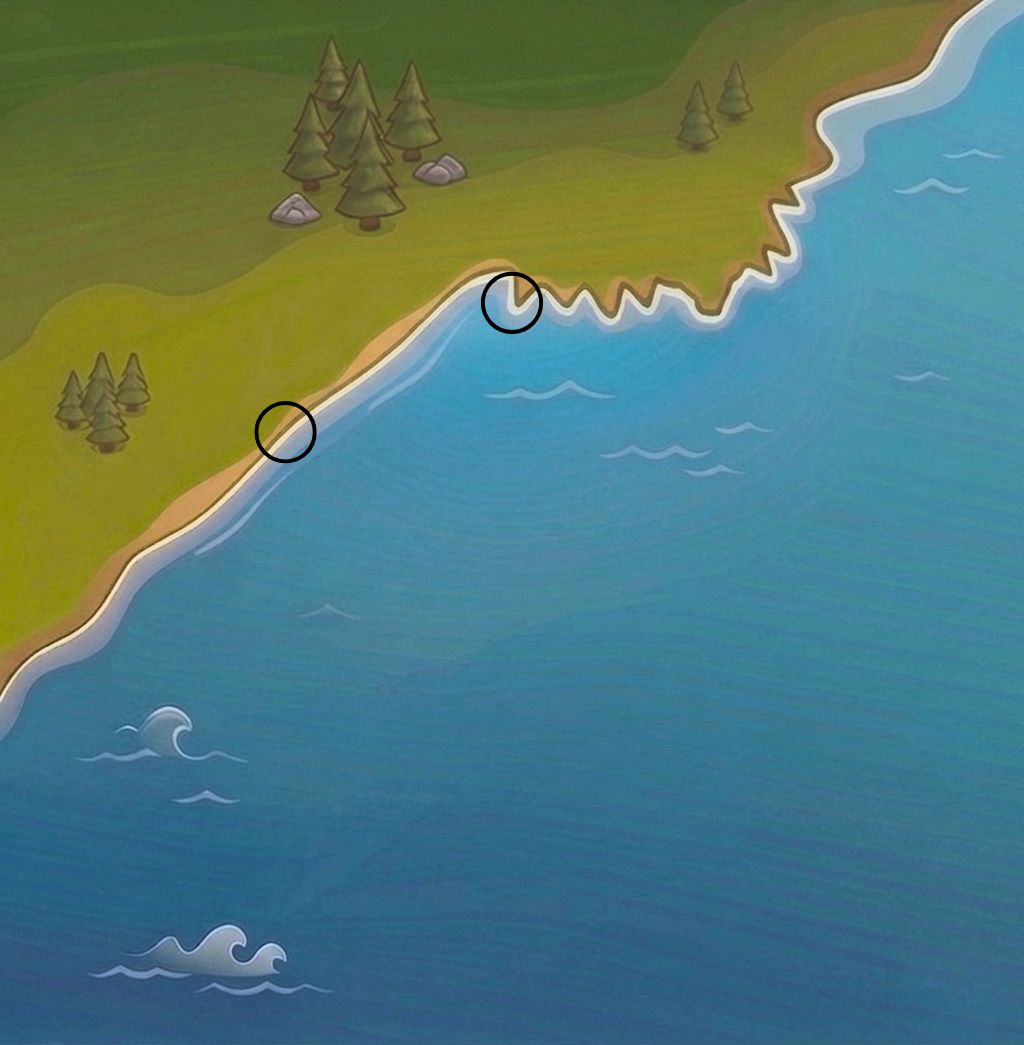
Imagine a coastline as a line separating sea and land…
In some stretches it is almost straight, while in others it is very irregular.
If we focus on a specific point on the coastline and draw smaller and smaller circles around it, we can study how sea and land are distributed inside each circle.
- If the coastline is fairly straight near that point, then in most circles it divides the circle into two similar parts.
- If the coastline is very irregular, this balance changes significantly from scale to scale.
Carleson’s conjecture is about summing all this information across scales and understanding what it reveals about the geometry of the point.
In the planar case, Carleson showed that a point on the coastline has a well‑defined direction (a tangent) if and only if the total accumulated irregularity across all these circles does not become too large.
The challenge in higher dimensions
While the conjecture was resolved in the plane in earlier works, extending it to higher dimensions posed substantial technical difficulties. As the authors explain, two main obstacles arise:
- The planar Carleson coefficient does not admit a straightforward generalization: in higher dimensions it may vanish even on non-flat surfaces.
- In higher dimensions, topological connectivity alone does not provide sufficient geometric control, forcing one to work with much broader and more carefully chosen classes of sets.
The article overcomes these difficulties by introducing new geometric coefficients, defined in terms of how two disjoint sets are distributed on spheres at different scales, and by developing a refined geometric analysis based on them.
Main results
First result: rectifiability from an integral condition
The first main result shows that the set of points where a higher-dimensional version of the ε coefficient satisfies a square-integrability condition is a rectifiable set.
More precisely, given two disjoint Borel sets  and
and  in
in  , the authors define a new coefficient
  that measures how close the partition induced by and on a sphere of radius r is to that induced by a hyperplane. They prove that the set of points x for which
  is n‑rectifiable. In particular, this means that, up to a negligible set, it can be covered by n-dimensional Lipschitz pieces
This result is especially noteworthy because it yields new information even in the planar case, reinforcing the role of Carleson-type square functions as precise tools for detecting geometric structure.
Second result: characterization of true tangent points
To go beyond rectifiability and obtain true tangent points, the article introduces a stronger family of coefficients based on spectral constants associated with spherical domains.
Under natural assumptions—specifically, that and are open sets satisfying the capacity density condition (CDC)—the authors prove that, up to a set of measure zero, a point x is a true tangent point for the pair (, ) if and only if an explicit integral condition ( ) involving these new coefficients holds.
This theorem improves and extends Carleson’s ε² conjecture to higher dimensions, providing a precise characterization of tangent points in codimension one.
A Visual Metaphor
When we move to higher dimensions, the “coastline” is no longer a line but a surface separating two regions of space.
This is where a new way of working is needed to pass the test. First, one has to ensure that the surface is not geometrically chaotic. The approach consists of looking, at each point, at how the two regions are distributed by surrounding it with spheres of different sizes.
If a point passes the test at all scales, then the surface can be said to be, almost everywhere near that point, made of pieces that resemble flat planes.
The second step tells us that such a point will be a true tangent point of the surface, on both sides, only if it satisfies an additional condition, given in the form of an integral.
Open directions
Beyond resolving a classical problem, the authors highlight several open questions directly related to the methods and results of the article:
- Slicing and rectifiability: to what extent do slicing techniques—by planes or spheres, and with respect to Hausdorff measures or contents—imply rectifiability without additional assumptions?
- Higher codimension: do analogues of these results hold for sets of higher codimension, and what would be the appropriate Carleson-type coefficients in that setting?
- Geometric refinements: is it possible to obtain sharper or more quantitative characterizations of local geometry based on these square functions?
- Connections with capacities and harmonic measure: a deeper understanding of the role of capacity density conditions and their interaction with free boundary phenomena.
These questions place the work at the center of an active research area linking rectifiability, harmonic analysis, and potential theory, and further consolidate Carleson-type coefficients as a unifying geometric language for the study of irregular boundaries in high dimensions.
Newsletter
Get the latest CRM news and activities delivered to your inbox
Subscribe now
Recent newsletters →
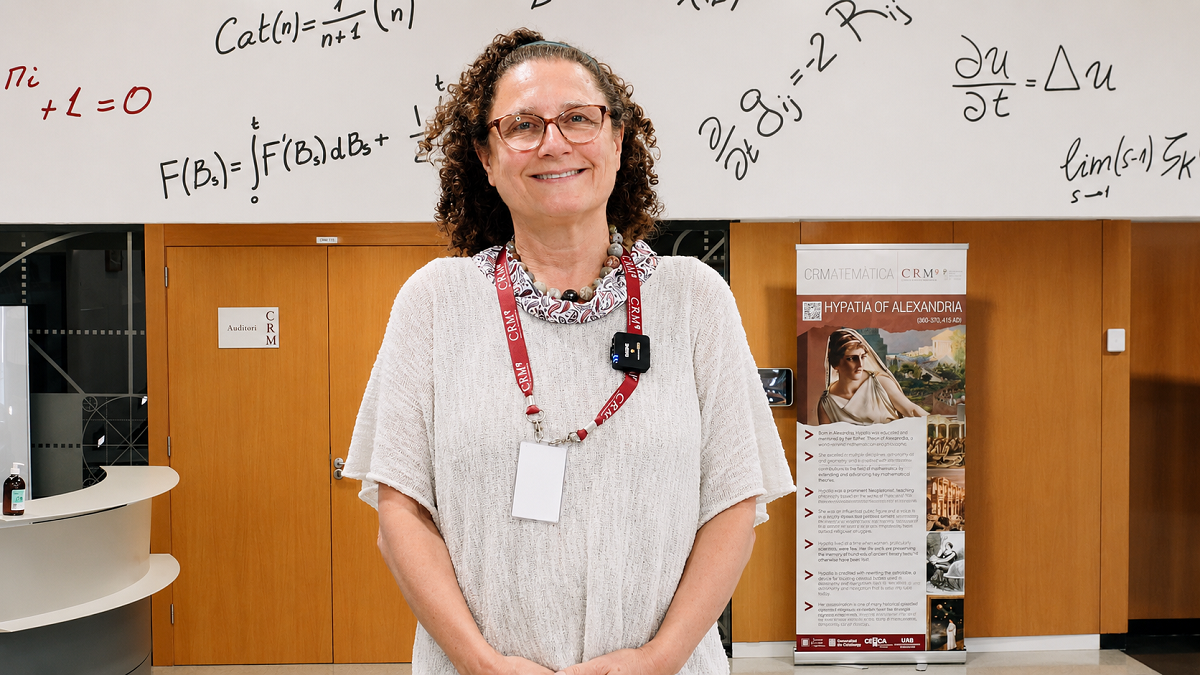
Susanna Terracini delivers the CRM Colloquium 2026
Susanna Terracini (Università di Torino) delivered the CRM Colloquium 2026 on 14 July, presenting a rigidity result for Kepler billiards obtained with Stefano Baranzini, Vivina Barutello and Irene De Blasi. She was at the centre as a member of the CRM Scientific...
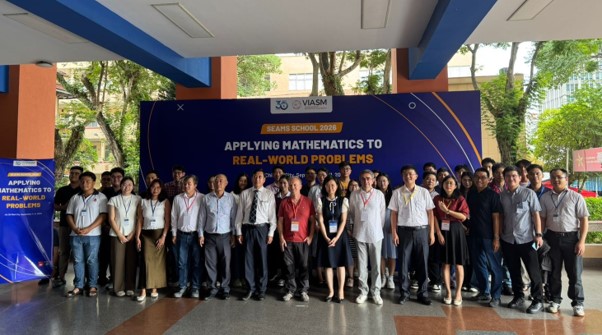
Ho Chi Minh City hosts the first SEAMS School on applying mathematics to real-world problems
More than fifty students from six countries spent a week at the University of Science, VNU-HCM, learning how mathematics gets used outside a mathematics department. CRM researcher Tim Myers co-organised the school and lectured on moving boundary problems. The...

A single ball on a fixed table can compute: Eva Miranda and Isaac Ramos prove that two-dimensional billiards are Turing complete
Eva Miranda (UPC, CRM) and Isaac Ramos (ETH Zürich) show that a point particle bouncing inside a planar table with fixed walls can simulate a universal Turing machine, settling a question Cristopher Moore left open in 1990. The result grew out of a master’s project...
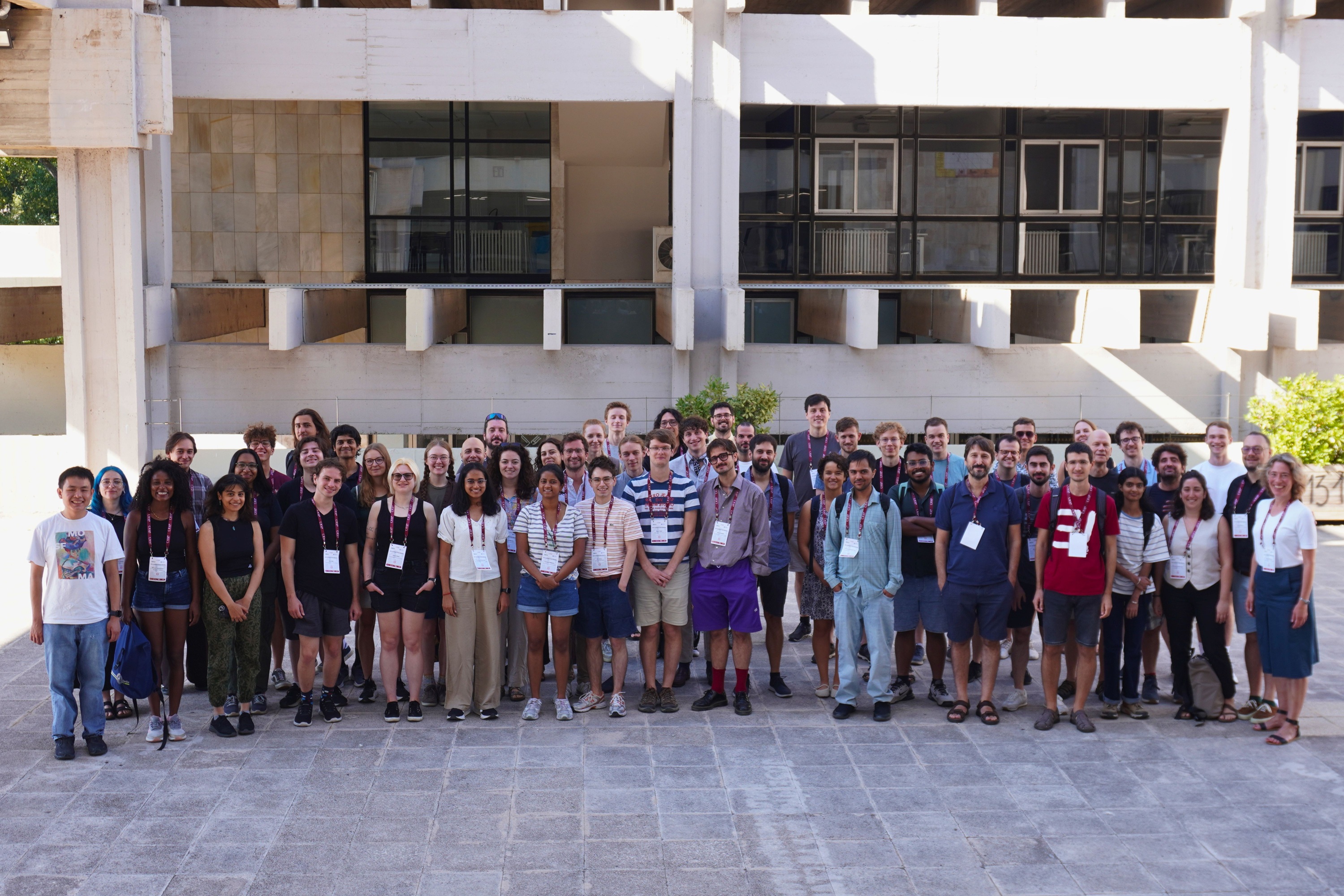
BMS-BGSMath Junior Meeting 2026: Barcelona and Berlin Strengthen Scientific Ties
From 2 to 4 September 2026, the Centre de Recerca Matemàtica (CRM) hosted the BMS-BGSMath Junior Meeting 2026, a three-day event jointly organised by the Berlin Mathematical School (BMS) and the Barcelona Graduate School of Mathematics (BGSMath), with the Centre de...
The CRM organises the 2026 Barcelona Summer School for Advanced Modeling of Behavior
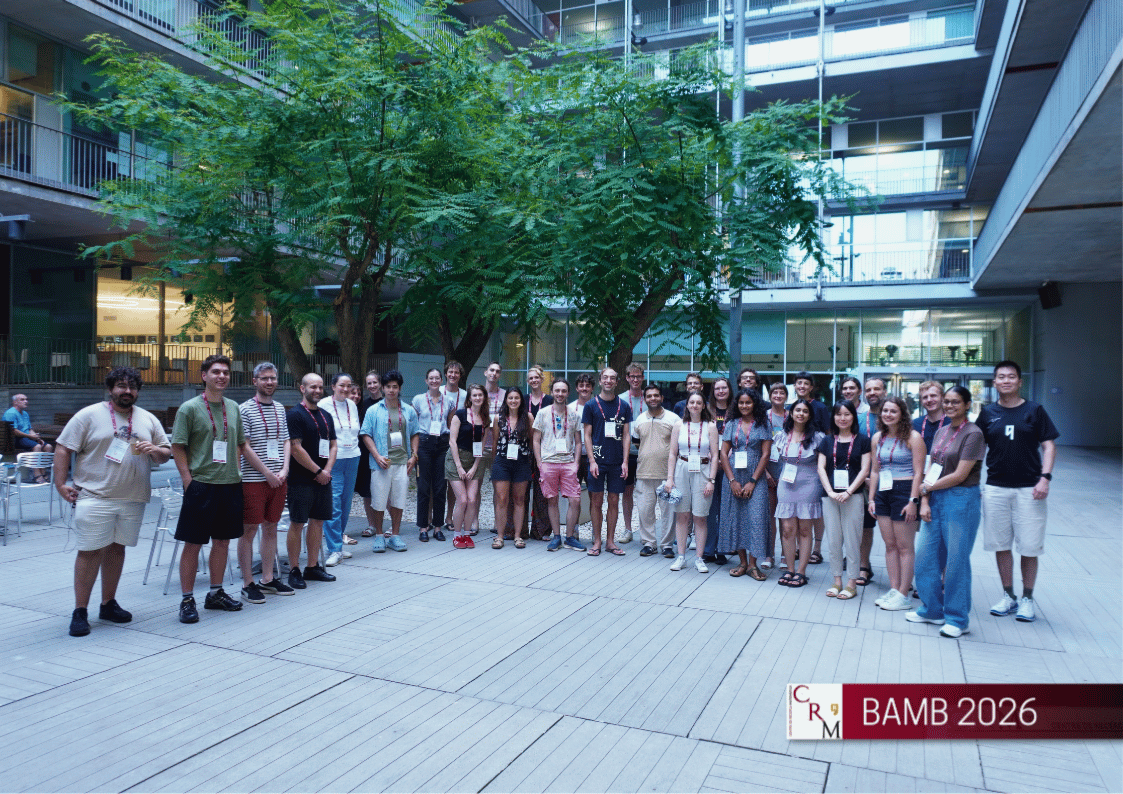
The Centre de Recerca Matemàtica held the sixth edition of BAMB!, the Barcelona Summer School for Advanced Modeling of Behavior, from 12 to 23 July 2026 at the Parc de Recerca Biomèdica de Barcelona. Thirty early-career researchers from fourteen countries followed...
Mallorca’s 1820 plague did not behave like a classic bubonic outbreak, study finds
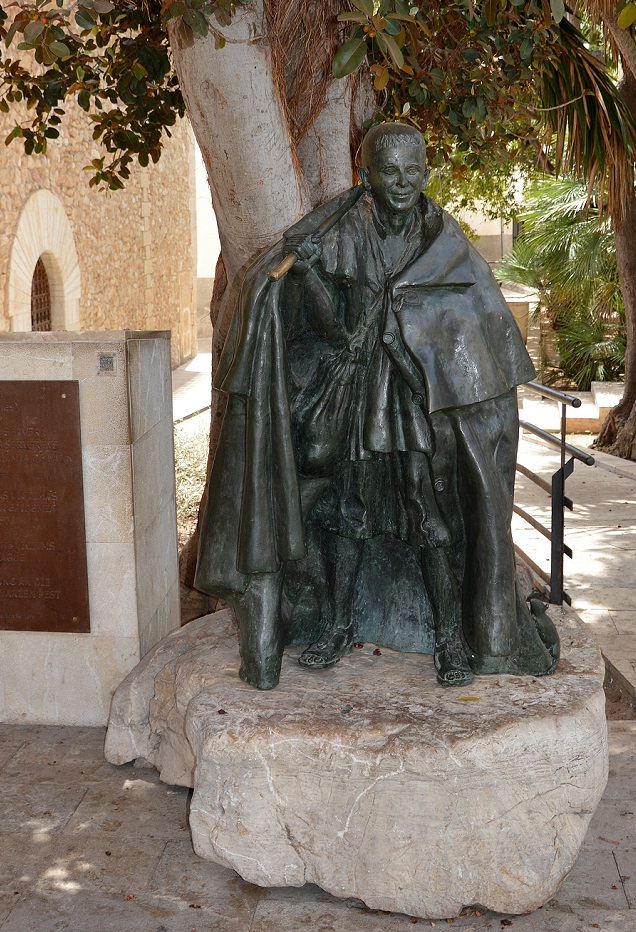
A study in PNAS by Pere Puig (UAB, CRM) and Joana Maria Pujadas-Mora (UOC, ICREA) reports what happens when the daily health records kept in Son Servera and Capdepera during the 1820 outbreak are analysed with a Bayesian epidemiological model: an unusually short...
|
|
CRM CommNatalia Vallina
|