The second edition of CAVARET, “Curves, Abelian VArieties and RElated Topics”, took place at the Faculty of Mathematics and Computer Science of the Universitat de Barcelona from 13 to 17 July 2026. Sixteen invited lectures and ten posters brought together 83 researchers who work on algebraic curves and abelian varieties from arithmetic, geometric and computational perspectives.
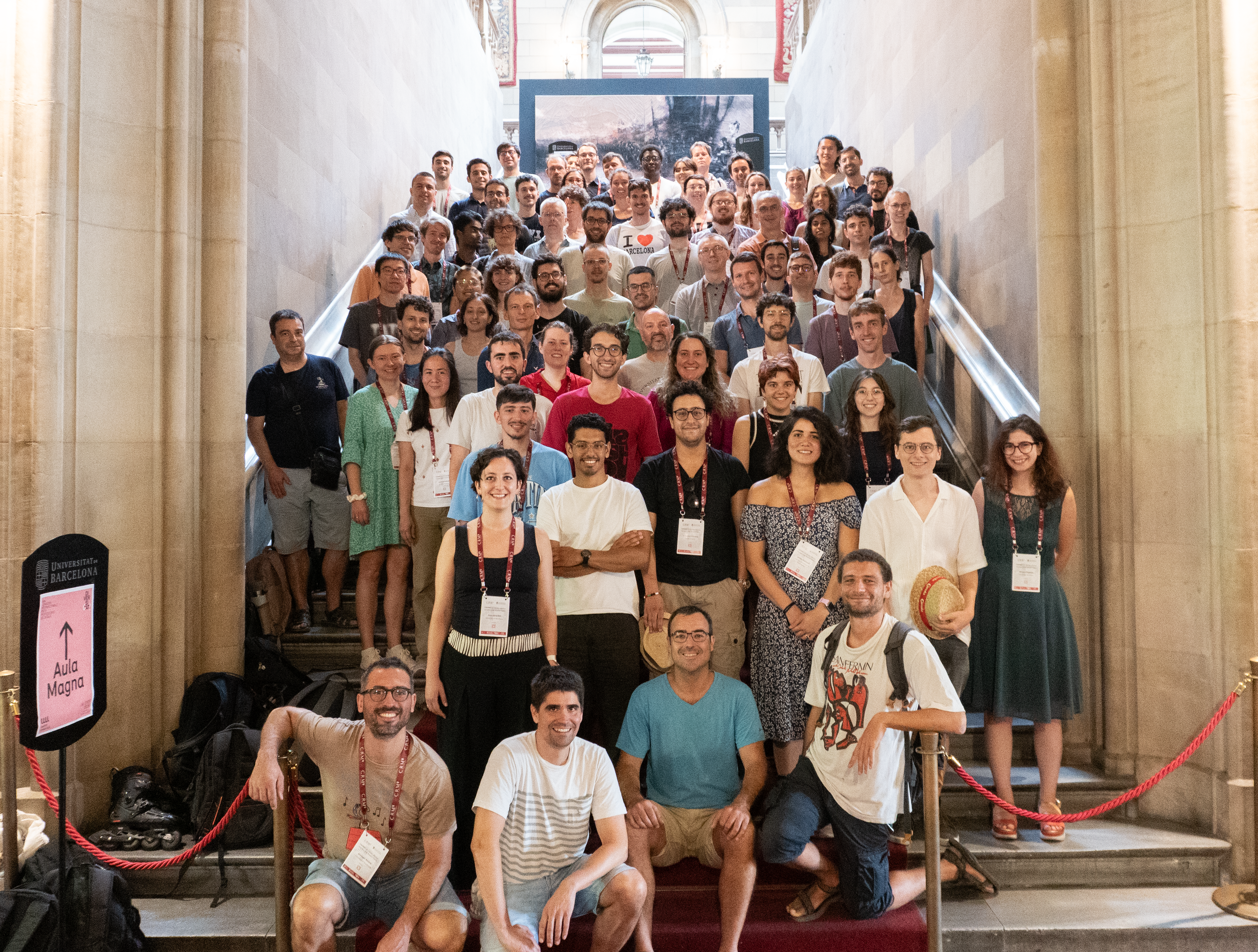
CAVARET 2, “Curves, Abelian VArieties and RElated Topics”, was held from 13 to 17 July 2026 at the Faculty of Mathematics and Computer Science of the Universitat de Barcelona, organised by the Centre de Recerca Matemàtica. The organising committee was made up of Emiliano Ambrosi and Giuseppe Ancona (Université de Strasbourg) together with Francesc Fité and Xavier Guitart (Universitat de Barcelona and CRM), the four organisers of the first edition in 2024. Ana Botero (Universität Bielefeld) and Anna Cadoret (Sorbonne Université) formed the scientific committee. The programme comprised sixteen invited lectures and a poster session, with 83 registered participants from institutions including Harvard, MIT, the National and Kapodistrian University of Athens, the Università di Padova, the University of Groningen and BITS Pilani in Hyderabad.
“Even if we think of the Millennium Problems: Birch and Swinnerton-Dyer, the Hodge conjecture, and to some extent the Riemann hypothesis, they already manifest in the field of abelian varieties.” Emiliano Ambrosi, Université de Strasbourg
The organisers chose the subject for its centrality. “These are objects that already illustrate some of the very important open questions in mathematics,” said Emiliano Ambrosi. “Even if we think of the Millennium Problems: Birch and Swinnerton-Dyer, the Hodge conjecture, and to some extent the Riemann hypothesis, they already manifest in the field of abelian varieties.” The aim was to bring together communities that rarely share a room. “Often there are people who work on abelian varieties and curves from one perspective, in one field,” Ambrosi added. “One of the main ideas was to make people who see the same object from different perspectives interact.”
The scientific programme
Modular curves opened the week. Jan Vonk (Leiden University) presented results on the arithmetic geometry of non-split Cartan modular curves at primes of bad reduction, with consequences for the ranks of their Jacobians, focusing on height pairings of CM and RM cycles. Juanita Duque Rosero (Boston University) spoke on triangular modular curves, which arise from quotients of the complex upper half-plane by congruence subgroups of hyperbolic triangle groups and connect to Darmon’s programme for rational points on generalised Fermat equations; with John Voight she has classified the Borel-kind triangular modular curves by genus. On Tuesday, Sachi Hashimoto (Brown University) addressed Mazur’s Program B, presenting a parameterisation of the rational points on all modular curves, conditional on a conjecture of Zywina, and asking to what extent those points arise from the intrinsic geometry of the curves.
Several talks addressed curves and abelian varieties in positive characteristic. Rachel Pries (Colorado State University) works on curves over finite fields with large automorphism groups. “A lot of my research is about finding curves that are very rare and unusual,” she explained. Supersingular curves have been identified genus by genus, first in genus one, then two, three and four; the results she presented in Barcelona extend to genus five. Her talk set out a method for counting the non-ordinary curves in any one-parameter family of cyclic covers of the projective line, generalising the Eichler–Deuring mass formula and the genus 2 results of Ibukiyama, Katsura and Oort. The proof uses intersection theory in the Chow ring and is joint work with Cavalieri; the application to special families of curves of genus 3 to 7 is joint with Cavalieri and Mantovan. The purpose of extending the calculation, she noted, is evidential: “We were trying to get evidence for big conjectures that people don’t know yet whether they will be true or false.”
Valentijn Karemaker (University of Amsterdam) approached the same territory through moduli, presenting geometric properties of the supersingular locus S_g in the moduli space of abelian varieties in characteristic p, including its geometric irreducibility, and discussing Oort’s conjecture, now proven, which establishes that generic points of S_g have automorphism group {±1}.
Christophe Ritzenthaler (Université de Rennes) traced the development of arithmetic statistics for curves over finite fields, from the general framework established by Katz and Sarnak in the nineties to recent results giving a more precise account of the asymptotic distribution of point counts. Asked which open problems he currently finds most compelling, he returned to the same question. Katz and Sarnak had described the distribution by means of precise continuous functions. Around ten years ago, Ritzenthaler and his colleagues carried out experiments suggesting the description could be sharpened, and formulated a conjecture; in 2024 it was shown that their conjecture required the addition of local terms; and earlier this year two young mathematicians produced what amounts to a proof. “In my field things don’t usually move so fast,” he said.
Javier Fresán (IMJ-PRG) presented joint work with Arthur Forey, Emmanuel Kowalski and Yuval Wigderson on graphs associated with Sidon sets. Although such graphs avoid certain prescribed subgraphs and are therefore not random, when the Sidon set is the set of rational points of a curve over a finite field embedded in its Jacobian, the eigenvalues of the adjacency matrix become equidistributed according to the Sato–Tate measure as the size of the field grows. Elena Berardini (Université de Bordeaux) spoke on abelian surfaces over finite fields containing no curves of small genus, a question that arises from coding theory: algebraic geometry codes constructed from an abelian surface satisfy a lower bound on their minimal distance that improves as the smallest genus of the curves contained in the surface increases. With A. Giangreco-Maidana and S. Marseglia she has characterised the isogeny classes of abelian surfaces containing no curves of genus 3 or less.
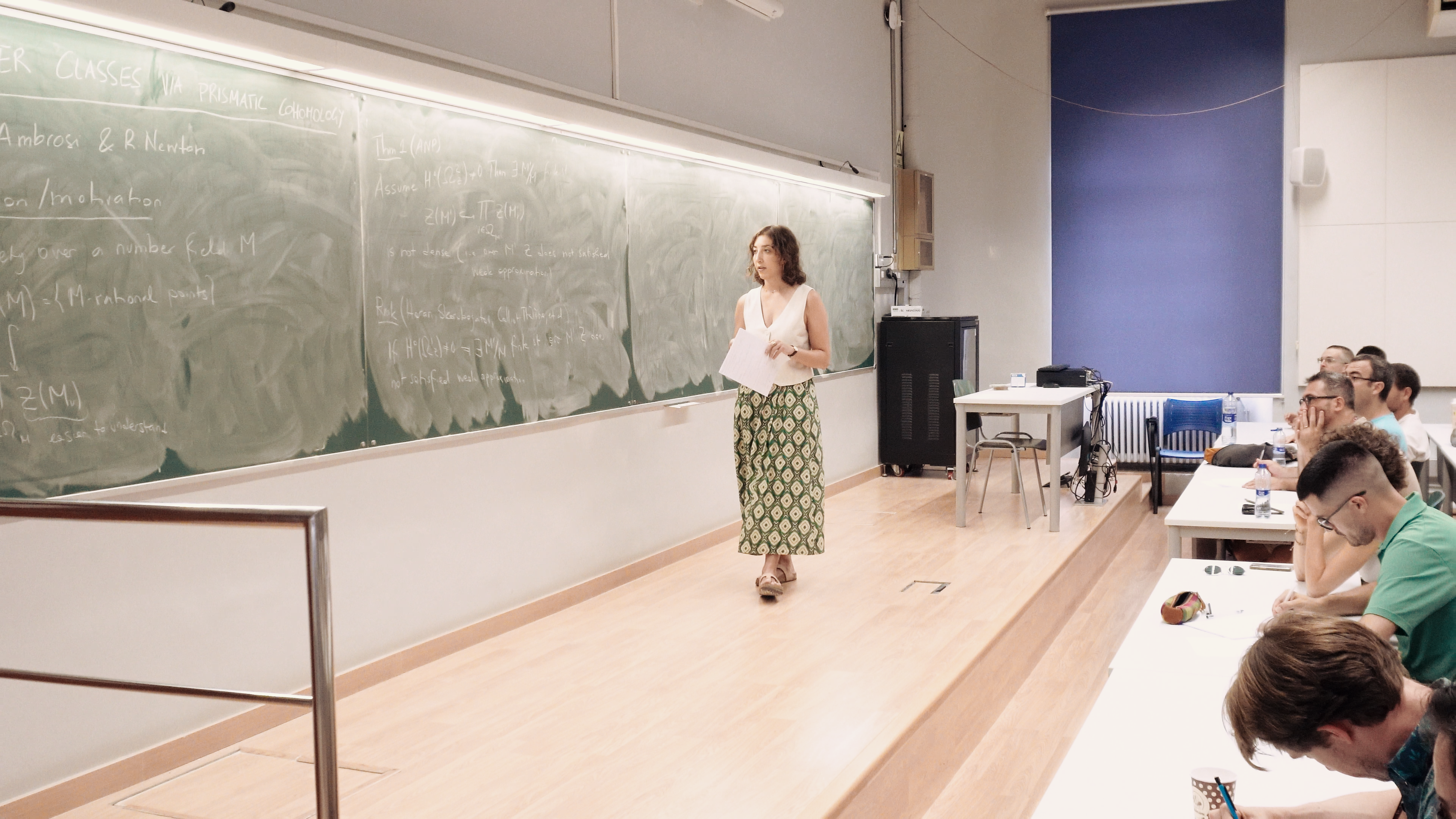
Periods and motives occupied much of the second half of the week. Emmanuel Ullmo (IHES), in joint work with Ziyang Gao, showed that for any simple CM abelian variety A one can construct a CM abelian variety B such that all non-trivial Hodge relations between the holomorphic periods of A × B are generated by explicit monomial quadratic relations. Charles Vial (Universität Bielefeld) presented work with Tobias Kreutz and Mingmin Shen on the de Rham–Betti conjecture and its variant with coefficients, a special case of the Grothendieck period conjecture, for abelian and hyper-Kähler varieties. Olivier Benoist (ENS de Paris) proved that function fields of curves over number fields have Pythagoras number at most 5, answering a question of Pop and Pfister. Margherita Pagano (Imperial College London) presented joint work with Emiliano Ambrosi and Rachel Newton using prismatic cohomology to establish the existence of p-torsion Brauer classes with surjective evaluation map. Jef Laga (University of Cambridge) returned to a question posed by Poonen and Stoll in the nineties, on whether every polarization of an abelian variety can be represented by a line bundle on some torsor, and explained why the answer is often positive and sometimes not. Dragoș Frățilă (Université de Strasbourg) closed Thursday with a new obstruction to descent up to isogeny, encoded in a matrix of p-adic numbers he calls ramified periods, arising from the comparison isomorphism between de Rham and crystalline cohomology, with examples of hyperelliptic curves over Q(√p) isomorphic to their Galois conjugates whose Jacobians do not descend to Q.
Friday was devoted to Hodge theory. Roberto Gualdi (Universitat Politècnica de Catalunya), in joint work with Paolo Dolce and Riccardo Pengo, presented an arithmetic version of the Kähler package in the context of Arakelov geometry, relating its validity to positivity conditions on the hermitian line bundle involved and to the strong form of the arithmetic standard conjectures proposed by Gillet and Soulé. Bruno Klingler (Humboldt-Universität zu Berlin) closed the conference with a construction that associates, to a smooth quasi-projective variety S carrying a polarizable complex variation of Hodge structure on the complement of a normal crossing divisor, a finitely generated subring of the rational Chow ring of S, generalising the classical construction of the tautological ring of A_g.
Techniques in common
Participants repeatedly identified the diversity of methods as the distinguishing feature of the week. “What always impresses me about these talks is that people are using very different techniques to solve problems that are very similar,” said Rachel Pries, citing the analytic and probabilistic tools applied to curves over finite fields in Ritzenthaler’s talk, the topological and lattice-theoretic methods in Karemaker’s, and the appearance of error-correcting codes, a subject she teaches to undergraduate students.
“By its nature research is unpredictable. If you know what you’re doing, what’s the point of doing it?” Christophe Ritzenthaler, Université de Rennes and director of CIMPA
Ritzenthaler described his own work in similar terms of exchange. “I’m not a theory builder, I’m more of a problem solver, in the sense that I pick problems that I find beautiful.” His central problem can be stated simply: fixing a finite field and a genus, find a curve of that genus passing through as many points as possible. Elementary to formulate and open to experiment, a complete answer for all finite fields at a fixed genus would require concepts deep enough to bear on the Schottky problem. He also noted that most participants worked over number fields rather than finite fields, where results are less effective because, in his words, “number fields are much more complicated than finite fields, and the Galois group is much harder to handle.”
Rachel Pries also reported that her talk incorporated results obtained through collaboration with AI systems, the first such project of her career. She has directed VaNTAGe, a virtual seminar on open conjectures in number theory and arithmetic geometry, since January 2020, which has recently run thematic series on Lean formalization of number theory and on machine learning in number theory.
Ritzenthaler has also directed CIMPA, the International Centre for Pure and Applied Mathematics, for the past six years. Founded in 1978 and based in Nice, the centre is a UNESCO Category 2 institution supported by Germany, France, Norway, Spain and Switzerland, and its work is to include researchers and students from developing countries in the international mathematical community, through research schools held in those countries and through grants supporting stays at research institutes elsewhere. One such agreement is held with the CRM, funding one- and two-month stays during the centre’s thematic semesters. “We can’t really see how powerful it is, because we’re spoiled with a good research environment and many events,” he said. “But for researchers who are quite isolated from the rest of the community, this is really a game changer.”
Meeting in person
Asked why in-person meetings remain necessary, Ritzenthaler noted that ERCOM, the European network of mathematics research centres of which the CRM is a member, had surveyed its members on online events during the pandemic, when reactions were largely negative and video conferencing was less developed than it is now. He considered the verdict deserving of qualification today, since remote access allows participation by those whose family or professional circumstances prevent travel. What has not been replaced, in his view, is the unplanned encounter. “By its nature research is unpredictable. If you know what you’re doing, what’s the point of doing it?” He praised the format adopted by CAVARET, with a small number of talks and long breaks, and suggested that conferences might go further in exchanging lecture time for collaborative working sessions.
“I think it filled a role where people suddenly learned that maybe math doesn’t need to be so isolated. Maybe math can be something that we work on together.” Rachel Pries, Colorado State University
Rachel Pries established VaNTAGe for reasons of geography, Colorado being distant from other universities and every conference requiring air travel. Launched in January 2020 and expanded when Andrew Sutherland made MIT’s video conferencing capacity available during the pandemic, the seminar now draws around thirty live participants per session but has accumulated between fifty and sixty thousand recorded views. The talks are organised in thematic series and oriented towards open conjectures, so that graduate students can return to them later and encounter several perspectives on a topic at once. Sutherland, who co-organises the seminar with her, was among the participants at CAVARET 2.
Pries is also a founder of Women in Numbers, which she began with collaborators in response to conditions she described plainly. “The conferences were just not so fun to go to. It was very masculine and very hierarchical and very isolating.” The model, women at all career stages working together on research projects, was subsequently taken up as Women in Algebraic Geometry, Women in Topology and Women in Analysis. “I think it filled a role where people suddenly learned that maybe math doesn’t need to be so isolated. Maybe math can be something that we work on together.” She observed that large collaborations spanning countries, career stages and techniques have since become standard practice across the community.
Early-career participation and continuity
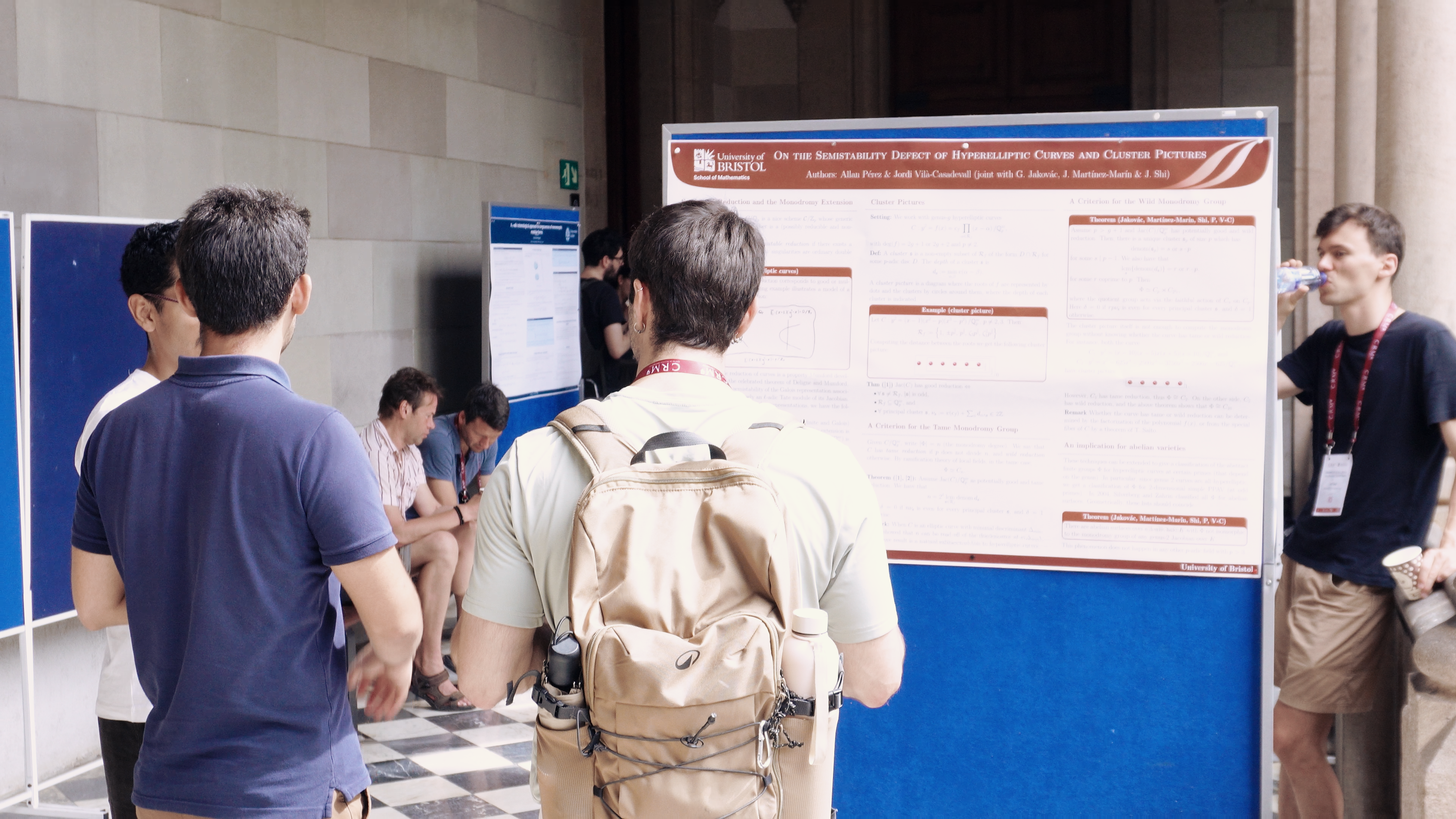
Ten posters were presented over the course of the week, by Jessica Alessandrì and Nirvana Coppola, Lorenzo Andreaus, Matt Broe, Paolo Bordignon, François Gatine, Júlia Martínez-Marín, Dimitrios Noulas, Pankaj Patel, Jordi Vilà-Casadevall and Robin Visser, most of them doctoral students and early postdoctoral researchers.
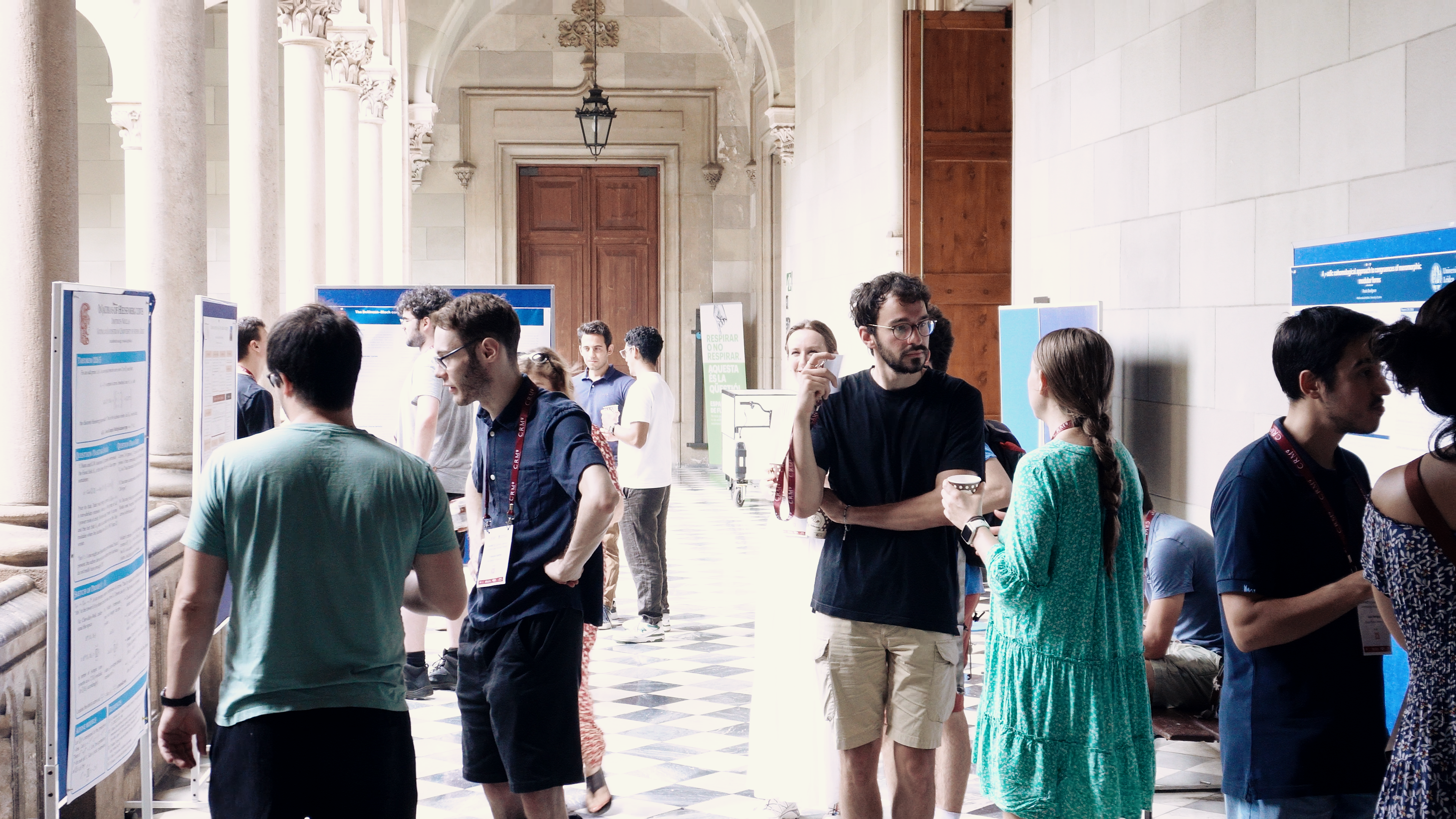
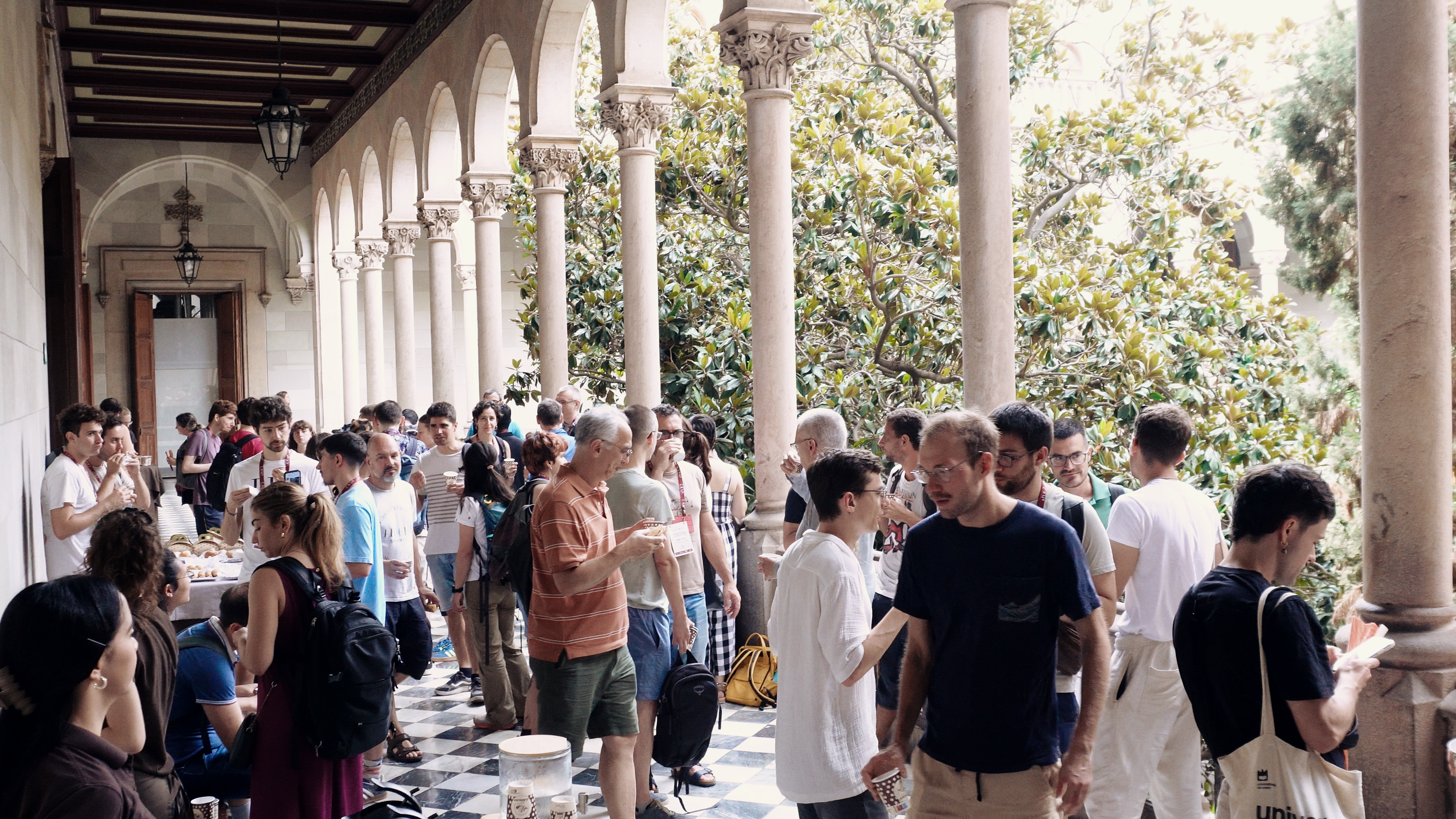
The organisers identified the atmosphere as one of the successes of the edition. “One thing I particularly enjoyed is that the atmosphere was very relaxed. People were asking lots of questions during talks, and this is something you don’t always see,” said Xavier Guitart. Giuseppe Ancona noted that younger participants approached senior colleagues without hesitation, which he observed is not always the case, and that the students attending will in time become each other’s collaborators.
Francesc Fité described the value of hosting the conference as running in both directions: an opportunity for the local community to engage with a wide range of topics and speakers, and an occasion for visiting researchers to become better acquainted with the arithmetic and algebraic geometry community in Barcelona. He also offered a measure of the first edition’s effect. At a conference held in Barcelona this February, several of the talks presented joint work that had begun at CAVARET in 2024.
Full video interviews with Christophe Ritzenthaler, Rachel Pries and the organisers of CAVARET 2 will be published on the CRM website in the coming weeks.
Newsletter
Get the latest CRM news and activities delivered to your inbox
Subscribe now
Recent newsletters →
Almost every automaton can be reset with a short word
For a random automaton with n states, a word of about √n log n letters is almost always enough to reset it.CRM CommPau VarelaCRMComm@crm.catGet the latest CRM news and activities in your inbox.Recent newsletters →Picture a conveyor belt carrying...
Exposició ‘Les matemàtiques de Gaudí’

CRM quod erat demonstrandum | 48

ADA: Decoding Brain Signals Misaligned in Time
The study addresses a key limitation of current brain decoding techniques: the difficulty of interpreting internal mental processes whose temporal dynamics vary from trial to trial.Decoding what is happening in a person’s mind from their brain activity is one of the...
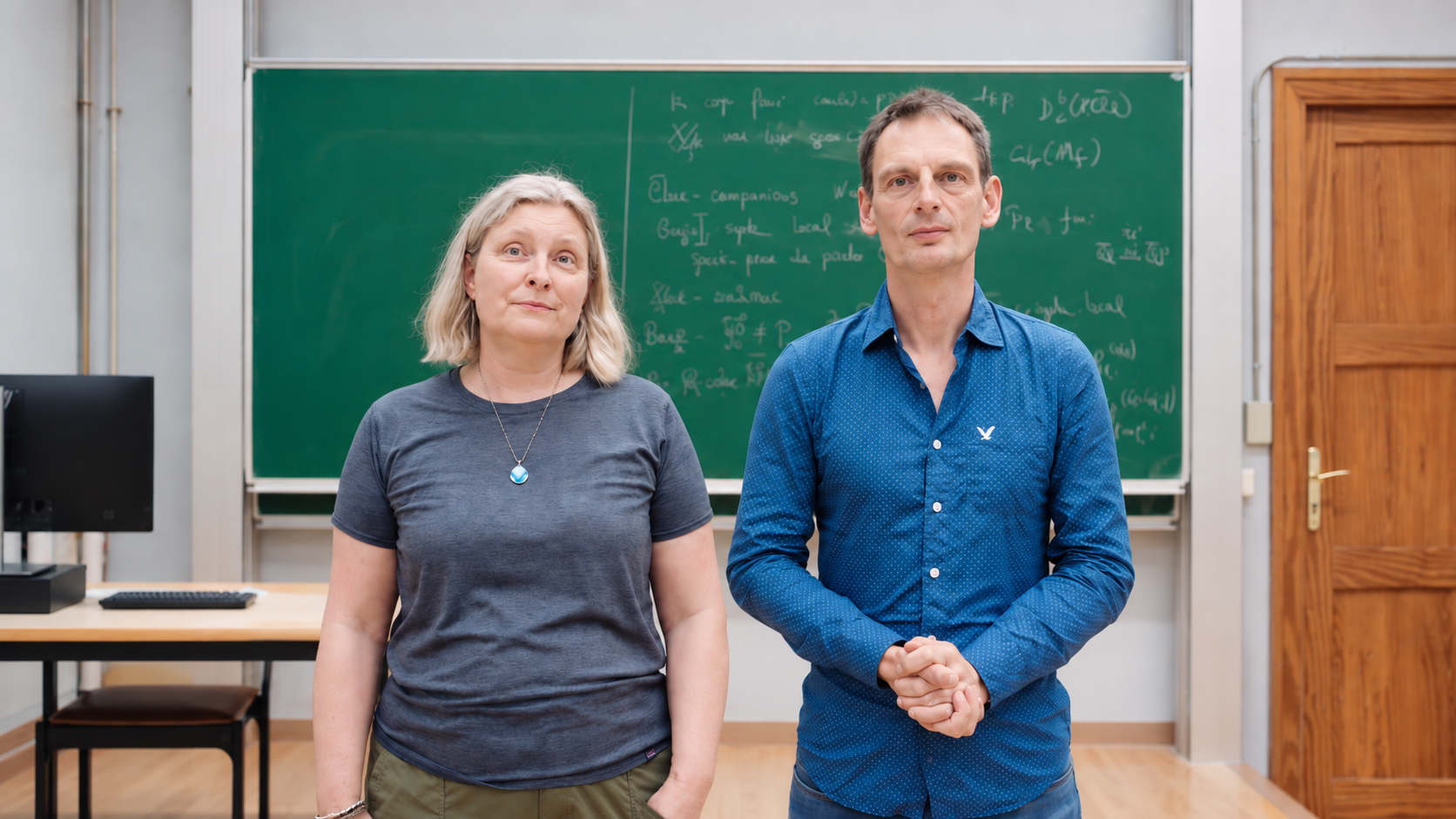
Rare curves, many points: Christophe Ritzenthaler and Rachel Pries on their research and the work around it
Christophe Ritzenthaler (Université de Rennes) and Rachel Pries (Colorado State University) both work on curves over finite fields: he hunts curves with as many points as possible, she hunts curves that almost never occur. In conversation with the CRM during their...
|
|
CRM CommPau Varela
|