Hong Wang (NYU Courant and IHES) has received the Fields Medal at the International Congress of Mathematicians in Philadelphia, alongside Yu Deng (University of Chicago), John Pardon (Stony Brook University) and Jacob Tsimerman (University of Toronto). In June 2025, Wang visited the Centre de Recerca Matemàtica during the Intensive Research Programme on Modern Fourier Analysis, where she gave a lecture.
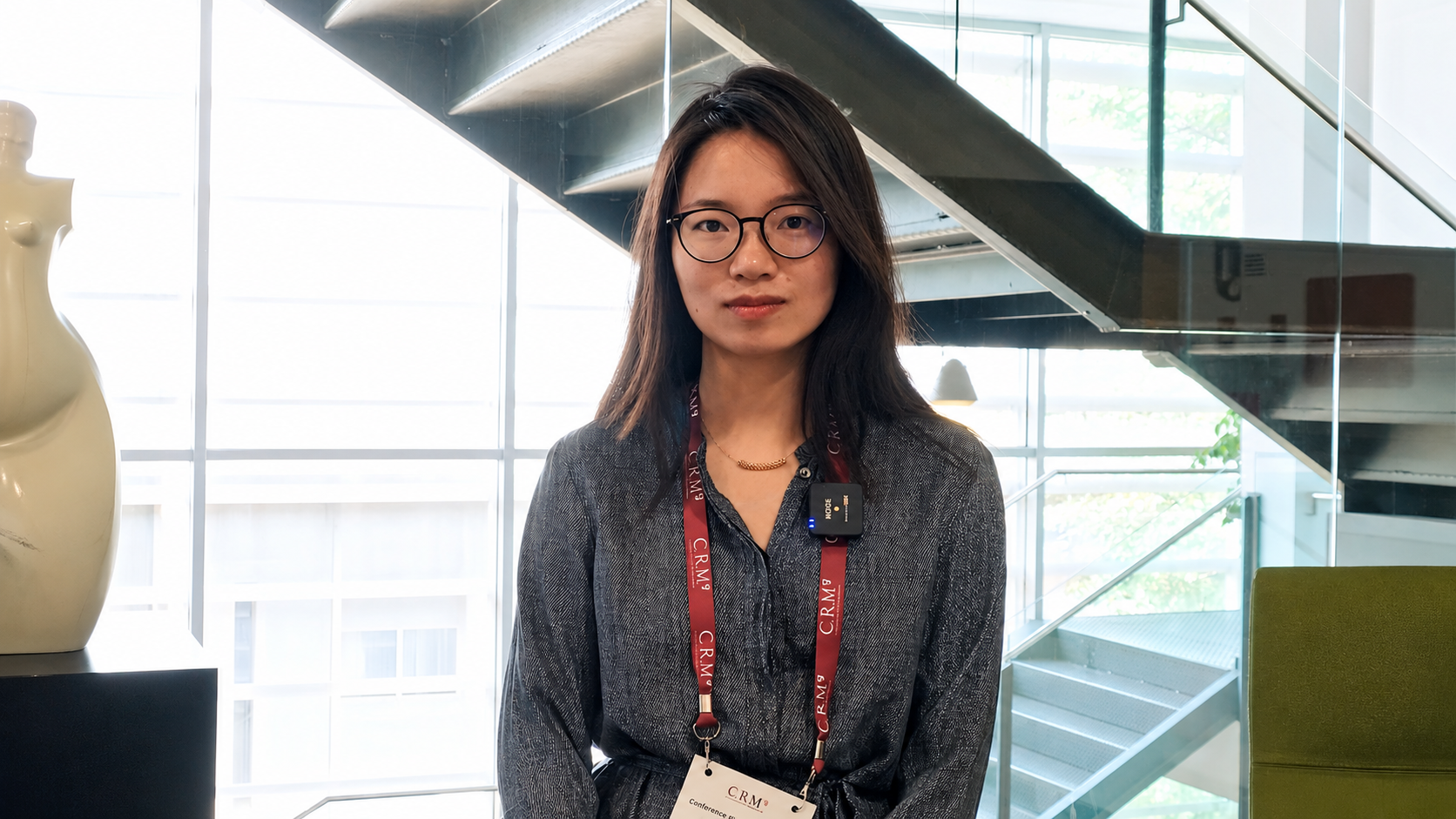
When Hong Wang walked into the CRM auditorium in June 2025, she had every reason to talk about the Kakeya conjecture. Fourteen weeks earlier, she and Joshua Zahl (University of British Columbia) had posted a 127-page proof of its three-dimensional case, a problem that had resisted every serious attempt for half a century. Terence Tao had called it one of the most sought-after open problems in geometric measure theory. She talked about something else.
Her lecture, on joint work with Shukun Wu, presented a geometric route towards Stein’s restriction conjecture, a question about functions whose Fourier transform lives on a sphere. The Kakeya proof came up in the interview afterwards, recorded between sessions of the Modern Trends in Fourier Analysis conference, which gathered over a hundred harmonic analysts at the CRM that week.
The problem she had just solved starts with a needle. In 1917, the Japanese mathematician Sōichi Kakeya asked how little area a line segment needs in order to turn and point in every direction. Rotating it about its centre traces a disc, but cleverer motions do better, and by 1928 Besicovitch had shown the answer can be made arbitrarily close to zero. The modern conjecture concerns the sets swept out this way: however thin, they should still have full dimension. Wang and Zahl proved it in three-dimensional space. A Kakeya set in R³ may occupy almost no volume, but its Hausdorff and Minkowski dimension is exactly 3. Thin, yes. Small, no.
“YOU HAVE TO BE HONEST WITH YOURSELF. SOMETIMES YOU SPEND A LONG TIME AND YOU NEED TO EVALUATE WHETHER YOU HAVE MADE PROGRESS OR WHETHER THINGS ARE REALLY STUCK. NOT TOO OPTIMISTIC, NOT TOO PESSIMISTIC.”
For Wang, the setting matters as much as the statement. “It concerns the three-dimensional space that we all live in,” she said in the interview. “If you change it to three-dimensional complex space, the statement we proved is false.” Any working strategy has to tell real numbers apart from complex ones, and most standard tools don’t. “It’s very easy to try to solve the problem using the tools you’re familiar with. But those tools might not distinguish real numbers and complex numbers, and that makes the approach impossible.”
The proof went in stages. Following ideas of Nets Katz, Wang and Zahl first handled a special class called sticky sets, then spent a further paper pushing the result to all sets. The key to that last step, she explained, came from work of Pablo Shmerkin: the idea that fractal structure can be found in any set, provided you look at the right scales. “This was a big turning point for my understanding of the area,” she said. “How to find structure in something very general, that might not have structure at all.”
On 23 July, at the ICM opening ceremony in Philadelphia, the International Mathematical Union awarded her the Fields Medal, together with Yu Deng (University of Chicago), John Pardon (Stony Brook University) and Jacob Tsimerman (University of Toronto). The citation honours her “for her work in harmonic analysis and geometric measure theory, including applications of multiscale and decoupling techniques to the local smoothing conjecture for the planar wave equation, and major advances in Fourier restriction, Falconer distance sets, Furstenberg sets in the plane, and the Kakeya problem in three dimensions”. Presented every four years since 1936 to between two and four mathematicians under forty, the medal is the most recognisable distinction in the discipline. Wang is the third woman to receive it, after Maryam Mirzakhani (2014) and Maryna Viazovska (2022). The same congress features an unusually strong Catalan presence, with a plenary lecture by Xavier Tolsa (ICREA-UAB-CRM) and invited talks by Xavier Cabré (ICREA-UPC-CRM) and Joaquim Ortega-Cerdà (UB-CRM).
None of it was quick. Wang traced her interest in restriction back more than a decade, to a paper by Luis Vega (BCAM) she read as a student. Asked what she finds rewarding about problems that take years, or decades, or never give in at all, she answered with something closer to method than to sentiment. “You have to be honest with yourself. Sometimes you spend a long time and you need to evaluate whether you have made progress or whether things are really stuck and you might need to move on. Not too optimistic, not too pessimistic. I think that process is rewarding.” And when the years produce no solution: “The intuition and the tools you have developed might be used to study some other problems.”
Restriction, meanwhile, remains open. Kakeya in three dimensions would follow from it; the implication does not run the other way. The conjecture she came to Bellaterra to talk about is still waiting.
The full interview is available on the CRM YouTube channel:
Newsletter
Get the latest CRM news and activities delivered to your inbox
Subscribe now
Recent newsletters →
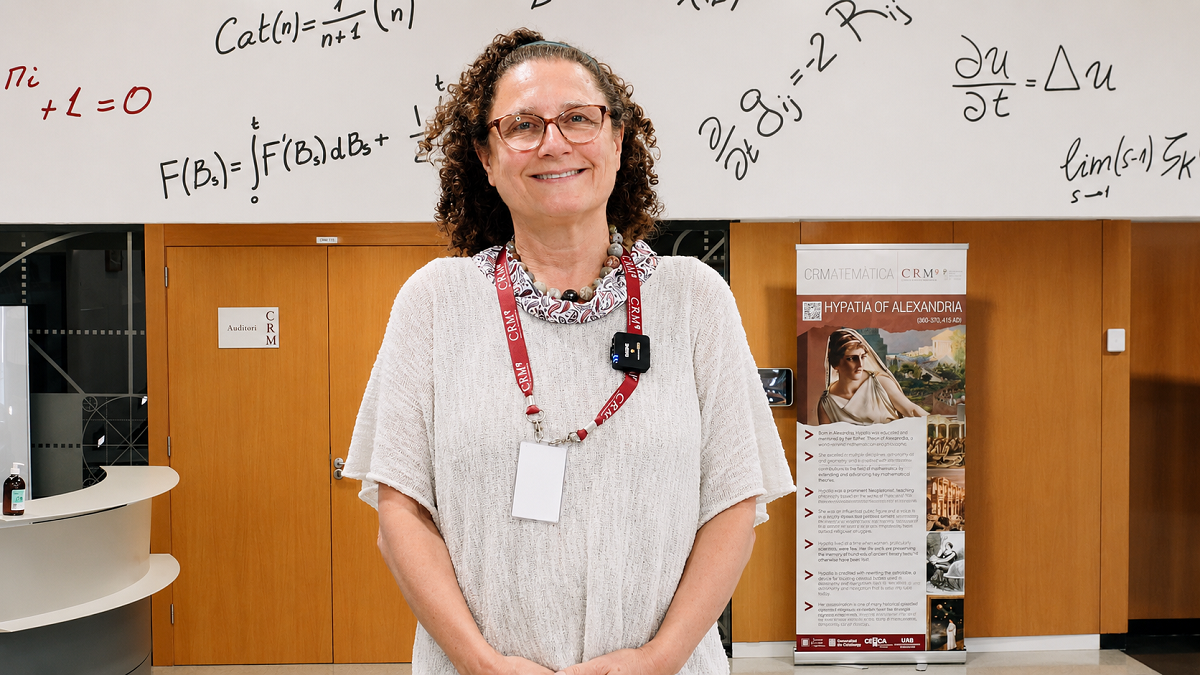
Susanna Terracini delivers the CRM Colloquium 2026
Susanna Terracini (Università di Torino) delivered the CRM Colloquium 2026 on 14 July, presenting a rigidity result for Kepler billiards obtained with Stefano Baranzini, Vivina Barutello and Irene De Blasi. She was at the centre as a member of the CRM Scientific...
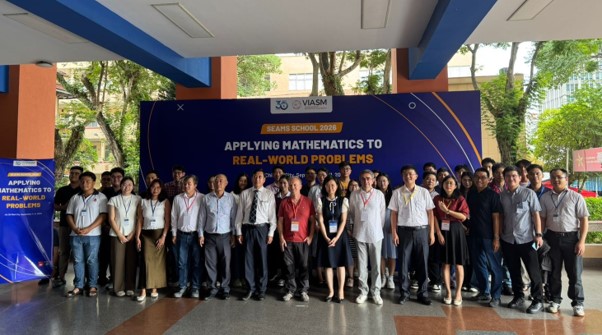
Ho Chi Minh City hosts the first SEAMS School on applying mathematics to real-world problems
More than fifty students from six countries spent a week at the University of Science, VNU-HCM, learning how mathematics gets used outside a mathematics department. CRM researcher Tim Myers co-organised the school and lectured on moving boundary problems. The...

A single ball on a fixed table can compute: Eva Miranda and Isaac Ramos prove that two-dimensional billiards are Turing complete
Eva Miranda (UPC, CRM) and Isaac Ramos (ETH Zürich) show that a point particle bouncing inside a planar table with fixed walls can simulate a universal Turing machine, settling a question Cristopher Moore left open in 1990. The result grew out of a master’s project...
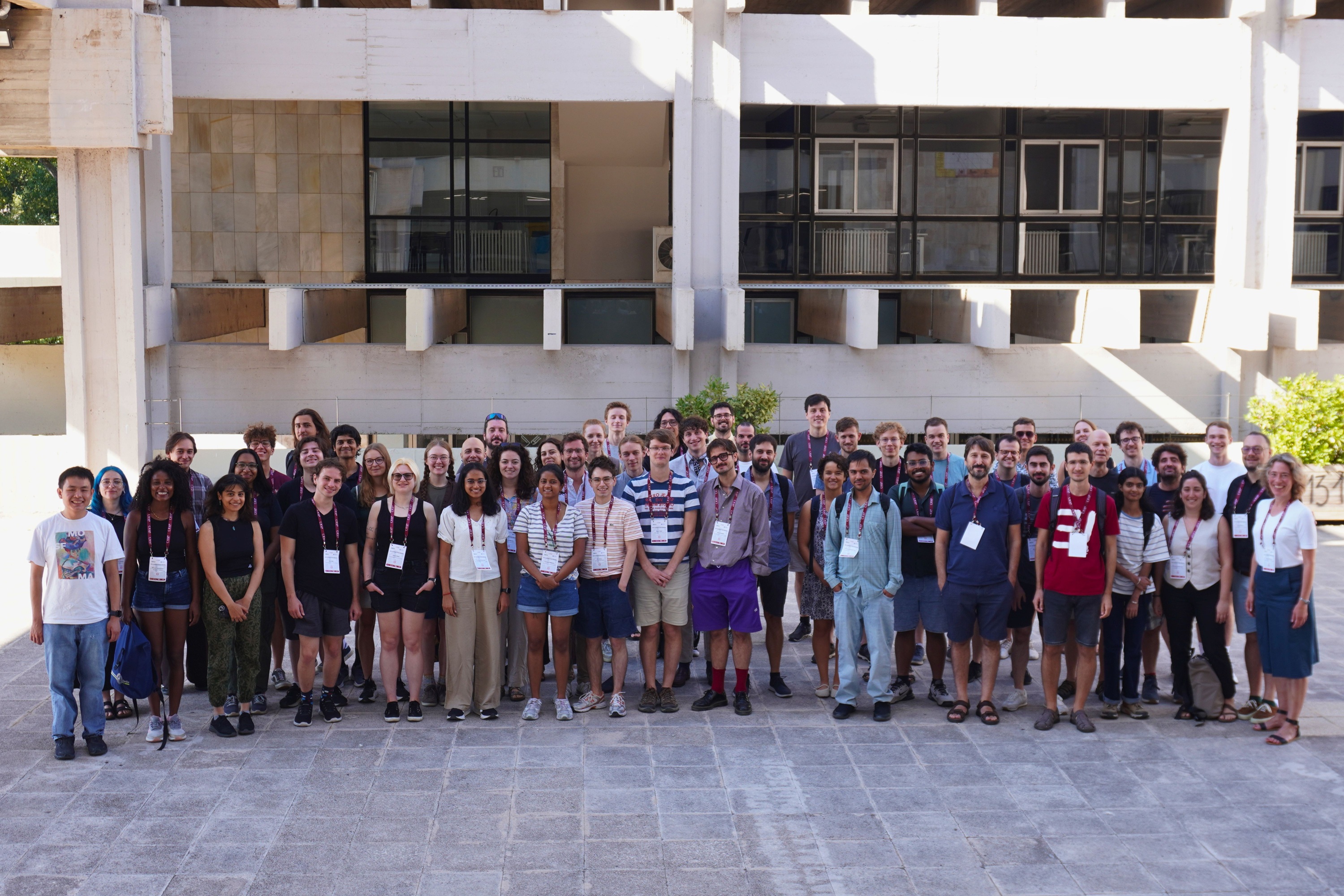
BMS-BGSMath Junior Meeting 2026: Barcelona and Berlin Strengthen Scientific Ties
From 2 to 4 September 2026, the Centre de Recerca Matemàtica (CRM) hosted the BMS-BGSMath Junior Meeting 2026, a three-day event jointly organised by the Berlin Mathematical School (BMS) and the Barcelona Graduate School of Mathematics (BGSMath), with the Centre de...
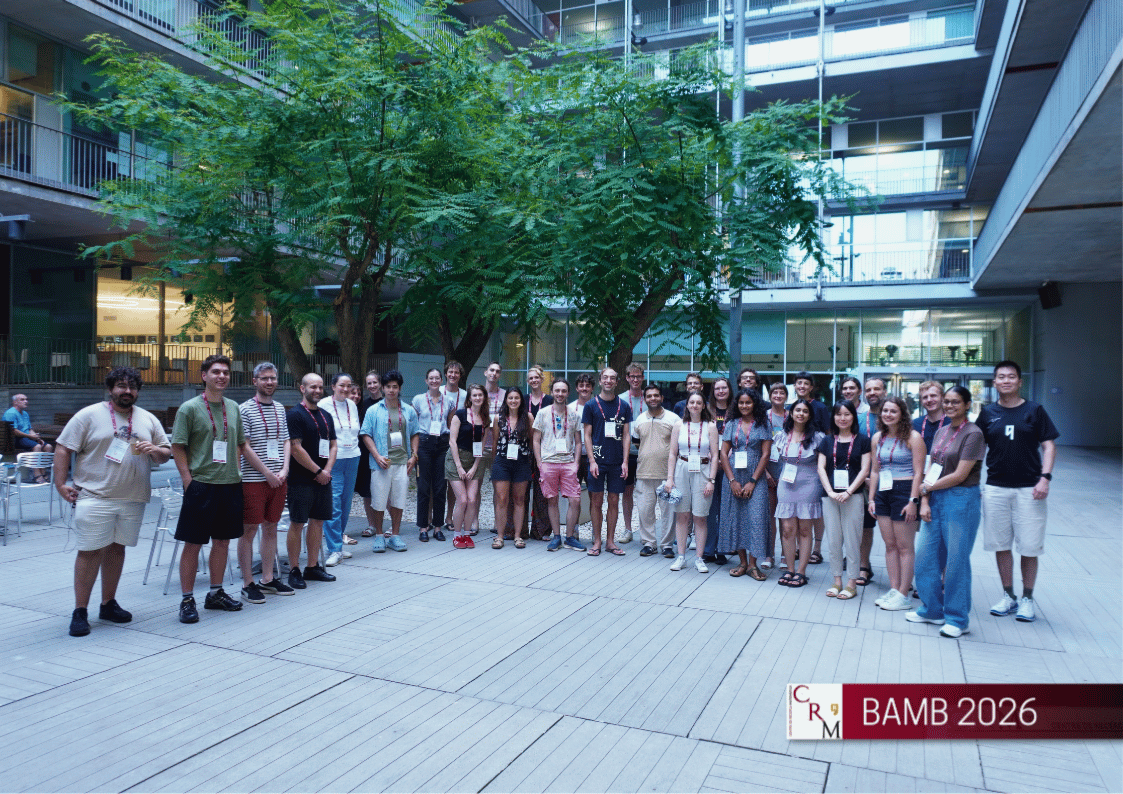
The CRM organises the 2026 Barcelona Summer School for Advanced Modeling of Behavior
The Centre de Recerca Matemàtica held the sixth edition of BAMB!, the Barcelona Summer School for Advanced Modeling of Behavior, from 12 to 23 July 2026 at the Parc de Recerca Biomèdica de Barcelona. Thirty early-career researchers from fourteen countries followed...
|
|
CRM CommPau Varela
|