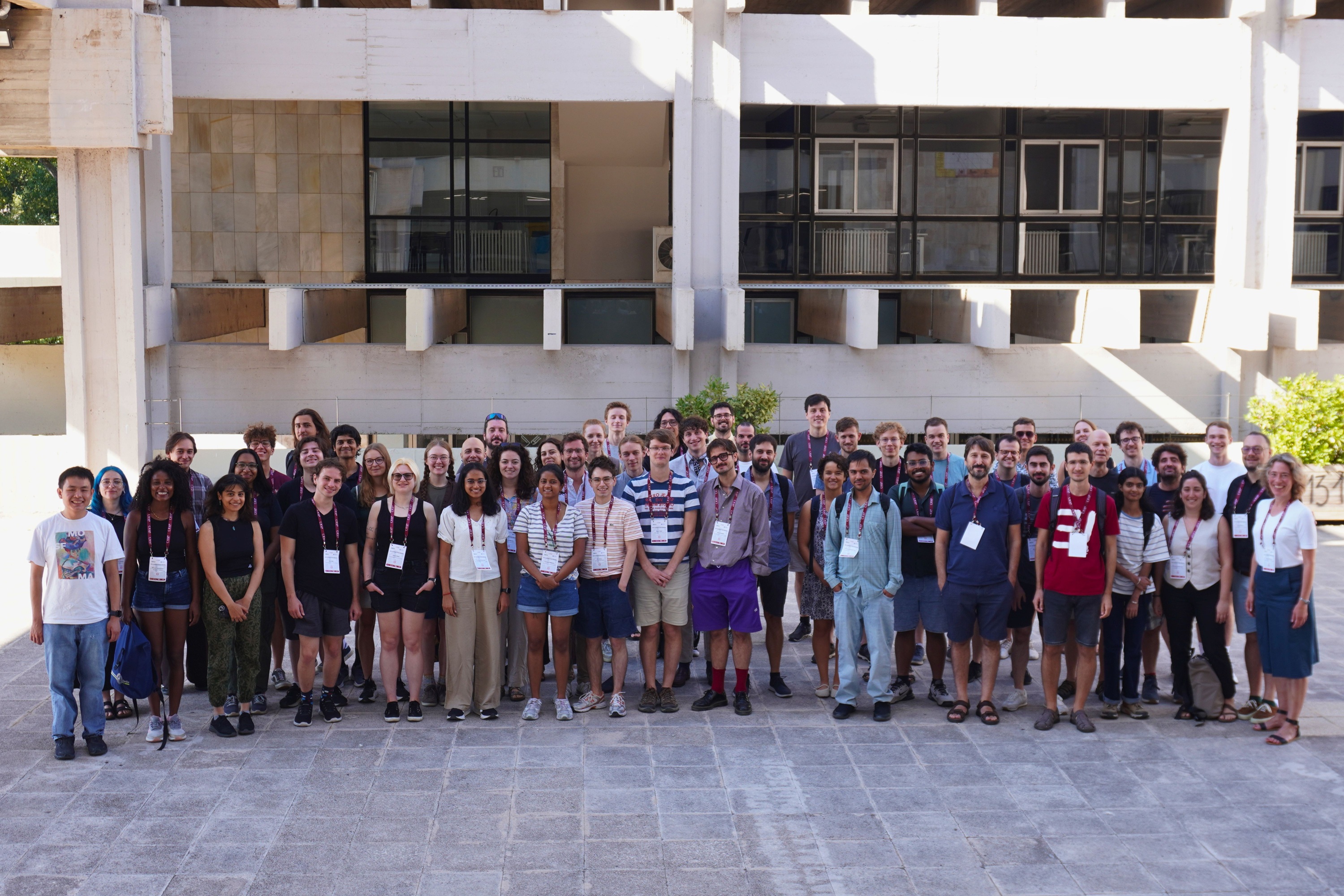
For four weeks in July 2026, the Centre de Recerca Matemàtica hosted the Barcelona Introduction to Mathematical Research (BIMR), a BGSMath summer programme built to give undergraduate and master’s students a first, genuine experience of mathematical research and a reason to consider a career in it.
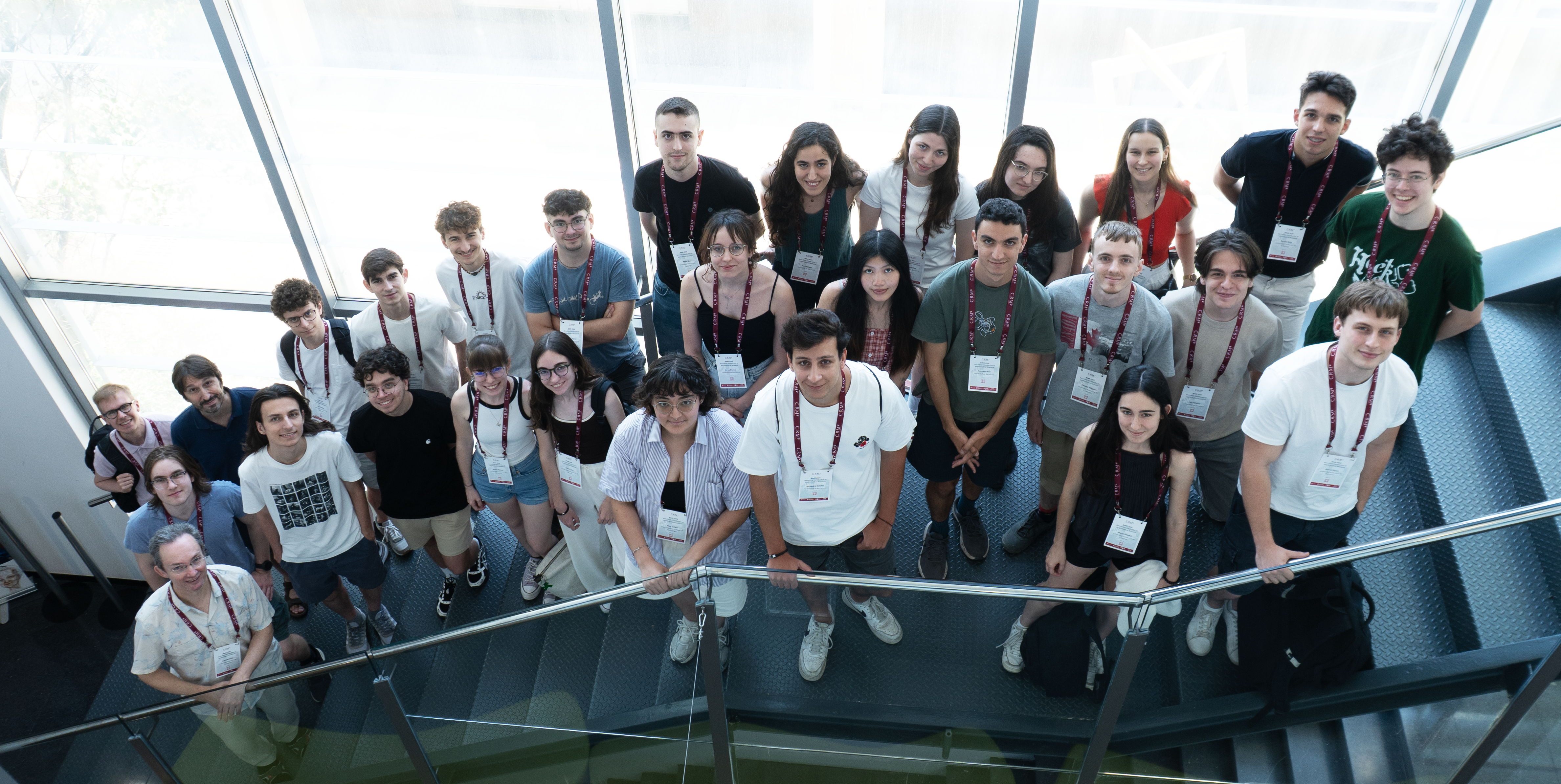
The Barcelona Introduction to Mathematical Research (BIMR) sets out to bring students into research early, while they’re still deciding what kind of mathematician they want to be. Rather than talk to them about what research is, the programme puts them to work. For a month, each participant, an undergraduate or master’s student, takes on a real research project under the supervision of a senior mathematician. The 2026 edition ran from 29 June to 24 July.
That work sat at the centre of the programme. Depending on the project, it meant reading one or a few research papers, working through book chapters, or making a first attempt at a small open problem. The aim was less to solve something than to find out, from the inside, what mathematical research asks of a person.
The students came from a wide range of institutions. Alongside the three public Barcelona universities, the Universitat Politècnica de Catalunya, the Universitat de Barcelona and the Universitat Autònoma de Barcelona, the cohort included students from the Complutense de Madrid, Oviedo, Santiago de Compostela and the Universidad Politécnica de Cartagena. Others came from further afield: the universities of Gothenburg and Umeå, Rennes 1, Trinity College, Koç University, the Massachusetts Institute of Technology, Banaras Hindu University, and the Sirindhorn International Institute of Technology at Thammasat University.
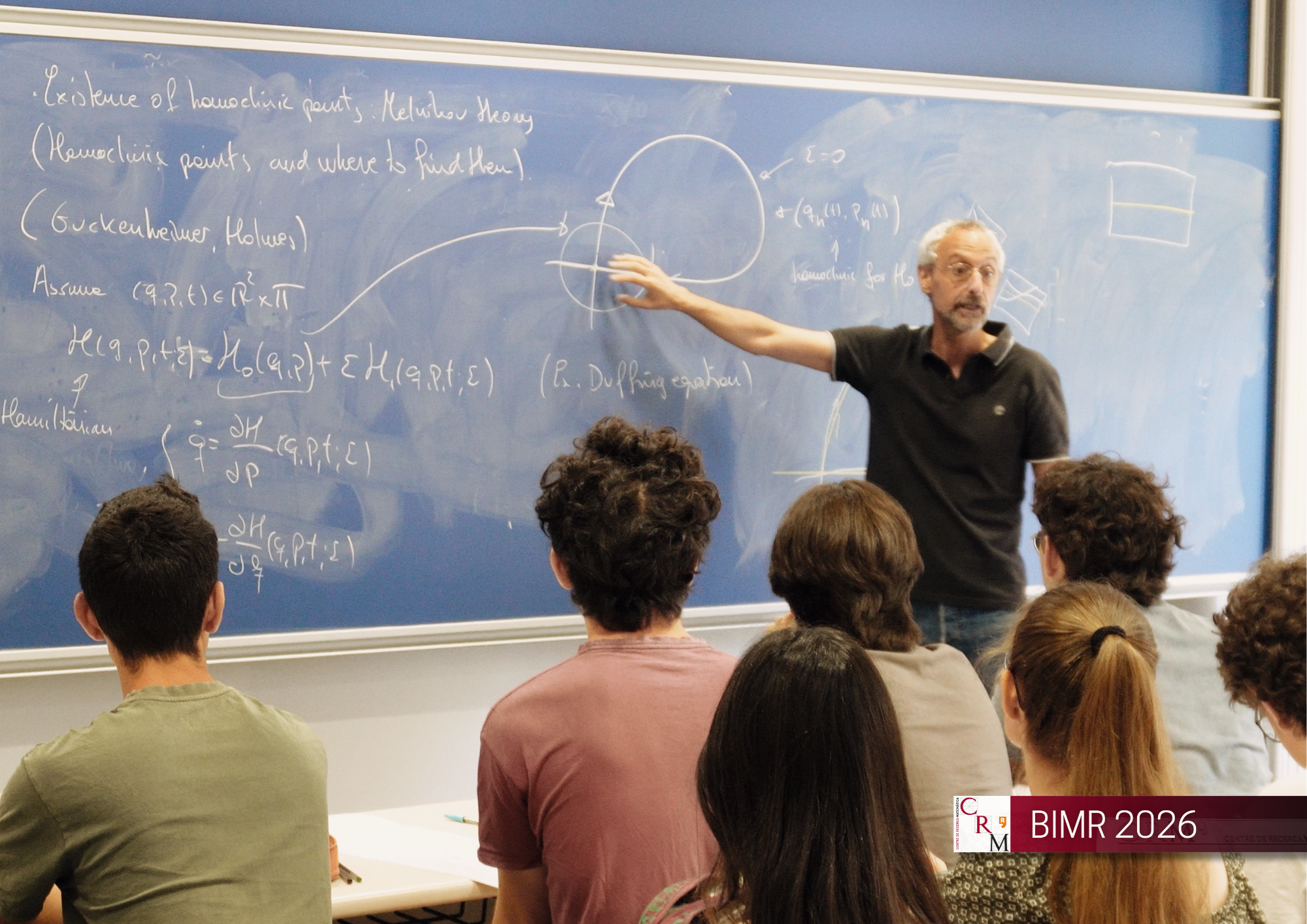
The projects are spread across four broad areas.
In analysis, partial differential equations and dynamical systems, Xavier Cabré’s students followed a proof of the existence of minimal surfaces, the least-area “soap films” that span a fixed wire, and used it as a way into the calculus of variations and geometric measure theory. Joan Claramunt ran two projects, one rebuilding quantum mechanics from C*-algebras up to the Stone–von Neumann theorem, the other on the Banach-Tarski paradox, where a solid ball is cut into five pieces and reassembled, by rigid motions alone, into two balls the size of the first. Xavier Jarque took students into holomorphic dynamics and the question of when a transcendental map can have a wandering domain. With Martí Prats they looked at what happens to a function’s integrability when you compose it with a rough, quasiconformal map, and at how the Dirichlet problem can still be solved on a jagged domain through harmonic measure. Eduard Vilalta supervised two projects on operator algebras, one circling the Free Group Factor Problem, the other reaching Lomonosov’s theorem and the Invariant Subspace Problem. Pablo Hidalgo Palencia’s students worked through the regularity theory of elliptic equations, the thread that runs from Schauder estimates to De Giorgi and Nash and Hilbert’s nineteenth problem. And a numerical project supervised by Joaquim Duran, Albert Mas and Tomás Sanz-Perela had students computing eigenvalues to hunt for the optimal shape of a quantum dot, the kind that appears in the description of graphene.
In algebra, geometry and number theory, Dolors Herbera introduced quiver representations, where a vector space hangs on each node of a directed graph and a linear map on each arrow, and asked when the whole thing breaks uniquely into indecomposable pieces, the road to Gabriel’s theorem. Roser Homs posed a sharper version of a practical worry: whether algebra can tell you, before you pay for the data, how many observations a statistical model needs to be estimable at all. Joan-Carles Lario and Jordi Guàrdia worked through Krasner’s lemma and its use in building tables of extensions of p-adic fields. Patrick Wyndham handed out Ryser’s conjecture, a clean statement about covering the edges of a hypergraph that has stayed open since 1970 and is proved only in scattered special cases.
In mathematical modelling and numerical simulation, Jezabel Curbelo and Gabriel Meletti had students chase coherent structures, the long-lived vortices, through real flow data, using Lagrangian diagnostics such as the LAVD and finite-time Lyapunov exponents on satellite or laboratory velocity fields. Yamila García’s project used graph theory to describe mechanical forces at the scale of a single molecule, with an eye on where academic mathematics meets industry. Jose Muñoz took on optimal control problems where the finishing time isn’t fixed in advance, and the numerical schemes that keep their Hamiltonian structure intact.
In combinatorics, Alberto Espuny Díaz set an infection loose on a graph, each vertex catching once enough of its neighbours have it, and asked the slow question: which starting configuration makes the spread take as long as possible before it stops.
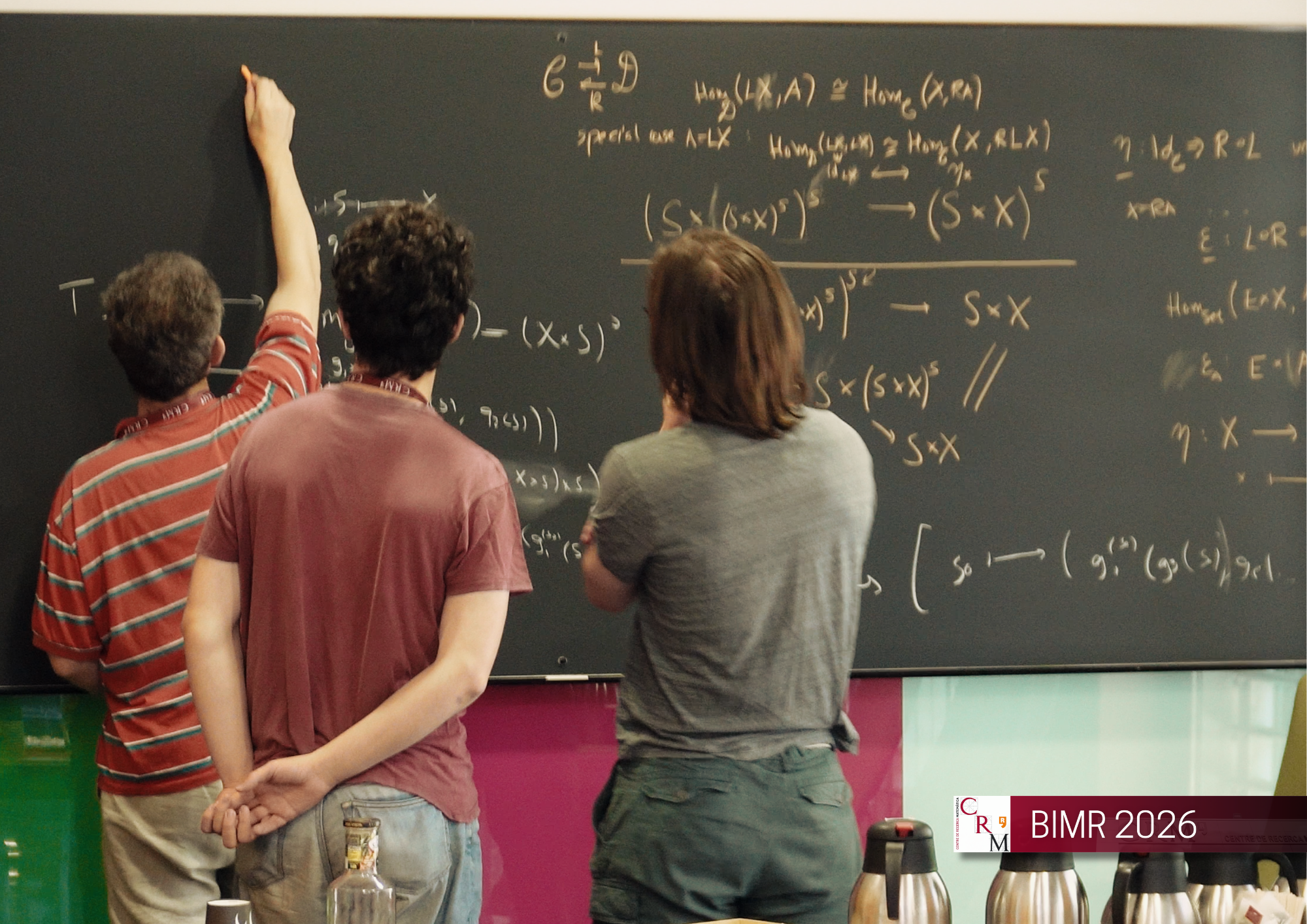
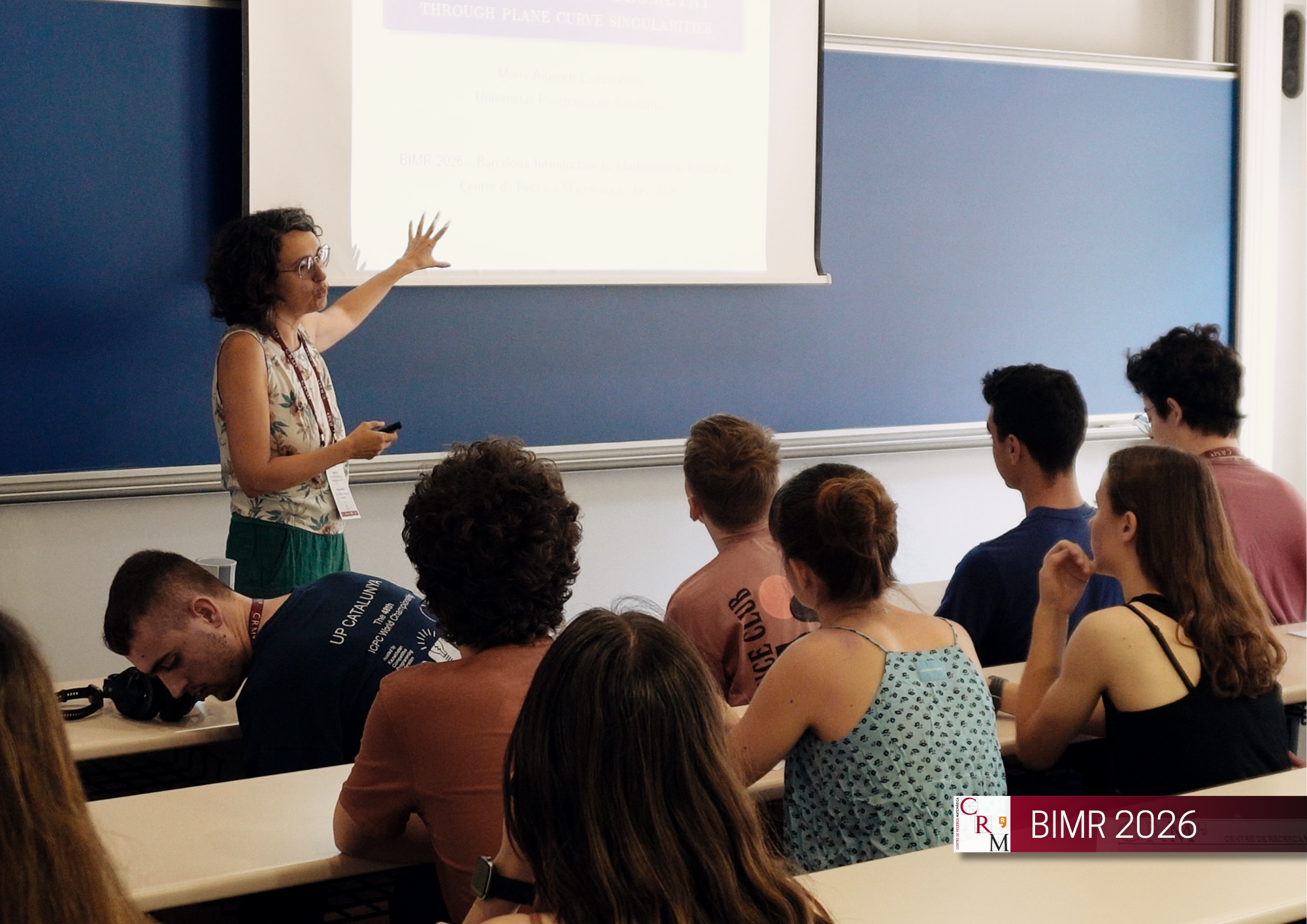
Alongside the projects, the first two weeks were given over to four minicourses on how research is actually done. Maria Alberich (UPC) started from the points where a plane curve stops behaving, the cusps and self-crossings, and showed how algebra, topology and geometry each read the same singular point differently, from Newton–Puiseux parametrizations to resolving the singularity by blowing it up. Gyula Csató (UB and CRM) opened the calculus of variations with two old puzzles: the brachistochrone, the curve down which a ball slides from one point to another in the least time, and the isoperimetric problem, which asks which loop of a given length encloses the most area. The point of the course was learning to differentiate something like the time of descent with respect to a curve instead of a number. Joachim Kock (UAB and CRM) called category theory the mathematics of mathematics and worked mostly inside the category of finite sets, where facts you thought you had understood in school hide a deeper layer, and where his riddles lived: what the number e has to do with the groupoid of finite sets, or in what precise sense addition and multiplication are dual. Pau Martín (UPC and CRM) closed the fortnight with celestial mechanics and the unsettling fact that the N-body problem contains, in some sense, every kind of dynamics there is, which is one way of saying it is about as complicated as a model can get.
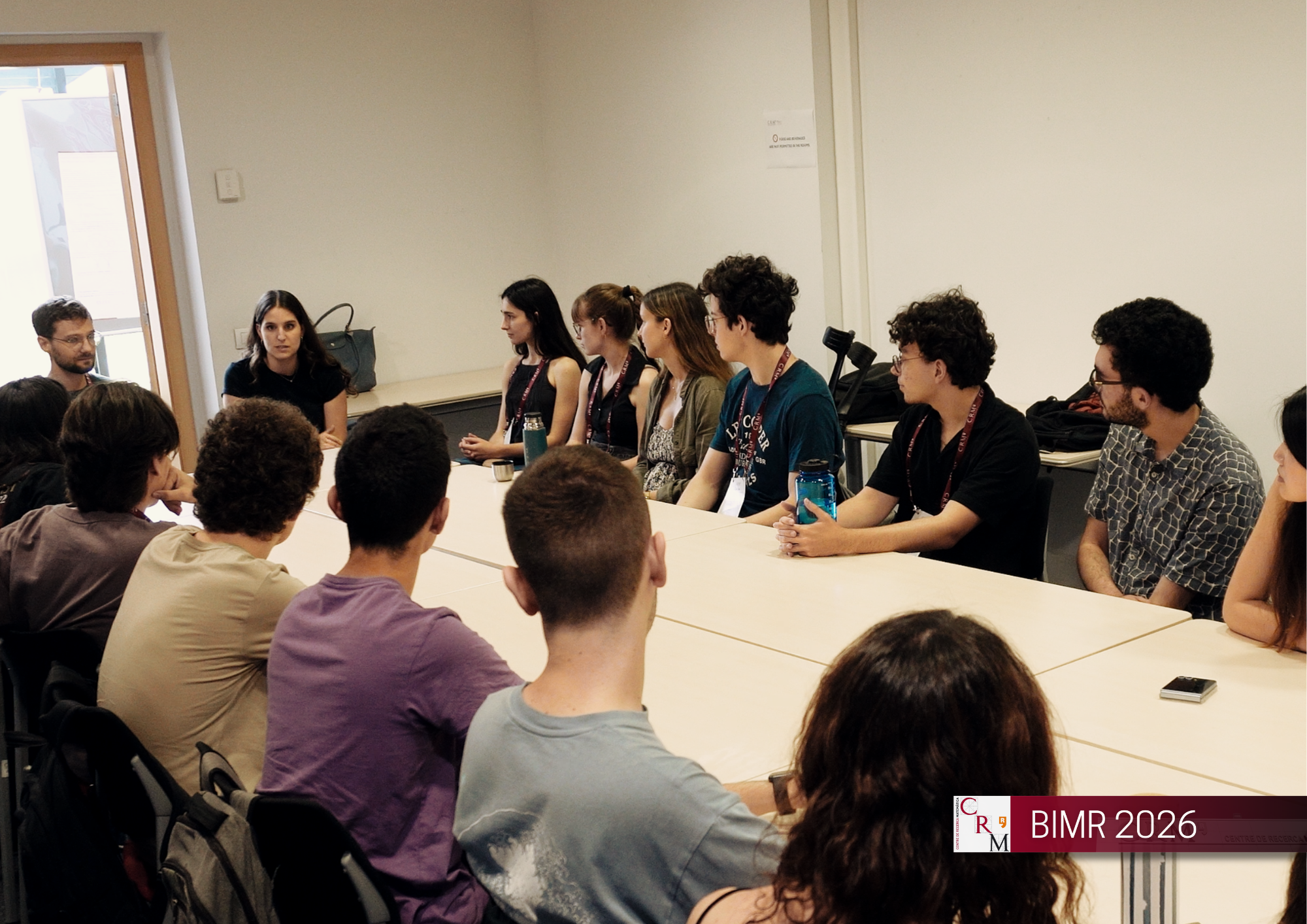
The programme also kept an eye on what comes after a first project. A round table titled “Academic career in mathematical research: what to do and when” addressed the practical side of building a career in research, and a general audience talk by Roser Homs (UPC) opened the mathematics up to a wider public. Daily coffee breaks and social gatherings ran through the first fortnight.
The BIMR 2026 was organised within the BGSMath by Natàlia Castellana (UAB and CRM), Marc Masdéu (UAB and CRM), Kostiantyn Drach (UB and CRM) and Olli Saari (UPC and CRM).
Newsletter
Get the latest CRM news and activities delivered to your inbox
Subscribe now
Recent newsletters →
BMS-BGSMath Junior Meeting 2026: Barcelona and Berlin Strengthen Scientific Ties
From 2 to 4 September 2026, the Centre de Recerca Matemàtica (CRM) hosted the BMS-BGSMath Junior Meeting 2026, a three-day event jointly organised by the Berlin Mathematical School (BMS) and the Barcelona Graduate School of Mathematics (BGSMath), with the Centre de...
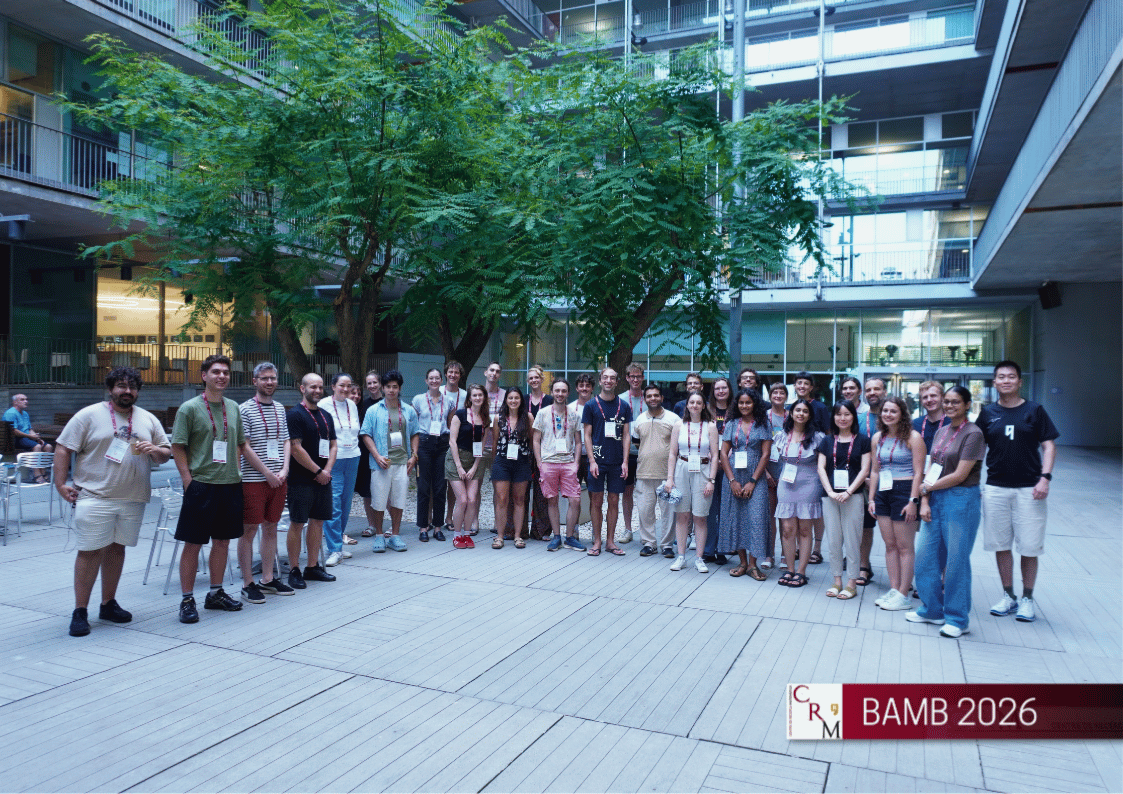
The CRM organises the 2026 Barcelona Summer School for Advanced Modeling of Behavior
The Centre de Recerca Matemàtica held the sixth edition of BAMB!, the Barcelona Summer School for Advanced Modeling of Behavior, from 12 to 23 July 2026 at the Parc de Recerca Biomèdica de Barcelona. Thirty early-career researchers from fourteen countries followed...
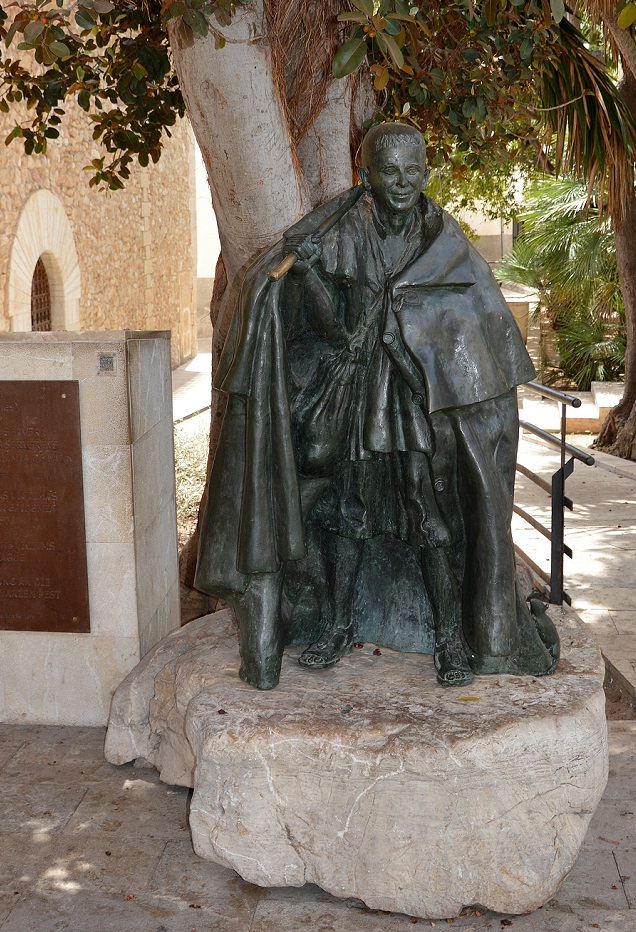
Mallorca’s 1820 plague did not behave like a classic bubonic outbreak, study finds
A study in PNAS by Pere Puig (UAB, CRM) and Joana Maria Pujadas-Mora (UOC, ICREA) reports what happens when the daily health records kept in Son Servera and Capdepera during the 1820 outbreak are analysed with a Bayesian epidemiological model: an unusually short...
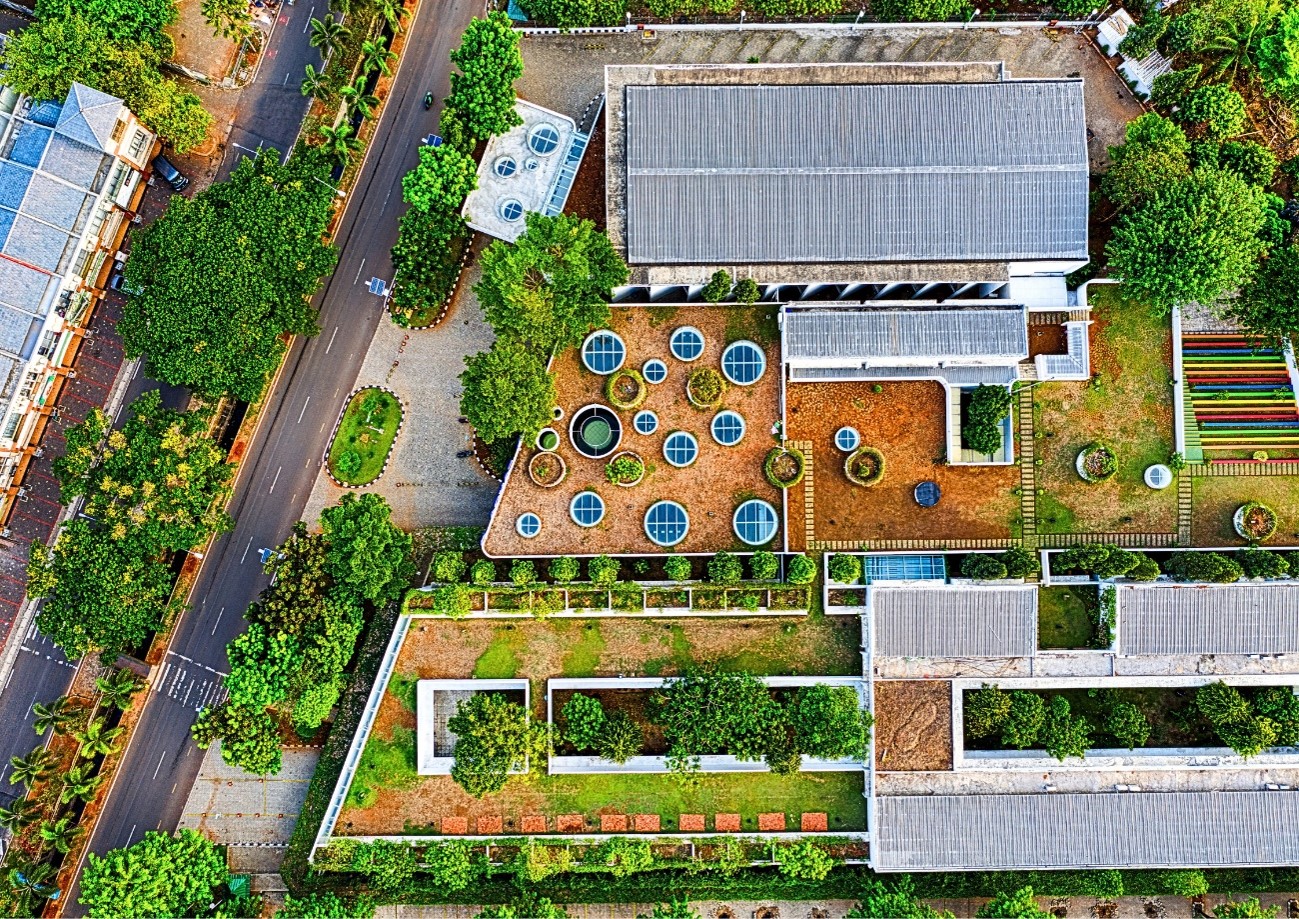
A recent study quantifies the vegetable production potential of Barcelona’s rooftops
A study published in Cities by researchers at ICTA-UAB, with collaboration from the CRM's Knowledge Transfer Unit, estimates that 65 hectares of municipal rooftop could supply 31% of the tomatoes consumed in Barcelona each year.Barcelona has 65 hectares of rooftop...
Boundary Conditions Day

Fixed-Point Day
La desfilada dels nombres: una ruta per Barcelona
CRM July Newsletter
CAVARET 2 brings together 83 researchers on curves and abelian varieties at the Universitat de Barcelona
The second edition of CAVARET, "Curves, Abelian VArieties and RElated Topics", took place at the Faculty of Mathematics and Computer Science of the Universitat de Barcelona from 13 to 17 July 2026. Sixteen invited lectures and ten posters brought together 83...
Mathematics on board: CRM’s demand forecasting model enters service on Barcelona’s H12 corridor
The H12 has run along Gran Via for years. What TMB switched on in July is the set of upgrades designed for it inside eBRT2030, a Horizon Europe project testing electric Bus Rapid Transit in six European cities. Behind it, forecasting passenger demand at every stop...
Dídac Gil Rams defends his doctoral thesis on the splitting of separatrices in generalized standard maps
Supervised by Inmaculada Baldomá and Pau Martín, the thesis proves the existence of chaotic dynamics in a broad family of area-preserving maps and combines classical analysis with computer-assisted proof. The defence took place on 3 July 2026 at the FME (UPC).Dídac...
How to Protect Bacteriophages Without Trapping Them? Mathematics to Improve an Alternative to Antibiotics
Bacteriophages — viruses capable of infecting and destroying bacteria — are considered one of the most promising alternatives to tackle the growing problem of antibiotic resistance. However, for these treatments to work, phages must overcome several obstacles before...
|
|
CRM CommPau Varela
|