Christophe Ritzenthaler (Université de Rennes) and Rachel Pries (Colorado State University) both work on curves over finite fields: he hunts curves with as many points as possible, she hunts curves that almost never occur. In conversation with the CRM during their visit to Barcelona in July 2026, they described a problem a master’s student can attack with a laptop, a result that arrived faster than either field usually allows, a first collaboration with AI, and the four things they run alongside the mathematics: CIMPA, a journal moving out of commercial publishing, a virtual seminar with sixty thousand views, and the network that changed how number theorists collaborate.
Christophe Ritzenthaler (Université de Rennes) and Rachel Pries (Colorado State University) were in Barcelona for the same reason, both invited to speak at CAVARET 2, and they work on the same kind of object. Beyond that the resemblance is in what they do when they aren’t proving things. Each of them has taken on a piece of the infrastructure that decides who gets to do mathematics at all.
We spoke with both during the conference week about the problems they work on, the initiatives they lead, and what a week like this one is for.
As many points as possible
Ritzenthaler works with objects defined by polynomial equations, the territory of algebraic geometry, and within it the classical ones: curves, abelian varieties, and the spaces that classify them, “which are miraculously also algebraic varieties.” Sometimes the geometry leads, sometimes the arithmetic. What stays constant is a preference for answers that can be computed. “I have always a focus in mind, to be as effective as possible, and sometimes even efficient, and implement programs to deal with these objects so that my colleagues can then use them a bit as a black box.”
He also had a word for his own temperament, one mathematicians don’t usually apply to themselves. “I think I’m a bit like an epicurean. As a mathematician I’m not a theory builder, I’m more like a problem solver, in the sense that I pick problems that I find beautiful. Or sometimes because I encounter colleagues I would like to work with.”
“I pick problems that I find beautiful. Or sometimes because I encounter colleagues I would like to work with.”
The problem he keeps coming back to can be stated in a breath. Take a finite field, a number system with only finitely many elements, and picture the plane over it as a grid of dots. Fix a genus, which measures how complicated a curve is allowed to be. Then find a curve of that genus that passes through as many of the dots as possible. “I like this problem because if you take it for a finite field and a fixed complexity, then it’s something very easy to describe. And even master’s students can maybe try to work on it with a computer, try to find examples and maybe break a record.”
The general question is another matter. An answer for all finite fields at a fixed genus, even genus three, will be slow in coming, “because one would need to find new concepts that would be very deep,” concepts he expects to reach as far as the Schottky problem.
Asked which open problem he finds most compelling right now, he chose one adjacent to his own. Rather than ask for the maximum number of points, some researchers study how curves are distributed by their number of points, which sounds like it should answer the first question and doesn’t, since the distribution controls the maximum only in a weak sense. Precise continuous functions describing that distribution have existed since the 1980s, due to Katz and Sarnak. About ten years ago Ritzenthaler and colleagues ran experiments and concluded the description was weaker than the evidence allowed, so they proposed a sharper conjecture. In 2024 someone showed the conjecture was itself too crude and needed local terms added. Then, at the beginning of this year, two young mathematicians arrived with something close to a proof. “It’s a very, very big step compared to what Katz and Sarnak could do at that time. And it’s very exciting. And also, I should say, in my field things don’t move so fast usually.“
Curves that are rare
Pries works over the same fields and looks for the opposite thing. “I especially study curves that have many symmetries, or automorphisms. Over finite fields there are unusual characteristics that we might look for, and a lot of my research is about finding curves that are very rare and unusual.”
The rare objects in her Barcelona talk were supersingular curves, which have been located one genus at a time. “For many decades people have studied supersingular curves, trying to find them, and have found them in genus one historically, and then two, and then three, and then four. And so the advances I talked about today were in genus five.” The purpose of the climb is to gather evidence: “We were trying to get evidence for big conjectures that people don’t know yet whether they will be true or false.”
She mentioned one thing about the project that she had never done before. “One unusual thing about my talk is that I also incorporated some AI collaborations, and that was the first project that I’ve ever done an AI collaboration with. And so that was very interesting for me.”
On what to work on next she was cheerfully overwhelmed. “When I was starting out in grad school, I thought there are not enough problems. And now I feel there are so many problems, I don’t know which ones to focus on.” Supersingular curves won because they fascinate her most; arithmetic statistics and the stratification of moduli spaces are the ones she’s watching.
Different tools on the same objects
What struck Pries at the conference was the gap between methods and problems. “People are using very different techniques to solve problems that are very similar.” Ritzenthaler’s own talk on arithmetic statistics brought analytic, functional-analytic and probabilistic tools to bear on curves over finite fields; Valentijn Karemaker’s on moduli spaces ran on very abstract facts about lattices. Error-correcting codes turned up too, which she teaches to undergraduates and hadn’t expected to meet.
Ritzenthaler placed his own corner a little to one side of the crowd. Most participants work over number fields rather than finite fields, “and so the flavour is a bit different, because it’s much less effective. And for a very simple reason: number fields are much more complicated than finite fields, and the Galois group is much more complicated to handle.” A heavy machinery accumulates, and the direct connection between geometry and arithmetic, the thing he prizes, slips out of view.
The fare to the room
For the past six years Ritzenthaler has directed CIMPA, the International Centre for Pure and Applied Mathematics, an association based in Nice and supported by the governments of France, Spain, Germany, Switzerland and Norway. “For almost fifty years now, its role has been to try to include more and more researchers and students from developing countries in the international mathematical community.” The work has two arms: research schools held directly in those countries, and grants that bring students and more senior colleagues to research institutes elsewhere. One of those agreements is with the CRM, and it funds stays of one or two months during the centre’s thematic semesters.
He was precise about what such a grant is worth, and about why it’s hard to see from Barcelona. “We can’t really see how powerful it is, because we are spoiled with a good research environment and many events. But for some researchers who are quite isolated from the rest of the community, this is really a game changer.” He added something rarer in an interview: pride in his own field. “I’m really proud of our community of researchers, which is really generous of time and money, and who really want to try to broaden the diversity of people around.”
His case for physical meetings started from the pandemic. “At that time, at Covid time, all our life was online. Even your cocktail party with friends was on Zoom.” Remote access, he thinks, has since earned a fairer hearing, because it lets colleagues take part whose family or professional circumstances keep them at home. What no format has replaced is the accident: the talk you sat through without meaning to and found useful, the coffee-break conversation about something else that turns out to be your problem too. “By essence research is unpredictable. If you know what you’re doing, what’s the point of doing it?”
Where the money goes
The week of the conference, Ritzenthaler took up the post of editor-in-chief of Foundations of Computational Mathematics, succeeding Teresa Krick. The journal is finishing a long move from Springer, a commercial publisher, to EMS Press, owned by the European Mathematical Society and non-profit; publication under the new imprint begins in January 2027. He let the two adjectives make the argument. “When I have said these two adjectives, commercial and non-profit, you may understand why we made this transition. We are doing all the work as authors, as referees, as editors, and at some point we would like this quantity of money to stay inside the community. And that’s what the EMS does. It reinvests all the money in grants, in support for conferences, instead of the commercial publishers giving it to rich people to become even richer.”
Most researchers, he thinks, have never been shown what follows from these choices. Within ERCOM, the European network of mathematics research centres to which the CRM belongs and which Ritzenthaler chairs, he and colleagues launched an awareness campaign last year: five posters, free to download and put up in a corridor, setting out the publication models and what actually happens when a paper goes to one journal rather than another.
On AI and publishing he declined to be alarmed. “It’s not really bringing any new problem. It’s just making more acute problems that already exist.” More papers, harder to tell good from bad, and predatory journals that accept the fee either way. Nor did he blame the authors. “Maybe don’t blame the player, blame the system, because somehow the colleagues just try to optimise their chance for the career in a given system. So one has to change the system.” He then made the odder suggestion that AI might do the changing for us, by making the system absurd enough to collapse. “What David Bessis calls on his blog the fall of the theorem economy: producing a theorem will not be a value enough to judge a researcher.” Bessis’s essay, “The fall of the theorem economy”, appeared in April.
A seminar without a plane ticket and the room that had to be built
Pries’s answer to distance is a seminar. “I live in Colorado. Colorado is very far from other universities, and so it’s hard for us to keep a seminar going. And every time I go to a conference, it involves an airplane flight.” In January 2020 she launched VaNTAGe, a virtual seminar on open conjectures in arithmetic geometry and number theory, expecting something small. The pandemic arrived within weeks. “So immediately everyone wanted to go to this seminar. And luckily Drew Sutherland offered to help, and he at MIT has a very good Zoom programme which can have 500 people coming at a time.” Andrew Sutherland co-organises it with her, and the recordings are on the seminar’s YouTube channel.
“Maybe math doesn’t need to be so isolating. Maybe math can be something that we work on together.”
Live attendance has since settled at around thirty. The recordings are another story. “What has surprised me is that we have tens of thousands of views. So even though not many people come to the talk as it’s happening, we now have 50,000, 60,000 views of these talks.” The talks are grouped into series so that a student can come back later and get several perspectives on a topic in one sitting, and they are pointed deliberately at open conjectures, “so that people can see how many open problems there are.” Recent series covered Lean formalisation of number theory and machine learning in number theory. “Right now there’s a feeling that a lot is happening because of AI and number theory.”
Pries founded Women in Numbers in 2008 with Kristin Lauter and Renate Scheidler; the first workshop met that November at Banff. Asked how it had shaped her career, she started with the reason for it. “I started it with some collaborators out of a feeling of isolation and despair. The conferences were just not so fun to go to. It was very masculine and very hierarchical and very isolating. And so we conceived of this idea of women working together from all career stages on projects. And for me it was transformative. It was a very positive feeling.”
The research followed the format. “I learned a lot of new things through those collaborations. I started new research directions, which now are very special to me as well.” The model spread, into Women in Algebraic Geometry, Women in Topology, Women in Analysis. “I think it filled a role where people suddenly learned that maybe math doesn’t need to be so isolating. Maybe math can be something that we work on together.”
Her reading of what happened next is that the whole community moved. Large collaborations across techniques, backgrounds, ages and countries are now ordinary for men and women alike. “I feel like this is the future of mathematics, to work on problems together.”
Full video interviews with Christophe Ritzenthaler and Rachel Pries, and with the organisers of CAVARET 2, will be published on the CRM website in the coming weeks.
Newsletter
Get the latest CRM news and activities delivered to your inbox
Subscribe now
Recent newsletters →

ADA: Decoding Brain Signals Misaligned in Time
The study addresses a key limitation of current brain decoding techniques: the difficulty of interpreting internal mental processes whose temporal dynamics vary from trial to trial.Decoding what is happening in a person’s mind from their brain activity is one of the...

Call open for the 2027 Ferran Sunyer i Balaguer Prize
The Ferran Sunyer i Balaguer Foundation is accepting submissions for its 2027 prize, which awards 15,000 euros and publication in Birkhäuser's Progress in Mathematics series to an expository monograph on an active area of mathematical research. The deadline is 27...
Susanna Terracini delivers the CRM Colloquium 2026
Susanna Terracini (Università di Torino) delivered the CRM Colloquium 2026 on 14 July, presenting a rigidity result for Kepler billiards obtained with Stefano Baranzini, Vivina Barutello and Irene De Blasi. She was at the centre as a member of the CRM Scientific...
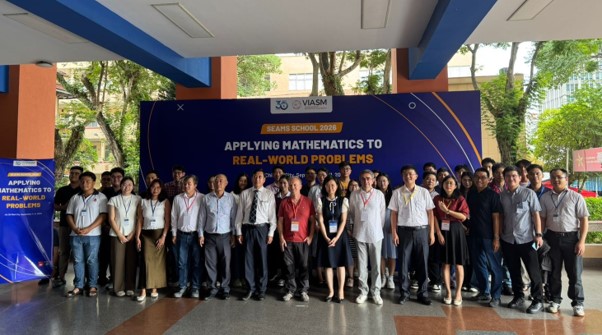
Ho Chi Minh City hosts the first SEAMS School on applying mathematics to real-world problems
More than fifty students from six countries spent a week at the University of Science, VNU-HCM, learning how mathematics gets used outside a mathematics department. CRM researcher Tim Myers co-organised the school and lectured on moving boundary problems. The...

A single ball on a fixed table can compute: Eva Miranda and Isaac Ramos prove that two-dimensional billiards are Turing complete
Eva Miranda (UPC, CRM) and Isaac Ramos (ETH Zürich) show that a point particle bouncing inside a planar table with fixed walls can simulate a universal Turing machine, settling a question Cristopher Moore left open in 1990. The result grew out of a master’s project...
|
|
CRM CommPau Varela
|