Three CRM-affiliated researchers, Xavier Tolsa (plenary speaker), Xavier Cabré and Joaquim Ortega-Cerdà, lectured at the ICM 2026 in Philadelphia. Cabré surveyed the regularity of stable solutions to reaction-diffusion equations, including his optimal dimension-9 result; Ortega-Cerdà presented the complete characterisation of the Hörmander-Bernhardsson extremal function in Fourier analysis; and Tolsa reviewed three decades of quantitative rectifiability, from the travelling salesman theorem to Carleson’s ε² conjecture.
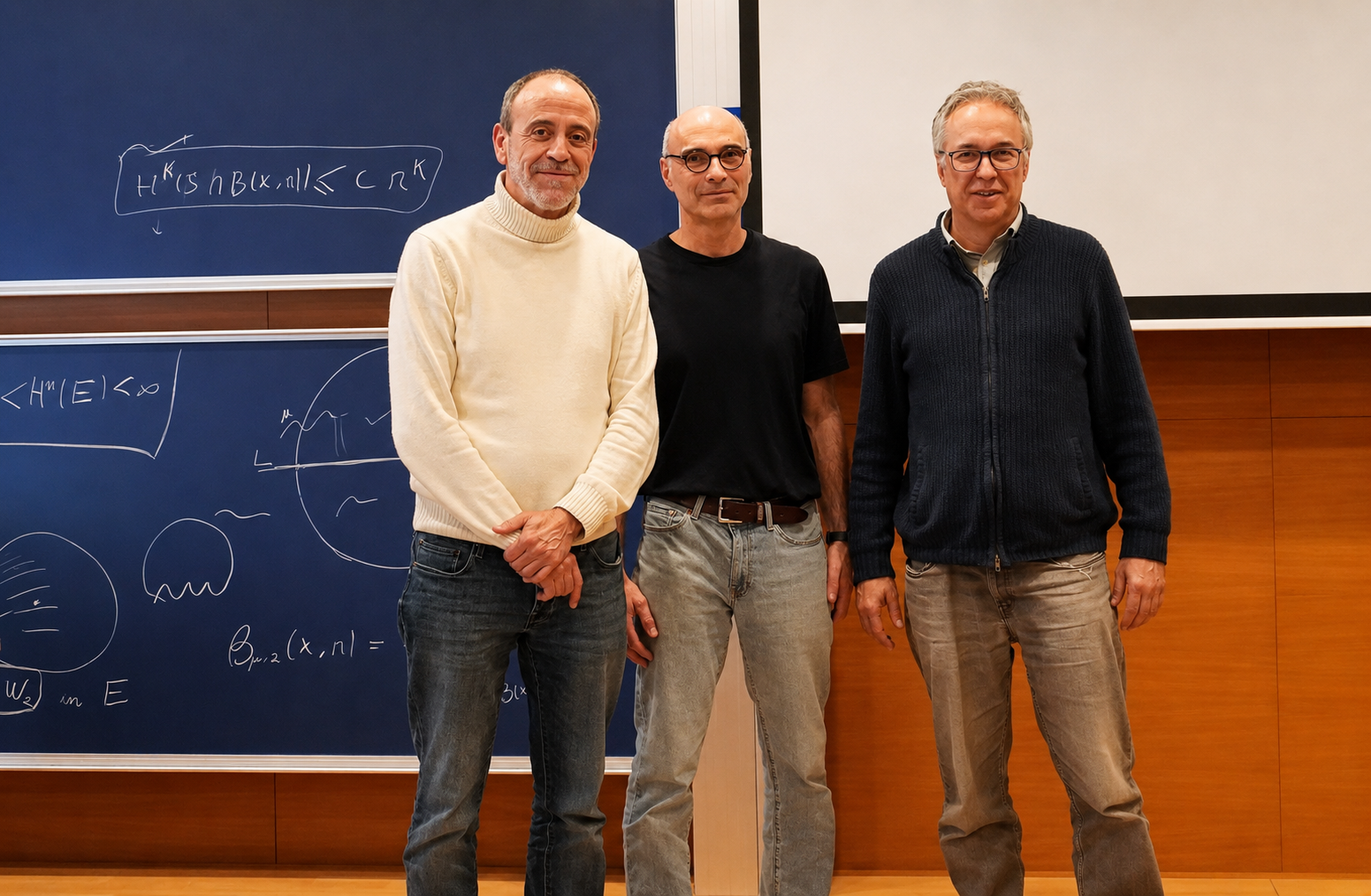
The International Congress of Mathematicians is underway in Philadelphia, where more than 4,000 participants have gathered at the Pennsylvania Convention Center from 23 to 30 July 2026. Three researchers affiliated with the Centre de Recerca Matemàtica are among the speakers: Xavier Tolsa (ICREA, UAB, CRM) as one of sixteen plenary speakers, and Xavier Cabré (ICREA, UPC, CRM) and Joaquim Ortega-Cerdà (UB, CRM) in the Partial Differential Equations and Analysis sections. Their written contributions have already been published, open access, in the congress proceedings by SIAM for the International Mathematical Union: Stable Solutions to Reaction-Diffusion Elliptic Problems (Cabré), Some Fourier Extremal Problems (Ortega-Cerdà) and Interactions between Quantitative Rectifiability, Singular Integrals, and Boundary Value Problems for Harmonic Functions (Tolsa).
The three papers cover very different territory: the regularity of stable solutions to elliptic equations, an extremal problem in Fourier analysis, and the interaction between geometric measure theory and harmonic functions. This article summarises what each of them contains.
Stable states and where they break
Xavier Cabré’s contribution opens with a physical experiment. A soap film stretched between two coaxial rings takes the shape of a catenoid, and it keeps that shape even after the rings have been pulled far enough apart that a pair of flat discs would have less total area. The film is no longer the absolute minimiser of area. It persists as a local one, stable against small perturbations, until the neck thins and collapses. In a 2010 paper in the European Journal of Physics, Ito and Sato filmed the whole sequence, including a single frame of the unstable thin-necked catenoid just before it gives way.
Stable solutions of this kind, minimisers among nearby states rather than among all states, are the subject of the paper. The same structure appears in combustion: in the Gel’fand problem, which models the thermal self-ignition of a gas mixture, stable stationary temperature profiles exist below a critical value of the reaction parameter and disappear above it, where the model predicts autoignition.
The central question is how regular these solutions must be. In the mid-1990s, Haim Brezis asked whether stable solutions to semilinear elliptic equations are bounded, for a broad class of nonlinearities, in low dimensions. The answer came in stages over more than two decades, with contributions by Nedev, Villegas and Cabré himself, who reached dimension 4 in 2010. The optimal result was obtained in 2020 by Cabré, Alessio Figalli, Xavier Ros-Oton and Joaquim Serra in Acta Mathematica: stable solutions are smooth up to dimension 9. The threshold is exact. From dimension 10 onwards, an explicit singular stable solution exists, and the paper explains why the same number 9 appears in the parallel theory of minimal surfaces.
The second part of the paper presents a recent result with Núria Cónsul (UPC) and Matthias Kurzke (Nottingham) on reaction problems posed on the boundary of a domain rather than in its interior. A classical theorem of Casten and Holland, and independently Matano, states that convex domains admit no nonconstant stable solutions for interior reactions with Neumann conditions. Whether the analogue held for boundary reactions was a question raised by Joan Solà-Morales in the mid-1990s. The new work shows that it fails: on the square, for a small reaction parameter, nonconstant stable solutions exist, with transitions located at the midpoints of two opposite sides. The proof required developing a Ginzburg-Landau theory for real-valued functions, and the result was first suggested by numerical computations of Cónsul and Àngel Jorba.
An extremal function, described completely
Joaquim Ortega-Cerdà’s contribution in the Analysis section concerns a problem that is simple to state. Among all bandlimited functions, those whose frequencies lie in a fixed interval, how large can the value at a single point be compared to the function’s overall size in the Lᵖ norm? The optimal constant, C_p, is known exactly only for p = 2, where the extremal function is the classical sinc.
The case p = 1 has a particular history. In 1993, Lars Hörmander and Bo Bernhardsson computed the constant numerically to ten decimal places, between 0.5409288219 and 0.5409288220, without identifying the extremal function. The problem then remained essentially untouched for three decades.
The paper surveys the recent progress obtained by Ortega-Cerdà in collaboration with Ove Fredrik Brevig, Andrés Chirre and Kristian Seip, and, in the case p = 1, with Andriy Bondarenko, Danylo Radchenko and Seip. For general p, the joint work establishes the asymptotic behaviour of C_p as p grows and as p tends to zero, together with structural properties of the extremal functions and their zeros. For p = 1, the results go much further. The zeros of the Hörmander-Bernhardsson function lie remarkably close to the half-integers, and a fixed-point argument built on this fact leads to a complete description, developed across a preliminary study and a second paper: the function satisfies both a second-order differential equation and a functional equation, and either one characterises it up to a constant.
The two characterisations are connected by a hidden algebraic symmetry, a commutation relation reminiscent of the structure underlying prolate spheroidal wave functions. As a consequence, the constant C₁ can now be computed to arbitrary precision; the paper prints roughly a hundred digits. A conceptual explanation for why the commutation relation exists remains, in the author’s words, one of the deepest open problems the work leaves behind.
Geometry, singular integrals and rough boundaries
Xavier Tolsa’s plenary contribution surveys quantitative rectifiability, a field that grew out of work by Peter Jones, Guy David and Stephen Semmes in the early 1990s and in which Tolsa has been a central figure for twenty-five years. The starting point is Jones’s travelling salesman theorem, which measures how well a set is approximated by lines at every scale and characterises, through a single summability condition, the sets contained in curves of finite length.
The survey traces how this circle of ideas resolved several long-standing problems. Among them is Carleson’s ε² conjecture, a characterisation of the tangent points of Jordan curves formulated in the 1980s and proved in 2021 by Benjamin Jaye, Tolsa and Michele Villa in the Annals of Mathematics, with the higher-dimensional extension obtained by Ian Fleschler, Tolsa and Villa in 2025. Another is the David-Semmes problem in codimension one, solved by Fedor Nazarov, Tolsa and Alexander Volberg in 2014, which established the equivalence between the boundedness of the Riesz transform and uniform rectifiability. This equivalence underpins the modern solution of the Painlevé problem for Lipschitz harmonic functions: for sets of finite length, removability is decided entirely by rectifiability.
The final sections turn to harmonic measure and boundary value problems in rough domains. Here the paper describes the solution of one-phase and two-phase free boundary problems for harmonic measure, and the recent answer, by Mihalis Mourgoglou and Tolsa in Duke Mathematical Journal (2024), to a question posed by Carlos Kenig in 1991 on the solvability of the regularity problem in chord-arc domains.
The survey closes with open questions. The David-Semmes problem in intermediate dimensions, the Neumann problem in chord-arc domains, and the dimension of harmonic measure in space, where the gap between Bourgain’s 1987 bound and Wolff’s counterexamples has not narrowed in nearly forty years, all remain unresolved.
The three proceedings papers are available open access through the links above. The recording of Tolsa’s plenary lecture has been published by the International Mathematical Union and can be watched below.
Newsletter
Get the latest CRM news and activities delivered to your inbox
Subscribe now
Recent newsletters →

ADA: Decoding Brain Signals Misaligned in Time
The study addresses a key limitation of current brain decoding techniques: the difficulty of interpreting internal mental processes whose temporal dynamics vary from trial to trial.Decoding what is happening in a person’s mind from their brain activity is one of the...
Rare curves, many points: Christophe Ritzenthaler and Rachel Pries on their research and the work around it
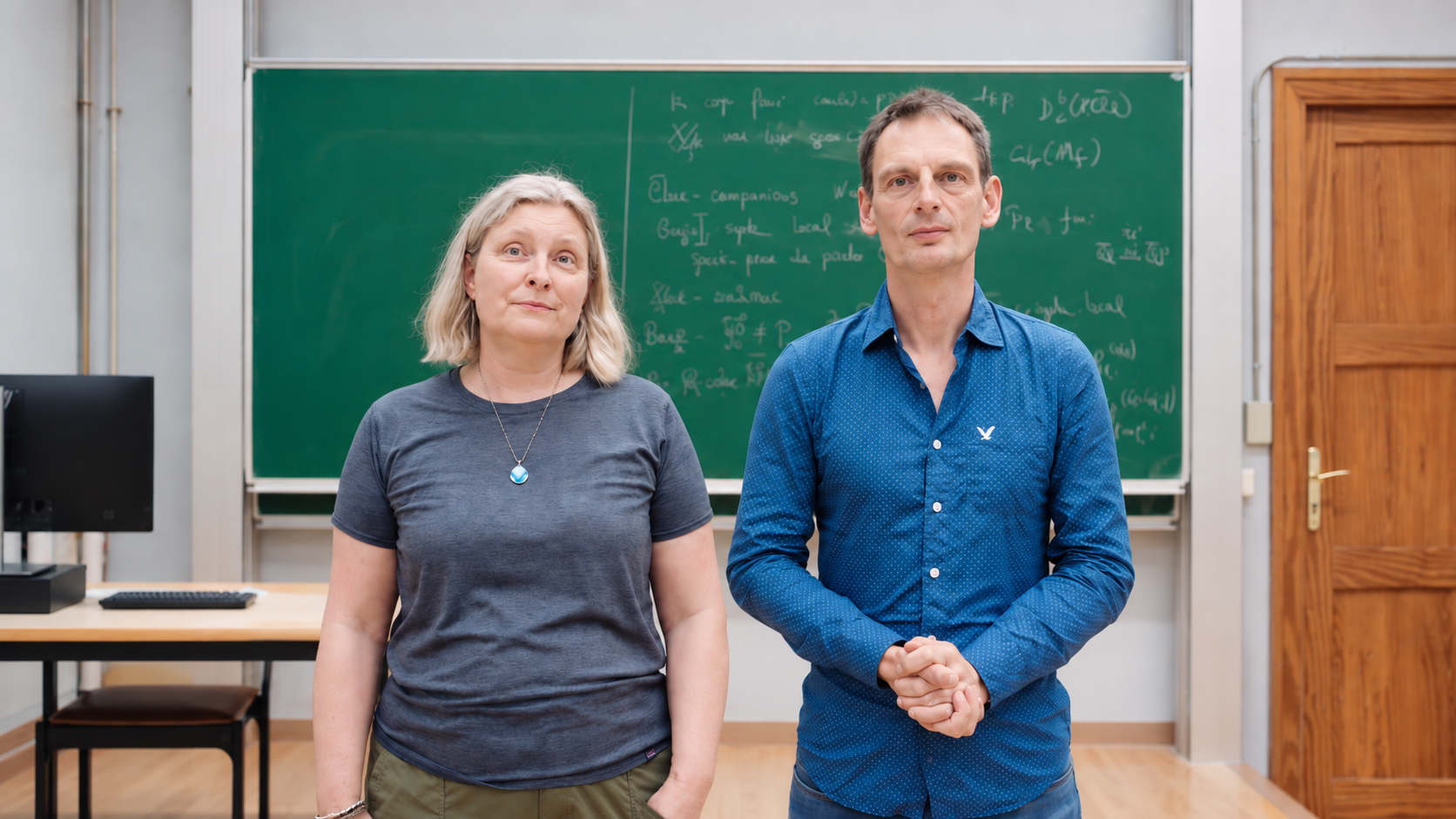
Christophe Ritzenthaler (Université de Rennes) and Rachel Pries (Colorado State University) both work on curves over finite fields: he hunts curves with as many points as possible, she hunts curves that almost never occur. In conversation with the CRM during their...

Call open for the 2027 Ferran Sunyer i Balaguer Prize
The Ferran Sunyer i Balaguer Foundation is accepting submissions for its 2027 prize, which awards 15,000 euros and publication in Birkhäuser's Progress in Mathematics series to an expository monograph on an active area of mathematical research. The deadline is 27...
Susanna Terracini delivers the CRM Colloquium 2026
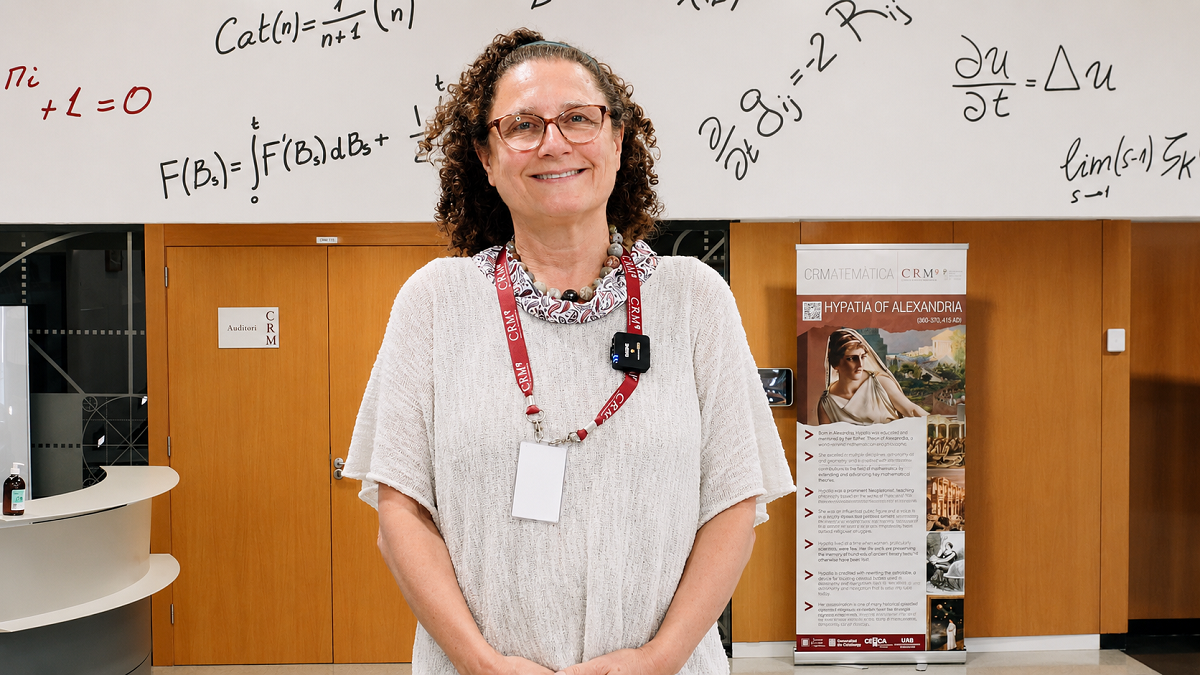
Susanna Terracini (Università di Torino) delivered the CRM Colloquium 2026 on 14 July, presenting a rigidity result for Kepler billiards obtained with Stefano Baranzini, Vivina Barutello and Irene De Blasi. She was at the centre as a member of the CRM Scientific...
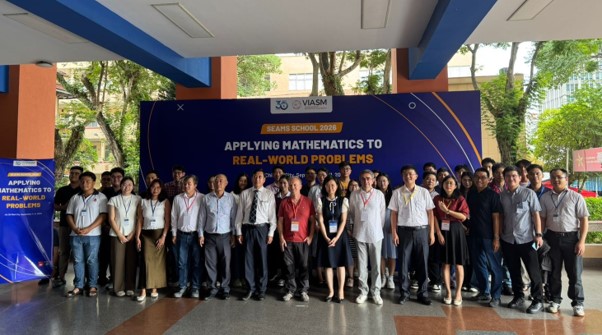
Ho Chi Minh City hosts the first SEAMS School on applying mathematics to real-world problems
More than fifty students from six countries spent a week at the University of Science, VNU-HCM, learning how mathematics gets used outside a mathematics department. CRM researcher Tim Myers co-organised the school and lectured on moving boundary problems. The...
|
|
CRM CommPau Varela
|