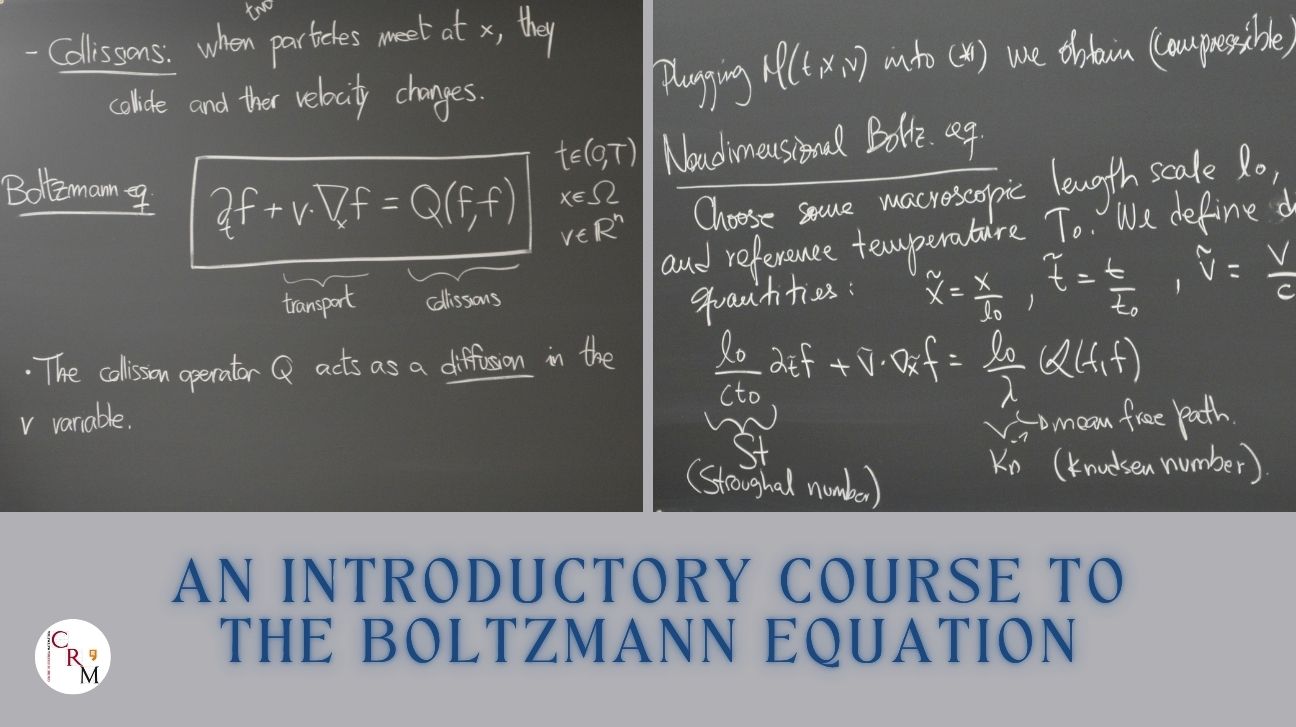
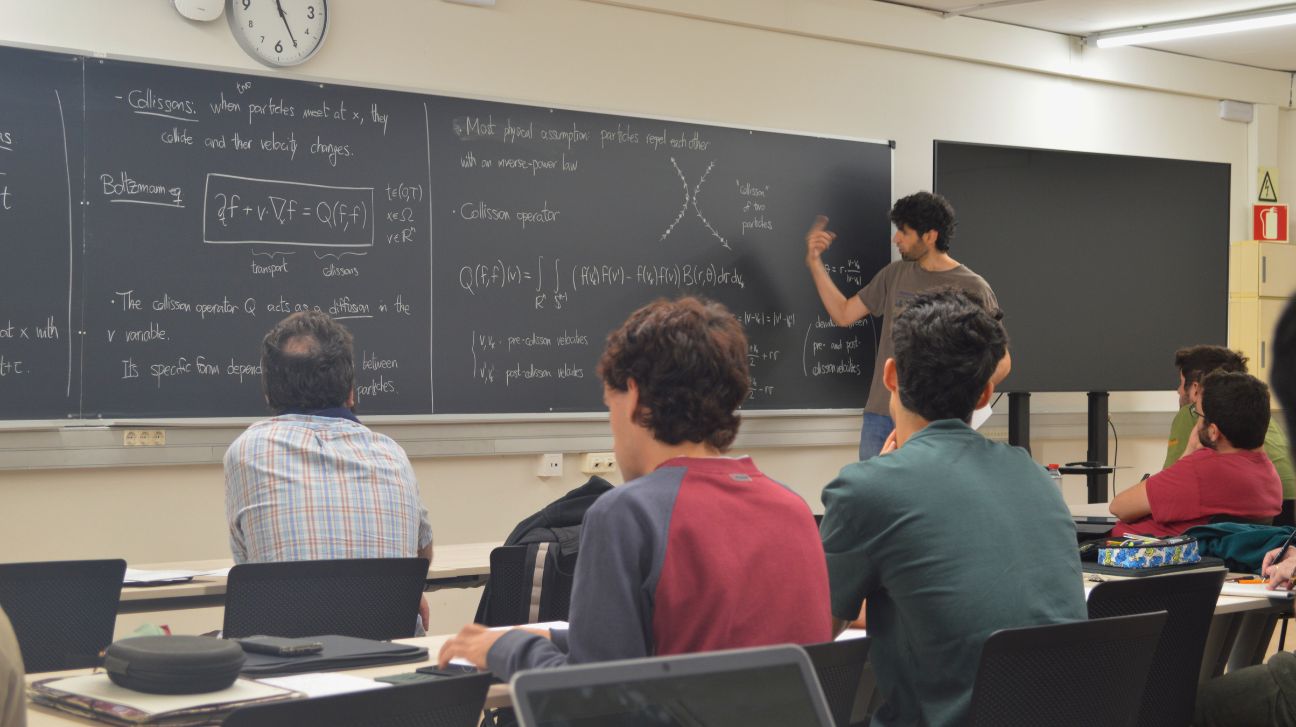
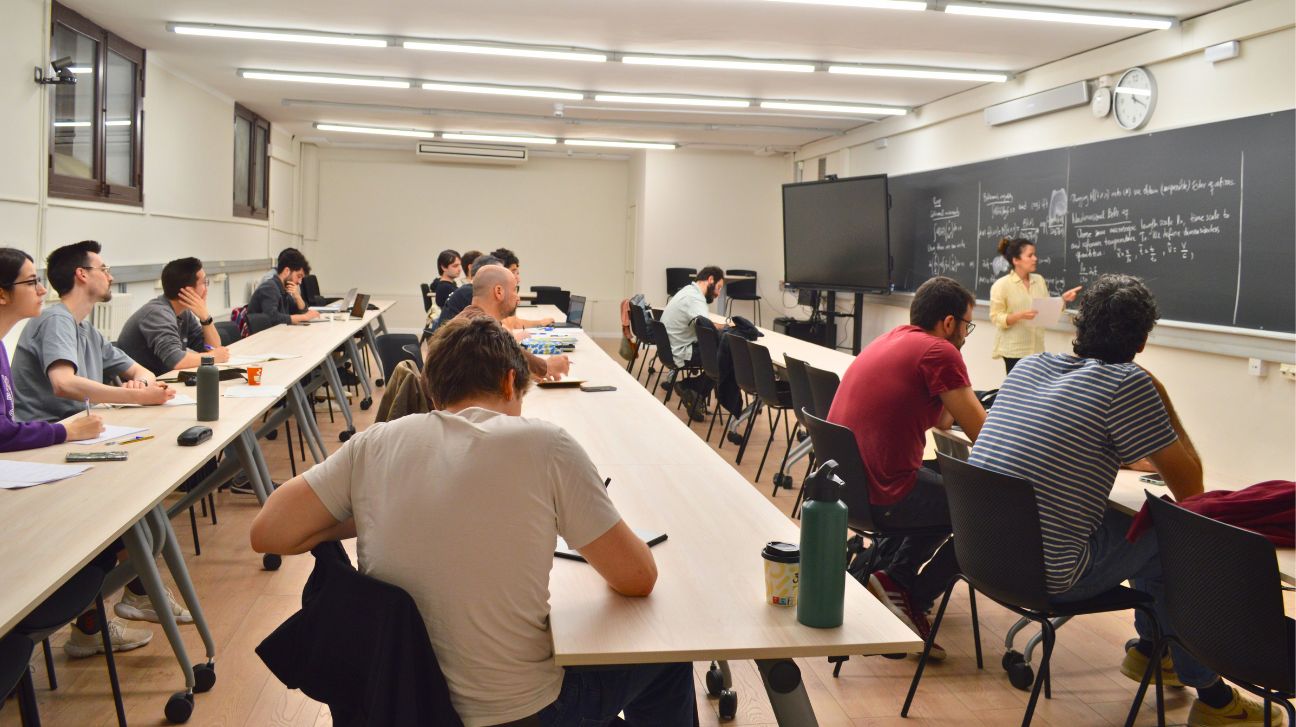
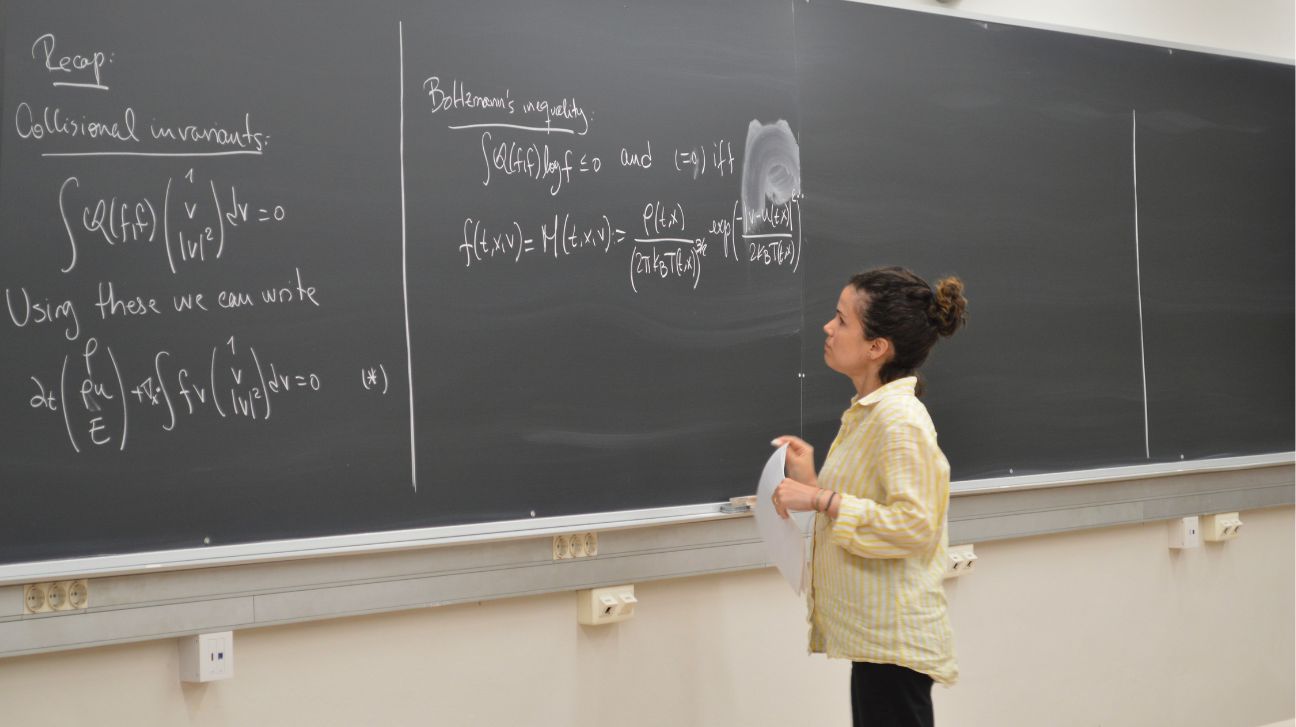
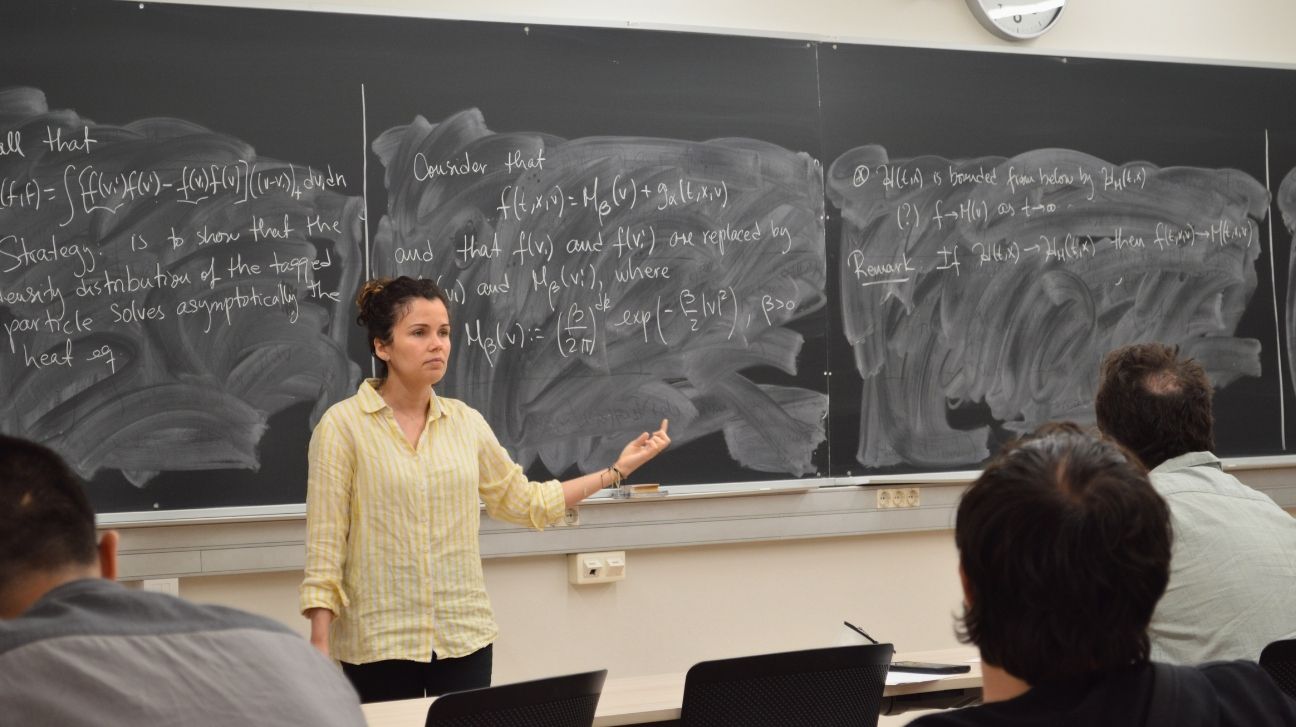
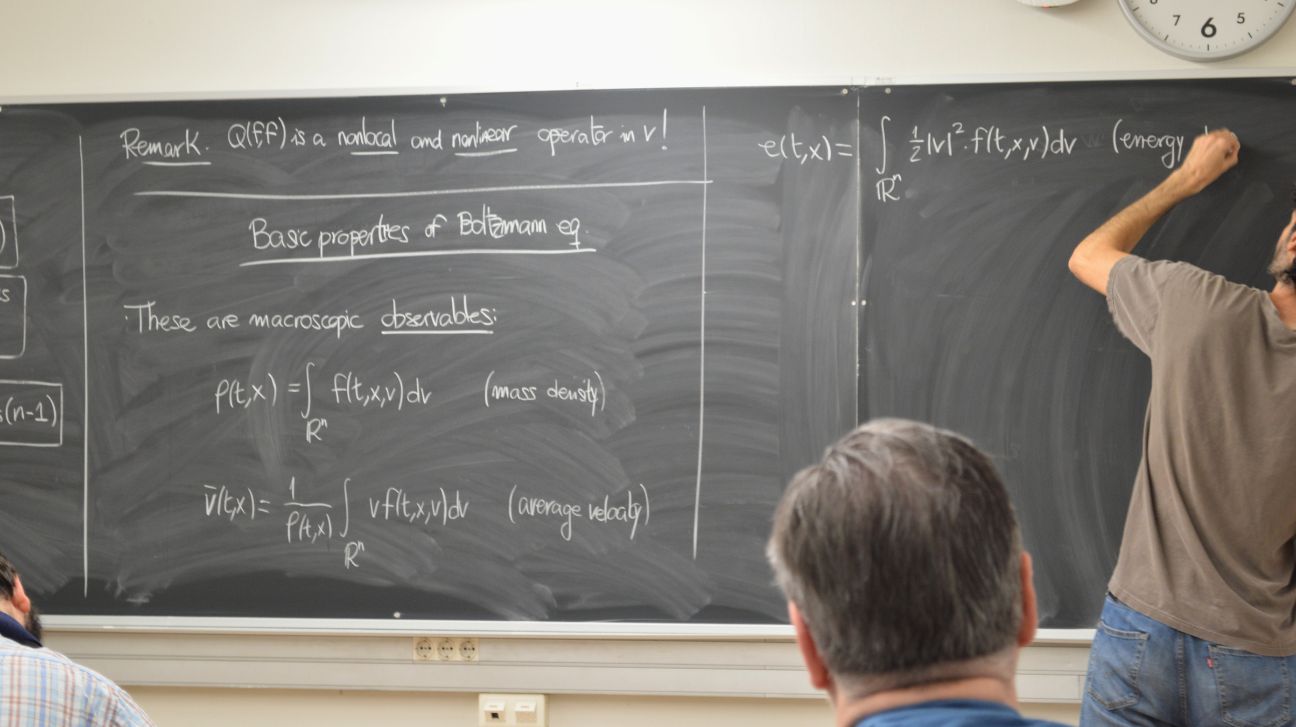
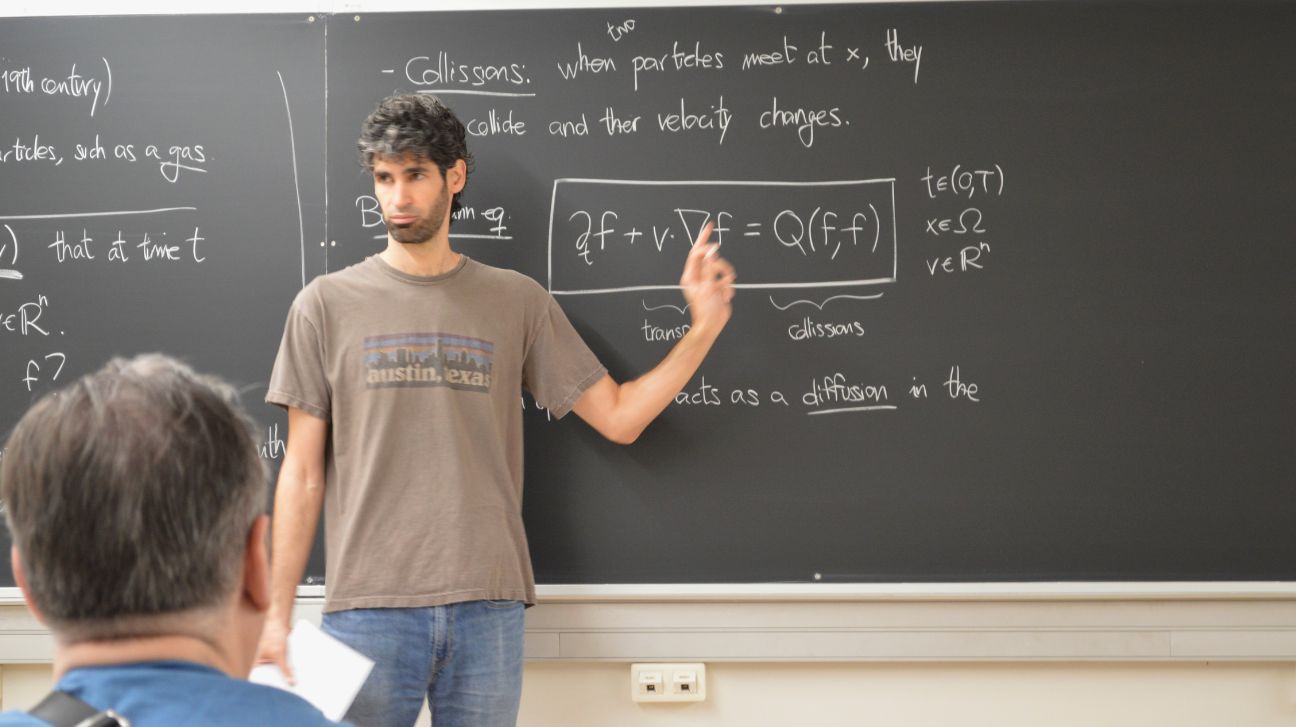
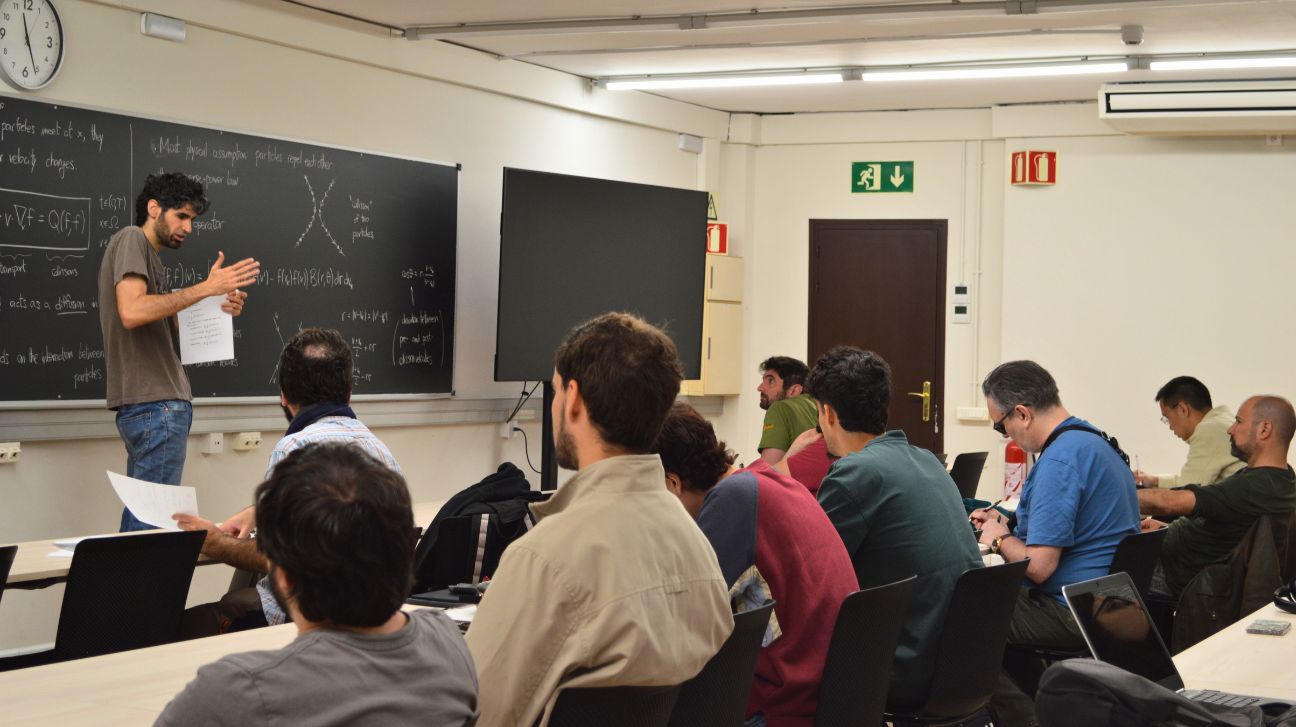
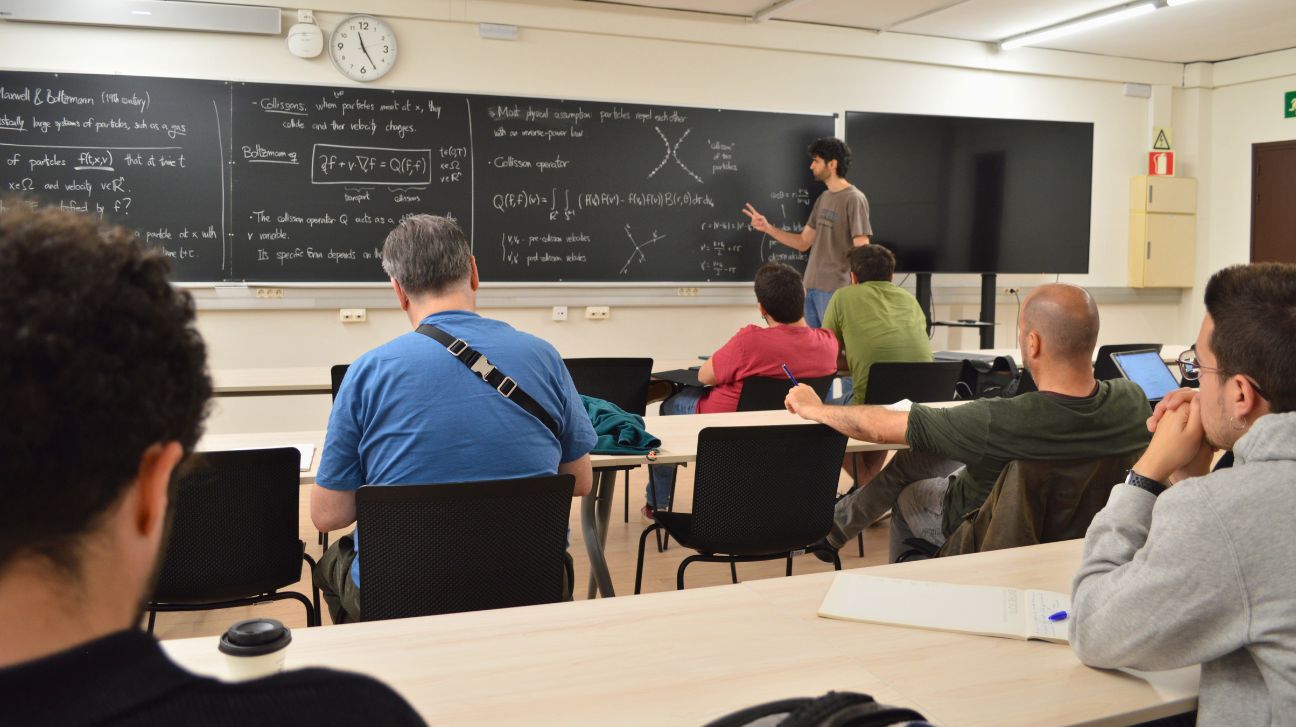
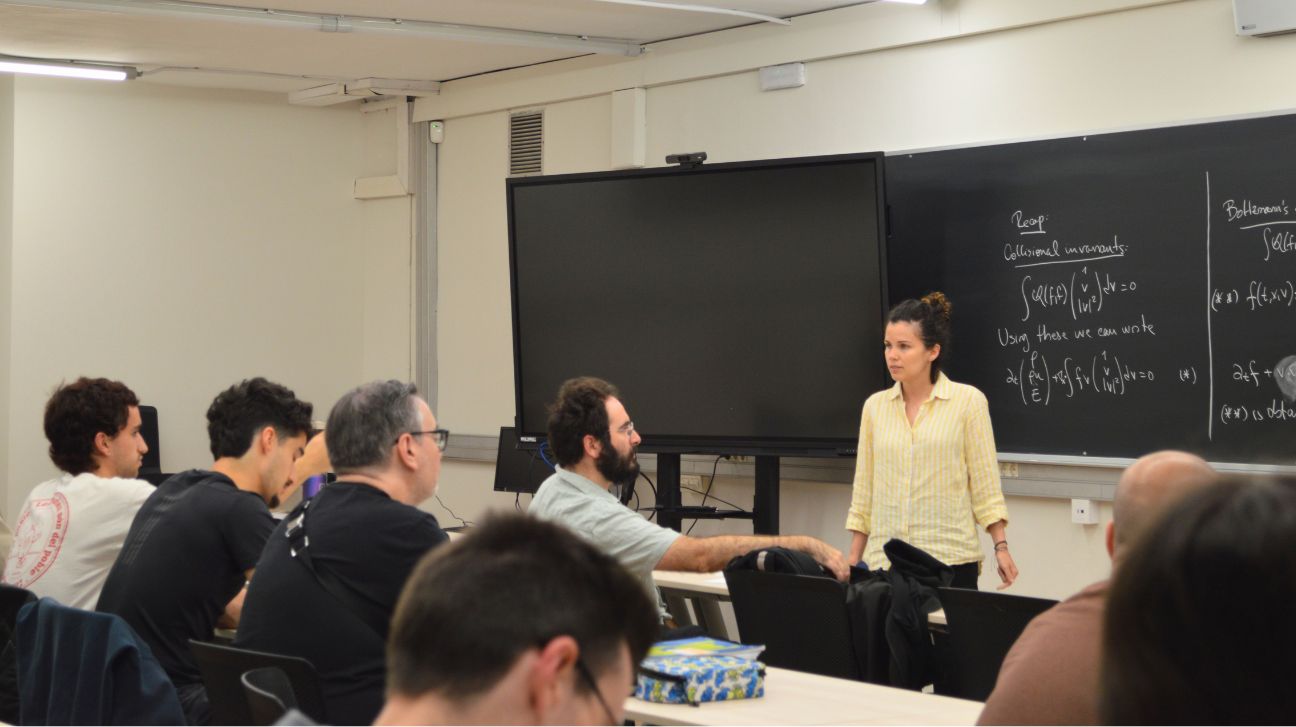
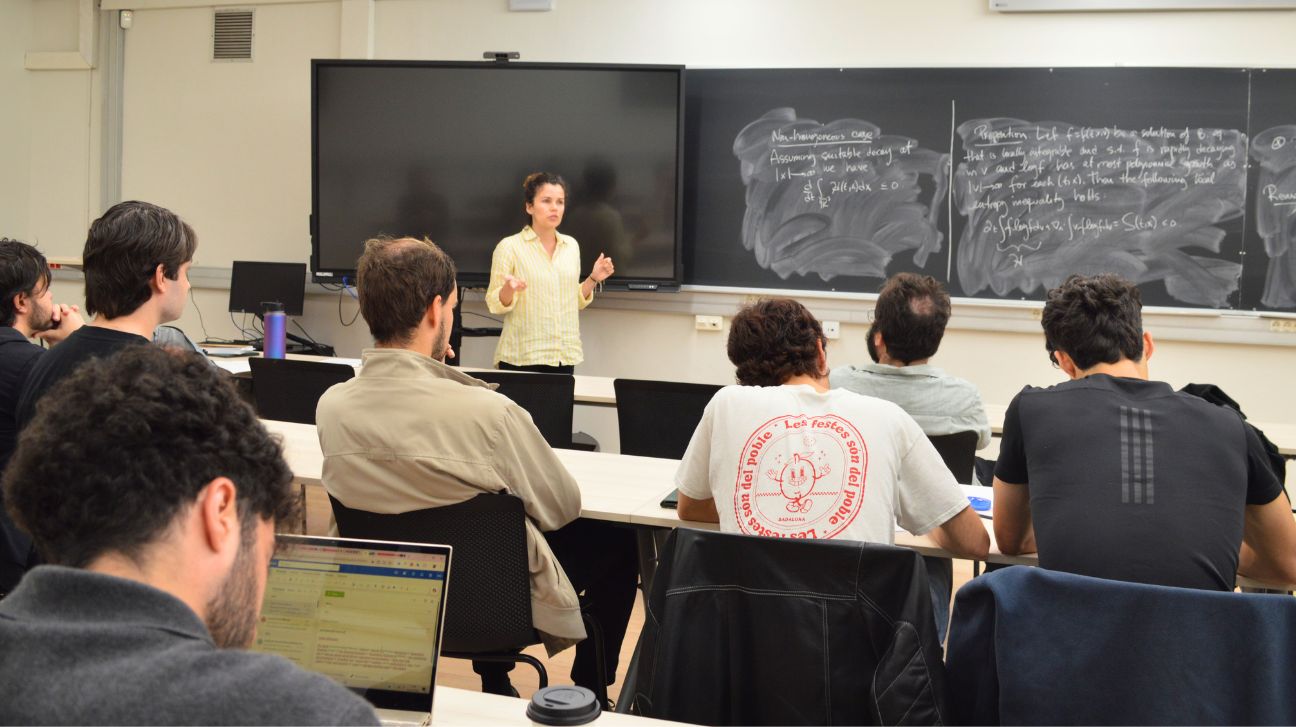
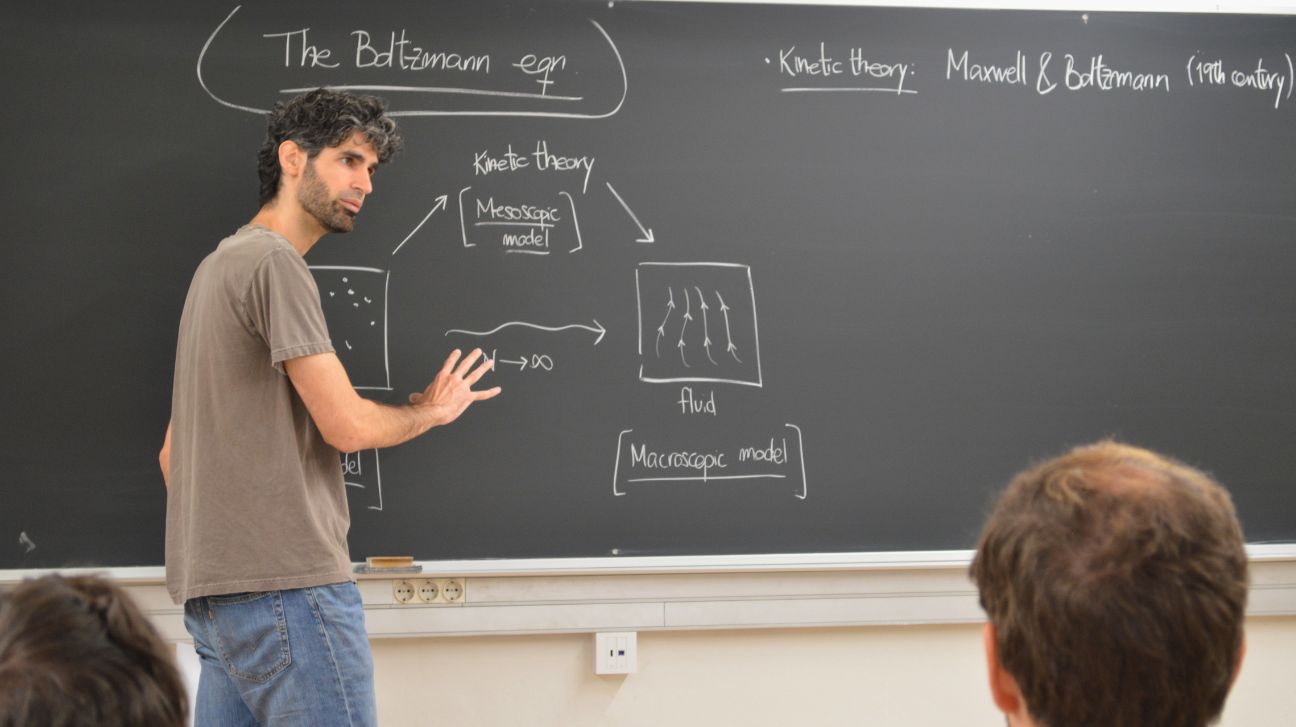
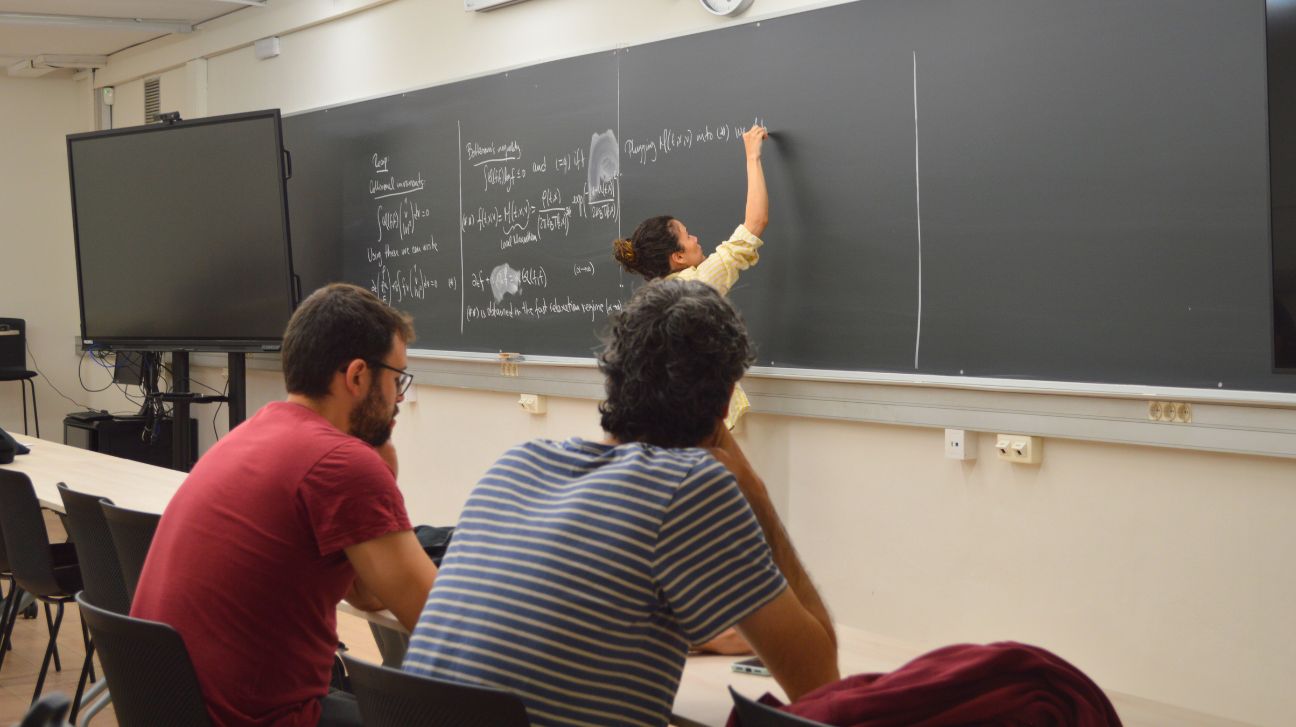
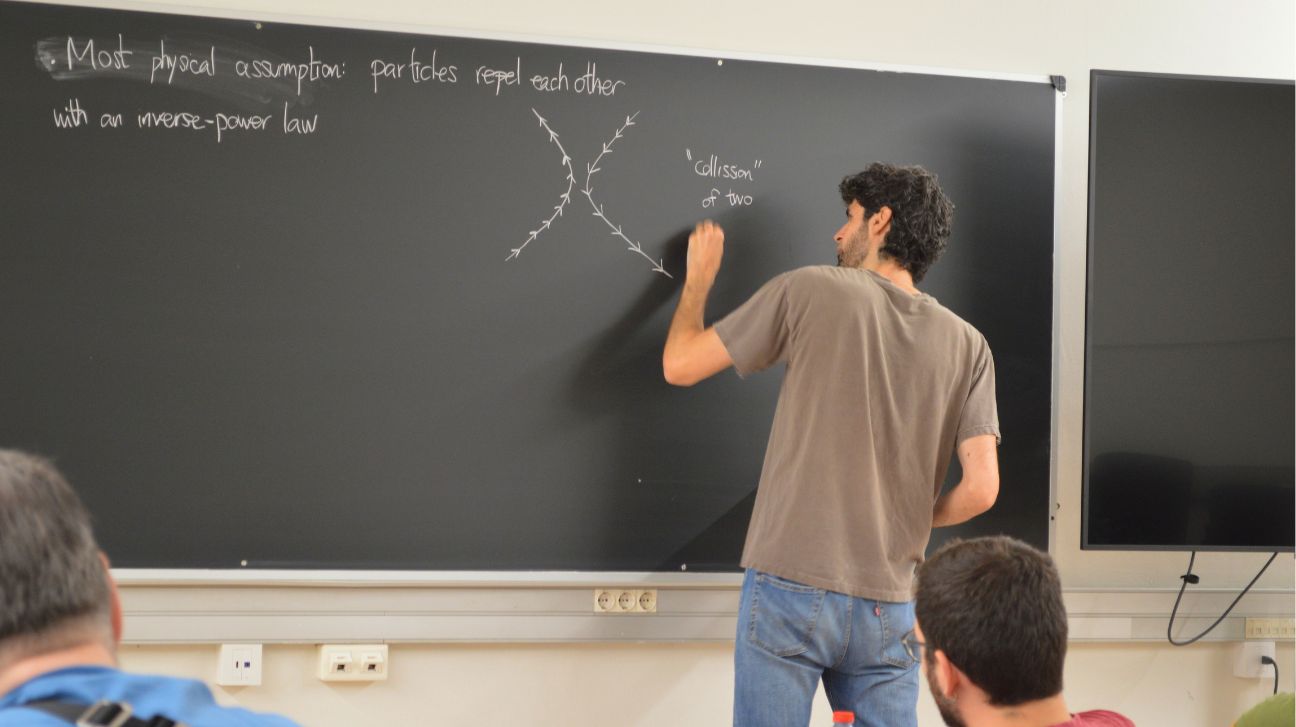
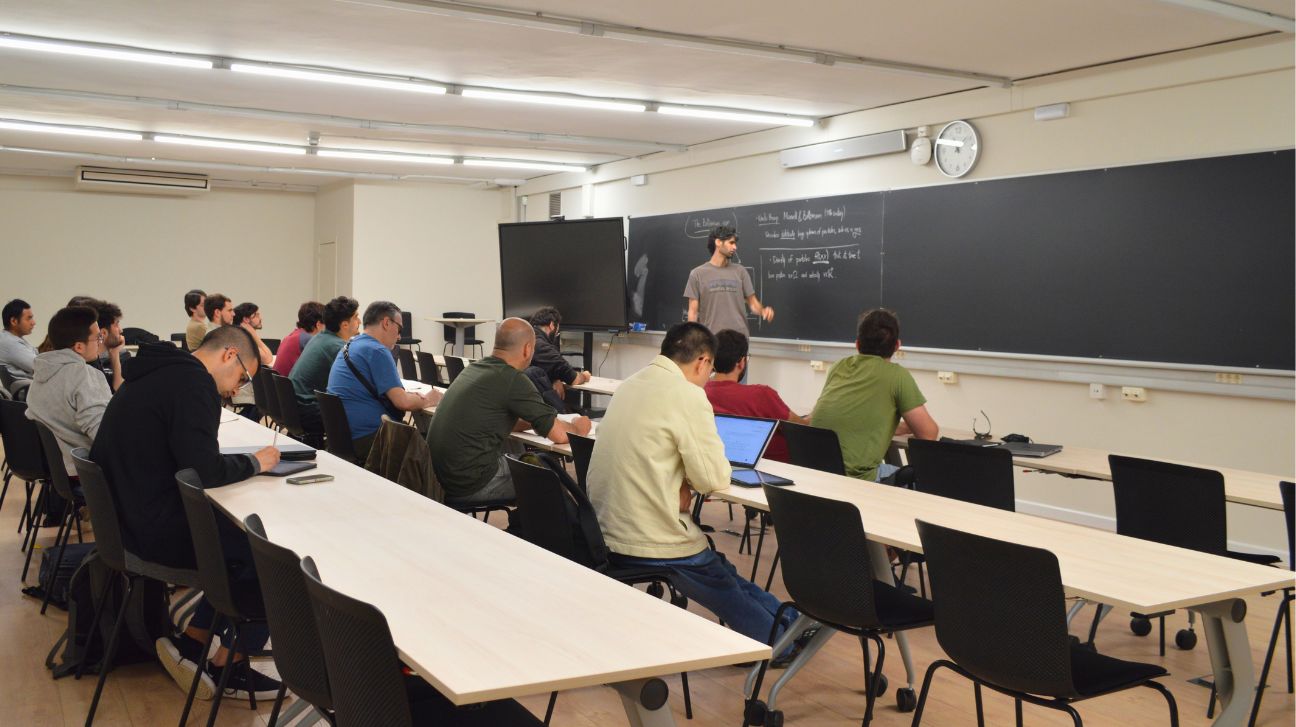
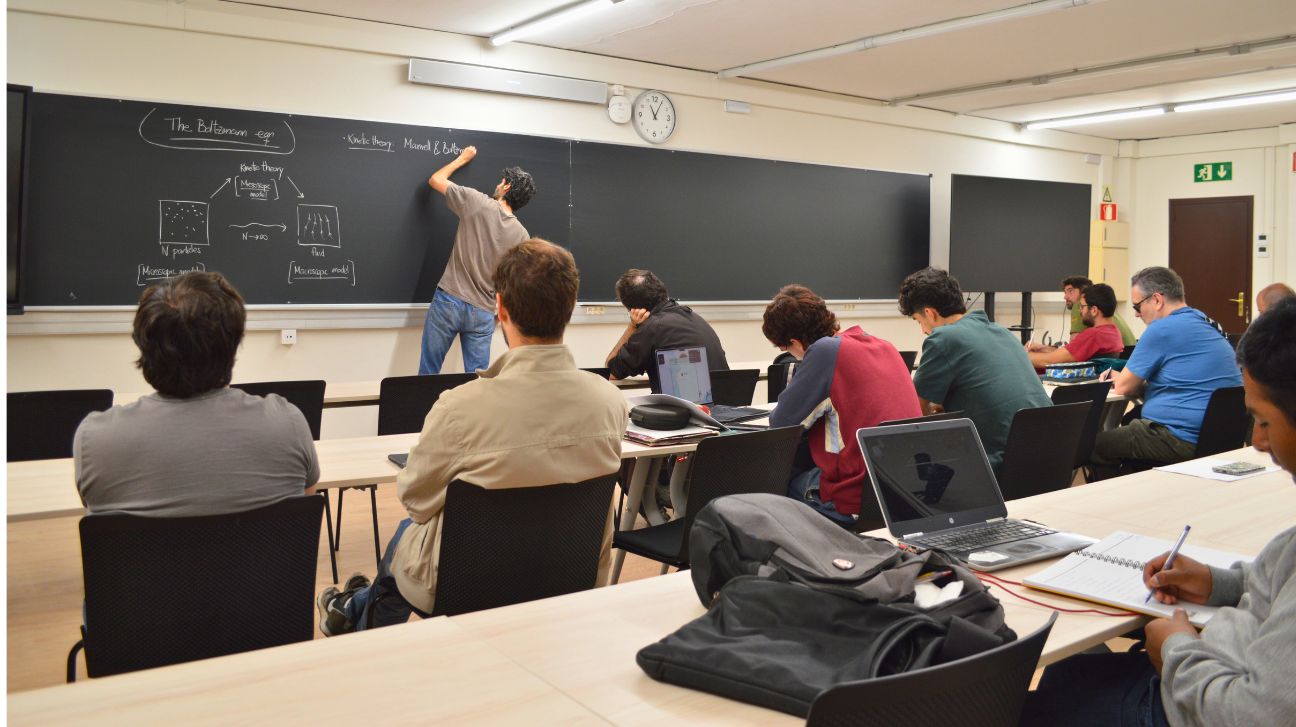
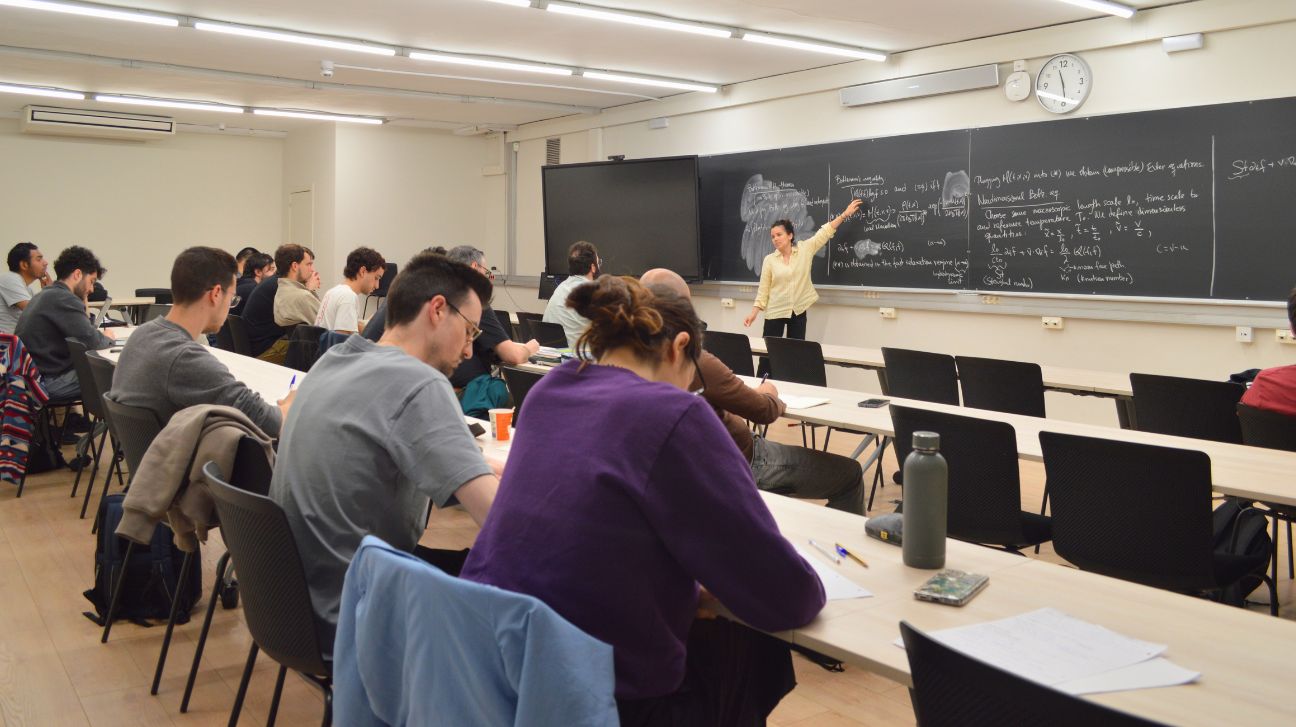
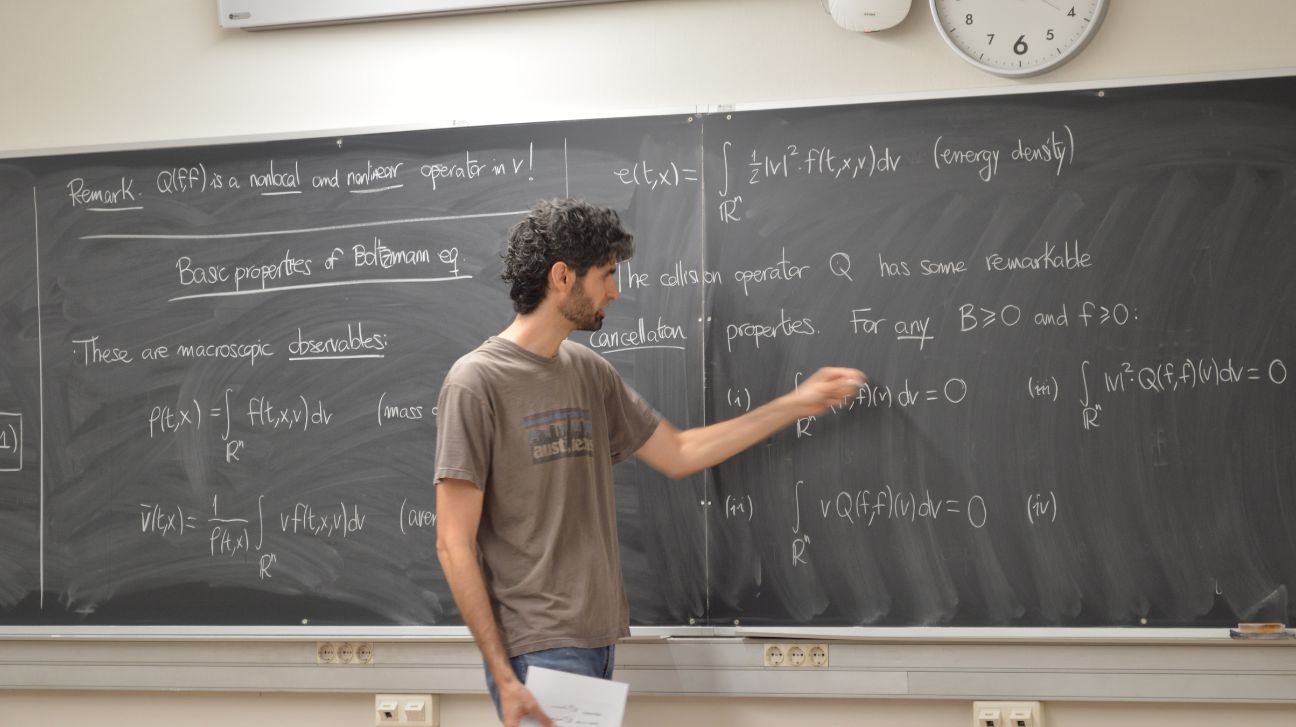
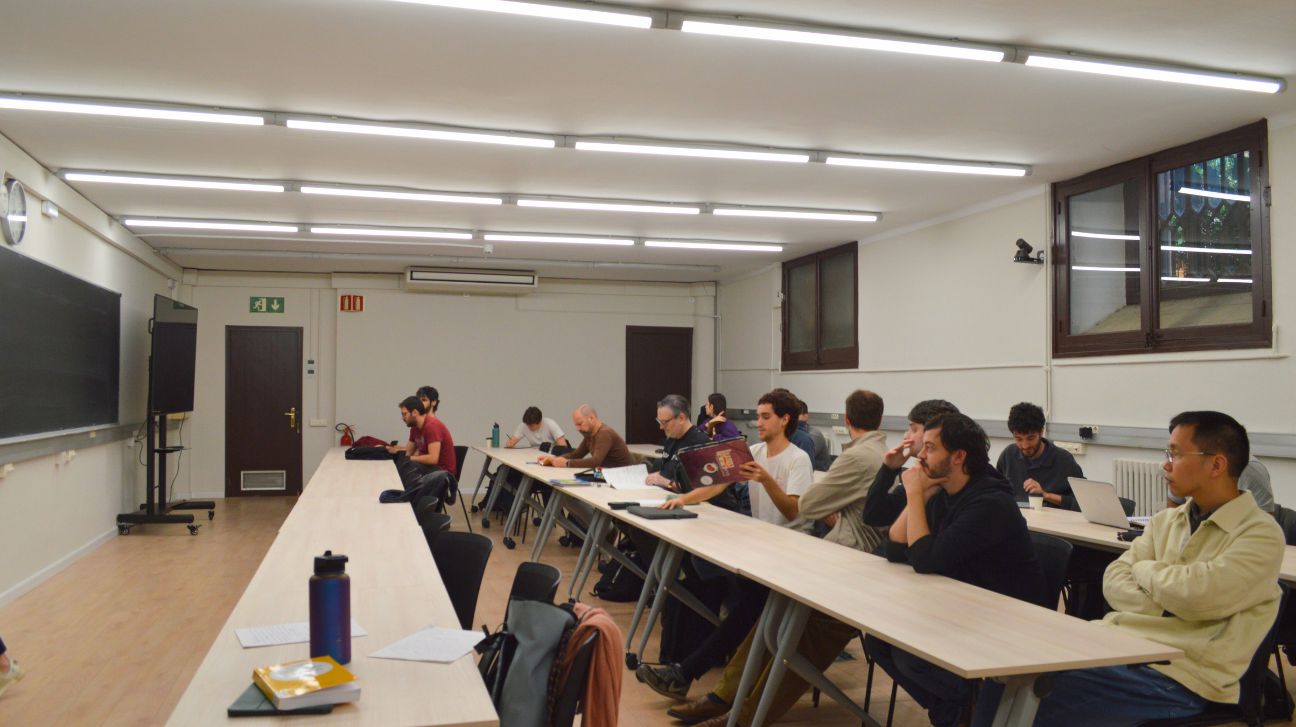
Between April 28 and May 14, 2026, the Faculty of Mathematics at the Universitat de Barcelona hosted the BGSMath course An introductory course to the Boltzmann equation. Over six sessions, the course brought together students and researchers interested in one of the fundamental equations of mathematical physics.
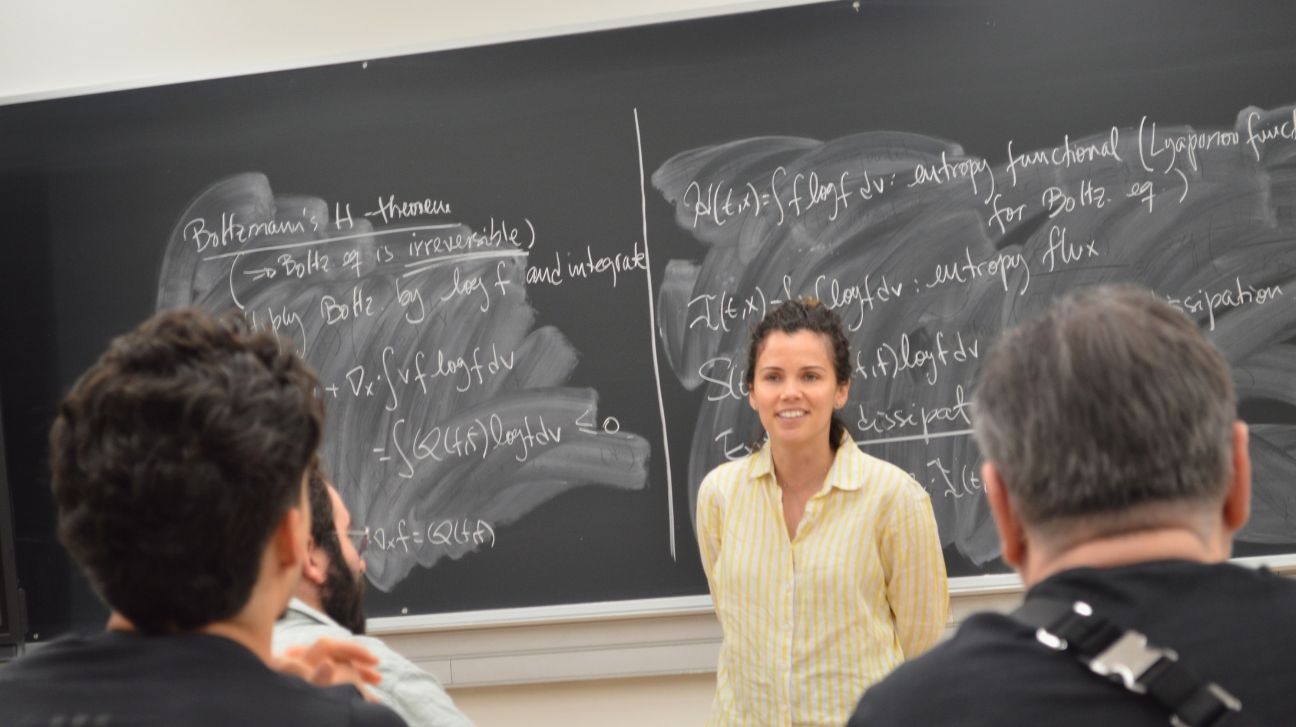
The sessions were led by Gissell Estrada (UPC–CRM), a specialist in the interaction between PDEs and kinetic theory and their interdisciplinary applications, and Xavier Ros-Oton (ICREA–UB–CRM), a renowned expert in partial differential equations, particularly known for his results on free boundary problems and integro-differential equations. Together, they offered an accessible yet rigorous introduction to a topic central to both physics and mathematics.
What is the Boltzmann equation?
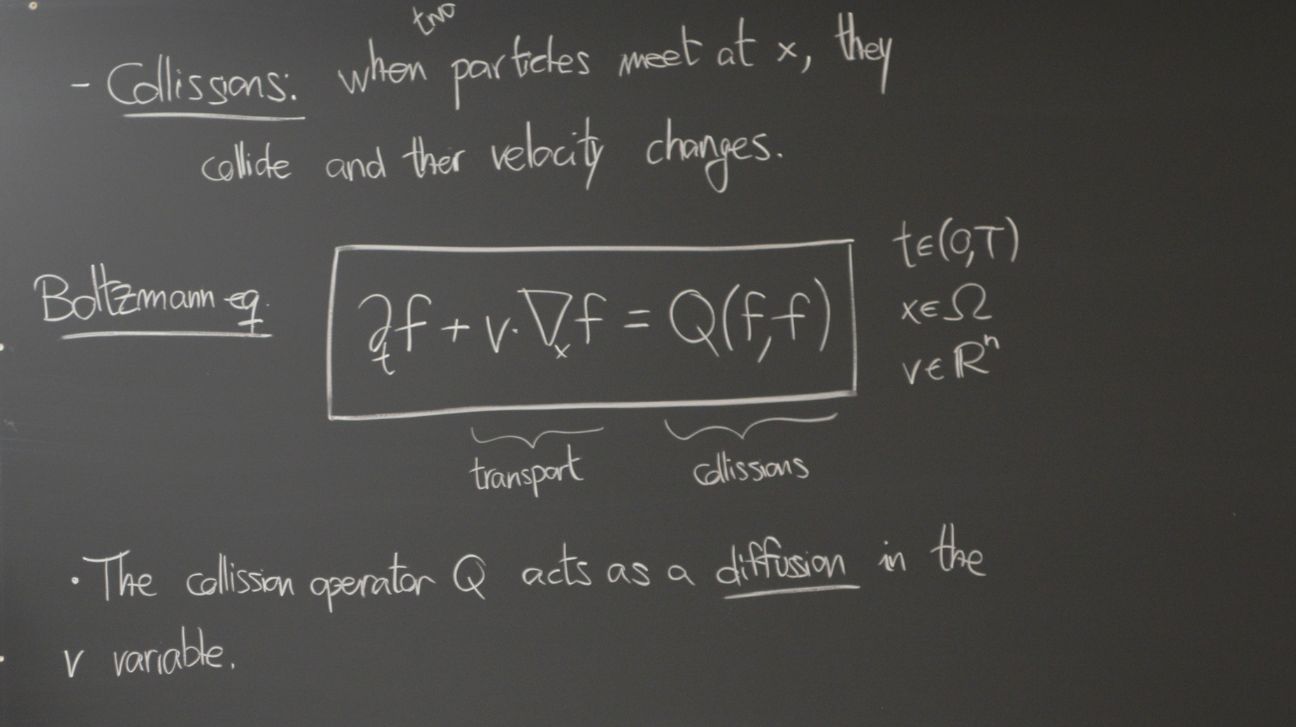
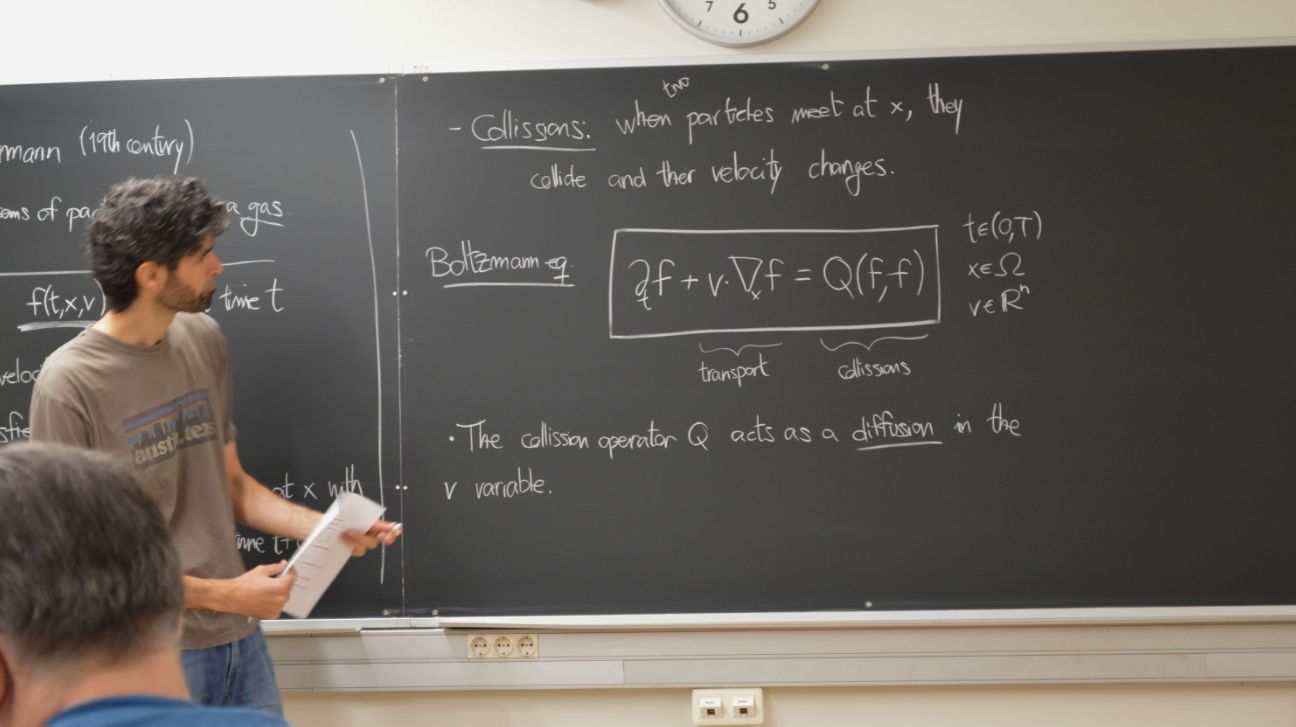
Although its name may sound technical, the Boltzmann equation arises from a very concrete question: how do millions—or even billions—of particles behave collectively when they interact with one another?
Boltzmann’s contribution was both deeply innovative and beautiful: he described the macroscopic world (temperature, pressure, equilibrium) by connecting it to the microscopic behavior (collisions between particles) through a statistical description of the whole system. In doing so, he was able to move from individual dynamics to a continuous description of the system—that is, to its macroscopic behavior.
This equation allows us to answer questions such as: how does the distribution of particle velocities evolve? Why does a gas tend toward equilibrium? Where does the irreversibility of time come from in macroscopic systems, if the underlying microscopic laws are reversible? These are profound questions about physical systems that Boltzmann managed to address with remarkable clarity and elegance.
To better understand this idea, we can think of an analogy. Imagine a town. It is made up of individuals with changing, complex, and highly specific relationships: friendships, conflicts, reunions… each interaction is different. Let us focus, for instance, on the relationship between two inhabitants: they may be friends, stop being so for some reason, and later reconnect. This would be an example of an interaction at the microscopic level of the town.
However, when we observe the town from the outside, we do not describe it through each individual relationship, but rather as a whole: with its dynamics, traditions, festivals, and overall character…
The Boltzmann equation does something very similar: it takes the details of these interactions and describes them statistically in order to capture the global behavior of the system. It does not track each particle individually, but instead gathers this set of interactions in a statistical way to provide a coherent picture of the whole.
The core of the course
The course offered a conceptual journey through the main mathematical challenges posed by the Boltzmann equation.
First, its derivation was addressed, starting from systems composed of many interacting particles with a well-defined macroscopic behavior. This approach connects to the famous sixth problem of Hilbert, which seeks to rigorously derive macroscopic physical laws from microscopic dynamics.
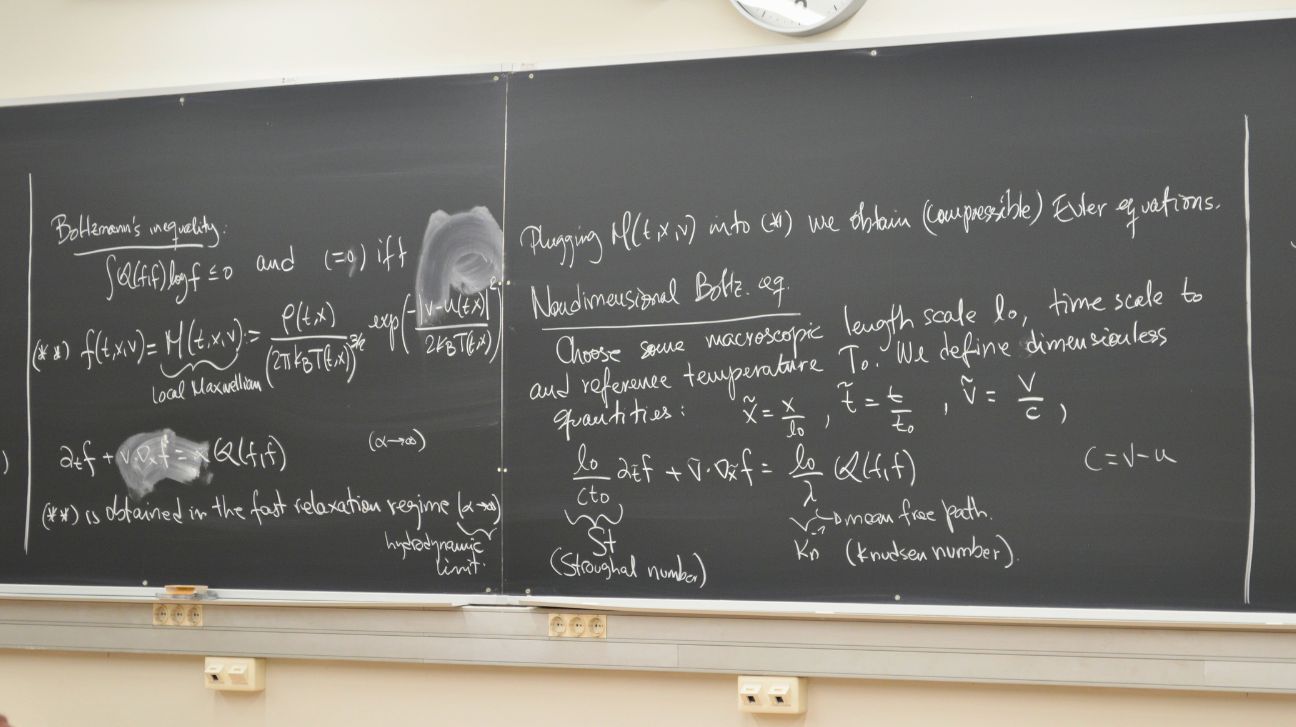
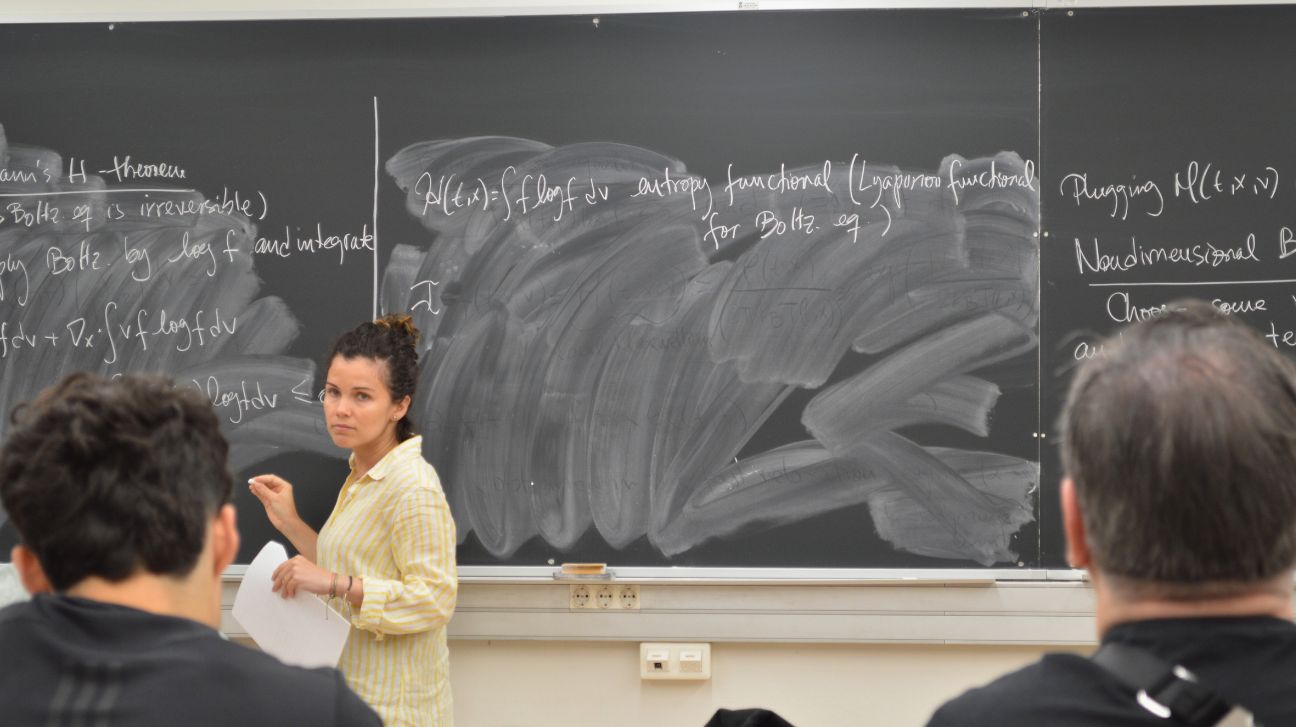
Next, some of its fundamental properties were presented: conservation laws, time irreversibility, the H-theorem—which describes how a system evolves toward equilibrium, independently of microscopic reversibility, introducing a preferred direction associated with the increase of entropy —the Boltzmann collision kernel, and simplified models such as the Kolmogorov equation.
Finally, key aspects of its mathematical analysis were explored: the Cauchy problem (existence, uniqueness, and long-time behavior), the regularity of solutions under certain macroscopic conditions, and some of the open problems that continue to drive research in this field.
Much more than an equation
Beyond its origins in gas physics, the Boltzmann equation now appears in surprising contexts: from biological models to network theory and collective dynamics.
In this sense, the course not only provided a technical introduction, but also an invitation to discover how an idea born in the 19th century remains a key tool for understanding complex systems in the 21st century.
Newsletter
Get the latest CRM news and activities delivered to your inbox
Subscribe now
Recent newsletters →
Susanna Terracini delivers the CRM Colloquium 2026
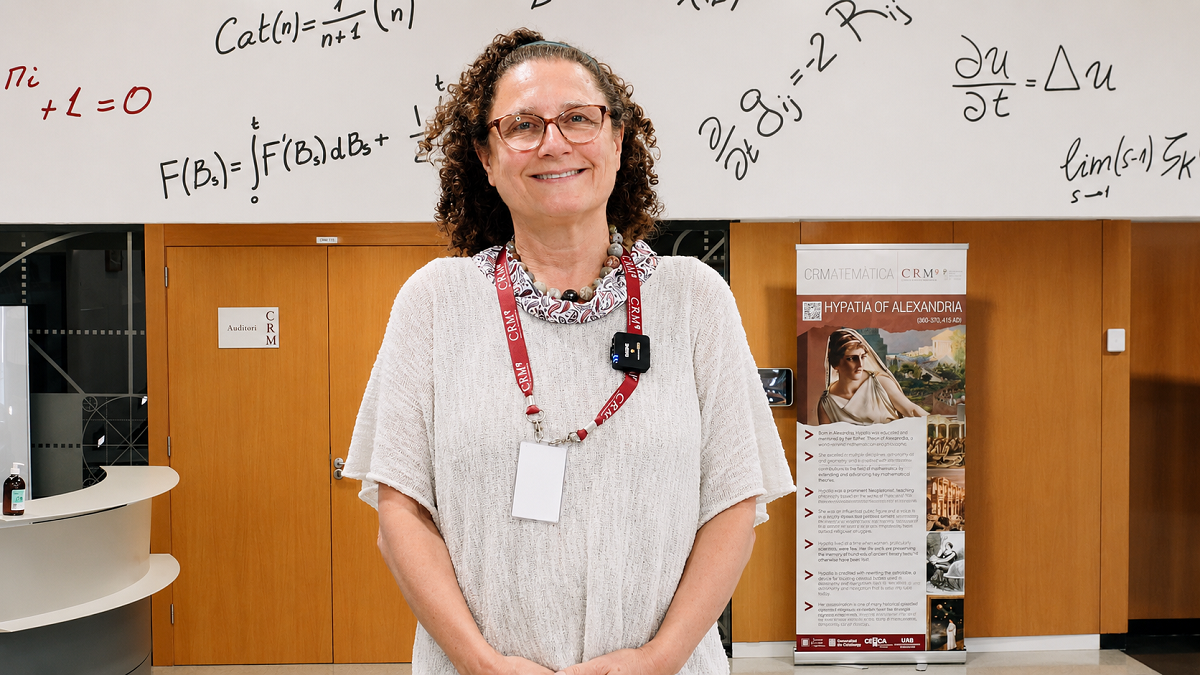
Susanna Terracini (Università di Torino) delivered the CRM Colloquium 2026 on 14 July, presenting a rigidity result for Kepler billiards obtained with Stefano Baranzini, Vivina Barutello and Irene De Blasi. She was at the centre as a member of the CRM Scientific...
Ho Chi Minh City hosts the first SEAMS School on applying mathematics to real-world problems
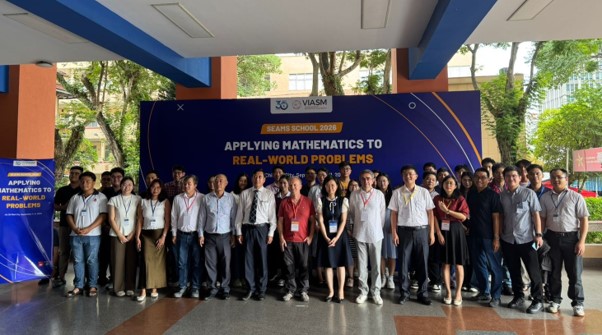
More than fifty students from six countries spent a week at the University of Science, VNU-HCM, learning how mathematics gets used outside a mathematics department. CRM researcher Tim Myers co-organised the school and lectured on moving boundary problems. The...

A single ball on a fixed table can compute: Eva Miranda and Isaac Ramos prove that two-dimensional billiards are Turing complete
Eva Miranda (UPC, CRM) and Isaac Ramos (ETH Zürich) show that a point particle bouncing inside a planar table with fixed walls can simulate a universal Turing machine, settling a question Cristopher Moore left open in 1990. The result grew out of a master’s project...
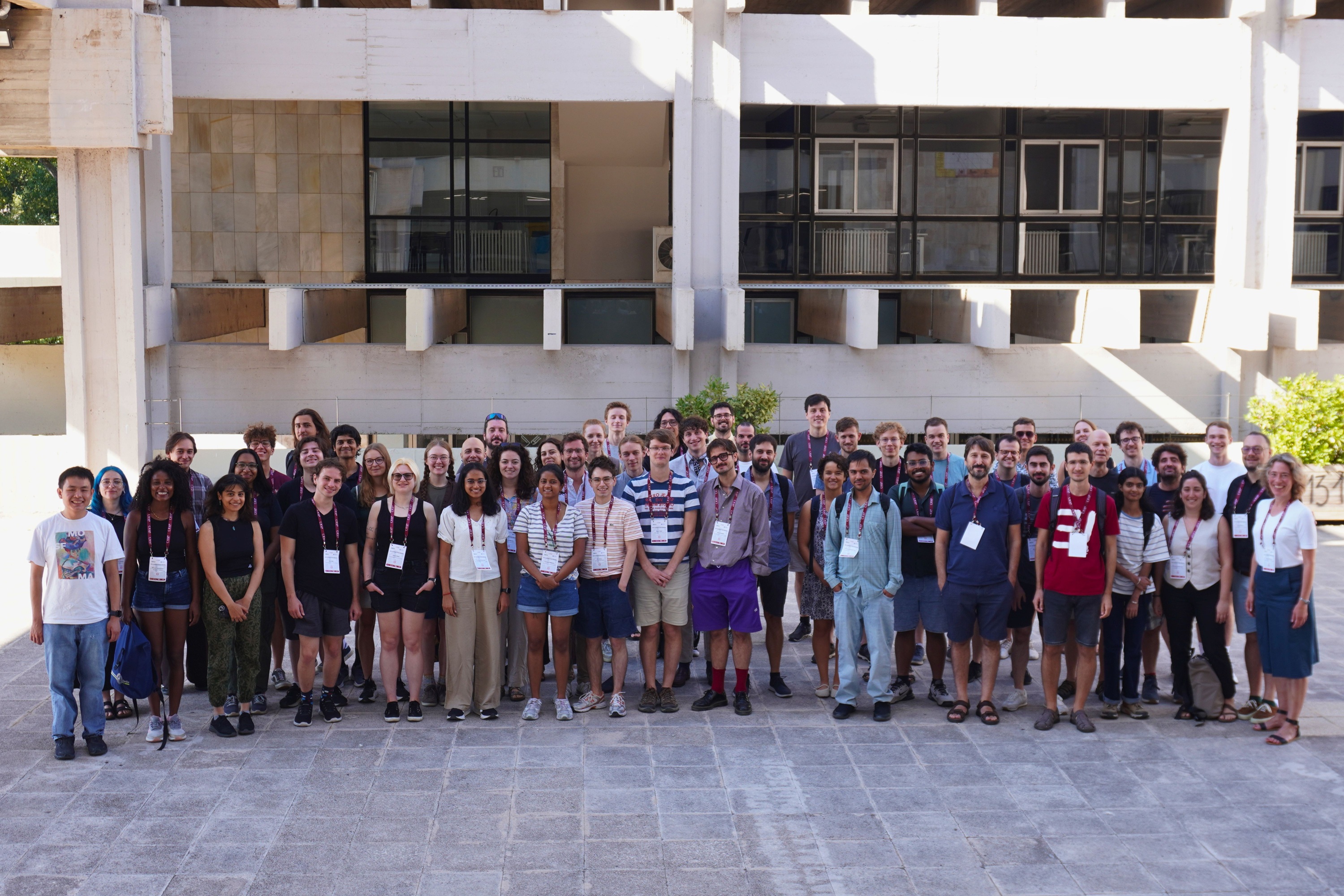
BMS-BGSMath Junior Meeting 2026: Barcelona and Berlin Strengthen Scientific Ties
From 2 to 4 September 2026, the Centre de Recerca Matemàtica (CRM) hosted the BMS-BGSMath Junior Meeting 2026, a three-day event jointly organised by the Berlin Mathematical School (BMS) and the Barcelona Graduate School of Mathematics (BGSMath), with the Centre de...
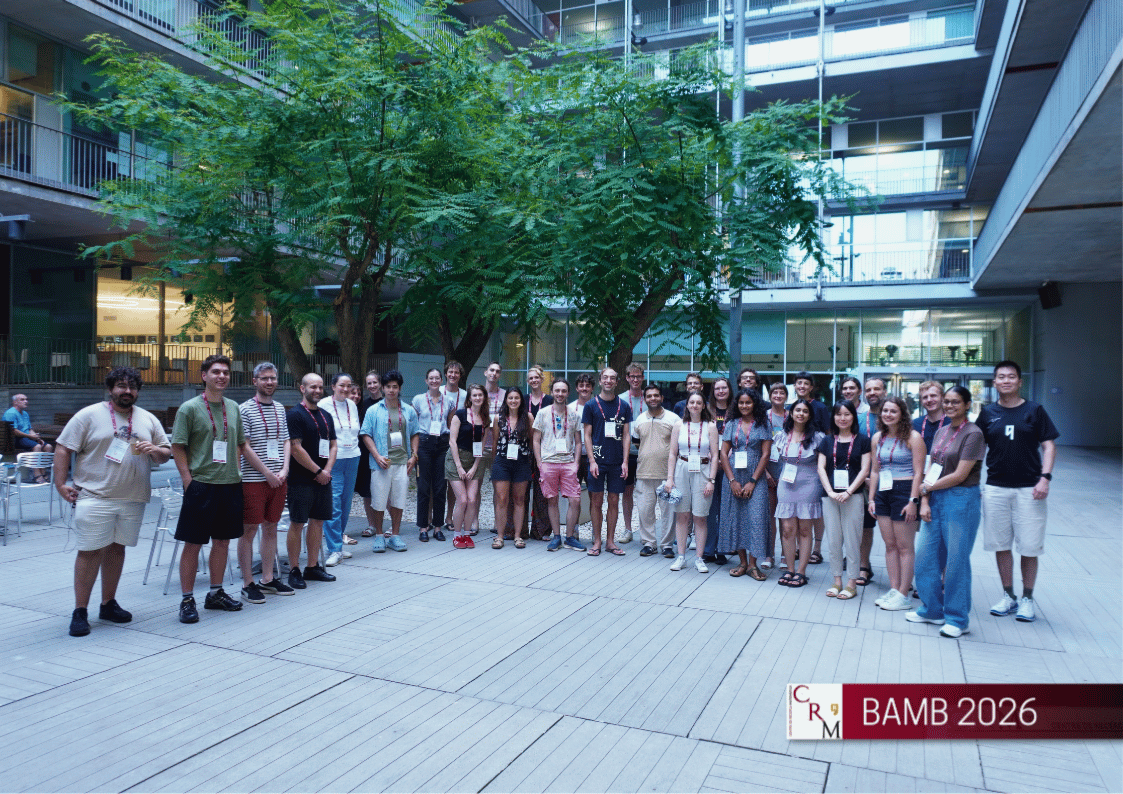
The CRM organises the 2026 Barcelona Summer School for Advanced Modeling of Behavior
The Centre de Recerca Matemàtica held the sixth edition of BAMB!, the Barcelona Summer School for Advanced Modeling of Behavior, from 12 to 23 July 2026 at the Parc de Recerca Biomèdica de Barcelona. Thirty early-career researchers from fourteen countries followed...
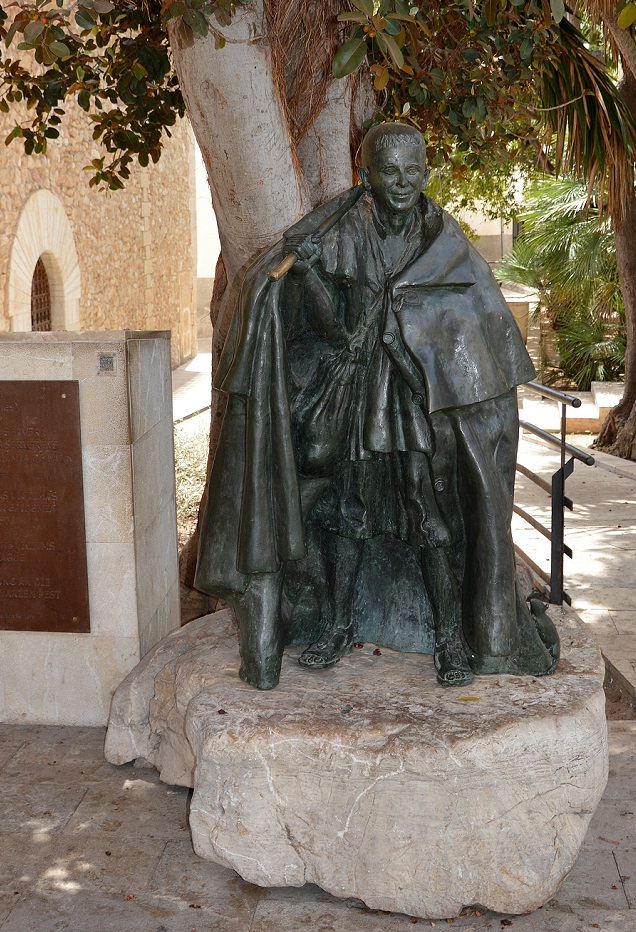
Mallorca’s 1820 plague did not behave like a classic bubonic outbreak, study finds
A study in PNAS by Pere Puig (UAB, CRM) and Joana Maria Pujadas-Mora (UOC, ICREA) reports what happens when the daily health records kept in Son Servera and Capdepera during the 1820 outbreak are analysed with a Bayesian epidemiological model: an unusually short...
|
|
CRM CommNatalia Vallina
|