
REGISTRATION
IS FREE
(Participation is subject to acceptance)
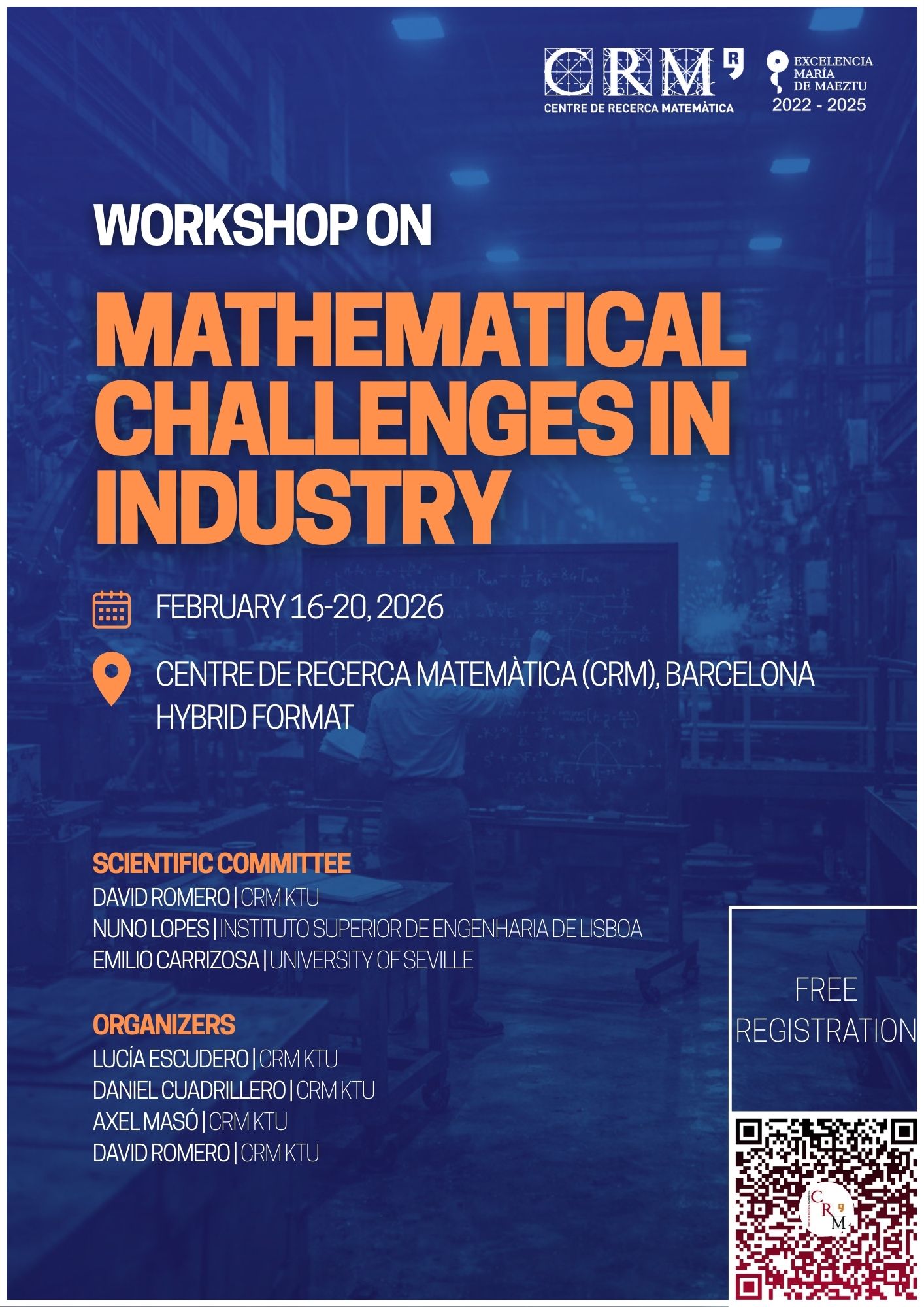
Workshop on Mathematical Challenges in Industry
Sign into February 20, 2026
Venue: Centre de Recerca Matemàtica (CRM)
Format: Hybrid
SCHEDULE
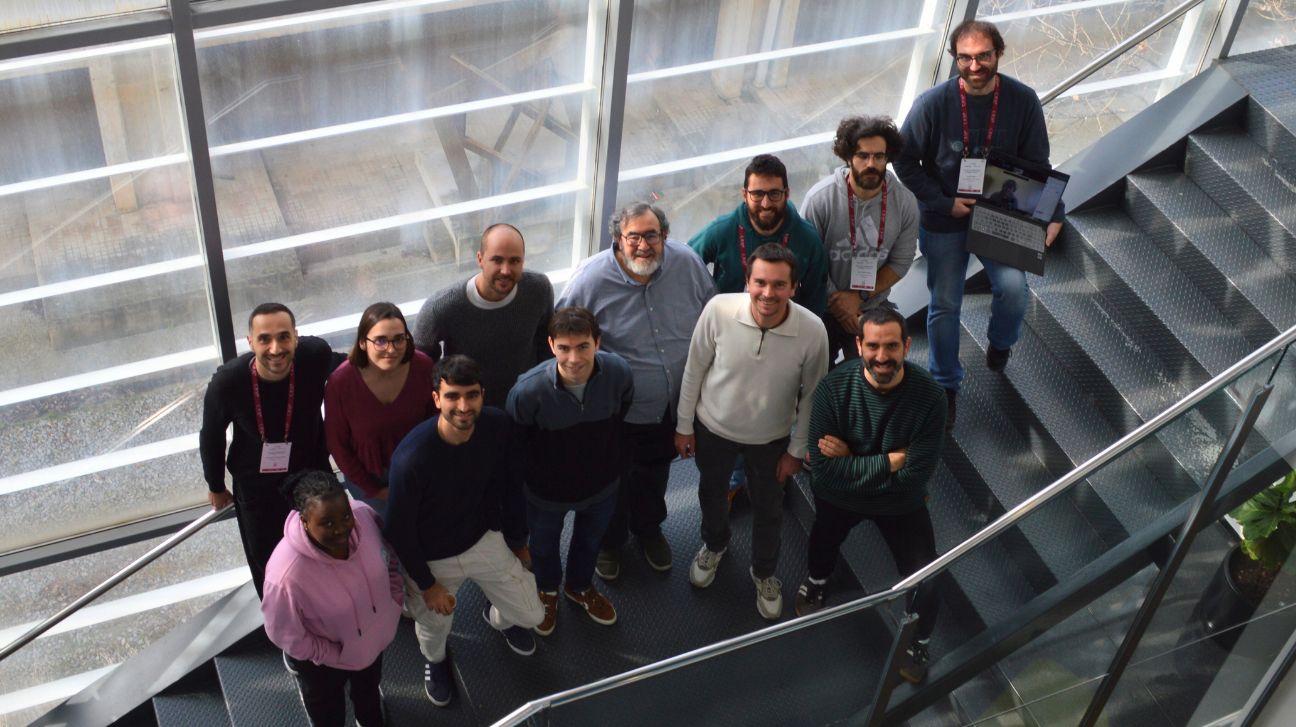
Group picture
Introduction
This initiative brings together mathematicians and industry professionals to address pressing real-world challenges in water management through advanced mathematical approaches. It aims to foster innovation by creating a direct and effective bridge between academic expertise and industrial and societal needs in the water sector.
The event is structured as an intensive, week-long workshop in which multidisciplinary teams of mathematicians (ranging from graduate students to experienced researchers) work collaboratively on problems proposed by industry and institutional partners. The immersive format encourages rapid problem analysis, mathematical modelling, and the development of practical, implementable solutions. Specifically, the event will feature three problem statements.
The challenges will focus on key aspects of water management, including infrastructure optimisation, and decision support for policy and operations. Working under the joint guidance of industry and academic researchers, each group will apply advanced mathematical methods to tackle concrete, real-world challenges in water management. Beyond immediate problem solving, the initiative seeks to stimulate long-term collaboration, knowledge transfer, and the emergence of new research directions with tangible impact in the water sector.
PROBLEMS
PROBLEM 1 | Smart Control of Wastewater Pumping Stations
Urban wastewater treatment plants are major energy consumers, with pumping systems accounting for a significant share of total electricity use. While these systems are essential to ensure stable and reliable operation, they are often managed using simple control strategies that do not take energy efficiency into account.
The challenge focuses on the intelligent operation of a pumping station equipped with multiple pumps. The objective is to develop a mathematical and computational approach that minimises energy consumption while ensuring stable flow conditions and respecting operational constraints. The solution should account for varying inflows, different pump characteristics, and decisions over a future time horizon, combining pump activation and operating frequencies in an optimal way.
This challenge invites participants to formulate the problem, define appropriate constraints and objectives, and propose an optimisation strategy capable of supporting more energy-efficient and proactive operation of wastewater pumping systems.
PROBLEM 2 | Data-Driven Modelling and Predictive Control of Wastewater Treatment Processes
Wastewater treatment plants are essential for environmental protection and public health, yet their operation is governed by complex, nonlinear biological dynamics and stringent regulatory constraints. While detailed mechanistic models are available, their complexity often hinders the direct application of advanced control techniques.
This challenge focuses on the identification of reduced-order, data-driven dynamical models—such as linear state-space representations—derived from input–output data of a wastewater treatment process. These models are intended to approximate the system dynamics around a given operating point and to serve as the basis for control design.
Participants are invited to use the identified models within a model predictive control (MPC) framework to regulate key effluent quality indicators while minimising operational costs, in particular energy consumption. The challenge highlights the interplay between system identification, model reduction, optimisation, and predictive control, illustrating how mathematical methods can support efficient and reliable operation of wastewater treatment systems.
PROBLEM 3 | Hybrid Modelling and Model Reduction for Wastewater Treatment Systems
Detailed mechanistic models are widely used to represent the biological processes involved in urban wastewater treatment. While these models provide high-fidelity descriptions of plant dynamics, their complexity often limits their direct use in optimisation and control tasks.
This challenge focuses on the mathematical modelling problem itself, rather than on plant operation or control. Participants are invited to work with a reduced-order mechanistic model of a wastewater treatment process and to improve its predictive capabilities through the construction of a hybrid (grey-box) model. The approach combines first-principles modelling with data-driven components trained on input–output data.
The objective is to design and validate a hybrid modelling strategy—such as a parallel residual architecture—that enhances the accuracy of a reduced model while preserving its low dimensionality. The challenge highlights core mathematical issues, including model reduction, parameter identifiability, residual modelling, and validation against a high-fidelity reference simulator.
This problem emphasises model quality and approximation, rather than control performance, and illustrates how hybrid mathematical models can bridge the gap between mechanistic understanding and data-driven learning in complex wastewater treatment systems.
SCIENTIFIC committee
Emilio Carrizosa | Universidad de Sevilla – Math-In
Nuno Lopes | Instituto Superior de Engenharia de Lisboa
David Romero | CRM Knowledge Transfer Unit
ORGANISING committee
Daniel Cuadrillero | CRM Knowledge Transfer Unit
Axel Masó | CRM Knowledge Transfer Unit
David Romero | CRM Knowledge Transfer Unit
SCHEDULE
MondayFebruary 16th |
TuesdayFebruary 17th |
WednesdayFebruary 18th |
ThursdayFebruary 19th |
FridayFebruary 20th |
|
| 09:30-10:00 |
|
Work Group | Work Group | Work Group | |
| 10:00-10:15 | Team Findings | ||||
| 10:15-10:30 |
Registration |
||||
| 10:30-11:00 |
Welcome |
||||
| 11:00-11:30 |
Coffee Break |
Group picture+Coffee Break |
Coffee Break |
||
| 11:30-13:45 | Work Group | Work Group | Work Group | Work Group | |
| 13:45-14:45 |
Lunch |
||||
| 14:45-16:15 | Work Group | Work Group | Work Group | Work Group | |
LIST OF PARTICIPANTS
| Name | Institution |
|---|---|
| Giorgi Khimshiashvili | Ilia State University, Tbilisi, Georgia |
| Muhammad Ijaz | University of Swabi |
| Nuno Lopes | Instituto Superior de Engenharia de Lisboa |
| Emilio Carrizosa Priego | Universidad de Sevilla – Math-In |
| Gerard Olivar-Tost | Universidad Católica del Maule |
| Francisco González de Cossío | ACCIONA |
| Cosmin Koch | ACCIONA |
| Ana Maria Jimenez Banzo | ACCIONA AGUA SA |
| Lluís Alsedà i Soler | Universitat Autònoma de Barcelona |
| Jan Colomina | Universitat Autònoma de Barcelona |
| Víctor Navas Portella | Universitat Autònoma de Barcelona |
| Marc Calvo Schwarzwalder | Universitat Politècnica de Catalunya |
| Marc Jorba-Cuscó | Universitat Politècnica de Catalunya |
| Daniel Pérez Palau | Universitat Politècnica de Catalunya |
| Juan Carlos Fernández Garcés | Universidad de Málaga |
| David Holoskov Holoskov | Universidad de Sevilla |
| Antonio Navas-Orozco | Universidad de Sevilla |
| José Carlos Castro Gómez | Universidad de Sevilla |
| Eduardo G. Pardo | Universidad Rey Juan Carlos |
| Deissy Milena Sotelo-Castelblanco | National University of Colombia |
| Francesco Paolo Contò | University of Pavia |
| Diego Alfonso Ramírez Muñoz | National Autonomous University of Mexico |
| Pedro Porras Flores | National Autonomous University of Mexico |
| Ângelo Manuel | University of Aveiro |
| Faustino Maciala | University of Minho |
| Lucía Escudero Sartages | Centre de Recerca Matemàtica |
| Daniel Cuadrillero Moles | Centre de Recerca Matemàtica |
| Axel Maso-Puigdellosas | Centre de Recerca Matemàtica |
| Rachael Olwande | Centre de Recerca Matemàtica |
| David Romero i Sànchez | Centre de Recerca Matemàtica |
| Elena Pilar Ochoa Ochoa | Universidad del Bío-Bío |
LODGING INFORMATION
ON-CAMPUS AND BELLATERRA
BARCELONA AND OFF-CAMPUS
acknowledgement
CRM Events code of conduct
All activities organized by the CRM are required to comply with the following Code of Conduct.
CRM Code of Conduct
scam warning
We are aware of a number of current scams targeting participants at CRM activities concerning registration or accommodation bookings. If you are approached by a third party (eg travellerpoint.org, Conference Committee, Global Travel Experts or Royal Visit) asking for booking or payment details, please ignore them.
Please remember:
i) CRM never uses third parties to do our administration for events: messages will come directly from CRM staff
ii) CRM will never ask participants for credit card or bank details
iii) If you have any doubt about an email you receive please get in touch
 |
For inquiries about this event please contact the Scientific Events Coordinator Ms. Núria Hernández at nhernandez@crm.cat
|
Sustainable Events
We are committed to organising sustainable events that minimise environmental impact and create a positive legacy for the host community. We support organisers in designing events aligned with the UN 2030 Sustainable Development Goals, reducing negative environmental impacts and promoting responsible practices.
All materials provided during our activities are responsibly sourced, including recycled pens and plastic-free badges. We work with responsible suppliers, and our catering partners use fully compostable materials while offering vegetarian and vegan options, with at least one event day being fully vegetarian.