

Mathematical Neuroscience
and other biological topics
Attendance at this conference
is by invitation only
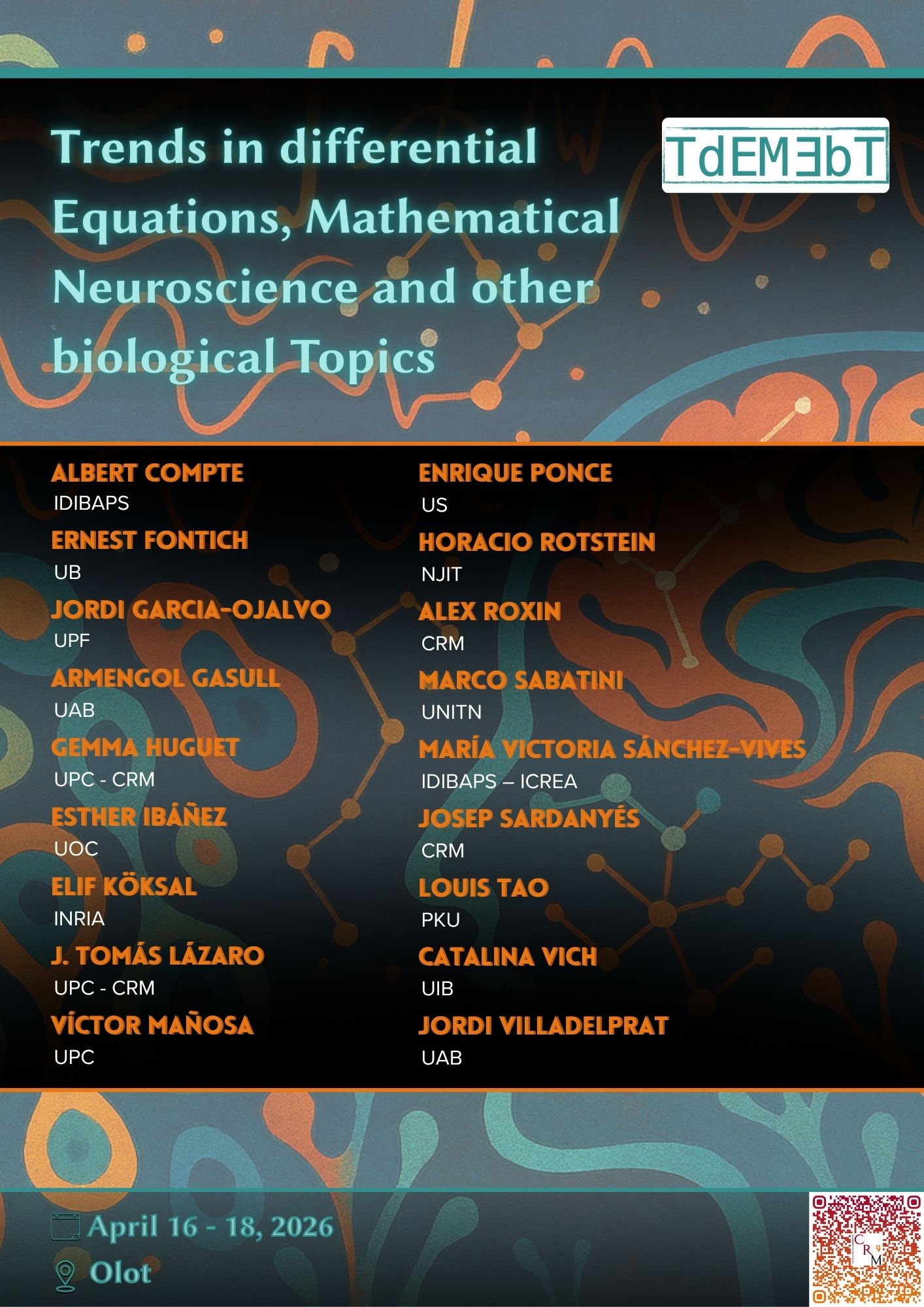
Trends in Differential Equations, Mathematical Neuroscience and other biological topics
Sign into April 18, 2026
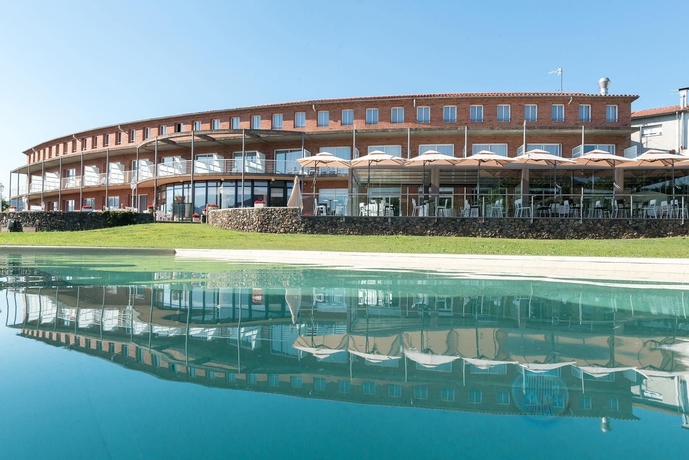
Venue: Hotel Riu Fluvià d'Olot (Girona)
SCHEDULE
REGISTRATION
VENUE
The event will take place at the Hotel Riu Fluvià d’Olot (Girona), where participants will be accommodated in shared rooms.
Introduction
This conference will be focused on three areas:
1) The qualitative theory of ordinary differential equations in the plane (including Hilbert’s 16th problem, period functions, etc.), with a special emphasis on predator-prey models.
2) Neuroscience, approached from the perspective of dynamical systems.
3) Mathematical modelling in biology.
The conference will have a twofold objective: on the one hand, to feature invited talks by national and international experts in these fields; on the other, to promote scientific discussion between established and early-career researchers.
speakers
Short-term plasticity in strongly coupled neural networks: a relevant model in neuropsychiatry
Albert Compte
Institut d’Investigacions Biomèdiques August Pi i Sunyer
Abstract
Dynamics of a discrete time hypercycle
Ernest Fontich
Universitat de Barcelona
Abstract
Modeling experience encoding in a minimal animal
Jordi Garcia-Ojalvo
Universitat Pompeu Fabra
Abstract
Simple non-autonomous differential equations with limit cycles
Armengol Gasull
Universitat Autònoma de Barcelona
Abstract
Persistent homology meets neuronal networks
Esther Ibáñez
Universitat Oberta de Catalunya
Abstract
Multiple timescale dynamics in neural population models
Elif Köksal
Institut National de Recherche en Informatique et en Automatique
Abstract
Kahan-Hirota-Kimura maps associated with isochronous centers
Víctor Mañosa
Universitat Politècnica de Catalunya
Abstract
Demystifying Arnold’s tongues in reversible planar periodic linear systems
Enrique Ponce
Universidad de Sevilla
Abstract
Interaction of segregated resonant mechanisms along the dendritic axis in CA1 pyramidal cells: Interplay of cellular biophysics and spatial structure
Horacio Rotstein
New Jersey Institute of Technology
Abstract
A solvable network model with Hebbian plasticity accounts for representational drift
Alex Roxin
Centre de Recerca Matemàtica
Abstract
Measure-preserving symmetries and reversibilities of ordinary differential systems
Marco Sabatini
Università degli Studi di Trento
Abstract
Breaking Network Synchrony with Sine Waves: Arnold Tongue Structure in Network Desynchronization
María Victoria Sánchez-Vives
Institut d’Investigacions Biomèdiques August Pi i Sunyer – Institut Català de Recerca i Estudis Avançats
Abstract
How Many Dimensions Do We Need to See a Ghost?
Josep Sardanyés
Centre de Recerca Matemàtica
Abstract
Louis Tao
Peking University
Monotonicity criteria for the period function
Jordi Villadelprat
Universitat Autònoma de Barcelona
Abstract
schedule
| Thursday April 16th |
Friday April 17th |
Saturday April 18th |
|
|---|---|---|---|
| 9.30–10.10 | Arrival in Olot |
The Hypercycle and Eigen’s paradox Tomás Lázaro |
Excursion & departure |
| 10.10–10.50 |
Dynamics of a discrete time hypercycle Ernest Fontich |
||
| 10.50–11.20 | Coffee break | ||
| 11.20–12.00 | Registration & Welcome |
How Many Dimensions Do We Need to See a Ghost? Josep Sardanyés |
|
| 12.00–12.40 |
Gemma Huguet & Catalina Vich |
Modeling experience encoding in a minimal animal Jordi García-Ojalvo |
|
| 12.40–13.20 |
Interaction of segregated resonant mechanisms along the dendritic axis in CA1 Horacio Rotstein New Jersey Institute of Technology |
Persistent homology meets neuronal networks Esther Ibáñez |
|
| Lunch | |||
| 15.00–15.40 |
Multiple timescale dynamics in neural population models Elif Köksal |
Simple non-autonomous differential equations with limit cycles Armengol Gasull |
|
| 15.40–16.20 |
A solvable network model with Hebbian plasticity accounts for representational drift Alex Roxin Centre de Recerca Matemàtica |
Measure-preserving symmetries and reversibilities of ordinary differential systems Marco Sabatini |
|
| 16.20–16.50 | Coffee break | Coffee Break | |
| 16.50–17.30 |
Synchrony with Sine Waves: Arnold Tongue Structure in Network Desynchronization Mavi Sánchez-Vives |
Kahan-Hirota-Kimura maps associated with isochronous centers Víctor Mañosa |
|
| 17.30–18.10 |
Short-term plasticity in strongly coupled neural networks: a relevant model in neuropsychiatry Albert Compte |
Demystifying Arnold’s tongues in reversible planar periodic linear systems Enrique Ponce |
|
| 18.10–18.50 | Louis Tao Peking University |
Monotonicity criteria for the period function Jordi Villadelprat |
|
| 20.00 | Dinner | ||
ORGANISING committee
Armengol Gasull | Universitat Autònoma de Barcelona
Gemma Huguet | Universitat Politècnica de Catalunya – Centre de Recerca Matemàtica
J. Tomás Lázaro | Universitat Politècnica de Catalunya – Centre de Recerca Matemàtica
Catalina Vich | Universitat de les Illes Balears
registration
Registration deadline 27 february 2026
CRM User Account Creation
After creating your CRM user account, you can log in on the activity webpage to complete your registration, or by clicking the button and then selecting ‘Sign in’.
REGISTER
INVOICE/PAYMENT INFORMATION
IF YOUR INSTITUTION COVERS YOUR REGISTRATION FEE: Please note that, in case your institution is paying for the registration via bank transfer, you will have to indicate your institution details and choose “Transfer” as the payment method at the end of the process.
UPF | UB | UPC | UAB
*If the paying institution is the UPF / UB/ UPC / UAB, after registering, please send an email to comptabilitat@crm.cat with your name and the institution internal reference number that we will need to issue the electronic invoice. Please, send us the Project code covering the registration if needed.
Paying by credit card
IF YOU PAY VIA CREDIT CARD but you need to provide the invoice to your institution to be reimbursed, please note that we will also need you to send an email to comptabilitat@crm.cat providing the internal reference number given by your institution and the code of the Project covering the registration (if necessary).
acknowledgement
 |
For inquiries about this event please contact the Scientific Events Coordinator Ms. Núria Hernández at nhernandez@crm.cat
|
CRM Events code of conduct
All activities organized by the CRM are required to comply with the following Code of Conduct.
CRM Code of Conduct
scam warning
We are aware of a number of current scams targeting participants at CRM activities concerning registration or accommodation bookings. If you are approached by a third party (eg travellerpoint.org, Conference Committee, Global Travel Experts or Royal Visit) asking for booking or payment details, please ignore them.
Please remember:
i) CRM never uses third parties to do our administration for events: messages will come directly from CRM staff
ii) CRM will never ask participants for credit card or bank details
iii) If you have any doubt about an email you receive please get in touch

Sustainable Events
We are committed to organising sustainable events that minimise environmental impact and create a positive legacy for the host community. We support organisers in designing events aligned with the UN 2030 Sustainable Development Goals, reducing negative environmental impacts and promoting responsible practices.
All materials provided during our activities are responsibly sourced, including recycled pens and plastic-free badges. We work with responsible suppliers, and our catering partners use fully compostable materials while offering vegetarian and vegan options, with at least one event day being fully vegetarian.
Mathematics can contribute to the understanding of brain function by providing models and analytical tools to describe and analyze the mechanisms underlying neuronal activity. Over the years, we have developed approaches based on dynamical systems and computational modeling to explore how neuronal dynamics shape computation and behavior.
In this talk, we will review several concepts and modeling frameworks that have emerged from this work with Prof. Guillamon. These include the study of isochrons and phase descriptions of oscillatory systems to characterize neuronal rhythms and their response to perturbations; mathematical techniques to address inverse problems, aimed at inferring experimentally inaccessible quantities such as synaptic conductances; and dynamical models of perceptual multistability, which provide insight into the competition between alternative neural representations in perception.
Together, these contributions illustrate how mathematical modeling can shed light on the mechanisms driving neuronal dynamics and their functional consequences for neural computation.
The origin of life in a prebiotic scenario and the storage of large amounts of information share the so-called error catastrophe or critical mutation rate. This abrupt change is due to the expected large accumulation of errors during replication (Eigen 1971; Eigen and Schuster 1979; Swetina and Schuster 1982; Küppers 1985; Maynard-Smith and Szathmary 1995) and appears to be intrinsically related to the information code length (Eigen’s paradox).
To solve this paradox, Eigen and Schuster (1979) proposed a plausible biochemical structure which they called the “hypercycle.” Hypercycles are catalytic networks of smaller replicators (units that self-copy and share information) arranged in a cyclic architecture. This spatial configuration avoids the error catastrophe and exhibits scenarios of stability; however, its robustness in the presence of parasites is not always clear. Its richness from the point of view of Dynamical Systems Theory is significant and displays many interesting features, as various papers by Solé, Sardanyés, Fontich, Guillamon, and others have shown.
In this talk we will provide a brief overview of some of these results.
Differential systems are often studied with the aid of symmetries, either to put them into a more convenient form, or to reduce their study to a proper portion of the space. In some cases finding a symmetry can even lead to discover dynamic properties of the system otherwise difficult to prove. This is the case of mirror symmetries, that can show the existence of periodic solutions in presence of rotating orbits. For planar systems this is the easiest way to prove the existence of cycles in absence of known first integrals. The argument showing that every rotating orbit of a planar system that meets the symmetry axis is a cycle applies without changes to mirror-like nonlinear symmetries. This provides a more general tool for proving local integrability. Such symmetries σ, usually called reversibilities, are characterized by the following flow property,

The existence of such a reversibility can be proved without knowing the flow by showing that

where is the Jacobian matrix of σ. A different flow property,

characterizes another class of symmetries, whose existence can be proved without knowing the flow by showing that

For the sake of simplicity we call “symmetries” only the second type trans‑ formations, using the term “reversibilities” for the first type.
We show that measure-preserving symmetries of an n-dimensional dif‑ ferential system preserve its divergence and the divergence derivatives along the solutions. Also, we prove that measure-preserving reversibilities pre‑ serve odd-order divergence derivatives along the solutions, and that even‑ order derivatives are multiplied by −1. We apply such results to find all the area-preserving symmetries and reversibilities of planar Lotka-Volterra and Liènard systems.
Ghosts arise when invariant structures disappear but their dynamical influence persists. After a bifurcation, equilibria or invariant manifolds may collide, lose stability, or cease to exist in the real phase space. Yet trajectories still slow down, linger near the vanished set, and exhibit robust scaling laws in their transient times. What disappears geometrically continues to organize the flow.
In this talk, I present a unified view of ghosts as remnants of normally hyperbolic invariant objects. Classical saddle–node bifurcations provide the simplest example: the annihilation of equilibria leaves behind bottleneck delays. But this mechanism extends far beyond local bifurcations. When curves of quasi-neutral equilibria break down through global bifurcations, their remnants generate qualitatively different slowing-down phenomena, reflecting the higher-dimensional nature of the underlying invariant structure.
Intrinsic noise does not destroy these ghosts. On the contrary, stochastic dynamics reveal their geometry even more clearly, as scaling laws emerge from the Hamiltonian structure underlying large deviations. Across deterministic and stochastic systems, local and global bifurcations, a common principle emerges: the character of the transient remembers the dimension of the object that has vanished.
A central insight is that ghosts cannot be fully understood by restricting attention to the real phase portrait alone. The invariant structures responsible for delayed transitions do not simply vanish; they persist in an extended geometric setting where their influence remains dynamically meaningful. To see a ghost, one must look in a space rich enough to contain its continuation.
In this sense, ghosts are not anomalies but universal transient generators, revealing that bifurcations reorganize geometry before they reorganize dynamics. I will finish the talk by showing evidence of a real ghost.
From many points of view, Riccati differential equations are well understood. For instance, their time-T flow is a M¨obius map, which implies that they can have at most two isolated periodic solutions (limit cycles). The
first aim of this talk is to show that these equations still present interesting open questions and, perhaps more importantly, that they arise naturally in the study of the exact number of limit cycles for several families of planar differential equations.
As an illustration, we describe some results on certain families of piecewise-rigid systems [4]. We also present new results concerning the exact number of limit cycles for several families of Riccati equations [3].
On the other hand, Abel equations are much more complicated and criteria to have upper bounds for some subfamilies of them are not easy to be found. We illustrate these facts with some results of [1,2]
The speaker is partially supported by the Spanish State Research Agency, through the project PID2022-136613NB-I00 grant.
References
[1] A. Gasull. Some open problems in low dimensional dynamical systems. SeMA J., 78, 233–269. 2021.
[2] A. Gasull, A. Guillamon. Limit cycles for generalized Abel equations. Internat. J. Bifur. Chaos Appl. Sci. Engrg., 16(2), 3737–3745. 2006.
[3] A. Gasull, D. D. Novaes, J. Torregrosa. Weak-Coppel problem for a class of Riccati differential equations. Preprint 2025.
[4] A. Gasull, J. Torregrosa. Limit cycles for piecewise rigid systems with homogeneous non-linearities. In preparation.
Adding a direct current (DC) offset broadened the modulatory range, enabling either entrainment or desynchronization depending on DC polarity. These results were quantitatively reproduced by a spiking-neuron model, supporting a nonlinear oscillator framework for predicting cortical responses to AC fields. The findings provide both mechanistic insight and a robust stimulation protocol with potential clinical relevance.
 ) and amplified by a persistent sodium current (
  ), and (ii) a dendritic resonance mediated by a hyperpolarization-activated current (
 ).
).While the propagation of (amplitude) resonances along dendritic trees has been investigated before, it is unclear how the two experimentally observed biophysically different and spatially segregated types of resonance interact in the presence of a heterogeneous distribution of ionic currents and membrane potential variations. It is also unknown what are the interaction and propagation properties of the associated phasonances (phase-resonances) generated by similar, segregated mechanisms. In this work, we address these issues using CA1 pyramidal neurons as a case study. We use a multicompartmental model based on the Hodgkin-Huxley formalism. The model includes
 , and , spatially and heterogeneously distributed along the dendrites, and oscillatory inputs at different locations. Our results reveal that voltage variations along the dendritic cable differentially activate ionic channels, creating a diverse range of resonant and phasonant responses. The spatial structure of the dendrites provides the neuron with remarkable flexibility to process these inputs and support a variety of scenarios of resonance interaction.
Topological Data Analysis (TDA) is a field within algebraic topology and computational geometry that emerged in the early 2000s, aimed at uncovering the topological structure of complex datasets. Its central tool is persistent homology, an algebraic framework that analyzes how topological features—such as cavities or holes in different dimensions— appear and disappear across scales.
The goal of this talk is to show that persistent homology can be useful to identify the dynamics of neuronal networks. In this case, we apply persistent homology to distinguish the four activity states generated by the Brunel network. Additionally, we use these topological techniques to detect and characterize the dynamical changes induced by synaptic plasticity, specifically short-term depression, in the Brunel network.
 fibrations, [8]. However, we will focus on KHK maps associated with quadratic vector fields with isochronous centers. These fields were characterized in [7] (see also [14]), obtaining four different cases, namely
  with
with  , following the notation in [3].
 . The maps in the family preserve the first integral of the vector field and, moreover, the original vector field is a Lie symmetry of the map. Furthermore, on each level curve of the first integral, the dynamics is conjugate to a rotation, and for each fixed step size, the rotation number is constant. As a consequence, for a dense set of values of the step size parameter, the maps are globally periodic, realizing all possible periods except period 2.
 ,
,  , and
, and  , we have found numerical evidence suggesting the non-integrability of the associated KHK maps. For these cases, we also define a new class of maps, which we call pseudo-KHK maps. These maps preserve the first integrals, the associated vector fields are Lie symmetries, and we provide a methodology for the study of their dynamics, based on the results in [6]. Their dynamics turns out to be significantly richer than the one of the continuous flows that they approximate.
A central tenet of neuroscience is that neuronal activity underlies thought and behavior. This means that when an animal exhibits the same behavior at different points in time, we ought to observe similar patterns of activity. Surprisingly, the advent of miniaturized microscopes for long-term, chronic recordings in awake behaving mice revealed that this is not the case. Rather, neuronal activity slowly yet continuously changes over time, so much so that patterns of activity underlying the same behavior separated by weeks can be nearly completely uncorrelated. This phenomenon is known as representational drift (RD).
We have argued that the mechanism underlying RD is ongoing learning. Specifically, when the animal learns or forms memories between recording sessions, this alters network connectivity which determines how inputs are converted into outputs. Therefore, during the recording session, even when the sensory input is nearly identical, the observed activity will have changed compared to the previous session. Here I will discuss a network model with Hebbian plasticity that accounts for salient aspects of RD through the ongoing encoding of patterns over time. RD, as measured by the correlation of the observed pattern of activity over time, can be calculated analytically by casting the plasticity as a Markov process and calculating the associated transition matrices. I will describe this calculation and show how the model not only fits the statistics of RD but also accounts for highly nontrivial effects of experience on drift rates.