

CRM Faculty Colloquium
Sign inVenue: Centre de Recerca Matemàtica (CRM)
Room: Auditorium
SCHEDULE
Introduction
In 2026, we will launch the CRM Faculty Colloquium. This quarterly colloquium, open to the entire mathematical community and delivered by researchers affiliated with the Centre, is a new initiative aimed at showcasing the research of our investigators, promoting synergies between different research groups, and strengthening the internal cohesion of the Centre.
lecturers
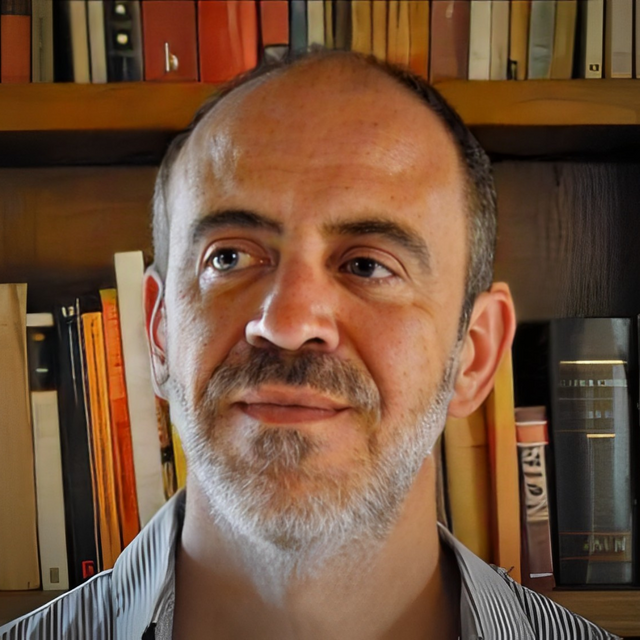
Elliptic PDEs: recent extensions on Hilbert’s 19th problem
Xavier Cabré
ICREA – UPC – CRM
Abstract
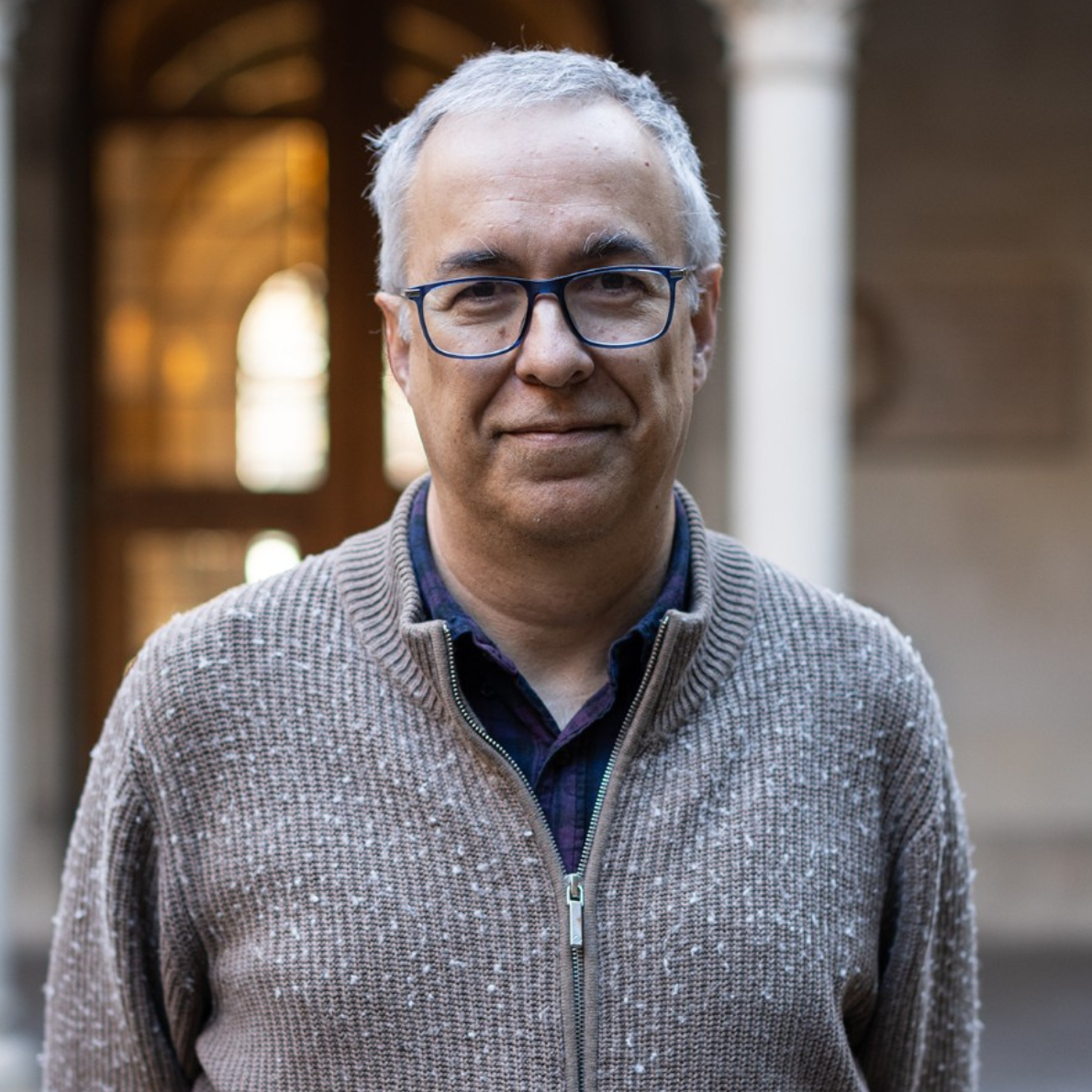
Serendipity strikes again
Joaquim Ortega
UB – CRM
Abstract
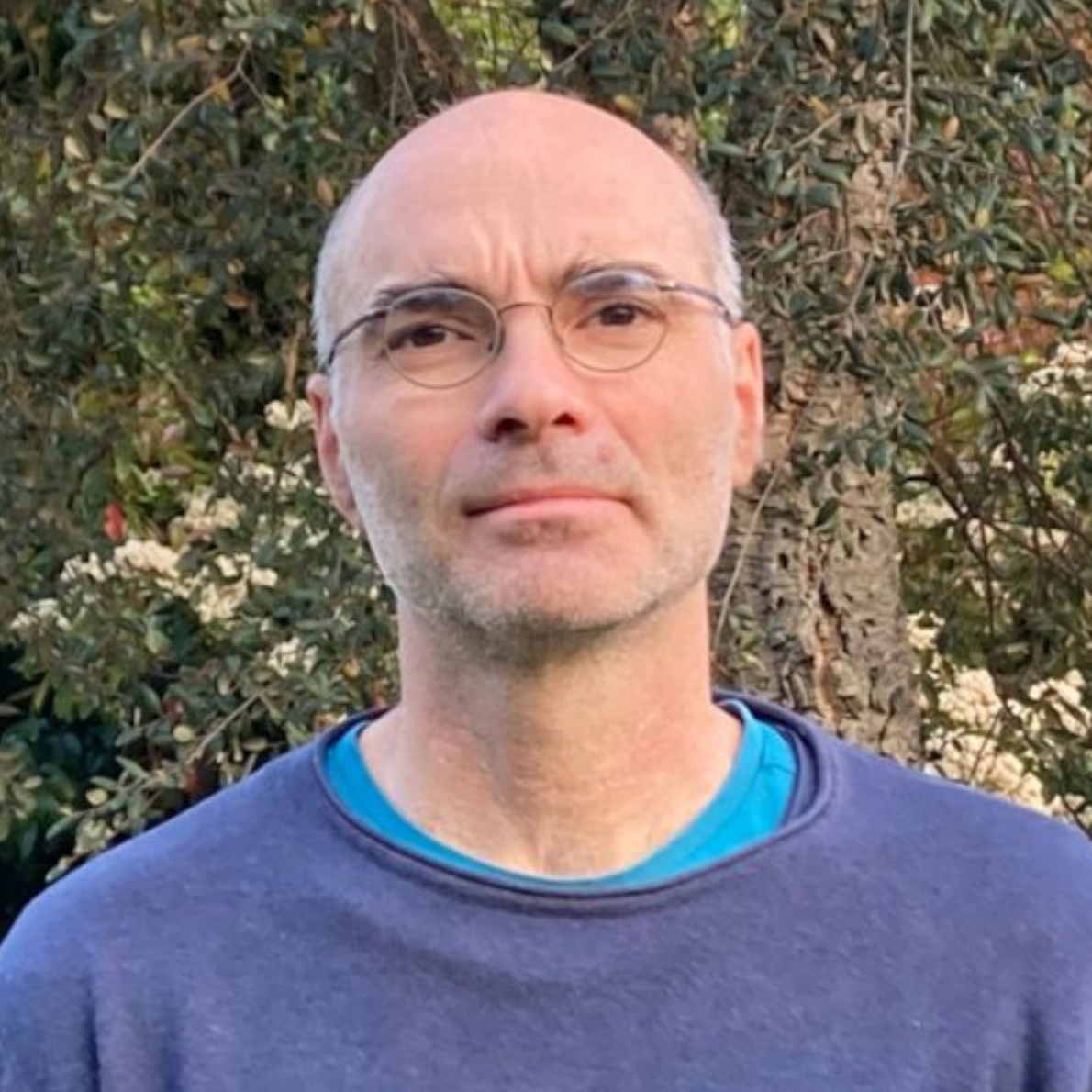
Quantitative rectifiability, singular integrals, and harmonic measure
Xavier Tolsa
ICREA – UAB – CRM
Abstract
SCHEDULE
15:00 – 15:10 | Welcome |
15:10 – 15:50 | Quantitative rectifiability, singular integrals, and harmonic measure Xavier Tolsa ICREA - UAB - CRM |
16:00 – 16:30 | Coffee Break |
16:30 – 17:10 | Serendipity strikes again Joaquim Ortega UB - CRM |
17:20 – 18:00 | Elliptic PDEs: recent extensions on Hilbert’s 19th problem Xavier Cabré ICREA - UPC - CRM |
 |
For inquiries about this event please contact the Scientific Events Coordinator Ms. Núria Hernández at nhernandez@crm.cat
|
CRM Events code of conduct
All activities organized by the CRM are required to comply with the following Code of Conduct.
CRM Code of Conduct
scam warning
We are aware of a number of current scams targeting participants at CRM activities concerning registration or accommodation bookings. If you are approached by a third party (eg travellerpoint.org, Conference Committee, Global Travel Experts or Royal Visit) asking for booking or payment details, please ignore them.
Please remember:
i) CRM never uses third parties to do our administration for events: messages will come directly from CRM staff
ii) CRM will never ask participants for credit card or bank details
iii) If you have any doubt about an email you receive please get in touch
Serendipity strikes again
Abstract:
In the 60s H. Landau, D. Slepian and H. Pollack working in the Bell Labs solved a central problem in electrical engineering with what they called a lucky accident. The heart of the argument relied on a commutation between an integral operator and a second-order differential operator. The eigenfunctions of the integral concentration operator were bandlimited signals with maximal concentration in time, while the eigenfunctions of the differential operator appear naturally when studying the heat equation in certain ellipsoids of revolution.
In some recent joint work with A. Bondarenko, D. Radchenko and K. Seip we consider an extremal problem in Fourier Analysis: find the maximum of the value at 0, among the bandlimited functions with  norm one. This question has arisen recurrently in analytic number theory, approximation theory, orthogonal polynomials, small divisors, operator theory and function theory. L. Hörmander and B. Bernhardsson in the 90s undertook a precise numerical study of the extremal function, and they posed the question of identifying it. We find a complete description. Our work hinges again on a serendipity: the commutation between a second-order differential operator and a weighted composition operator.
Joaquim Ortega (UB & CRM)
Elliptic PDEs: recent extensions on Hilbert’s 19th problem
Abstract:
In 1900 Hilbert’s 19th problem asked whether minimizers of elliptic functionals are always analytic. A celebrated result of De Giorgi and Nash in the late 1950s solved the problem for uniformly convex (equivalently, uniformly elliptic) functionals. The important case of the minimal surfaces equation required substantial additional work, culminated by Simons 1968 paper.
We will explain such developments and then turn into a closely related problem: the regularity of stable solutions, a larger class than absolute minimizers. In this case, positive answers have only been established in the current 2020 decade, though some cases remain still open. For stable minimal surfaces, the results are proved in several articles by Chodosh, Li, Minter, Stryker, and Mazet. For reaction-diffusion equations, the optimal result has been established in a paper by Cabré, Figalli, Ros-Oton, and Serra. We will finally mention some open problems on the regularity of stable solutions -the main ones being the regularity of stable minimal surfaces in  and of stable solutions to reaction equations for the fractional Laplacian.
Xavier Cabré (ICREA & UPC & CRM)
Quantitative rectifiability, singular integrals, and harmonic measure
Abstract:A subset of Euclidean space is called  -rectifiable if it is, up to a set of measure zero, contained in a countable union of
  -dimensional manifolds. The field of quantitative rectifiability studies this notion using techniques from harmonic analysis, including square functions and singular integral operators.
On the other hand, harmonic measure plays a fundamental role in addressing the Dirichlet problem for the Laplacian and appears naturally in several areas of complex analysis. For a bounded domain, the harmonic measure of a portion of the boundary equals the probability that a Brownian path initiated inside the domain first exits through that portion.
A longstanding question in analysis concerns the precise connection between harmonic measure and surface measure on the boundary of a domain, a relationship in which rectifiability is a key ingredient. In this talk, we will review classical theorems together with recent developments that rely on tools from quantitative rectifiability and singular integrals. In particular, we will describe the resolution of the one-phase and two-phase problems for harmonic measure, as well as other questions concerning the dimension of harmonic measure.
Xavier Tolsa (ICREA & UAB & CRM)