
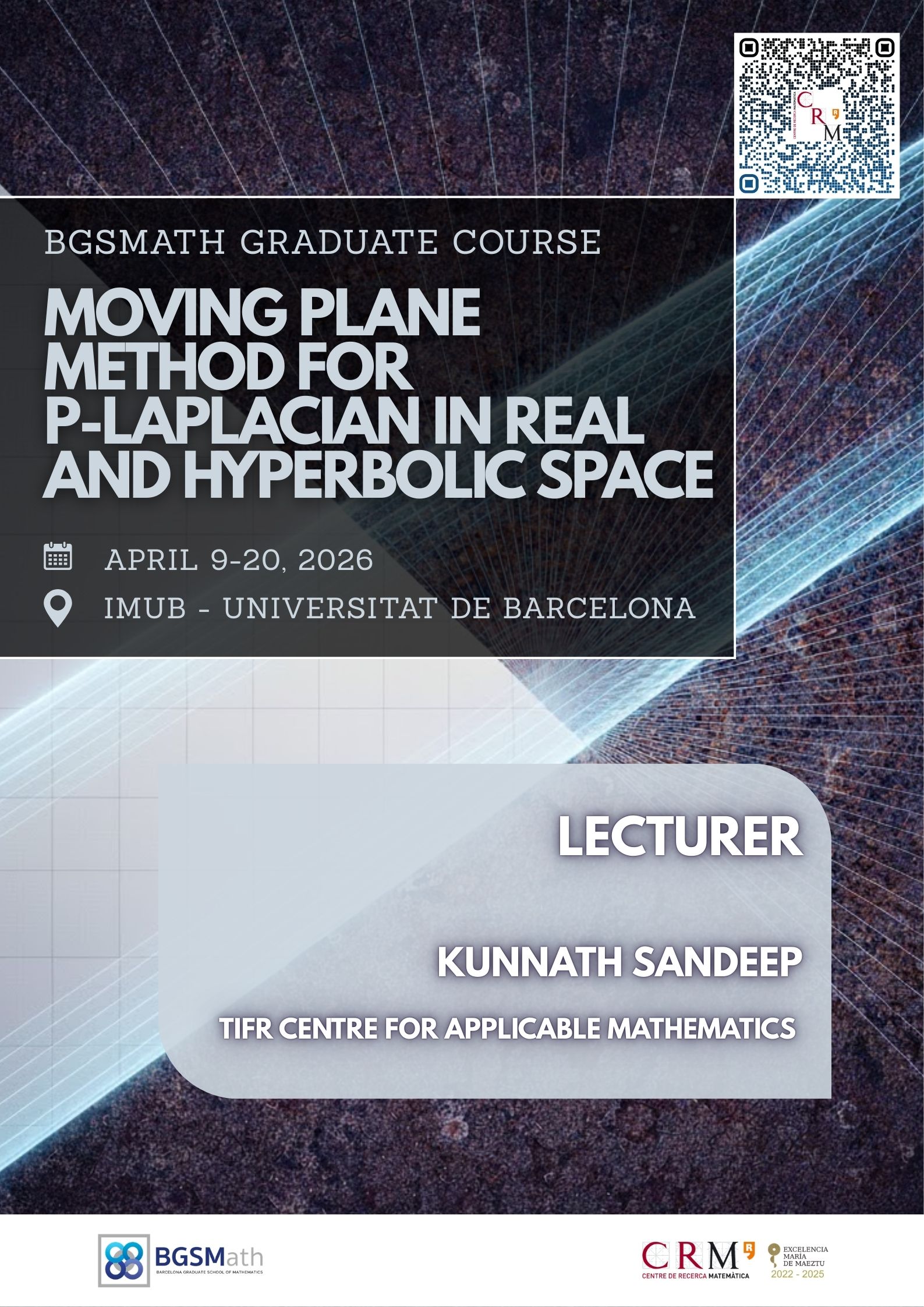
[ POSTPONED ] Moving plane method for p-Laplacian in Real and Hyperbolic space
to April 20, 2026
Venue: IMUB - Universitat de Barcelona
Room: Seminar room
Update: The course has been postponed to April. New schedule available.
SCHEDULE
Introduction
Symmetry properties of solutions of partial differential equations is a very interesting and challenging subject. Most often if the solution admits certain symmetry, then it simplifies the PDE to a lower dimensional space and this often helps in having a better understanding of the solution. For example radial symmetry makes the PDE into an ODE and analysing this ODE is much simpler in many situations than studying the original PDE. These are the kind of tools used in many situations to establish classification results for solutions of PDEs or for proving uniqueness results.
There are many tools to establish the symmetry of positive solutions of PDEs which are of elliptic type. The most prominent one is the method of moving planes. The method was developed by Alexandrov to establish that the closed connected hypersurfaces of constant mean curvature in the Euclidean space are spheres. The method was introduced in the case of PDE by Serrin to study an over-determined problem and later developed further to study the symmetry properties of elliptic type PDEs by Gidas, Ni and Nirenberg. Since then the method has been used in a variety of contexts to study symmetry properties. The method relies heavily on the maximum principle or more generally strong comparison principle.
One of the significant applications of this method is in establishing the radial symmetry (and hence the classification) of solutions of the semilinear elliptic PDE:

In fact this is the Euler–Lagrange equation corresponding to the Sobolev inequality in the space  .
.
However when it comes to the Euler–Lagrange equation of the Sobolev inequality in the general space  , it is the p-Laplace equation:

where  and
and  , which is quasilinear and degenerate elliptic and hence strong comparison principle is missing in this case to directly apply the moving plane method. Another issue in applying the moving plane method in the whole space
  is to start the plane moving from infinity.
In the past decade, tools have been developed to tackle these issues and prove the symmetry results for p-Laplace equations in the Euclidean space and in the hyperbolic space  . In this series of lectures we plan to discuss these issues.
lecturers

Kunnath Sandeep
TIFR Centre for Applicable Mathematics
Professor and Dean at the TIFR Centre for Applicable Mathematics, Bangalore (India). His research focuses on nonlinear partial differential equations, variational methods, and problems involving critical exponents in Euclidean and hyperbolic spaces. He is known for fundamental contributions to symmetry results in elliptic PDEs and to sharp inequalities of Sobolev and Moser–Trudinger type. Prof. Sandeep received the Shanti Swarup Bhatnagar Prize (2015), one of India’s highest science awards, and he was elected in 2019 as Fellow of the Indian Academy of Sciences.
Course Content
The following topics will be covered :
1- Classical Moving plane method and the case p = 2 ( [1], [2])
2- Regularity estimates and comparison principle for p ∈(1, n) ([3], [5], [6] )
3- Symmetry of Solutions of the Euler Lagrange equation corresponding to the Sobolev inequality ([8],[7])
4- Moving plane method for p-Laplace type equations in Hyperbolic space. ([4], [9])
Prerequisites : Knowledge of basic theory of second order uniformly elliptic PDEs, like maximum principle, comparison principle etc.
SCHEDULE
Schedule: Four sessions, each two hours long
- Thursday, April 09, 11:00–13:00
- Monday, April 13, 11:00–13:00
- Thursday, April 16, 11:00–13:00
- Monday, April 20, 11:00–13:00
BIBLIOGRAPHY
[1] Gidas, B. ; Ni, Wei Ming and Nirenberg, L. Symmetry and related properties via the maximum principle, Comm. Math. Phys. 68 (1979), no. 3, 209-243.
[2] Serrin, James A symmetry problem in potential theory, Arch. Rational Mech. Anal. 43 (1971), 304-318.
[3] Damascelli, Lucio. Comparison theorems for some quasilinear degenerate elliptic operators and applications to symmetry and monotonicity results, Ann. Inst. H. Poincaré C Anal. Non Linéaire 15 (1998), no. 4, 493-516.
[4] Almeida, Luís; Damascelli, Lucio; Ge, Yuxin. A few symmetry results for nonlinear elliptic PDE on noncompact manifolds Ann. Inst. H. Poincaré C Anal. Non Linéaire 19 (2002), no. 3, 313-342.
[5] Damascelli, Lucio; Sciunzi, Berardino. Regularity, monotonicity and symmetry of positive solutions of m-Laplace equations J. Differential Equations 206 (2004), no. 2, 483-515.
[6] Damascelli, Lucio; Sciunzi, Berardino. Harnack inequalities, maximum and comparison principles, and regularity of positive solutions of m-Laplace equations, Calc. Var. Partial Differential Equations 25 (2006), no. 2, 139-159.
[7] Vétois, Jérôme A priori estimates and application to the symmetry of solutions for critical p -Laplace equations J. Differential Equations 260 (2016), no. 1, 149-161.
[8] Damascelli, Lucio; Merchán, Susana; Montoro, Luigi; Sciunzi, Berardino. Radial symmetry and applications for a problem involving the −∆p operator and critical nonlinearity in \mathbb{R}^N. Adv. Math. 265 (2014)313-335.
[9] Ramya Dutta, Kunnath Sandeep. Symmetry for a quasilinear elliptic equation in hyperbolic space. Ann. Scuola Norm. Sup. Pisa Cl. Sci. To appear.
LIST OF PARTICIPANTS
| Name | Institution |
|---|---|
| Pau Mac an Mhaoir | Universitat de Barcelona |
| Pablo García Arias | Universitat de Barcelona |
| Joan Domingo Pasarin | Universitat de Barcelona |
| Alejandro Martínez Sánchez | Universitat de Barcelona |
| Pablo Hidalgo Palencia | Universitat de Barcelona |
| Gyula Csato | Universitat de Barcelona |
| David Horas Marcos | Universitat de Barcelona |
| Frank William Hammond Espinosa | Universitat Politècnica de Catalunya |
| Tapendu Rana | Ghent University |
| Joaquim Duran i Lamiel | Centre de Recerca Matemàtica |
 |
For inquiries about this event please contact the Scientific Events Coordinator Ms. Núria Hernández at nhernandez@crm.cat
|
CRM Events code of conduct
All activities organized by the CRM are required to comply with the following Code of Conduct.
CRM Code of Conduct
scam warning
We are aware of a number of current scams targeting participants at CRM activities concerning registration or accommodation bookings. If you are approached by a third party (eg travellerpoint.org, Conference Committee, Global Travel Experts or Royal Visit) asking for booking or payment details, please ignore them.
Please remember:
i) CRM never uses third parties to do our administration for events: messages will come directly from CRM staff
ii) CRM will never ask participants for credit card or bank details
iii) If you have any doubt about an email you receive please get in touch

Sustainable Events
We are committed to organising sustainable events that minimise environmental impact and create a positive legacy for the host community. We support organisers in designing events aligned with the UN 2030 Sustainable Development Goals, reducing negative environmental impacts and promoting responsible practices.
All materials provided during our activities are responsibly sourced, including recycled pens and plastic-free badges. We work with responsible suppliers, and our catering partners use fully compostable materials while offering vegetarian and vegan options, with at least one event day being fully vegetarian.