

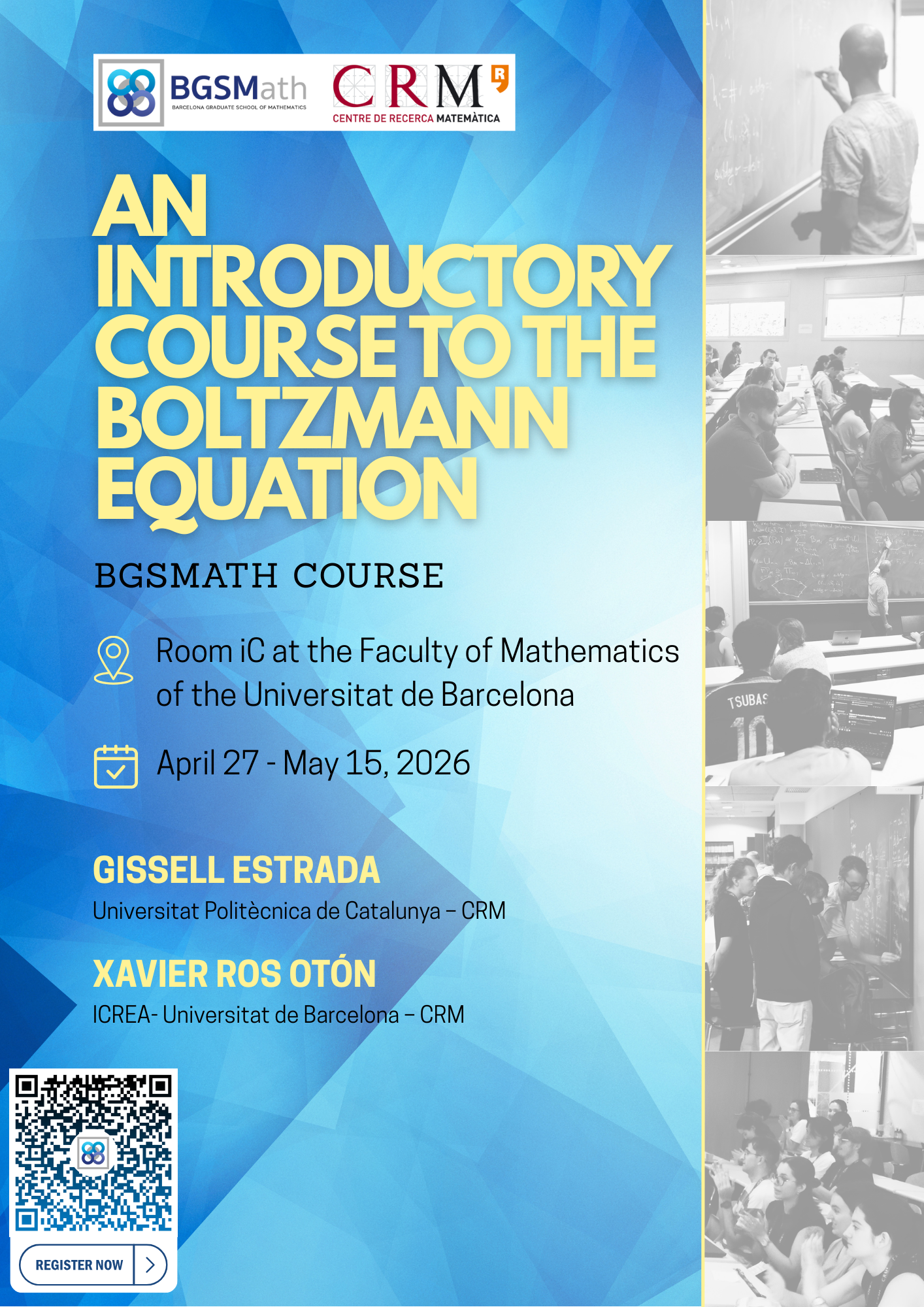
An introductory course to the Boltzmann equation
to May 14, 2026
Venue: Universitat de Barcelona (UB)
Room: Room iC - Faculty of Mathematics - Universitat de Barcelona.
Introduction
The Boltzmann equation is one of the fundamental equations of Physics, and in particular in statistical mechanics. This partial differential equation models the evolution of a gas, or, more generally, any system composed of a large number of particles. It was derived by Boltzmann and Maxwell in the 19th century and it remains a subject of interest to the scientific community (see references below).
From a mathematical point of view, the analysis of the Boltzmann equation has connections to several areas of mathematics such as modelling of biological or social systems, PDE, analysis, and dynamical systems.
The goal of this introductory course is to present this topic in an accessible manner, and present some known results concerning the derivation of the Boltzmann equation (starting from the dynamics of N -particle systems), as well as an overview of some important PDE results and open problems in this topic.
lecturers
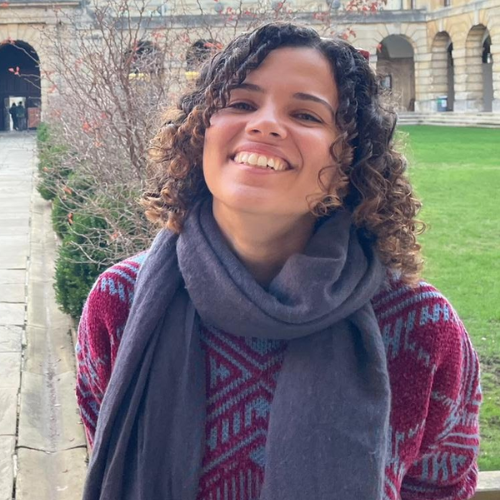
Gissell Estrada
Universitat Politècnica de Catalunya – CRM
Gissell Estrada is a tenure-track lecturer in Mathematics at the Universitat Politècnica de Catalunya and a researcher at the Centre de Recerca Matemàtica. Her work focuses on the interaction between partial differential equations, kinetic theory, and interdisciplinary applications in biology, network theory, and robotics. She holds a PhD in Applied Mathematics from the Maxwell Institute Graduate School in Analysis and its Applications at the University of Edinburgh, and has conducted research at Sorbonne University, the Basque Center for Applied Mathematics, and the University of Oxford. She was awarded a BBVA Beca Leonardo 2025 for the project Collective migration across scales: From PDEs to physical swarms.
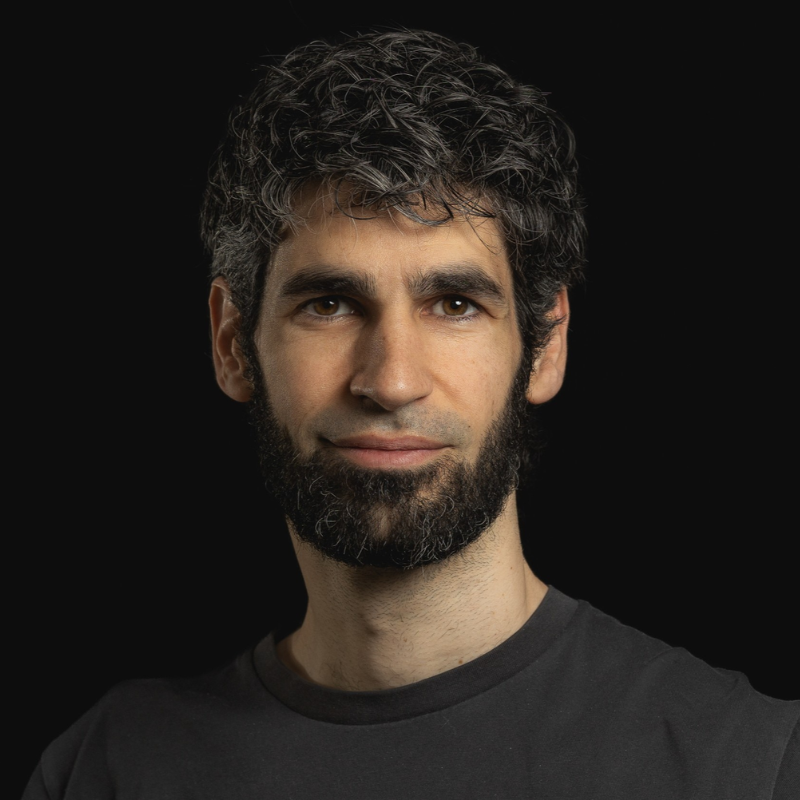
Xavier Ros Otón
ICREA- Universitat de Barcelona – CRM
Xavier Ros Otón is an ICREA Research Professor and Catedràtic d’Universitat at UB since 2020. Previously, he was an Assistant Professor at Universität Zürich, as well as R. H. Bing Instructor at the University of Texas at Austin. He is a mathematician who works on Partial Differential Equations (PDE). Specifically, he studies the regularity of solutions to elliptic and parabolic PDE, and he is mostly known for his results on free boundary problems and integro-differential equations. PI of an ERC Starting Grant (2019-2024) and an ERC Consolidator Grant (2024-2029), he has received several national and international awards: Premi Nacional de Recerca al Talent Jove (2024), Frontiers of Sciences (2023), Premio Nacional de Investigación para Jovenes (2023), Stampacchia Gold Medal (2021), Premio Investigación Científica Fundación Princesa de Girona (2019), among others.
SCHEDULE
Schedule: Six sessions, each two hours long
- Tuesday, April 28, 11:00–13:00
- Thursday, April 30, 11:00–13:00
- Tuesday, May 5, 11:00–13:00
- Thursday, May 7, 11:00–13:00
- Tuesday, May 12, 11:00–13:00
- Thursday, May 14, 11:00–13:00
CONTENT
1. Derivation of the Boltzmann equation
• Dynamics of interacting particle systems
• Mean-field limit and Kinetic equations
• Hilbert 6th problem: from Newtonian dynamics to continuum equations
2. Basic properties of Boltzmann equation
• Time-irreversibility and Boltzmann H-Theorem
• Conservation laws, Maxwellian solutions
• Boltzmann collision kernel
• A toy model: Kolmogorov equation
3. Analysis of the Boltzmann equation
• Cauchy problem: existence, uniqueness, and long-time behavior
• Regularity of solutions under macroscopic bounds
• Open problems
Prerequisites: Basic knowledge of Real Analysis is required. Some knowledge of PDE is useful but not mandatory.
BIBLIOGRAPHY
[1] C. Cercignani, R. Illner, and M. Pulvirenti. The mathematical theory of dilute gases, volume 106. Springer Science & Business Media, 2013.
[2] P. Degond. Macroscopic limits of the Boltzmann equation: a review. Modeling and computational methods for kinetic equations, pages 3–57, 2004.
[3] Y. Deng, Z. Hani, and X. Ma. Hilbert’s sixth problem: derivation of fluid equations via Boltzmann’s kinetic theory. arXiv preprint arXiv:2503.01800, 2025.
[4] L. Desvillettes and C. Villani. On the trend to global equilibrium for spatially inhomogeneous kinetic systems: the Boltzmann equation. Inventiones mathematicae, 159(2):245–316, 2005.
[5] I. Gallagher. From classical mechanics to kinetic theory and fluid dynamics. Journées équations aux dérivées partielles, pages 1–14, 2014.
[6] I. Gallagher, L. Saint-Raymond, and B. Texier. From Newton to Boltzmann: hard spheres and short-range potentials. European Mathematical Society Z¨urich, Switzerland, 2013.
[7] P. Gressman and R. Strain. Global classical solutions of the Boltzmann equation without angular cut-off. Journal of the American Mathematical Society, 24(3):771–847, 2011.
[8] C. Imbert and L. Silvestre. Global regularity estimates for the Boltzmann equation without cut-off. Journal of the American Mathematical Society, 35(3):625–703, 2022.
[9] L. Saint-Raymond. Hydrodynamic limits of the Boltzmann equation. Number 1971. Springer Science & Business Media, 2009.
[10] C. Villani. A review of mathematical topics in collisional kinetic theory. Handbook of mathematical fluid dynamics, 1(71-305):3–8, 2002.
LIST OF PARTICIPANTS
| Name | Institution |
|---|---|
| Zamurat Ayobami Adegboye | Federal University of Health Sciences (FUHSO) Otukpo |
| Edy Saul Condorhuanca Rimachi | Universidad Nacional de San Antonio Abad del Cusco |
| Edgar Jhonny Caviedes Ccorimanya | Universidad Nacional de San Antonio Abad del Cusco |
| Josué Alejandro Flórez Huicho | Universidad Nacional de San Antonio Abad del Cusco |
| Cleofe peña gómez | Institut d’Investigació i Innovació Parc Taulí (I3PT-CERCA) - UAB |
| Alvaro Corral | Universitat Autònoma de Barcelona – Centre de Recerca Matemàtica |
| Gionni Marchetti | Postillón XAI, Barcelona, Spain |
| Yuanxi He | Universitat de Barcelona |
| Tomás Sanz Perela | Universitat de Barcelona |
| Domènec Ruiz-Balet | Universitat de Barcelona |
| David Horas Marcos | Universitat de Barcelona |
| Alejandro Martínez Sánchez | Universitat de Barcelona |
| Pau Mac an Mhaoir | Universitat de Barcelona |
| Pablo Hidalgo Palencia | Universitat de Barcelona |
| Joan Domingo Pasarin | Universitat de Barcelona |
| Salim Boukfal Lazaar | Universitat Autònoma de Barcelona |
| Albert Beardo | Universitat Autònoma de Barcelona |
| Víctor Izquierdo | Universitat Autònoma de Barcelona |
| Joan Hernández García | Universitat Autònoma de Barcelona |
| Teodoro Mayayo | Universitat Autònoma de Barcelona |
| Marc Magaña Centelles | Universitat Autònoma de Barcelona |
| Víctor Villegas-Morral | Universitat Politècnica de Catalunya |
| Albert Atserias | Universitat Politècnica de Catalunya |
| Cristian Moreno | Universitat de Girona |
| Marcos Solera Diana | Universitat de València |
| Jordi Piñero | Trinity College |
| Fatemeh Keivani | Aalto University |
| Miquel Saucedo | Centre de Recerca Matemàtica |
| Joaquim Duran i Lamiel | Centre de Recerca Matemàtica |
| Rachael Olwande | Centre de Recerca Matemàtica |
 |
For inquiries about this event please contact the Scientific Events Coordinator Ms. Núria Hernández at nhernandez@crm.cat
|
CRM Events code of conduct
All activities organized by the CRM are required to comply with the following Code of Conduct.
CRM Code of Conduct
scam warning
We are aware of a number of current scams targeting participants at CRM activities concerning registration or accommodation bookings. If you are approached by a third party (eg travellerpoint.org, Conference Committee, Global Travel Experts or Royal Visit) asking for booking or payment details, please ignore them.
Please remember:
i) CRM never uses third parties to do our administration for events: messages will come directly from CRM staff
ii) CRM will never ask participants for credit card or bank details
iii) If you have any doubt about an email you receive please get in touch

Sustainable Events
We are committed to organising sustainable events that minimise environmental impact and create a positive legacy for the host community. We support organisers in designing events aligned with the UN 2030 Sustainable Development Goals, reducing negative environmental impacts and promoting responsible practices.
All materials provided during our activities are responsibly sourced, including recycled pens and plastic-free badges. We work with responsible suppliers, and our catering partners use fully compostable materials while offering vegetarian and vegan options, with at least one event day being fully vegetarian.