Four mini-courses, from incompressible fluids to the geometry of boundaries, around a shared body of technique. CRM Auditorium, 15 to 18 June 2026.
A rotating blob of fluid that never settles into rest. The ragged edge of a region in the plane. A weighted inequality that Benjamin Muckenhoupt wrote down in 1980 and that resisted proof for more than four decades. The three sit far apart in any textbook. What links them is a single body of technique, the analysis of singular integrals.
That connection was the organising idea behind the Harmonic Analysis and PDEs Summer School, held at the Centre de Recerca Matemàtica from 15 to 18 June.
The format was a summer school with four mini-courses running across the week, one lecture per course per day, so that each subject built up as a connected argument instead of a single talk. One invited lecture completed the programme, put together by an organising committee from the Universitat Autònoma de Barcelona: Joan Mateu, Juan Carlos Cantero, Joan Orobitg and Joan Verdera.
Two of the courses turned on the incompressible Euler equations, the idealised description of a fluid with no viscosity that Euler set down in the eighteenth century and that still hides elementary mysteries. Zineb Hassainia, a research scientist at NYU Abu Dhabi, took the audience through coherent structures: vortex patches that rotate without changing shape, and the periodic orbits traced by isolated point vortices. The harder material came with leapfrogging, the motion in which vortex rings overtake one another in turn.
Tarek Elgindi, professor at Duke University, came at the same equations from the direction of failure. In 2021 he proved that smooth enough solutions of the three-dimensional Euler equations can develop a singularity in finite time, a result that caught the field off guard because it appeared under conditions where the equations had been assumed to stay well behaved. His course concentrated on steady solutions, the configurations a fluid can hold without changing.
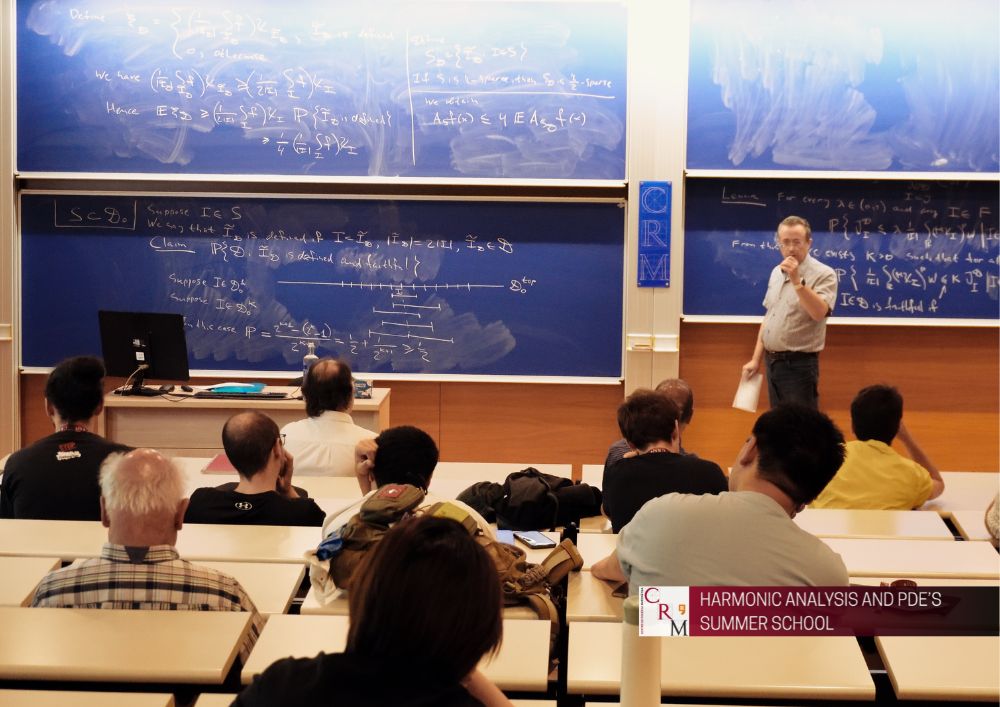
The weighted-inequality thread ran through Andrei Lerner‘s lectures. At the CRM he set out the resolution of a question Muckenhoupt had left open since 1980, the Cₚ conjecture, on exactly when a weighted estimate relating the Hilbert transform to the Hardy-Littlewood maximal operator can hold. Lerner settled it with Fedor Nazarov and Sheldy Ombrosi.
Carlos Pérez, an Ikerbasque Research Professor at the University of the Basque Country and BCAM, who first visited CRM in 1999, gave the week’s only invited lecture. He used it to ask what the regularity of a function can mean when its derivatives may not exist at all, and answered by looking at local averages instead of pointwise values. Out of that came sharper local Poincaré-Sobolev estimates, and with them a path to the De Giorgi regularity theorem and a self-contained proof of the John-Nirenberg theorem for functions of bounded mean oscillation. Holding it together was a property Pérez called self-improving: a weak local bound on how much a function oscillates quietly upgrades itself into a far stronger statement about its size across the whole domain.
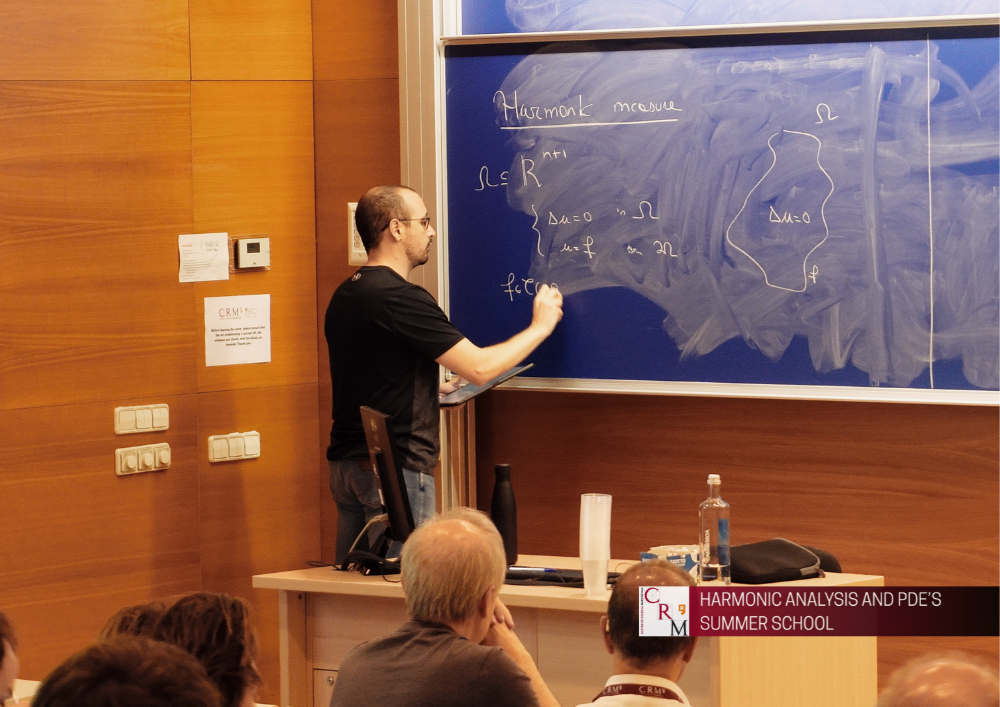
Carmelo Puliatti‘s course sat at a junction of analysis and geometry, with probability never far off. Harmonic measure records where a Brownian particle released inside a region first reaches the boundary, and it governs the Dirichlet problem for the Laplacian. F. and M. Riesz showed in 1916 that, on a reasonable planar domain, this measure and arc length see the same sets. The converse, that absolute continuity of harmonic measure forces the boundary to be rectifiable, was proved in 2016 by a group of seven authors. Puliatti, now a Ramón y Cajal fellow at the UAB, obtained his PhD at the UAB as a BGSMath fellow, the CRM training unit.
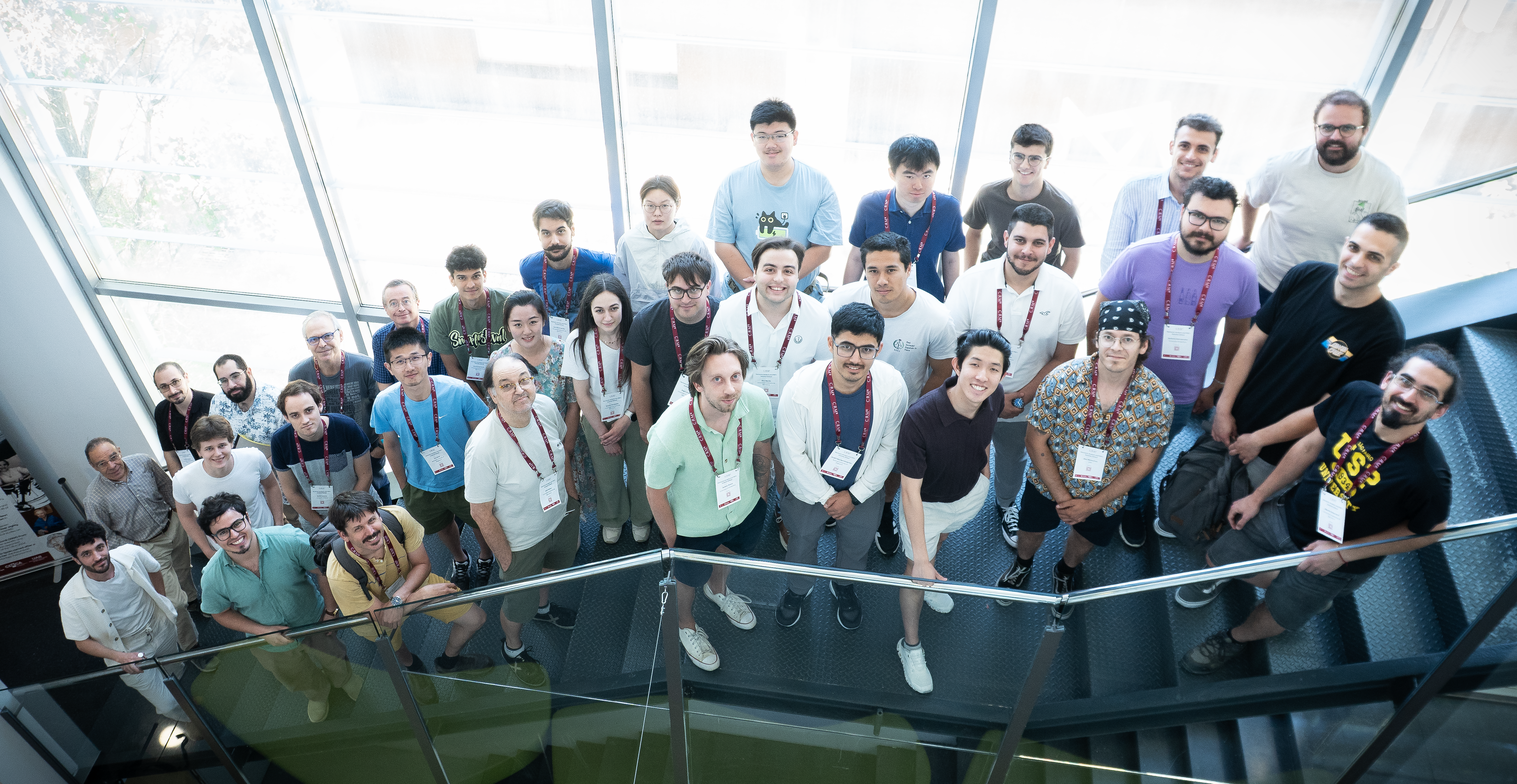
The roughly forty participants came from well beyond Barcelona. Alongside a large UAB and CRM contingent, the register included Princeton, New York University and the University of Connecticut, the National University of Singapore, ETH Zurich, the University of Bonn, the universities of Ioannina and Athens, University College Dublin, NYU Abu Dhabi, Jilin University and the Chinese University of Hong Kong, with the Universitat de Barcelona, the Universitat Politècnica de Catalunya, the UOC and the Universidad de Sevilla also present. All in all, nine countries across three continents.
The school’s stated scope reached a little wider than the four courses themselves, taking in anisotropic interaction energy minimisers and variational problems that arise in materials science and in models of how biological populations spread.
Newsletter
Get the latest CRM news and activities delivered to your inbox
Subscribe now
Recent newsletters →
The CRM opens the academic year and unveils its Directors’ Gallery
A review of the year, the Communication Plan 2026–2030 and three research talks filled the morning of 19 October.The unveiling of the Directors’ Gallery.CRM CommPau VarelaCRMComm@crm.catGet the latest CRM news and activities in your inbox.Recent...
The CRM Mentoring Programme, as Told by One of Its Pairs
PhD student Joaquim Duran and mathematician Robert Cardona, one of the pairs in the CRM Mentoring ProgrammeJoaquim Duran (left) and Robert Cardona.CRM CommPau VarelaCRMComm@crm.catGet the latest CRM news and activities in your inbox.Recent...
When the reward comes within reach, the brain changes what it compares
As the tokens piled up, choices got faster and more accurate at the same time. The yardstick for judging each offer had moved.CRM CommPau VarelaCRMComm@crm.catGet the latest CRM news and activities in your inbox.Recent newsletters →Two subjects...

Almost every automaton can be reset with a short word
For a random automaton with n states, a word of about √n log n letters is almost always enough to reset it.CRM CommPau VarelaCRMComm@crm.catGet the latest CRM news and activities in your inbox.Recent newsletters →Picture a conveyor belt carrying...
Exposició ‘Les matemàtiques de Gaudí’
|
|
CRM CommPau Varela
|