

Summer School 2026
REGISTRATION FEE
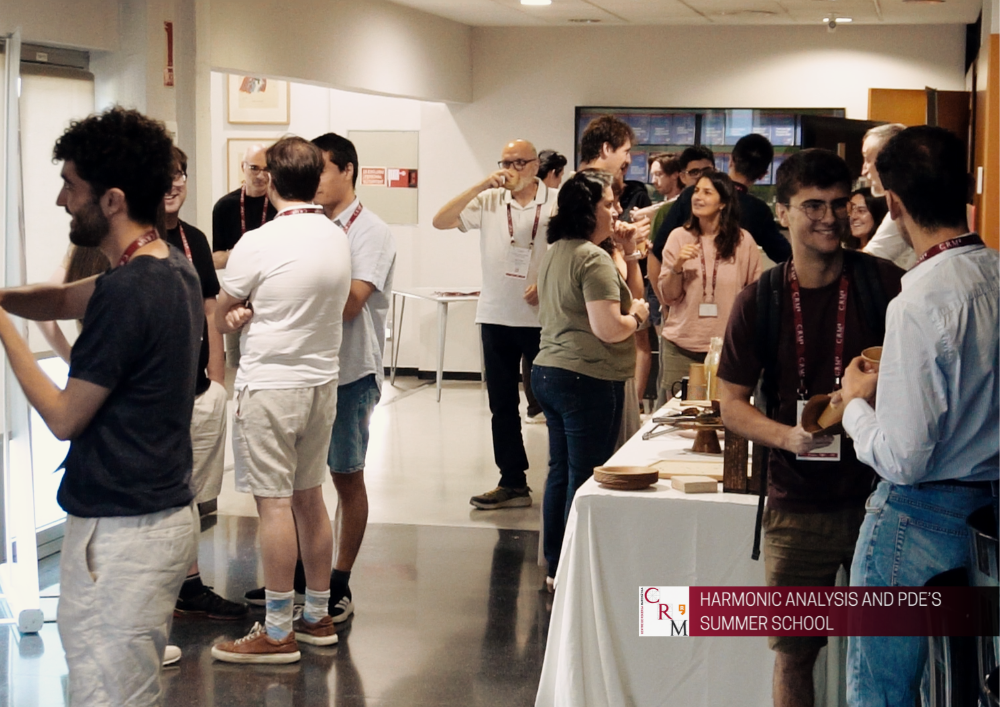
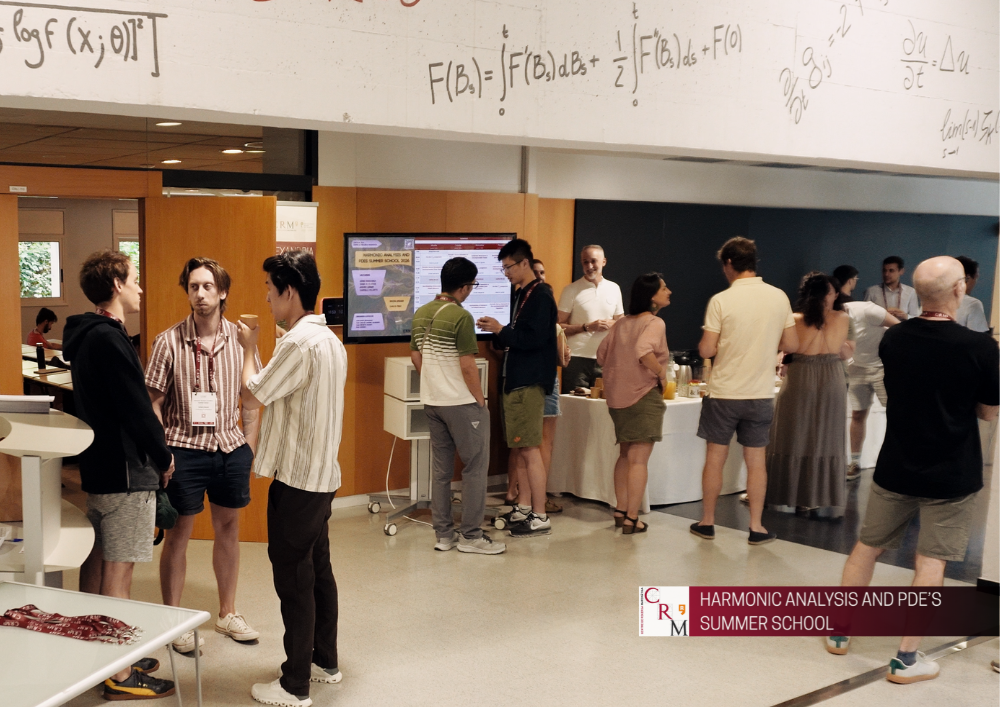
Registration includes: Coffee breaks
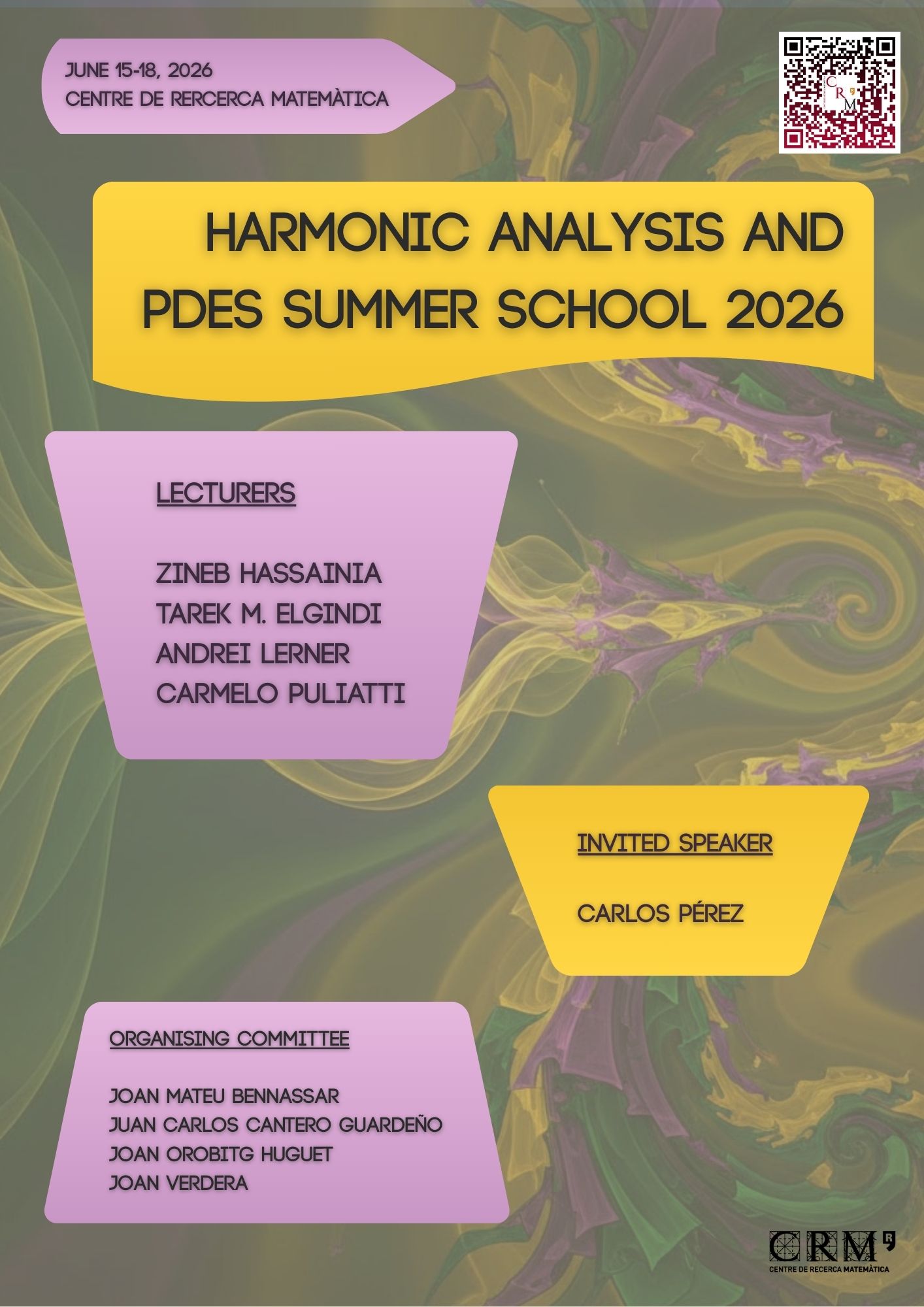
Harmonic Analysis and PDE’s Summer School
Sign into June 18, 2026
Venue: Centre de Recerca Matemàtica (CRM)
Room: Auditorium
*Early registration (200€) deadline 03/05/2026 included
*Late registration (350€) deadline 01/06/2026 included
Effective June 15th, 2026, bank transfer payments will no longer be accepted for any CRM activity. All registration fees must be paid by card to complete the registration process.
If your institution requires an invoice for reimbursement or administrative purposes, you can request it during the registration process. Once your registration fee has been paid, please send the proof of payment to comptabilitat@crm.cat. The invoice will be issued after the payment has been received and verified.
SCHEDULE
REGISTRATION
Introduction
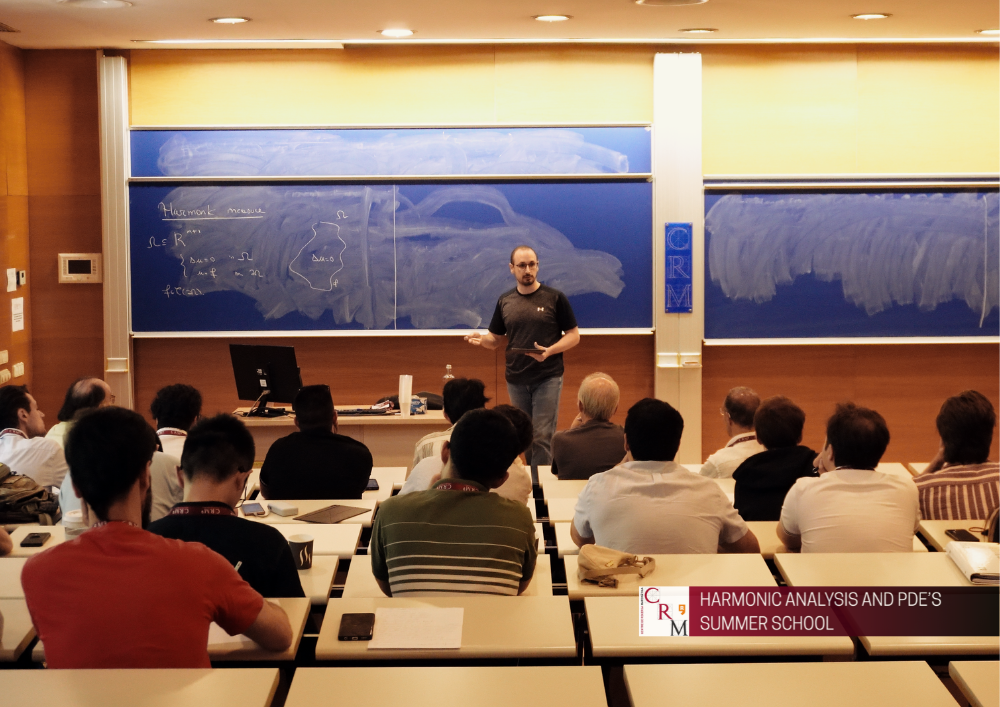
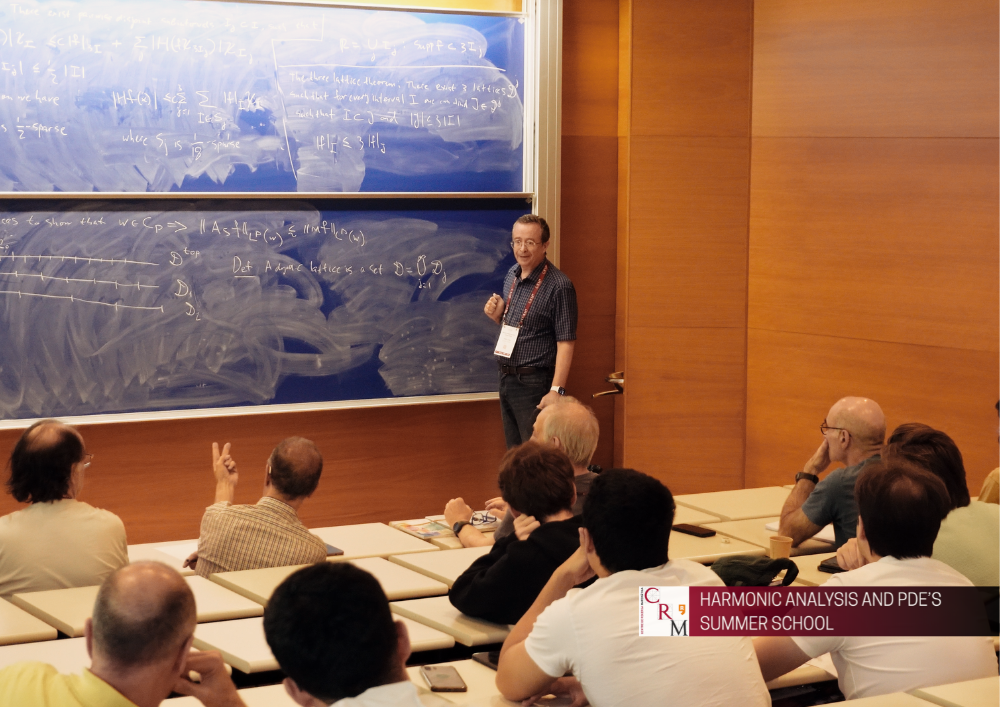
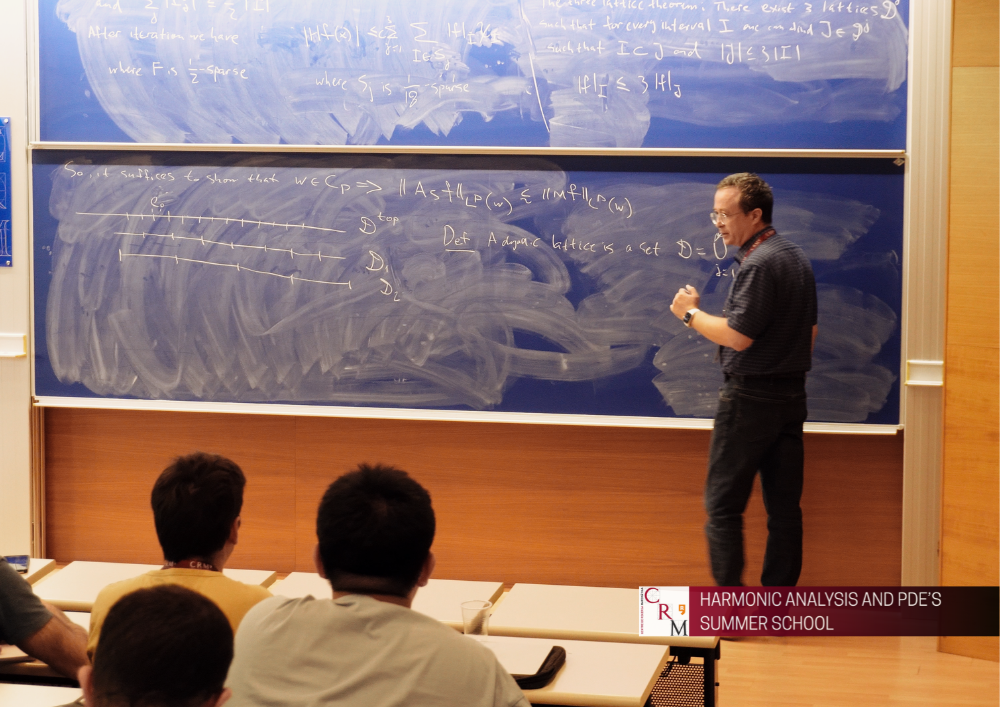
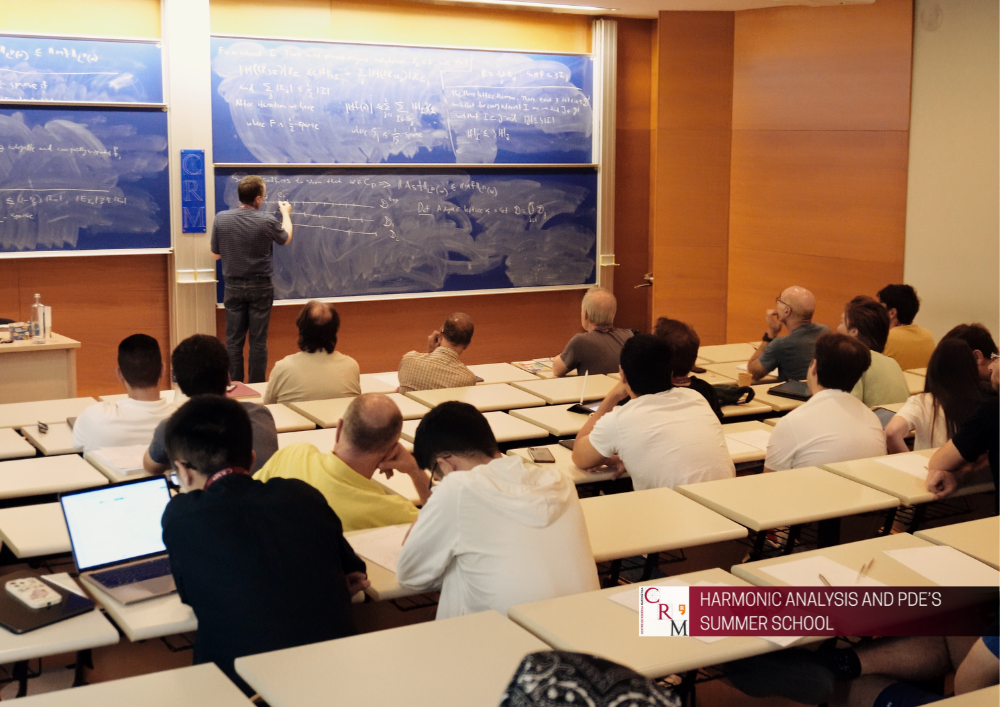
This summer school aims to study problems related to questions of singular integrals in a wide sense, fluid mechanics and other active scalar equations, as well as problems of anisotropic interaction energy minimizers. These energy minimizer questions come from materials science and biological populations.
lecturers
Periodic Vortex Dynamics in the Incompressible Euler Equations
Zineb Hassainia
Abstract
Coherent Structures in Incompressible Fluids
Tarek M. Elgindi
Abstract
On the  conjecture
Andrei Lerner
Abstract
Rectifiability of Harmonic and Elliptic Measure
Carmelo Puliatti
Abstract
invited speakers
A Modern Geometric Perspective On Poincaré-Sobolev Inequalities: A Derivative-Free Harmonic Analysis Approach
Carlos Pérez
Abstract
ORGANISING committee
Joan Mateu Bennassar | Universitat Autònoma de Barcelona
Juan Carlos Cantero Guardeño | Universitat Autònoma de Barcelona
Joan Orobitg Huguet | Universitat Autònoma de Barcelona
Joan Verdera | Universitat Autònoma de Barcelona
SCHEDULE
| Time | Monday 15 June | Tuesday 16 June | Wednesday 17 June | Thursday 18 June |
|---|---|---|---|---|
| 09:00 → 09:30 | Registration | |||
| 09:30 → 10:20 |
On the
 conjecture conjectureAndrei Lerner
|
Periodic Vortex Dynamics in the Incompressible Euler Equations
Zineb Hassainia
|
Coherent Structures in Incompressible Fluids
Tarek M. Elgindi
|
Rectifiability of Harmonic and Elliptic Measure
Carmelo Puliatti
|
| 10:30 → 11:20 |
Periodic Vortex Dynamics in the Incompressible Euler Equations
Zineb Hassainia
|
Rectifiability of Harmonic and Elliptic Measure
Carmelo Puliatti
|
On the
conjectureAndrei Lerner
|
Coherent Structures in Incompressible Fluids
Tarek M. Elgindi
|
| 11:30 → 12:15 | Coffee Break | Group Picture + Coffee Break | Coffee Break | Coffee Break |
| 12:15 → 13:05 |
Rectifiability of Harmonic and Elliptic Measure
Carmelo Puliatti
|
Coherent Structures in Incompressible Fluids
Tarek M. Elgindi
|
Periodic Vortex Dynamics in the Incompressible Euler Equations
Zineb Hassainia
|
On the
conjectureAndrei Lerner
|
| 13:15 → 15:00 | Lunch | |||
| 15:00 → 15:50 |
Coherent Structures in Incompressible Fluids
Tarek M. Elgindi
|
On the
conjectureAndrei Lerner
|
Rectifiability of Harmonic and Elliptic Measure
Carmelo Puliatti
|
Periodic Vortex Dynamics in the Incompressible Euler Equations
Zineb Hassainia
|
| 16:00 → 16:50 | – |
A Modern Geometric Perspective On Poincaré-Sobolev Inequalities: A Derivative-Free Harmonic Analysis Approach
Carlos Pérez
|
– | – |
LIST OF PARTICIPANTS
| Name | Institution |
|---|---|
| Alec Melenchon | UOC |
| Xavier Tolsa Domènech | ICREA, Universitat Autònoma de Barcelona, and CRM |
| Omar Lazar | New-York University Abu Dhabi |
| David Horas Marcos | Universitat de Barcelona |
| Pau Mac an Mhaoir | Universitat de Barcelona |
| Marina Fernàndez Vilaseca | Universitat Autònoma de Barcelona |
| Martí Prats Soler | Universitat Autònoma de Barcelona |
| Joan Hernández García | Universitat Autònoma de Barcelona |
| Joan Orobitg Huguet | Universitat Autònoma de Barcelona |
| Alberto Dayan | Universitat Autònoma de Barcelona |
| Marc Magaña Centelles | Universitat Autònoma de Barcelona |
| Àlex Martín | Universitat Autònoma de Barcelona |
| Cole Jeznach | Universitat Autònoma de Barcelona |
| Joan Verdera | Universitat Autònoma de Barcelona |
| Joquim Martin | Universitat Autònoma de Barcelona |
| Artur Nicolau | Universitat Autònoma de Barcelona |
| Alberto Debernardi Pinos | Universitat Autònoma de Barcelona |
| Juan Carlos Cantero | Universitat Autònoma de Barcelona |
| Laura Prat Baiget | Universitat Autònoma de Barcelona |
| Luis Lloret-Sanchez | Universitat Autònoma de Barcelona |
| Angel Lorenzo Martínez | Universitat Autònoma de Barcelona |
| Jaume Capdevila Jové | Universitat Autònoma de Barcelona |
| Joan Mateu Bennassar | Universitat Autònoma de Barcelona |
| Yingying Cai | Universitat Autònoma de Barcelona |
| Frank William Hammond | Universitat Politècnica de Catalunya |
| Joana Pech Alberich | Universitat Politècnica de Catalunya |
| Vittorio Baroncini | Universidad de Sevilla |
| Yuanlin Sun | Jilin University |
| Daniel Sanchez Simon del Pino | University of Bonn |
| Stefanos Koustas | National and Kapodistrian University of Athens |
| Vasileios Kalivopoulos | University of Ioannina |
| Chen Zhang | Chinese University of Hong Kong |
| Changhong Li | University College Dublin |
| Tao ZHOU | National University of Singapore |
| Khakimboy Egamberganov | National University of Singapore |
| Martin González Yu | Swiss Federal Institute of Technology in Zurich |
| Kevin Wong | Princeton University |
| Gerard Castro López | New York University |
| Zackary Boone | University of Connecticut |
| Miquel Saucedo | Centre de Recerca Matemàtica |
Accommodation and registration grants
- Application deadline for grants is 06/04/2026
- Resolutions will be sent by 15/04/2026
registration
Registration deadline: 01/06/2026
CRM User Account Creation
After creating your CRM user account, you can log in on the activity webpage to complete your registration, or by clicking the button and then selecting ‘Sign in’.
REGISTER
LODGING INFORMATION
ON-CAMPUS AND BELLATERRA
BARCELONA AND OFF-CAMPUS
 |
For inquiries about this event, please contact the Head of Scientific Events, Ms Núria Hernández, at nhernandez@crm.cat
|
CRM Events code of conduct
All activities organized by the CRM are required to comply with the following Code of Conduct.
CRM Code of Conduct
scam warning
We are aware of a number of current scams targeting participants at CRM activities concerning registration or accommodation bookings. If you are approached by a third party (eg travellerpoint.org, Conference Committee, Global Travel Experts or Royal Visit) asking for booking or payment details, please ignore them.
Please remember:
i) CRM never uses third parties to do our administration for events: messages will come directly from CRM staff
ii) CRM will never ask participants for credit card or bank details
iii) If you have any doubt about an email you receive please get in touch

Sustainable Events
We are committed to organising sustainable events that minimise environmental impact and create a positive legacy for the host community. We support organisers in designing events aligned with the UN 2030 Sustainable Development Goals, reducing negative environmental impacts and promoting responsible practices.
All materials provided during our activities are responsibly sourced, including recycled pens and plastic-free badges. We work with responsible suppliers, and our catering partners use fully compostable materials while offering vegetarian and vegan options, with at least one event day being fully vegetarian.
We will discuss various aspects of the incompressible Euler equation: ,
, .
.
We will focus primarily on the properties and construction of steady solutions.
In this lecture, we present a modern perspective on functional smoothness and regularity by employing sharp tools from harmonic analysis. We first move beyond classical pointwise analysis to explore regularity through the lens of local averages. This approach provides a more flexible and robust framework, particularly in settings where traditional derivatives either do not exist or cannot be defined. Subsequently, we apply these techniques to derive improved local Poincaré-Sobolev estimates, which are instrumental in proving the celebrated De Giorgi regularity theorem. This framework also yields a self-contained proof of the John–Nirenberg theorem for BMO functions. A central theme of the discussion is the “self-improving” property—a remarkable phenomenon where modest local control over oscillations leads to significantly stronger global integrability. As further applications, we present an extension of the Nash inequality, providing an alternative path to De Giorgi’s theorem, as well as a generalization of the Gagliardo–Nirenberg–Sobolev theorem within the setting of Campanato spaces. This lecture is based on joint works with Iker Gardeazabal and Emiel Lorist, and with Alejandro Claros and Linfei Zheng.
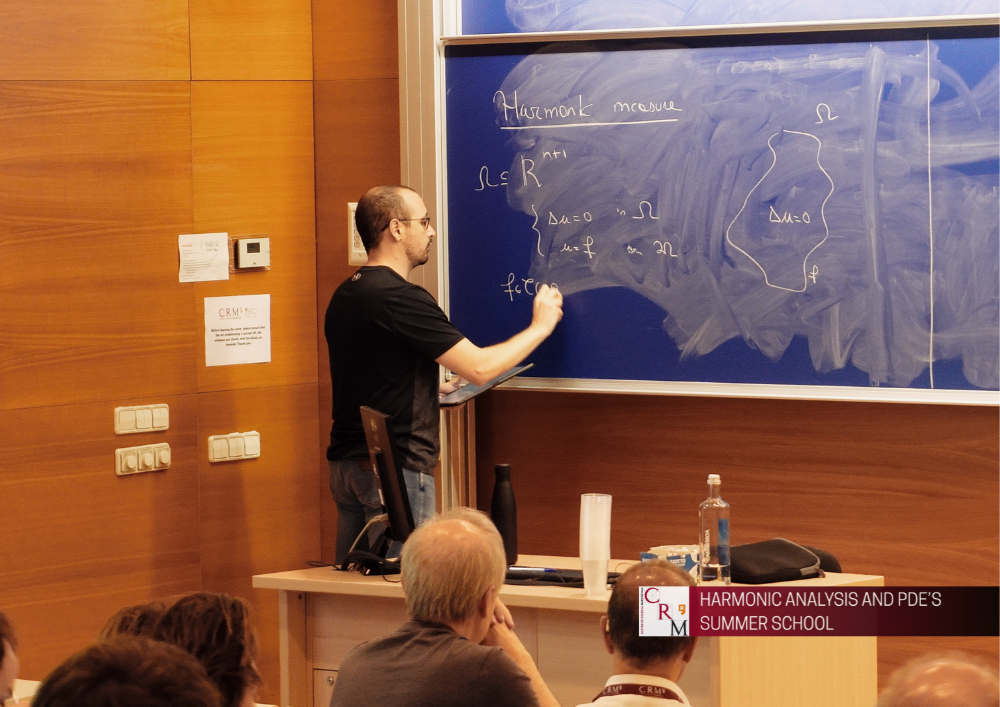
Harmonic measure is a widely studied topic in analysis that arises naturally in connection with the Dirichlet problem for the Laplacian on a domain. It can also be interpreted in terms of the first-passage probability of Brownian motion.
This measure is supported on the boundary of the domain, and its interplay with the surface measure contains deep geometrical and analytical information. These connections have been studied since the paper of F. and M. Riesz (1916), in which they proved that harmonic measure is mutually absolutely continuous with respect to arc length in the case of a simply connected planar domain with rectifiable boundary.
In 2016, Azzam, Hofmann, Martell, Mayboroda, Mourgoglou, Tolsa, and Volberg proved that the absolute continuity of harmonic measure implies rectifiability of the boundary. In this course I will discuss the techniques involved in the proof of this result, which rely heavily on harmonic analysis, and I will also discuss related problems such as generalizations to elliptic PDEs in divergence form under suitable regularity assumptions on the coefficients.
In 1980, B. Muckenhoupt conjectured that the weighted  inequality connecting the Hilbert transform and the Hardy-Littlewood maximal operator holds if and only if the weight w satisfies the so-called
  condition. Very recently, in joint work with F. Nazarov and S. Ombrosi, we gave a positive answer to this conjecture. In this minicourse, I plan to give an overview of the proof of this result and to explain several of the main ideas and technical ingredients behind it.
This mini-course introduces periodic coherent structures in the two- and three-dimensional incompressible Euler equations. We begin with the finite-dimensional viewpoint of autonomous dynamical systems, Hamiltonian flows, conserved quantities, periodic orbits, and point-vortex dynamics. We then develop the bifurcation tools needed in infinite-dimensional settings and show how they lead to classical families of rigidly rotating vortex patches. We also discuss the desingularization
of rigid point-vortex configurations via concentrated vortex patches, using the implicit function theorem in Banach spaces.
In the second part of the course, we turn to non-rigid motions, with particular emphasis on leapfrogging vortex dynamics. We explain how the planar leapfrogging motion can be desingularized at the level of vortex patches, and why this problem requires more delicate techniques such as KAM theory and Nash–Moser iteration. Finally, we describe how these ideas can be adapted to the three-dimensional axisymmetric Euler equations in order to construct leapfrogging vortex rings.