

REGISTRATION FEE
50€
(includes coffee breaks and lunch; dinner not included).
Barcelona Weekend on Operator Algebras
Sign into January 31, 2026
Venue: Centre de Recerca Matemàtica
Room: Auditorium
Event summary
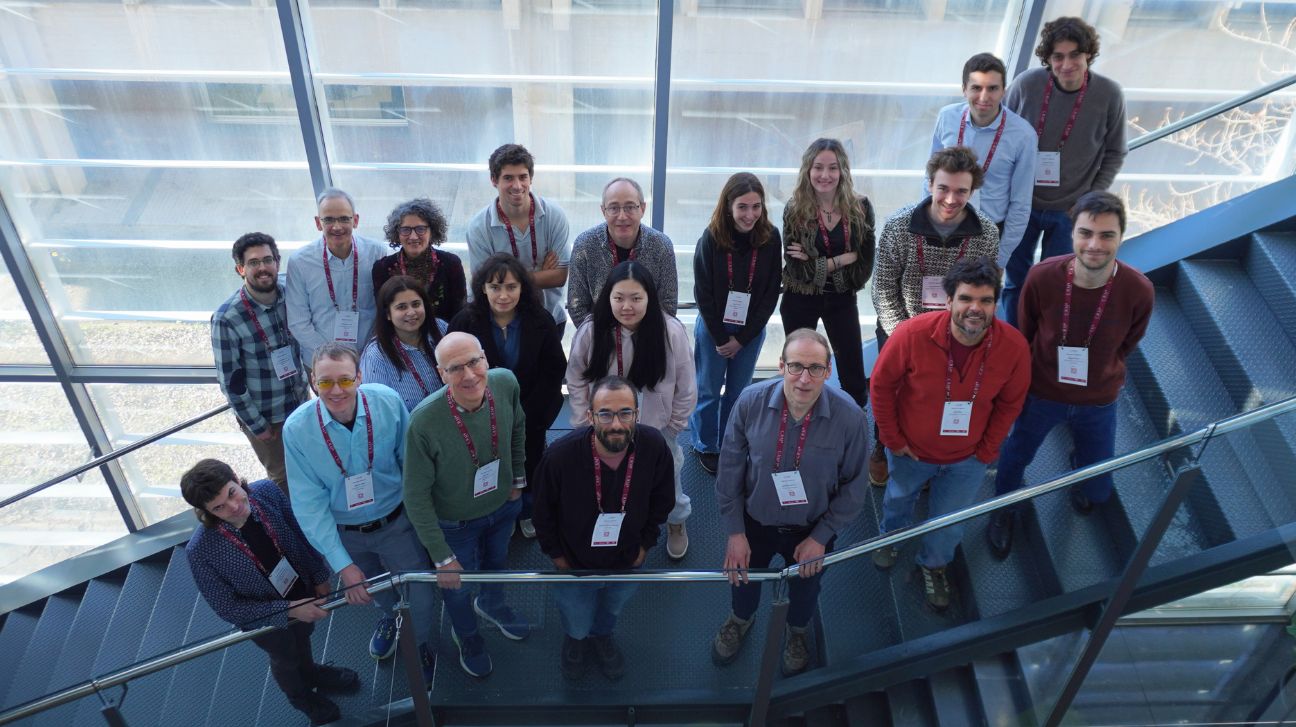
Group picture
ORGANISING committee
Ramon Antoine | Universitat Autònoma de Barcelona – CRM
Joan Bosa | Universidad de Zaragoza
Francesc Perera | Universitat Autònoma de Barcelona – CRM
lecturers
Embeddings into the ultrapower of the Jiang-Su algebra
Ben Bouwen
Czech Academy of Sciences
Abstract
KMS States for separated graph  -algebras – II. Amalgamated probability
Joan Claramunt
Universitat Politècnica de Catalunya
Abstract
Cartan subalgebras of self-similar graph -algebras
Shanshan Hua
University of Münster
Abstract
KMS States for separated graph -algebras – I. Quasi-invariant measures
Fernando Lledó
Universidad Carlos III
Abstract
Coherence and derived groups of artin groups
Conchita Martínez
Universidad de Zaragoza
Abstract
The Cuntz semigroup of rings of continuous functions on one-dimensional spaces
Guillem Quingles
Universitat Autònoma de Barcelona
Abstract
The radius of comparison for actions of on simple AH algebras
 on simple AH algebras
Apurva Seth
University of Oxford
Abstract
Cones and asymptotic liftings
Tatiana Shulman
University of Gothemburg
Abstract
Strict comparison for twisted group C∗-algebras
Eduard Vilalta
Universitat Politècnica de Catalunya
Abstract
AF-embeddability for decomposition rank 1 algebras
Joachim Zacharias
University of Glasgow
Abstract
SCHEDULE
Friday January 30th | Saturday January 31st | |
9:15 | Registration + Welcome | |
9:30 | KMS States for separated graph -algebras – I. Quasi-invariant measures Fernando Lledó Universidad Carlos III | AF-embeddability for decomposition rank 1 algebras Joachim Zacharias University of Glasgow |
10:30 | Group Picture + Coffee Break | Coffee Break |
11:00 | Cartan subalgebras of self-similar graph -algebras Shanshan Hua University of Münster | Embeddings into the ultrapower of the Jiang-Su algebra Ben Bouwen Czech Academy of Sciences |
12:00 | Cones and asymptotic liftings Tatiana Shulman University of Gothemburg | KMS States for separated graph -algebras – II. Amalgamated probability Joan Claramunt Universitat Politècnica de Catalunya |
13:00 | Lunch Break | |
14:30 | Coherence and derived groups of artin groups Conchita Martínez Universidad de Zaragoza | |
15:30 | Strict comparison for twisted group C∗-algebras Eduard Vilalta Universitat Politècnica de Catalunya | |
16:30 | Coffee Break | |
17:00 | The Cuntz semigroup of rings of continuous functions on one-dimensional spaces Guillem Quingles Universitat Autònoma de Barcelona | |
18:00 | The radius of comparison for actions of on simple AH algebras Apurva Seth University of Oxford |
LIST OF PARTICIPANTS
| Name | Institution |
|---|---|
| Ben Bouwen | Czech Academy of Sciences |
| Tatiana Shulman | University of Gothemburg |
| Francesc Perera Domenech | UAB-CRM |
| Ramon Antoine Riolobos | UAB-CRM |
| César de Almenara de la Peña | Universitat Autònoma de Barcelona |
| Guillem Quingles Daví | Universitat Autònoma de Barcelona |
| Pere Ara Bertran | Universitat Autònoma de Barcelona |
| Miguel Sales Cabrera | Universitat Autònoma de Barcelona |
| Joan Claramunt Carós | Universitat Politècnica de Catalunya |
| Joan Claramunt Carós | Universitat Politècnica de Catalunya |
| Eduard Vilalta | Universitat Politècnica de Catalunya |
| Sofia Siron | Universidad de Zaragoza |
| Conchita Martínez | Universidad de Zaragoza |
| Joan Bosa | Universidad de Zaragoza |
| Laura Saenz | Universidad Carlos III de Madrid |
| Fernando Lledó | Universidad Carlos III de Madrid |
| Shanshan Hua | University of Münster |
| Tomás Pacheco | University of Lisbon |
| Hannes Thiel | Chalmers University of Technology |
| Lucas Hataishi | University of Oxford |
| Apurva Seth | University of Oxford |
| Joachim Zacharias | University of Glasgow |
registration
Before registering for the activity, you will be asked to create a CRM web user account through the following link. Please note that both personal and academic information must be completed in the web user intranet.
CRM User Account Creation
After creating your CRM user account, you can log in on the activity webpage to complete your registration, or by clicking the button and then selecting ‘Sign in’.
REGISTER
INVOICE/PAYMENT INFORMATION
IF YOUR INSTITUTION COVERS YOUR REGISTRATION FEE: Please note that, in case your institution is paying for the registration via bank transfer, you will have to indicate your institution details and choose “Transfer” as the payment method at the end of the process.
UPF | UB | UPC | UAB
*If the paying institution is the UPF / UB/ UPC / UAB, after registering, please send an email to comptabilitat@crm.cat with your name and the institution internal reference number that we will need to issue the electronic invoice. Please, send us the Project code covering the registration if needed.
Paying by credit card
IF YOU PAY VIA CREDIT CARD but you need to provide the invoice to your institution to be reimbursed, please note that we will also need you to send an email to comptabilitat@crm.cat providing the internal reference number given by your institution and the code of the Project covering the registration (if necessary).
LODGING INFORMATION
ON-CAMPUS AND BELLATERRA
BARCELONA AND OFF-CAMPUS
acknowledgement

 |
For inquiries about this event please contact the Scientific Events Coordinator Ms. Núria Hernández at nhernandez@crm.cat
|
CRM Events code of conduct
All activities organized by the CRM are required to comply with the following Code of Conduct.
CRM Code of Conduct
scam warning
We are aware of a number of current scams targeting participants at CRM activities concerning registration or accommodation bookings. If you are approached by a third party (eg travellerpoint.org, Conference Committee, Global Travel Experts or Royal Visit) asking for booking or payment details, please ignore them.
Please remember:
i) CRM never uses third parties to do our administration for events: messages will come directly from CRM staff
ii) CRM will never ask participants for credit card or bank details
iii) If you have any doubt about an email you receive please get in touch
 -algebras, introduced by Exel and Pardo, generalize graph -algebras by encoding self-similar group actions on directed graphs. This class of -algebras admits natural groupoid models and is broad, covering Nekrashevych algebras and Katsura algebras (and hence UCT Kirchberg algebras). In joint work (WOA III) with Archey, Duwenig, McCormick, Norton, and Yang, we study Cartan subalgebras in self-similar graph -algebras beyond the “locally faithful” setting.-algebras have Cartan subalgebras described either via the interior of isotropy in the path groupoid, or combinatorially through the so-called *cycline pairs* encoding the dynamics. We obtain analogous descriptions for a large class of self-similar graph -algebras, producing Cartan subalgebras and associated new groupoid models, which recover part of the original self-similar dynamics.
Given real numbers  , and
, and  , in this talk we shall construct a simple unital -algebra
  of stable rank one and an action
  such that the radius of comparison of is
  , while the radius of comparison of the crossed product
  is
is  . This talk is based on joint work with Ilan Hirshberg and M. Ali Asadi-Vasfi.
Recent developments within the area of model theory for  -algebras have led to manyinteresting questions and remarkable results. One such question, posed by Farah et al. in 2021, is the following: is the Jiang-Su algebra
  existentially closed in the class of unital, nuclear, stably finite, projectionless -algebras? This question can be rephrased in terms of existence of an embedding into the ultrapower of Z, which itself can be seen as a -algebraic analogue of the famous Connes embedding problem for von Neumann algebras. This prompts the study of when such an embedding exists. In joint work with Jennifer Pi (University of Oxford), we show that cones over separable -algebras always embed into the ultrapower of , a direct analogue of Voiculescu’s result that such -algebras are quasidiagonal. As such, we propose embeddability into the ultrapower of as a similar regularity property. This is supported by our main result, which establishes homotopy invariance of this property under some additional hypotheses. In this talk, I will discuss these results, as well as their connections with model theoretic and -algebraic problems.
AF-embeddability, ie the question whether a given -algebra can be realised as a subalgebra of an AF-algebra has been studied for a long time with prominent early results by Pimsner and Voicuescu who constructed such embeddings for irrational rotation algebras in 1980. Since then many AF-embeddings have been constructed for concrete examples but also many non-constructive AF-embeddability results have been obtained for classes of algebras typically assuming the UCT. In this talk we consider a separable unital -algebra A of decomposition rank at most 1 and construct from a suitable system of 1-decomposable cpc-approximations an AF-algebra E together with an embedding of A into E and a conditional expectation of E onto A without assuming the UCT and indicate some applications and related results.
For any ring R a new invariant has been defined in the form of a partially ordered abelian monoid, built from an equivalence relation on the class of countably generated projective modules and denoted by S(R). It has been named the Cuntz semigroup of the ring R, since its construction is akin to the manufacture of the Cuntz semigroup of a -algebra using countably generated Hilbert modules. Two questions about this semigroup that remain open in the general case are whether S(R) belongs to the abstract Cuntz category, Cu, and whether, given a C*-algebra A, its Cuntz semigroup as a ring and as a -algebra coincide.
In this talk I will focus on the class of rings R over which every projective module is a direct sum of finitely generated modules. I will give a representation of S(R) as a certain monoid of intervals of V (R), and I will answer the two questions mentioned. We will also compute the Cuntz semigroup for rings of continuous functions on one-dimensional spaces. As an application, for such rings we can characterize the class of a countably generated projective ideal by its trace ideal. We will see that the situation is different when considering real-valued or complex-valued functions. I will also present the related notion of left normality for a ring and see whether is satisfied for such rings of continuous functions.
This is work of my Ph.D. under the supervision of Pere Ara and Francesc Perera.
In this talk I will present a first method to construct KMS states for certain separated graph -algebras  (E, C). We will consider finite and bipartite separated graphs (E, C) and base our construction on the analysis of the so-called tame algebra
  (E, C), a quotient of A that admits a realization as a crossed product of continuous functions on a configuration space by a partial action of a free group. The existence of KMS-states on A is obtained by constructing a measure on the configuration space that is quasi-invariant with respect to the coloured dynamics. I will also mention during the talk concrete examples of the different structures involved.
This is joint work with P. Ara (UAB), J. Claramunt (UPC) and E. Gillaspy (U. Montana)
In this talk I will present a second method to construct KMS states for general separated graph -algebras  . I will start by introducing the main tool utilized, namely amalgamated probability, a generalization of free probability, and how it will play a central role in the search for KMS states. Necessary conditions for existence of KMS states on
  will be given and, under mild conditions, we prove that such conditions are also suffcient. I will demonstrate, in specific examples, how to use those conditions to explicitly construct KMS states on , which in general may differ from the KMS states constructed using the first method presented by F. Lledó. This shows that, in general, the KMS simplex of separated graph -algebras is much richer than the usual graph -algebras.
This is joint work with Pere Ara (UAB), Elizabeth Gillaspy (UM) and Fernando Lledó (UC3M).
Strict comparison is a fundamental property of C∗-algebras, originally introduced by Blackadar to capture the appropiate generalization of Murray-von Neumann comparison theory for factors. Since its introduction, it has become a cornerstone of the modern structure theory of C∗-algebras.
A key feature of strict comparison is its versatility: it is useful for both nuclear and non-nuclear C*-algebras, with applications ranging from classification results to the recent negative solution of the Tarski problem. A central line of research has been to determine which (reduced, possibly twisted) group C*-algebras possess this property—a question that has seen significant progress in both the amenable and non-amenable settings.
In this talk, I will outline the main ideas underlying these developments and discuss, in particular, recent joint work with S. Raum and H. Thiel
A groups is called coherent if it has the property that any finitely generated subgroup is also finitely presented. Coherence of groups is a very interesting phenomenon that one encounters mainly in small dimension. In the case of a right angled Artin group, it is a classical result by Droms that coherence can be characterized in terms of the defining graph and it was shown later by Droms, B. Servatius and H. Servatius that it is equivalent to the derived group being free. The characterization in terms of the defining graph has been extended to the family of Artin groups by Gordon and Wise and in this talk we will show that for arbitrary Artin groups the same characterization of coherence in terms of the derived group holds true. We will also review some recent results on coherence and discuss the relationship with properties such as the coherence of the group ring, a relationship which is far from being well understood in general.
I will talk mostly about cone C*-algebras. We will discuss their properties- some known (e.g. quasidiagonality and quasidiagonality of amenable traces) and some new. We also will discuss homotopy invariance of several C*-algebraic properties.