
Xavier Tolsa, professor ICREA al Departament de Matemàtiques de la UAB i adscrit al CRM, ha rebut el Premi Nacional d’Investigació 2024 en la modalitat Julio Rey Pastor pel seu treball en àrees com l’anàlisi harmònic i la teoria geomètrica de funcions, destacant per la resolució de problemes com el de Painlevé.
Xavier Tolsa, professor de recerca ICREA al Departament de Matemàtiques de la UAB i adscrit al Centre de Recerca Matemàtica (CRM), ha estat guardonat amb el Premi Nacional d’Investigació 2024. Aquests guardons, els més prestigiosos d’Espanya en l’àmbit de la investigació científica, són atorgats pel Ministeri de Ciència i Innovació i compten amb 20 modalitats dotades amb 30.000 euros cadascuna.
Concretament, Tolsa ha estat reconegut en la modalitat Julio Rey Pastor, en Matemàtiques i Tecnologies de la Informació i les Comunicacions, per la seva destacada trajectòria nacional i internacional en àrees com l’anàlisi harmònic, la teoria del potencial i la teoria geomètrica de funcions. Entre els seus èxits més remarcables destaca la resolució de problemes clàssics, com el de Painlevé, sobre la caracterització geomètrica de conjunts evitables.
Sobre aquest reconeixement, Tolsa destaca: “És un reconeixement molt important a la meva trajectòria, a escala estatal, i que dona molta visibilitat a aquest nivell. D’altra banda, rebre un reconeixement per la feina ben feta, sempre agrada.”
Tot i haver resolt problemes clàssics, la seva recerca no s’atura. Preguntat sobre els reptes actuals que l’interessen, Tolsa explica: “Fa uns anys treballava molt en problemes a la frontera entre la teoria geomètrica de la mesura i l’anàlisi harmònica, com el problema de Painlevé. Més recentment, m’he anat acostant a qüestions relacionades amb les equacions en derivades parcials, però quasi sempre amb una component important de teoria geomètrica de la mesura.” Tolsa no té un únic problema en ment, sinó diversos: “Estic interessat en les propietats geomètriques de la mesura harmònica i alguns problemes de frontera lliure relacionats, en la resolució en L^p del problema de Neumann per l’equació de Laplace en dominis no suaus, o en algunes qüestions de continuació única a la frontera per funcions harmòniques.”
En els últims anys, els matemàtics i matemàtiques catalanes han rebut diversos reconeixements nacionals i internacionals per la seva excel·lència. En relació amb l’estat de la comunitat matemàtica catalana, Tolsa es mostra positiu. “Crec que hi ha uns quants matemàtics coneguts internacionalment que estan fent molt bona feina i que són reconeguts per aquest fet. Ara bé, a les universitats hi ha un problema de relleu generacional important, a causa del fet que durant molts anys s’han ofert molt poques noves places de professor. Això ha provocat un envelliment de les plantilles de professors universitaris, que són els que fan la major part de la recerca matemàtica a Catalunya. Ara, de sobte, les universitats comencen a oferir moltes places concentrades en un període molt curt de temps, i hi ha el perill que no es puguin cobrir amb gent amb un nivell alt d’excel·lència”, explica Tolsa.
El guardó del Premi Nacional d’Investigació 2024 posa de manifest no només els èxits personals, sinó també la força i el talent de la comunitat matemàtica catalana, que continua destacant i fent contribucions significatives. Aquest reconeixement serveix com a inspiració per continuar avançant en aquest camí d’excel·lència científica.
Subscribe for more CRM News
|
|
CRM CommPau Varela
|

Jagged walls and unknown edges: a workshop on free boundary problems
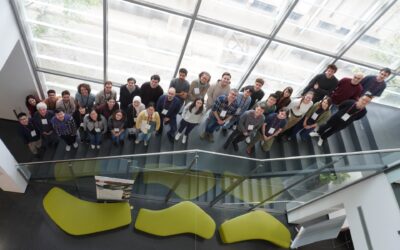
From 2 to 6 November, the Workshop on Free Boundary Problems brought together more than fifty registered participants from institutions in eleven countries at the CRM. Over five days they heard 21 talks on elliptic and parabolic free boundaries and on geometric measure theory and harmonic analysis in rough domains, with speakers including Guy David, Svitlana Mayboroda, Susanna Terracini and Robin Neumayer. The workshop was the second intensive week of the Intensive Research Programme on Analysis of Free Boundary Problems, which continues at the CRM until 4 December.
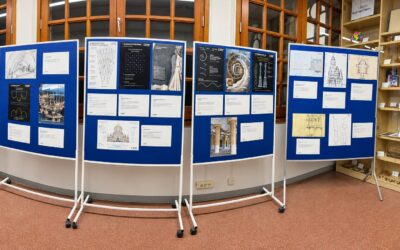
The CRM exhibition ‘Les matemàtiques de Gaudí’ moves to the University of Barcelona
After its October run at the UAB, the exhibition Les matemàtiques de Gaudí, produced by the CRM, can be seen at the University of Barcelona’s CRAI Biblioteca de Matemàtiques i Informàtica from 2 to 30 November 2026.
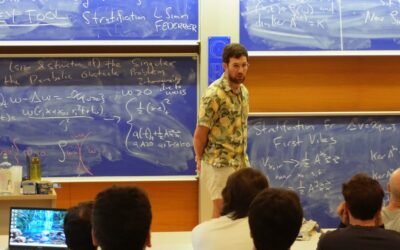
Advanced Course on Free Boundary Problems Opens the Intensive Weeks of the IRP
From 26 to 30 October, around forty researchers attended the Advanced Course on Free Boundary Problems at the CRM, three seven-hour mini-courses given by Bozhidar Velichkov (Università di Pisa), Max Engelstein (University of Minnesota) and Zihui Zhao (Johns Hopkins University). The course was the first of the two intensive weeks of the Intensive Research Programme on Analysis of Free Boundary Problems, which runs until 4 December.
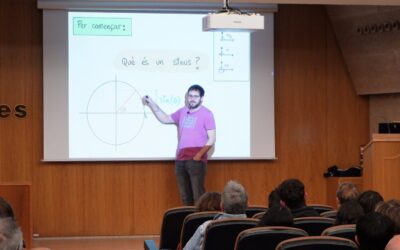
El CRM rep els estudiants de la prova de nivell de Bojos per les Matemàtiques 2027
Els aspirants a Bojos per les Matemàtiques 2027 van visitar el Centre de Recerca Matemàtica (CRM) dissabte 24 d’octubre, després de fer la prova de nivell a la Facultat de Ciències i Biociències de la UAB. En acabat, Tomás Sanz (UB-CRM) els va explicar què té a veure l’escalfament d’una barra de ferro amb els àudios de WhatsApp.
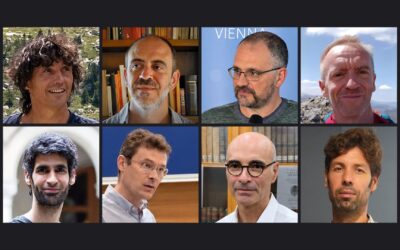
Eight CRM Researchers in the 2026 Stanford-Elsevier List of Highly Cited Scientists
The Centre de Recerca Matemàtica (CRM) has eight researchers in the 2026 update of the Stanford-Elsevier ranking of highly cited scientists, which John P. A. Ioannidis (Stanford University) and Jeroen Baas (Elsevier) compile from Scopus data. Xavier Cabré, Álvaro Corral, Tim Myers, Xavier Ros-Oton, Sergey Tikhonov and Xavier Tolsa appear both in the career-long ranking and in the one for 2025, and Diego Vidaurre and Simeon Ball in the 2025 ranking.
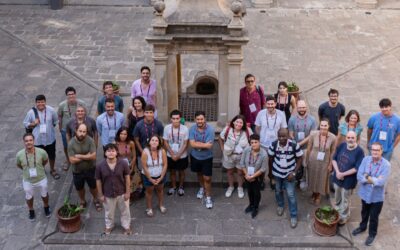
Fish schools and growing tissues: a workshop on how collective behaviour emerges
The Centre de Recerca Matemàtica (CRM) organised the Barcelona Workshop on Kinetic and Macroscopic Models in Biology with Friends II, held from 7 to 10 September at the Institut d’Estudis Catalans. More than thirty researchers discussed how order at the scale of tissues and animal groups arises from local interactions between individuals, in a programme that included talks by CRM researchers Daria Stepanova and Juan Arellano-Tintó. Two of the speakers, James Sharpe (EMBL Barcelona) and Chiara Villa (CNRS, Université Paris Cité), talked to the CRM about their research.
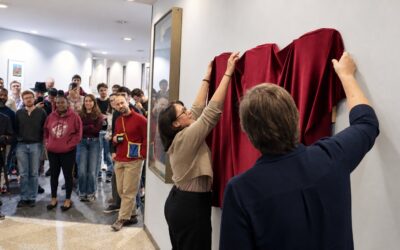
The CRM opens the academic year and unveils its Directors’ Gallery
A review of the year, the Communication Plan 2026–2030 and three research talks filled the morning of 19 October.The unveiling of the Directors’ Gallery.CRM CommPau VarelaCRMComm@crm.catGet the latest CRM news and activities in your inbox.Recent...

The CRM Mentoring Programme, as Told by One of Its Pairs
PhD student Joaquim Duran and mathematician Robert Cardona, one of the pairs in the CRM Mentoring ProgrammeJoaquim Duran (left) and Robert Cardona.CRM CommPau VarelaCRMComm@crm.catGet the latest CRM news and activities in your inbox.Recent...
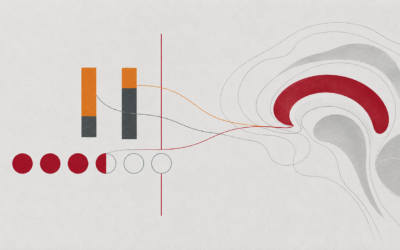
When the reward comes within reach, the brain changes what it compares
As the tokens piled up, choices got faster and more accurate at the same time. The yardstick for judging each offer had moved.CRM CommPau VarelaCRMComm@crm.catGet the latest CRM news and activities in your inbox.Recent newsletters →Two subjects...

Almost every automaton can be reset with a short word
Guillaume Chapuy (Université Paris Cité, CNRS) and Guillem Perarnau (UPC, CRM) have shown that a random finite automaton with n states can, with high probability, be reset by a word of length of order √n log n. The result, published in ACM Transactions on Algorithms, pins the exponent at 1/2, the lower end of a decade of numerical estimates, and addresses the random version of the synchronization problem behind a conjecture Ján Černý posed in 1964 and which still remains open.
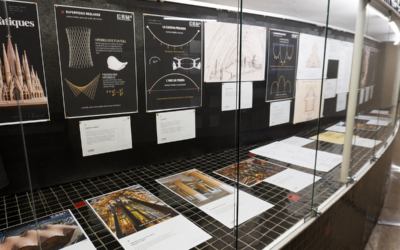
Exposició ‘Les matemàtiques de Gaudí’